lock NISSAN TEANA 2008 Service Manual
[x] Cancel search | Manufacturer: NISSAN, Model Year: 2008, Model line: TEANA, Model: NISSAN TEANA 2008Pages: 5121, PDF Size: 69.03 MB
Page 4221 of 5121
DRIVER AIR BAG MODULE
SR-7
< ON-VEHICLE REPAIR >
C
D
E
F
G
I
J
K
L
MA
B
SR
N
O
P
3. Pull out driver air bag module.
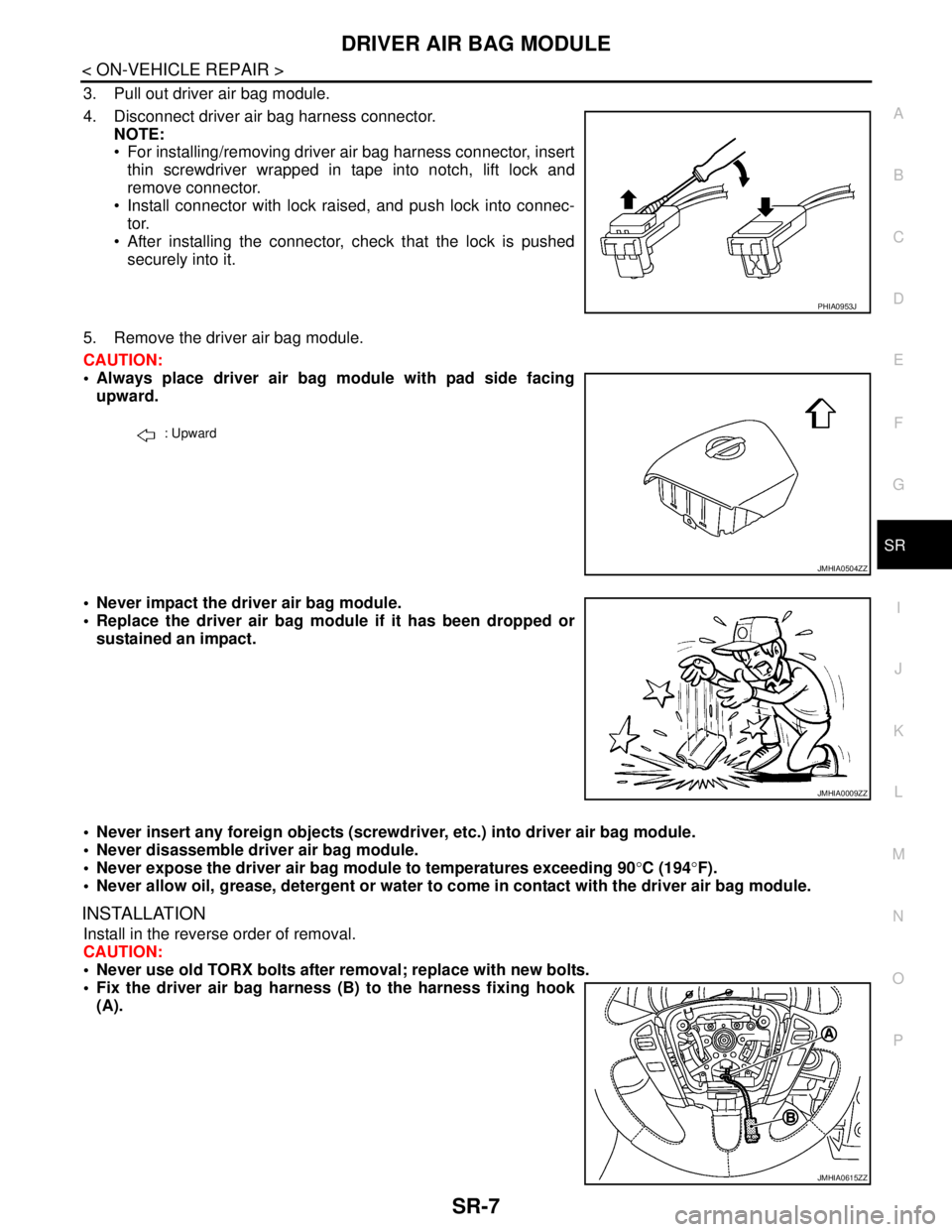
4. Disconnect driver air bag harness connector.
NOTE:
For installing/removing driver air bag harness connector, insert
thin screwdriver wrapped in tape into notch, lift lock and
remove connector.
Install connector with lock raised, and push lock into connec-
tor.
After installing the connector, check that the lock is pushed
securely into it.
5. Remove the driver air bag module.
CAUTION:
Always place driver air bag module with pad side facing
upward.
Never impact the driver air bag module.
Replace the driver air bag module if it has been dropped or
sustained an impact.
Never insert any foreign objects (screwdriver, etc.) into driver air bag module.
Never disassemble driver air bag module.
Never expose the driver air bag module to temperatures exceeding 90°C (194°F).
Never allow oil, grease, detergent or water to come in contact with the driver air bag module.
INSTALLATION
Install in the reverse order of removal.
CAUTION:
Never use old TORX bolts after removal; replace with new bolts.
Fix the driver air bag harness (B) to the harness fixing hook
(A).
PHIA0953J
: Upward
JMHIA0504ZZ
JMHIA0009ZZ
JMHIA0615ZZ
Page 4224 of 5121
SR-10
< ON-VEHICLE REPAIR >
SPIRAL CABLE
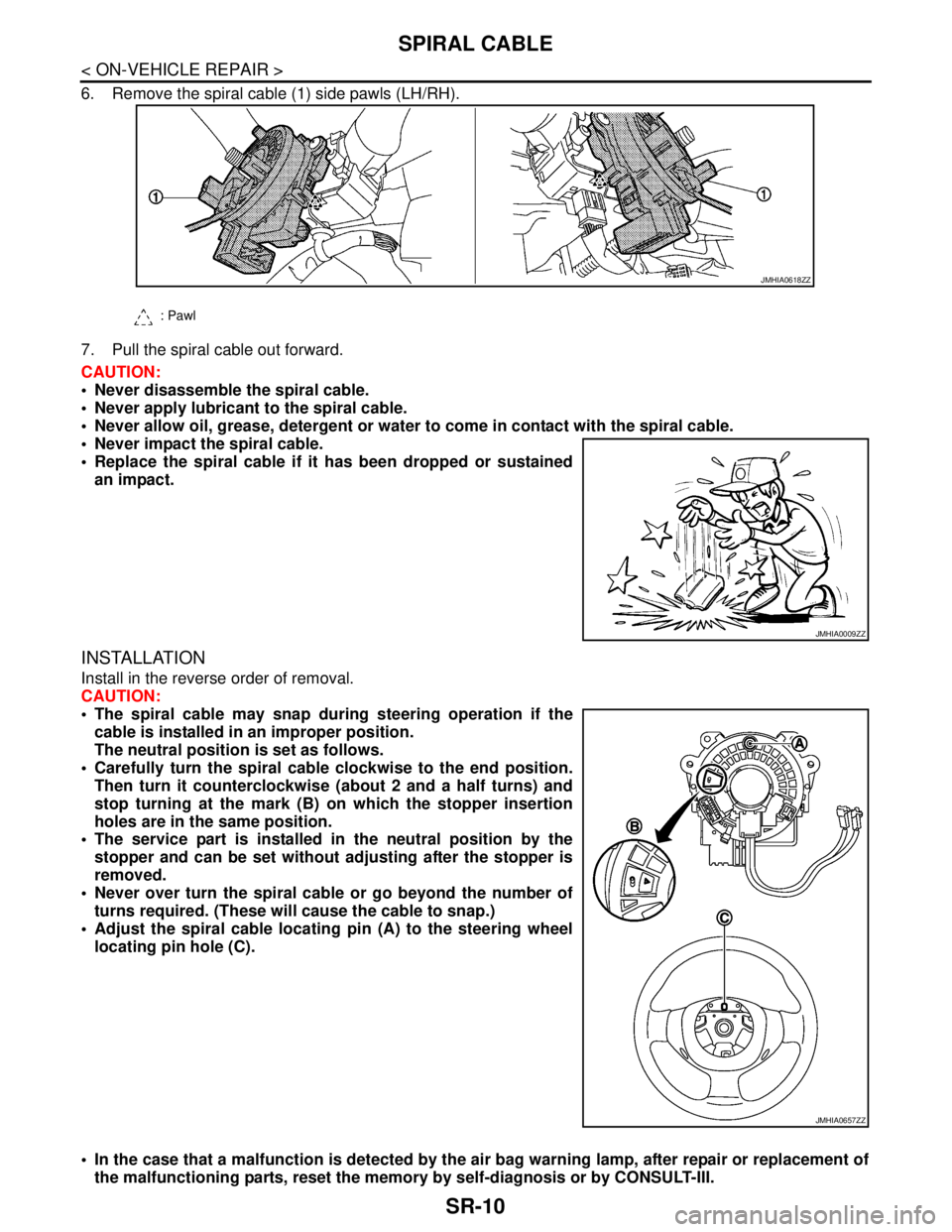
6. Remove the spiral cable (1) side pawls (LH/RH).
7. Pull the spiral cable out forward.
CAUTION:
Never disassemble the spiral cable.
Never apply lubricant to the spiral cable.
Never allow oil, grease, detergent or water to come in contact with the spiral cable.
Never impact the spiral cable.
Replace the spiral cable if it has been dropped or sustained
an impact.
INSTALLATION
Install in the reverse order of removal.
CAUTION:
The spiral cable may snap during steering operation if the
cable is installed in an improper position.
The neutral position is set as follows.
Carefully turn the spiral cable clockwise to the end position.
Then turn it counterclockwise (about 2 and a half turns) and
stop turning at the mark (B) on which the stopper insertion
holes are in the same position.
The service part is installed in the neutral position by the
stopper and can be set without adjusting after the stopper is
removed.
Never over turn the spiral cable or go beyond the number of
turns required. (These will cause the cable to snap.)
Adjust the spiral cable locating pin (A) to the steering wheel
locating pin hole (C).
In the case that a malfunction is detected by the air bag warning lamp, after repair or replacement of
the malfunctioning parts, reset the memory by self-diagnosis or by CONSULT-III.
: Pawl
JMHIA0618ZZ
JMHIA0009ZZ
JMHIA0657ZZ
Page 4228 of 5121
SR-14
< ON-VEHICLE REPAIR >
SIDE CURTAIN AIR BAG MODULE
SIDE CURTAIN AIR BAG MODULE
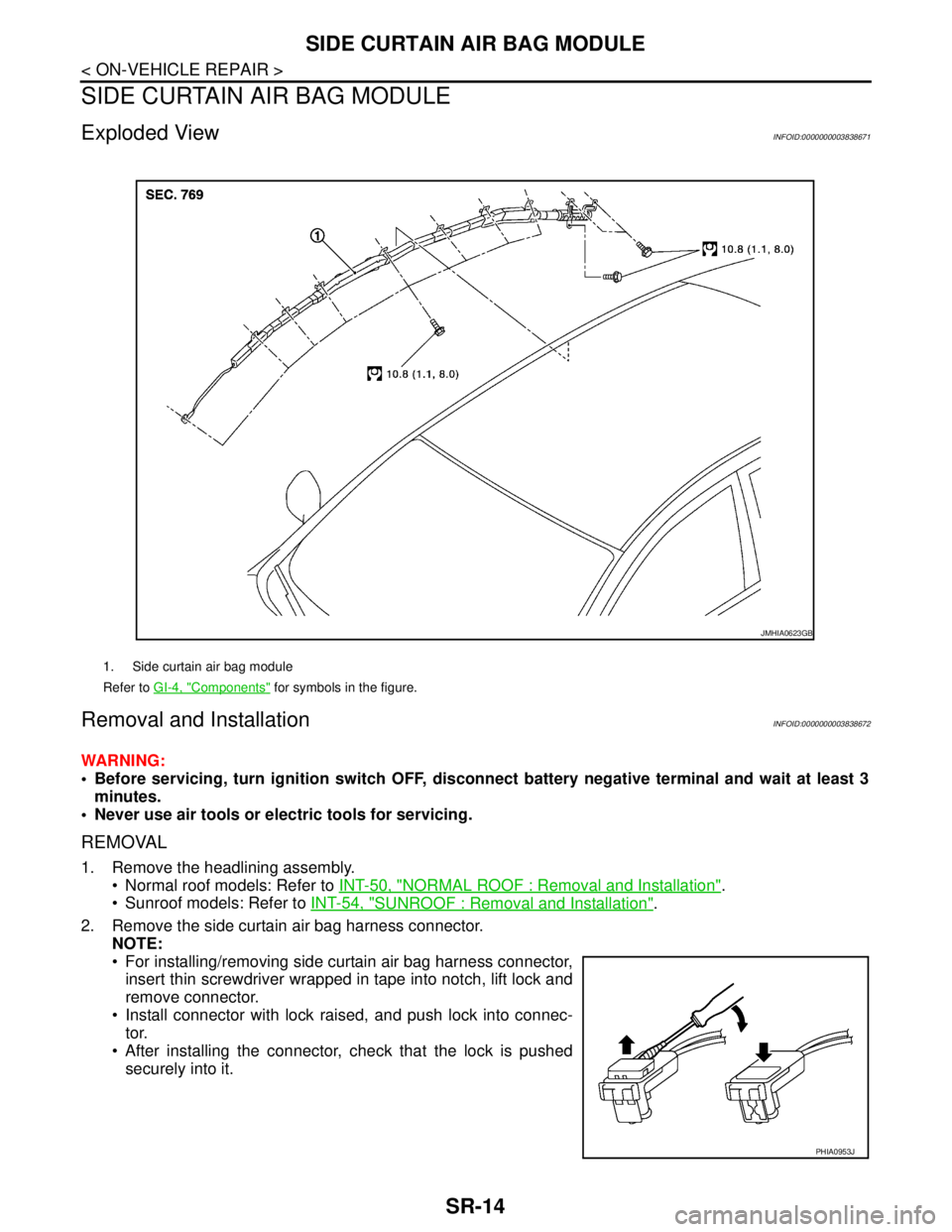
Exploded ViewINFOID:0000000003838671
Removal and InstallationINFOID:0000000003838672
WARNING:
Before servicing, turn ignition switch OFF, disconnect battery negative terminal and wait at least 3
minutes.
Never use air tools or electric tools for servicing.
REMOVAL
1. Remove the headlining assembly.
Normal roof models: Refer to INT-50, "
NORMAL ROOF : Removal and Installation".
Sunroof models: Refer to INT-54, "
SUNROOF : Removal and Installation".
2. Remove the side curtain air bag harness connector.
NOTE:
For installing/removing side curtain air bag harness connector,
insert thin screwdriver wrapped in tape into notch, lift lock and
remove connector.
Install connector with lock raised, and push lock into connec-
tor.
After installing the connector, check that the lock is pushed
securely into it.
1. Side curtain air bag module
Refer to GI-4, "
Components" for symbols in the figure.
JMHIA0623GB
PHIA0953J
Page 4239 of 5121
DISPOSAL OF AIR BAG MODULE AND SEAT BELT PRE-TENSIONER
SR-25
< ON-VEHICLE REPAIR >
C
D
E
F
G
I
J
K
L
MA
B
SR
N
O
P
DISPOSAL OF AIR BAG MODULE AND SEAT BELT PRE-TENSIONER
Caution for Air Bag Module and Seat Belt Pre-tensionerINFOID:0000000003839142
Precaution for Work
Before disposing of air bag module and seat belt pre-tensioner, or vehicles equipped with such systems,
deploy the systems. If such systems have already been deployed due to an accident, dispose of them as
indicated in Disposing of Air Bag Module and Seat Belt Pre-tensioner. Refer to SR-25, "
Caution for Air Bag
Module and Seat Belt Pre-tensioner".
When deploying the air bag module and seat belt pre-tensioner, always use the Special Service Tool;
Deployment tool (SST: KV99106400).
When deploying the air bag module and seat belt pre-tensioner, stand at least 5.0 m (16.4 ft.) away from the
deployment component.
When deploying air bag module and seat belt pre-tensioner, a fairly loud noise is made, followed by smoke
being released. The smoke is not poisonous, however, be careful not to inhale smoke since it irritates the
throat and can cause choking.
Always activate one air bag module at a time.
Due to heat, leave air bag module unattended for more than 30 minutes after deployment. Also leave seat
belt pre-tensioner unattended for more than 10 minutes after deployment.
Wear gloves when handling a deployed air bag module and seat belt pre-tensioner.
Never apply water to the deployed air bag module and seat belt pre-tensioner.
Wash your hands after work is completed.
Place the vehicle outdoors with an open space of at least 6.0 m (19.7 ft) on all sides when deploying air bag
module and seat belt pre-tensioner while mounted in vehicle.
Use a volt meter to make sure the vehicle battery is fully charged.
Never dispose of the air bag module and seat belt pre-tensioner that does not deploy.
CHECKING DEPLOYMENT TOOL
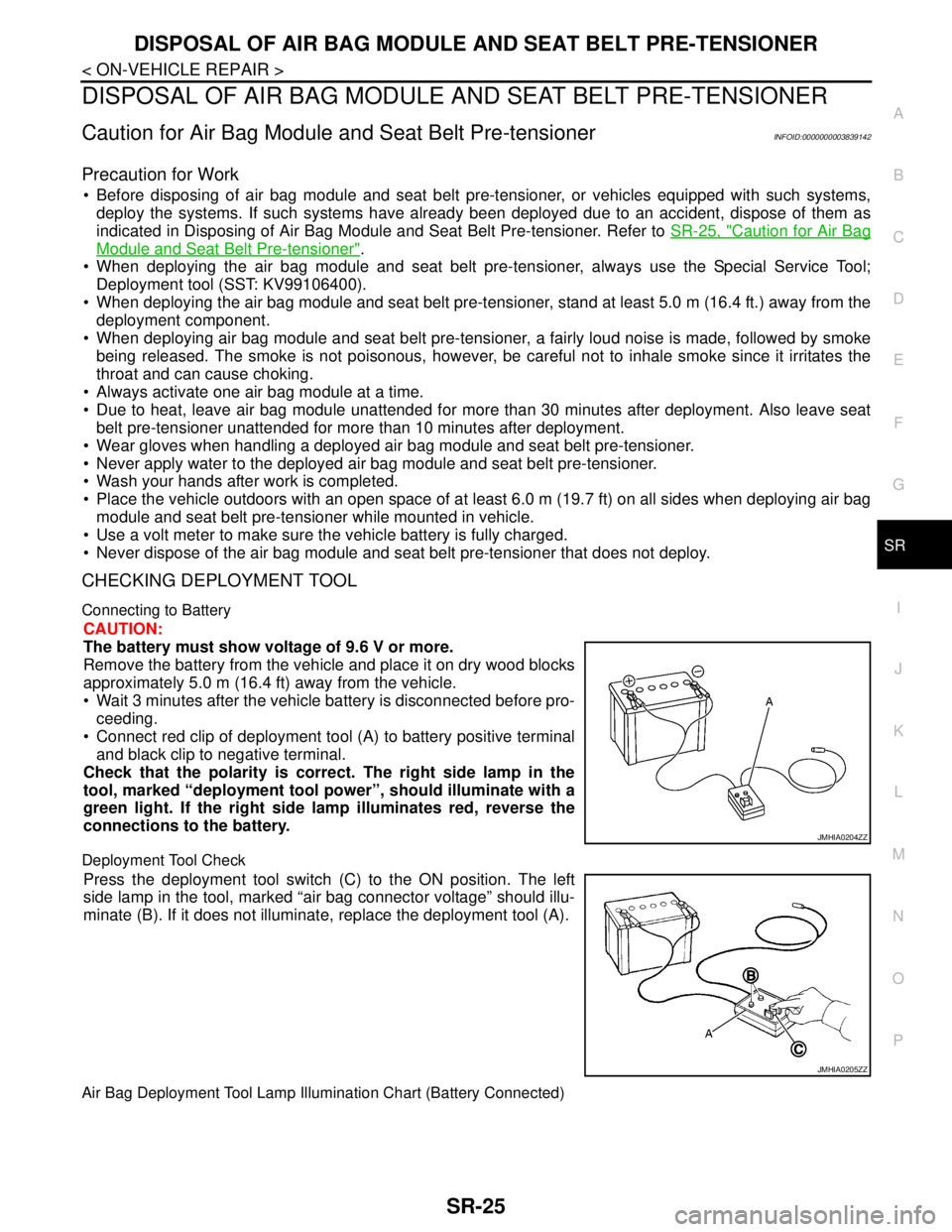
Connecting to Battery
CAUTION:
The battery must show voltage of 9.6 V or more.
Remove the battery from the vehicle and place it on dry wood blocks
approximately 5.0 m (16.4 ft) away from the vehicle.
Wait 3 minutes after the vehicle battery is disconnected before pro-
ceeding.
Connect red clip of deployment tool (A) to battery positive terminal
and black clip to negative terminal.
Check that the polarity is correct. The right side lamp in the
tool, marked “deployment tool power”, should illuminate with a
green light. If the right side lamp illuminates red, reverse the
connections to the battery.
Deployment Tool Check
Press the deployment tool switch (C) to the ON position. The left
side lamp in the tool, marked “air bag connector voltage” should illu-
minate (B). If it does not illuminate, replace the deployment tool (A).
Air Bag Deployment Tool Lamp Illumination Chart (Battery Connected)
JMHIA0204ZZ
JMHIA0205ZZ
Page 4388 of 5121
SRS AIR BAG WARNING LAMP DOES NOT TURN OFF
SRC-145
< SYMPTOM DIAGNOSIS >
C
D
E
F
G
I
J
K
L
MA
B
SRC
N
O
P
SYMPTOM DIAGNOSIS
SRS AIR BAG WARNING LAMP DOES NOT TURN OFF
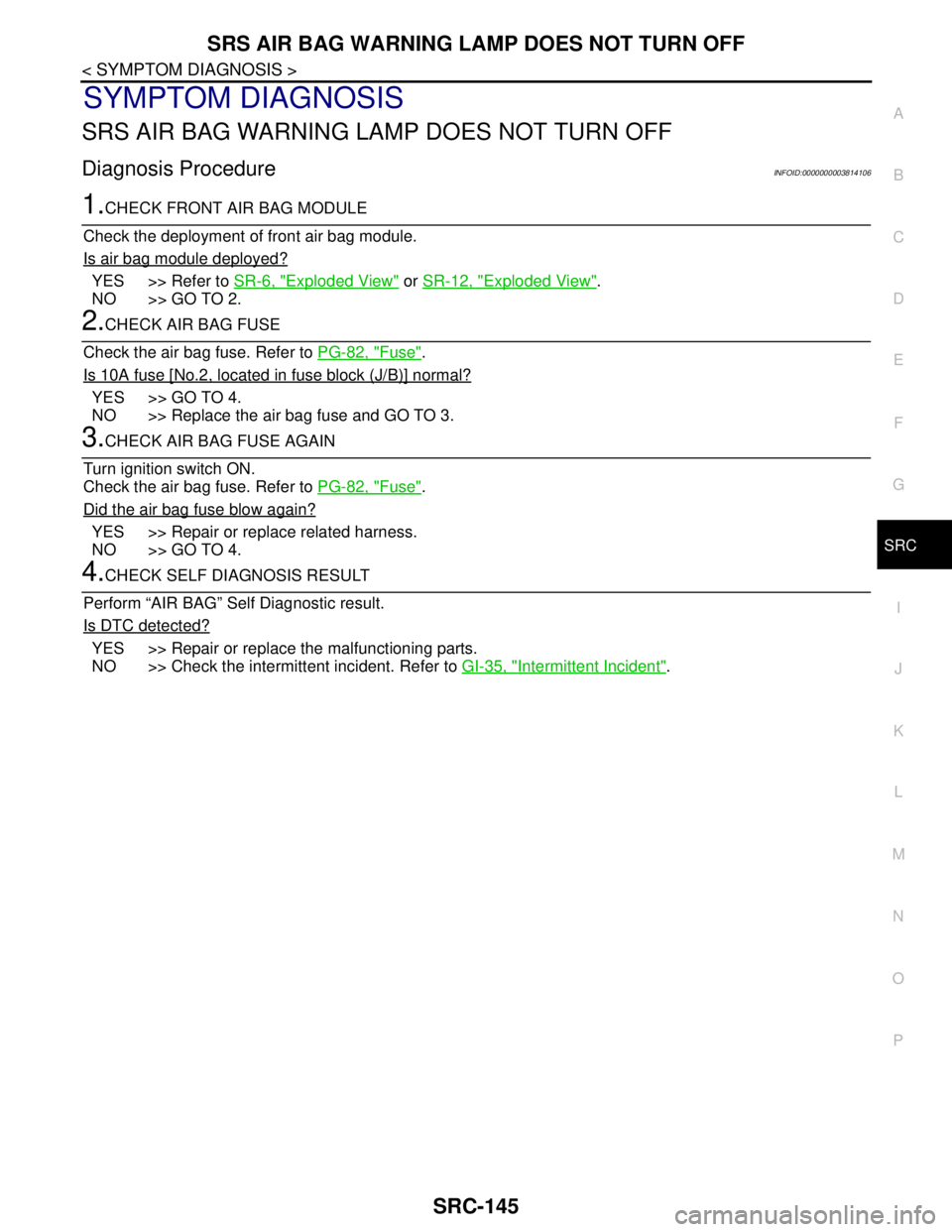
Diagnosis ProcedureINFOID:0000000003814106
1.CHECK FRONT AIR BAG MODULE
Check the deployment of front air bag module.
Is air bag module deployed?
YES >> Refer to SR-6, "Exploded View" or SR-12, "Exploded View".
NO >> GO TO 2.
2.CHECK AIR BAG FUSE
Check the air bag fuse. Refer to PG-82, "
Fuse".
Is 10A fuse [No.2, located in fuse block (J/B)] normal?
YES >> GO TO 4.
NO >> Replace the air bag fuse and GO TO 3.
3.CHECK AIR BAG FUSE AGAIN
Turn ignition switch ON.
Check the air bag fuse. Refer to PG-82, "
Fuse".
Did the air bag fuse blow again?
YES >> Repair or replace related harness.
NO >> GO TO 4.
4.CHECK SELF DIAGNOSIS RESULT
Perform “AIR BAG” Self Diagnostic result.
Is DTC detected?
YES >> Repair or replace the malfunctioning parts.
NO >> Check the intermittent incident. Refer to GI-35, "
Intermittent Incident".
Page 4389 of 5121
SRC-146
< SYMPTOM DIAGNOSIS >
SRS AIR BAG WARNING LAMP DOES NOT TURN ON
SRS AIR BAG WARNING LAMP DOES NOT TURN ON
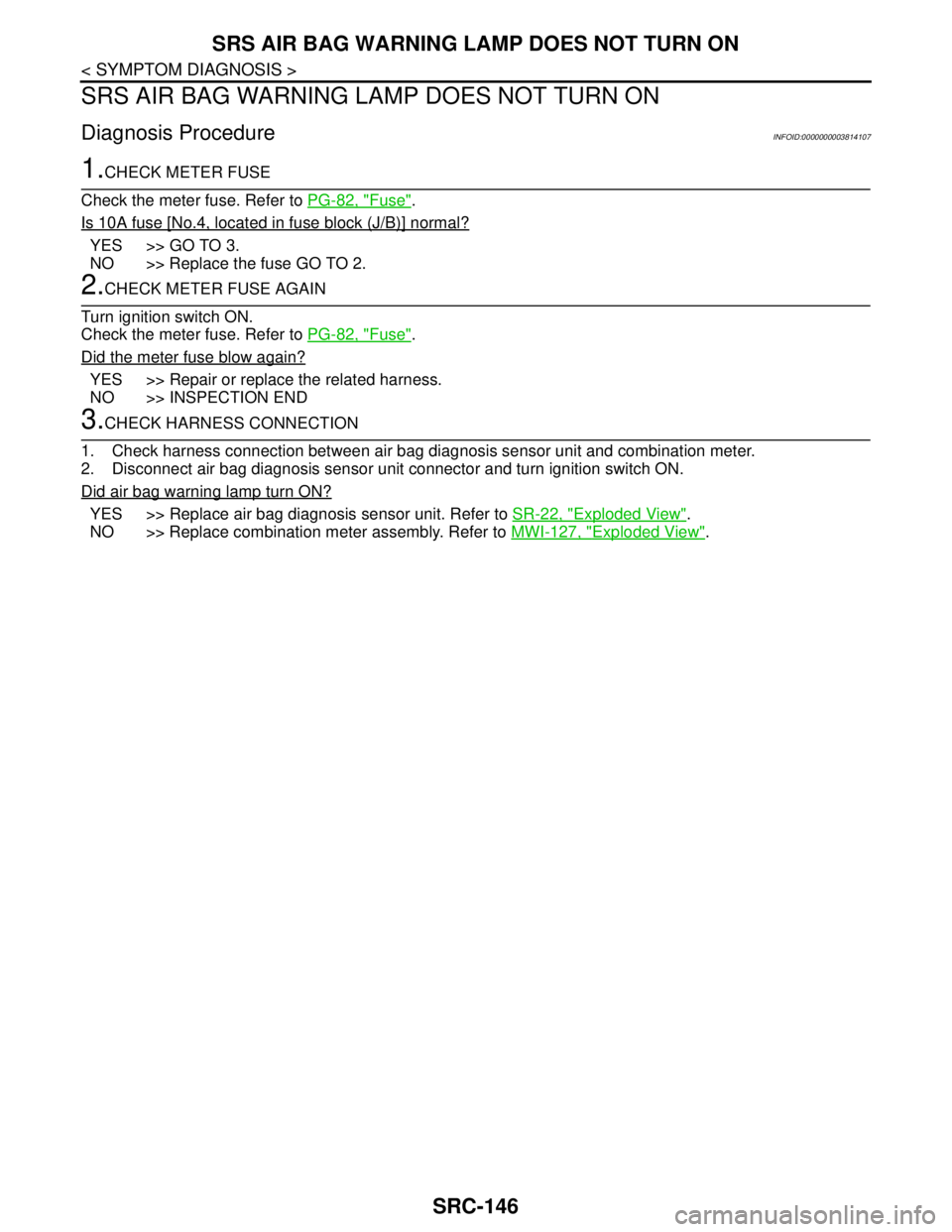
Diagnosis ProcedureINFOID:0000000003814107
1.CHECK METER FUSE
Check the meter fuse. Refer to PG-82, "
Fuse".
Is 10A fuse [No.4, located in fuse block (J/B)] normal?
YES >> GO TO 3.
NO >> Replace the fuse GO TO 2.
2.CHECK METER FUSE AGAIN
Turn ignition switch ON.
Check the meter fuse. Refer to PG-82, "
Fuse".
Did the meter fuse blow again?
YES >> Repair or replace the related harness.
NO >> INSPECTION END
3.CHECK HARNESS CONNECTION
1. Check harness connection between air bag diagnosis sensor unit and combination meter.
2. Disconnect air bag diagnosis sensor unit connector and turn ignition switch ON.
Did air bag warning lamp turn ON?
YES >> Replace air bag diagnosis sensor unit. Refer to SR-22, "Exploded View".
NO >> Replace combination meter assembly. Refer to MWI-127, "
Exploded View".
Page 4392 of 5121
ST-2
< SYMPTOM DIAGNOSIS >
NOISE, VIBRATION AND HARSHNESS (NVH) TROUBLESHOOTING
SYMPTOM DIAGNOSIS
NOISE, VIBRATION AND HARSHNESS (NVH) TROUBLESHOOTING
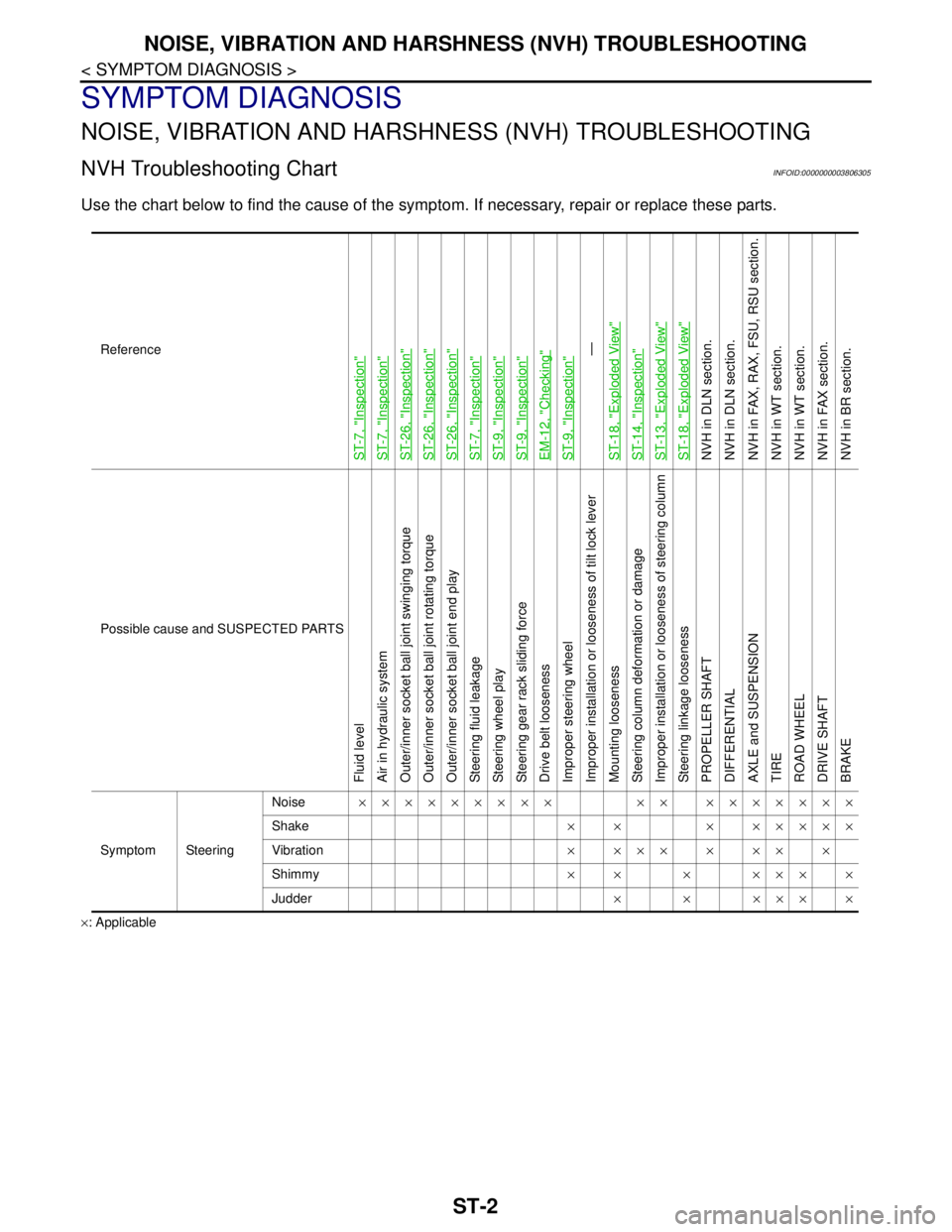
NVH Troubleshooting ChartINFOID:0000000003806305
Use the chart below to find the cause of the symptom. If necessary, repair or replace these parts.
×: ApplicableReference
ST-7, "
Inspection
"
ST-7, "
Inspection
"
ST-26, "
Inspection
"
ST-26, "
Inspection
"
ST-26, "
Inspection
"
ST-7, "
Inspection
"
ST-9, "
Inspection
"
ST-9, "
Inspection
"
EM-12, "
Checking
"
ST-9, "
Inspection
"—
ST-18, "
Exploded View
"
ST-14, "
Inspection
"
ST-13, "
Exploded View
"
ST-18, "
Exploded View
"
NVH in DLN section.
NVH in DLN section.
NVH in FAX, RAX, FSU, RSU section.
NVH in WT section.
NVH in WT section.
NVH in FAX section.
NVH in BR section.
Possible cause and SUSPECTED PARTS
Fluid level
Air in hydraulic system
Outer/inner socket ball joint swinging torque
Outer/inner socket ball joint rotating torque
Outer/inner socket ball joint end play
Steering fluid leakage
Steering wheel play
Steering gear rack sliding force
Drive belt looseness
Improper steering wheel
Improper installation or looseness of tilt lock lever
Mounting looseness
Steering column deformation or damage
Improper installation or looseness of steering column
Steering linkage looseness
PROPELLER SHAFT
DIFFERENTIAL
AXLE and SUSPENSION
TIRE
ROAD WHEEL
DRIVE SHAFT
BRAKE
Symptom SteeringNoise××××××××× ×× ×××××××
Shake× × × ×××××
Vibration××××××××
Shimmy×× × ××××
Judder××××××
Page 4393 of 5121
PRECAUTIONS
ST-3
< PRECAUTION >
C
D
E
F
H
I
J
K
L
MA
B
ST
N
O
P
PRECAUTION
PRECAUTIONS
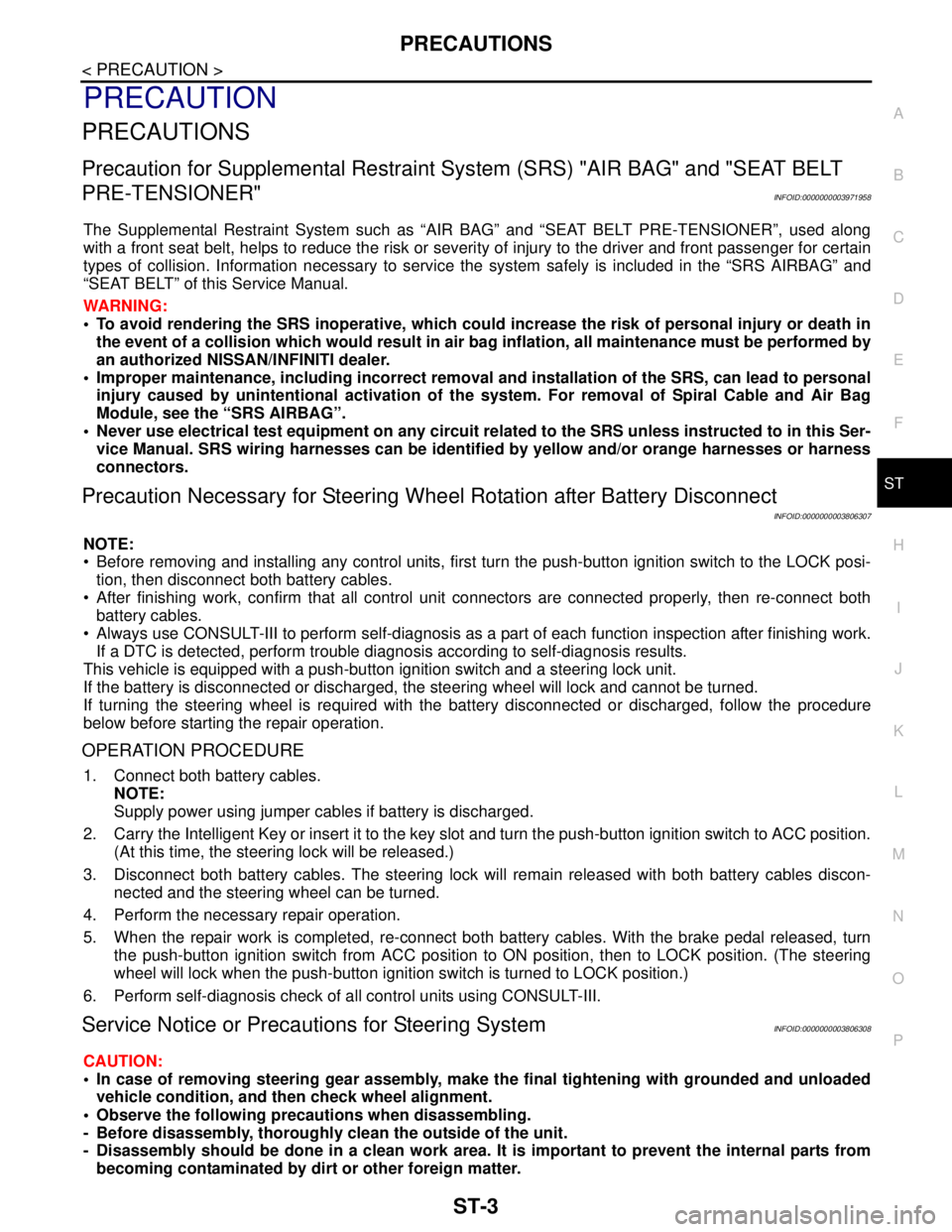
Precaution for Supplemental Restraint System (SRS) "AIR BAG" and "SEAT BELT
PRE-TENSIONER"
INFOID:0000000003971958
The Supplemental Restraint System such as “AIR BAG” and “SEAT BELT PRE-TENSIONER”, used along
with a front seat belt, helps to reduce the risk or severity of injury to the driver and front passenger for certain
types of collision. Information necessary to service the system safely is included in the “SRS AIRBAG” and
“SEAT BELT” of this Service Manual.
WARNING:
• To avoid rendering the SRS inoperative, which could increase the risk of personal injury or death in
the event of a collision which would result in air bag inflation, all maintenance must be performed by
an authorized NISSAN/INFINITI dealer.
Improper maintenance, including incorrect removal and installation of the SRS, can lead to personal
injury caused by unintentional activation of the system. For removal of Spiral Cable and Air Bag
Module, see the “SRS AIRBAG”.
Never use electrical test equipment on any circuit related to the SRS unless instructed to in this Ser-
vice Manual. SRS wiring harnesses can be identified by yellow and/or orange harnesses or harness
connectors.
Precaution Necessary for Steering Wheel Rotation after Battery Disconnect
INFOID:0000000003806307
NOTE:
Before removing and installing any control units, first turn the push-button ignition switch to the LOCK posi-
tion, then disconnect both battery cables.
After finishing work, confirm that all control unit connectors are connected properly, then re-connect both
battery cables.
Always use CONSULT-III to perform self-diagnosis as a part of each function inspection after finishing work.
If a DTC is detected, perform trouble diagnosis according to self-diagnosis results.
This vehicle is equipped with a push-button ignition switch and a steering lock unit.
If the battery is disconnected or discharged, the steering wheel will lock and cannot be turned.
If turning the steering wheel is required with the battery disconnected or discharged, follow the procedure
below before starting the repair operation.
OPERATION PROCEDURE
1. Connect both battery cables.
NOTE:
Supply power using jumper cables if battery is discharged.
2. Carry the Intelligent Key or insert it to the key slot and turn the push-button ignition switch to ACC position.
(At this time, the steering lock will be released.)
3. Disconnect both battery cables. The steering lock will remain released with both battery cables discon-
nected and the steering wheel can be turned.
4. Perform the necessary repair operation.
5. When the repair work is completed, re-connect both battery cables. With the brake pedal released, turn
the push-button ignition switch from ACC position to ON position, then to LOCK position. (The steering
wheel will lock when the push-button ignition switch is turned to LOCK position.)
6. Perform self-diagnosis check of all control units using CONSULT-III.
Service Notice or Precautions for Steering SystemINFOID:0000000003806308
CAUTION:
In case of removing steering gear assembly, make the final tightening with grounded and unloaded
vehicle condition, and then check wheel alignment.
Observe the following precautions when disassembling.
- Before disassembly, thoroughly clean the outside of the unit.
- Disassembly should be done in a clean work area. It is important to prevent the internal parts from
becoming contaminated by dirt or other foreign matter.
Page 4397 of 5121
POWER STEERING FLUID
ST-7
< ON-VEHICLE MAINTENANCE >
C
D
E
F
H
I
J
K
L
MA
B
ST
N
O
P
ON-VEHICLE MAINTENANCE
POWER STEERING FLUID
InspectionINFOID:0000000003826225
FLUID LEVEL
1. Check fluid level with engine stopped.
2. Ensure that fluid level is between MIN and MAX.
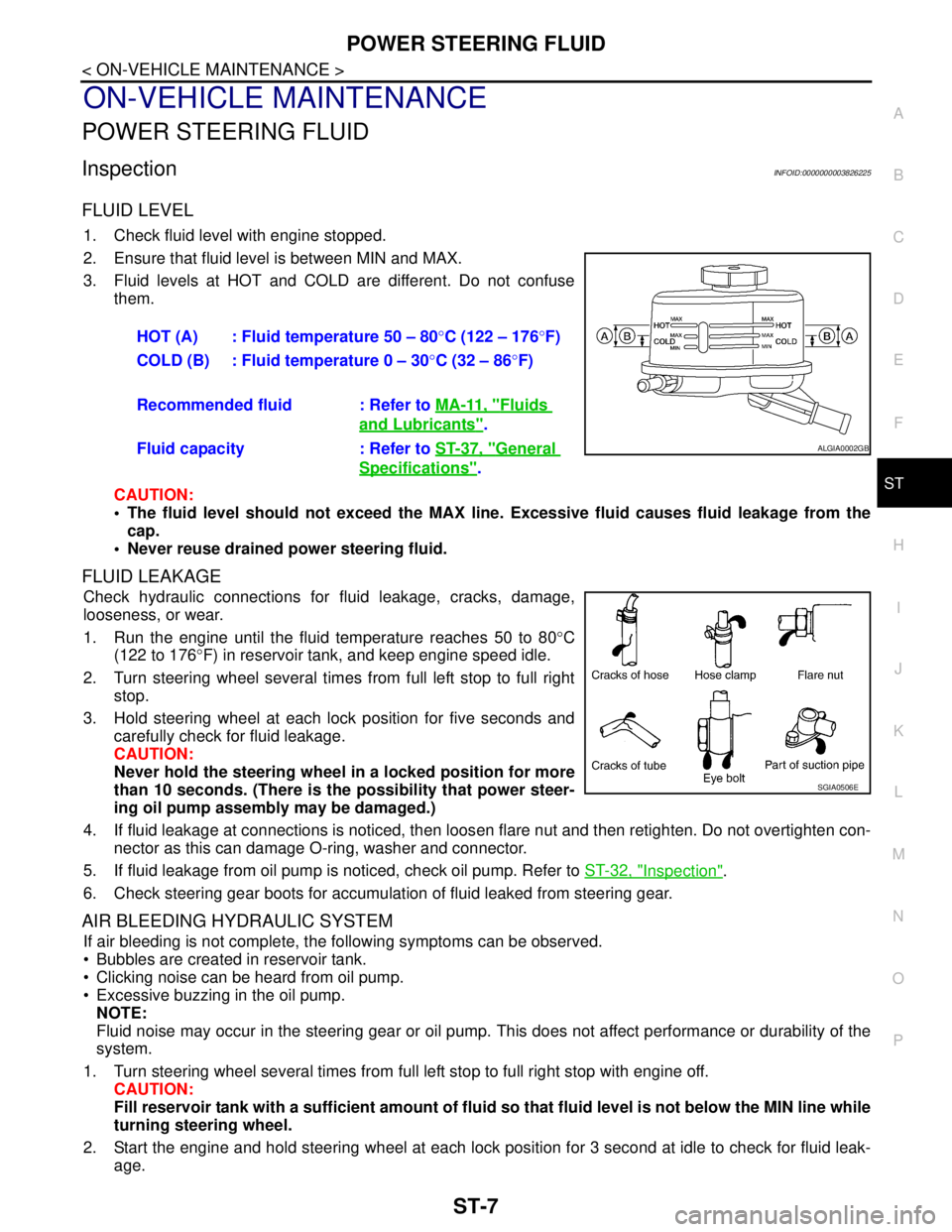
3. Fluid levels at HOT and COLD are different. Do not confuse
them.
CAUTION:
The fluid level should not exceed the MAX line. Excessive fluid causes fluid leakage from the
cap.
Never reuse drained power steering fluid.
FLUID LEAKAGE
Check hydraulic connections for fluid leakage, cracks, damage,
looseness, or wear.
1. Run the engine until the fluid temperature reaches 50 to 80°C
(122 to 176°F) in reservoir tank, and keep engine speed idle.
2. Turn steering wheel several times from full left stop to full right
stop.
3. Hold steering wheel at each lock position for five seconds and
carefully check for fluid leakage.
CAUTION:
Never hold the steering wheel in a locked position for more
than 10 seconds. (There is the possibility that power steer-
ing oil pump assembly may be damaged.)
4. If fluid leakage at connections is noticed, then loosen flare nut and then retighten. Do not overtighten con-
nector as this can damage O-ring, washer and connector.
5. If fluid leakage from oil pump is noticed, check oil pump. Refer to ST-32, "
Inspection".
6. Check steering gear boots for accumulation of fluid leaked from steering gear.
AIR BLEEDING HYDRAULIC SYSTEM
If air bleeding is not complete, the following symptoms can be observed.
Bubbles are created in reservoir tank.
Clicking noise can be heard from oil pump.
Excessive buzzing in the oil pump.
NOTE:
Fluid noise may occur in the steering gear or oil pump. This does not affect performance or durability of the
system.
1. Turn steering wheel several times from full left stop to full right stop with engine off.
CAUTION:
Fill reservoir tank with a sufficient amount of fluid so that fluid level is not below the MIN line while
turning steering wheel.
2. Start the engine and hold steering wheel at each lock position for 3 second at idle to check for fluid leak-
age.HOT (A) : Fluid temperature 50 – 80°C (122 – 176°F)
COLD (B) : Fluid temperature 0 – 30°C (32 – 86°F)
Recommended fluid : Refer to MA-11, "
Fluids
and Lubricants".
Fluid capacity : Refer to ST-37, "
General
Specifications".
ALGIA0002GB
SGIA0506E
Page 4398 of 5121

ST-8
< ON-VEHICLE MAINTENANCE >
POWER STEERING FLUID
3. Repeat step 2 above several times at approximately 3 second intervals.
CAUTION:
Never hold the steering wheel in a locked position for more than 10 seconds. (There is the possi-
bility that oil pump may be damaged.)
4. Check fluid for bubbles and white contamination.
5. Stop the engine if bubbles and white contamination do not drain out. Perform step 2 and 3 above after
waiting until bubbles and white contamination drain out.
6. Stop the engine, and then check fluid level.