Its control NISSAN TEANA 2014 Service Manual
[x] Cancel search | Manufacturer: NISSAN, Model Year: 2014, Model line: TEANA, Model: NISSAN TEANA 2014Pages: 4801, PDF Size: 51.2 MB
Page 853 of 4801
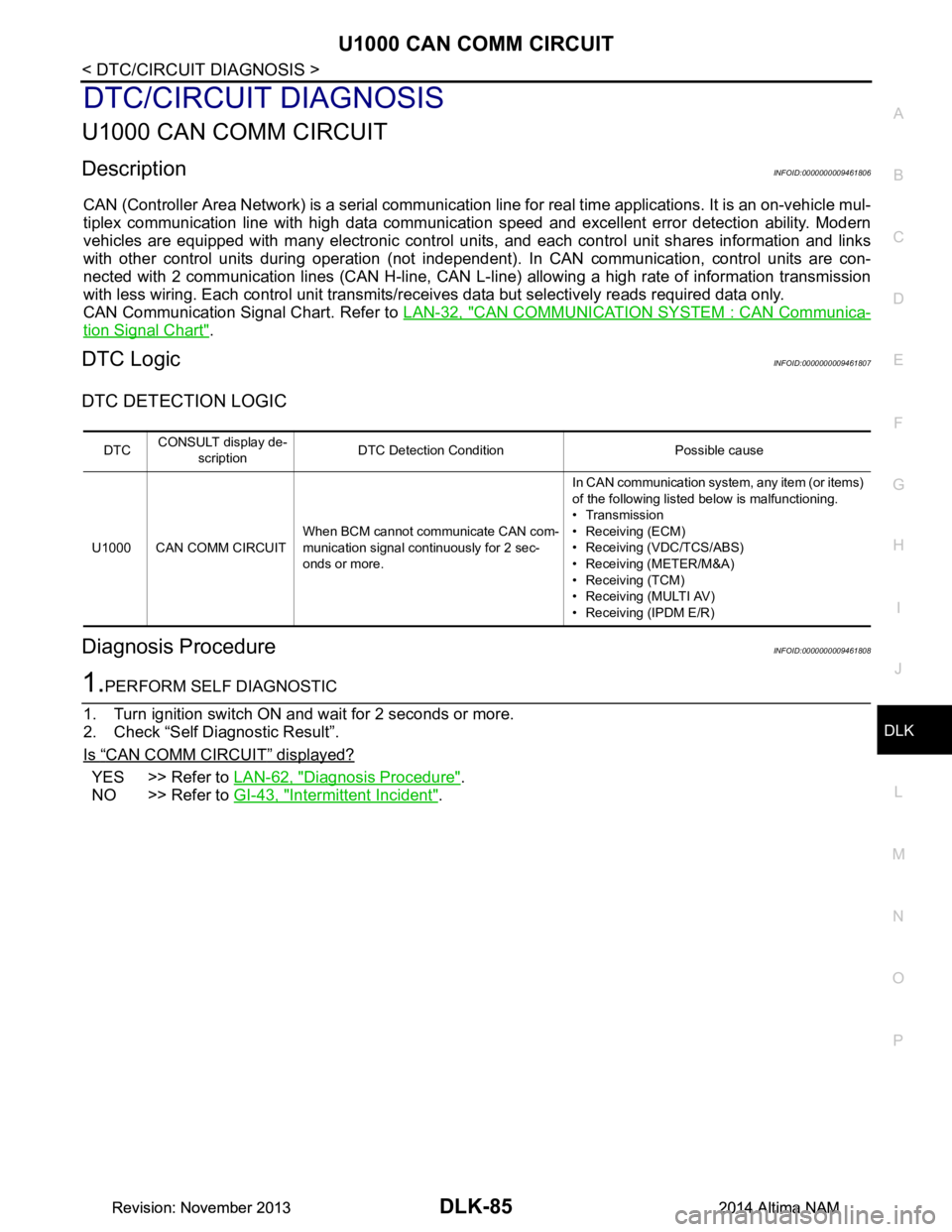
U1000 CAN COMM CIRCUITDLK-85
< DTC/CIRCUIT DIAGNOSIS >
C
D E
F
G H
I
J
L
M A
B
DLK
N
O P
DTC/CIRCUIT DIAGNOSIS
U1000 CAN COMM CIRCUIT
DescriptionINFOID:0000000009461806
CAN (Controller Area Network) is a serial communication line for real time applications. It is an on-vehicle mul-
tiplex communication line with high data communicati on speed and excellent error detection ability. Modern
vehicles are equipped with many electronic control uni ts, and each control unit shares information and links
with other control units during operation (not independent ). In CAN communication, control units are con-
nected with 2 communication lines (CAN H-line, CAN L-li ne) allowing a high rate of information transmission
with less wiring. Each control unit transmits/recei ves data but selectively reads required data only.
CAN Communication Signal Chart. Refer to LAN-32, "CAN COMMUNICATION SYSTEM : CAN Communica-
tion Signal Chart".
DTC LogicINFOID:0000000009461807
DTC DETECTION LOGIC
Diagnosis ProcedureINFOID:0000000009461808
1.PERFORM SELF DIAGNOSTIC
1. Turn ignition switch ON and wait for 2 seconds or more.
2. Check “Self Diagnostic Result”.
Is
“CAN COMM CIRCUIT” displayed?
YES >> Refer to LAN-62, "Diagnosis Procedure".
NO >> Refer to GI-43, "Intermittent Incident"
.
DTCCONSULT display de-
scription DTC Detection Condit
ion Possible cause
U1000 CAN COMM CIRCUIT When BCM cannot communicate CAN com-
munication signal continuously for 2 sec-
onds or more. In CAN communication system, any item (or items)
of the following listed below is malfunctioning.
•Transmission
• Receiving (ECM)
• Receiving (VDC/TCS/ABS)
• Receiving (METER/M&A)
• Receiving (TCM)
• Receiving (MULTI AV)
• Receiving (IPDM E/R)
Revision: November 20132014 Altima NAMRevision: November 20132014 Altima NAM
Page 1016 of 4801
![NISSAN TEANA 2014 Service Manual
EC-16
< PRECAUTION >[QR25DE]
PRECAUTIONS
• Be sure to connect rubber tubes properly afte
r work. A misconnected or disconnected rubber tube
may cause the MIL to light up due to the malfunction of](/img/5/57390/w960_57390-1015.png "NISSAN TEANA 2014 Service Manual
EC-16
< PRECAUTION >[QR25DE]
PRECAUTIONS
• Be sure to connect rubber tubes properly afte
r work. A misconnected or disconnected rubber tube
may cause the MIL to light up due to the malfunction of")
EC-16
< PRECAUTION >[QR25DE]
PRECAUTIONS
• Be sure to connect rubber tubes properly afte
r work. A misconnected or disconnected rubber tube
may cause the MIL to light up due to the malfunction of the EVAP system or fuel injection system,
etc.
• Be sure to erase the unnecessary malfunction info rmation (repairs completed) from the ECM and
TCM (Transmission control module) before returning the vehicle to the customer.
General PrecautionsINFOID:0000000009462050
•Always use a 12 volt battery as power source.
• Do not attempt to disconnect battery cables while engine is
running.
• Before connecting or disconnecting the ECM harness con-
nector, turn ignition switch OFF and disconnect negative bat-
tery cable. Failure to do so may damage the ECM because
battery voltage is applied to ECM even if ignition switch is
turned OFF.
• Before removing parts, turn ig nition switch OFF and then dis-
connect battery ground cable.
• Do not disassemble ECM.
• If a battery cable is disconnected, the memory will return to
the ECM value.
The ECM will now start to self-control at its initial value.
Engine operation can vary slight ly when the terminal is dis-
connected. However, this is no t an indication of a malfunc-
tion. Do not replace parts b ecause of a slight variation.
• If the battery is disconnected, the following emission-related
diagnostic information will be lost within 24 hours.
- Diagnostic trouble codes
- 1st trip diagnostic trouble codes
- Freeze frame data
- 1st trip freeze frame data
- System readiness test (SRT) codes
- Test values
• When connecting or disconnect ing pin connectors into or
from ECM, take care not to damage pin terminals (bend or
break).
Make sure that there are not any bends or breaks on ECM pin
terminal, when connecting pin connectors.
• Securely connect ECM harness connectors.
A poor connection can cause an extremely high (surge) volt-
age to develop in coil and co ndenser, thus resulting in dam-
age to ICs.
• Keep engine control system harness at least 10 cm (4 in) away
from adjacent harness, to preven t engine control system mal-
functions due to receiving exter nal noise, degraded operation
of ICs, etc.
• Keep engine control system parts and harness dry.
• Before replacing ECM, perform ECM Terminals and Reference
Value inspection and make sure ECM functions properly.
Refer to EC-88, "Reference Value"
.
• Handle mass air flow sensor carefully to avoid damage.
• Do not clean mass air flow senso r with any type of detergent.
• Do not disassemble electric throttle control actuator.
• Even a slight leak in the ai r intake system can cause serious
incidents.
• Do not shock or jar the camshaft position sensor (PHASE),
crankshaft position sensor (POS).
SEF289H
PBIA9222J
PBIB0090E
MEF040D
Revision: November 20132014 Altima NAMRevision: November 20132014 Altima NAM
Page 1018 of 4801
![NISSAN TEANA 2014 Service Manual
EC-18
< PRECAUTION >[QR25DE]
PRECAUTIONS
•
When installing C.B. ham radio or a mobile phone, be sure to
observe the following as it m ay adversely affect electronic
control systems depending on in](/img/5/57390/w960_57390-1017.png "NISSAN TEANA 2014 Service Manual
EC-18
< PRECAUTION >[QR25DE]
PRECAUTIONS
•
When installing C.B. ham radio or a mobile phone, be sure to
observe the following as it m ay adversely affect electronic
control systems depending on in")
EC-18
< PRECAUTION >[QR25DE]
PRECAUTIONS
•
When installing C.B. ham radio or a mobile phone, be sure to
observe the following as it m ay adversely affect electronic
control systems depending on installation location.
- Keep the antenna as far as possi ble from the electronic con-
trol units.
- Keep the antenna feeder line more than 20 cm (8 in) away
from the harness of electronic controls.
Do not let them run parallel for a long distance.
- Adjust the antenna and feeder line so that the standing-wave
ratio can be kept smaller.
- Be sure to ground the radio to vehicle body.
SEF708Y
Revision: November 20132014 Altima NAMRevision: November 20132014 Altima NAM
Page 1027 of 4801
![NISSAN TEANA 2014 Service Manual
COMPONENT PARTSEC-27
< SYSTEM DESCRIPTION > [QR25DE]
C
D E
F
G H
I
J
K L
M A
EC
NP
O
The ECM activates the fuel pump for 1 second after the ignition
switch is turned ON to improve engine start abil](/img/5/57390/w960_57390-1026.png "NISSAN TEANA 2014 Service Manual
COMPONENT PARTSEC-27
< SYSTEM DESCRIPTION > [QR25DE]
C
D E
F
G H
I
J
K L
M A
EC
NP
O
The ECM activates the fuel pump for 1 second after the ignition
switch is turned ON to improve engine start abil")
COMPONENT PARTSEC-27
< SYSTEM DESCRIPTION > [QR25DE]
C
D E
F
G H
I
J
K L
M A
EC
NP
O
The ECM activates the fuel pump for 1 second after the ignition
switch is turned ON to improve engine start ability. If the ECM
receives a engine speed signal from the camshaft position sensor
(PHASE), it knows that the engine is rotating, and causes the pump
to operate. If the engine speed signal is not received when the igni-
tion switch is ON, the engine stalls. The ECM stops pump operation
and prevents battery discharging, thereby improving safety. The
ECM does not directly drive the fuel pump. It sends the control signal
to the fuel pump control module, which in turn controls the fuel
pump.
FUEL LEVEL SENSOR
The fuel level sensor is mounted in the fuel level sensor unit.
The sensor detects a fuel level in the fuel tank and tr ansmits a signal to the combination meter. The combina-
tion meter sends the fuel level sensor signal to the ECM via the CAN communication line.
It consists of two parts, one is mechanical float and the ot her is variable resistor. Fuel level sensor output volt-
age changes depending on the movement of the fuel mechanical float.
Fuel Tank Temperature SensorINFOID:0000000009462060
The fuel tank temperature sensor is used to detect the fuel tempera-
ture inside the fuel tank. The sensor modifies a voltage signal from
the ECM. The modified signal returns to the ECM as the fuel temper-
ature input. The sensor uses a ther mistor which is sensitive to the
change in temperature. The electrical resistance of the thermistor
decreases as temperature increases.
*: These data are reference values and are measured between ECM terminals.
Mass Air Flow Sensor (With Intake Air Temperature Sensor)INFOID:0000000009462061
MASS AIR FLOW SENSOR
JPBIA5842ZZ
Condition Fuel pump operation
Ignition switch is turned to ON. Operates for 1 second.
Engine running and cranking Operates.
When engine is stopped Stops in 1.5 seconds.
Except as shown above Sto ps .
SEF012P
Fluid temperature
[° C ( °F)] Voltage* (V) Resistance (k
Ω)
20 (68) 3.5 2.3 - 2.7
50 (122) 2.2 0.79 - 0.90
Revision: November 20132014 Altima NAMRevision: November 20132014 Altima NAM
Page 1028 of 4801
![NISSAN TEANA 2014 Service Manual
EC-28
< SYSTEM DESCRIPTION >[QR25DE]
COMPONENT PARTS
The mass air flow sensor is placed in the stream of intake air. It
measures the intake flow rate by measuring a part of the entire
intake flow.](/img/5/57390/w960_57390-1027.png "NISSAN TEANA 2014 Service Manual
EC-28
< SYSTEM DESCRIPTION >[QR25DE]
COMPONENT PARTS
The mass air flow sensor is placed in the stream of intake air. It
measures the intake flow rate by measuring a part of the entire
intake flow.")
EC-28
< SYSTEM DESCRIPTION >[QR25DE]
COMPONENT PARTS
The mass air flow sensor is placed in the stream of intake air. It
measures the intake flow rate by measuring a part of the entire
intake flow. The MAF sensor controls the temperature of the heater
in sensing element to a certain amount. The temperature distribution
around the heater changes according to the increase in intake air
volume. The change is detected by a thermistor and the air volume
data is sent to ECM by the MAF sensor.
INTAKE AIR TEMPERATURE SENSOR
The intake air temperature sensor is built-into mass air flow sensor. The sensor detects intake air temperature
and transmits a signal to the ECM.
The temperature sensing unit uses a thermistor wh ich is sensitive to the change in temperature.
*: These data are reference values on the diagnosis tool.
Manifold Absolute Pressure SensorINFOID:0000000009462062
The manifold absolute pressure (MAP) sensor is placed at intake
manifold collector. It detects intake manifold pressure and sends the
voltage signal to the ECM.
The sensor uses a silicon diaphragm which is sensitive to the
change in pressure. As the pressure increases, the voltage rises.
NOTE:
The sensor is equipped, but used for trouble diagnosis only.
Engine Coolant Te mperature SensorINFOID:0000000009462063
The engine coolant temperature sensor is used to detect the engine
coolant temperature. The sensor modifies a voltage signal from the
ECM. The modified signal returns to the ECM as the engine coolant
temperature input. The sensor uses a thermistor which is sensitive to
the change in temperature. The elec trical resistance of the ther-
mistor decreases as temperature increases.
PBIA9559J
Intake air temperature
[° C ( °F)] Vo l ta g e* (V)
25 (77) 1.9 – 2.1
80 (176) 3.2 – 3.4
JPBIA4619ZZ
JPBIA5280ZZ
Revision: November 20132014 Altima NAMRevision: November 20132014 Altima NAM
Page 1032 of 4801
![NISSAN TEANA 2014 Service Manual
EC-32
< SYSTEM DESCRIPTION >[QR25DE]
COMPONENT PARTS
Air Fuel Ratio (A/F) Sensor 1
INFOID:0000000009462072
The sensor element of the A/F sensor 1 is composed an electrode
layer, which transports ion](/img/5/57390/w960_57390-1031.png "NISSAN TEANA 2014 Service Manual
EC-32
< SYSTEM DESCRIPTION >[QR25DE]
COMPONENT PARTS
Air Fuel Ratio (A/F) Sensor 1
INFOID:0000000009462072
The sensor element of the A/F sensor 1 is composed an electrode
layer, which transports ion")
EC-32
< SYSTEM DESCRIPTION >[QR25DE]
COMPONENT PARTS
Air Fuel Ratio (A/F) Sensor 1
INFOID:0000000009462072
The sensor element of the A/F sensor 1 is composed an electrode
layer, which transports ions. It has a heater in the element.
The sensor is capable of precise measurement = 1, but also in the lean and rich range. Together with its
control electronics, the sensor outputs a cl ear, continuous signal throughout a wide range.
The exhaust gas components diffuse through the diffusi on layer at the sensor cell. An electrode layer is
applied voltage, and this current relati ve oxygen density in lean. Also this current relative hydrocarbon density
in rich.
Therefore, the A/F sensor 1 is able to indicate air fuel ratio by this
electrode layer of current. In additi on, a heater is integrated in the
sensor to ensure the required operating temperature of approxi-
mately 760 °C (1,400 °F).
A/F SENSOR 1 HEATER
A/F sensor 1 heater is integrated in the sensor.
The ECM performs ON/OFF duty control of the A/F sensor 1 heater corresponding to the engine operating
condition to keep the temperature of A/F s ensor 1 element within the specified range.
Heated Oxygen Sensor 2INFOID:0000000009462073
The heated oxygen sensor 2, after three way catalyst (manifold),
monitors the oxygen level in the exhaust gas.
Even if switching characteristics of the air fuel ratio (A/F) sensor 1
are shifted, the air fuel ratio is controlled to stoichiometric, by the sig-
nal from the heated oxygen sensor 2.
This sensor is made of ceramic zirconia. The zirconia generates volt-
age from approximately 1 V in richer conditions to 0 V in leaner con-
ditions.
Under normal conditions the heated ox ygen sensor 2 is not used for
engine control operation.
HEATED OXYGEN SENSOR 2 HEATER
Heated oxygen sensor 2 heater is integrated in the sensor.
The ECM performs ON/OFF control of the heated oxy gen sensor 2 heater corresponding to the engine speed,
amount of intake air and engine coolant temperature.
JPBIA4038GB
JPBIA5446GB
SEF327R
Revision: November 20132014 Altima NAMRevision: November 20132014 Altima NAM
Page 1045 of 4801
![NISSAN TEANA 2014 Service Manual
SYSTEMEC-45
< SYSTEM DESCRIPTION > [QR25DE]
C
D E
F
G H
I
J
K L
M A
EC
NP
O
MIXTURE RATIO FEEDBACK CONTROL (CLOSED LOOP CONTROL)
The mixture ratio feedback system prov
ides the best air-fuel mixture](/img/5/57390/w960_57390-1044.png "NISSAN TEANA 2014 Service Manual
SYSTEMEC-45
< SYSTEM DESCRIPTION > [QR25DE]
C
D E
F
G H
I
J
K L
M A
EC
NP
O
MIXTURE RATIO FEEDBACK CONTROL (CLOSED LOOP CONTROL)
The mixture ratio feedback system prov
ides the best air-fuel mixture")
SYSTEMEC-45
< SYSTEM DESCRIPTION > [QR25DE]
C
D E
F
G H
I
J
K L
M A
EC
NP
O
MIXTURE RATIO FEEDBACK CONTROL (CLOSED LOOP CONTROL)
The mixture ratio feedback system prov
ides the best air-fuel mixture ratio for driveability and emission control.
The three way catalyst (manifold) can then better r educe CO, HC and NOx emissions. This system uses A/F
sensor 1 in the exhaust manifold to monitor whether t he engine operation is rich or lean. The ECM adjusts the
injection pulse width according to the sensor voltage si gnal. For more information about A/F sensor 1, refer to
EC-32, "Air Fuel Ratio (A/F) Sensor 1"
. This maintains the mixture rati o within the range of stoichiometric
(ideal air-fuel mixture).
This stage is referred to as the closed loop control condition.
Heated oxygen sensor 2 is located downstream of the th ree way catalyst (manifold). Even if the switching
characteristics of A/F sensor 1 shift, the air-fuel rati o is controlled to stoichiometric by the signal from heated
oxygen sensor 2.
• Open Loop Control
The open loop system condition refers to when the EC M detects any of the following conditions. Feedback
control stops in order to maintain stabilized fuel combustion.
- Deceleration and acceleration
- High-load, high-speed operation
- Malfunction of A/F sensor 1 or its circuit
- Insufficient activation of A/F sensor 1 at low engine coolant temperature
- High engine coolant temperature
- During warm-up
- After shifting from N to D
- When starting the engine
MIXTURE RATIO SELF-LEARNING CONTROL
The mixture ratio feedback control system monitors the mixture ratio signal transmitted from A/F sensor 1.
This feedback signal is then sent to the ECM. The ECM cont rols the basic mixture ratio as close to the theoret-
ical mixture ratio as possible. However, the basic mi xture ratio is not necessarily controlled as originally
designed. Both manufacturing differences (i.e., mass air flow sensor hot wire) and characteristic changes dur-
ing operation (i.e., fuel injector clogging) directly affect mixture ratio.
Accordingly, the difference between the basic and theoretical mixture ratios is monitored in this system. This is
then computed in terms of “injection pulse duration” to automatically compensate for the difference between
the two ratios.
“Fuel trim” refers to the feedback compensation value co mpared against the basic injection duration. Fuel trim
includes short term fuel trim and long term fuel trim.
“Short term fuel trim” is the short-term fuel compensati on used to maintain the mixture ratio at its theoretical
value. The signal from A/F sensor 1 indicates whether the mixture ratio is RICH or LEAN compared to the the-
oretical value. The signal then triggers a reduction in fuel volume if the mixture ratio is rich, and an increase in
fuel volume if it is lean.
“Long term fuel trim” is overall fuel compensation ca rried out long-term to compensate for continual deviation
of the short term fuel trim from the central value. Such deviation will occur due to individual engine differences,
wear over time and changes in the usage environment.
PBIB2793E
Revision: November 20132014 Altima NAMRevision: November 20132014 Altima NAM
Page 1047 of 4801
![NISSAN TEANA 2014 Service Manual
SYSTEMEC-47
< SYSTEM DESCRIPTION > [QR25DE]
C
D E
F
G H
I
J
K L
M A
EC
NP
O
by input signals (for engine speed and intake air) from t
he crankshaft position sensor (POS), camshaft position
sensor (P](/img/5/57390/w960_57390-1046.png "NISSAN TEANA 2014 Service Manual
SYSTEMEC-47
< SYSTEM DESCRIPTION > [QR25DE]
C
D E
F
G H
I
J
K L
M A
EC
NP
O
by input signals (for engine speed and intake air) from t
he crankshaft position sensor (POS), camshaft position
sensor (P")
SYSTEMEC-47
< SYSTEM DESCRIPTION > [QR25DE]
C
D E
F
G H
I
J
K L
M A
EC
NP
O
by input signals (for engine speed and intake air) from t
he crankshaft position sensor (POS), camshaft position
sensor (PHASE) and the mass air flow sensor.
VARIOUS FUEL INJECTION INCREASE/DECREASE COMPENSATION
In addition, the amount of fuel injected is compens ated to improve engine performance under various operat-
ing conditions as listed below.
• When starting the engine
• During acceleration
• Hot-engine operation
• When selector lever is changed from N to D
• High-load, high-speed operation
• During deceleration
• During high engine speed operation
MIXTURE RATIO FEEDBACK CONTROL (CLOSED LOOP CONTROL)
The mixture ratio feedback system prov ides the best air-fuel mixture ratio for driveability and emission control.
The three way catalyst (manifold) can then better r educe CO, HC and NOx emissions. This system uses A/F
sensor 1 in the exhaust manifold to monitor whether t he engine operation is rich or lean. The ECM adjusts the
injection pulse width according to the sensor voltage si gnal. For more information about A/F sensor 1, refer to
EC-32, "Air Fuel Ratio (A/F) Sensor 1"
. This maintains the mixture rati o within the range of stoichiometric
(ideal air-fuel mixture).
This stage is referred to as the closed loop control condition.
Heated oxygen sensor 2 is located downstream of the th ree way catalyst (manifold). Even if the switching
characteristics of A/F sensor 1 shift, the air-fuel rati o is controlled to stoichiometric by the signal from heated
oxygen sensor 2.
• Open Loop Control
The open loop system condition refers to when the EC M detects any of the following conditions. Feedback
control stops in order to maintain stabilized fuel combustion.
- Deceleration and acceleration
- High-load, high-speed operation
- Malfunction of A/F sensor 1 or its circuit
- Insufficient activation of A/F sensor 1 at low engine coolant temperature
- High engine coolant temperature
- During warm-up
- After shifting from N to D
- When starting the engine
MIXTURE RATIO SELF-LEARNING CONTROL
The mixture ratio feedback control system monitors the mixture ratio signal transmitted from A/F sensor 1.
This feedback signal is then sent to the ECM. The ECM cont rols the basic mixture ratio as close to the theoret-
ical mixture ratio as possible. However, the basic mi xture ratio is not necessarily controlled as originally
designed. Both manufacturing differences (i.e., mass air flow sensor hot wire) and characteristic changes dur-
ing operation (i.e., fuel injector clogging) directly affect mixture ratio.
Accordingly, the difference between the basic and theoretical mixture ratios is monitored in this system. This is
then computed in terms of “injection pulse duration” to automatically compensate for the difference between
the two ratios.
“Fuel trim” refers to the feedback compensation value co mpared against the basic injection duration. Fuel trim
includes short term fuel trim and long term fuel trim.
PBIB2793E
Revision: November 20132014 Altima NAMRevision: November 20132014 Altima NAM
Page 1048 of 4801
![NISSAN TEANA 2014 Service Manual
EC-48
< SYSTEM DESCRIPTION >[QR25DE]
SYSTEM
“Short term fuel trim” is the short-term fuel compensati
on used to maintain the mixture ratio at its theoretical
value. The signal from A/F sensor 1 i](/img/5/57390/w960_57390-1047.png "NISSAN TEANA 2014 Service Manual
EC-48
< SYSTEM DESCRIPTION >[QR25DE]
SYSTEM
“Short term fuel trim” is the short-term fuel compensati
on used to maintain the mixture ratio at its theoretical
value. The signal from A/F sensor 1 i")
EC-48
< SYSTEM DESCRIPTION >[QR25DE]
SYSTEM
“Short term fuel trim” is the short-term fuel compensati
on used to maintain the mixture ratio at its theoretical
value. The signal from A/F sensor 1 indicates whether the mixture ratio is RICH or LEAN compared to the the-
oretical value. The signal then triggers a reduction in fuel volume if the mixture ratio is rich, and an increase in
fuel volume if it is lean.
“Long term fuel trim” is overall fuel compensation carri ed out long-term to compensate for continual deviation
of the short term fuel trim from t he central value. Such deviation will occur due to individual engine differences,
wear over time and changes in the usage environment.
FUEL INJECTION TIMING
Two types of systems are used.
• Sequential Multiport Fuel Injection System Fuel is injected into each cylinder during each engine cycle according to the firing order. This system is used
when the engine is running.
• Simultaneous Multiport Fuel Injection System Fuel is injected simultaneously into all four cylinder s twice each engine cycle. In other words, pulse signals
of the same width are simultaneously transmitted from the ECM.
The four injectors will then receive the signals two times for each engine cycle.
This system is used when the engine is being started and/ or if the fail-safe system (CPU) is operating.
FUEL SHUT-OFF
Fuel to each cylinder is cut off during deceleration, operation of the engine at excessively high speeds or oper-
ation of the vehicle at excessively high speeds.
ELECTRIC IGNITION SYSTEM
ELECTRIC IGNITION SYSTEM : System DescriptionINFOID:0000000009462095
SYSTEM DIAGRAM
SYSTEM DESCRIPTION
Firing order: 1 - 3 - 4 - 2
The ignition timing is controlled by the ECM to maintain the best air-fuel ratio for every running condition of the
engine. The ignition timing data is stored in the ECM.
SEF337W
JPBIA3193GB
Revision: November 20132014 Altima NAMRevision: November 20132014 Altima NAM
Page 1055 of 4801
![NISSAN TEANA 2014 Service Manual
SYSTEMEC-55
< SYSTEM DESCRIPTION > [QR25DE]
C
D E
F
G H
I
J
K L
M A
EC
NP
O
Intake Manifold Tuning Valve Operating Condition
ECM opens the intake manifold tuning valve when all of the following con](/img/5/57390/w960_57390-1054.png "NISSAN TEANA 2014 Service Manual
SYSTEMEC-55
< SYSTEM DESCRIPTION > [QR25DE]
C
D E
F
G H
I
J
K L
M A
EC
NP
O
Intake Manifold Tuning Valve Operating Condition
ECM opens the intake manifold tuning valve when all of the following con")
SYSTEMEC-55
< SYSTEM DESCRIPTION > [QR25DE]
C
D E
F
G H
I
J
K L
M A
EC
NP
O
Intake Manifold Tuning Valve Operating Condition
ECM opens the intake manifold tuning valve when all of the following conditions are satisfied.
• Engine speed: 5,000 rpm or more
• Engine coolant temperature: -30 °C (-22 °F) or more
• Battery voltage: 16 V or less
ENGINE PROTECTION CONTROL AT LOW ENGINE OIL PRESSURE
ENGINE PROTECTION CONTROL AT LOW ENGINE OIL PRESSURE : System De-
scription
INFOID:0000000009462100
SYSTEM DIAGRAM
INPUT/OUTPUT SIGNAL CHART
SYSTEM DESCRIPTION
• The engine protection control at low engine oil pressure warns the driver of a decrease in engine oil pres-
sure by the oil pressure warning lamp a before the engine becomes damaged.
• When detecting a decrease in engine oil pressure at an engine speed less than 1,000 rpm, ECM transmits an oil pressure warning lamp signal to the combination meter.The combination meter turns ON the oil pres-
sure warning lamp, according to the signal.
*: When detecting a normal engine oil pressure, ECM turns OFF the oil pressure warning lamp.
FUEL FILLER CAP WARNING SYSTEM
JPBIA4922GB
Sensor Input signal to ECM ECM function Actuator
Engine oil pressure sensor Engine pressure Engine protection control
• Oil pressure warning lamp
signal
•FUel cut control Combination meter
• Oil pressure warning lamp
Crankshaft position sensor
(POS) Engine speed
Engine oil temperature sensor Engine oil temperature
Decrease in engine oil pressure Engine speed Combination meter
Fuel cut
Oil pressure warning lamp
Detection Less than 1,000 rpm ON* NO
1,000 rpm or more ON YES
Revision: November 20132014 Altima NAMRevision: November 20132014 Altima NAM