light NISSAN TEANA 2014 Repair Manual
[x] Cancel search | Manufacturer: NISSAN, Model Year: 2014, Model line: TEANA, Model: NISSAN TEANA 2014Pages: 4801, PDF Size: 51.2 MB
Page 918 of 4801
DLK-150
< DTC/CIRCUIT DIAGNOSIS >
HOMELINK UNIVERSAL TRANSCEIVER
HOMELINK UNIVERSAL TRANSCEIVER
DescriptionINFOID:0000000009461904
Homelink universal transceiver can store and transmit a maximum of 3 radio signals.
Allows operation of garage doors, gates, home and office lighting, entry door locks and security system, etc.
Homelink universal transceiver power supply uses vehicl e battery, which enables it to maintain every program
in case battery is discharged or removed.
Component Function CheckINFOID:0000000009461905
1.CHECK FUNCTION
Check that system receiver (garage door opener, et c.) operates with original hand-held transmitter.
Is the inspection result normal?
YES >> GO TO 2
NO >> Receiver or hand-held transmitter is malfunctioning.
2.CHECK ILLUMINATE
1. Turn ignition switch “OFF”.
2. Press each of the transmitter buttons and watch for the red light to illuminate with each button.
Is the inspection result normal?
YES >> GO TO 3
NO >> Refer to DLK-150, "Diagnosis Procedure"
.
3.CHECK TRANSMITTER
Check transmitter with Tool*.
*:For details, refer to Technical Service Bulletin.
Is the inspection result normal?
YES >> Receiver or hand-held transmitter malfunction, not vehicle related.
NO >> Replace auto anti-dazzling inside mirror (homelink universal transceiver). Refer to MIR-19,
"Removal and Installation".
Diagnosis ProcedureINFOID:0000000009461906
Regarding Wiring Diagram information, refer to DLK-49, "Wiring Diagram".
1.CHECK POWER SUPPLY
1. Disconnect auto anti-dazzling inside mirror (homelink universal transceiver) connector.
2. Check voltage between auto anti-dazzling inside mirror (homelink universal transceiver) harness connec-
tor and ground.
Is the inspection result normal?
YES >> GO TO 2
NO >> Check the following. • 10A fuse [No. 1 located in the fuse block (J/B)]
• Harness for open or short between fuse and auto anti-dazzling inside mirror (homelink universal
transceiver).
2.CHECK GROUND CIRCUIT
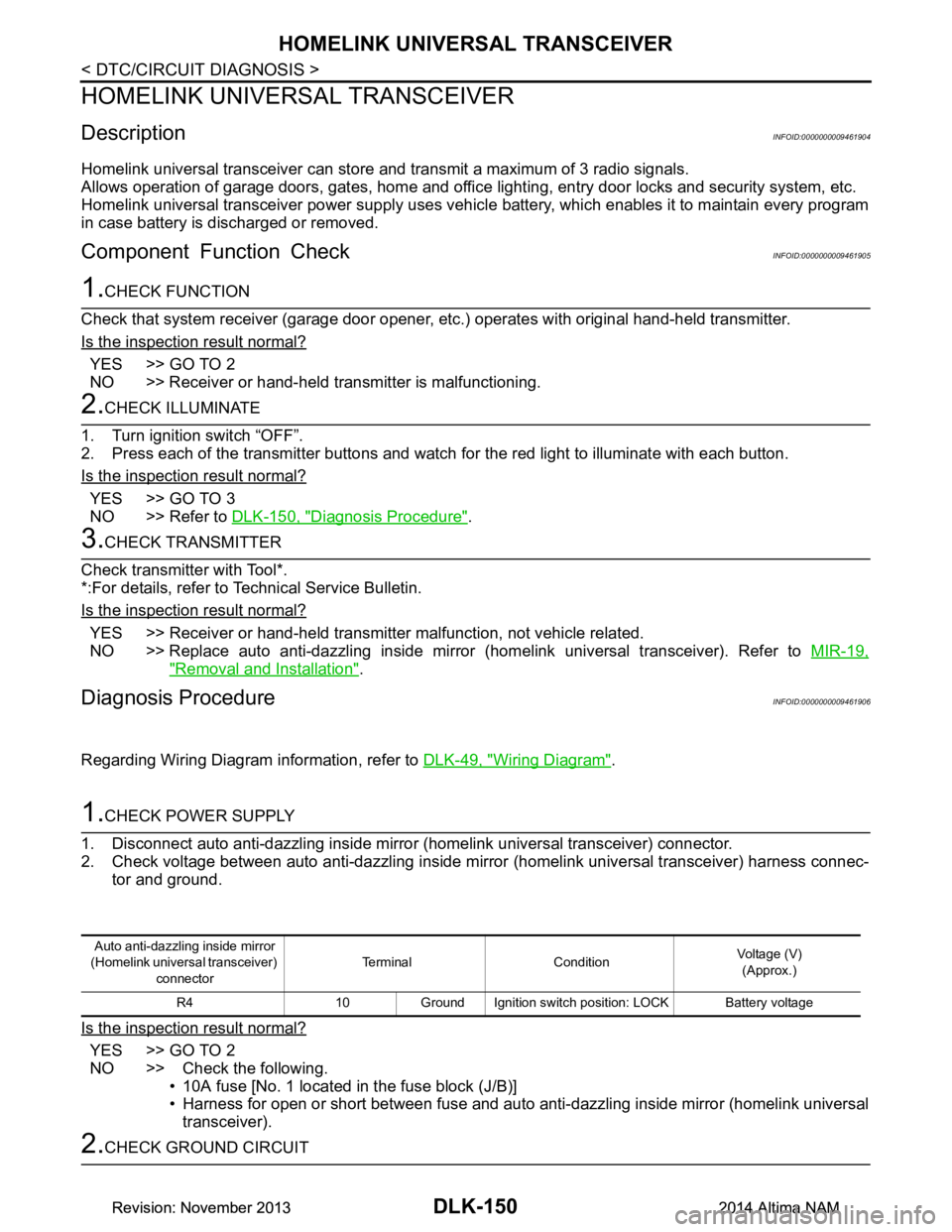
Auto anti-dazzling inside mirror
(Homelink universal transceiver) connector Terminal Condition
Voltage (V)
(Approx.)
R4 10 Ground Ignition switch position: LOCK Battery voltage
Revision: November 20132014 Altima NAMRevision: November 20132014 Altima NAM
Page 932 of 4801
DLK-164
< SYMPTOM DIAGNOSIS >
SQUEAK AND RATTLE TROUBLE DIAGNOSES
SQUEAK AND RATTLE TROUBLE DIAGNOSES
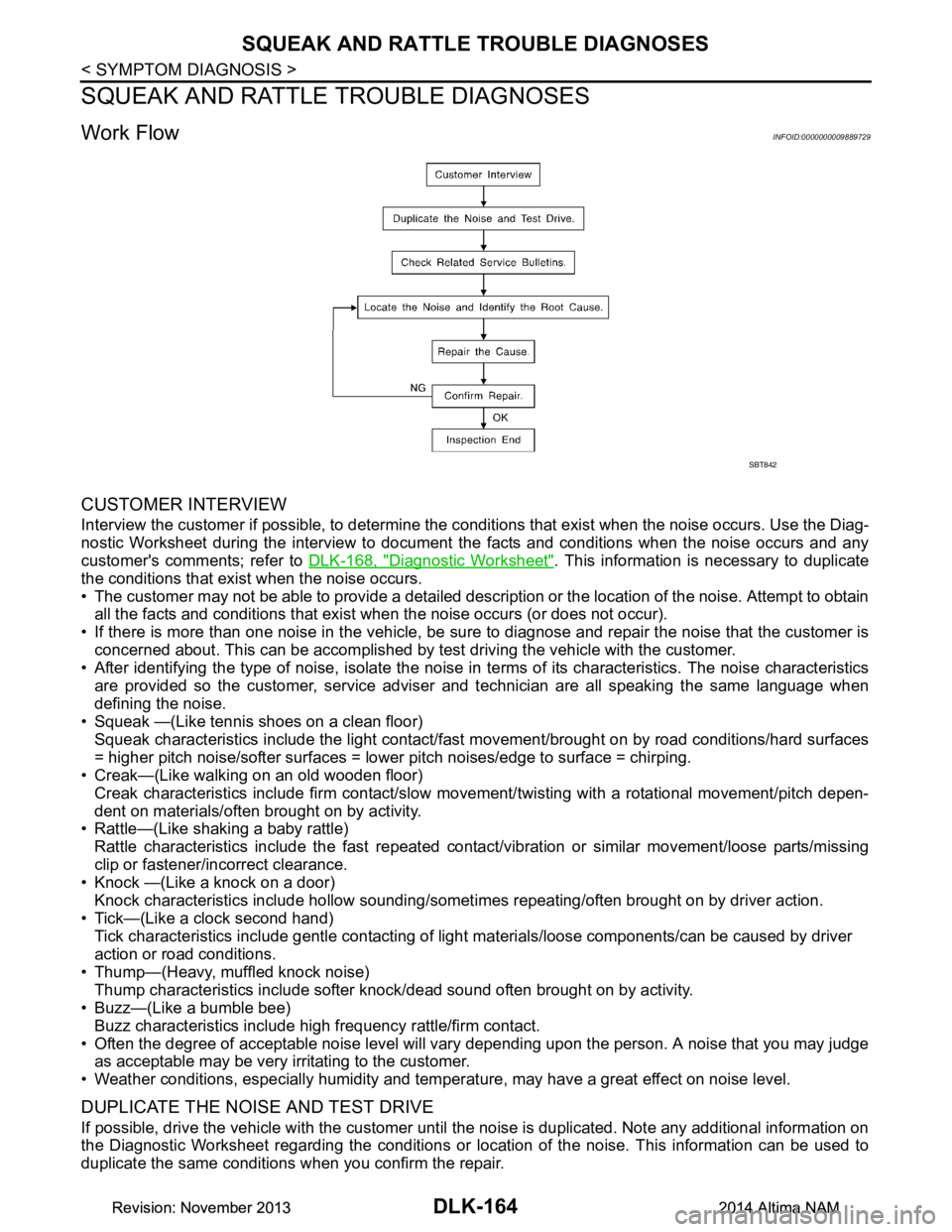
Work FlowINFOID:0000000009889729
CUSTOMER INTERVIEW
Interview the customer if possible, to determine the conditions that exist when the noise occurs. Use the Diag-
nostic Worksheet during the interview to document the facts and conditions when the noise occurs and any
customer's comments; refer to DLK-168, "Diagnostic Worksheet"
. This information is necessary to duplicate
the conditions that exist when the noise occurs.
• The customer may not be able to provide a detailed description or the location of the noise. Attempt to obtain all the facts and conditions that exist w hen the noise occurs (or does not occur).
• If there is more than one noise in the vehicle, be sure to diagnose and repair the noise that the customer is
concerned about. This can be accomplished by test driving the vehicle with the customer.
• After identifying the type of noise, isolate the noise in terms of its characteristics. The noise characteristics
are provided so the customer, service adviser and technician are all speaking the same language when
defining the noise.
• Squeak —(Like tennis shoes on a clean floor)
Squeak characteristics include the light contact/fast movement/brought on by road conditions/hard surfaces
= higher pitch noise/softer surfaces = lower pitch noises/edge to surface = chirping.
• Creak—(Like walking on an old wooden floor)
Creak characteristics include firm contact/slow mo vement/twisting with a rotational movement/pitch depen-
dent on materials/often brought on by activity.
• Rattle—(Like shaking a baby rattle)
Rattle characteristics include the fast repeated contac t/vibration or similar movement/loose parts/missing
clip or fastener/incorrect clearance.
• Knock —(Like a knock on a door)
Knock characteristics include hollow sounding/someti mes repeating/often brought on by driver action.
• Tick—(Like a clock second hand) Tick characteristics include gentle contacting of light materials/loose components/can be caused by driver
action or road conditions.
• Thump—(Heavy, muffled knock noise) Thump characteristics include softer k nock/dead sound often brought on by activity.
• Buzz—(Like a bumble bee)
Buzz characteristics include hi gh frequency rattle/firm contact.
• Often the degree of acceptable noise level will vary depending upon the person. A noise that you may judge as acceptable may be very irritating to the customer.
• Weather conditions, especially humidity and temperat ure, may have a great effect on noise level.
DUPLICATE THE NOISE AND TEST DRIVE
If possible, drive the vehicle with the customer until the noise is duplicated. Note any additional information on
the Diagnostic Worksheet regarding the conditions or lo cation of the noise. This information can be used to
duplicate the same conditions when you confirm the repair.
SBT842
Revision: November 20132014 Altima NAMRevision: November 20132014 Altima NAM
Page 934 of 4801

DLK-166
< SYMPTOM DIAGNOSIS >
SQUEAK AND RATTLE TROUBLE DIAGNOSES
1. Cluster lid A and the instrument panel
2. Acrylic lens and combination meter housing
3. Instrument panel to front pillar finisher
4. Instrument panel to windshield
5. Instrument panel pins
6. Wiring harnesses behind the combination meter
7. A/C defroster duct and duct joint
These incidents can usually be located by tapping or moving the components to duplicate the noise or by
pressing on the components while driving to stop the noise. Most of these incidents can be repaired by apply-
ing felt cloth tape or silicone spray (in hard to reach areas). Urethane pads can be used to insulate wiring har-
ness.
CAUTION:
Do not use silicone spray to isolate a squeak or ra ttle. If you saturate the area with silicone, you will
not be able to recheck the repair.
CENTER CONSOLE
Components to pay attention to include:
1. Shift selector assembly cover to finisher
2. A/C control unit and cluster lid C
3. Wiring harnesses behind audio and A/C control unit
The instrument panel repair and isolation pr ocedures also apply to the center console.
DOORS
Pay attention to the:
1. Finisher and inner panel making a slapping noise
2. Inside handle escutcheon to door finisher
3. Wiring harnesses tapping
4. Door striker out of alignment causing a popping noise on starts and stops
Tapping or moving the components or pressing on them wh ile driving to duplicate the conditions can isolate
many of these incidents. You can usually insulate the areas with felt cloth tape or insulator foam blocks from
the NISSAN Squeak and Rattle Kit (J-50397) to repair the noise.
TRUNK
Trunk noises are often caused by a loose jack or loose items put into the trunk by the owner.
In addition look for:
1. Trunk lid bumpers out of adjustment
2. Trunk lid striker out of adjustment
3. The trunk lid torsion bars knocking together
4. A loose license plate or bracket
Most of these incidents can be repaired by adjusting, se curing or insulating the item(s) or component(s) caus-
ing the noise.
SUNROOF/HEADLINING
Noises in the sunroof/headlining area c an often be traced to one of the following:
1. Sunroof lid, rail, linkage or seals making a rattle or light knocking noise
2. Sun visor shaft shaking in the holder
3. Front or rear windshield touching headlining and squeaking
Again, pressing on the components to stop the noise while duplicating the conditions can isolate most of these
incidents. Repairs usually consist of insulating with felt cloth tape.
OVERHEAD CONSOLE (FRONT AND REAR)
Overhead console noises are often caused by the c onsole panel clips not being engaged correctly. Most of
these incidents are repaired by pushing up on the c onsole at the clip locations until the clips engage.
In addition look for:
1. Loose harness or harness connectors.
2. Front console map/reading lamp lens loose.
Revision: November 20132014 Altima NAMRevision: November 20132014 Altima NAM
Page 942 of 4801
DLK-174
< REMOVAL AND INSTALLATION >
HOOD
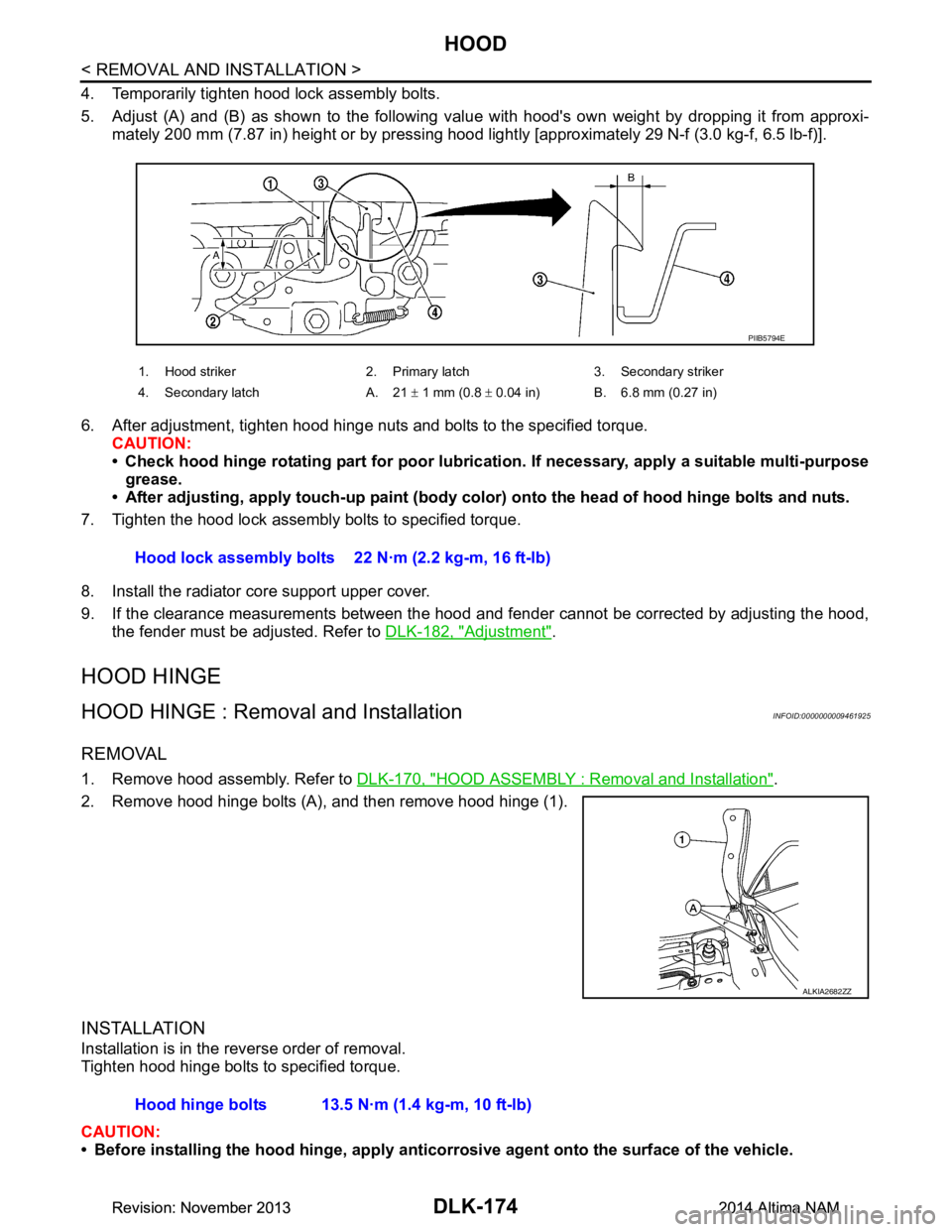
4. Temporarily tighten hood lock assembly bolts.
5. Adjust (A) and (B) as shown to the following val ue with hood's own weight by dropping it from approxi-
mately 200 mm (7.87 in) height or by pressing hood light ly [approximately 29 N-f (3.0 kg-f, 6.5 lb-f)].
6. After adjustment, tighten hood hinge nuts and bolts to the specified torque. CAUTION:
• Check hood hinge rotating part for poor lubrication. If necessary, apply a suitable multi-purpose
grease.
• After adjusting, apply touch-up paint (body color) onto the head of hood hinge bolts and nuts.
7. Tighten the hood lock assembly bolts to specified torque.
8. Install the radiator core support upper cover.
9. If the clearance measurements between the hood and fender cannot be corrected by adjusting the hood,
the fender must be adjusted. Refer to DLK-182, "Adjustment"
.
HOOD HINGE
HOOD HINGE : Removal and InstallationINFOID:0000000009461925
REMOVAL
1. Remove hood assembly. Refer to DLK-170, "HOOD ASSEMBLY : Removal and Installation".
2. Remove hood hinge bolts (A), and then remove hood hinge (1).
INSTALLATION
Installation is in the reverse order of removal.
Tighten hood hinge bolts to specified torque.
CAUTION:
• Before installing the hood hinge, apply anticorrosive agent onto the surface of the vehicle.
1. Hood striker 2. Primary latch 3. Secondary striker
4. Secondary latch A. 21 ± 1 mm (0.8 ± 0.04 in) B. 6.8 mm (0.27 in)
PIIB5794E
Hood lock assembly bolts 22 N·m (2.2 kg-m, 16 ft-lb)
ALKIA2682ZZ
Hood hinge bolts 13.5 N·m (1.4 kg-m, 10 ft-lb)
Revision: November 20132014 Altima NAMRevision: November 20132014 Altima NAM
Page 977 of 4801
TRUNK LIDDLK-209
< REMOVAL AND INSTALLATION >
C
D E
F
G H
I
J
L
M A
B
DLK
N
O P
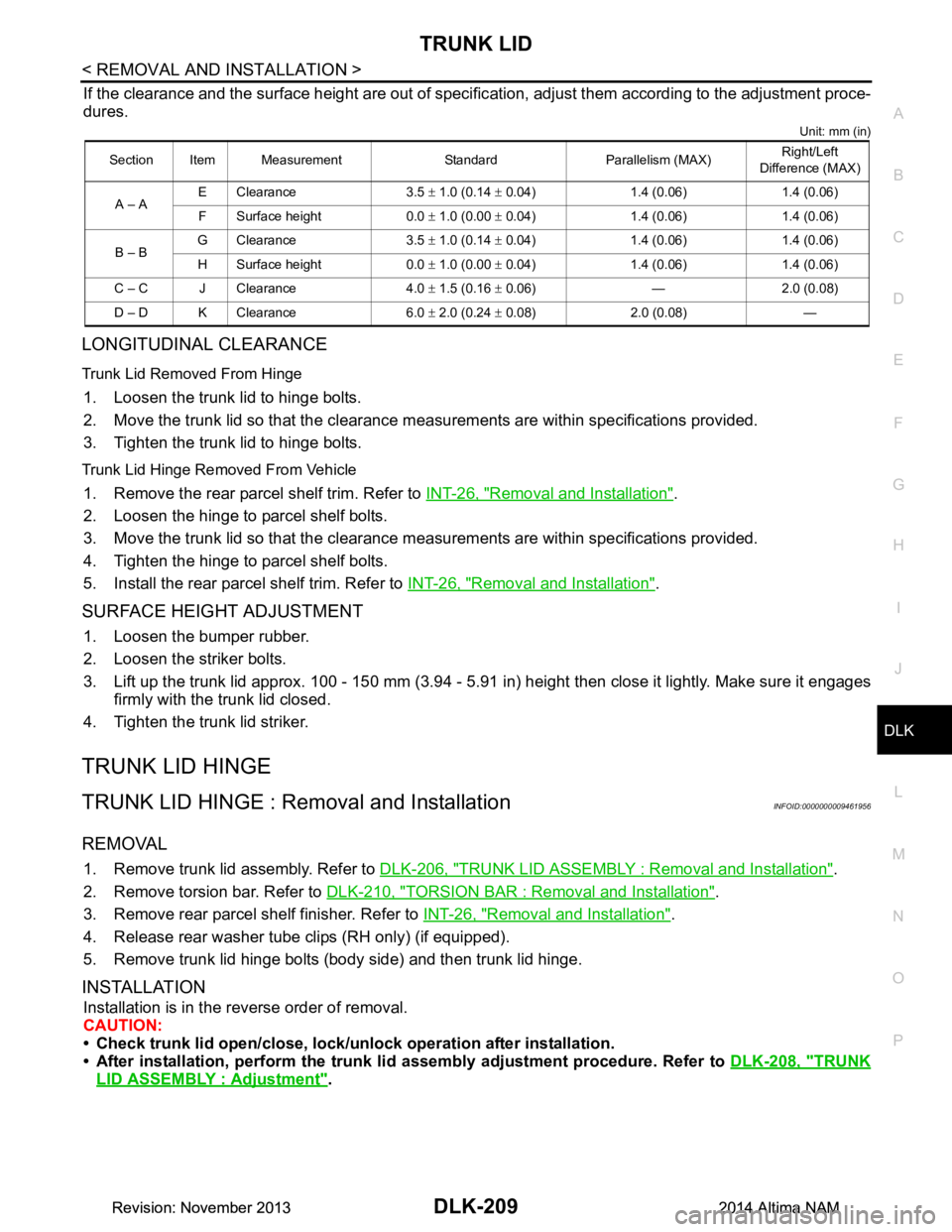
If the clearance and the surface height are out of specific ation, adjust them according to the adjustment proce-
dures.
Unit: mm (in)
LONGITUDINAL CLEARANCE
Trunk Lid Removed From Hinge
1. Loosen the trunk lid to hinge bolts.
2. Move the trunk lid so that the clearance m easurements are within specifications provided.
3. Tighten the trunk lid to hinge bolts.
Trunk Lid Hinge Removed From Vehicle
1. Remove the rear parcel shelf trim. Refer to INT-26, "Removal and Installation".
2. Loosen the hinge to parcel shelf bolts.
3. Move the trunk lid so that the clearance m easurements are within specifications provided.
4. Tighten the hinge to parcel shelf bolts.
5. Install the rear parcel shelf trim. Refer to INT-26, "Removal and Installation"
.
SURFACE HEIGHT ADJUSTMENT
1. Loosen the bumper rubber.
2. Loosen the striker bolts.
3. Lift up the trunk lid approx. 100 - 150 mm (3.94 - 5.91 in) height then close it lightly. Make sure it engages
firmly with the trunk lid closed.
4. Tighten the trunk lid striker.
TRUNK LID HINGE
TRUNK LID HINGE : Remo val and InstallationINFOID:0000000009461956
REMOVAL
1. Remove trunk lid assembly. Refer to DLK-206, "TRUNK LID ASSEMBLY : Removal and Installation".
2. Remove torsion bar. Refer to DLK-210, "TORSION BAR : Removal and Installation"
.
3. Remove rear parcel shelf finisher. Refer to INT-26, "Removal and Installation"
.
4. Release rear washer tube clips (RH only) (if equipped).
5. Remove trunk lid hinge bolts (body side) and then trunk lid hinge.
INSTALLATION
Installation is in the reverse order of removal.
CAUTION:
• Check trunk lid open/close, lock/un lock operation after installation.
• After installation, perform the trunk li d assembly adjustment procedure. Refer to DLK-208, "TRUNK
LID ASSEMBLY : Adjustment".
Section Item Measurement Standard Parallelism (MAX) Right/Left
Difference (MAX)
A – A E Clearance 3.5
± 1.0 (0.14 ± 0.04) 1.4 (0.06) 1.4 (0.06)
F Surface height 0.0 ± 1.0 (0.00 ± 0.04) 1.4 (0.06) 1.4 (0.06)
B – B G Clearance 3.5
± 1.0 (0.14 ± 0.04) 1.4 (0.06) 1.4 (0.06)
H Surface height 0.0 ± 1.0 (0.00 ± 0.04) 1.4 (0.06) 1.4 (0.06)
C – C J Clearance 4.0 ± 1.5 (0.16 ± 0.06) — 2.0 (0.08)
D – D K Clearance 6.0 ± 2.0 (0.24 ± 0.08) 2.0 (0.08) —
Revision: November 20132014 Altima NAMRevision: November 20132014 Altima NAM
Page 1015 of 4801
![NISSAN TEANA 2014 Repair Manual
PRECAUTIONSEC-15
< PRECAUTION > [QR25DE]
C
D E
F
G H
I
J
K L
M A
EC
NP
O
PRECAUTION
PRECAUTIONS
Precaution for Supplemental
Restraint System (SRS) "AIR BAG" and "SEAT BELT
PRE-TENSIONER"
INFOID:00](/img/5/57390/w960_57390-1014.png "NISSAN TEANA 2014 Repair Manual
PRECAUTIONSEC-15
< PRECAUTION > [QR25DE]
C
D E
F
G H
I
J
K L
M A
EC
NP
O
PRECAUTION
PRECAUTIONS
Precaution for Supplemental
Restraint System (SRS) \"AIR BAG\" and \"SEAT BELT
PRE-TENSIONER\"
INFOID:00")
PRECAUTIONSEC-15
< PRECAUTION > [QR25DE]
C
D E
F
G H
I
J
K L
M A
EC
NP
O
PRECAUTION
PRECAUTIONS
Precaution for Supplemental
Restraint System (SRS) "AIR BAG" and "SEAT BELT
PRE-TENSIONER"
INFOID:0000000009951805
The Supplemental Restraint System such as “A IR BAG” and “SEAT BELT PRE-TENSIONER”, used along
with a front seat belt, helps to reduce the risk or severi ty of injury to the driver and front passenger for certain
types of collision. Information necessary to service t he system safely is included in the SR and SB section of
this Service Manual.
WARNING:
• To avoid rendering the SRS inoper ative, which could increase the risk of personal injury or death in
the event of a collision which would result in air bag inflation, all maintenance must be performed by
an authorized NISSAN/INFINITI dealer.
• Improper maintenance, including in correct removal and installation of the SRS, can lead to personal
injury caused by unintentional act ivation of the system. For removal of Spiral Cable and Air Bag
Module, see the SR section.
• Do not use electrical test equipm ent on any circuit related to the SRS unless instructed to in this
Service Manual. SRS wiring harnesses can be identi fied by yellow and/or orange harnesses or har-
ness connectors.
PRECAUTIONS WHEN USING POWER TOOLS (AIR OR ELECTRIC) AND HAMMERS
WARNING:
• When working near the Airbag Diagnosis Sensor Un it or other Airbag System sensors with the Igni-
tion ON or engine running, DO NOT use air or el ectric power tools or strike near the sensor(s) with a
hammer. Heavy vibration could activate the sensor( s) and deploy the air bag(s), possibly causing
serious injury.
• When using air or electric power tools or hammers , always switch the Ignition OFF, disconnect the
battery and wait at least three mi nutes before performing any service.
Precaution for Procedure without Cowl Top CoverINFOID:0000000009462048
When performing the procedure after removing cowl top cover, cover
the lower end of windshield with urethane, etc to prevent damage to
windshield.
On Board Diagnostic (OBD) S ystem of Engine and CVTINFOID:0000000009462049
The ECM has an on board diagnostic system . It will light up the malfunction indicator lamp (MIL) to warn the
driver of a malfunction causing emission deterioration.
CAUTION:
• Be sure to turn the ignition switch OFF and di sconnect the negative battery cable before any repair
or inspection work. The open/short circuit of re lated switches, sensors, solenoid valves, etc. will
cause the MIL to light up.
• Be sure to connect and lock the connectors secure ly after work. A loose (unlocked) connector will
cause the MIL to light up due to the open circuit. (Be sure the connector is free from water, grease,
dirt, bent terminals, etc.)
• Certain systems and components, especially those related to OBD, may use a new style slide-lock-
ing type harness connector. For descripti on and how to disconnect, refer to PG-65, "Description"
.
• Be sure to route and secure the harnesses properly after work. The interference of the harness with
a bracket, etc. may cause the MIL to li ght up due to the short circuit.
PIIB3706J
Revision: November 20132014 Altima NAMRevision: November 20132014 Altima NAM
Page 1016 of 4801
![NISSAN TEANA 2014 Repair Manual
EC-16
< PRECAUTION >[QR25DE]
PRECAUTIONS
• Be sure to connect rubber tubes properly afte
r work. A misconnected or disconnected rubber tube
may cause the MIL to light up due to the malfunction of](/img/5/57390/w960_57390-1015.png "NISSAN TEANA 2014 Repair Manual
EC-16
< PRECAUTION >[QR25DE]
PRECAUTIONS
• Be sure to connect rubber tubes properly afte
r work. A misconnected or disconnected rubber tube
may cause the MIL to light up due to the malfunction of")
EC-16
< PRECAUTION >[QR25DE]
PRECAUTIONS
• Be sure to connect rubber tubes properly afte
r work. A misconnected or disconnected rubber tube
may cause the MIL to light up due to the malfunction of the EVAP system or fuel injection system,
etc.
• Be sure to erase the unnecessary malfunction info rmation (repairs completed) from the ECM and
TCM (Transmission control module) before returning the vehicle to the customer.
General PrecautionsINFOID:0000000009462050
•Always use a 12 volt battery as power source.
• Do not attempt to disconnect battery cables while engine is
running.
• Before connecting or disconnecting the ECM harness con-
nector, turn ignition switch OFF and disconnect negative bat-
tery cable. Failure to do so may damage the ECM because
battery voltage is applied to ECM even if ignition switch is
turned OFF.
• Before removing parts, turn ig nition switch OFF and then dis-
connect battery ground cable.
• Do not disassemble ECM.
• If a battery cable is disconnected, the memory will return to
the ECM value.
The ECM will now start to self-control at its initial value.
Engine operation can vary slight ly when the terminal is dis-
connected. However, this is no t an indication of a malfunc-
tion. Do not replace parts b ecause of a slight variation.
• If the battery is disconnected, the following emission-related
diagnostic information will be lost within 24 hours.
- Diagnostic trouble codes
- 1st trip diagnostic trouble codes
- Freeze frame data
- 1st trip freeze frame data
- System readiness test (SRT) codes
- Test values
• When connecting or disconnect ing pin connectors into or
from ECM, take care not to damage pin terminals (bend or
break).
Make sure that there are not any bends or breaks on ECM pin
terminal, when connecting pin connectors.
• Securely connect ECM harness connectors.
A poor connection can cause an extremely high (surge) volt-
age to develop in coil and co ndenser, thus resulting in dam-
age to ICs.
• Keep engine control system harness at least 10 cm (4 in) away
from adjacent harness, to preven t engine control system mal-
functions due to receiving exter nal noise, degraded operation
of ICs, etc.
• Keep engine control system parts and harness dry.
• Before replacing ECM, perform ECM Terminals and Reference
Value inspection and make sure ECM functions properly.
Refer to EC-88, "Reference Value"
.
• Handle mass air flow sensor carefully to avoid damage.
• Do not clean mass air flow senso r with any type of detergent.
• Do not disassemble electric throttle control actuator.
• Even a slight leak in the ai r intake system can cause serious
incidents.
• Do not shock or jar the camshaft position sensor (PHASE),
crankshaft position sensor (POS).
SEF289H
PBIA9222J
PBIB0090E
MEF040D
Revision: November 20132014 Altima NAMRevision: November 20132014 Altima NAM
Page 1041 of 4801
![NISSAN TEANA 2014 Repair Manual
SYSTEMEC-41
< SYSTEM DESCRIPTION > [QR25DE]
C
D E
F
G H
I
J
K L
M A
EC
NP
O
ECM controls the engine by various functions.
ENGINE CONTROL SYSTEM : Fail SafeINFOID:0000000009462092
NON DTC RELATED ITE](/img/5/57390/w960_57390-1040.png "NISSAN TEANA 2014 Repair Manual
SYSTEMEC-41
< SYSTEM DESCRIPTION > [QR25DE]
C
D E
F
G H
I
J
K L
M A
EC
NP
O
ECM controls the engine by various functions.
ENGINE CONTROL SYSTEM : Fail SafeINFOID:0000000009462092
NON DTC RELATED ITE")
SYSTEMEC-41
< SYSTEM DESCRIPTION > [QR25DE]
C
D E
F
G H
I
J
K L
M A
EC
NP
O
ECM controls the engine by various functions.
ENGINE CONTROL SYSTEM : Fail SafeINFOID:0000000009462092
NON DTC RELATED ITEM
DTC RELATED ITEM
Description
When a DTC is detected, ECM executes a mode (in the
Fail-safe mode) applicable to the DTC. The fail-safe
mode has the preset traveling control mode (accelera tor angle variation and engine output limit) and device fix
mode.
Function Reference
Multiport fuel injection system EC-43, "MULTIPORT FUEL INJECTION SYSTEM : System De-
scription (with automatic air conditioner)"
Electric ignition system
EC-48, "ELECTRIC IGNITION SYSTEM : System Description"
Intake valve timing control EC-49, "INTAKE VALVE TIMING CONTROL : System Description"
Exhaust valve timing control EC-52, "EXHAUST VALVE TIMING
CONTROL : System Descrip-tion"
Intake manifold runner control EC-53, "INTAKE MANIFOLD RUNNER CONTROL : System De-scription"
Intake manifold tuning system
EC-54, "INTAKE MANIFOLD TUNI
NG SYSTEM : System Descrip-tion"
Engine protection control EC-55, "ENGINE PROTECTION CONTROL AT LOW ENGINE OIL PRESSURE : System Description"
Fuel filler cap warning systemEC-56, "FUEL FILLER CAP WARNING SYSTEM : System De-scription"
Air conditioning cut control
EC-56, "AIR CONDITIONING CUT CONTROL : System Descrip-tion (with automatic air conditioner)"
Cooling fan controlEC-59, "COOLING FAN CONTROL :
System Description (with au-tomatic air conditioner)"
Evaporative emission system EC-62, "EVAPORATIVE EMISSION
SYSTEM : System Descrip-tion"
Automatic speed control device (ASCD) EC-63, "AUTOMATIC SPEED CONTROL DEVICE (ASCD) : Sys-tem Description"
CAN communication
EC-64, "CAN COMMUNICATION : System Description"
Detected
items Engine operating condition
in fail-safe mode Remarks Reference page
Malfunction
indicator
lamp circuit Engine speed will not rise
more than 2,500 rpm due
to the fuel cut When there is an open circuit on MIL circuit, the ECM cannot warn the
driver by lighting up MIL when there is malfunction on engine control
system.
Therefore, when electrical controlled throttle and part of ECM related
diagnoses are continuously detected as NG for 5 trips, ECM warns the
driver that engine control system malfunctions and MIL circuit is open
by means of operating fail safe function.
The fail safe function also operates when above diagnoses except MIL
circuit are detected and demands the driver to repair the malfunction. EC-517, "Compo-
nent Function
Check"
Revision: November 20132014 Altima NAMRevision: November 20132014 Altima NAM
Page 1064 of 4801
![NISSAN TEANA 2014 Repair Manual
EC-64
< SYSTEM DESCRIPTION >[QR25DE]
SYSTEM
The ASCD operation status is indicated by two indica
tors (CRUISE and SET on the information display) on the
combination meter. If any malfunction occurs i](/img/5/57390/w960_57390-1063.png "NISSAN TEANA 2014 Repair Manual
EC-64
< SYSTEM DESCRIPTION >[QR25DE]
SYSTEM
The ASCD operation status is indicated by two indica
tors (CRUISE and SET on the information display) on the
combination meter. If any malfunction occurs i")
EC-64
< SYSTEM DESCRIPTION >[QR25DE]
SYSTEM
The ASCD operation status is indicated by two indica
tors (CRUISE and SET on the information display) on the
combination meter. If any malfunction occurs in AS CD system, SET indicator blinks and ASCD control is deac-
tivated.
NOTE:
Always drive vehicle in safe manner according to traffic conditions and obey all traffic laws.
SET OPERATION
Press MAIN switch. (CRUISE is indicated on the information display.)
When vehicle speed reaches a desired speed between approximately 40 km/h (25 MPH) and 144 km/h (89
MPH), press SET/COAST switch. (Then SET is indicated on the information display.)
ACCELERATE OPERATION
If the RESUME/ACCELERATE switch is pressed during cruise control driving, increase the vehicle speed until
the switch is released or vehicle speed r eaches maximum speed controlled by the system.
And then ASCD will keep the new set speed.
CANCEL OPERATION
When any of following conditions exist, cruise operation will be canceled.
• CANCEL switch is pressed
• More than 2 switches at ASCD steering switch are pressed at the same time (Set speed will be cleared)
• Brake pedal is depressed
• Selector lever is changed to N, P, R position
• Vehicle speed decreased to 13 km/h (8 MPH) lower than the set speed
• TCS system is operated
When the ECM detects any of the following conditions , the ECM will cancel the cruise operation and inform
the driver by blinking indicators.
• Engine coolant temperature is slightly higher than t he normal operating temperature, CRUISE indicator may
blink slowly.
When the engine coolant temperature decreases to the normal operating temperature, CRUISE indicator will
stop blinking and the cruise operation will be able to wo rk by pressing SET/COAST switch or RESUME/
ACCELERATE switch.
• Malfunction for some self-diagnoses regarding AS CD control: SET indicator will blink quickly.
If MAIN switch is turned to OFF during ASCD is acti vated, all of ASCD operations will be canceled and vehicle
speed memory will be erased.
COAST OPERATION
When the SET/COAST switch is press ed during cruise control driving, decrease vehicle set speed until the
switch is released. And then ASCD will keep the new set speed.
RESUME OPERATION
When the RESUME/ACCELERATE switch is pressed after cancel operation other than pressing MAIN switch
is performed, vehicle speed will return to last set s peed. To resume vehicle set speed, vehicle condition must
meet following conditions.
• Brake pedal is released
• Selector lever is in other than P and N positions
• Vehicle speed is greater than 40 km/h (25 MPH) and less than 144 km/h (89 MPH)
CAN COMMUNICATION
CAN COMMUNICATION : System DescriptionINFOID:0000000009462108
CAN (Controller Area Network) is a serial communication line for real time application. It is an on-vehicle mul-
tiplex communication line with high data communication s peed and excellent error detection ability. Many elec-
tronic control units are equipped onto a vehicle, and each control unit shares information and links with other
control units during operation (not independent). In CA N communication, control units are connected with 2
communication lines (CAN H line, CAN L line) allowing a high rate of information transmission with less wiring.
Each control unit transmits/receives data but selectively reads required data only.
Refer to LAN-32, "CAN COMMUNICA TION SYSTEM : CAN Communication Signal Chart"
, about CAN com-
munication for detail.
Revision: November 20132014 Altima NAMRevision: November 20132014 Altima NAM
Page 1067 of 4801
![NISSAN TEANA 2014 Repair Manual
DIAGNOSIS SYSTEM (ECM)EC-67
< SYSTEM DESCRIPTION > [QR25DE]
C
D E
F
G H
I
J
K L
M A
EC
NP
O
DIAGNOSIS SYSTEM (ECM)
DIAGNOSIS DESCRIPTION
DIAGNOSIS DESCRIPTION : 1s
t Trip Detection Logic and Two Tri](/img/5/57390/w960_57390-1066.png "NISSAN TEANA 2014 Repair Manual
DIAGNOSIS SYSTEM (ECM)EC-67
< SYSTEM DESCRIPTION > [QR25DE]
C
D E
F
G H
I
J
K L
M A
EC
NP
O
DIAGNOSIS SYSTEM (ECM)
DIAGNOSIS DESCRIPTION
DIAGNOSIS DESCRIPTION : 1s
t Trip Detection Logic and Two Tri")
DIAGNOSIS SYSTEM (ECM)EC-67
< SYSTEM DESCRIPTION > [QR25DE]
C
D E
F
G H
I
J
K L
M A
EC
NP
O
DIAGNOSIS SYSTEM (ECM)
DIAGNOSIS DESCRIPTION
DIAGNOSIS DESCRIPTION : 1s
t Trip Detection Logic and Two Trip Detection Logic
INFOID:0000000009462112
When a malfunction is detected for the first time, 1st tr ip DTC and 1st trip Freeze Frame data are stored in the
ECM memory. The MIL will not illuminate at this stage. <1st trip>
If the same malfunction is detected again during the next drive, the DTC and Freeze Frame data are stored in
the ECM memory, and the MIL illuminates. The MIL illu minates at the same time when the DTC is stored.
<2nd trip> The “trip” in the “Two Trip Detection Logic” means a driving mode in which self-diagnosis is per-
formed during vehicle operation. Specific on board diagnosti c items will cause the ECM to illuminate or blink
the MIL, and store DTC and Freeze Frame data, even in the 1st trip, as shown below.
×: Applicable —: Not applicable
DIAGNOSIS DESCRIPTION : DTC and Freeze Frame DataINFOID:0000000009462113
DTC AND 1ST TRIP DTC
The 1st trip DTC (whose number is the same as the DT C number) is displayed for the latest self-diagnostic
result obtained. If the ECM memory was cleared previously , and the 1st trip DTC did not recur, the 1st trip DTC
will not be displayed.
If a malfunction is detected during the 1st trip, the 1st trip DTC is saved in the ECM memory. The MIL will not
light up (two trip detection logic). If the same malfunc tion is not detected in the 2nd trip (meeting the required
driving pattern), the 1st trip DTC is cleared from the ECM memory. If the same malfunction is detected in the
2nd trip, both the 1st trip DTC and DTC are saved in t he ECM memory and the MIL lights up. In other words,
the DTC is stored in the ECM memory and the MIL light s up when the same malfunction occurs in two consec-
utive trips. If a 1st trip DTC is stored and a non-diagnostic operation is performed between the 1st and 2nd
trips, only the 1st trip DTC will continue to be stored. Fo r malfunctions that blink or light up the MIL during the
1st trip, the DTC and 1st trip DTC are stored in the ECM memory.
For malfunctions in which 1st trip DTCs are displayed, refer to EC-105, "DTC Index"
. These items are
required by legal regulations to c ontinuously monitor the system/component . In addition, the items monitored
non-continuously are also displayed on CONSULT.
1st trip DTC is specified in Service $07 of SAE J1979/ ISO 15031-5. 1st trip DTC detection occurs without illu-
minating the MIL and therefore does not warn the driver of a malfunction.
When a 1st trip DTC is detected, check, print out or write down and erase (1st trip) DTC and Freeze Frame
data as specified in Work Flow procedure Step 2, refer to EC-165, "Work Flow"
. Then perform DTC Confirma-
tion Procedure or Component Function Check to try to duplicate the malfunction. If the malfunction is dupli-
cated, the item requires repair.
FREEZE FRAME DATA AND 1ST TRIP FREEZE FRAME DATA
The ECM records the driving conditions such as fuel system status, calculated load value, engine coolant tem-
perature, short term fuel trim, long term fuel trim, engi ne speed, vehicle speed, absolute throttle position, base
fuel schedule and intake air temperature at the moment a malfunction is detected.
Data which are stored in the ECM memory, along with the 1st trip DTC, are called 1st trip freeze frame data.
The data, stored together with the DTC data, are called freeze frame data and displayed on CONSULT or
GST. The 1st trip freeze frame data c an only be displayed on the CONSULT screen.
Items MIL DTC 1st trip DTC
1st trip 2nd trip 1st trip
displaying 2nd trip
displaying 1st trip
displaying 2nd trip
display- ing
Blinking Illuminat-
ed Blinking Illuminat-
ed
Misfire (Possible three way catalyst
damage) — DTC: P0300 – P0304
is being detected ×
———— — ×—
Misfire (Possible three way catalyst
damage) — DTC: P0300 – P0304
is being detected ——
×—— ×——
One trip detection diagnoses (Re-
fer to EC-105, "DTC Index"
.) —
×—— ×———
Except above — — — ×— ×× —
Revision: November 20132014 Altima NAMRevision: November 20132014 Altima NAM