unit NISSAN TERRANO 2002 Service User Guide
[x] Cancel search | Manufacturer: NISSAN, Model Year: 2002, Model line: TERRANO, Model: NISSAN TERRANO 2002Pages: 1767, PDF Size: 41.51 MB
Page 180 of 1767
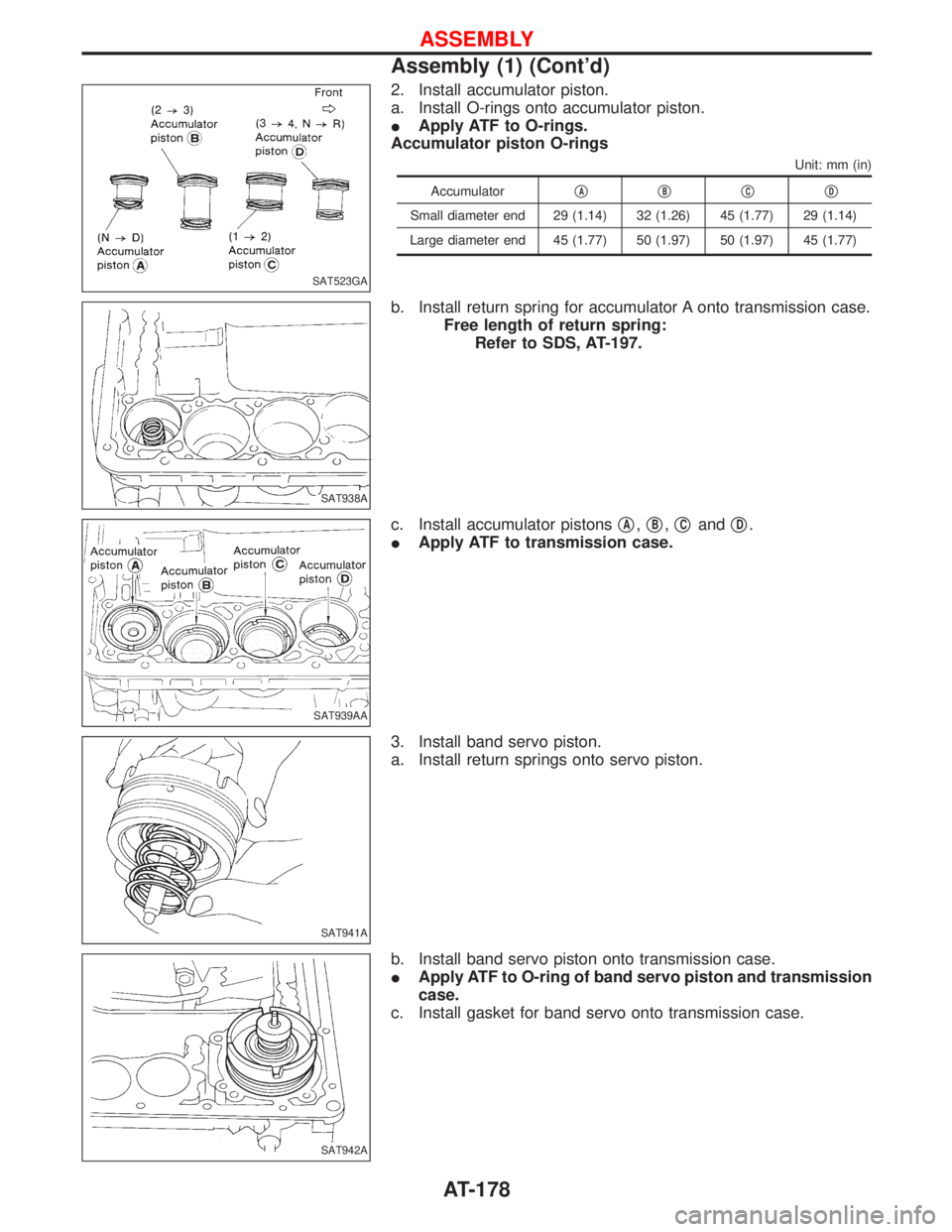
2. Install accumulator piston.
a. Install O-rings onto accumulator piston.
IApply ATF to O-rings.
Accumulator piston O-rings
Unit: mm (in)
AccumulatorqAqBqCqD
Small diameter end 29 (1.14) 32 (1.26) 45 (1.77) 29 (1.14)
Large diameter end 45 (1.77) 50 (1.97) 50 (1.97) 45 (1.77)
b. Install return spring for accumulator A onto transmission case.
Free length of return spring:
Refer to SDS, AT-197.
c. Install accumulator pistonsq
A,qB,qCandqD.
IApply ATF to transmission case.
3. Install band servo piston.
a. Install return springs onto servo piston.
b. Install band servo piston onto transmission case.
IApply ATF to O-ring of band servo piston and transmission
case.
c. Install gasket for band servo onto transmission case.
SAT523GA
SAT938A
SAT939AA
SAT941A
SAT942A
ASSEMBLY
Assembly (1) (Cont'd)
AT-178
Page 182 of 1767
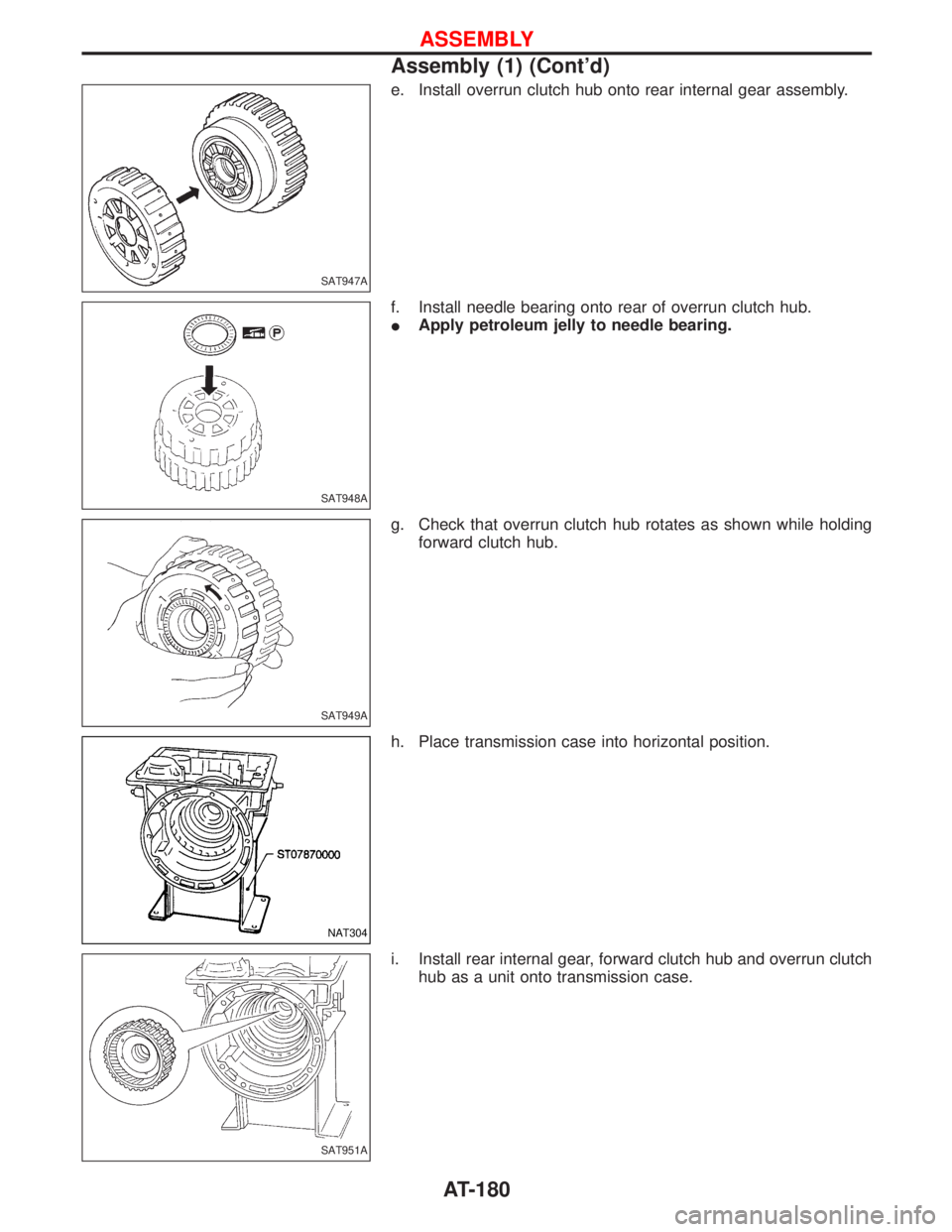
e. Install overrun clutch hub onto rear internal gear assembly.
f. Install needle bearing onto rear of overrun clutch hub.
IApply petroleum jelly to needle bearing.
g. Check that overrun clutch hub rotates as shown while holding
forward clutch hub.
h. Place transmission case into horizontal position.
i. Install rear internal gear, forward clutch hub and overrun clutch
hub as a unit onto transmission case.
SAT947A
SAT948A
SAT949A
NAT304
SAT951A
ASSEMBLY
Assembly (1) (Cont'd)
AT-180
Page 197 of 1767
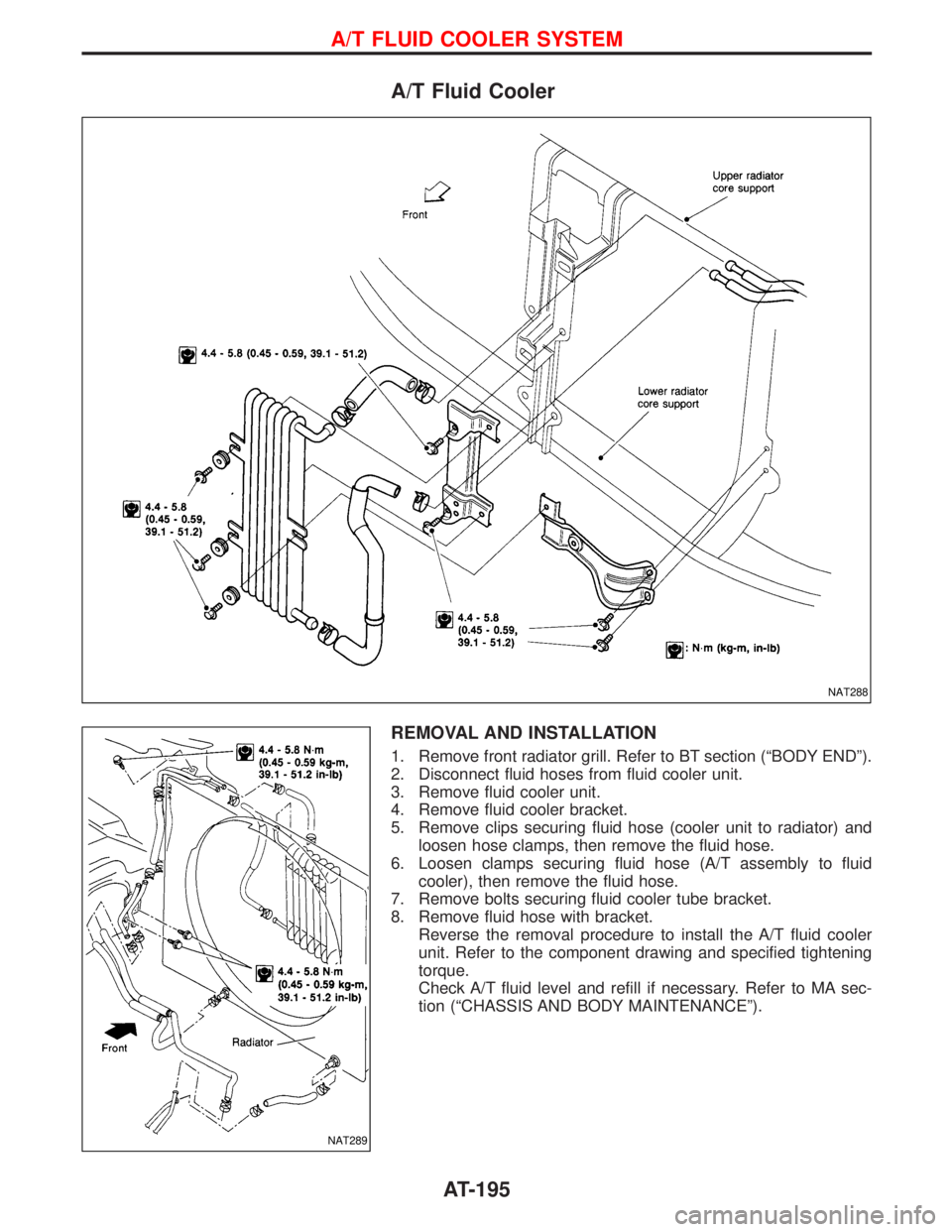
A/T Fluid Cooler
REMOVAL AND INSTALLATION
1. Remove front radiator grill. Refer to BT section (ªBODY ENDº).
2. Disconnect fluid hoses from fluid cooler unit.
3. Remove fluid cooler unit.
4. Remove fluid cooler bracket.
5. Remove clips securing fluid hose (cooler unit to radiator) and
loosen hose clamps, then remove the fluid hose.
6. Loosen clamps securing fluid hose (A/T assembly to fluid
cooler), then remove the fluid hose.
7. Remove bolts securing fluid cooler tube bracket.
8. Remove fluid hose with bracket.
Reverse the removal procedure to install the A/T fluid cooler
unit. Refer to the component drawing and specified tightening
torque.
Check A/T fluid level and refill if necessary. Refer to MA sec-
tion (ªCHASSIS AND BODY MAINTENANCEº).
NAT288
NAT289
A/T FLUID COOLER SYSTEM
AT-195
Page 199 of 1767

RETURN SPRINGSUnit: mm (in)
PartsItem
Part No. Free length Outer diameter
Control
valveUpper
bodyTorque converter relief valve
springq
131742-41X23 38.0 (1.496) 9.0 (0.354)
Pressure regulator valve
springq
231742-41X24 44.02 (1.7331) 14.0 (0.551)
Pressure modifier valve
springq
331742-41X19 31.95 (1.2579) 6.8 (0.268)
Accumulator control valve
springÐÐÐÐ
Shuttle shift valve D springq
431762-41X01 25.0 (0.984) 7.0 (0.276)
4-2 sequence valve springq
531756-41X00 29.1 (1.146) 6.95 (0.2736)
Shift valve B springq
631762-41X01 25.0 (0.984) 7.0 (0.276)
4-2 relay valve springq
731756-41X00 29.1 (1.146) 6.95 (0.2736)
Shift valve A springq
831762-41X01 25.0 (0.984) 7.0 (0.276)
Overrun clutch control valve
springq
931762-41X03 23.6 (0.929) 7.0 (0.276)
Overrun clutch reducing
valve springq
1031742-41X20 32.5 (1.280) 7.0 (0.276)
Shuttle shift valve S springq
1131762-41X04 51.0 (2.008) 5.65 (0.2224)
Pilot valve springq
1231742-41X13 25.7 (1.012) 9.0 (0.354)
Torque converter clutch con-
trol valve springq
1331742-41X22 18.5 (0.728) 13.0 (0.512)
Lower
bodyModifier accumulator
piston springq
131742-27X70 31.4 (1.236) 9.8 (0.386)
1st reducing valve springq
231756-41X05 25.4 (1.000) 6.75 (0.2657)
3-2 timing valve springq
331742-41X06 23.0 (0.906) 6.7 (0.264)
Servo charger valve springq
431742-41X06 23.0 (0.906) 6.7 (0.264)
Reverse clutch 16 pcs 31521-41X02 (Assembly) 19.69 (0.7752) 11.6 (0.457)
High clutch 10 pcs 31521-41X03 (Assembly) 24.2 (0.953) 11.6 (0.457)
Forward clutch
(Overrun clutch)20 pcs 32521-41X00 (Assembly) 35.77 (1.4083) 9.7 (0.382)
Low & reverse
brake18 pcs 31655-41X00 (Assembly) 22.3 (0.878) 11.2 (0.441)
Band servoSpringq
A31605-41X05 45.6 (1.795) 34.3 (1.350)
Springq
B31605-41X00 53.8 (2.118) 40.3 (1.587)
Springq
C31605-41X01 29.7 (1.169) 27.6 (1.087)
AccumulatorAccumulatorq
A31605-41X02 43.0 (1.693) 18.0 (0.709)
Accumulatorq
B31605-41X10 66.0 (2.598) 20.0 (0.787)
Accumulatorq
C31605-41X09 45.0 (1.772) 29.3 (1.154)
Accumulatorq
D31605-41X06 58.4 (2.299) 17.3 (0.681)
ACCUMULATOR O-RING
AccumulatorDiameter mm (in)
qAqBqCqD
Small diameter end 29 (1.14) 32 (1.26) 45 (1.77) 29 (1.14)
Large diameter end 45 (1.77) 50 (1.97) 50 (1.97) 45 (1.77)
SERVICE DATA AND SPECIFICATIONS (SDS)
Specifications and Adjustment (Cont'd)
AT-197
Page 204 of 1767
Diagnostic Procedure 2 (Warning lamp stays on
when ignition switch is turned ON)............................69
Diagnostic Procedure 3 (ABS actuator solenoid
valve and solenoid valve relay) .................................71
Diagnostic Procedure 4 (Wheel sensor or rotor) ......73
Diagnostic Procedure 5 (Motor Relay or motor) .......75
Diagnostic Procedure 7 (Low voltage) ......................77
Diagnostic Procedure 8 (G sensor) ...........................78
Diagnostic Procedure 9 (Control unit) .......................79
Diagnostic Procedure 10 (Pedal vibration and
noise) .........................................................................80Diagnostic Procedure 11 (Long stopping
distance) ....................................................................80
Diagnostic Procedure 12 (Unexpected pedal
action) ........................................................................81
Diagnostic Procedure 13 ...........................................82
Diagnostic Procedure 14 ...........................................82
Electrical Components Inspection .............................83
SERVICE DATA AND SPECIFICATIONS (SDS)..........84
General Specifications ...............................................84
Inspection and Adjustment ........................................85
CONTENTS(Cont'd)
BR-2
Page 205 of 1767
Supplement Restraint System (SRS) ªAIR BAGº
and ªSEAT BELT PRE-TENSIONERº
The Supplemental Restraint System ªAir Bagº and ªSeat Belt Pre-tensionerº, used along with a seat belt, help
to reduce the risk or severity or injury to the driver and front passenger in a collision. The Supplemental
Restraint System consists of an air bag module (located in the center of the steering wheel and on the instru-
ment panel on the passenger side, where fitted), seat belt pre-tensioners, a diagnosis sensor unit, warning
lamp, wiring harness and spiral cable. Information necessary to service the system safely is included in the
BT sectionof this Service Manual.
WARNING:
ITo avoid rendering the SRS inoperative (which could increase the risk of personal injury or death
in the event of a collision which would result in air bag inflation), all maintenance must be per-
formed by an authorized NISSAN dealer.
IImproper maintenance, including incorrect removal and installation of the SRS, can lead to per-
sonal injury caused by unintentional activation of the system.
IDo not use electrical test equipment on any circuit related to the SRS unless instructed to in this
Service Manual. SRS wiring harnesses (except ªSEAT BELT-TENSIONERº connector) can be iden-
tified with yellow harness connector and with yellow harness protector or yellow insulation tape
before the harness connectors.
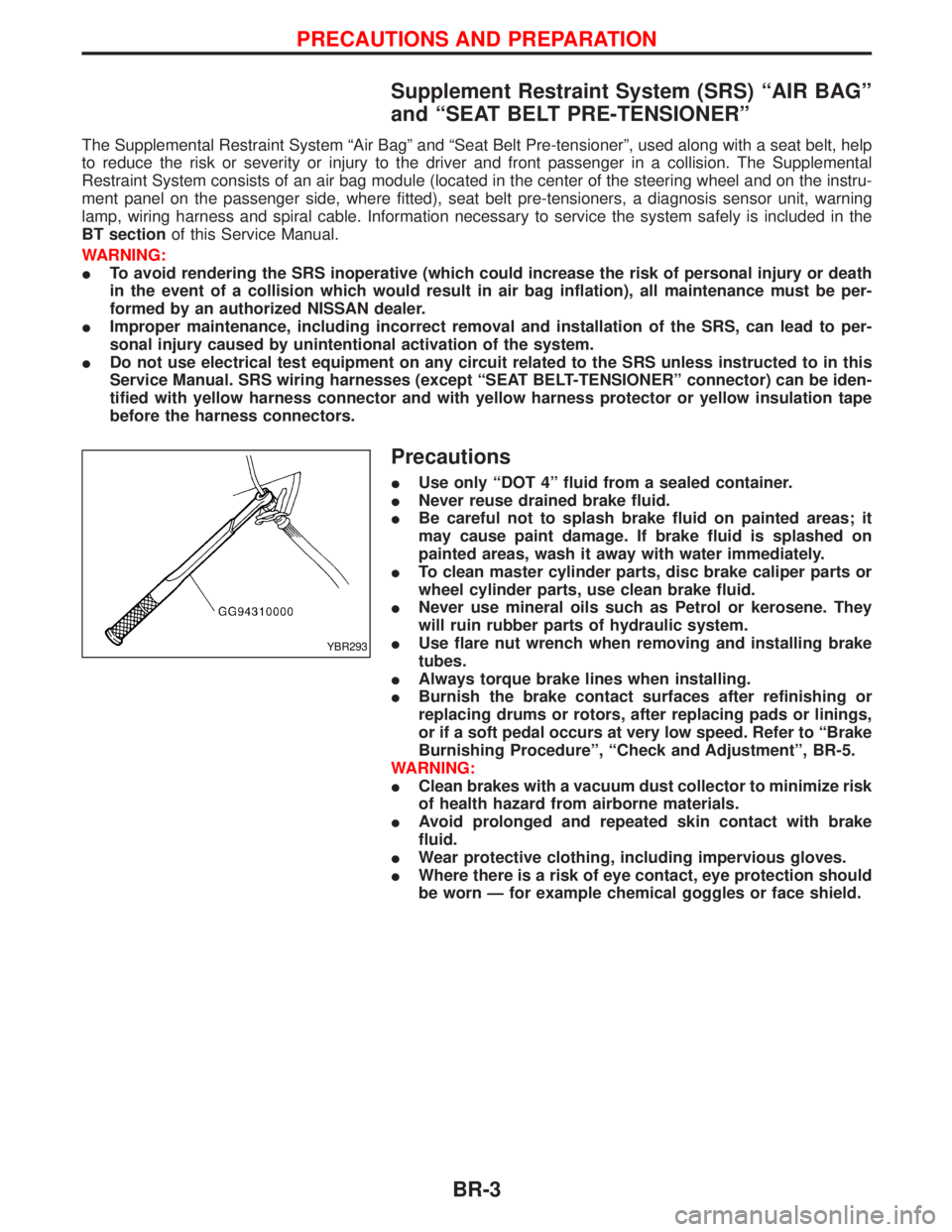
Precautions
IUse only ªDOT 4º fluid from a sealed container.
INever reuse drained brake fluid.
IBe careful not to splash brake fluid on painted areas; it
may cause paint damage. If brake fluid is splashed on
painted areas, wash it away with water immediately.
ITo clean master cylinder parts, disc brake caliper parts or
wheel cylinder parts, use clean brake fluid.
INever use mineral oils such as Petrol or kerosene. They
will ruin rubber parts of hydraulic system.
IUse flare nut wrench when removing and installing brake
tubes.
IAlways torque brake lines when installing.
IBurnish the brake contact surfaces after refinishing or
replacing drums or rotors, after replacing pads or linings,
or if a soft pedal occurs at very low speed. Refer to ªBrake
Burnishing Procedureº, ªCheck and Adjustmentº, BR-5.
WARNING:
IClean brakes with a vacuum dust collector to minimize risk
of health hazard from airborne materials.
IAvoid prolonged and repeated skin contact with brake
fluid.
IWear protective clothing, including impervious gloves.
IWhere there is a risk of eye contact, eye protection should
be worn Ð for example chemical goggles or face shield.
YBR293
PRECAUTIONS AND PREPARATION
BR-3
Page 215 of 1767
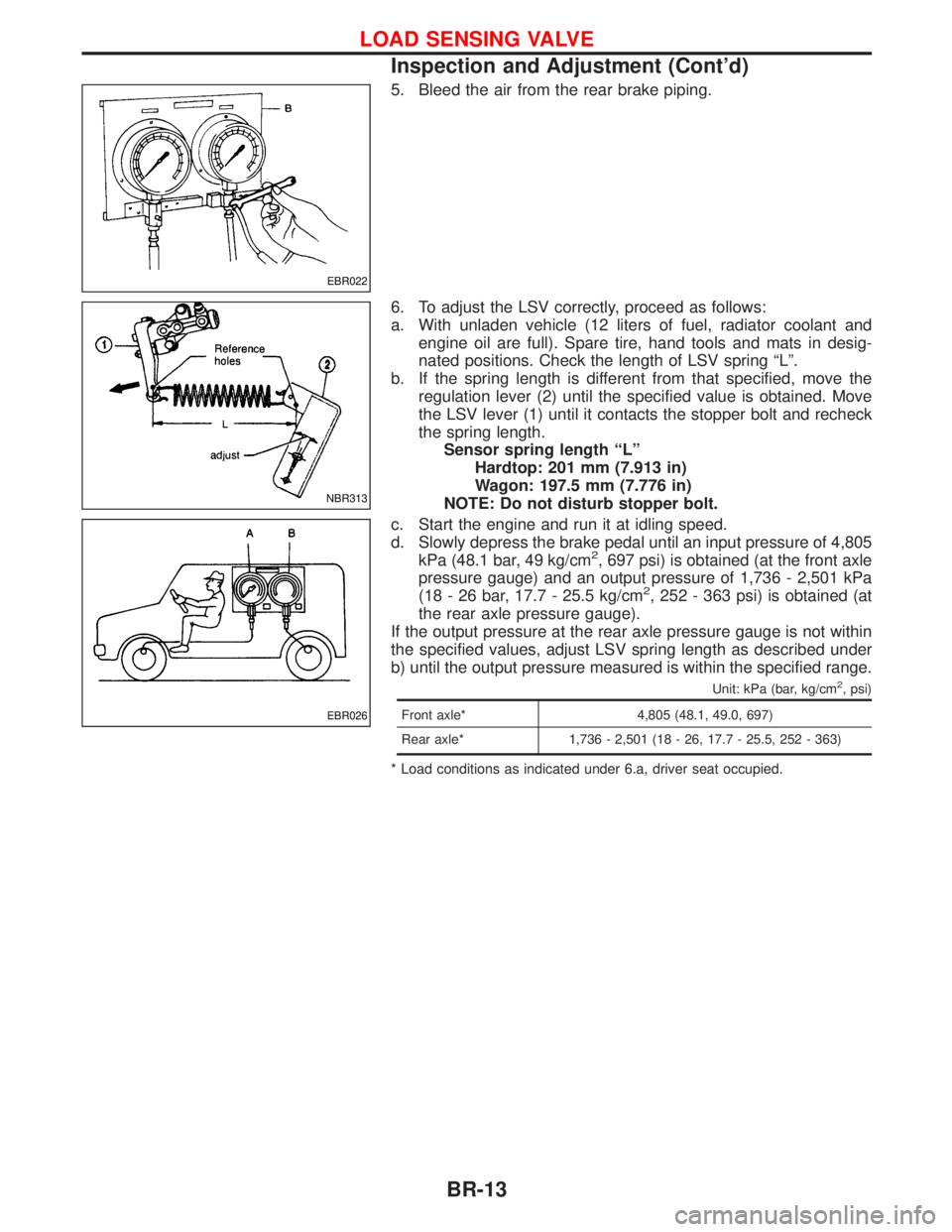
5. Bleed the air from the rear brake piping.
6. To adjust the LSV correctly, proceed as follows:
a. With unladen vehicle (12 liters of fuel, radiator coolant and
engine oil are full). Spare tire, hand tools and mats in desig-
nated positions. Check the length of LSV spring ªLº.
b. If the spring length is different from that specified, move the
regulation lever (2) until the specified value is obtained. Move
the LSV lever (1) until it contacts the stopper bolt and recheck
the spring length.
Sensor spring length ªLº
Hardtop: 201 mm (7.913 in)
Wagon: 197.5 mm (7.776 in)
NOTE: Do not disturb stopper bolt.
c. Start the engine and run it at idling speed.
d. Slowly depress the brake pedal until an input pressure of 4,805
kPa (48.1 bar, 49 kg/cm
2, 697 psi) is obtained (at the front axle
pressure gauge) and an output pressure of 1,736 - 2,501 kPa
(18 - 26 bar, 17.7 - 25.5 kg/cm
2, 252 - 363 psi) is obtained (at
the rear axle pressure gauge).
If the output pressure at the rear axle pressure gauge is not within
the specified values, adjust LSV spring length as described under
b) until the output pressure measured is within the specified range.
Unit: kPa (bar, kg/cm2, psi)
Front axle* 4,805 (48.1, 49.0, 697)
Rear axle* 1,736 - 2,501 (18 - 26, 17.7 - 25.5, 252 - 363)
* Load conditions as indicated under 6.a, driver seat occupied.
EBR022
NBR313
EBR026
LOAD SENSING VALVE
Inspection and Adjustment (Cont'd)
BR-13
Page 239 of 1767
Purpose
The Anti-lock Brake System (ABS) with an integrated Electronic Brake force Distribution (EBD) system con-
sists of electronic and hydraulic components. It allows you to control the braking force so that wheel lock can
be avoided during braking.
The advantages of ABS with EBD
1) Better tracking performance through improved steering wheel control.
2) Improved maneuverability and safer vehicle control.
3) Improved vehicle stability by preventing flat spins.
4) Shorter stopping distance and optimal utilisation of the rear brakes under many different circumstances.
Operation
IABS with EBD has self-test capabilities. The ABS warning lamp is illuminated for 1 second each time the
ignition switch is turned ªONº. After the engine is started, the ABS warning lamp turns off. An ABS self-test
is performed the first time the vehicle reaches 6 km/h (4 MPH) to ensure the system is operational. A
mechanical noise may be heard as the ABS performs this self-test and is a normal part of the self-test
feature. If a malfunction is detected during this check, the ABS warning lamp will stay on.
During the self-test, it also performs a EBD check when it detects a failure the ABS warning light will go
on simultaneously with the brake warning light and an audible sound will sound constantly.
IEBD system will only operate when the ABS is not in active status and it uses the inlet valves of ABS con-
trol unit to limit the pressure to the rear wheels when they tend to go into slip.
IWhen the vehicle speed is less than 10 km/h (6 MPH) the ABS system does not operate.
IWhile driving, a mechanical noise may be heard during ABS operation, this is a normal system condition.
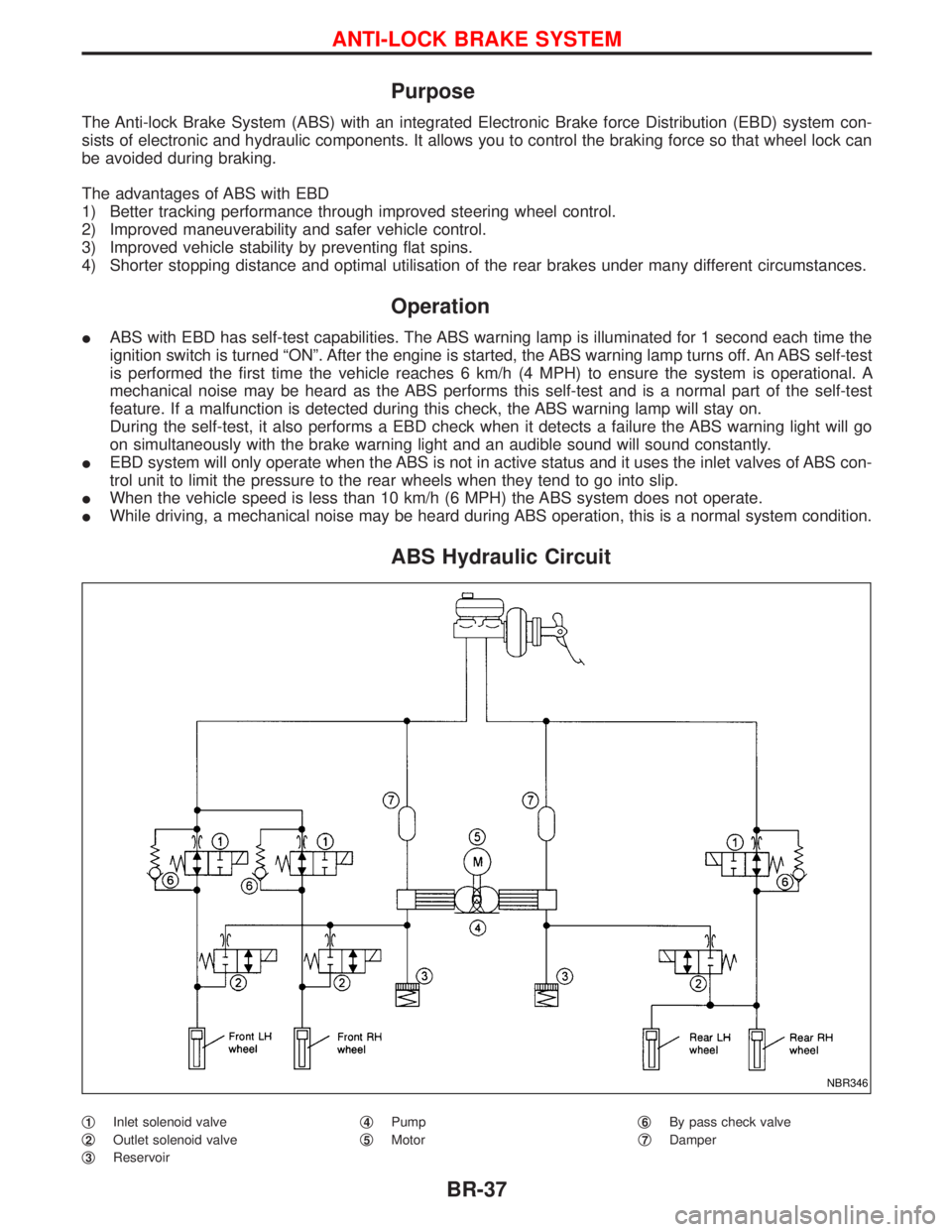
ABS Hydraulic Circuit
q1Inlet solenoid valve
q
2Outlet solenoid valve
q
3Reservoirq
4Pump
q
5Motorq
6By pass check valve
q
7Damper
NBR346
ANTI-LOCK BRAKE SYSTEM
BR-37
Page 240 of 1767
System Description
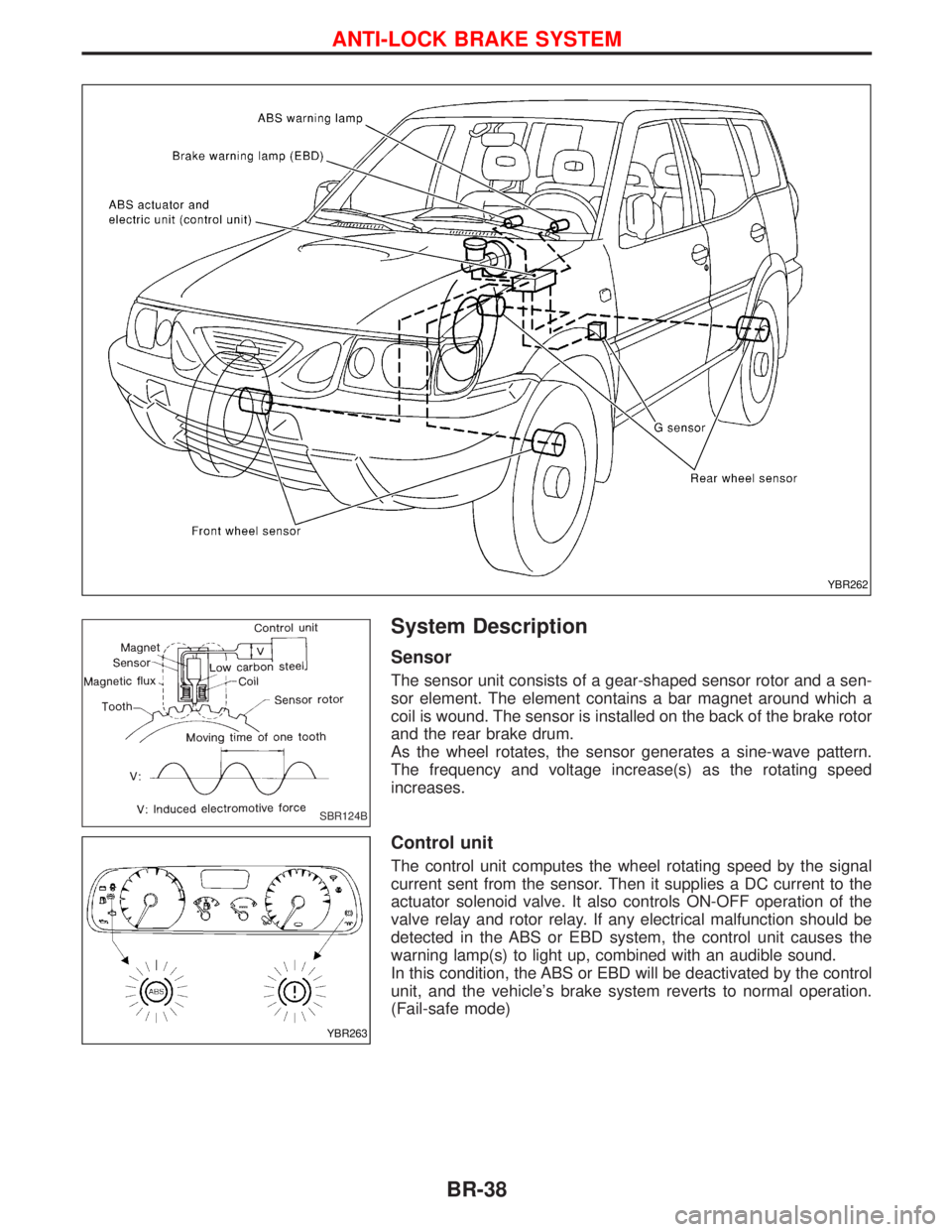
Sensor
The sensor unit consists of a gear-shaped sensor rotor and a sen-
sor element. The element contains a bar magnet around which a
coil is wound. The sensor is installed on the back of the brake rotor
and the rear brake drum.
As the wheel rotates, the sensor generates a sine-wave pattern.
The frequency and voltage increase(s) as the rotating speed
increases.
Control unit
The control unit computes the wheel rotating speed by the signal
current sent from the sensor. Then it supplies a DC current to the
actuator solenoid valve. It also controls ON-OFF operation of the
valve relay and rotor relay. If any electrical malfunction should be
detected in the ABS or EBD system, the control unit causes the
warning lamp(s) to light up, combined with an audible sound.
In this condition, the ABS or EBD will be deactivated by the control
unit, and the vehicle's brake system reverts to normal operation.
(Fail-safe mode)
YBR262
SBR124B
YBR263
ANTI-LOCK BRAKE SYSTEM
BR-38
Page 241 of 1767

G SENSOR
The G sensor analyses deceleration during braking to determine whether the vehicle is being driven on a road
with low surface resistance () (snow-covered road, etc.). The ABS control unit uses the signal from the
deceleration sensor to compensate for road surface conditions when controlling the braking operation.
NBR136
ANTI-LOCK BRAKE SYSTEM
System Description (Cont'd)
BR-39