Ignition NISSAN TERRANO 2004 Service Repair Manual
[x] Cancel search | Manufacturer: NISSAN, Model Year: 2004, Model line: TERRANO, Model: NISSAN TERRANO 2004Pages: 1833, PDF Size: 53.42 MB
Page 1576 of 1833
![NISSAN TERRANO 2004 Service Repair Manual POWER SUPPLY AND GROUND CIRCUIT
Power is supplied at all times
Ithrough 10A fuse [No. 16, located in the fuse block (J/B)]
I to combination meter terminal 27.
With the ignition switch in the ON or STA](/img/5/57394/w960_57394-1575.png "NISSAN TERRANO 2004 Service Repair Manual POWER SUPPLY AND GROUND CIRCUIT
Power is supplied at all times
Ithrough 10A fuse [No. 16, located in the fuse block (J/B)]
I to combination meter terminal 27.
With the ignition switch in the ON or STA")
POWER SUPPLY AND GROUND CIRCUIT
Power is supplied at all times
Ithrough 10A fuse [No. 16, located in the fuse block (J/B)]
I to combination meter terminal 27.
With the ignition switch in the ON or START position, power is supplied
I through 10A fuse [No. 12, located in the fuse block (J/B)]
I to combination meter terminal 28.
Ground is supplied
I through body grounds F36, F47 (LHD models) or M33, M754 (RHD models)
I to combination meter terminal 29.
WATER TEMPERATURE GAUGE
The water temperature gauge indicates the engine coolant temperature.
Thermal transmitter provides a engine coolant temperature signal to combination meter for water temperature
gauge.
TACHOMETER
The tachometer indicates engine speed in revolution per minutes (rpm). ECM provides an engine speed sig-
nal to combination meter for tachometer.
FUEL GAUGE
The fuel gauge indicates the approximate fuel level in the fuel tank.
The fuel gauge is regulated by a variable ground signal supplied
Ifrom body grounds B10 and B18
I through terminal 3 of the fuel level sensor unit and
I through terminal 2 (TD27Ti engine) or 1 (ZD30DDTi engine) of the fuel level sensor unit
I to combination meter terminal 13 for the fuel gauge.
SPEEDOMETER
The combination meter receives a signal from vehicle speed sensor. The speedometer converts the signal into
the vehicle speed displayed.
AMBIENT TEMPERATURE GAUGE
Ambient temperature sensor provides the signal for ambient temperature to combination meter.
METER AND GAUGES
System Description (Cont'd)
EL-83
http://vnx.su/
Page 1583 of 1833
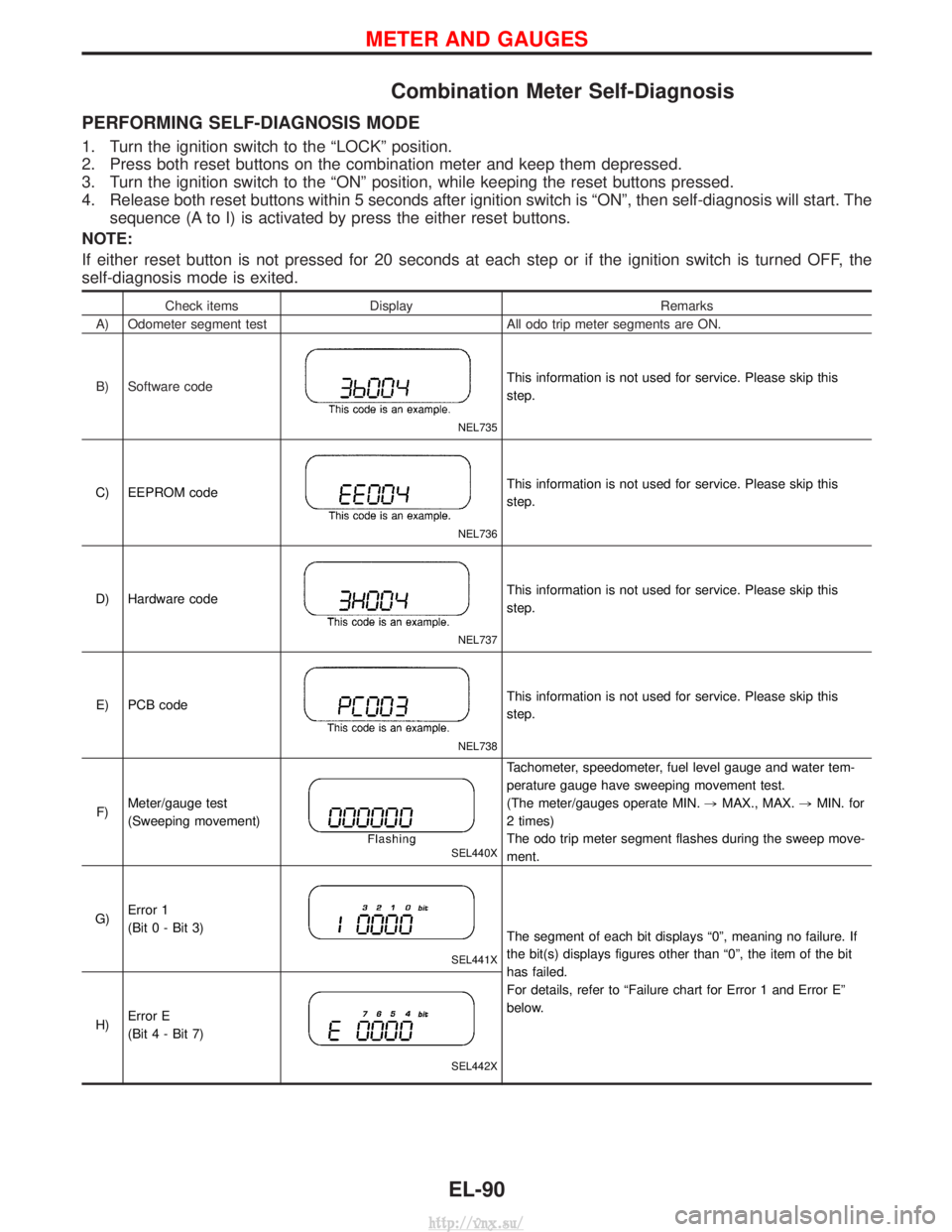
Combination Meter Self-Diagnosis
PERFORMING SELF-DIAGNOSIS MODE
1. Turn the ignition switch to the ªLOCKº position.
2. Press both reset buttons on the combination meter and keep them depressed.
3. Turn the ignition switch to the ªONº position, while keeping the reset buttons pressed.
4. Release both reset buttons within 5 seconds after ignition switch is ªONº, then self-diagnosis will start. Thesequence (A to I) is activated by press the either reset buttons.
NOTE:
If either reset button is not pressed for 20 seconds at each step or if the ignition switch is turned OFF, the
self-diagnosis mode is exited.
Check items Display Remarks
A) Odometer segment test All odo trip meter segments are ON.
B) Software code
NEL735
This information is not used for service. Please skip this
step.
C) EEPROM code
NEL736
This information is not used for service. Please skip this
step.
D) Hardware code
NEL737
This information is not used for service. Please skip this
step.
E) PCB code
NEL738
This information is not used for service. Please skip this
step.
F) Meter/gauge test
(Sweeping movement)
SEL440X
Tachometer, speedometer, fuel level gauge and water tem-
perature gauge have sweeping movement test.
(The meter/gauges operate MIN.
,MAX., MAX. ,MIN. for
2 times)
The odo trip meter segment flashes during the sweep move-
ment.
G) Error 1
(Bit 0 - Bit 3)
SEL441X
The segment of each bit displays ª0º, meaning no failure. If
the bit(s) displays figures other than ª0º, the item of the bit
has failed.
For details, refer to ªFailure chart for Error 1 and Error Eº
below.
H) Error E
(Bit 4 - Bit 7)
SEL442X
METER AND GAUGES
EL-90
http://vnx.su/
Page 1584 of 1833

Check itemsDisplay Remarks
I) Fuel warning lamp test
SEL443X
Fuel warning lamp is on and odo trip meter segment ªFUELº
flashes.
Failure Chart for ªError 1º and ªError Eº
Bit Detectable items Description of the failureDisplayed figure on the
bit
Failure No failure
0 Speedometer input
signal
No input signal
When no signal is detected for 30 minutes continuously with
the ignition ON, it should be judged as signal failure.
(If input signal is detected later, then the judgement will be
canceled immediately.) 1
0
Abnormal input signal
When any signal of frequency which would not exist in normal
conditions is detected, it should be judged as signal failure. 2
1 Tachometer input
signal
No input signal
When no signal is detected for 30 minutes continuously with
the ignition ON, it should be judged as signal failure.
(If input signal is detected later, then the judgement will be
canceled immediately.) 1
0
Abnormal input signal
When any signal of frequency which would not exist in normal
conditions is detected, it should be judged as signal failure. 2
2 Fuel level input sig-
nal
Short circuit
When short circuit of the signal line is detected for 5 seconds
or more, it should be judged as short-circuit failure. 1
0
Open circuit
When open circuit of the signal line is detected for 5 seconds
or more, it should be judged as open-circuit failure. 2
3 Water temperature
input signal Short circuit
When short circuit of the signal line is detected for 5 seconds
or more, it should be judged as short-circuit failure. 10
4 Outside air tempera-
ture input signal
Short circuit
When short circuit of the signal line is detected for 5 seconds
or more, it should be judged as short-circuit failure. 1
0
Open circuit
When open circuit of the signal line is detected for 5 seconds
or more, it should be judged as open-circuit failure. 2
5 Reset buttons Short circuit for reset buttons
When the short circuit is continu-
ously detected for 5 minutes or
more, it should be judged as
short-circuit failure. Right side reset button has
failed.
1
0
Left side reset button has
failed. 2
Both reset buttons have
failed. 3
6Ð Ð 00
7 CPU EEPROM failure 1
0
CPU RAM failure 2
METER AND GAUGES
Combination Meter Self-Diagnosis (Cont'd)
EL-91
http://vnx.su/
Page 1587 of 1833
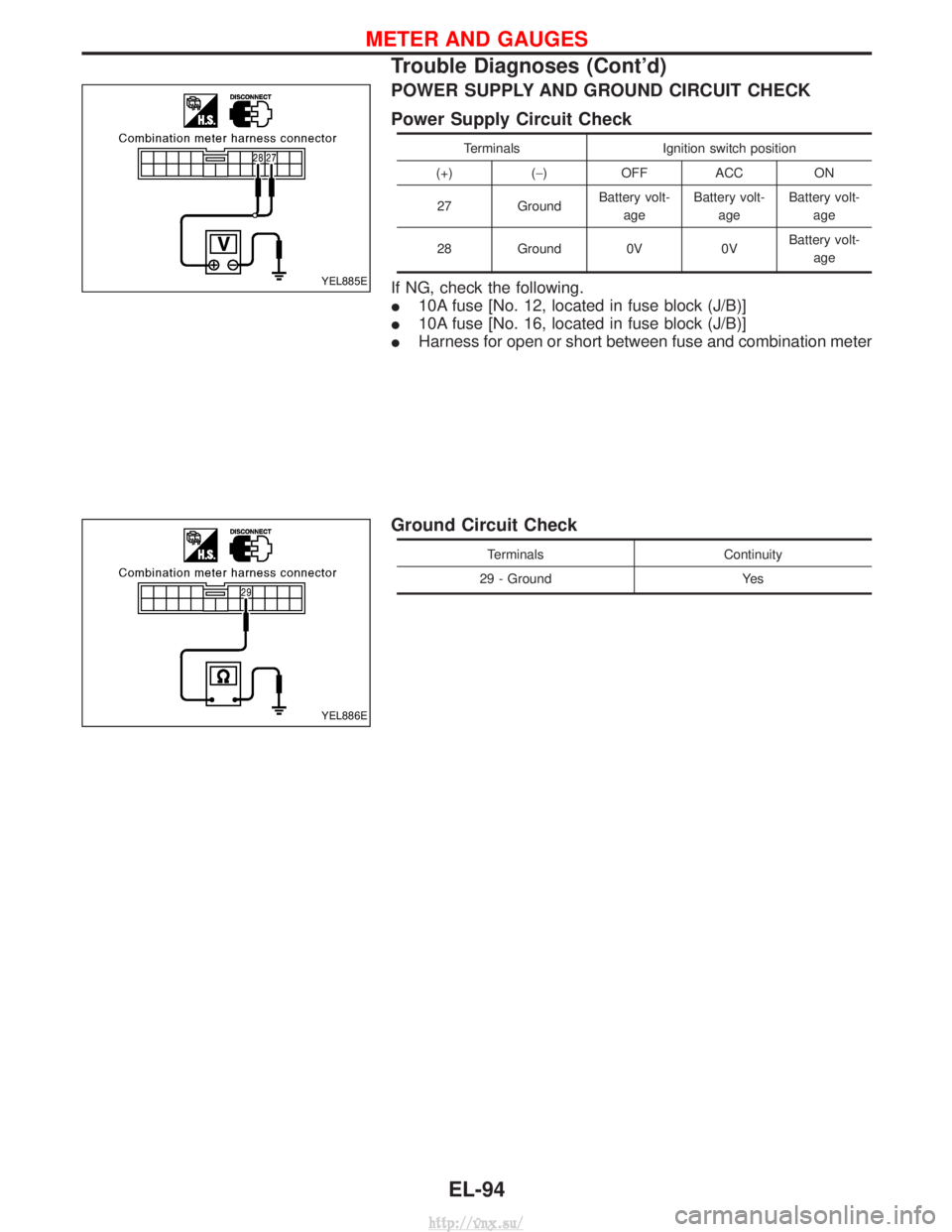
POWER SUPPLY AND GROUND CIRCUIT CHECK
Power Supply Circuit Check
TerminalsIgnition switch position
(+) (-) OFF ACC ON
27 Ground Battery volt-
age Battery volt-
age Battery volt-
age
28 Ground 0V 0V Battery volt-
age
If NG, check the following.
I10A fuse [No. 12, located in fuse block (J/B)]
I 10A fuse [No. 16, located in fuse block (J/B)]
I Harness for open or short between fuse and combination meter
Ground Circuit Check
Terminals Continuity
29 - Ground Yes
YEL885E
YEL886E
METER AND GAUGES
Trouble Diagnoses (Cont'd)
EL-94
http://vnx.su/
Page 1588 of 1833
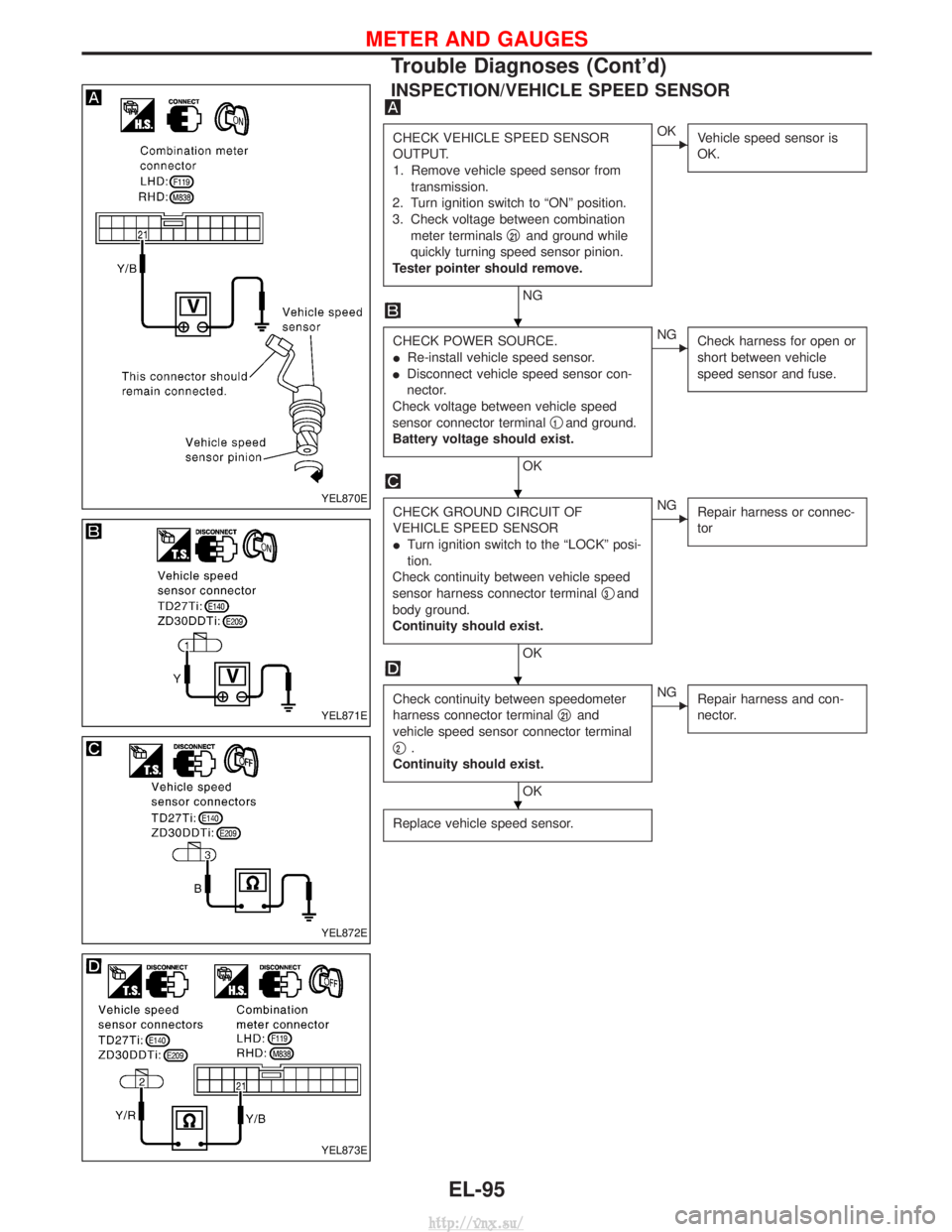
INSPECTION/VEHICLE SPEED SENSOR
CHECK VEHICLE SPEED SENSOR
OUTPUT.
1. Remove vehicle speed sensor fromtransmission.
2. Turn ignition switch to ªONº position.
3. Check voltage between combination meter terminals q
21and ground while
quickly turning speed sensor pinion.
Tester pointer should remove.
NG
EOK Vehicle speed sensor is
OK.
CHECK POWER SOURCE.
IRe-install vehicle speed sensor.
I Disconnect vehicle speed sensor con-
nector.
Check voltage between vehicle speed
sensor connector terminal q
1and ground.
Battery voltage should exist.
OK
ENG Check harness for open or
short between vehicle
speed sensor and fuse.
CHECK GROUND CIRCUIT OF
VEHICLE SPEED SENSOR
ITurn ignition switch to the ªLOCKº posi-
tion.
Check continuity between vehicle speed
sensor harness connector terminal q
3and
body ground.
Continuity should exist.
OK
ENG Repair harness or connec-
tor
Check continuity between speedometer
harness connector terminal q
21and
vehicle speed sensor connector terminal
q
2.
Continuity should exist.
OK
ENG Repair harness and con-
nector.
Replace vehicle speed sensor.
YEL870E
YEL871E
YEL872E
YEL873E
H
H
H
H
METER AND GAUGES
Trouble Diagnoses (Cont'd)
EL-95
http://vnx.su/
Page 1618 of 1833
System Description
The rear window defogger system is controlled by the time control unit. The rear window defogger operates
only for approximately 15 minutes.
Rear window defogger switch is built into the A/C control panel.
Power is supplied at all times
Ithrough 10A fuse [No. 5, located in the fuse block (J/B)]
I to time control unit terminal U09.
With the ignition switch in the ON or START position, power is supplied
I through 10A fuse [No. 26, located in the fuse block (J/B)]
I to time control unit terminal U01
I to rear window defogger relay coil power side.
Ground is supplied
I to time control unit terminal U16
I through terminal MM2 of fuse block (J/B)
I through body grounds F36, F47 (LHD models) or M33, M754 (RHD models)
I to terminal 5 of A/C control panel (rear window defogger switch)
I through body grounds M33 and M754.
When the rear defogger switch is turned ON, ground is supplied
I through terminals 3 and 5 of A/C control panel (rear defogger switch)
I through terminal M19 of fuse block (J/B)
I to time control unit terminal U03.
Terminal U13 of time control unit then supplies ground to the rear window defogger relay coil ground side.
With power and ground supplied, the rear window defogger relay is energized.
Power is supplied
I through 15A fuse [No. 14 and No. 15, located in the fuse block (J/B)]
I to the rear window defogger terminal 1
I through 10A fuse [No. 1, located in the fuse block (J/B)]
I to door mirror LH/RH (defogger) terminal 3.
Ground is supplied
I to rear window defogger terminal 2
I to door mirror LH/RH terminal 2
I through body grounds B10 and B18.
With power and ground supplied, the rear window defogger filaments heat and defog the rear window.
When the system is activated, the rear window defogger indicator illuminates in the rear window defogger
switch.
REAR WINDOW DEFOGGER AND DOOR MIRROR DEFOGGER
EL-125
http://vnx.su/
Page 1621 of 1833
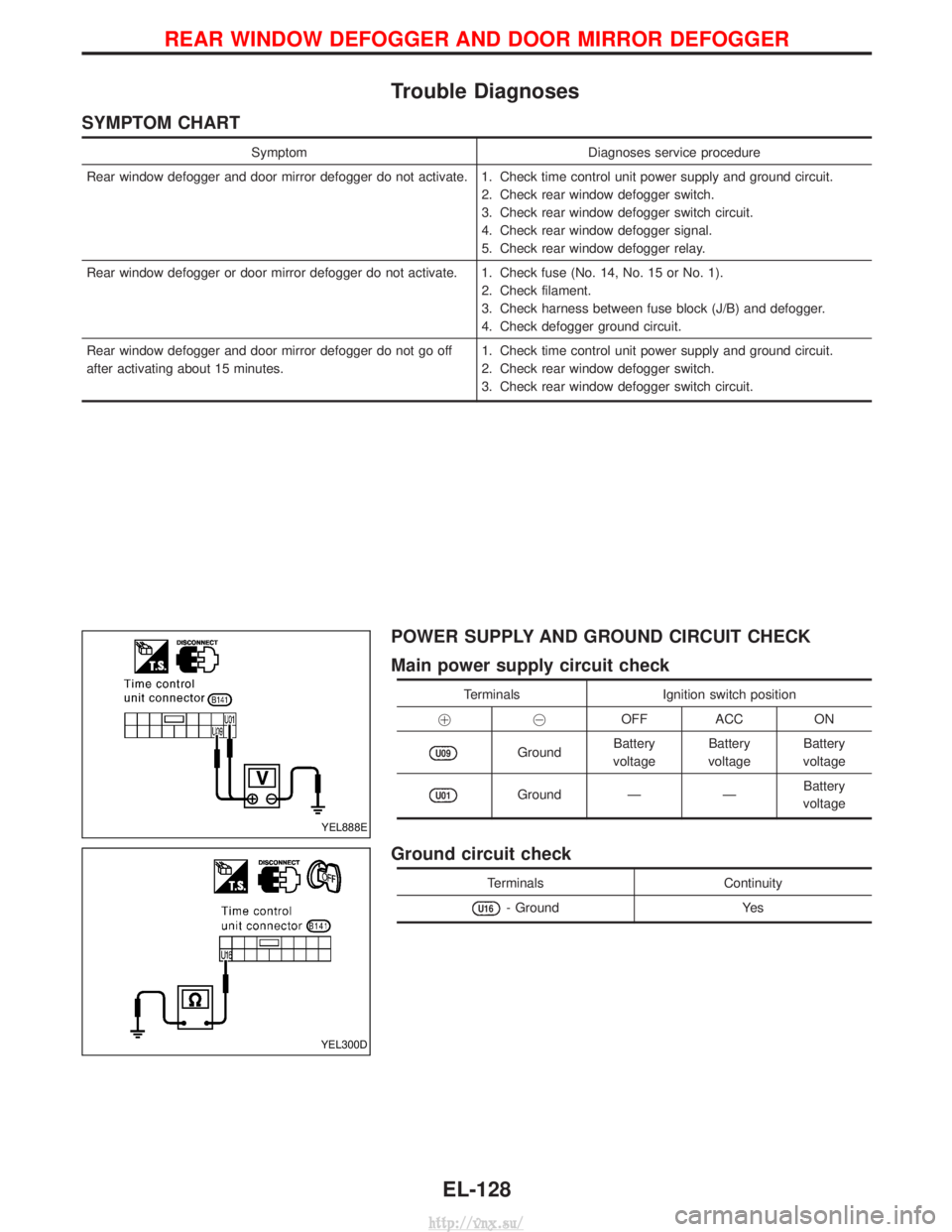
Trouble Diagnoses
SYMPTOM CHART
SymptomDiagnoses service procedure
Rear window defogger and door mirror defogger do not activate. 1. Check time control unit power supply and ground circuit. 2. Check rear window defogger switch.
3. Check rear window defogger switch circuit.
4. Check rear window defogger signal.
5. Check rear window defogger relay.
Rear window defogger or door mirror defogger do not activate. 1. Check fuse (No. 14, No. 15 or No. 1). 2. Check filament.
3. Check harness between fuse block (J/B) and defogger.
4. Check defogger ground circuit.
Rear window defogger and door mirror defogger do not go off
after activating about 15 minutes. 1. Check time control unit power supply and ground circuit.
2. Check rear window defogger switch.
3. Check rear window defogger switch circuit.
POWER SUPPLY AND GROUND CIRCUIT CHECK
Main power supply circuit check
Terminals
Ignition switch position
!@ OFF ACC ON
U09GroundBattery
voltage Battery
voltage Battery
voltage
U01Ground ÐÐBattery
voltage
Ground circuit check
Terminals Continuity
U16- GroundYes
YEL888E
YEL300D
REAR WINDOW DEFOGGER AND DOOR MIRROR DEFOGGER
EL-128
http://vnx.su/
Page 1623 of 1833
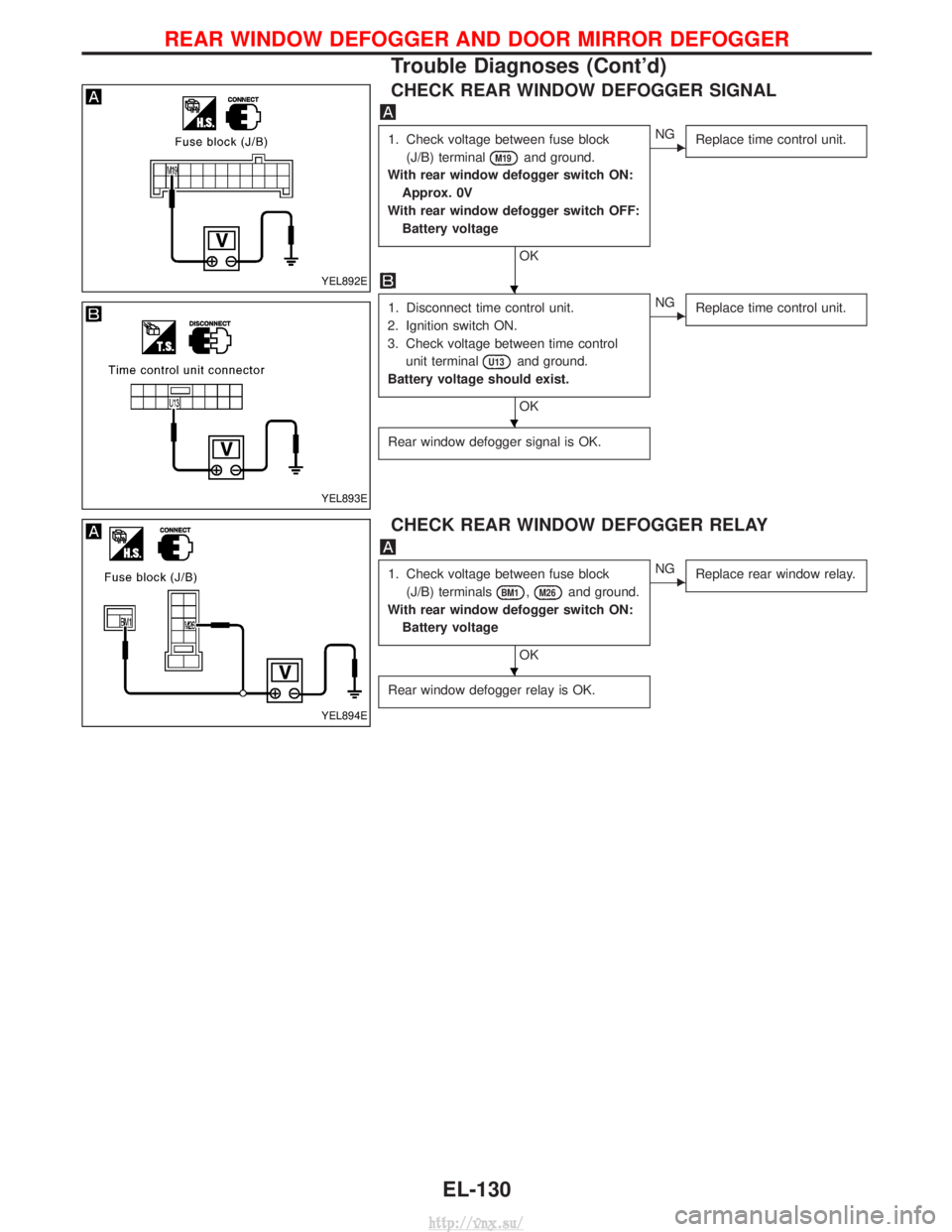
CHECK REAR WINDOW DEFOGGER SIGNAL
1. Check voltage between fuse block(J/B) terminal
M19and ground.
With rear window defogger switch ON: Approx. 0V
With rear window defogger switch OFF: Battery voltage
OK
ENG Replace time control unit.
1. Disconnect time control unit.
2. Ignition switch ON.
3. Check voltage between time control unit terminal
U13and ground.
Battery voltage should exist.
OK
ENG Replace time control unit.
Rear window defogger signal is OK.
CHECK REAR WINDOW DEFOGGER RELAY
1. Check voltage between fuse block
(J/B) terminals
BM1,M26and ground.
With rear window defogger switch ON: Battery voltage
OK
ENG Replace rear window relay.
Rear window defogger relay is OK.
YEL892E
YEL893E
YEL894E
H
H
H
REAR WINDOW DEFOGGER AND DOOR MIRROR DEFOGGER
Trouble Diagnoses (Cont'd)
EL-130
http://vnx.su/
Page 1627 of 1833
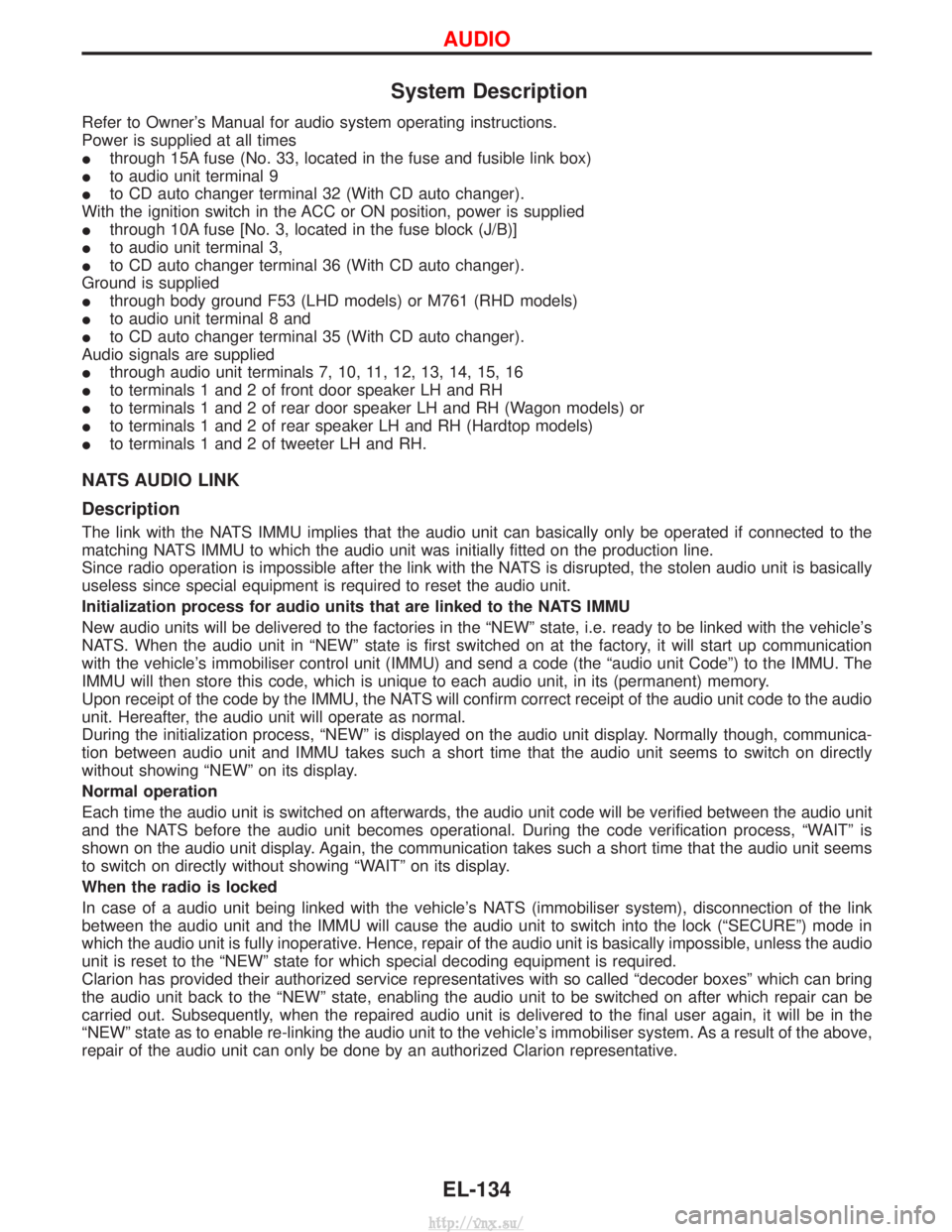
System Description
Refer to Owner's Manual for audio system operating instructions.
Power is supplied at all times
Ithrough 15A fuse (No. 33, located in the fuse and fusible link box)
I to audio unit terminal 9
I to CD auto changer terminal 32 (With CD auto changer).
With the ignition switch in the ACC or ON position, power is supplied
I through 10A fuse [No. 3, located in the fuse block (J/B)]
I to audio unit terminal 3,
I to CD auto changer terminal 36 (With CD auto changer).
Ground is supplied
I through body ground F53 (LHD models) or M761 (RHD models)
I to audio unit terminal 8 and
I to CD auto changer terminal 35 (With CD auto changer).
Audio signals are supplied
I through audio unit terminals 7, 10, 11, 12, 13, 14, 15, 16
I to terminals 1 and 2 of front door speaker LH and RH
I to terminals 1 and 2 of rear door speaker LH and RH (Wagon models) or
I to terminals 1 and 2 of rear speaker LH and RH (Hardtop models)
I to terminals 1 and 2 of tweeter LH and RH.
NATS AUDIO LINK
Description
The link with the NATS IMMU implies that the audio unit can basically only be operated if connected to the
matching NATS IMMU to which the audio unit was initially fitted on the production line.
Since radio operation is impossible after the link with the NATS is disrupted, the stolen audio unit is basically
useless since special equipment is required to reset the audio unit.
Initialization process for audio units that are linked to the NATS IMMU
New audio units will be delivered to the factories in the ªNEWº state, i.e. ready to be linked with the vehicle's
NATS. When the audio unit in ªNEWº state is first switched on at the factory, it will start up communication
with the vehicle's immobiliser control unit (IMMU) and send a code (the ªaudio unit Codeº) to the IMMU. The
IMMU will then store this code, which is unique to each audio unit, in its (permanent) memory.
Upon receipt of the code by the IMMU, the NATS will confirm correct receipt of the audio unit code to the audio
unit. Hereafter, the audio unit will operate as normal.
During the initialization process, ªNEWº is displayed on the audio unit display. Normally though, communica-
tion between audio unit and IMMU takes such a short time that the audio unit seems to switch on directly
without showing ªNEWº on its display.
Normal operation
Each time the audio unit is switched on afterwards, the audio unit code will be verified between the audio unit
and the NATS before the audio unit becomes operational. During the code verification process, ªWAITº is
shown on the audio unit display. Again, the communication takes such a short time that the audio unit seems
to switch on directly without showing ªWAITº on its display.
When the radio is locked
In case of a audio unit being linked with the vehicle's NATS (immobiliser system), disconnection of the link
between the audio unit and the IMMU will cause the audio unit to switch into the lock (ªSECUREº) mode in
which the audio unit is fully inoperative. Hence, repair of the audio unit is basically impossible, unless the audio
unit is reset to the ªNEWº state for which special decoding equipment is required.
Clarion has provided their authorized service representatives with so called ªdecoder boxesº which can bring
the audio unit back to the ªNEWº state, enabling the audio unit to be switched on after which repair can be
carried out. Subsequently, when the repaired audio unit is delivered to the final user again, it will be in the
ªNEWº state as to enable re-linking the audio unit to the vehicle's immobiliser system. As a result of the above,
repair of the audio unit can only be done by an authorized Clarion representative.
AUDIO
EL-134
http://vnx.su/
Page 1640 of 1833
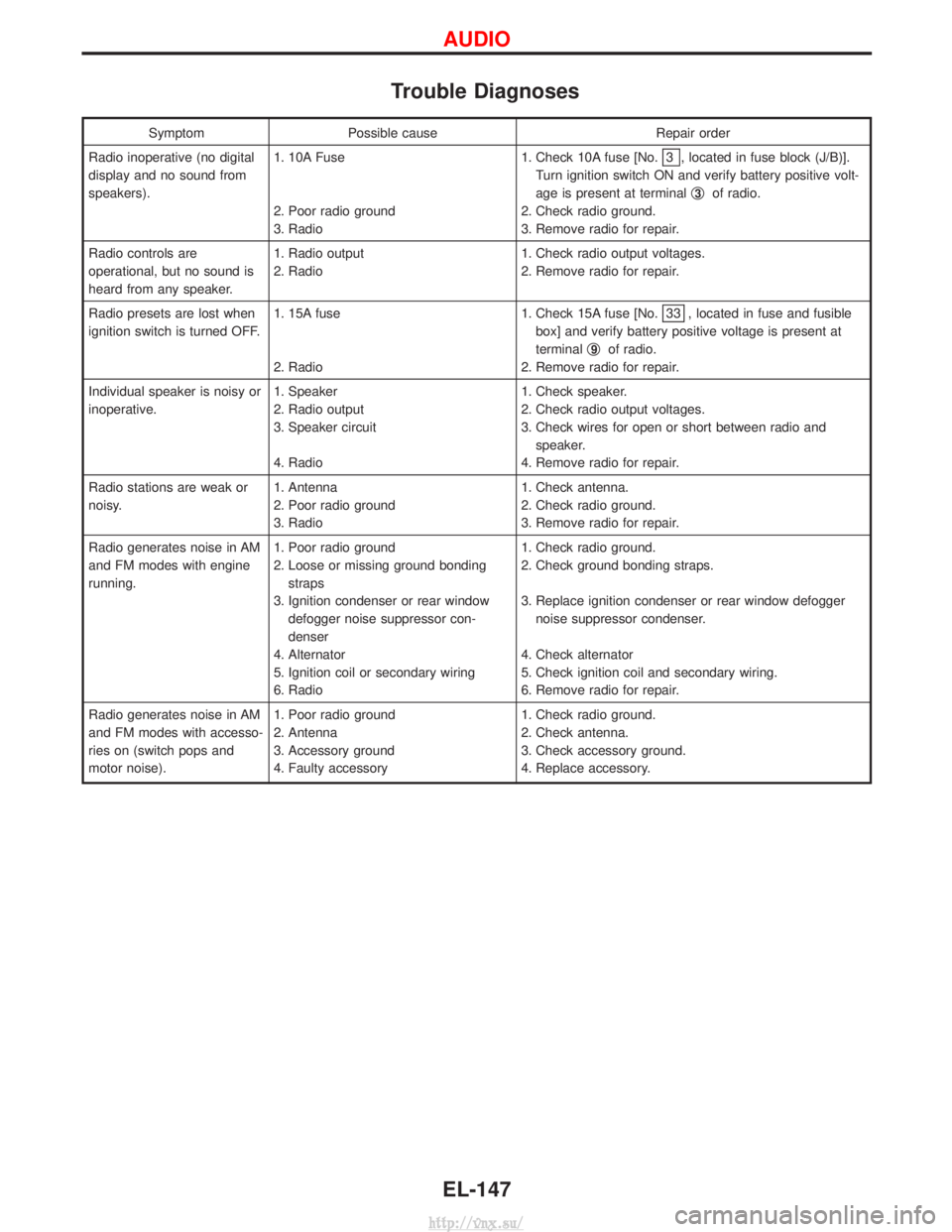
Trouble Diagnoses
SymptomPossible cause Repair order
Radio inoperative (no digital
display and no sound from
speakers). 1. 10A Fuse
2. Poor radio ground
3. Radio 1. Check 10A fuse [No.
3 , located in fuse block (J/B)].
Turn ignition switch ON and verify battery positive volt-
age is present at terminal q
3of radio.
2. Check radio ground.
3. Remove radio for repair.
Radio controls are
operational, but no sound is
heard from any speaker. 1. Radio output
2. Radio
1. Check radio output voltages.
2. Remove radio for repair.
Radio presets are lost when
ignition switch is turned OFF. 1. 15A fuse
2. Radio 1. Check 15A fuse [No.
33 , located in fuse and fusible
box] and verify battery positive voltage is present at
terminal q
9of radio.
2. Remove radio for repair.
Individual speaker is noisy or
inoperative. 1. Speaker
2. Radio output
3. Speaker circuit
4. Radio 1. Check speaker.
2. Check radio output voltages.
3. Check wires for open or short between radio and
speaker.
4. Remove radio for repair.
Radio stations are weak or
noisy. 1. Antenna
2. Poor radio ground
3. Radio 1. Check antenna.
2. Check radio ground.
3. Remove radio for repair.
Radio generates noise in AM
and FM modes with engine
running. 1. Poor radio ground
2. Loose or missing ground bonding
straps
3. Ignition condenser or rear window defogger noise suppressor con-
denser
4. Alternator
5. Ignition coil or secondary wiring
6. Radio 1. Check radio ground.
2. Check ground bonding straps.
3. Replace ignition condenser or rear window defogger
noise suppressor condenser.
4. Check alternator
5. Check ignition coil and secondary wiring.
6. Remove radio for repair.
Radio generates noise in AM
and FM modes with accesso-
ries on (switch pops and
motor noise). 1. Poor radio ground
2. Antenna
3. Accessory ground
4. Faulty accessory 1. Check radio ground.
2. Check antenna.
3. Check accessory ground.
4. Replace accessory.
AUDIO
EL-147
http://vnx.su/