brake PEUGEOT 108 2015 Owner's Manual
[x] Cancel search | Manufacturer: PEUGEOT, Model Year: 2015, Model line: 108, Model: PEUGEOT 108 2015Pages: 271, PDF Size: 7.42 MB
Page 108 of 271
106
108_en_Chap07_securite_ed01-2015
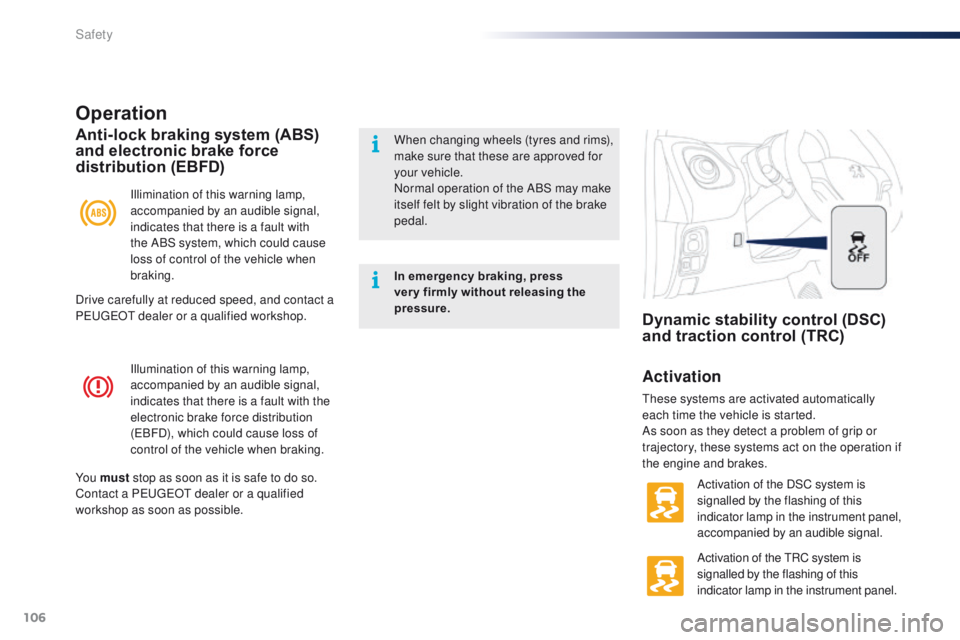
Illumination of this warning lamp,
accompanied by an audible signal,
indicates that there is a fault with the
electronic brake force distribution
(
eB
FD), which could cause loss of
control of the vehicle when braking.
Operation
Illimination of this warning lamp,
accompanied by an audible signal,
indicates that there is a fault with
the ABS system, which could cause
loss of control of the vehicle when
braking.
Anti-lock braking system (ABS)
and electronic brake force
distribution (EBFD)When changing wheels (tyres and rims),
make sure that these are approved for
your vehicle.
Normal operation of the ABS may make
itself felt by slight vibration of the brake
pedal.
In emergency braking, press
ver y firmly without releasing the
pressure.
Yo u must stop as soon as it is safe to do so.
Contact a P
e
uge
Ot
dealer or a qualified
workshop as soon as possible.
Dynamic stability control (DSC)
and traction control (TRC)
Activation
these systems are activated automatically
each time the vehicle is started.
As soon as they detect a problem of grip or
trajectory, these systems act on the operation if
the engine and brakes.
Activation of the DSC system is
signalled by the flashing of this
indicator lamp in the instrument panel,
accompanied by an audible signal.
Activation of the
t
R
C system is
signalled by the flashing of this
indicator lamp in the instrument panel.
Drive carefully at reduced speed, and contact a
P
e
uge
Ot
dealer or a qualified workshop.
Safety
Page 110 of 271
108
108_en_Chap07_securite_ed01-2015
Active City Brake
Active City Brake is a driving assistance system that aims to avoid a frontal collision or reduce the speed of an impact if the driver does not react or
reacts too late (brake application too late).
th
is system is designed to improve
driving safety.
It remains the driver's responsibility to
continuously monitor the state of the
traffic and to assess the distances and
relative speeds of other vehicles.
Active City Brake can in no
circumstances replace the need for
vigilance on the part of the driver.
Never look at the laser sensor through
an optical instrument (magnifying glass,
microscope...) at a distance of less than
10 centimetres: risk of eye injury.
Automatic braking occurs later than if
done by the driver, so as to intervene
only when there is a high risk of
collision.
Principle
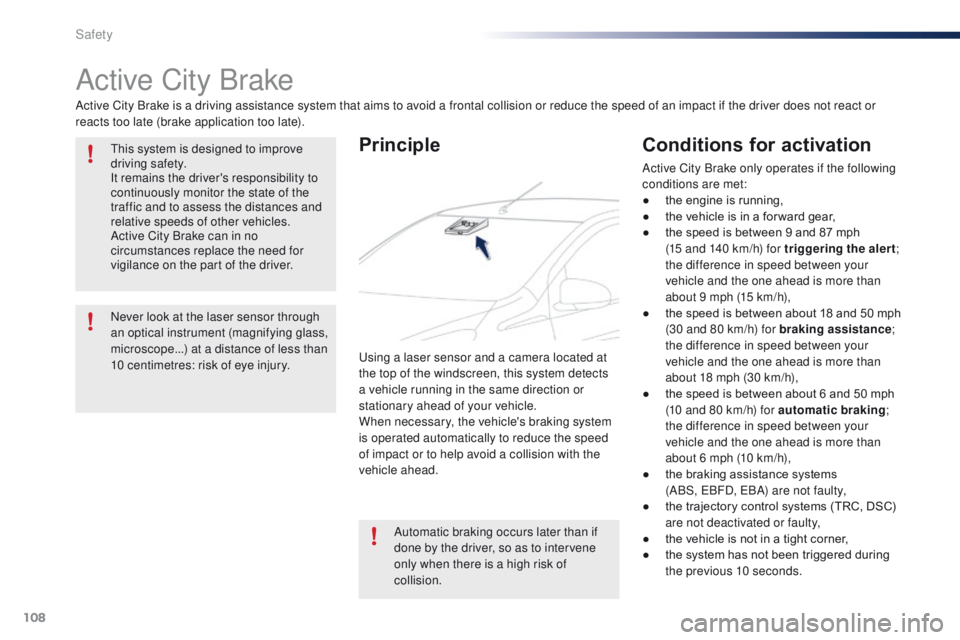
using a laser sensor and a camera located at
the top of the windscreen, this system detects
a vehicle running in the same direction or
stationary ahead of your vehicle.
When necessary, the vehicle's braking system
is operated automatically to reduce the speed
of impact or to help avoid a collision with the
vehicle ahead.
Conditions for activation
Active City Brake only operates if the following
conditions are met:
●
t
he engine is running,
●
t
he vehicle is in a for ward gear,
●
t
he speed is between 9 and 87 mph
(15 and 140 km/h) for triggering the alert ;
the difference in speed between your
vehicle and the one ahead is more than
about 9 mph (15 km/h),
●
t
he speed is between about 18 and 50 mph
(30 and 80 km/h) for braking assistance ;
the difference in speed between your
vehicle and the one ahead is more than
about 18 mph (30 km/h),
●
t
he speed is between about 6 and 50 mph
(10 and 80 km/h) for automatic braking ;
the difference in speed between your
vehicle and the one ahead is more than
about 6 mph (10 km/h),
●
t
he braking assistance systems
(ABS,
e
B
FD, e
B
A) are not faulty,
●
t
he trajectory control systems (TRC, DSC)
are not deactivated or faulty,
●
t
he vehicle is not in a tight corner,
●
t
he system has not been triggered during
the previous 10 seconds.
Safety
Page 111 of 271
109
108_en_Chap07_securite_ed01-2015
Activation
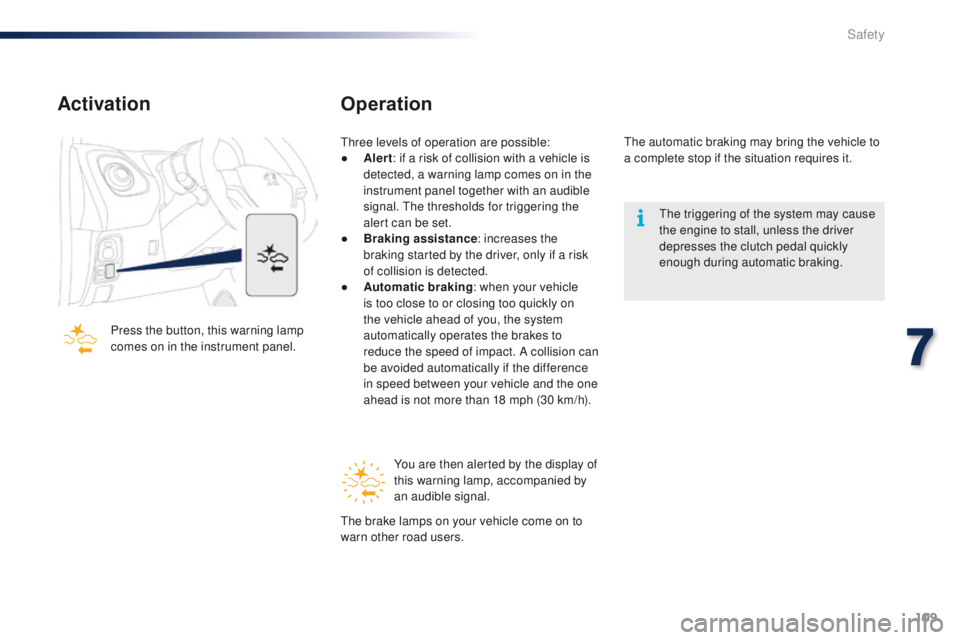
Press the button, this warning lamp
comes on in the instrument panel.
Operation
three levels of operation are possible:
● A lert: if a risk of collision with a vehicle is
detected, a warning lamp comes on in the
instrument panel together with an audible
signal.
t
h
e thresholds for triggering the
alert can be set.
●
Br
aking assistance : increases the
braking started by the driver, only if a risk
of collision is detected.
●
A
utomatic braking : when your vehicle
is too close to or closing too quickly on
the vehicle ahead of you, the system
automatically operates the brakes to
reduce the speed of impact. A collision can
be avoided automatically if the difference
in speed between your vehicle and the one
ahead is not more than 18 mph (30 km/h).
You are then alerted by the display of
this warning lamp, accompanied by
an audible signal.th e automatic braking may bring the vehicle to
a complete stop if the situation requires it.
th
e brake lamps on your vehicle come on to
warn other road users.
th
e triggering of the system may cause
the engine to stall, unless the driver
depresses the clutch pedal quickly
enough during automatic braking.
7
Safety
Page 145 of 271
143
108_en_Chap09_info-pratiques_ed01-2015
Changing a wheel
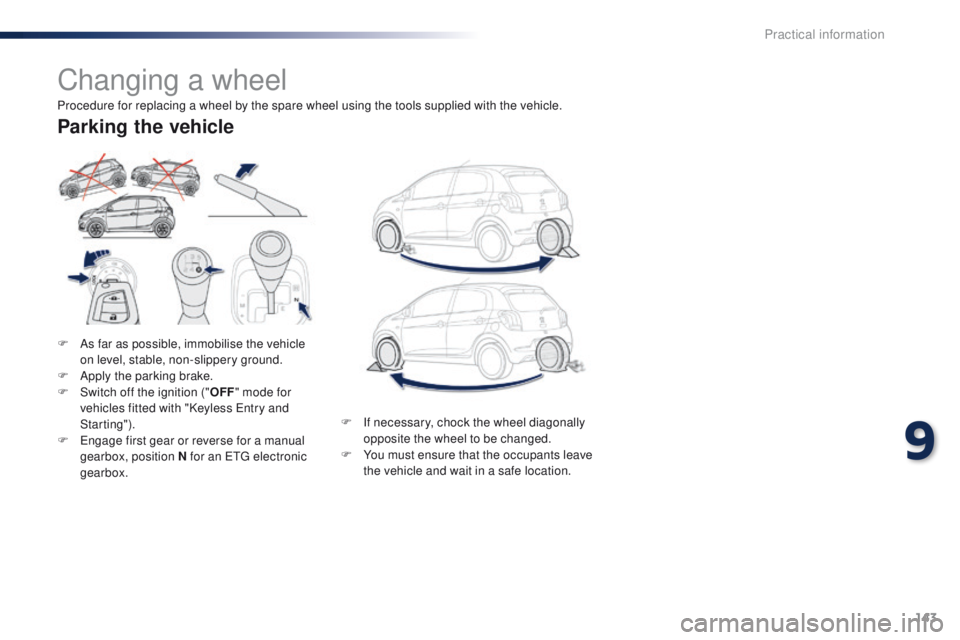
F As far as possible, immobilise the vehicle on level, stable, non-slippery ground.
F
A
pply the parking brake.
F
S
witch off the ignition (" OFF" mode for
vehicles fitted with "Keyless
e
n
try and
Starting").
F
e
n
gage first gear or reverse for a manual
gearbox, position N for an
etg electronic
gearbox.
Parking the vehicle
Procedure for replacing a wheel by the spare wheel using the tools supplied with the vehicle.
F
I
f necessary, chock the wheel diagonally
opposite the wheel to be changed.
F
Y
ou must ensure that the occupants leave
the vehicle and wait in a safe location.
9
Practical information
Page 150 of 271
148
108_en_Chap09_info-pratiques_ed01-2015
Snow chains
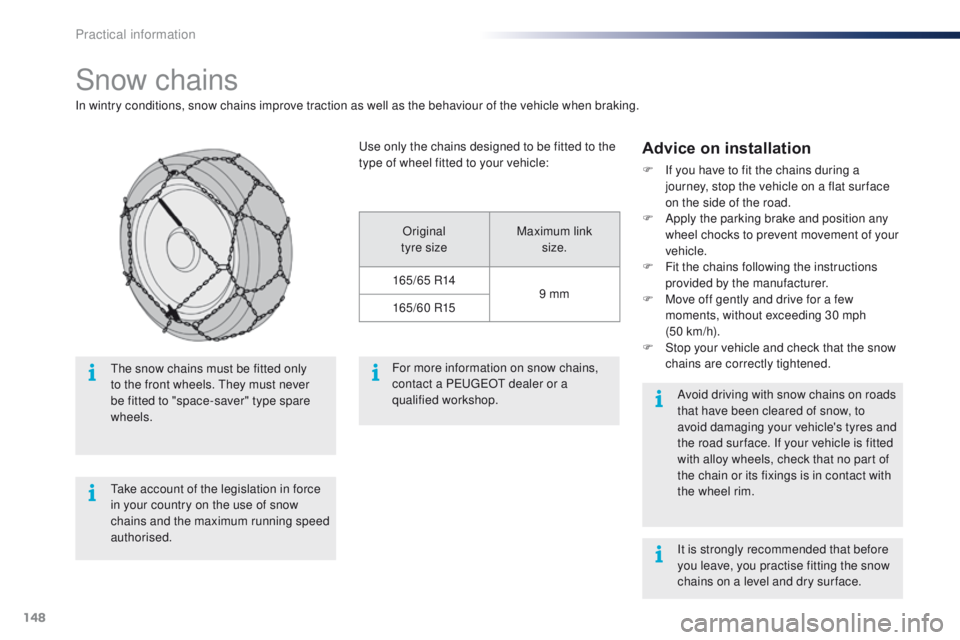
In wintry conditions, snow chains improve traction as well as the behaviour of the vehicle when braking.
Advice on installation
F If you have to fit the chains during a journey, stop the vehicle on a flat sur face
on the side of the road.
F
A
pply the parking brake and position any
wheel chocks to prevent movement of your
vehicle.
F
F
it the chains following the instructions
provided by the manufacturer.
F
M
ove off gently and drive for a few
moments, without exceeding 30 mph
(50
km/h).
F
S
top your vehicle and check that the snow
chains are correctly tightened.
ta
ke account of the legislation in force
in your country on the use of snow
chains and the maximum running speed
authorised.
th
e snow chains must be fitted only
to the front wheels.
t
h
ey must never
be fitted to "space-saver" type spare
wheels. Avoid driving with snow chains on roads
that have been cleared of snow, to
avoid damaging your vehicle's tyres and
the road sur face. If your vehicle is fitted
with alloy wheels, check that no part of
the chain or its fixings is in contact with
the wheel rim.
us
e only the chains designed to be fitted to the
type of wheel fitted to your vehicle:
Original
tyre size Maximum link
size.
165/65 R14 9 mm
165/60 R15
For more information on snow chains,
contact a P
e
uge
Ot
dealer or a
qualified workshop.
It is strongly recommended that before
you leave, you practise fitting the snow
chains on a level and dry sur face.
Practical information
Page 154 of 271
152
108_en_Chap09_info-pratiques_ed01-2015
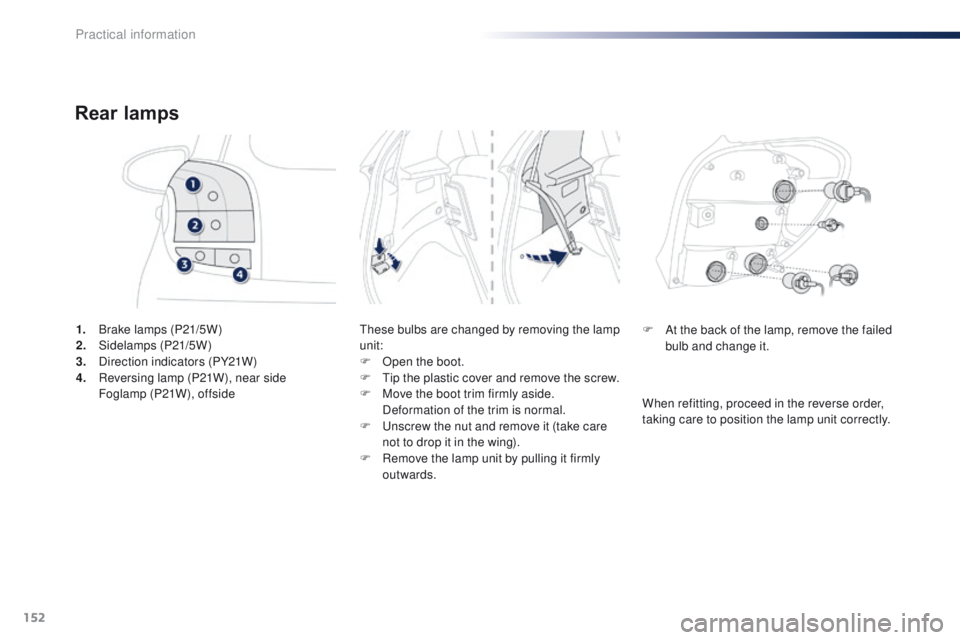
1. Brake lamps (P21/5W)
2. Sidelamps (P21/5W)
3.
D
irection indicators (PY21W)
4.
R
eversing lamp (P21W), near side
F
oglamp (P21W), offside
Rear lamps
these bulbs are changed by removing the lamp
unit:
F
O
pen the boot.
F
t
i
p the plastic cover and remove the screw.
F
M
ove the boot trim firmly aside.
D
eformation of the trim is normal.
F
u
n
screw the nut and remove it (take care
not to drop it in the wing).
F
R
emove the lamp unit by pulling it firmly
outwards. F
A t the back of the lamp, remove the failed
bulb and change it.
When refitting, proceed in the reverse order,
taking care to position the lamp unit correctly.
Practical information
Page 155 of 271
153
108_en_Chap09_info-pratiques_ed01-2015
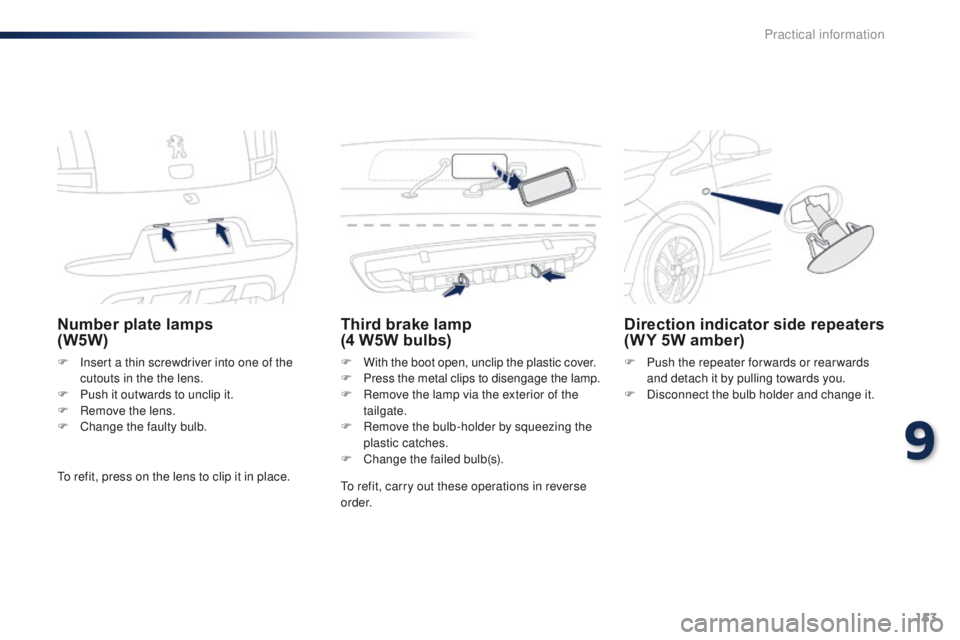
Number plate lamps
(W5W)
F Insert a thin screwdriver into one of the cutouts in the the lens.
F
P
ush it outwards to unclip it.
F
R
emove the lens.
F
C
hange the faulty bulb.
Third brake lamp
(4 W5W bulbs)
F With the boot open, unclip the plastic cover.
F P ress the metal clips to disengage the lamp.
F
R
emove the lamp via the exterior of the
tailgate.
F
R
emove the bulb-holder by squeezing the
plastic catches.
F
C
hange the failed bulb(s).
Direction indicator side repeaters
(WY 5W amber)
F Push the repeater for wards or rear wards and detach it by pulling towards you.
F
D
isconnect the bulb holder and change it.
to r
efit, press on the lens to clip it in place.
to r
efit, carry out these operations in reverse
o r d e r.
9
Practical information
Page 159 of 271
157
108_en_Chap09_info-pratiques_ed01-2015
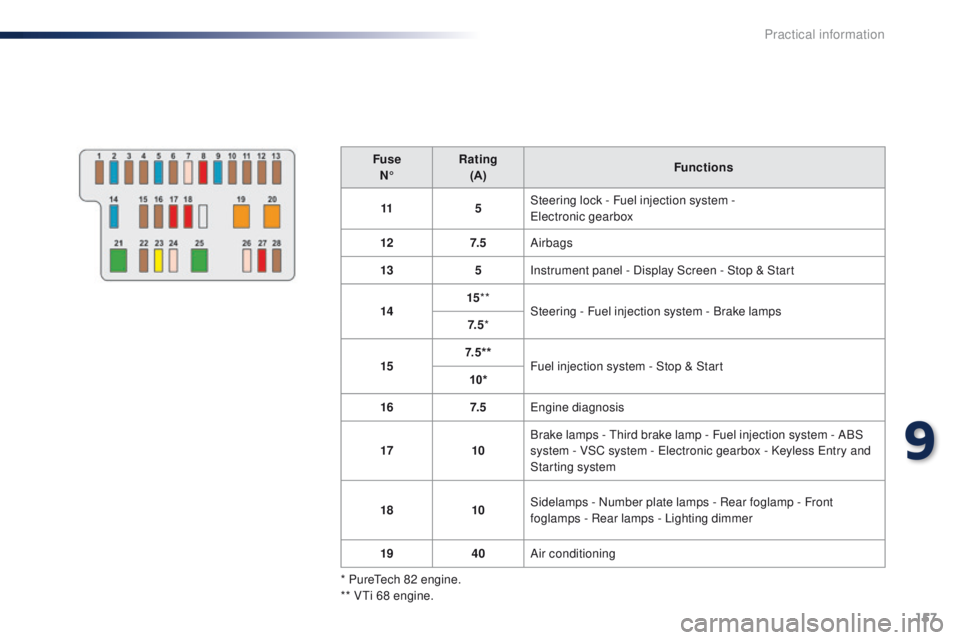
FuseN° Rating
(A) Functions
11 5Steering lock - Fuel injection system -
ele
ctronic gearbox
12 7. 5Airbags
13 5Instrument panel - Display Screen - Stop & Start
14 15
**
Steering - Fuel injection system - Brake lamps
7. 5 *
15 7. 5 * *
Fuel injection system - Stop & Start
10*
16 7. 5
en
gine diagnosis
17 10Brake lamps -
t
h
ird brake lamp - Fuel injection system - ABS
system - VSC system -
e
l
ectronic gearbox - Keyless e
n
try and
Starting system
18 10Sidelamps - Number plate lamps - Rear foglamp - Front
foglamps - Rear lamps - Lighting dimmer
19 40Air conditioning
* Pure
te
ch 82 engine.
** V
ti 6
8 engine.
9
Practical information
Page 160 of 271
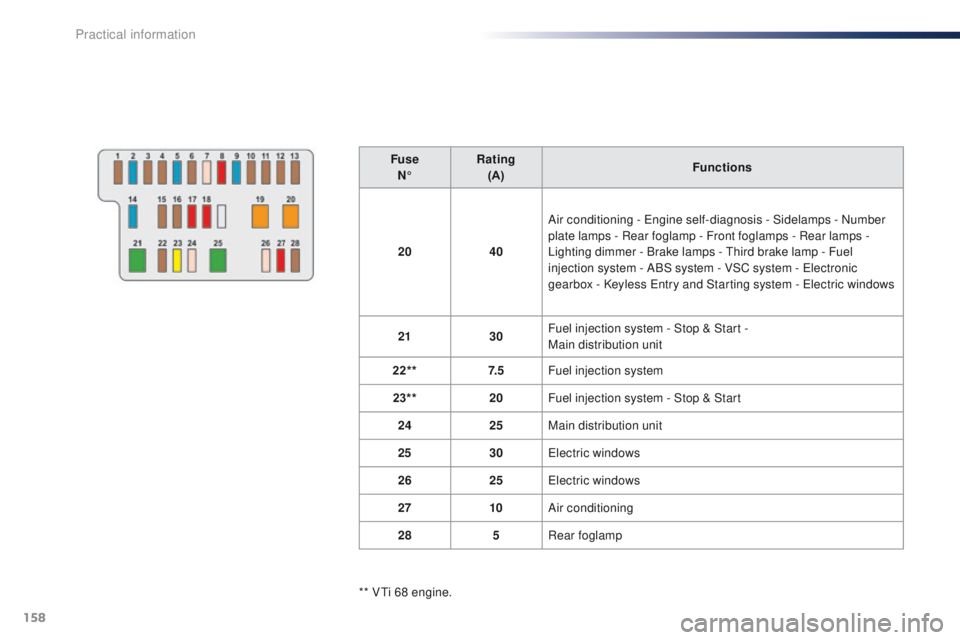
158
108_en_Chap09_info-pratiques_ed01-2015
FuseN° Rating
(A) Functions
20 40Air conditioning -
e
n
gine self-diagnosis - Sidelamps - Number
plate lamps - Rear foglamp - Front foglamps - Rear lamps
-
Lighting dimmer - Brake lamps -
t
h
ird brake lamp - Fuel
injection system - ABS system - VSC system -
e
l
ectronic
gearbox - Keyless
e
n
try and Starting system - e
l
ectric windows
21 30Fuel injection system - Stop & Start -
Main distribution unit
22** 7. 5Fuel injection system
23** 20Fuel injection system - Stop & Start
24 25Main distribution unit
25 30
el
ectric windows
26 25
el
ectric windows
27 10Air conditioning
28 5Rear foglamp
** V
ti 6
8 engine.
Practical information
Page 161 of 271
159
108_en_Chap09_info-pratiques_ed01-2015
Fuse
N° Rating
(A) Functions
1 10Right hand dipped beam
2 10Left hand dipped beam - Headlamp adjustment
3 7. 5Right hand main beam
4 7. 5Left hand main beam
5 * 15Fuel injection system
6 * 7. 5Fuel injection system
7 * 15Fuel injection system
8 * 7. 5Cooling fan
9 7. 5Air conditioning
10 ** 7. 5Fuel injection system - Brake lamps -
th
ird brake lamp
11 5Courtesy lamp - Boot lamp
12 10
Direction indicators - Hazard warning lamps - Instrument panel - Display screen
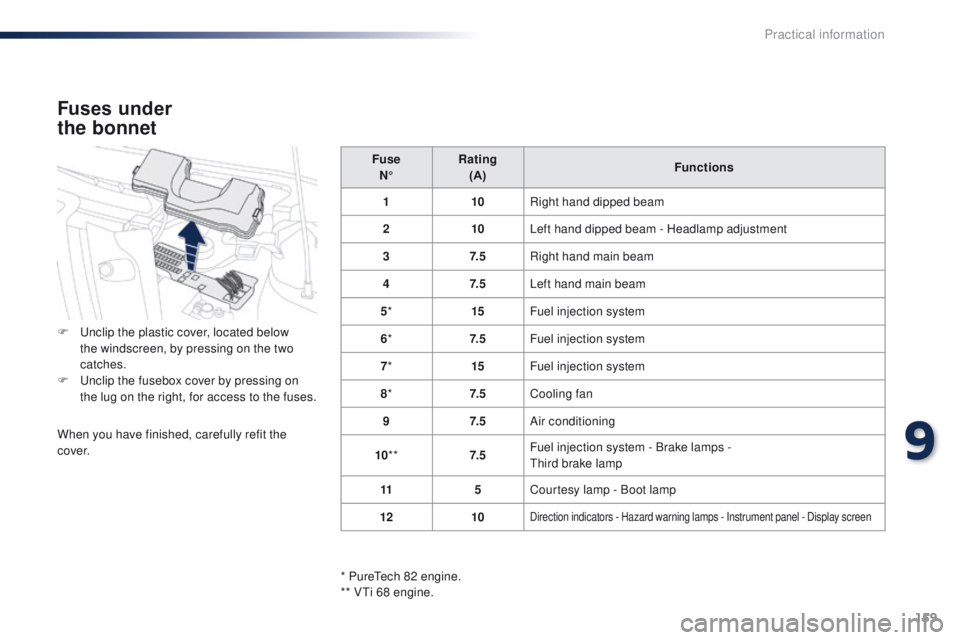
Fuses under
the bonnet
F unclip the plastic cover, located below
the windscreen, by pressing on the two
catches.
F
u
n
clip the fusebox cover by pressing on
the lug on the right, for access to the fuses.
When you have finished, carefully refit the
c ove r.
* Pure
te
ch 82 engine.
** V
ti 6
8 engine.
9
Practical information