warning light Peugeot 3008 Hybrid 4 2012 - RHD (UK. Australia) User Guide
[x] Cancel search | Manufacturer: PEUGEOT, Model Year: 2012, Model line: 3008 Hybrid 4, Model: Peugeot 3008 Hybrid 4 2012Pages: 284, PDF Size: 14.08 MB
Page 106 of 284
VIS
104
In fog or snow, the sunshine
sensor may detect suffi cient
light. In this case, the lighting
will not come on automatically.
Do not cover the sunshine sensor,
coupled with the rain sensor and lo-
cated in the centre of the windscreen
behind the rear view mirror; the as-
sociated functions would no longer
be controlled.
When the automatic illumination of
headlamps function is activated, un-
der low ambient light the dipped beams
headlamps come on automatically when
the ignition is switched off.
Operating fault
In the event of a malfunction of
the sunshine sensor, the lighting
comes on, this warning lamp is
displayed in the instrument panel
and/or a message appears in the screen,
accompanied by an audible signal.
Contact a PEUGEOT dealer or a quali-
fi ed workshop.
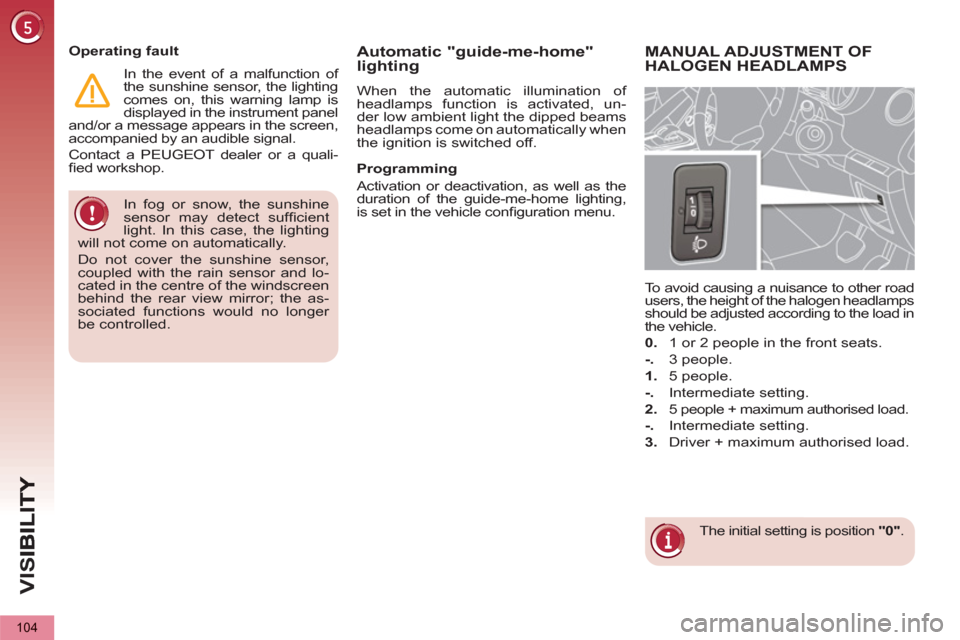
MANUAL ADJUSTMENT OF
HALOGEN HEADLAMPS
The initial setting is position "0"
.
To avoid causing a nuisance to other road
users, the height of the halogen headlamps
should be adjusted according to the load in
the vehicle.
0.
1 or 2 people in the front seats.
-.
3 people.
1.
5 people.
-.
Intermediate setting.
2.
5 people + maximum authorised load.
-.
Intermediate setting.
3.
Driver + maximum authorised load.
Automatic "guide-me-home"lighting
Programming
Activation or deactivation, as well as the
duration of the guide-me-home lighting,
is set in the vehicle confi guration menu.
Page 135 of 284
SA
F
133
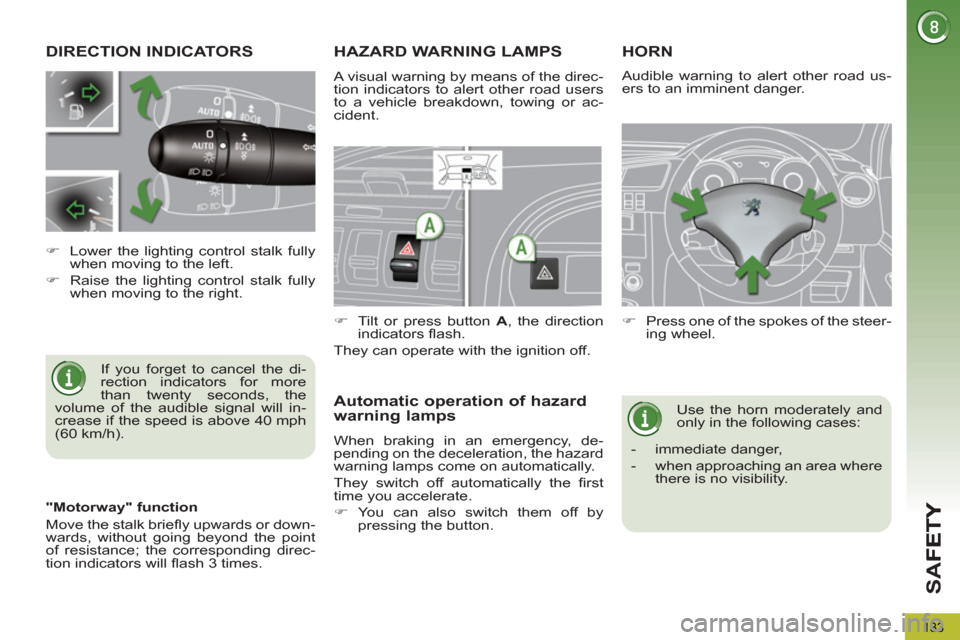
DIRECTION INDICATORS
If you forget to cancel the di-
rection indicators for more
than twenty seconds, the
volume of the audible signal will in-
crease if the speed is above 40 mph
(60 km/h).
)
Lower the lighting control stalk fully
when moving to the left.
)
Raise the lighting control stalk fully
when moving to the right.
HAZARD WARNING LAMPS
A visual warning by means of the direc-
tion indicators to alert other road users
to a vehicle breakdown, towing or ac-
cident.
)
Tilt or press button A
, the direction
indicators fl ash.
They can operate with the ignition off.
Automatic operation of hazard
warning lamps
When braking in an emergency, de-
pending on the deceleration, the hazard
warning lamps come on automatically.
They switch off automatically the fi rst
time you accelerate.
)
You can also switch them off by
pressing the button.
HORN
)
Press one of the spokes of the steer-
ing wheel.
Use the horn moderately and
only in the following cases:
- immediate danger,
- when approaching an area where
there is no visibility.
Audible warning to alert other road us-
ers to an imminent danger.
"Motorway" function
Move the stalk briefl y upwards or down-
wards, without going beyond the point
of resistance; the corresponding direc-
tion indicators will fl ash 3 times.
Page 136 of 284
SA
F
134
ELECTRONIC STABILITY PROGRAMME (ESC)
Definitions
Anti-skid regulation (ASR)
The ASR system (also known as Trac-
tion Control) optimises traction in order
to avoid wheel slip by acting on the
brakes of the driving wheels and on the
engine. It also improves the directional
stability of the vehicle on acceleration.
Dynamic stability control (DSC)
If there is a difference between the path
followed by the vehicle and that re-
quired by the driver, the DSC monitors
each wheel and automatically acts on
the brake of one or more wheels and
on the engine to return the vehicle to
the required path, within the limits of the
laws of physics.
Emergency braking assistance
In an emergency, this system enables
you to reach the optimum braking pres-
sure more quickly and therefore reduce
the stopping distance.
It is triggered in relation to the speed at
which the brake pedal is pressed. This
is felt by a reduction in the resistance of
the pedal and an increase in the effec-
tiveness of the braking.
Anti-lock braking system (ABS) and
electronic brake force distribution
(EBFD)
This system improves the stability and
manoeuvrability of your vehicle when
braking and provides improved control
in corners, in particular on poor or slip-
pery road surfaces.
The ABS prevents wheel lock in the
event of emergency braking.
The electronic brake force distribution
system manages the braking pressure
wheel by wheel.
When this warning lamp
comes on, accompanied by an
audible signal and a message,
it indicates that there is a fault
with the ABS, which could cause loss of
control of the vehicle when braking.
When this warning lamp comes
on, coupled with the STOP
warning lamp, accompanied
by an audible signal and a
message, it indicates that there is a fault
with the electronic brake force distribu-
tion (EBFD), which could cause loss of
control of the vehicle when braking.
You must stop as soon as it is safe
to do so.
In both cases, contact a PEUGEOT
dealer or a qualifi ed workshop.
When changing wheels (tyres
and rims), make sure that
these are approved for your
vehicle.
Normal operation of the ABS may
make itself felt by slight vibrations of
the brake pedal.
In emergency braking, press
very fi rmly without releas-
ing the pressure.
Anti-lock braking system (ABS) and
electronic brake force distribution
(EBFD)
Electronic Stability Programme (ESC:
Electronic Stability Control) incorporat-
ing the following systems:
- the anti-lock braking system (ABS)
and the electronic brake force distri-
bution (EBFD),
- the emergency braking assistance,
- the anti-slip regulation (ASR) or
traction control,
- the dynamic stability control (DSC).
Page 140 of 284
SA
F
138
The driver must ensure that
passengers use the seat belts
correctly and that they are all
restrained securely before setting off.
Wherever you are seated in the ve-
hicle, always fasten your seat belt,
even for short journeys.
Do not interchange the seat belt
buckles as they will not fulfi l their role
fully.
The seat belts are fi tted with an inertia
reel permitting automatic adjustment
of the length of the strap to your size.
The seat belt is stowed automatically
when not in use.
Before and after use, ensure that the
seat belt is reeled in correctly.
The lower part of the strap must be
positioned as low as possible on the
pelvis.
The upper part must be positioned in
the hollow of the shoulder.
The inertia reels are fi tted with an au-
tomatic locking device which comes
into operation in the event of a col-
lision, emergency braking or if the
vehicle rolls over. You can release
the device by pulling fi rmly on the
strap and releasing it so that it reels
in slightly. In order to be effective, a seat belt
must:
- be tightened as close to the body
as possible,
- be pulled in front of you with a
smooth movement, checking that
it does not twist,
- be used to restrain only one person,
- not bear any trace of cuts or fraying,
- not be converted or modifi ed to
avoid affecting its performance.
In accordance with current safety
regulations, for all repairs on your
vehicle, go to a qualifi ed workshop
with the skills and equipment need-
ed, which a PEUGEOT dealer is able
to provide.
Have your seat belts checked regu-
larly by a PEUGEOT dealer or a
qualifi ed workshop, particularly if the
straps show signs of damage.
Clean the seat belt straps with soapy
water or a textile cleaning product,
sold by PEUGEOT dealers.
After folding or moving a seat or rear
bench seat, ensure that the seat belt
is positioned and reeled in correctly.
Recommendations for children
Use a suitable child seat if the pas-
senger is less than 12 years old or
shorter than one and a half metres.
Never use the same seat belt to se-
cure more than one person.
Never allow a child to travel on your lap.
In the event of an impact
Depending on the nature and se-
riousness of the impact
, the pre-
tensioning device may be deployed
before and independently of the
airbags. Deployment of the preten-
sioners is accompanied by a slight
discharge of harmless smoke and
a noise, due to the activation of the
pyrotechnic cartridge incorporated in
the system.
In all cases, the airbag warning lamp
comes on.
Following an impact, have the seat
belts system checked, and if neces-
sary replaced, by a PEUGEOT deal-
er or a qualifi ed workshop.
In the event of an accident, the high
voltage is disconnected automatically.
Page 146 of 284
D
R
I
144
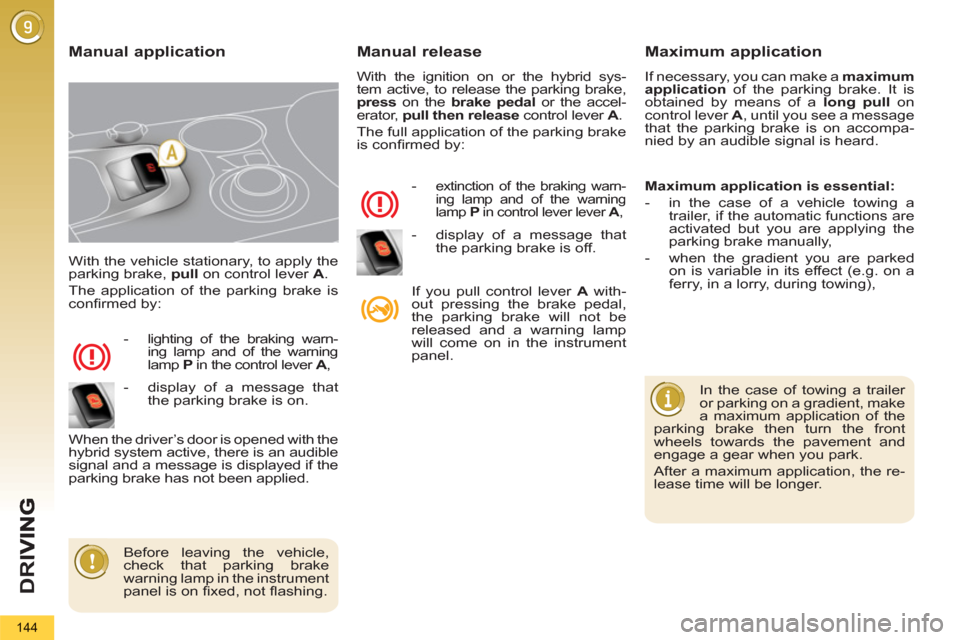
With the vehicle stationary, to apply the
parking brake, pull
on control lever A
.
The application of the parking brake is
confi rmed by:
- lighting of the braking warn-
ing lamp and of the warning
lamp P
in the control lever A
,
When the driver’s door is opened with the
hybrid system active, there is an audible
signal and a message is displayed if the
parking brake has not been applied.
Manual release
With the ignition on or the hybrid sys-
tem active, to release the parking brake,
press
on the brake
pedal
or the accel-
erator, pull then release
control lever A
.
The full application of the parking brake
is confi rmed by:
-
extinction of the braking warn-
ing lamp and of the warning
lamp P
in control lever lever A
,
If you pull control lever A
with-
out pressing the brake pedal,
the parking brake will not be
released and a warning lamp
will come on in the instrument
panel.
Manual application Maximum application
If necessary, you can make a maximum
application
of the parking brake. It is
obtained by means of a long pull
on
control lever A
, until you see a message
that the parking brake is on accompa-
nied by an audible signal is heard.
In the case of towing a trailer
or parking on a gradient, make
a maximum application of the
parking brake then turn the front
wheels towards the pavement and
engage a gear when you park.
After a maximum application, the re-
lease time will be longer.
Before leaving the vehicle,
check that parking brake
warning lamp in the instrument
panel is on fi xed, not fl ashing.
Maximum application is essential:
- in the case of a vehicle towing a
trailer, if the automatic functions are
activated but you are applying the
parking brake manually,
- when the gradient you are parked
on is variable in its effect (e.g. on a
ferry, in a lorry, during towing),
- display of a message that
the parking brake is on.
- display of a message that
the parking brake is off.
Page 198 of 284
PRACTICAL INFORMATION
196
TOWING A TRAILER, ...
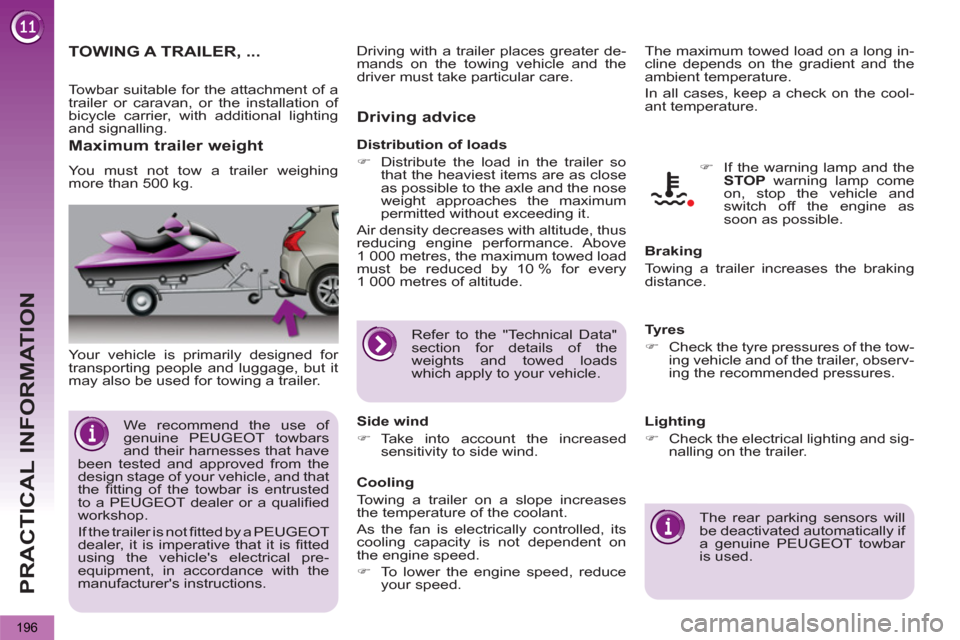
Your vehicle is primarily designed for
transporting people and luggage, but it
may also be used for towing a trailer.
Driving advice
The maximum towed load on a long in-
cline depends on the gradient and the
ambient temperature.
In all cases, keep a check on the cool-
ant temperature.
Cooling
Towing a trailer on a slope increases
the temperature of the coolant.
As the fan is electrically controlled, its
cooling capacity is not dependent on
the engine speed.
)
To lower the engine speed, reduce
your speed.
Side wind
)
Take into account the increased
sensitivity to side wind.
Tyres
)
Check the tyre pressures of the tow-
ing vehicle and of the trailer, observ-
ing the recommended pressures.
Braking
Towing a trailer increases the braking
distance.
)
If the warning lamp and the
STOP
warning lamp come
on, stop the vehicle and
switch off the engine as
soon as possible.
Maximum trailer weight
You must not tow a trailer weighing
more than 500 kg.
Distribution of loads
)
Distribute the load in the trailer so
that the heaviest items are as close
as possible to the axle and the nose
weight approaches the maximum
permitted without exceeding it.
Air density decreases with altitude, thus
reducing engine performance. Above
1 000 metres, the maximum towed load
must be reduced by 10 % for every
1 000 metres of altitude.
Driving with a trailer places greater de-
mands on the towing vehicle and the
driver must take particular care.
We recommend the use of
genuine PEUGEOT towbars
and their harnesses that have
been tested and approved from the
design stage of your vehicle, and that
the fi tting of the towbar is entrusted
to a PEUGEOT dealer or a qualifi ed
workshop.
If the trailer is not fi tted by a PEUGEOT
dealer, it is imperative that it is fi tted
using the vehicle's electrical pre-
equipment, in accordance with the
manufacturer's instructions.
Refer to the "Technical Data"
section for details of the
weights and towed loads
which apply to your vehicle.
Lighting
)
Check the electrical lighting and sig-
nalling on the trailer.
The rear parking sensors will
be deactivated automatically if
a genuine PEUGEOT towbar
is used.
Towbar suitable for the attachment of a
trailer or caravan, or the installation of
bicycle carrier, with additional lighting
and signalling.
Page 204 of 284
TECHNICAL DATA
202
The GTW and towed load values indicated are valid up to a maximum altitude of 1000 metres; the towed load mentioned
must be reduced by 10 % for each additional 1000 metres of altitude.
The speed of a towing vehicle must not exceed 60 mph (100 km/h) (comply with the legislation in force in your country).
High ambient temperatures may result in a reduction in the performance of the vehicle to protect the engine; if the ambient
temperature is above 37 °C, limit the towed load.
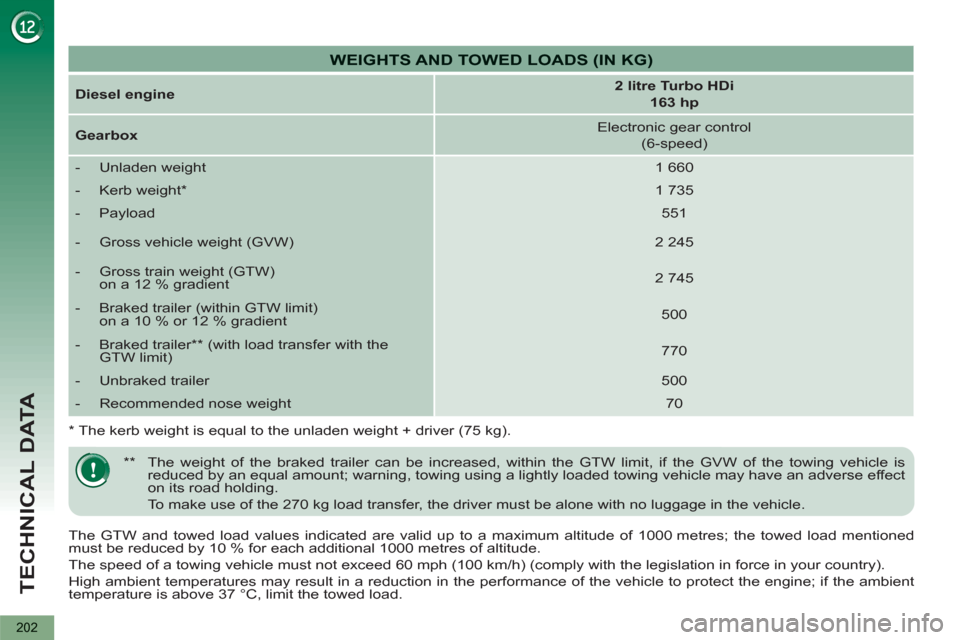
WEIGHTS AND TOWED LOADS (IN KG)
* The kerb weight is equal to the unladen weight + driver (75 kg).
**
The weight of the braked trailer can be increased, within the GTW limit, if the GVW of the towing vehicle is
reduced by an equal amount; warning, towing using a lightly loaded towing vehicle may have an adverse effect
on its road holding.
To make use of the 270 kg load transfer, the driver must be alone with no luggage in the vehicle.
Diesel engine
2 litre Turbo HDi
163 hp
Gearbox
Electronic gear control
(6-speed)
- Unladen weight
1 660
- Kerb weight *
1 735
- Payload
551
- Gross vehicle weight (GVW)
2 245
- Gross train weight (GTW)
on a 12 % gradient
2 745
- Braked trailer (within GTW limit)
on a 10 % or 12 % gradient
500
- Braked trailer ** (with load transfer with the
GTW limit)
770
- Unbraked trailer
500
- Recommended nose weight
70
Page 274 of 284
ALPHABETICAL INDEX
272
Eco-driving ..................................... 39
Economical driving ........................ 39
Economy mode............................. 193
Eco off ............................................ 38
Electric window controls ................. 92
Electronic engine
immobiliser ............................ 87, 89
Electronic stability control
(ESC) ......................................... 134
Emergency call ..................... 206, 207
Emergency warning lamps ........... 133
Energy economy mode................. 193
Engine, Diesel ............... 99, 165, 166,
201, 202
Engine compartment .............. 45, 166
Engine compartment fusebox ....... 183
Engine oil level indicator ......... 60, 167
Engines................................. 200, 201
Environment ......................... 8, 39, 89
ESC/ASR ...................................... 134Halogen headlamps...................... 179
Hands-free kit ............................... 263
Hazard warning lamps .................. 133
Head-up display............ 151, 153, 155
Headlamp adjustment................... 104
Headlamp wash ............................ 106
Headlamp wash reservoir ............. 167
Head restraints, front ...................... 78
Head restraints, rear ....................... 80
Heated seats .................................. 78
Heating ........................................... 39
Height and reach adjustment,
steering wheel ............................. 82
High voltage...... 42, 44, 138, 164, 191
High voltage cable .......................... 44
Hill start assist .............................. 148
History ............................................ 41
Hooks ............................................119
Horn .............................................. 133
Hybrid ................. 4, 6, 26, 31, 35, 190
Hybrid fl ow ............................ 4, 26, 35
Hybrid selector................................ 31
Hybrid system ............... 4, 26, 27, 215 Filling with fuel .......................... 98, 99
Fitting a wheel .............................. 177
Fitting roof bars............................. 197
Fittings, boot ..................................118
Flashing indicators........................ 133
Flat bed lorry or trailer ............ 46, 195
Foglamps, rear ............................. 101
Folding the rear seats ..................... 80
Front foglamps...................... 101, 180
Front seats.......................... 76, 77, 79
Fuel..................................... 39, 98, 99
Fuel consumption ..................... 39, 41
Fuel consumption fi gures ............... 41
Fuel fi ller cap .................................. 98
Fuel fi ller fl ap ............................ 98, 99
Fuel gauge...................................... 98
Fuel tank ................................... 98, 99
Fusebox, dashboard ..................... 183
Fuses ............................................ 183G.P.S. ........................................... 220
Gearbox, electronic
gear control ....................... 157, 169
Gear lever ....................................... 39
Gear lever, electronic
gear control gearbox ................. 157
Glove box ......................................112
Grab handle on console ................ 111
Grab handles ................................. 111
Guidance ...................................... 220
Guide-me-home............................ 103Identifi cation plates ....................... 204
Indicators, direction ...................... 133
Indicator lamps, status
....................51Infl ating accessories
(using the kit) ............................. 170
Infl ating tyres .................................. 39
Inputs for audio
system ....................... 236, 260, 262
Instrument panel lighting ................ 61
Instrument panels ..................... 47, 48
Instrument panel screen ................. 47
Interior fi ttings ................................ 111
Interior mood lighting .................... 109
ISOFIX .......................................... 130
ISOFIX child seats ................. 129-131
ISOFIX mountings ........................ 129
Keeping children
safe .................... 122, 130, 131, 139
Key with remote control ....... 85-87, 89
Labels, identifi cation ..................... 204
Lamps, warning and
indicator ........................... 49, 52, 53
LED daytime running lamps ......... 102
Level, brake fl uid .......................... 167
Level, headlamp wash .......... 106, 167
Level, power steering fl uid ............ 167 Jack .............................................. 176
JACK socket ......................... 260, 262
Jukebox (copy) ............................. 234
Jukebox (playing) ......................... 235
E
H
FI
K
LJG
Page 276 of 284
ALPHABETICAL INDEX
274
Safety for children........... 92, 127, 132
Screen, colour 16/9 .............. 215, 242
Screen, monochrome ........... 256, 266
Screen, monochrome C.................. 68
Screen, multifunction
(with audio equipment) .... 62, 65, 67
Screen-wash reservoir.................. 167
Screen menu map ................ 242, 266
Screenwash, front......................... 106
Screenwash fl uid level .......... 106, 167
Seat adjustment........................ 76, 77
Seat belts............................... 136-138
Seats, electric ................................. 77
Seats, rear ...................................... 80
Serial number, vehicle .................. 204
Service indicator ............................. 58
Servicing ......................................... 39
Service warning light ...................... 53
Setting the clock ............................. 62
Short-cut menus ........................... 216
Sidelamps ..................... 100, 102, 181
Side repeater ................................ 180
SIM card ................................112, 240
Ski fl ap ...........................................116
Snow chain ................................... 204
Spare wheel.................................. 176
Speed limiter................................. 153
Speedometer ............................ 34, 47
Spotlamps, side ............................ 109
Start ............................................ 5, 29
Starting the engine ......... 5, 29, 30, 37
Starting the vehicle ....... 5, 29, 87, 157
Steering mounted controls,
audio .................................. 214, 255
Stopping the vehicle ..... 5, 29, 87, 157
Stop & Start .... 73, 164, 165, 167, 168
Storage ...................111, 113, 116, 118
Storage box ...................................112
Storage wells .................................118
Stowing rings .................................118
Sun visor................................112, 121
Switching off the
engine ................................ 5, 29, 30Vehicle identifi cation ..................... 204
Ventilation ..................... 43, 71, 72, 82
Voice commands .......................... 212
Warning lamps .................... 51, 53, 54
Wash-wipe, rear ........................... 106
Weights ......................................... 202
Welcome lighting .................. 103, 109
Window controls ............................. 92
Wiper, rear .................................... 106
Wiper control stalk ................. 105-107
Wipers .................................. 105, 107
T
V
W
Table of weights ............................ 202
Tables of engines.................. 200, 201
Tables of fuses.............................. 183
Tank, fuel ........................................ 99
Technical data........................ 200-202
Telephone ...................... 207, 237-239
Telephone, hands-free ........... 237-239
Temperature, coolant ...................... 57
Temperature control
for heated seats ........................... 78
Temporary tyre repair kit ............... 170
Third brake lamp........................... 182
TMC (Traffi c info) .......................... 229
Tools ............................................. 176
Total distance recorder ................... 61
Towbar .......................................... 196
Towed loads.................................. 202
Towing another
vehicle ......................... 46, 194, 195
Traction control (ASR) ...... 52, 55, 135
Traffi c information (TA) ......... 230, 258
Traffi c information (TMC) ...... 229, 230
Trip computer ........................... 68, 70
Trip distance recorder ..................... 61
Tyre pressures .............................. 204
Tyres ............................................... 39Under fl oor storage ....................... 121
Unlocking ........................................ 85
Unlocking from the inside ............... 95
Update risk areas ......................... 227
Updating POIs .............................. 227
USB (Peugeot Connect) ........113, 260 Synchronising the remote
control .......................................... 88
System, ASR ................................ 135
System, navigation ....................... 220
SU
Page 280 of 284
VISUAL SEARCH
278
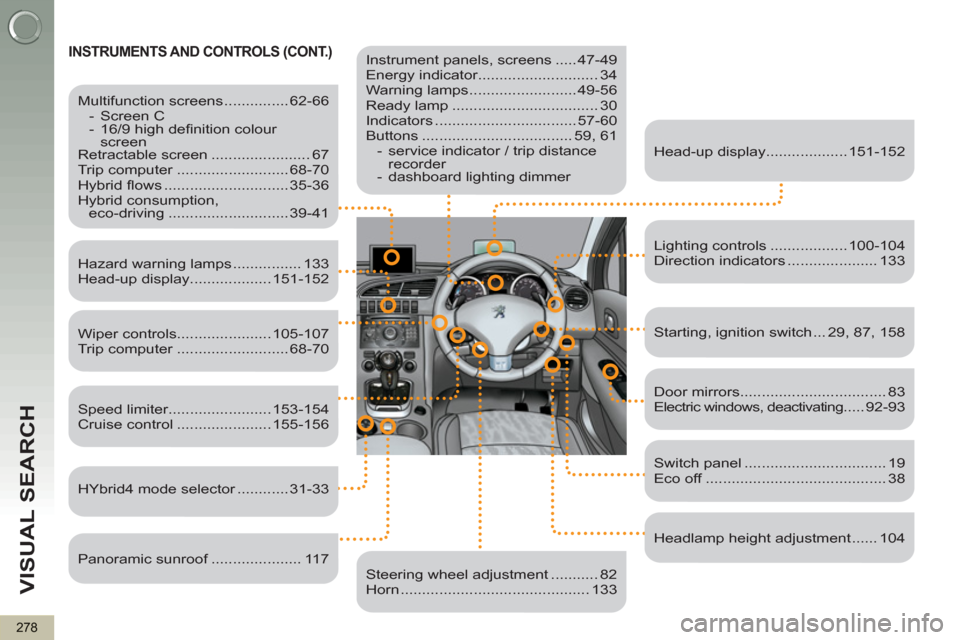
INSTRUMENTS AND CONTROLS (CONT.)
Instrument panels, screens ..... 47-49
Energy indicator............................ 34
Warning lamps ......................... 49-56
Ready lamp .................................. 30
Indicators ................................. 57-60
Buttons ................................... 59, 61
- service indicator / trip distance
recorder
- dashboard lighting dimmer
Head-up display................... 151-152
Lighting controls .................. 100-104
Direction indicators ..................... 133
Speed limiter........................ 153-154
Cruise control ...................... 155-156
Switch panel ................................. 19
Eco off .......................................... 38
Door mirrors .................................. 83
Electric windows, deactivating..... 92-93
Headlamp height adjustment ...... 104
Steering wheel adjustment ........... 82
Horn ............................................ 133
Multifunction screens ............... 62-66
- Screen C
- 16/9 high defi nition colour
screen
Retractable screen ....................... 67
Trip computer .......................... 68-70
Hybrid fl ows ............................. 35-36
Hybrid consumption,
eco-driving ............................ 39-41
Hazard warning lamps ................ 133
Head-up display................... 151-152
Wiper controls...................... 105-107
Trip computer .......................... 68-70
Starting, ignition switch ... 29, 87, 158
HYbrid4 mode selector ............ 31-33
Panoramic sunroof ..................... 117