wheel Peugeot 3008 Hybrid 4 2012 - RHD (UK. Australia) User Guide
[x] Cancel search | Manufacturer: PEUGEOT, Model Year: 2012, Model line: 3008 Hybrid 4, Model: Peugeot 3008 Hybrid 4 2012Pages: 284, PDF Size: 14.08 MB
Page 30 of 284

HY
B
28
The electronic power supervisor - 4
automatically manages the operation of the
two power units (Diesel and electric) to provide the lowest consumption.
An inverter and a transformer are needed to manage the electric power.
The inverter acts on the torque of the electric motor, by regulating the current com-
ing from the high voltage battery pack. Its operating range is between 150 and
270 volts.
The transformer converts the 200 V of the battery pack to 12 V, to power the
vehicle's ancillary systems.
The Stop & Start system - 5
allows the Diesel engine to be put into standby dur-
ing stops (traffi c lights, a stop, or in a traffi c jam, for example) or during phases of
running in all-electric mode.
The stopping and restarting of the Diesel engine is done in a way that is instanta-
neous and transparent for the driver.
The electronic gearbox - 6
provides, in automatic mode, signifi cant savings in
fuel consumption compared to a conventional manual gearbox, thanks to its elec-
tronic control system.
It also offers improved driving pleasure with the possibility at any time of choosing
the gear changing mode: automatic or manual, using the paddles located behind
the steering wheel.
Page 34 of 284
HY
B
32
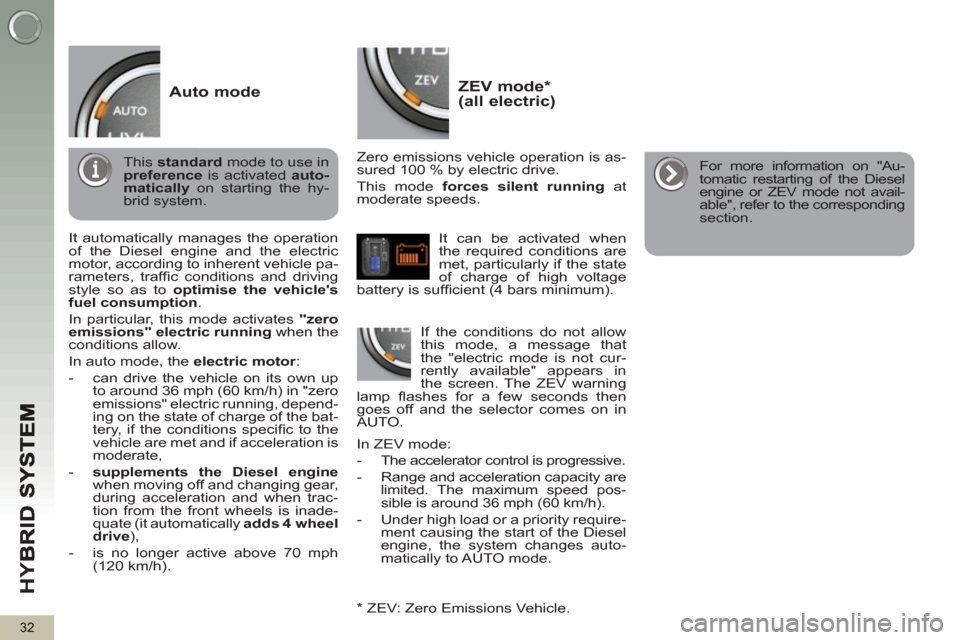
ZEV mode * (all electric)
Zero emissions vehicle operation is as-
sured 100 % by electric drive.
This mode forces silent running
at
moderate speeds.
* ZEV: Zero Emissions Vehicle. In ZEV mode:
- The accelerator control is progressive.
- Range and acceleration capacity are
limited. The maximum speed pos-
sible is around 36 mph (60 km/h).
- Under high load or a priority require-
ment causing the start of the Diesel
engine, the system changes auto-
matically to AUTO mode.
It can be activated when
the required conditions are
met, particularly if the state
of charge of high voltage
battery is suffi cient (4 bars minimum).
If the conditions do not allow
this mode, a message that
the "electric mode is not cur-
rently available" appears in
the screen. The ZEV warning
lamp fl ashes for a few seconds then
goes off and the selector comes on in
AUTO.
Auto mode
It automatically manages the operation
of the Diesel engine and the electric
motor, according to inherent vehicle pa-
rameters, traffi c conditions and driving
style so as to optimise the vehicle's
fuel consumption
.
In particular, this mode activates "zero
emissions" electric running
when the
conditions allow.
In auto mode, the electric motor
:
- can drive the vehicle on its own up
to around 36 mph (60 km/h) in "zero
emissions" electric running, depend-
ing on the state of charge of the bat-
tery, if the conditions specifi c to the
vehicle are met and if acceleration is
moderate,
- supplements the Diesel engine
when moving off and changing gear,
during acceleration and when trac-
tion from the front wheels is inade-
quate (it automatically adds
4 wheel
drive
),
- is no longer active above 70 mph
(120 km/h).
This standard
mode to use in
preference
is activated auto-
matically
on starting the hy-
brid system.
For more information on "Au-
tomatic restarting of the Diesel
engine or ZEV mode not avail-
able", refer to the corresponding
section.
Page 35 of 284
HY
B
33
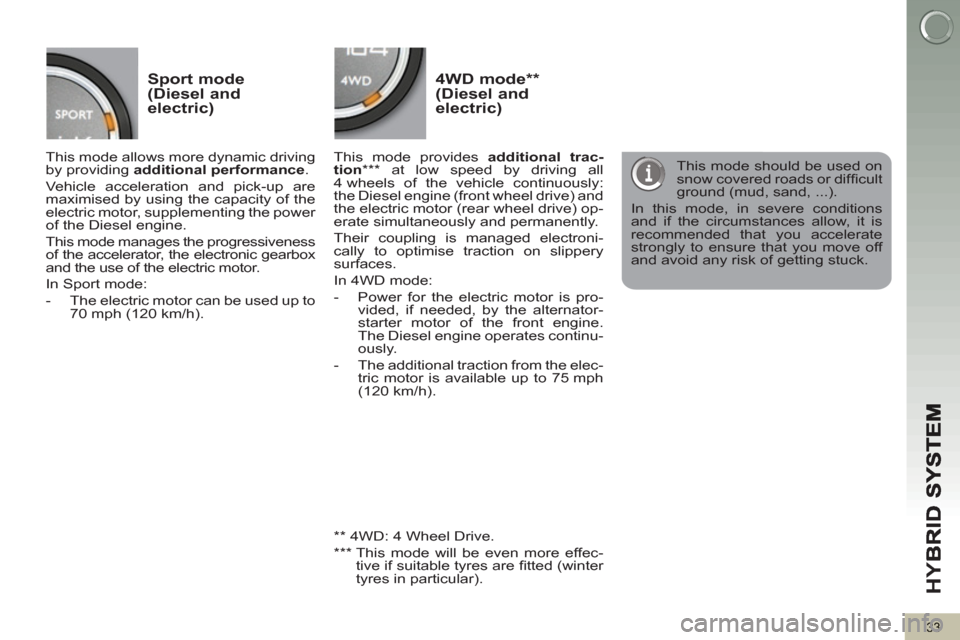
Sport mode (Diesel and electric)
4WD mode ** (Diesel and
electric)
This mode allows more dynamic driving
by providing additional performance
.
Vehicle acceleration and pick-up are
maximised by using the capacity of the
electric motor, supplementing the power
of the Diesel engine.
This mode manages the progressiveness
of the accelerator, the electronic gearbox
and the use of the electric motor.
In Sport mode:
- The electric motor can be used up to
70 mph (120 km/h).
This mode provides additional trac-
tion
*** at low speed by driving all
4 wheels of the vehicle continuously:
the Diesel engine (front wheel drive) and
the electric motor (rear wheel drive) op-
erate simultaneously and permanently.
Their coupling is managed electroni-
cally to optimise traction on slippery
surfaces.
In 4WD mode:
- Power for the electric motor is pro-
vided, if needed, by the alternator-
starter motor of the front engine.
The Diesel engine operates continu-
ously.
- The additional traction from the elec-
tric motor is available up to 75 mph
(120 km/h).
This mode should be used on
snow covered roads or diffi cult
ground (mud, sand, ...).
In this mode, in severe conditions
and if the circumstances allow, it is
recommended that you accelerate
strongly to ensure that you move off
and avoid any risk of getting stuck.
** 4WD: 4 Wheel Drive.
***
This mode will be even more effec-
tive if suitable tyres are fi tted (winter
tyres in particular).
Page 37 of 284
HY
B
35
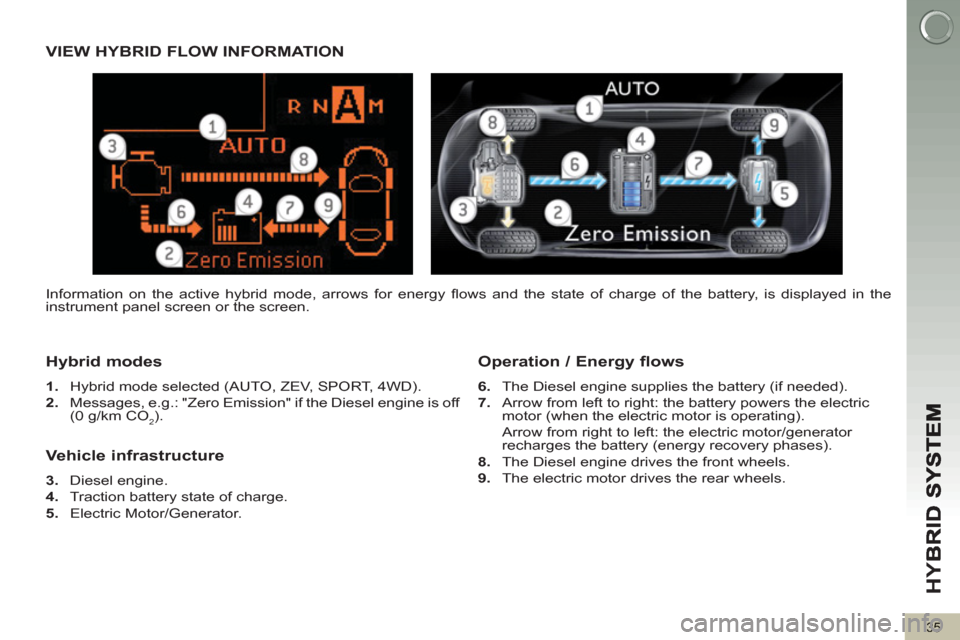
VIEW HYBRID FLOW INFORMATION
H
ybrid modes
1.
Hybrid mode selected (AUTO, ZEV, SPORT, 4WD).
2.
Messages, e.g.: "Zero Emission" if the Diesel engine is off
(0 g/km CO
2).
Operation / Energy flows
6.
The Diesel engine supplies the battery (if needed).
7.
Arrow from left to right: the battery powers the electric
motor (when the electric motor is operating).
Arrow from right to left: the electric motor/generator
recharges the battery (energy recovery phases).
8.
The Diesel engine drives the front wheels.
9.
The electric motor drives the rear wheels.
Vehicle infrastructure
3.
Diesel engine.
4.
Traction battery state of charge.
5.
Electric Motor/Generator. Information on the active hybrid mode, arrows for energy fl ows and the state of charge of the battery, is displayed in the
instrument panel screen or the screen.
Page 38 of 284
HY
B
36
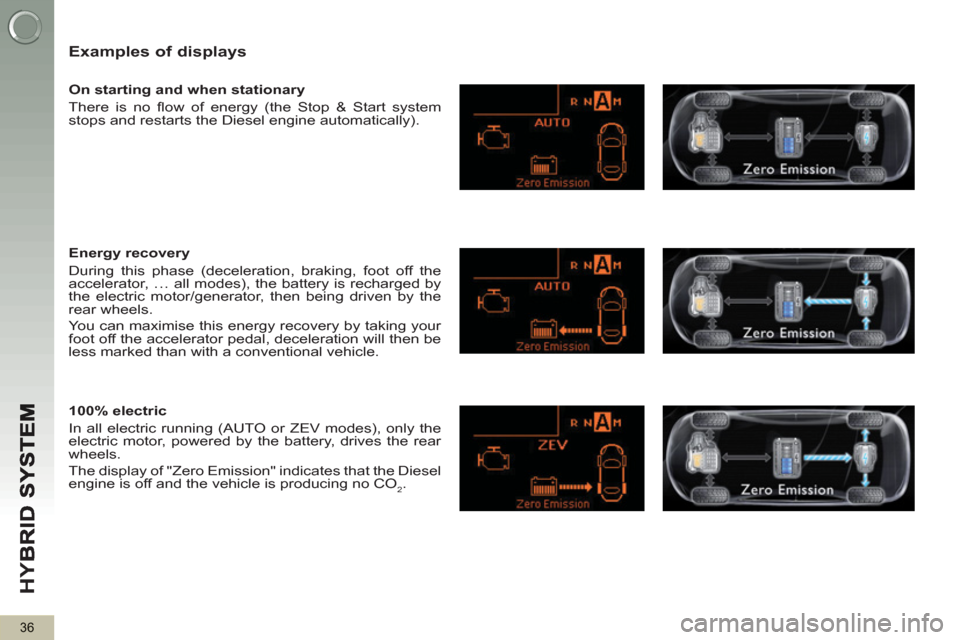
Examples of displays
On starting and when stationary
There is no fl ow of energy (the Stop & Start system
stops and restarts the Diesel engine automatically).
Energy recovery
During this phase (deceleration, braking, foot off the
accelerator, … all modes), the battery is recharged by
the electric motor/generator, then being driven by the
rear wheels.
You can maximise this energy recovery by taking your
foot off the accelerator pedal, deceleration will then be
less marked than with a conventional vehicle.
100% electric
In all electric running (AUTO or ZEV modes), only the
electric motor, powered by the battery, drives the rear
wheels.
The display of "Zero Emission" indicates that the Diesel
engine is off and the vehicle is producing no CO
2.
Page 42 of 284
HY
B
40
Limit the causes of excess consumption
Spread loads throughout the vehicle;
place the heaviest items in the bottom
of the boot, as close as possible to the
rear seats.
Limit the loads carried in the vehicle
and reduce wind resistance (roof bars,
roof rack, bicycle carrier, trailer...). Use
a roof box in preference.
Remove roof bars and roof racks after
use.
At the end of winter, remove snow
tyres and refi t your summer tyres.
Observe the recommendationson maintenance
Check the tyre pressures regularly,
when cold, referring to the label in the
door aperture, driver's side.
Carry out this check in particular:
- before a long journey,
- at each change of season,
- after a long period out of use.
Have your vehicle serviced regularly
(engine oil, oil fi lter, air fi lter...) and ob-
serve the schedule of operations rec-
ommended by the manufacturer.
When refuelling, do not continue after
the 3 rd cut-off of the nozzle to avoid
any overfl ow.
At the wheel of your new vehicle,
it is only after the fi rst 1 800 miles
(3 000 kilometres) that you will see
the fuel consumption settle down to a
consistent average.
Page 48 of 284
HY
B
46
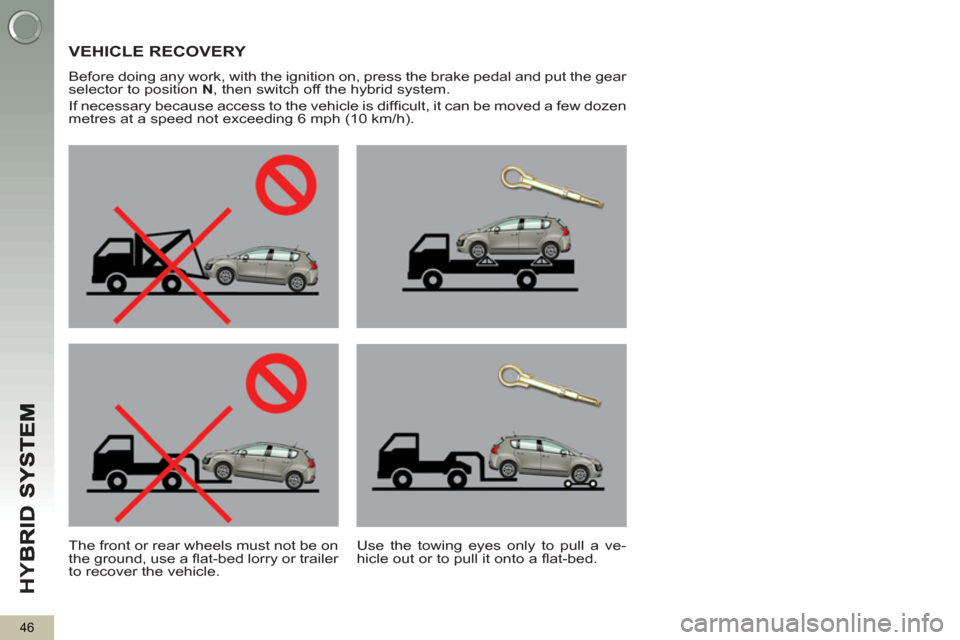
VEHICLE RECOVERY
Before doing any work, with the ignition on, press the brake pedal and put the gear
selector to position N
, then switch off the hybrid system.
If necessary because access to the vehicle is diffi cult, it can be moved a few dozen
metres at a speed not exceeding 6 mph (10 km/h).
The front or rear wheels must not be on
the ground, use a fl at-bed lorry or trailer
to recover the vehicle.
Use the towing eyes only to pull a ve-
hicle out or to pull it onto a fl at-bed.
Page 80 of 284
CO
78
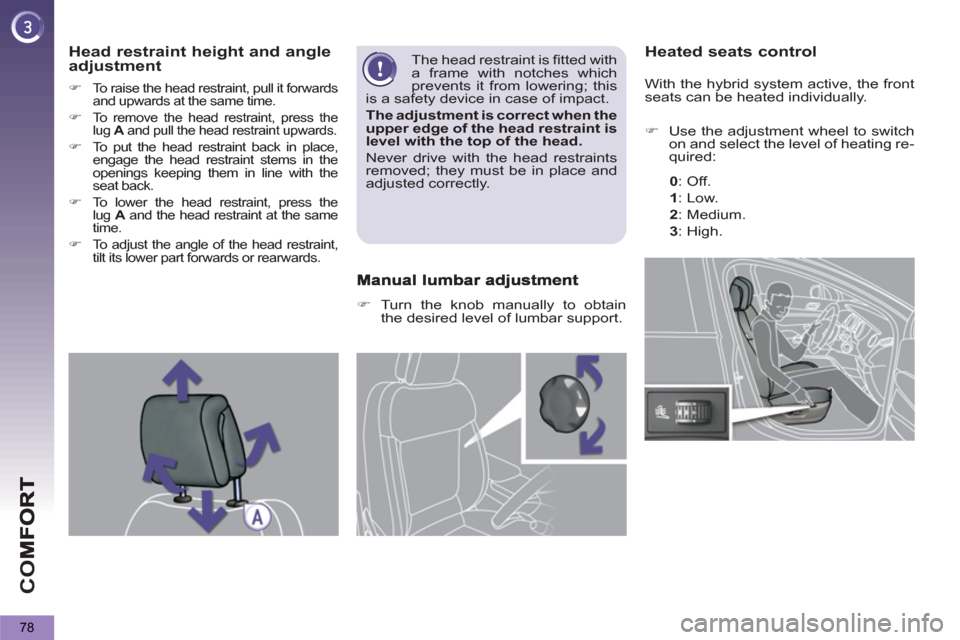
Heated seats control
)
Use the adjustment wheel to switch
on and select the level of heating re-
quired:
0
:
Off.
1
:
Low.
2
:
Medium.
3
:
High.
Head restraint height and angleadjustment
)
To raise the head restraint, pull it forwards
and upwards at the same time.
)
To remove the head restraint, press the
lug A
and pull the head restraint upwards.
)
To put the head restraint back in place,
engage the head restraint stems in the
openings keeping them in line with the
seat back.
)
To lower the head restraint, press the
lug A
and the head restraint at the same
time.
)
To adjust the angle of the head restraint,
tilt its lower part forwards or rearwards.
The head restraint is fi tted with
a frame with notches which
prevents it from lowering; this
is a safety device in case of impact.
The adjustment is correct when the
upper edge of the head restraint is
level with the top of the head.
Never drive with the head restraints
removed; they must be in place and
adjusted correctly.
)
Turn the knob manually to obtain
the desired level of lumbar support.
With the hybrid system active, the front
seats can be heated individually.
Page 84 of 284
CO
82
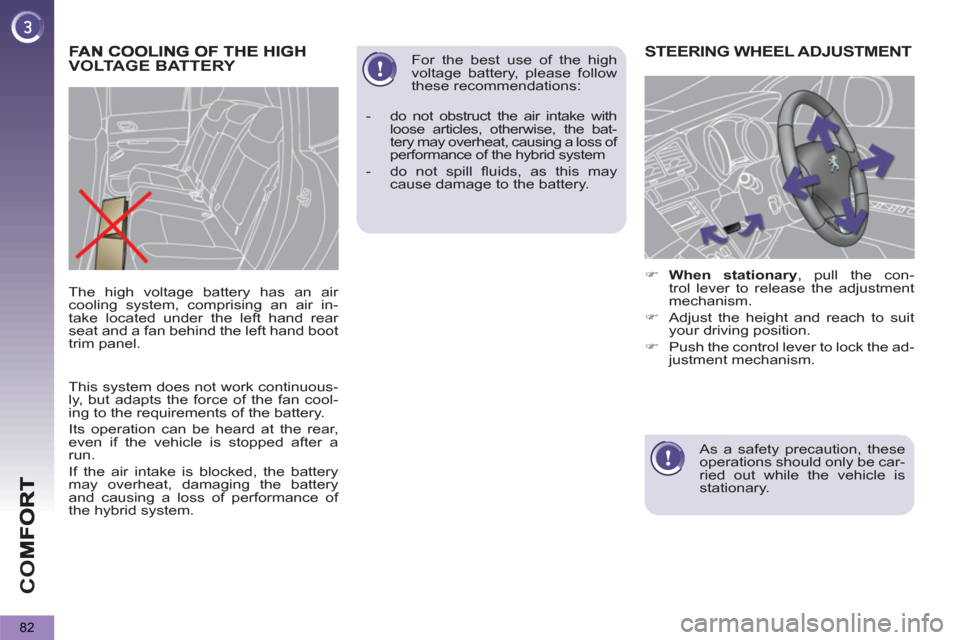
This system does not work continuous-
ly, but adapts the force of the fan cool-
ing to the requirements of the battery.
Its operation can be heard at the rear,
even if the vehicle is stopped after a
run.
If the air intake is blocked, the battery
may overheat, damaging the battery
and causing a loss of performance of
the hybrid system.
STEERING WHEEL ADJUSTMENT
)
When stationary
, pull the con-
trol lever to release the adjustment
mechanism.
)
Adjust the height and reach to suit
your driving position.
)
Push the control lever to lock the ad-
justment mechanism.
As a safety precaution, these
operations should only be car-
ried out while the vehicle is
stationary.
VOLTAGE BATTERY
For the best use of the high
voltage battery, please follow
these recommendations:
- do not obstruct the air intake with
loose articles, otherwise, the bat-
tery may overheat, causing a loss of
performance of the hybrid system
- do not spill fl uids, as this may
cause damage to the battery.
The high voltage battery has an air
cooling system, comprising an air in-
take located under the left hand rear
seat and a fan behind the left hand boot
trim panel.
Page 113 of 284
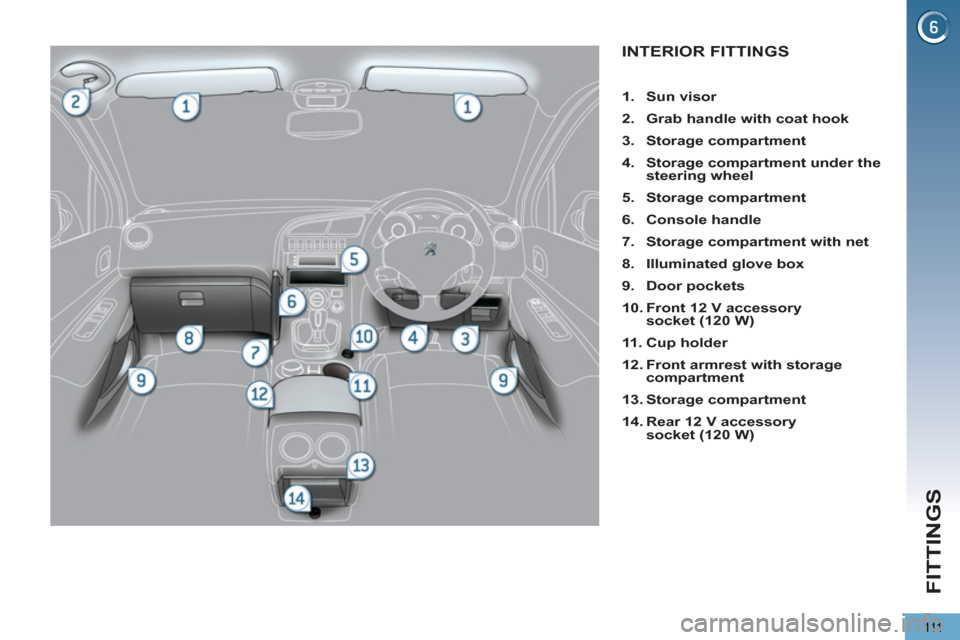
FITTINGS
111
INTERIOR FITTINGS
1.
Sun visor
2.
Grab handle with coat hook
3.
Storage compartment
4.
Storage compartment under the
steering wheel
5.
Storage compartment
6.
Console handle
7.
Storage compartment with net
8.
Illuminated glove box
9.
Door pockets
10.
Front 12 V accessory
socket (120 W)
11 .
Cup holder
12.
Front armrest with storage
compartment
13.
Storage compartment
14.
Rear 12 V accessory
socket (120 W)