ESP Peugeot 3008 Hybrid 4 2012 - RHD (UK. Australia) Owner's Guide
[x] Cancel search | Manufacturer: PEUGEOT, Model Year: 2012, Model line: 3008 Hybrid 4, Model: Peugeot 3008 Hybrid 4 2012Pages: 284, PDF Size: 14.08 MB
Page 110 of 284

VIS
108
COURTESY LAMPS
1.
Front courtesy lamp
2.
Map reading lamps
Front and rear courtesy lamps
In this position, the courtesy
lamp comes on gradually:
Map reading lamps
)
With the ignition on, press the cor-
responding switch.
With the "permanent lighting"
mode, the lighting time varies
according to the circumstances:
- with the ignition off, approximately
ten minutes,
- in energy economy mode, ap-
proximately thirty seconds,
- with the hybrid system active, un-
limited.
- when the vehicle is unlocked,
-
when the key is removed from the ignition,
- when a door is opened,
- when the remote control locking but-
ton is activated, in order to locate
your vehicle.
Permanently off.
Permanently on.
When the front courtesy lamp
is in the "permanently on" po-
sition, the rear courtesy lamp
will also come on, unless it is in the
"permanently off" position.
To switch off the rear courtesy lamp,
place it in the "permanently off" position.
Rear side reading lamps
)
With the ignition on, the fi rst press
of the reading lamp switch switches
on the reading lamp in "permanently
on" mode.
)
Following a second press, it comes on:
- when the vehicle is unlocked,
- when the key is removed from the
ignition,
- when a door is opened,
- when the remote control locking
button is pressed, in order to
locate your vehicle.
It switches off gradually:
- when the vehicle is locked,
- when the ignition is switched on,
- 30 seconds after the last door is
closed.
It switches off gradually:
- when the vehicle is locked,
- when the ignition is switched on,
- 30 seconds after the last door is
closed.
3.
Rear side reading lamps
4.
Rear courtesy lamp
Take care not to place anything in contact
with the courtesy lamps.
Page 135 of 284
SA
F
133
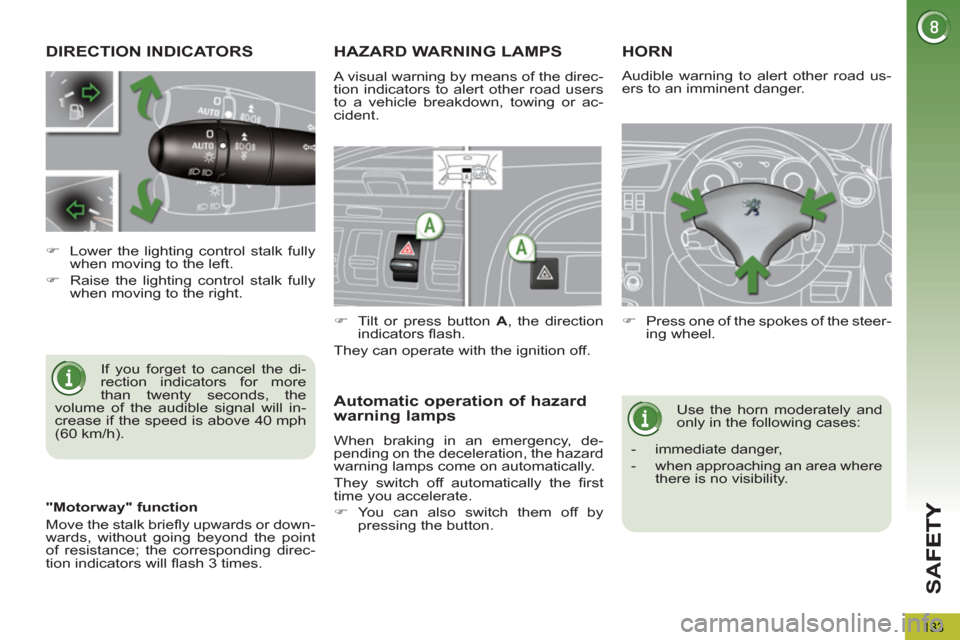
DIRECTION INDICATORS
If you forget to cancel the di-
rection indicators for more
than twenty seconds, the
volume of the audible signal will in-
crease if the speed is above 40 mph
(60 km/h).
)
Lower the lighting control stalk fully
when moving to the left.
)
Raise the lighting control stalk fully
when moving to the right.
HAZARD WARNING LAMPS
A visual warning by means of the direc-
tion indicators to alert other road users
to a vehicle breakdown, towing or ac-
cident.
)
Tilt or press button A
, the direction
indicators fl ash.
They can operate with the ignition off.
Automatic operation of hazard
warning lamps
When braking in an emergency, de-
pending on the deceleration, the hazard
warning lamps come on automatically.
They switch off automatically the fi rst
time you accelerate.
)
You can also switch them off by
pressing the button.
HORN
)
Press one of the spokes of the steer-
ing wheel.
Use the horn moderately and
only in the following cases:
- immediate danger,
- when approaching an area where
there is no visibility.
Audible warning to alert other road us-
ers to an imminent danger.
"Motorway" function
Move the stalk briefl y upwards or down-
wards, without going beyond the point
of resistance; the corresponding direc-
tion indicators will fl ash 3 times.
Page 137 of 284
SA
F
135
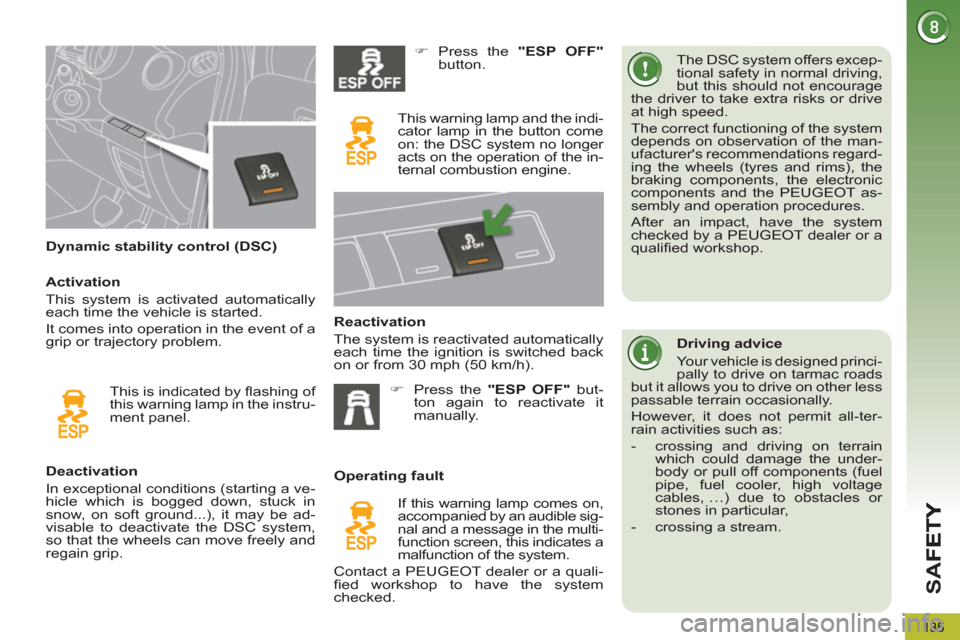
Dynamic stability control (DSC) The DSC system offers excep-
tional safety in normal driving,
but this should not encourage
the driver to take extra risks or drive
at high speed.
The correct functioning of the system
depends on observation of the man-
ufacturer's recommendations regard-
ing the wheels (tyres and rims), the
braking components, the electronic
components and the PEUGEOT as-
sembly and operation procedures.
After an impact, have the system
checked by a PEUGEOT dealer or a
qualifi ed workshop.
Deactivation
In exceptional conditions (starting a ve-
hicle which is bogged down, stuck in
snow, on soft ground...), it may be ad-
visable to deactivate the DSC system,
so that the wheels can move freely and
regain grip.
)
Press the "ESP OFF"
button.
This warning lamp and the indi-
cator lamp in the button come
on: the DSC system no longer
acts on the operation of the in-
ternal combustion engine.
Reactivation
The system is reactivated automatically
each time the ignition is switched back
on or from 30 mph (50 km/h).
Operating fault
If this warning lamp comes on,
accompanied by an audible sig-
nal and a message in the multi-
function screen, this indicates a
malfunction of the system.
Contact a PEUGEOT dealer or a quali-
fi ed workshop to have the system
checked. This is indicated by fl ashing of
this warning lamp in the instru-
ment panel.
Activation
This system is activated automatically
each time the vehicle is started.
It comes into operation in the event of a
grip or trajectory problem.
)
Press the "ESP OFF"
but-
ton again to reactivate it
manually.
Driving advice
Your vehicle is designed princi-
pally to drive on tarmac roads
but it allows you to drive on other less
passable terrain occasionally.
However, it does not permit all-ter-
rain activities such as:
- crossing and driving on terrain
which could damage the under-
body or pull off components (fuel
pipe, fuel cooler, high voltage
cables, …) due to obstacles or
stones in particular,
- crossing a stream.
Page 139 of 284

SA
F
137
1.
Front and/or rear seat belts not fas-
tened / unfastened warning lamp.
2.
Front left seat belt warning lamp.
3.
Front right seat belt warning lamp.
4.
Rear right seat belt warning lamp.
5.
Rear centre seat belt warning lamp.
6.
Rear left seat belt warning lamp.
Seat belt not fastened / unfastened
warning lamps display
Rear seat belts
The rear seats are each fi tted with a
three-point inertia reel seat belt with
force limiter (with the exception of the
centre rear seat).
Seat belt unfastened warning lamp
This warning lamp comes on on
the seat belt and passenger's
front airbag warning lamps dis-
play, when one or more rear
passengers unfasten their seat belt.
From approximately 12 mph (20 km/h),
this warning lamp fl ashes for two min-
utes accompanied by an audible signal.
Once these two minutes have elapsed,
this warning lamp remains on until the
one or more rear passengers fasten
their seat belt.
Fastening
)
Pull the strap, then insert the tongue
in the buckle.
)
Check that the seat belt is fastened
correctly by pulling the strap.
Unfastening
)
Press the red button on the buckle.
)
Guide the seat belt as it reels in.
The corresponding warning lamp 2
or
3
comes on in red on the seat belt and
passenger's front airbag warning lamps
display if the seat belt is not fastened or
is unfastened.
When the ignition is switched on, with
the hybrid system active or when the
vehicle is moving at less than 12 mph
(20 km/h), the corresponding warning
lamps 4
, 5
and 6
come on in red for ap-
proximately 30 seconds, if the seat belt
is not fastened.
When the vehicle is moving at more
than 12 mph (20 km/h), the correspond-
ing warning lamp 4
, 5
or 6
comes on in
red, accompanied by an audible signal
and a message on the multifunction
screen, if a rear passenger has unfas-
tened their seat belt.
Seat belt unfastened warning lamps
display
Page 143 of 284

SA
F
141
Lateral airbags
System which protects the driver and
front passenger in the event of a seri-
ous side impact in order to limit the risk
of injury to the chest.
Each lateral airbag is fi tted in the front, in
the outer side of the seat back frame.
Deployment
The lateral airbags are deployed unilater-
ally in the event of a serious side impact
applied to all or part of the side impact
zone B
, perpendicular to the longitudinal
centreline of the vehicle on a horizontal
plane and directed from the outside to-
wards the inside of the vehicle.
Curtain airbags
System which protects the driver and
passengers (with the exception of the
rear centre passenger) in the event of a
serious side impact in order to limit the
risk of injury to the side of the head.
Each curtain airbag is built into the pil-
lars and the upper passenger compart-
ment area.
Operating fault
Deployment
The curtain airbag is deployed at the same
time as the corresponding lateral airbag in
the event of a serious side impact applied
to all or part of the side impact zone B
,
perpendicular to the longitudinal cen-
treline of the vehicle on a horizontal plane
and directed from the outside towards the
inside of the vehicle.
The curtain airbag infl ates between the
front or rear occupant of the vehicle and
the windows.
In the event of a minor impact
or bump on the side of the
vehicle or if the vehicle rolls
over, the airbag may not be
deployed.
In the event of a rear or front colli-
sion, the airbag is not deployed.
Impact detection zones
A.
Front impact zone.
B.
Side impact zone.
If this warning lamp comes on in
the instrument panel, accompa-
nied by an audible signal and a
message in the screen, contact
a PEUGEOT dealer or a quali-
fi ed workshop to have the system checked.
The airbags may no longer be deployed in
the event of a serious impact. The lateral airbag infl ates between the
front occupant of the vehicle and the
corresponding door panel.
Page 155 of 284

D
R
153
SPEED LIMITER
The controls of this system are grouped
together on stalk A
.
1.
Speed limiter mode selection dial
2.
Programmed value decrease button
3.
Programmed value increase button
4.
Speed limiter on / off button
The programmed information is grouped
together on the instrument panel screen.
5.
Speed limiter on / off indication
6.
Speed limiter mode selection indication
7.
Programmed speed value
Steering mounted controls Displays in the instrument panel
The speed limiter cannot, in
any circumstances, replace
the need to observe speed
limits, nor can it replace the need for
vigilance and responsibility on the
part of the driver.
The speed limiter is switched on
manually:
it requires a programmed speed of at least
20 mph (30 km/h).
The speed limiter is switched off
by
manual operation of the control.
The programmed speed remains in the
memory when the ignition is switched
off.
This information also appears
in the head-up display.
For more information on the head-up
display, refer to the relevant page in
this "Driving" section.
System which prevents the vehicle from
exceeding the speed programmed by
the driver.
When the programmed speed limit is
reached, pressing the accelerator ped-
al no longer has any effect unless it is
pressed fi rmly, which permits temporary
exceeding of the programmed speed.
To return to the programmed speed,
simply slow down to a speed below the
programmed speed by releasing the ac-
celerator.
Page 157 of 284

D
R
155
CRUISE CONTROL
The controls of this system are grouped
together on stalk A
.
1.
Cruise control mode selection wheel
2.
Speed programming / programmed
value decrease button
3.
Speed programming / programmed
value increase button
4.
Cruise control off / resume button The programmed information is grouped
together in the instrument panel screen.
5.
Cruise control off / resume indication
6.
Cruise control mode selection indication
7.
Programmed speed value
Steering mounted controls Displays in the instrument panel
The cruise control cannot, in
any circumstances, replace
the need to observe speed
limits, nor can it replace the need for
vigilance and responsibility on the
part of the driver.
Cruise control is switched on
manual-
ly: it requires a minimum vehicle speed
of 25 mph (40 km/h) and the engage-
ment second gear in sequential mode
(position M
).
Cruise control is switched off
manually
or by pressing the brake pedal or on trig-
gering of the "dynamic stability control"
system for safety reasons.
It is possible to exceed the programmed
speed temporarily by pressing the ac-
celerator pedal.
To return to the programmed speed,
simply release the accelerator pedal.
This information also appears
in the head-up display.
For more information on the head-up
display, refer to the relevant page in
this "Driving" section. Switching off the ignition cancels any
programmed speed value.
System which automatically maintains
the speed of the vehicle at the value
programmed by the driver, without any
action on the accelerator pedal.
Page 163 of 284

D
R
161
PARKING SENSORS
This system indicates the proximity of an
obstacle (person, vehicle, tree, gate, etc.)
which comes within the fi eld of detection
of sensors located in the bumper.
Certain types of obstacle (stake, road-
works cone, etc.) detected initially will
no longer be detected at the end of the
manoeuvre due to the presence of blind
spots.
This function cannot, in any
circumstances, take the place
of the vigilance and responsi-
bility of the driver.
The system is switched on by engaging
reverse gear. This is accompanied by
an audible signal.
The system is switched off when you
exit reverse gear.
Audible assistance
The proximity information is given by an
intermittent audible signal, the frequency
of which increases as the vehicle ap-
proaches the obstacle.
The sound emitted by the speaker (right
or left) indicates the side on which the
obstacle is located.
When the distance between the vehicle
and the obstacle becomes less than ap-
proximately thirty centimetres, the audible
signal becomes continuous.
Visual assistance
This supplements the audible signal
by displaying bars in the multifunction
screen which move progressively nearer
to the vehicle. When the obstacle is near,
the "Danger" symbol is also displayed in
the screen.
Page 185 of 284

PRACTICAL INFORMATION
183
CHANGING A FUSE
Access to the tools
The fuse extraction tweezer is fi tted
to the back of the dashboard fusebox
cover.
To gain access to it:
)
Remove the cover completely.
)
Remove the tweezer.
Changing a fuse
Good
Failed
)
Use the special tweezer to extract
the fuse from its housing.
)
Always replace the faulty fuse with a
fuse of the same rating.
)
Check that the number etched on
the box, the rating etched on the
fuse and the tables below all agree.
Installing electrical
accessories
Your vehicle's electrical system
is designed to operate with standard
or optional equipment.
Before installing other electrical
equipment or accessories on your
vehicle, contact a PEUGEOT dealer.
PEUGEOT will not accept
responsibility for the cost in-
curred in repairing your vehicle
or for rectifying malfunctions resulting
from the installation of accessories
not supplied and not recommended
by PEUGEOT and not installed in
accordance with its instructions, in
particular when the combined consump-
tion of all of the additional equipment
connected exceeds 10 milliamperes.
Before changing a fuse, the cause of
the failure must be identifi ed and recti-
fi ed.
)
Identify the faulty fuse by checking
the condition of its fi lament.
Procedure for replacing a faulty fuse
with a new fuse to rectify a failure of the
corresponding function.
Page 189 of 284
PRACTICAL INFORMATION
187
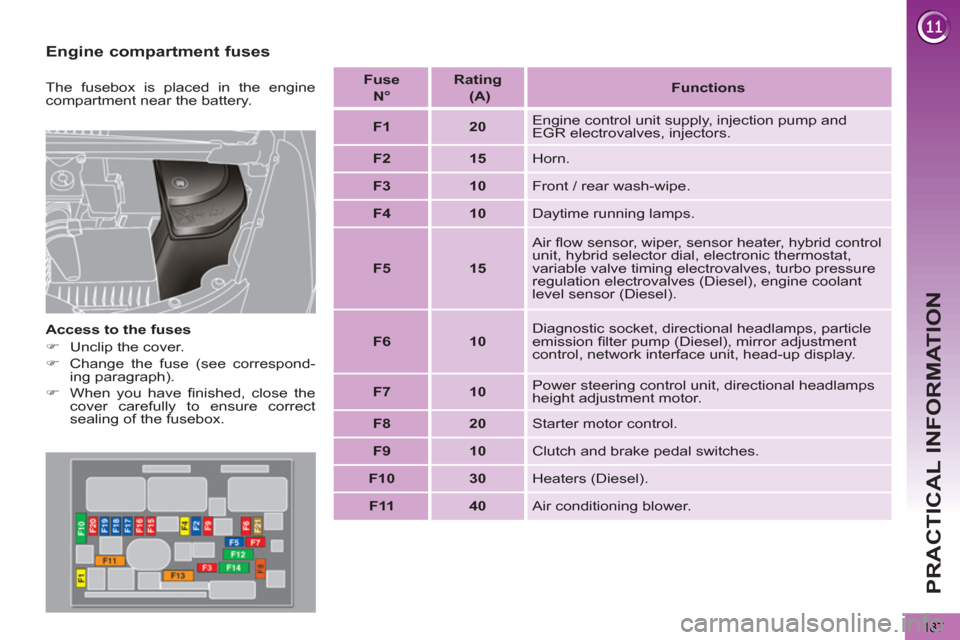
Engine compartment fuses
Access to the fuses
)
Unclip the cover.
)
Change the fuse (see correspond-
ing paragraph).
)
When you have fi nished, close the
cover carefully to ensure correct
sealing of the fusebox.
The fusebox is placed in the engine
compartment near the battery.
Fuse
N°
Rating
(A)
Functions
F1
20
Engine control unit supply, injection pump and
EGR electrovalves, injectors.
F2
15
Horn.
F3
10
Front / rear wash-wipe.
F4
10
Daytime running lamps.
F5
15
Air fl ow sensor, wiper, sensor heater, hybrid control
unit, hybrid selector dial, electronic thermostat,
variable valve timing electrovalves, turbo pressure
regulation electrovalves (Diesel), engine coolant
level sensor (Diesel).
F6
10
Diagnostic socket, directional headlamps, particle
emission fi lter pump (Diesel), mirror adjustment
control, network interface unit, head-up display.
F7
10
Power steering control unit, directional headlamps
height adjustment motor.
F8
20
Starter motor control.
F9
10
Clutch and brake pedal switches.
F10
30
Heaters (Diesel).
F11
40
Air conditioning blower.