child seat Peugeot 3008 Hybrid 4 2012 Owner's Manual - RHD (UK. Australia)
[x] Cancel search | Manufacturer: PEUGEOT, Model Year: 2012, Model line: 3008 Hybrid 4, Model: Peugeot 3008 Hybrid 4 2012Pages: 284, PDF Size: 14.08 MB
Page 4 of 284
CONTENTS
FAMILIARISATION 4-25
IN
STRUMENTS and
CONTROLS 47-61
CHILD SAFETY 122-132
MULTIFUNCTION
SCREEN
S62-70
SAFETY 133-142 COMFORT 71-8
4
ACCESS 85-99
VISIBILITY 100-110FITTINGS 111-12
1
Instrument panels...........................47Indicator and warning lamps..........49Indicators........................................57Adjustment buttons.........................61
Child seats....................................122ISOFIX child seats........................129Child lock ......................................132
Screen C (Peugeot ConnectSound (RD5))...............................6216/9 high definition retractable colour
screen (Peugeot Connect Media).....65
Direction indicators.......................133Hazard warning lamps..................133Horn ..............................................133ESC system..................................134Front seat belts.............................136Airbags .........................................139
Heating and Ventilation ..................71Rear screen demist - defrost..........72Dual-zone digital air conditioning......73Front seats .....................................76Rear seats......................................80Steering wheel adjustment.............82Mirrors............................................83
Remote control key........................85Alarm ..............................................90Electric windows.............................92Doors..............................................94Boot................................................96Lower tailgate.................................97Fuel tank.........................................98Misfuel prevention (Diesel) .............99
Lighting controls...........................100LED lamps ....................................102Daytime running lamps.................102Automatic illumination
of headlamps..............................103Headlamp adjustment..................104Wiper controls ..............................105Automatic rain sensitive wipers .....107Courtesy lamps............................108Interior mood lighting....................109Boot lamp......................................110
Interior fittings................................111Front armrest.................................113Rear multimedia............................115Panoramic sunroof........................f117Boot fittings....................................118HYBRID SYSTEM 26-46
Presentation...................................26Ready lamp....................................30HYbrid4 mode selector...................r31Energy consumption / generationindicator........................................r34Display of hybrid power flow..........35Eco off............................................f38Eco-driving......................................39Consumption ..................................41High voltage battery.......................42Vehicle recovery.............................46
Page 22 of 284
20
FA
M
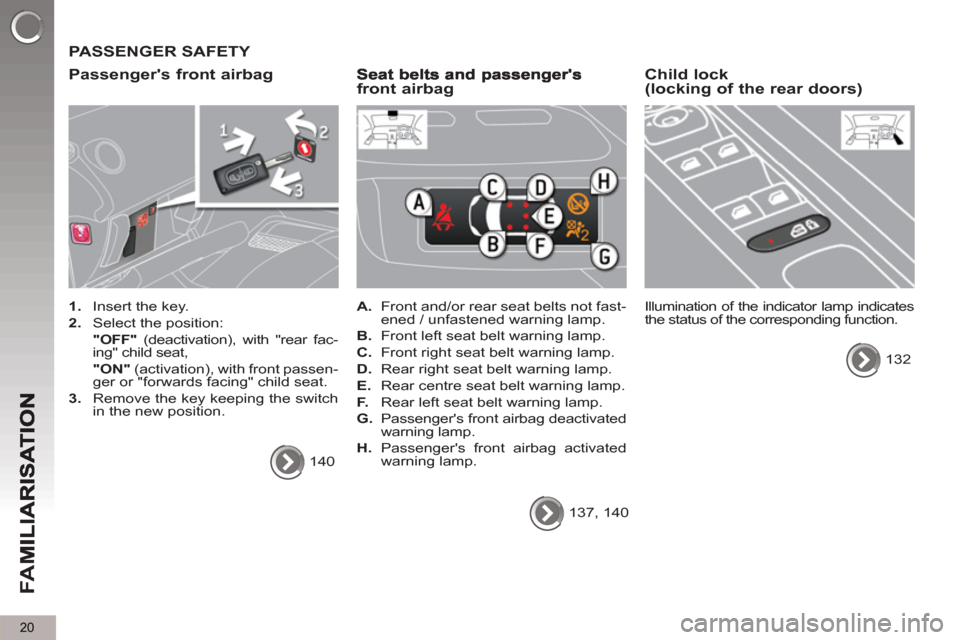
PASSENGER SAFETY
Passen
ger's front airbag
1.
Insert the key.
2.
Select the position:
"OFF"
(deactivation), with "rear fac-
ing" child seat,
"ON"
(activation), with front passen-
ger or "forwards facing" child seat.
3.
Remove the key keeping the switch
in the new position.
140
front airbag
A.
Front and/or rear seat belts not fast-
ened / unfastened warning lamp.
B.
Front left seat belt warning lamp.
C.
Front right seat belt warning lamp.
D.
Rear right seat belt warning lamp.
E.
Rear centre seat belt warning lamp.
F.
Rear left seat belt warning lamp.
G.
Passenger's front airbag deactivated
warning lamp.
H.
Passenger's front airbag activated
warning lamp.
137, 140
Child lock (locking of the rear doors)
Illumination of the indicator lamp indicates
the status of the corresponding function.
132
Page 54 of 284
52
IN
S
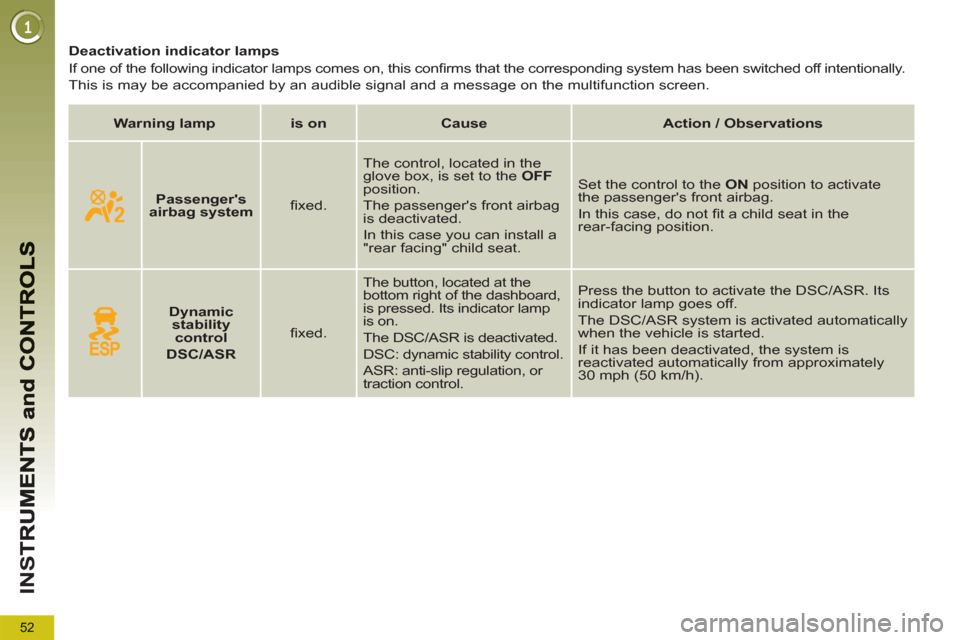
Deactivation indicator lamps
If one of the following indicator lamps comes on, this confi rms that the corresponding system has been switched off intentionally.
This is may be accompanied by an audible signal and a message on the multifunction screen.
Warning lamp
is on
Cause
Action / Observations
Passenger's
airbag system
fi xed. The control, located in the
glove box, is set to the OFF
position.
The passenger's front airbag
is deactivated.
In this case you can install a
"rear facing" child seat. Set the control to the ON
position to activate
the passenger's front airbag.
In this case, do not fi t a child seat in the
rear-facing position.
Dynamic
stability
control
DSC/ASR
fi xed. The button, located at the
bottom right of the dashboard,
is pressed. Its indicator lamp
is on.
The DSC/ASR is deactivated.
DSC: dynamic stability control.
ASR: anti-slip regulation, or
traction control. Press the button to activate the DSC/ASR. Its
indicator lamp goes off.
The DSC/ASR system is activated automatically
when the vehicle is started.
If it has been deactivated, the system is
reactivated automatically from approximately
30 mph (50 km/h).
Page 124 of 284
CHILD SAFETY
122
PEUGEOT recommends
that
children should travel in the
outer
rear seats
of your ve-
hicle:
- "rearwards-facing"
up to the
age of 2,
-
"forwards-facing"
over the age of 2.
TO CHILD SEATS
*
The rules for carrying children are
specifi c to each country. Refer to the
legislation in force in your country. Although one of PEUGEOT's main cri-
teria when designing your vehicle, the
safety of your children also depends on
you.
For maximum safety, please observe
the following recommendations:
- in accordance with European reg-
ulations, all children under the
age of 12 or less than one and a
half metres tall must travel in ap-
proved child seats suited to their
weight
, on seats fi tted with a seat
belt or ISOFIX mountings * ,
- statistically, the safest seats in
your vehicle for carrying children
are the rear seats,
- a child weighing less than 9 kg
must travel in the "rearwards-
facing" position both in the front
and in the rear.
Page 125 of 284
CHILD SAFETY
123
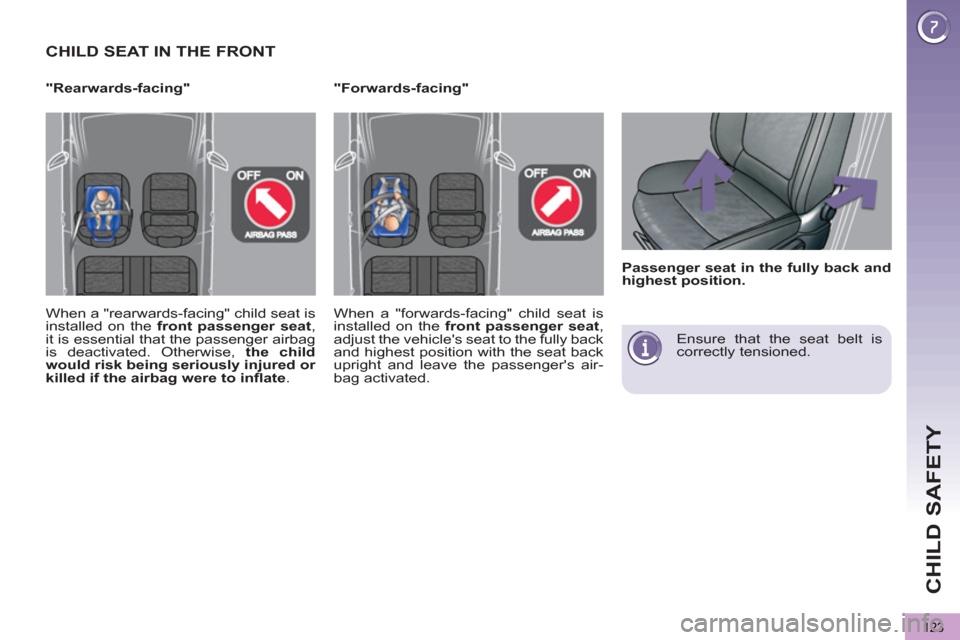
"Forwards-facing"
"Rearwards-facing"
CHILD SEAT IN THE FRONT
Passenger seat in the fully back and
highest position.
Ensure that the seat belt is
correctly tensioned. When a "rearwards-facing" child seat is
installed on the front passenger seat
,
it is essential that the passenger airbag
is deactivated. Otherwise, the child
would risk being seriously injured or
killed if the airbag were to infl ate
. When a "forwards-facing" child seat is
installed on the front passenger seat
,
adjust the vehicle's seat to the fully back
and highest position with the seat back
upright and leave the passenger's air-
bag activated.
Page 126 of 284
CHILD SAFETY
124
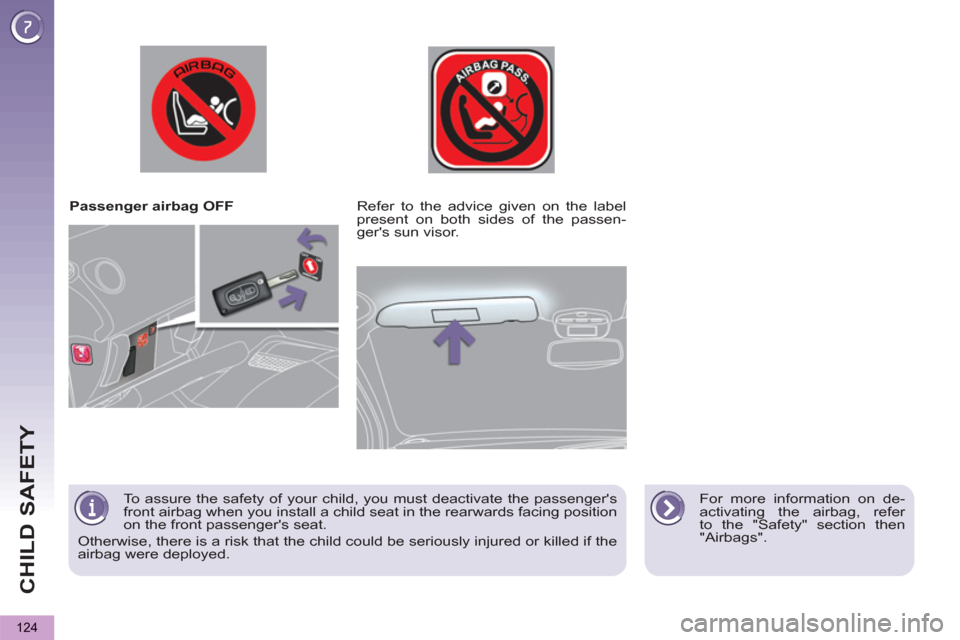
Passenger airbag OFF
For more information on de-
activating the airbag, refer
to the "Safety" section then
"Airbags".
Refer to the advice given on the label
present on both sides of the passen-
ger's sun visor.
To assure the safety of your child, you must deactivate the passenger's
front airbag when you install a child seat in the rearwards facing position
on the front passenger's seat.
Otherwise, there is a risk that the child could be seriously injured or killed if the
airbag were deployed.
Page 127 of 284
CHILD SAFETY
125
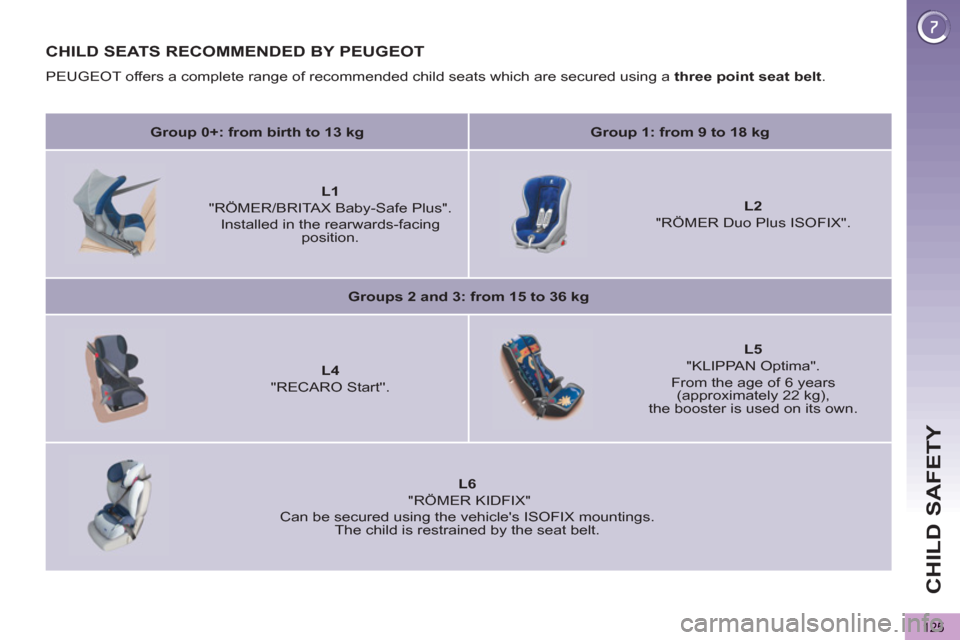
CHILD SEATS RECOMMENDED BY PEUGEOT
PEUGEOT offers a complete range of recommended child seats which are secured using a three point seat belt
.
Group 0+: from birth to 13 kg
Group 1: from 9 to 18 kg
L1
"RÖMER/BRITAX Baby-Safe Plus".
Installed in the rearwards-facing
position.
L2
"RÖMER Duo Plus ISOFIX".
Groups 2 and 3: from 15 to 36 kg
L4
"RECARO Start''.
L5
"KLIPPAN Optima".
From the age of 6 years
(approximately 22 kg),
the booster is used on its own.
L6
"RÖMER KIDFIX"
Can be secured using the vehicle's ISOFIX mountings.
The child is restrained by the seat belt.
Page 128 of 284
CHILD SAFETY
126
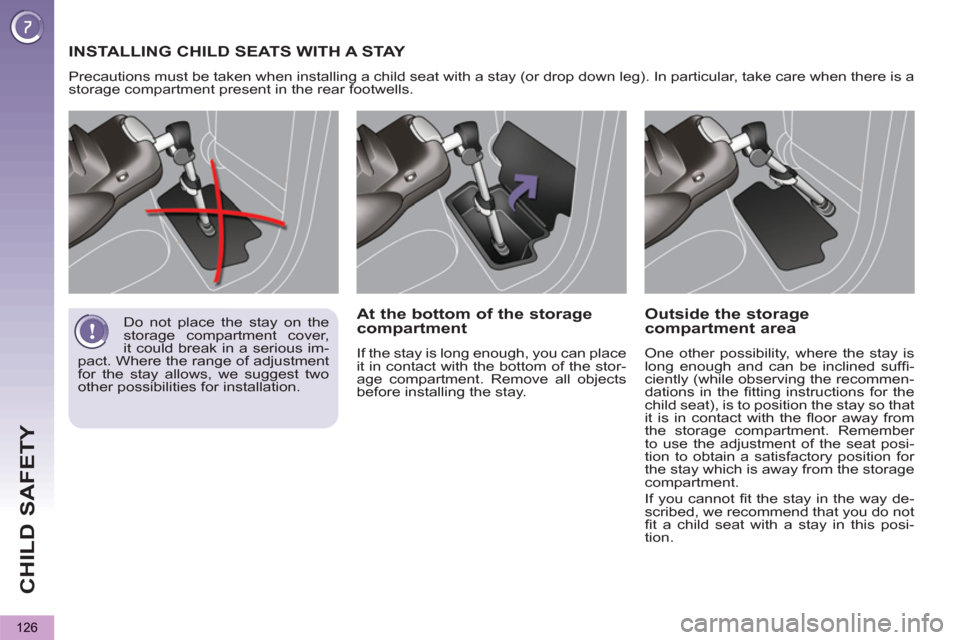
INSTALLING CHILD SEATS WITH A STAY
Precautions must be taken when installing a child seat with a stay (or drop down leg). In particular, take care when there is a
storage compartment present in the rear footwells.
At the bottom of the storage
compartment
If the stay is long enough, you can place
it in contact with the bottom of the stor-
age compartment. Remove all objects
before installing the stay.
Outside the storage
compartment area
One other possibility, where the stay is
long enough and can be inclined suffi -
ciently (while observing the recommen-
dations in the fi tting instructions for the
child seat), is to position the stay so that
it is in contact with the fl oor away from
the storage compartment. Remember
to use the adjustment of the seat posi-
tion to obtain a satisfactory position for
the stay which is away from the storage
compartment.
If you cannot fi t the stay in the way de-
scribed, we recommend that you do not
fi t a child seat with a stay in this posi-
tion. Do not place the stay on the
storage compartment cover,
it could break in a serious im-
pact. Where the range of adjustment
for the stay allows, we suggest two
other possibilities for installation.
Page 129 of 284
CHILD SAFETY
127
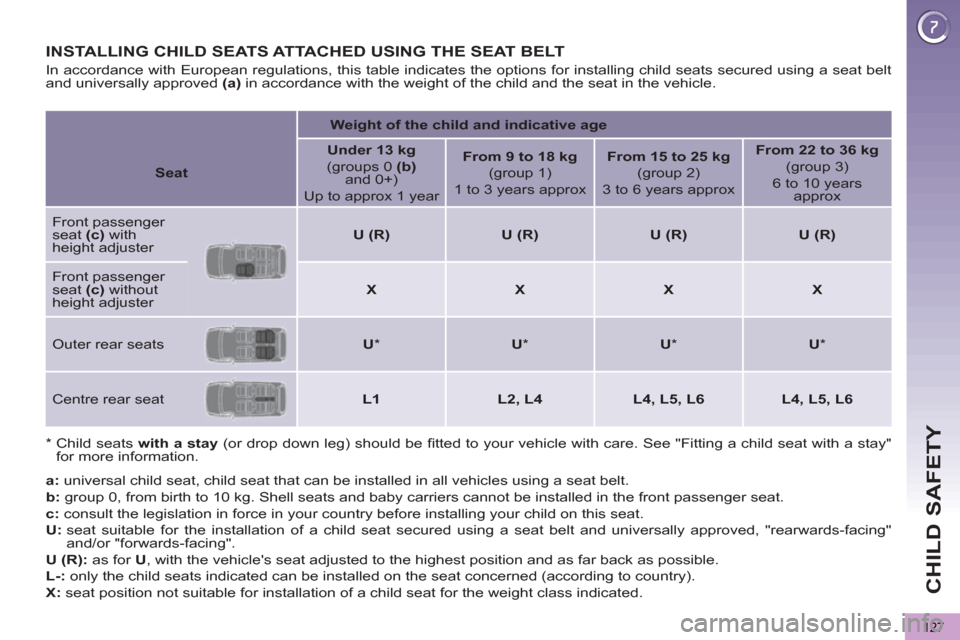
INSTALLING CHILD SEATS ATTACHED USING THE SEAT BELT
*
Child seats with a
stay
(or drop down leg) should be fi tted to your vehicle with care. See "Fitting a child seat with a stay"
for more information.
In accordance with European regulations, this table indicates the options for installing child seats secured using a seat belt
and universally approved (a)
in accordance with the weight of the child and the seat in the vehicle.
Weight of the child and indicative age
Seat
Under 13 kg
(groups 0 (b)
and 0+)
Up to approx 1 year
From 9 to 18 kg
(group 1)
1 to 3 years approx
From 15 to 25 kg
(group 2)
3 to 6 years approx
From 22 to 36 kg
(group 3)
6 to 10 years
approx
Front passenger
seat (c)
with
height adjuster
U (R)
U (R)
U (R)
U (R)
Front passenger
seat (c)
without
height adjuster
X
X
X
X
Outer rear seats
U
*
U
*
U
*
U
*
Centre rear seat
L1
L2, L4
L4, L5, L6
L4, L5, L6
a:
universal child seat, child seat that can be installed in all vehicles using a seat belt.
b:
group 0, from birth to 10 kg. Shell seats and baby carriers cannot be installed in the front passenger seat.
c:
consult the legislation in force in your country before installing your child on this seat.
U:
seat suitable for the installation of a child seat secured using a seat belt and universally approved, "rearwards-facing"
and/or "forwards-facing".
U (R):
as for U
, with the vehicle's seat adjusted to the highest position and as far back as possible.
L-:
only the child seats indicated can be installed on the seat concerned (according to country).
X:
seat position not suitable for installation of a child seat for the weight class indicated.
Page 130 of 284
CHILD SAFETY
128
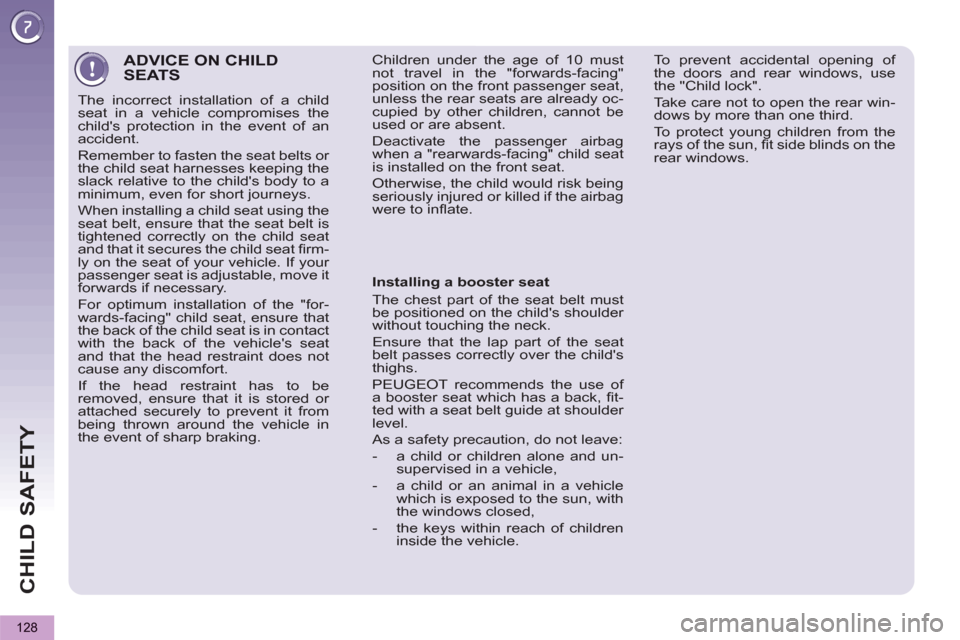
ADVICE ON CHILD SEATS
The incorrect installation of a child
seat in a vehicle compromises the
child's protection in the event of an
accident.
Remember to fasten the seat belts or
the child seat harnesses keeping the
slack relative to the child's body to a
minimum, even for short journeys.
When installing a child seat using the
seat belt, ensure that the seat belt is
tightened correctly on the child seat
and that it secures the child seat fi rm-
ly on the seat of your vehicle. If your
passenger seat is adjustable, move it
forwards if necessary.
For optimum installation of the "for-
wards-facing" child seat, ensure that
the back of the child seat is in contact
with the back of the vehicle's seat
and that the head restraint does not
cause any discomfort.
If the head restraint has to be
removed, ensure that it is stored or
attached securely to prevent it from
being thrown around the vehicle in
the event of sharp braking.
Installing a booster seat
The chest part of the seat belt must
be positioned on the child's shoulder
without touching the neck.
Ensure that the lap part of the seat
belt passes correctly over the child's
thighs.
PEUGEOT recommends the use of
a booster seat which has a back, fi t-
ted with a seat belt guide at shoulder
level.
As a safety precaution, do not leave:
- a child or children alone and un-
supervised in a vehicle,
- a child or an animal in a vehicle
which is exposed to the sun, with
the windows closed,
- the keys within reach of children
inside the vehicle. To prevent accidental opening of
the doors and rear windows, use
the "Child lock".
Take care not to open the rear win-
dows by more than one third.
To protect young children from the
rays of the sun, fi t side blinds on the
rear windows.
Children under the age of 10 must
not travel in the "forwards-facing"
position on the front passenger seat,
unless the rear seats are already oc-
cupied by other children, cannot be
used or are absent.
Deactivate the passenger airbag
when a "rearwards-facing" child seat
is installed on the front seat.
Otherwise, the child would risk being
seriously injured or killed if the airbag
were to infl ate.