fuel consumption Peugeot 3008 Hybrid 4 2012 Owner's Manual - RHD (UK. Australia)
[x] Cancel search | Manufacturer: PEUGEOT, Model Year: 2012, Model line: 3008 Hybrid 4, Model: Peugeot 3008 Hybrid 4 2012Pages: 284, PDF Size: 14.08 MB
Page 4 of 284
CONTENTS
FAMILIARISATION 4-25
IN
STRUMENTS and
CONTROLS 47-61
CHILD SAFETY 122-132
MULTIFUNCTION
SCREEN
S62-70
SAFETY 133-142 COMFORT 71-8
4
ACCESS 85-99
VISIBILITY 100-110FITTINGS 111-12
1
Instrument panels...........................47Indicator and warning lamps..........49Indicators........................................57Adjustment buttons.........................61
Child seats....................................122ISOFIX child seats........................129Child lock ......................................132
Screen C (Peugeot ConnectSound (RD5))...............................6216/9 high definition retractable colour
screen (Peugeot Connect Media).....65
Direction indicators.......................133Hazard warning lamps..................133Horn ..............................................133ESC system..................................134Front seat belts.............................136Airbags .........................................139
Heating and Ventilation ..................71Rear screen demist - defrost..........72Dual-zone digital air conditioning......73Front seats .....................................76Rear seats......................................80Steering wheel adjustment.............82Mirrors............................................83
Remote control key........................85Alarm ..............................................90Electric windows.............................92Doors..............................................94Boot................................................96Lower tailgate.................................97Fuel tank.........................................98Misfuel prevention (Diesel) .............99
Lighting controls...........................100LED lamps ....................................102Daytime running lamps.................102Automatic illumination
of headlamps..............................103Headlamp adjustment..................104Wiper controls ..............................105Automatic rain sensitive wipers .....107Courtesy lamps............................108Interior mood lighting....................109Boot lamp......................................110
Interior fittings................................111Front armrest.................................113Rear multimedia............................115Panoramic sunroof........................f117Boot fittings....................................118HYBRID SYSTEM 26-46
Presentation...................................26Ready lamp....................................30HYbrid4 mode selector...................r31Energy consumption / generationindicator........................................r34Display of hybrid power flow..........35Eco off............................................f38Eco-driving......................................39Consumption ..................................41High voltage battery.......................42Vehicle recovery.............................46
Page 8 of 284
6
FA
M
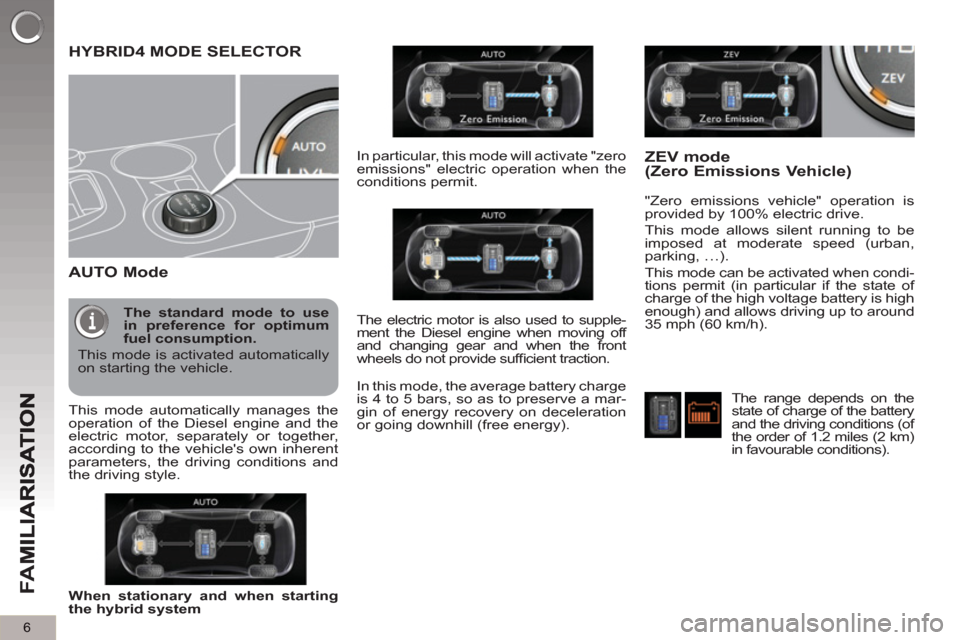
HYBRID4 MODE SELECTOR
AUTO Mode
"Zero emissions vehicle" operation is
provided by 100% electric drive.
This mode allows silent running to be
imposed at moderate speed (urban,
parking, …).
This mode can be activated when condi-
tions permit (in particular if the state of
charge of the high voltage battery is high
enough) and allows driving up to around
35 mph (60 km/h).
ZEV mode(Zero Emissions Vehicle)
When stationary and when starting
the hybrid system
This mode automatically manages the
operation of the Diesel engine and the
electric motor, separately or together,
according to the vehicle's own inherent
parameters, the driving conditions and
the driving style.
The standard mode to use
in preference for optimum
fuel consumption.
This mode is activated automatically
on starting the vehicle.
In particular, this mode will activate "zero
emissions" electric operation when the
conditions permit.
The electric motor is also used to supple-
ment the Diesel engine when moving off
and changing gear and when the front
wheels do not provide suffi cient traction.
The range depends on the
state of charge of the battery
and the driving conditions (of
the order of 1.2 miles (2 km)
in favourable conditions).
In this mode, the average battery charge
is 4 to 5 bars, so as to preserve a mar-
gin of energy recovery on deceleration
or going downhill (free energy).
Page 10 of 284
8
FA
M
FOR ECONOMICAL DRIVING, CARING FOR THE ENVIRONMENT
Main recommendations for driving economically
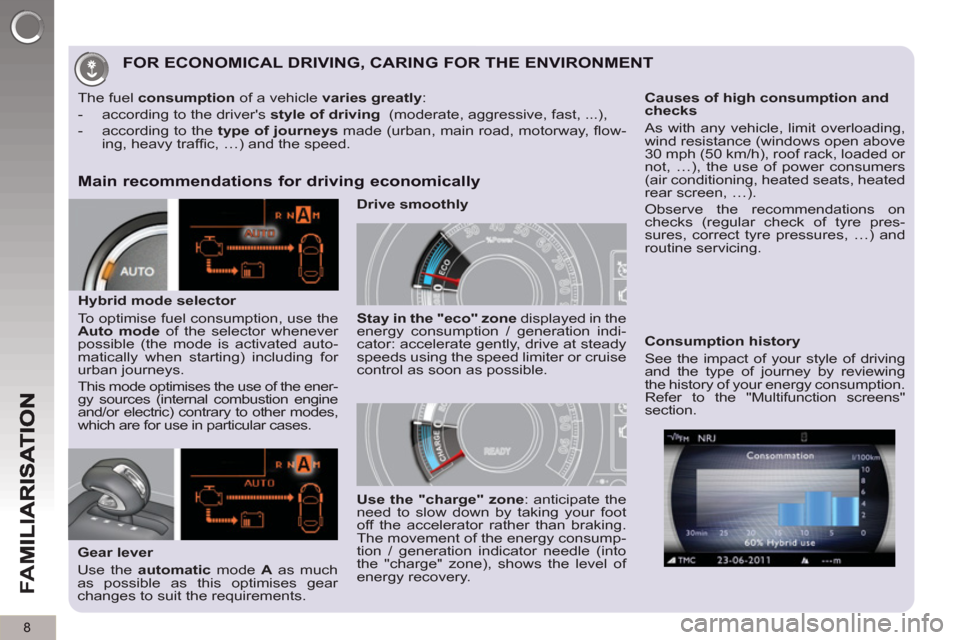
Gear lever
Use the automatic
mode A
as much
as possible as this optimises gear
changes to suit the requirements.
The fuel consumption
of a vehicle varies greatly
:
- according to the driver's style of driving
(moderate, aggressive, fast, ...),
- according to the type of journeys
made (urban, main road, motorway, fl ow-
ing, heavy traffi c, …) and the speed.
Hybrid mode selector
To optimise fuel consumption, use the
Auto
mode
of the selector whenever
possible (the mode is activated auto-
matically when starting) including for
urban journeys.
This mode optimises the use of the ener-
gy sources (internal combustion engine
and/or electric) contrary to other modes,
which are for use in particular cases.
Stay in the "eco" zone
displayed in the
energy consumption / generation indi-
cator: accelerate gently, drive at steady
speeds using the speed limiter or cruise
control as soon as possible.
Causes of high consumption and
checks
As with any vehicle, limit overloading,
wind resistance (windows open above
30 mph (50 km/h), roof rack, loaded or
not, …), the use of power consumers
(air conditioning, heated seats, heated
rear screen, …).
Observe the recommendations on
checks (regular check of tyre pres-
sures, correct tyre pressures, …) and
routine servicing.
Consumption history
See the impact of your style of driving
and the type of journey by reviewing
the history of your energy consumption.
Refer to the "Multifunction screens"
section.
Use the "charge"
zone: anticipate the
need to slow down by taking your foot
off the accelerator rather than braking.
The movement of the energy consump-
tion / generation indicator needle (into
the "charge" zone), shows the level of
energy recovery.
Drive smoothly
Page 30 of 284

HY
B
28
The electronic power supervisor - 4
automatically manages the operation of the
two power units (Diesel and electric) to provide the lowest consumption.
An inverter and a transformer are needed to manage the electric power.
The inverter acts on the torque of the electric motor, by regulating the current com-
ing from the high voltage battery pack. Its operating range is between 150 and
270 volts.
The transformer converts the 200 V of the battery pack to 12 V, to power the
vehicle's ancillary systems.
The Stop & Start system - 5
allows the Diesel engine to be put into standby dur-
ing stops (traffi c lights, a stop, or in a traffi c jam, for example) or during phases of
running in all-electric mode.
The stopping and restarting of the Diesel engine is done in a way that is instanta-
neous and transparent for the driver.
The electronic gearbox - 6
provides, in automatic mode, signifi cant savings in
fuel consumption compared to a conventional manual gearbox, thanks to its elec-
tronic control system.
It also offers improved driving pleasure with the possibility at any time of choosing
the gear changing mode: automatic or manual, using the paddles located behind
the steering wheel.
Page 33 of 284
HY
B
31
HYBRID4 MODE SELECTOR
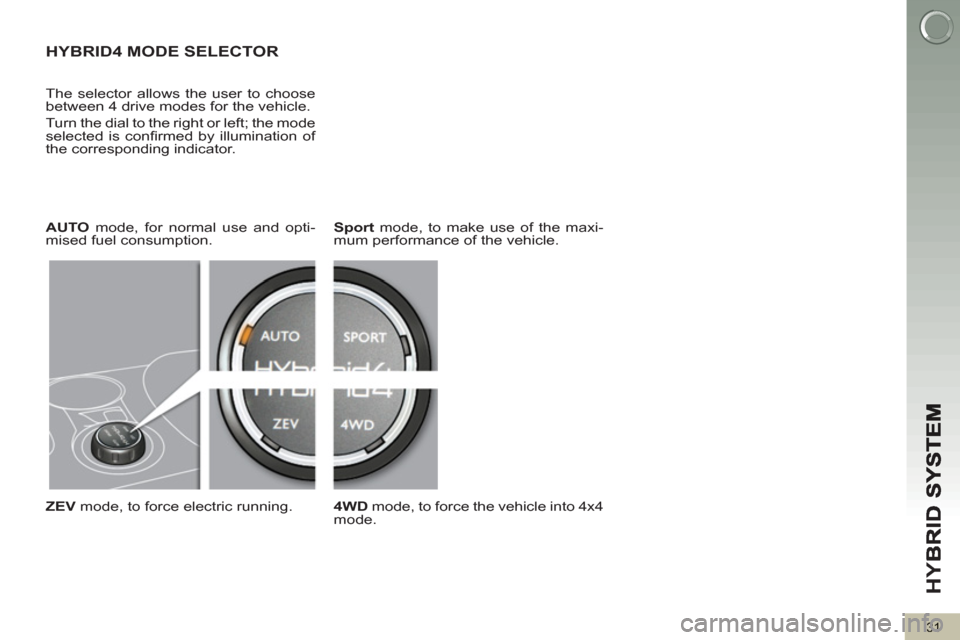
The selector allows the user to choose
between 4 drive modes for the vehicle.
Turn the dial to the right or left; the mode
selected is confi rmed by illumination of
the corresponding indicator.
ZEV
mode, to force electric running.
Sport
mode, to make use of the maxi-
mum performance of the vehicle.
4WD
mode, to force the vehicle into 4x4
mode.
AUTO
mode, for normal use and opti-
mised fuel consumption.
Page 34 of 284
HY
B
32
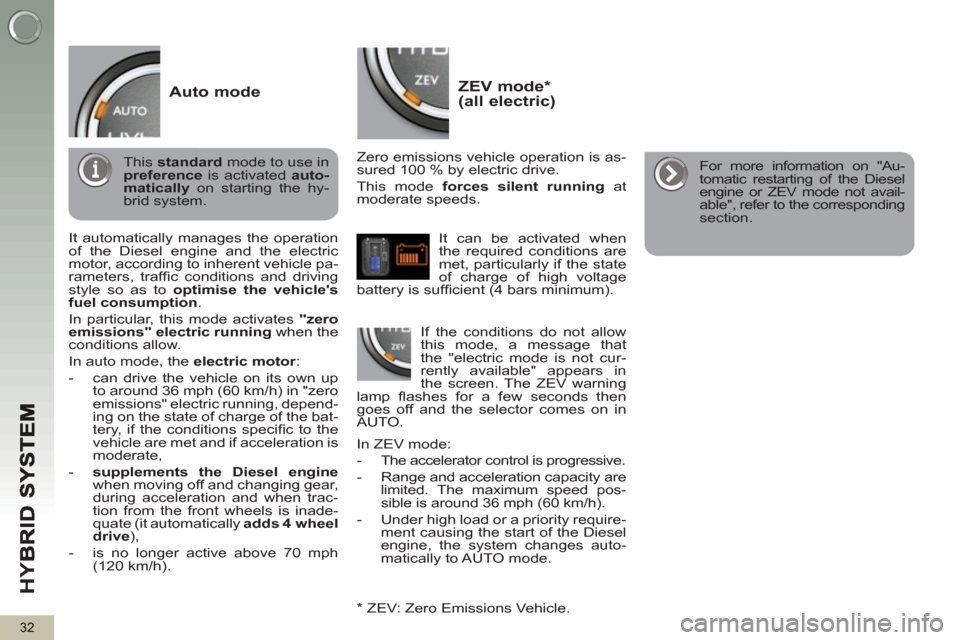
ZEV mode * (all electric)
Zero emissions vehicle operation is as-
sured 100 % by electric drive.
This mode forces silent running
at
moderate speeds.
* ZEV: Zero Emissions Vehicle. In ZEV mode:
- The accelerator control is progressive.
- Range and acceleration capacity are
limited. The maximum speed pos-
sible is around 36 mph (60 km/h).
- Under high load or a priority require-
ment causing the start of the Diesel
engine, the system changes auto-
matically to AUTO mode.
It can be activated when
the required conditions are
met, particularly if the state
of charge of high voltage
battery is suffi cient (4 bars minimum).
If the conditions do not allow
this mode, a message that
the "electric mode is not cur-
rently available" appears in
the screen. The ZEV warning
lamp fl ashes for a few seconds then
goes off and the selector comes on in
AUTO.
Auto mode
It automatically manages the operation
of the Diesel engine and the electric
motor, according to inherent vehicle pa-
rameters, traffi c conditions and driving
style so as to optimise the vehicle's
fuel consumption
.
In particular, this mode activates "zero
emissions" electric running
when the
conditions allow.
In auto mode, the electric motor
:
- can drive the vehicle on its own up
to around 36 mph (60 km/h) in "zero
emissions" electric running, depend-
ing on the state of charge of the bat-
tery, if the conditions specifi c to the
vehicle are met and if acceleration is
moderate,
- supplements the Diesel engine
when moving off and changing gear,
during acceleration and when trac-
tion from the front wheels is inade-
quate (it automatically adds
4 wheel
drive
),
- is no longer active above 70 mph
(120 km/h).
This standard
mode to use in
preference
is activated auto-
matically
on starting the hy-
brid system.
For more information on "Au-
tomatic restarting of the Diesel
engine or ZEV mode not avail-
able", refer to the corresponding
section.
Page 41 of 284
HY
B
39
ECO-DRIVING
Eco-driving is a range of everyday practices that allow the motorist to optimise their fuel consumption and CO2 emis-
sions.
Optimise the use of your gearbox
Use automatic mode A
as much as pos-
sible as this optimises gear changes to
suit the circumstances.
Drive smoothly
If your vehicle has cruise control, make
use of the system at speeds above
25 mph (40 km/h) when the traffi c is
fl owing well.
Control the use of your electrical equipment
Before moving off, if the passenger
compartment is too warm, ventilate it by
opening the windows and air vents be-
fore using the air conditioning.
Above 30 mph (50 km/h), close the win-
dows and leave the air vents open.
Remember to make use of equipment
that can help keep the temperature in
the passenger compartment down (sun
roof and window blinds...).
Switch off the air conditioning, unless
it has automatic digital regulation, as
soon as the desired temperature is at-
tained.
Switch off the demisting and defrosting
controls, if not automatic.
Switch off the heated seat as soon as
possible.
Switch off the headlamps and front fo-
glamps when the level of light does not
require their use.
Avoid running the Diesel engine when
stationary, particularly in winter; your
vehicle will warm up much faster while
driving.
As a passenger, if you avoid connect-
ing your multimedia devices (fi lm, mu-
sic, video game...), you will contribute
towards limiting the consumption of
electrical energy, and so of fuel.
Disconnect your portable devices be-
fore leaving the vehicle.
Maintain a safe distance between ve-
hicles, use engine braking rather than
the brake pedal, and press the accel-
erator progressively. These practices
contribute towards a reduction in fuel
consumption and CO
2 emissions and
also helps reduce the background traf-
fi c noise.
Page 42 of 284
HY
B
40
Limit the causes of excess consumption
Spread loads throughout the vehicle;
place the heaviest items in the bottom
of the boot, as close as possible to the
rear seats.
Limit the loads carried in the vehicle
and reduce wind resistance (roof bars,
roof rack, bicycle carrier, trailer...). Use
a roof box in preference.
Remove roof bars and roof racks after
use.
At the end of winter, remove snow
tyres and refi t your summer tyres.
Observe the recommendationson maintenance
Check the tyre pressures regularly,
when cold, referring to the label in the
door aperture, driver's side.
Carry out this check in particular:
- before a long journey,
- at each change of season,
- after a long period out of use.
Have your vehicle serviced regularly
(engine oil, oil fi lter, air fi lter...) and ob-
serve the schedule of operations rec-
ommended by the manufacturer.
When refuelling, do not continue after
the 3 rd cut-off of the nozzle to avoid
any overfl ow.
At the wheel of your new vehicle,
it is only after the fi rst 1 800 miles
(3 000 kilometres) that you will see
the fuel consumption settle down to a
consistent average.
Page 51 of 284
49
IN
S
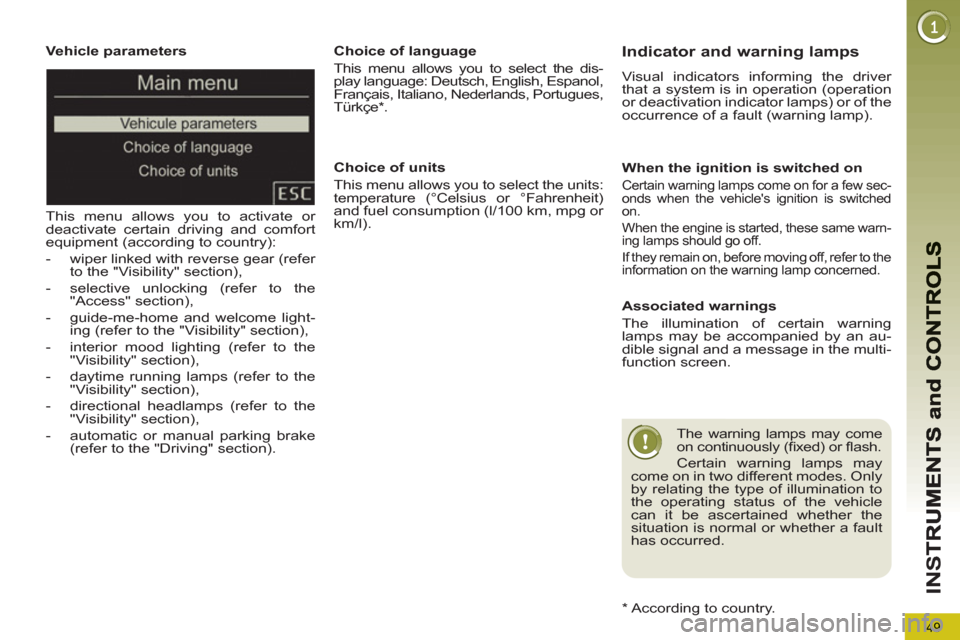
Vehicle parameters
This menu allows you to activate or
deactivate certain driving and comfort
equipment (according to country):
- wiper linked with reverse gear (refer
to the "Visibility" section),
- selective unlocking (refer to the
"Access" section),
- guide-me-home and welcome light-
ing (refer to the "Visibility" section),
- interior mood lighting (refer to the
"Visibility" section),
- daytime running lamps (refer to the
"Visibility" section),
- directional headlamps (refer to the
"Visibility" section),
- automatic or manual parking brake
(refer to the "Driving" section).
Choice of units
This menu allows you to select the units:
temperature (°Celsius or °Fahrenheit)
and fuel consumption (l/100 km, mpg or
km/l).
Choice of language
This menu allows you to select the dis-
play language: Deutsch, English, Espanol,
Français, Italiano, Nederlands, Portugues,
Türkçe * .
*
According to country. Indicator and warning lamps
Visual indicators informing the driver
that a system is in operation (operation
or deactivation indicator lamps) or of the
occurrence of a fault (warning lamp).
When the ignition is switched on
Certain warning lamps come on for a few sec-
onds when the vehicle's ignition is switched
on.
When the engine is started, these same warn-
ing lamps should go off.
If they remain on, before moving off, refer to the
information on the warning lamp concerned.
Associated warnings
The illumination of certain warning
lamps may be accompanied by an au-
dible signal and a message in the multi-
function screen.
The warning lamps may come
on continuously (fi xed) or fl ash.
Certain warning lamps may
come on in two different modes. Only
by relating the type of illumination to
the operating status of the vehicle
can it be ascertained whether the
situation is normal or whether a fault
has occurred.
Page 71 of 284
69
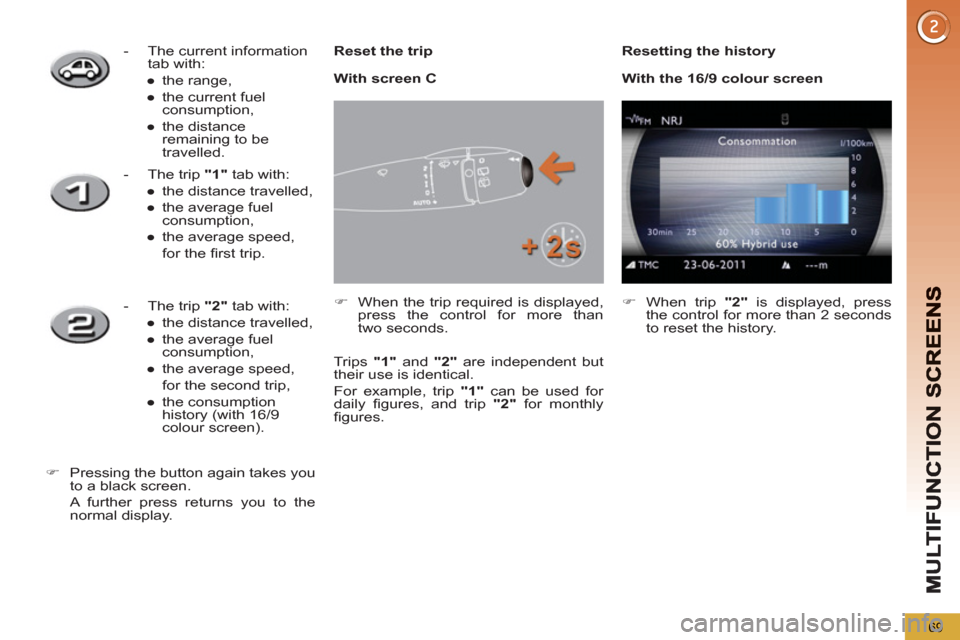
Reset the trip
)
When the trip required is displayed,
press the control for more than
two seconds.
Trips "1"
and "2"
are independent but
their use is identical.
For example, trip "1"
can be used for
daily fi gures, and trip "2"
for monthly
fi gures.
- The current information
tab with:
●
the range,
●
the current fuel
consumption,
●
the distance
remaining to be
travelled.
- The trip "1"
tab with:
●
the distance travelled,
●
the average fuel
consumption,
●
the average speed,
for the fi rst trip.
- The trip "2"
tab with:
●
the distance travelled,
●
the average fuel
consumption,
●
the average speed,
for the second trip,
●
the consumption
history (with 16/9
colour screen).
)
Pressing the button again takes you
to a black screen.
A further press returns you to the
normal display.
Resetting the history
With screen C
)
When trip "2"
is displayed, press
the control for more than 2 seconds
to reset the history.
With the 16/9 colour screen