fuel type Peugeot 3008 Hybrid 4 2012 Owner's Manual - RHD (UK. Australia)
[x] Cancel search | Manufacturer: PEUGEOT, Model Year: 2012, Model line: 3008 Hybrid 4, Model: Peugeot 3008 Hybrid 4 2012Pages: 284, PDF Size: 14.08 MB
Page 10 of 284
8
FA
M
FOR ECONOMICAL DRIVING, CARING FOR THE ENVIRONMENT
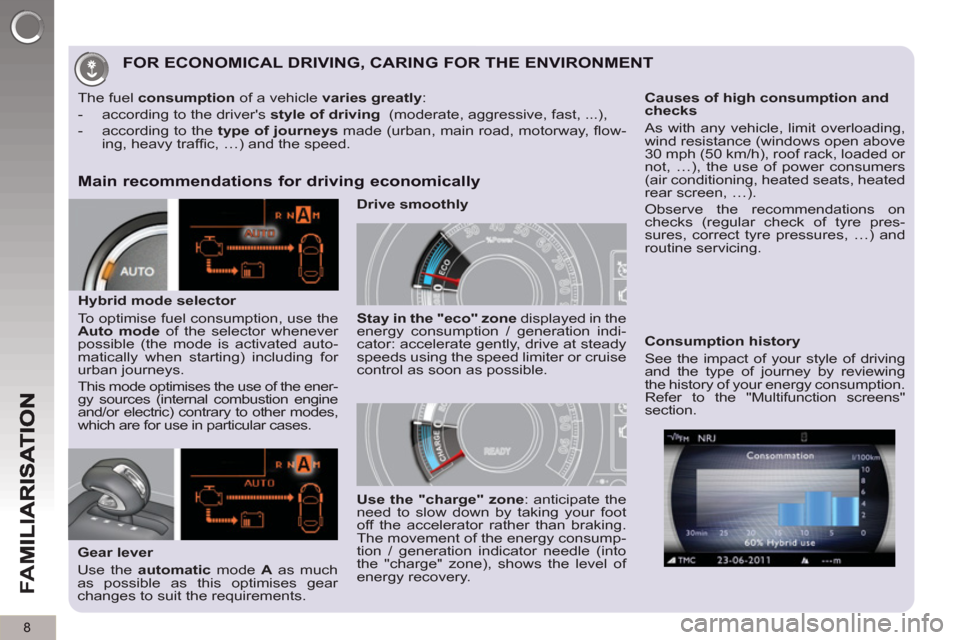
Main recommendations for driving economically
Gear lever
Use the automatic
mode A
as much
as possible as this optimises gear
changes to suit the requirements.
The fuel consumption
of a vehicle varies greatly
:
- according to the driver's style of driving
(moderate, aggressive, fast, ...),
- according to the type of journeys
made (urban, main road, motorway, fl ow-
ing, heavy traffi c, …) and the speed.
Hybrid mode selector
To optimise fuel consumption, use the
Auto
mode
of the selector whenever
possible (the mode is activated auto-
matically when starting) including for
urban journeys.
This mode optimises the use of the ener-
gy sources (internal combustion engine
and/or electric) contrary to other modes,
which are for use in particular cases.
Stay in the "eco" zone
displayed in the
energy consumption / generation indi-
cator: accelerate gently, drive at steady
speeds using the speed limiter or cruise
control as soon as possible.
Causes of high consumption and
checks
As with any vehicle, limit overloading,
wind resistance (windows open above
30 mph (50 km/h), roof rack, loaded or
not, …), the use of power consumers
(air conditioning, heated seats, heated
rear screen, …).
Observe the recommendations on
checks (regular check of tyre pres-
sures, correct tyre pressures, …) and
routine servicing.
Consumption history
See the impact of your style of driving
and the type of journey by reviewing
the history of your energy consumption.
Refer to the "Multifunction screens"
section.
Use the "charge"
zone: anticipate the
need to slow down by taking your foot
off the accelerator rather than braking.
The movement of the energy consump-
tion / generation indicator needle (into
the "charge" zone), shows the level of
energy recovery.
Drive smoothly
Page 12 of 284
10
FA
M
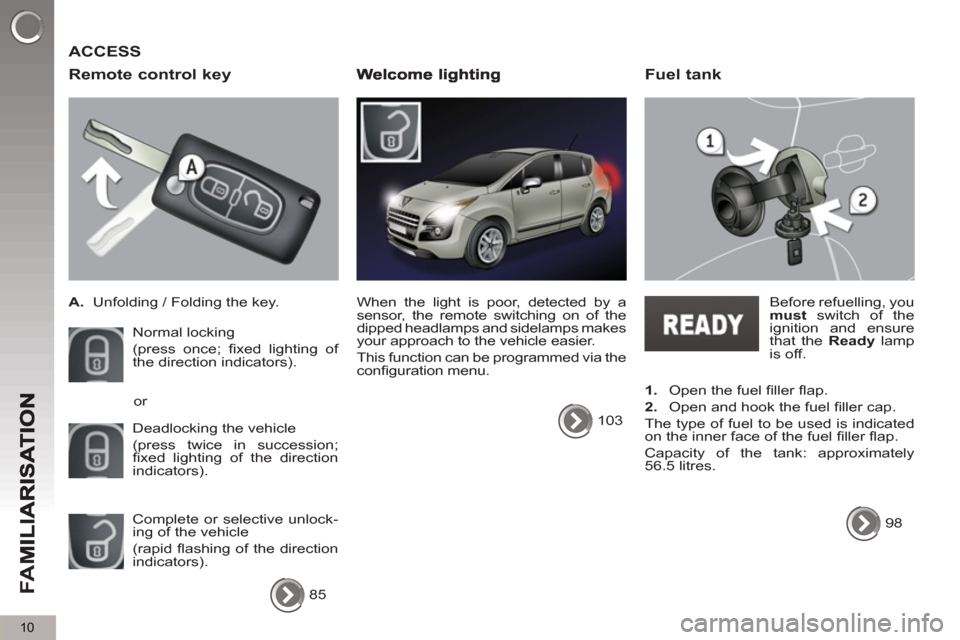
ACCESS
Remote control ke
y
A.
Unfolding / Folding the key.
Normal locking
(press once; fi xed lighting of
the direction indicators).
Deadlocking the vehicle
(press twice in succession;
fi xed lighting of the direction
indicators).
Complete or selective unlock-
ing of the vehicle
(rapid fl ashing of the direction
indicators). or
85
When the light is poor, detected by a
sensor, the remote switching on of the
dipped headlamps and sidelamps makes
your approach to the vehicle easier.
This function can be programmed via the
confi guration menu.
103
98
Fuel tank
Before refuelling, you
must
switch of the
ignition and ensure
that the Ready
lamp
is off.
1.
Open the fuel fi ller fl ap.
2.
Open and hook the fuel fi ller cap.
The type of fuel to be used is indicated
on the inner face of the fuel fi ller fl ap.
Capacity of the tank: approximately
56.5 litres.
Page 46 of 284
HY
B
44
The high voltage battery must not in any
circumstances be charged from an ex-
ternal source and must only be handled
by a workshop technician.
There is the risk of serious burns, as
well as electric arcs that could cause
serious injury or even death.
A used Ni-MH (Nickel Metal Hydride)
type high voltage battery must be re-
moved in an appropriate manner by a
repair workshop, so that its recycling
presents no risk to the environment.
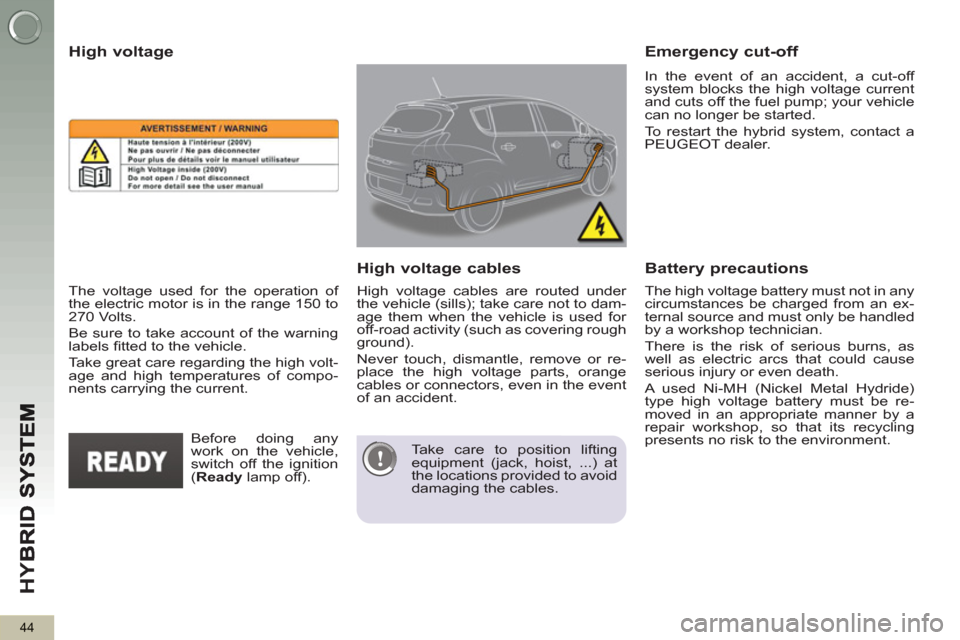
High voltage
The voltage used for the operation of
the electric motor is in the range 150 to
270 Volts.
Be sure to take account of the warning
labels fi tted to the vehicle.
Take great care regarding the high volt-
age and high temperatures of compo-
nents carrying the current.
Emergency cut-off
High voltage cables are routed under
the vehicle (sills); take care not to dam-
age them when the vehicle is used for
off-road activity (such as covering rough
ground).
Never touch, dismantle, remove or re-
place the high voltage parts, orange
cables or connectors, even in the event
of an accident.
Before doing any
work on the vehicle,
switch off the ignition
( Ready
lamp off).
Battery precautions High voltage cables
Take care to position lifting
equipment (jack, hoist, ...) at
the locations provided to avoid
damaging the cables.
In the event of an accident, a cut-off
system blocks the high voltage current
and cuts off the fuel pump; your vehicle
can no longer be started.
To restart the hybrid system, contact a
PEUGEOT dealer.
Page 51 of 284
49
IN
S
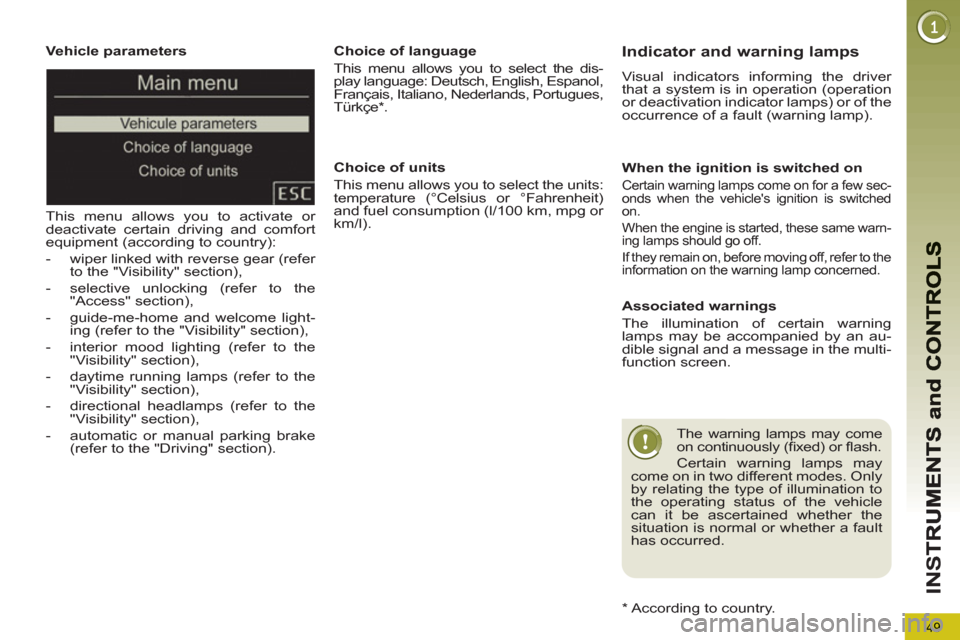
Vehicle parameters
This menu allows you to activate or
deactivate certain driving and comfort
equipment (according to country):
- wiper linked with reverse gear (refer
to the "Visibility" section),
- selective unlocking (refer to the
"Access" section),
- guide-me-home and welcome light-
ing (refer to the "Visibility" section),
- interior mood lighting (refer to the
"Visibility" section),
- daytime running lamps (refer to the
"Visibility" section),
- directional headlamps (refer to the
"Visibility" section),
- automatic or manual parking brake
(refer to the "Driving" section).
Choice of units
This menu allows you to select the units:
temperature (°Celsius or °Fahrenheit)
and fuel consumption (l/100 km, mpg or
km/l).
Choice of language
This menu allows you to select the dis-
play language: Deutsch, English, Espanol,
Français, Italiano, Nederlands, Portugues,
Türkçe * .
*
According to country. Indicator and warning lamps
Visual indicators informing the driver
that a system is in operation (operation
or deactivation indicator lamps) or of the
occurrence of a fault (warning lamp).
When the ignition is switched on
Certain warning lamps come on for a few sec-
onds when the vehicle's ignition is switched
on.
When the engine is started, these same warn-
ing lamps should go off.
If they remain on, before moving off, refer to the
information on the warning lamp concerned.
Associated warnings
The illumination of certain warning
lamps may be accompanied by an au-
dible signal and a message in the multi-
function screen.
The warning lamps may come
on continuously (fi xed) or fl ash.
Certain warning lamps may
come on in two different modes. Only
by relating the type of illumination to
the operating status of the vehicle
can it be ascertained whether the
situation is normal or whether a fault
has occurred.
Page 100 of 284
AC
C
98
The key cannot be removed
from the lock until the cap is
put back on the tank.
Opening the cap may trigger an in-
rush of air. This vacuum, which is
completely normal, is caused by the
sealing of the fuel system.
FUEL TANK
Capacity of the tank: approximately
56.5 litres.
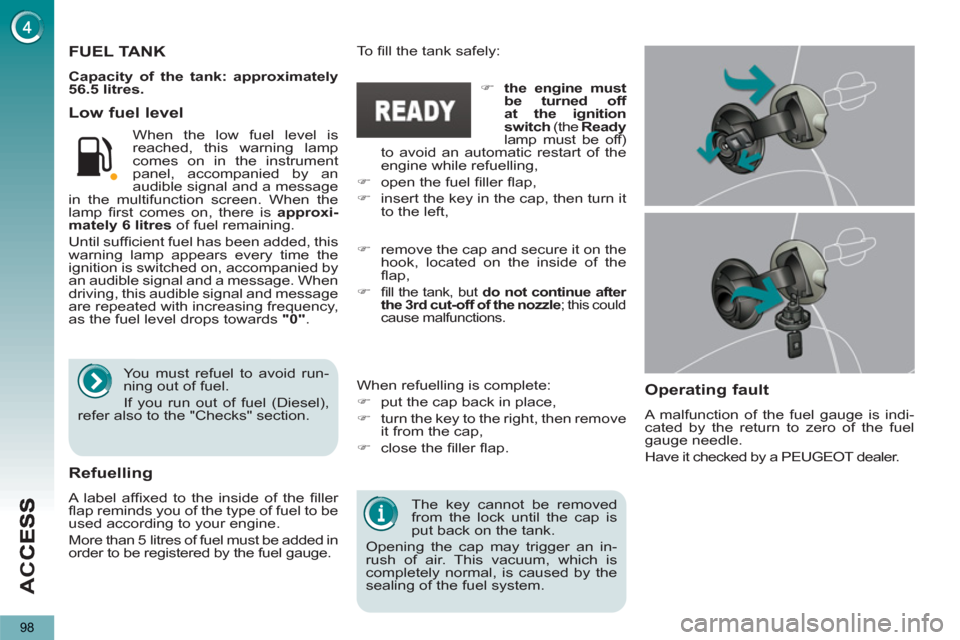
To fi ll the tank safely:
When refuelling is complete:
)
put the cap back in place,
)
turn the key to the right, then remove
it from the cap,
)
close the fi ller fl ap.
)
remove the cap and secure it on the
hook, located on the inside of the
fl ap,
)
fi ll the tank, but do not continue after
the 3rd cut-off of the nozzle
; this could
cause malfunctions.
Low fuel level
Operatin
g fault
A malfunction of the fuel gauge is indi-
cated by the return to zero of the fuel
gauge needle.
Have it checked by a PEUGEOT dealer.
Refuelling
A label affi xed to the inside of the fi ller
fl ap reminds you of the type of fuel to be
used according to your engine.
More than 5 litres of fuel must be added in
order to be registered by the fuel gauge. When the low fuel level is
reached, this warning lamp
comes on in the instrument
panel, accompanied by an
audible signal and a message
in the multifunction screen. When the
lamp fi rst comes on, there is approxi-
mately
6 litres
of fuel remaining.
Until suffi cient fuel has been added, this
warning lamp appears every time the
ignition is switched on, accompanied by
an audible signal and a message. When
driving, this audible signal and message
are repeated with increasing frequency,
as the fuel level drops towards "0"
.
You must refuel to avoid run-
ning out of fuel.
If you run out of fuel (Diesel),
refer also to the "Checks" section.
)
the engine must
be turned off
at the ignition
switch
(the Ready
lamp must be off)
to avoid an automatic restart of the
engine while refuelling,
)
open the fuel fi ller fl ap,
)
insert the key in the cap, then turn it
to the left,
Page 101 of 284
DIESEL
AC
C
99
Quality of the fuel used for Diesel engines
The Diesel engines are perfectly com-
patible with biofuels which conform to
current and future European standards
(Diesel fuel which complies with stan-
dard EN 590 mixed with a biofuel which
complies with standard EN 14214)
available at the pumps (containing up
to 7 % Fatty Acid Methyl Ester).
The B30 biofuel can be used in certain
Diesel engines; however, this use is sub-
ject to strict application of the special ser-
vicing conditions. Contact a PEUGEOT
dealer or a qualifi ed workshop.
The use of any other type of (bio)fuel
(vegetable or animal oils, pure or dilut-
ed, domestic fuel...) is strictly prohibited
(risk of damage to the engine and fuel
system).
(DIESEL)
*
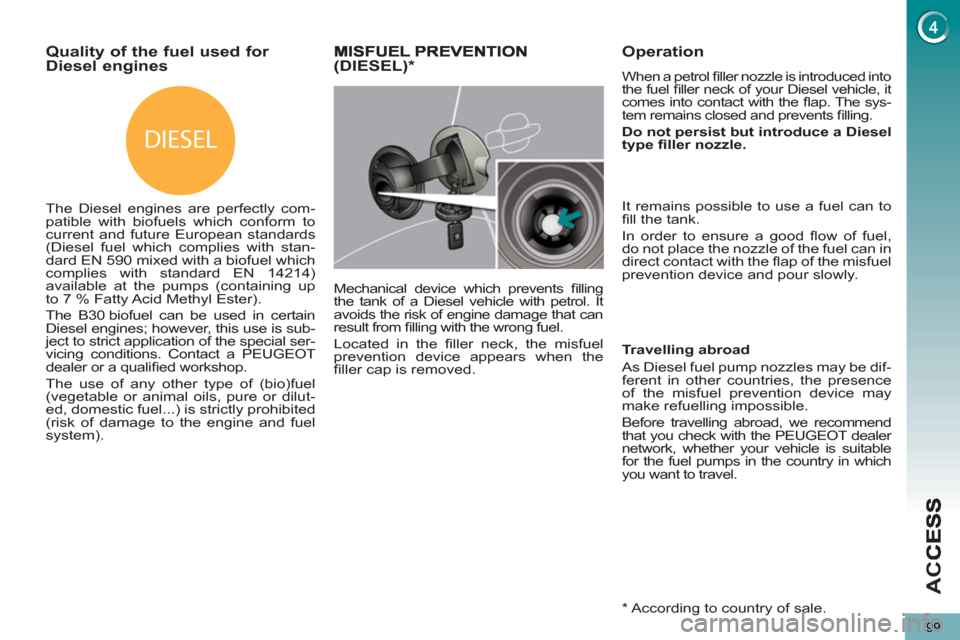
Mechanical device which prevents fi lling
the tank of a Diesel vehicle with petrol. It
avoids the risk of engine damage that can
result from fi lling with the wrong fuel.
Located in the fi ller neck, the misfuel
prevention device appears when the
fi ller cap is removed.
Operation
When a petrol fi ller nozzle is introduced into
the fuel fi ller neck of your Diesel vehicle, it
comes into contact with the fl ap. The sys-
tem remains closed and prevents fi lling.
Do not persist but introduce a Diesel
type fi ller nozzle.
It remains possible to use a fuel can to
fi ll the tank.
In order to ensure a good fl ow of fuel,
do not place the nozzle of the fuel can in
direct contact with the fl ap of the misfuel
prevention device and pour slowly.
*
According to country of sale.
Travelling abroad
As Diesel fuel pump nozzles may be dif-
ferent in other countries, the presence
of the misfuel prevention device may
make refuelling impossible.
Before travelling abroad, we recommend
that you check with the PEUGEOT dealer
network, whether your vehicle is suitable
for the fuel pumps in the country in which
you want to travel.