ignition Peugeot 3008 Hybrid 4 2012 Owner's Manual
[x] Cancel search | Manufacturer: PEUGEOT, Model Year: 2012, Model line: 3008 Hybrid 4, Model: Peugeot 3008 Hybrid 4 2012Pages: 284, PDF Size: 55.64 MB
Page 7 of 284
5
FAMILIARISATION
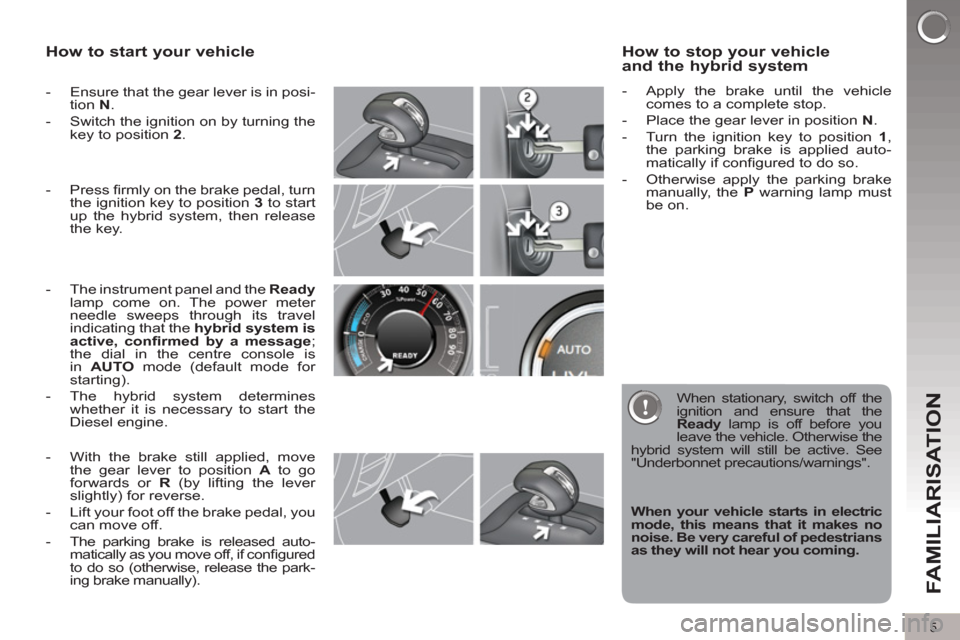
How to start your vehicle
- Ensure that the gear lever is in posi-
tion N
.
- Switch the ignition on by turning the
key to position 2
.
- The instrument panel and the Ready
lamp come on. The power meter
needle sweeps through its travel
indicating that the hybrid system is
active, confi rmed by a message
;
the dial in the centre console is
in AUTO
mode (default mode for
starting).
- The hybrid system determines
whether it is necessary to start the
Diesel engine.
- With the brake still applied, move
the gear lever to position A
to go
forwards or R
(by lifting the lever
slightly) for reverse.
- Lift your foot off the brake pedal, you
can move off.
- The parking brake is released auto-
matically as you move off, if confi gured
to do so (otherwise, release the park-
ing brake manually).
How to stop your vehicle
and the hybrid system
- Apply the brake until the vehicle
comes to a complete stop.
- Place the gear lever in position N
.
- Turn the ignition key to position 1
,
the parking brake is applied auto-
matically if confi gured to do so.
- Otherwise apply the parking brake
manually, the P
warning lamp must
be on.
- Press fi rmly on the brake pedal, turn
the ignition key to position 3
to start
up the hybrid system, then release
the key.
When stationary, switch off the
ignition and ensure that the
Ready
lamp is off before you
leave the vehicle. Otherwise the
hybrid system will still be active. See
"Underbonnet precautions/warnings".
When your vehicle starts in electric
mode, this means that it makes no
noise. Be very careful of pedestrians
as they will not hear you coming.
Page 12 of 284
10
FAMILIARISATION
OPENING
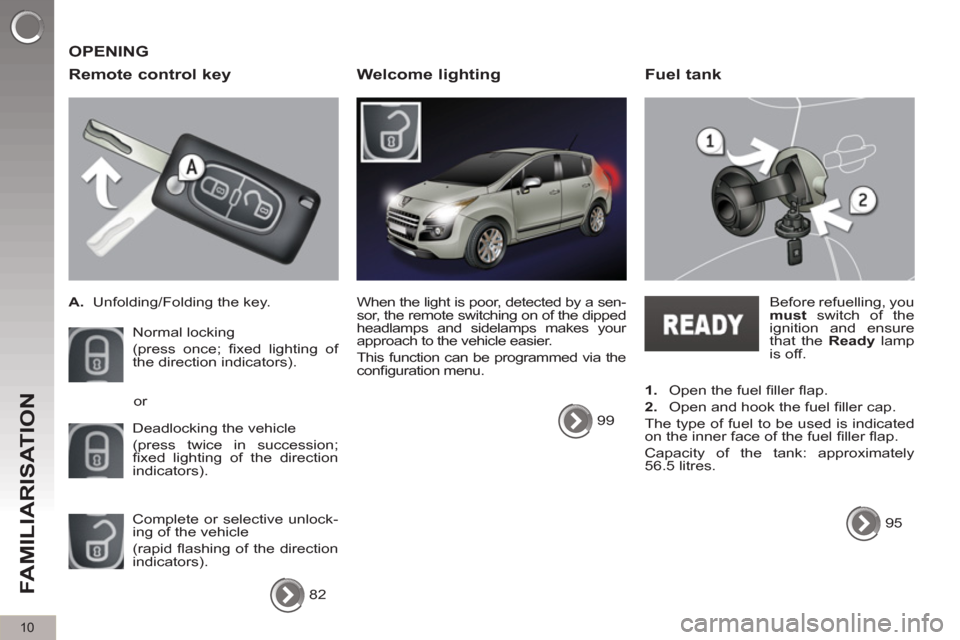
Remote control key
A.
Unfolding/Folding the key.
Normal locking
(press once; fi xed lighting of
the direction indicators).
Deadlocking the vehicle
(press twice in succession;
fi xed lighting of the direction
indicators).
Complete or selective unlock-
ing of the vehicle
(rapid fl ashing of the direction
indicators). or
82 When the light is poor, detected by a sen-
sor, the remote switching on of the dipped
headlamps and sidelamps makes your
approach to the vehicle easier.
This function can be programmed via the
confi guration menu.
99
95
Fuel tank
Before refuelling, you
must
switch of the
ignition and ensure
that the Ready
lamp
is off.
1.
Open the fuel fi ller fl ap.
2.
Open and hook the fuel fi ller cap.
The type of fuel to be used is indicated
on the inner face of the fuel fi ller fl ap.
Capacity of the tank: approximately
56.5 litres.
Welcome lighting
Page 16 of 284
14
FAMILIARISATION
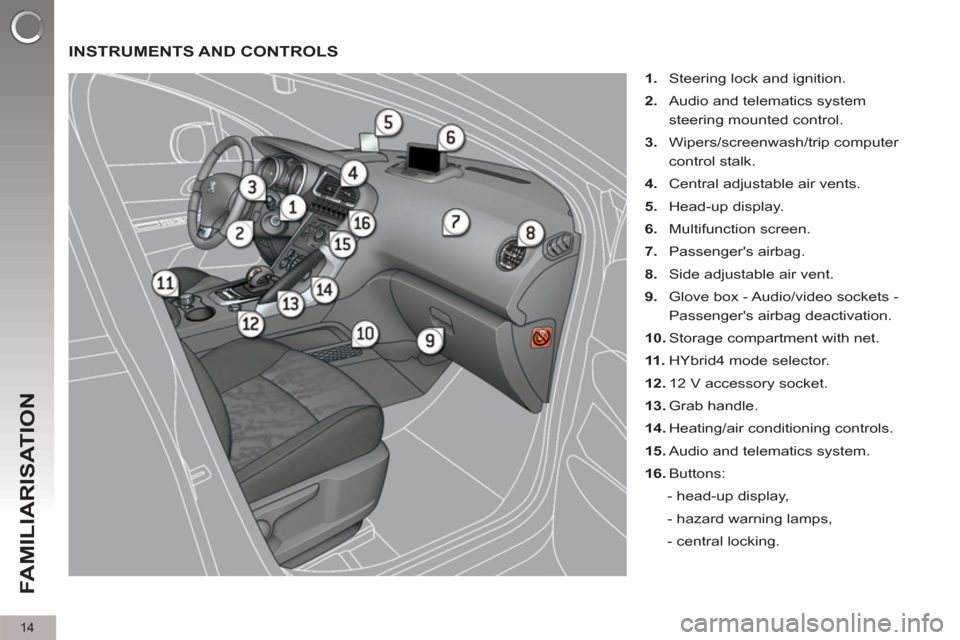
INSTRUMENTS AND CONTROLS
1.
Steering lock and ignition.
2.
Audio and telematics system
steering mounted control.
3.
Wipers/screenwash/trip computer
control stalk.
4.
Central adjustable air vents.
5.
Head-up display.
6.
Multifunction screen.
7.
Passenger's airbag.
8.
Side adjustable air vent.
9.
Glove box - Audio/video sockets -
Passenger's airbag deactivation.
10.
Storage compartment with net.
11 .
HYbrid4 mode selector.
12.
12 V accessory socket.
13.
Grab handle.
14.
Heating/air conditioning controls.
15.
Audio and telematics system.
16.
Buttons:
- head-up display,
- hazard warning lamps,
- central locking.
Page 21 of 284
19
FAMILIARISATION
MONITORING
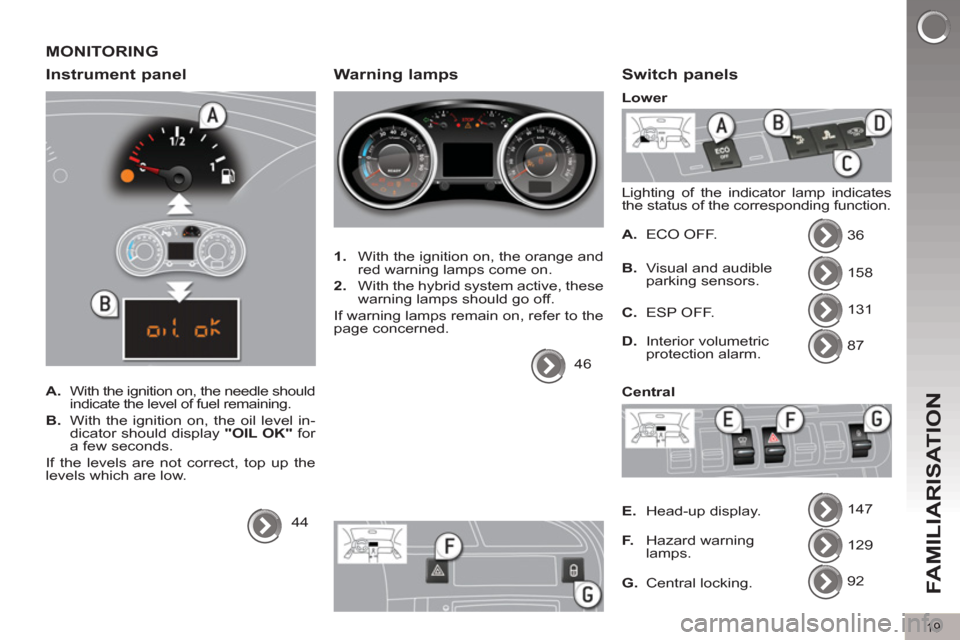
Instrument panel
A.
With the ignition on, the needle should
indicate the level of fuel remaining.
B.
With the ignition on, the oil level in-
dicator should display "OIL OK"
for
a few seconds.
If the levels are not correct, top up the
levels which are low.
44
Warning lamps
1.
With the ignition on, the orange and
red warning lamps come on.
2.
With the hybrid system active, these
warning lamps should go off.
If warning lamps remain on, refer to the
page concerned.
46
Switch panels
Lighting of the indicator lamp indicates
the status of the corresponding function.
A.
ECO OFF.
36
158
131
87
147
129
92
B.
Visual and audible
parking sensors.
C.
ESP OFF.
D.
Interior volumetric
protection alarm.
E.
Head-up display.
F.
Hazard warning
lamps.
G.
Central locking.
Lower
Central
Page 24 of 284
22
FAMILIARISATION
DRIVING SAFELY
Electric parking brake
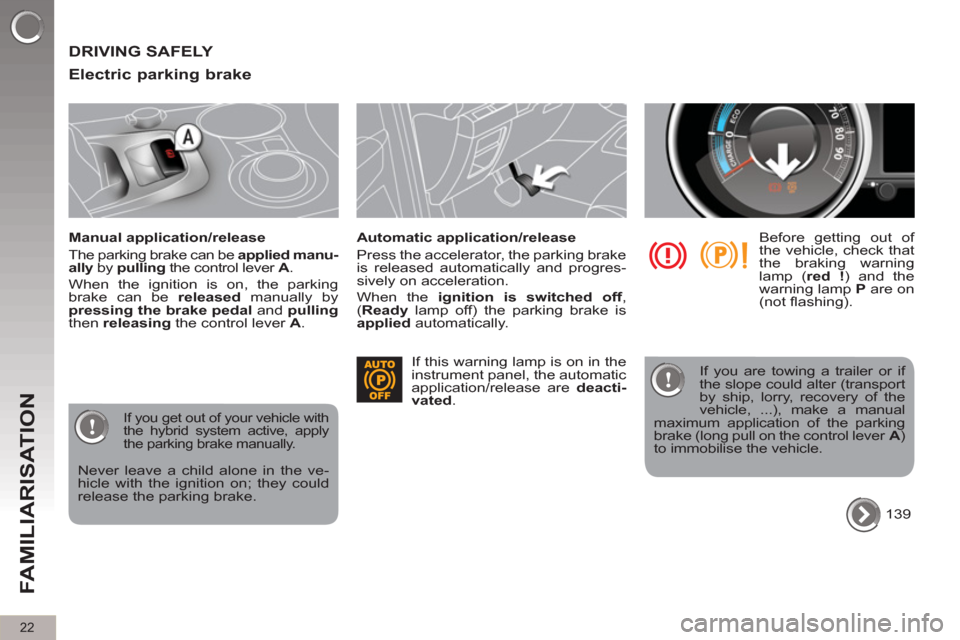
Manual application/release
The parking brake can be applied manu-
ally
by pulling
the control lever A
.
When the ignition is on, the parking
brake can be released
manually by
pressing the brake pedal
and pulling
then releasing
the control lever A
.
Automatic application/release
Press the accelerator, the parking brake
is released automatically and progres-
sively on acceleration.
When the ignition is switched off
,
( Ready
lamp off) the parking brake is
applied
automatically.
If you get out of your vehicle with
the hybrid system active, apply
the parking brake manually.
Before getting out of
the vehicle, check that
the braking warning
lamp ( red !
) and the
warning lamp P
are on
(not fl ashing).
Never leave a child alone in the ve-
hicle with the ignition on; they could
release the parking brake.
139 If this warning lamp is on in the
instrument panel, the automatic
application/release are deacti-
vated
.
If you are towing a trailer or if
the slope could alter (transport
by ship, lorry, recovery of the
vehicle, ...), make a manual
maximum application of the parking
brake (long pull on the control lever A
)
to immobilise the vehicle.
Page 25 of 284
23
FAMILIARISATION
Head-up display
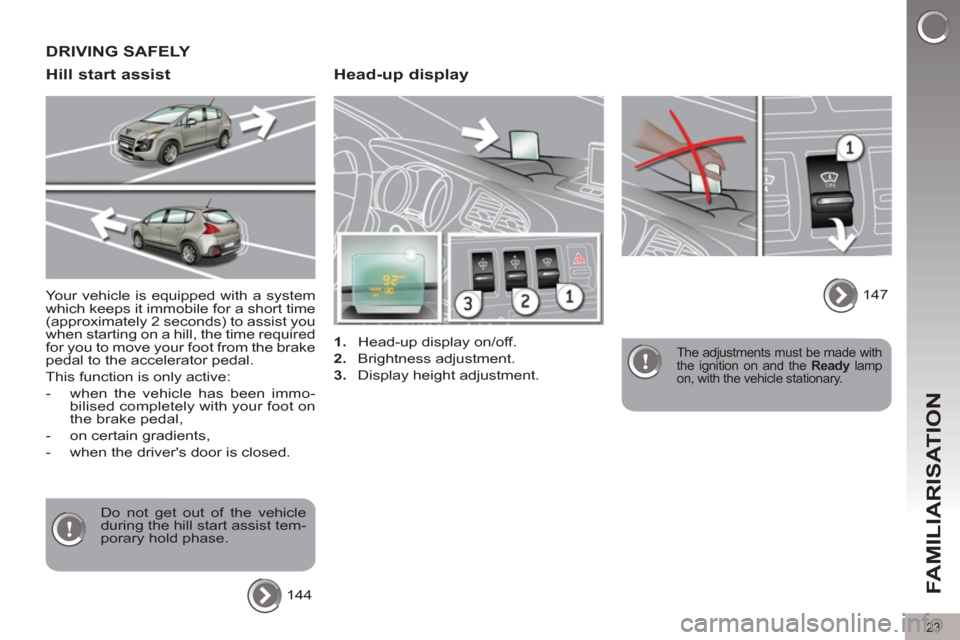
1.
Head-up display on/off.
2.
Brightness adjustment.
3.
Display height adjustment.
The adjustments must be made with
the ignition on and the Ready
lamp
on, with the vehicle stationary.
147
Your vehicle is equipped with a system
which keeps it immobile for a short time
(approximately 2 seconds) to assist you
when starting on a hill, the time required
for you to move your foot from the brake
pedal to the accelerator pedal.
This function is only active:
- when the vehicle has been immo-
bilised completely with your foot on
the brake pedal,
- on certain gradients,
- when the driver's door is closed.
Do not get out of the vehicle
during the hill start assist tem-
porary hold phase.
144
Hill start assist DRIVING SAFELY
Page 31 of 284
HYBRID SYSTEM
29
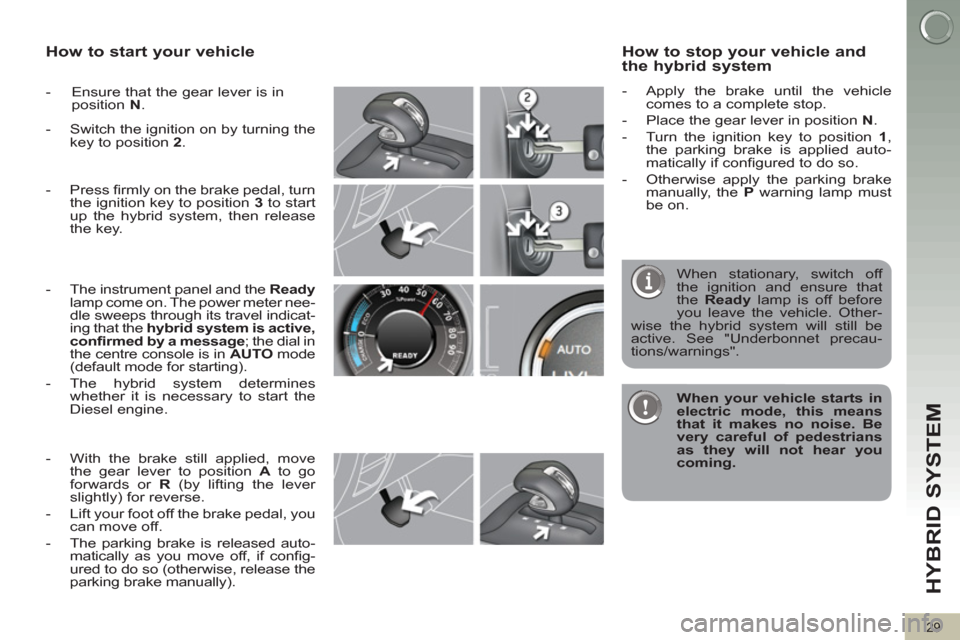
How to start your vehicle
- Ensure that the gear lever is in
position N
.
- Switch the ignition on by turning the
key to position 2
.
- Press fi rmly on the brake pedal, turn
the ignition key to position 3
to start
up the hybrid system, then release
the key.
- The instrument panel and the Ready
lamp come on. The power meter nee-
dle sweeps through its travel indicat-
ing that the hybrid system is active,
confi rmed by a message
; the dial in
the centre console is in AUTO
mode
(default mode for starting).
- The hybrid system determines
whether it is necessary to start the
Diesel engine.
- With the brake still applied, move
the gear lever to position A
to go
forwards or R
(by lifting the lever
slightly) for reverse.
- Lift your foot off the brake pedal, you
can move off.
- The parking brake is released auto-
matically as you move off, if confi g-
ured to do so (otherwise, release the
parking brake manually).
How to stop your vehicle and
the hybrid system
- Apply the brake until the vehicle
comes to a complete stop.
- Place the gear lever in position N
.
- Turn the ignition key to position 1
,
the parking brake is applied auto-
matically if confi gured to do so.
- Otherwise apply the parking brake
manually, the P
warning lamp must
be on.
When your vehicle starts in
electric mode, this means
that it makes no noise. Be
very careful of pedestrians
as they will not hear you
coming.
When stationary, switch off
the ignition and ensure that
the Ready
lamp is off before
you leave the vehicle. Other-
wise the hybrid system will still be
active. See "Underbonnet precau-
tions/warnings".
Page 32 of 284
HYBRID SYSTEM
30
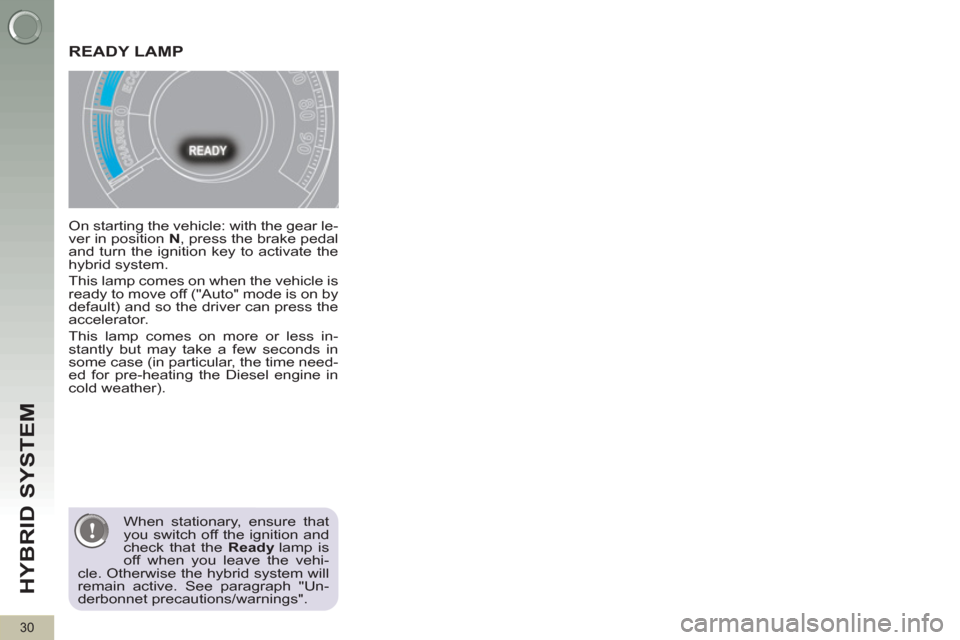
On starting the vehicle: with the gear le-
ver in position N
, press the brake pedal
and turn the ignition key to activate the
hybrid system.
This lamp comes on when the vehicle is
ready to move off ("Auto" mode is on by
default) and so the driver can press the
accelerator.
This lamp comes on more or less in-
stantly but may take a few seconds in
some case (in particular, the time need-
ed for pre-heating the Diesel engine in
cold weather).
READY LAMP
When stationary, ensure that
you switch off the ignition and
check that the Ready
lamp is
off when you leave the vehi-
cle. Otherwise the hybrid system will
remain active. See paragraph "Un-
derbonnet precautions/warnings".
Page 38 of 284
HYBRID SYSTEM
36
Automatic restarting of
the Diesel engine
Various conditions can lead to restarting
or maintaining the Diesel engine, princi-
pally:
- during sustained and sharp ac-
celeration ,
- to maintain a comfortable tempera-
ture in the passenger compartment,
- when demisting,
- if the high voltage battery is not
suffi ciently charged,
-
in mountainous conditions (altitude),
- in certain temperature conditions
for the engine, such as a low am-
bient temperature (below 0 °C),
- if the temperature of the hybrid
system is too high,
- when using the vehicle after pro-
longed parking in a sunny area,
- when using the vehicle on a steep
slope,
- when regenerating the particle
emissions fi lter,
- fuel level too low.
In ZEV mode, these conditions lead
to an immediate change to AUTO
mode.
The Diesel engine is switched off auto-
matically as soon as these conditions
are lifted.
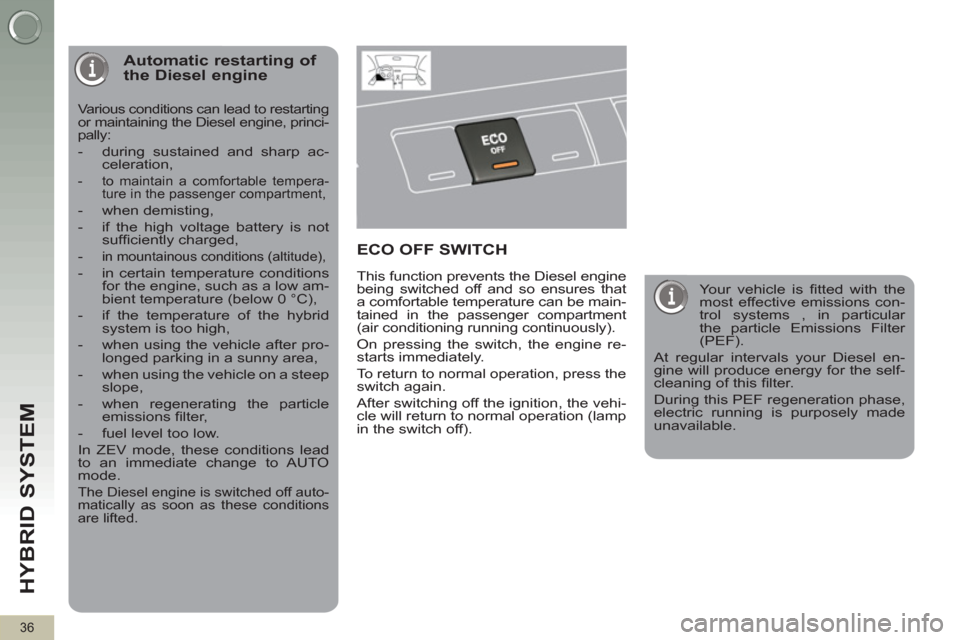
ECO OFF SWITCH
This function prevents the Diesel engine
being switched off and so ensures that
a comfortable temperature can be main-
tained in the passenger compartment
(air conditioning running continuously).
On pressing the switch, the engine re-
starts immediately.
To return to normal operation, press the
switch again.
After switching off the ignition, the vehi-
cle will return to normal operation (lamp
in the switch off).
Your vehicle is fi tted with the
most effective emissions con-
trol systems , in particular
the particle Emissions Filter
(PEF).
At regular intervals your Diesel en-
gine will produce energy for the self-
cleaning of this fi lter.
During this PEF regeneration phase,
electric running is purposely made
unavailable.
Page 43 of 284
HYBRID SYSTEM
41
The high voltage battery must not in any
circumstances be charged from an ex-
ternal source and must only be handled
by a workshop technician.
There is the risk of serious burns, as
well as electric arcs that could cause
serious injury or even death.
A used Ni-MH (Nickel Metal Hydride)
type high voltage battery must be re-
moved in an appropriate manner by a
repair workshop, so that its recycling
presents no risk to the environment.
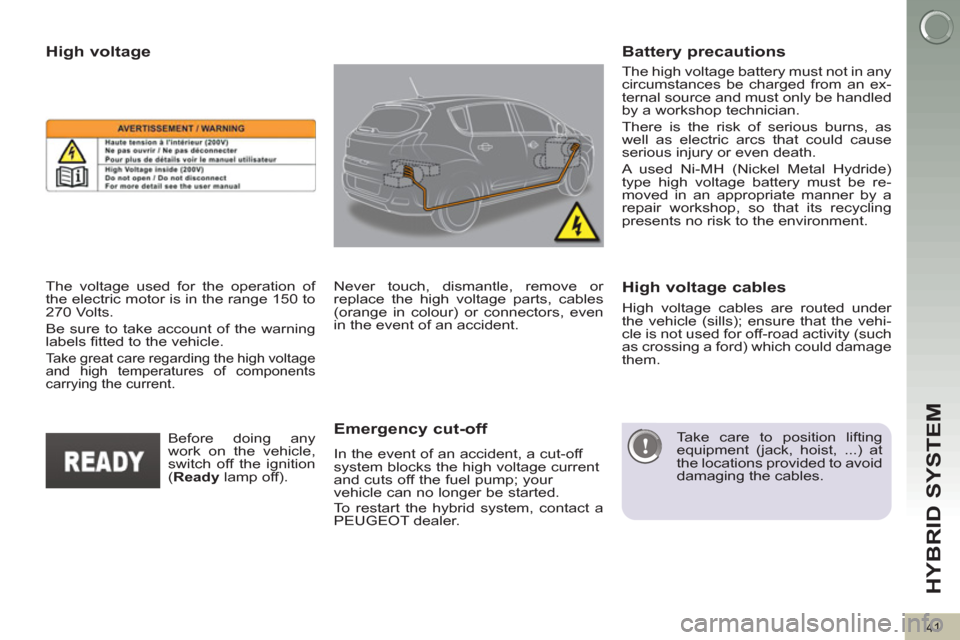
High voltage
The voltage used for the operation of
the electric motor is in the range 150 to
270 Volts.
Be sure to take account of the warning
labels fi tted to the vehicle.
Take great care regarding the high voltage
and high temperatures of components
carrying the current.
Emergency cut-off
In the event of an accident, a cut-off
system blocks the high voltage current
and cuts off the fuel pump; your
vehicle can no longer be started.
To restart the hybrid system, contact a
PEUGEOT dealer. Never touch, dismantle, remove or
replace the high voltage parts, cables
(orange in colour) or connectors, even
in the event of an accident.
High voltage cables are routed under
the vehicle (sills); ensure that the vehi-
cle is not used for off-road activity (such
as crossing a ford) which could damage
them.
Before doing any
work on the vehicle,
switch off the ignition
( Ready
lamp off).
Battery precautions
High voltage cables
Take care to position lifting
equipment (jack, hoist, ...) at
the locations provided to avoid
damaging the cables.