time Peugeot 308 2014 Repair Manual
[x] Cancel search | Manufacturer: PEUGEOT, Model Year: 2014, Model line: 308, Model: Peugeot 308 2014Pages: 400, PDF Size: 10.05 MB
Page 181 of 400
179
5
Visibility
308_EN_CHAP05_VISIBILITE_ED02-2013
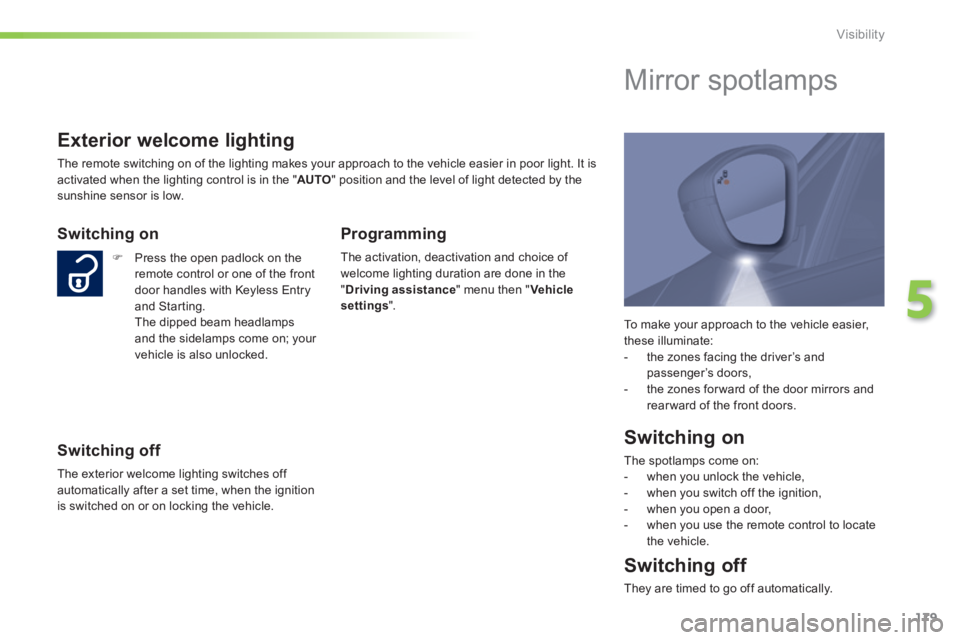
To make your approach to the vehicle easier, these illuminate: - the zones facing the driver’s and passenger’s doors, - the zones for ward of the door mirrors and rear ward of the front doors.
Mirror spotlamps
Switching on
The spotlamps come on: - when you unlock the vehicle, - when you switch off the ignition, - when you open a door, - when you use the remote control to locate the vehicle.
Switching off
They are timed to go off automatically.
Exterior welcome lighting
The remote switching on of the lighting makes your approach to the vehicle easier in poor light. It is activated when the lighting control is in the " AUTO " position and the level of light detected by the sunshine sensor is low.
Switching on
Press the open padlock on the remote control or one of the front door handles with Keyless Entry and Starting. The dipped beam headlamps and the sidelamps come on; your vehicle is also unlocked.
Switching off
The exterior welcome lighting switches off automatically after a set time, when the ignition is switched on or on locking the vehicle.
Programming
The activation, deactivation and choice of welcome lighting duration are done in the " Driving assistance " menu then " Vehicle settings ".
Page 184 of 400
182
Visibility
308_EN_CHAP05_VISIBILITE_ED02-2013
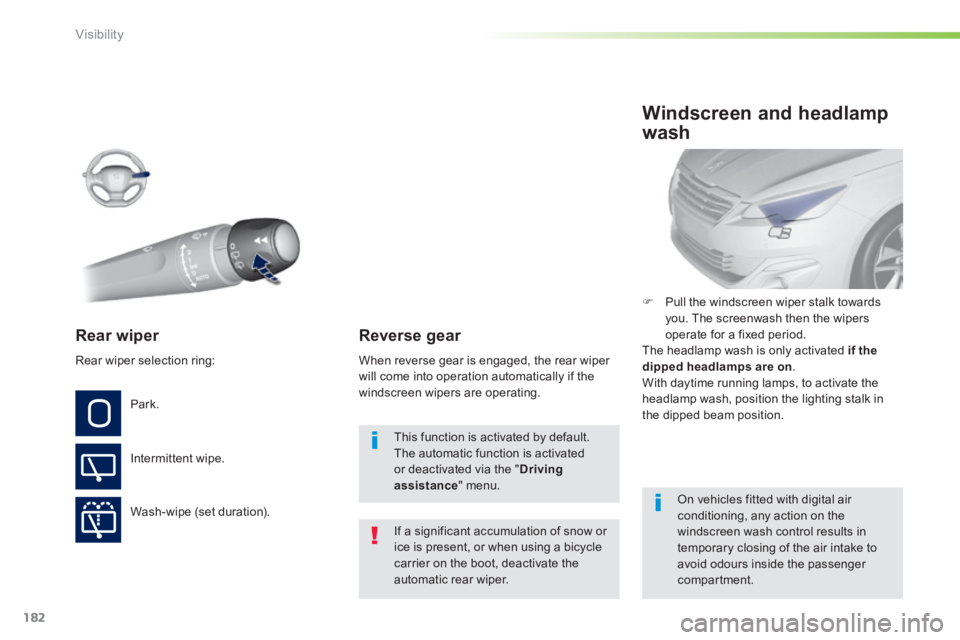
Rear wiper
If a significant accumulation of snow or ice is present, or when using a bicycle carrier on the boot, deactivate the automatic rear wiper.
Park.
Intermittent wipe.
Wash-wipe (set duration).
Reverse gear
Pull the windscreen wiper stalk towards you. The screenwash then the wipers operate for a fixed period. The headlamp wash is only activated if the dipped headlamps are on . With daytime running lamps, to activate the headlamp wash, position the lighting stalk in the dipped beam position.
Windscreen and headlamp
wash
On vehicles fitted with digital air conditioning, any action on the windscreen wash control results in temporary closing of the air intake to avoid odours inside the passenger compartment.
Rear wiper selection ring: When reverse gear is engaged, the rear wiper will come into operation automatically if the windscreen wipers are operating.
This function is activated by default. The automatic function is activated or deactivated via the " Driving assistance " menu.
Page 185 of 400
183
5
Visibility
308_EN_CHAP05_VISIBILITE_ED02-2013
Screenwash/headlamp wash level low
In the case of vehicles fitted with headlamp washers, when the fluid reservoir low level is reached this warning lamp comes on in
the instrument panel, accompanied by an audible signal and a message.
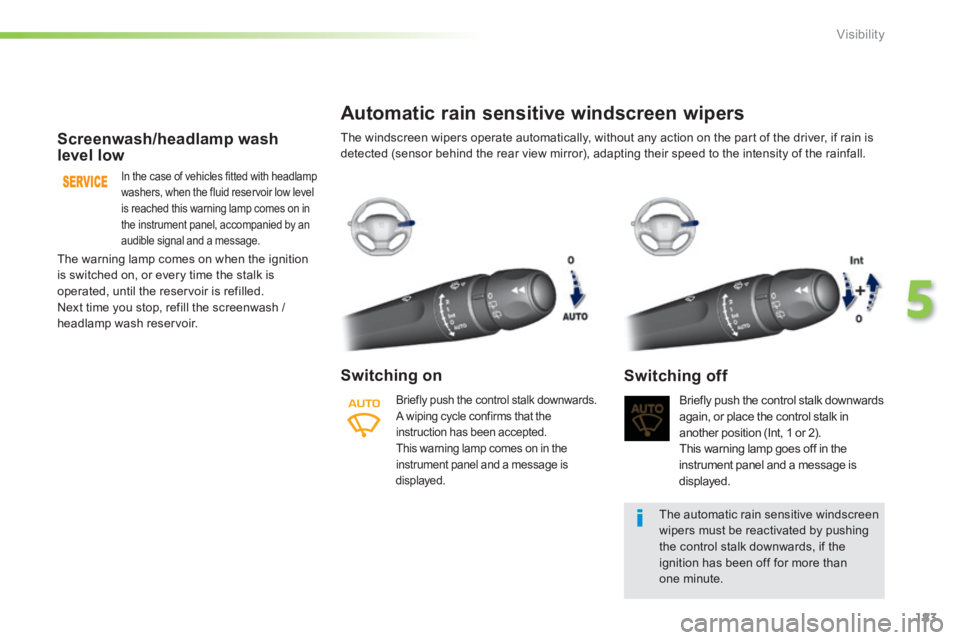
Automatic rain sensitive windscreen wipers
Switching on
Briefly push the control stalk downwards. A wiping cycle confirms that the instruction has been accepted. This warning lamp comes on in the instrument panel and a message is displayed.
Briefly push the control stalk downwards again, or place the control stalk in
another position (Int, 1 or 2). This warning lamp goes off in the instrument panel and a message is displayed.
Switching off
The automatic rain sensitive windscreen wipers must be reactivated by pushing the control stalk downwards, if the ignition has been off for more than one minute.
The warning lamp comes on when the ignition is switched on, or every time the stalk is operated, until the reservoir is refilled. Next time you stop, refill the screenwash / headlamp wash reservoir.
The windscreen wipers operate automatically, without any action on the part of the driver, if rain is detected (sensor behind the rear view mirror), adapting their speed to the intensity of the rainfall.
Page 187 of 400
185
5
Visibility
308_EN_CHAP05_VISIBILITE_ED02-2013
Courtesy lamps
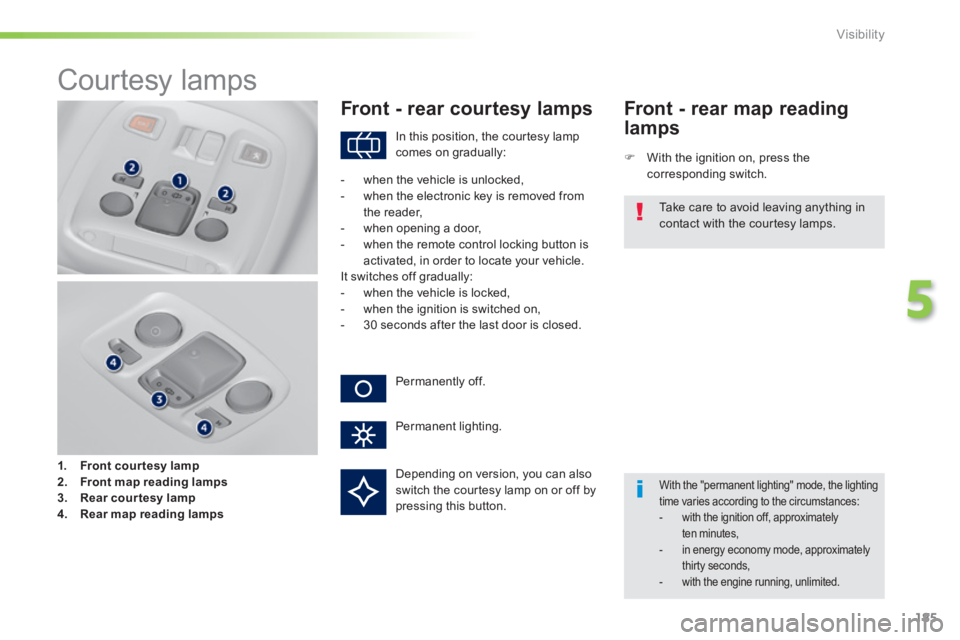
1. Front courtesy lamp2. Front map reading lamps3. Rear courtesy lamp4. Rear map reading lamps
Front - rear courtesy lamps
With the ignition on, press the corresponding switch.
Front - rear map reading
lamps
With the "permanent lighting" mode, the lighting time varies according to the circumstances: - with the ignition off, approximately ten minutes, - in energy economy mode, approximately thirty seconds, - with the engine running, unlimited.
In this position, the courtesy lamp comes on gradually:
Permanently off.
Permanent lighting.
- when the vehicle is unlocked, - when the electronic key is removed from the reader,
- when opening a door, - when the remote control locking button is activated, in order to locate your vehicle. It switches off gradually: - when the vehicle is locked, - when the ignition is switched on, - 30 seconds after the last door is closed.
Take care to avoid leaving anything in
contact with the courtesy lamps.
Depending on version, you can also switch the courtesy lamp on or off by pressing this button.
Page 189 of 400
187
6
Safety
308_EN_CHAP06_SECURITE_ED02-2013
Automatic operation of
hazard warning lamps
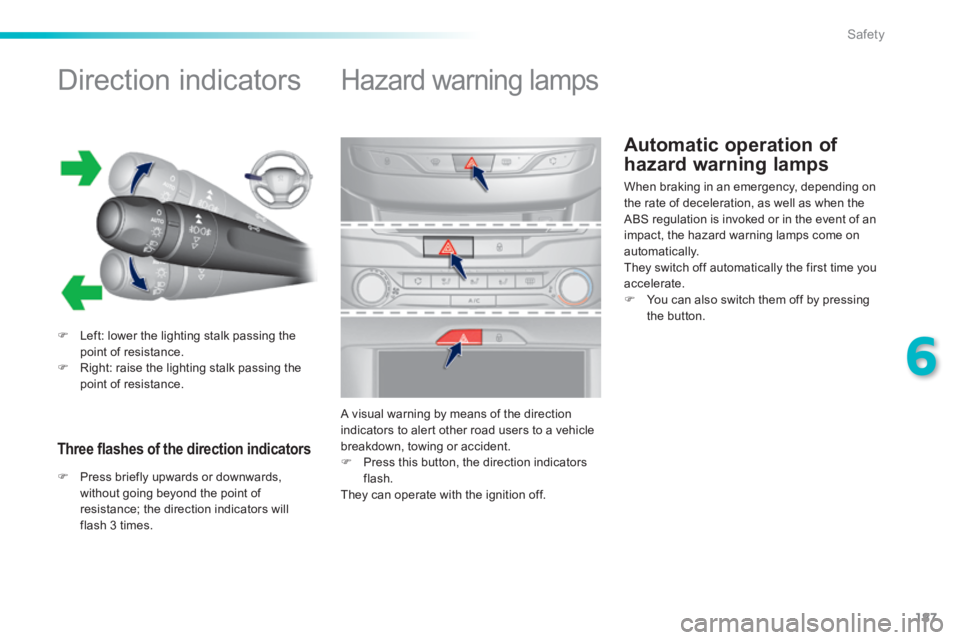
Direction indicators
Left: lower the lighting stalk passing the point of resistance. Right: raise the lighting stalk passing the point of resistance.
Three fl ashes of the direction indicators
Hazard warning lamps
A visual warning by means of the direction indicators to alert other road users to a vehicle breakdown, towing or accident. Press this button, the direction indicators flash. They can operate with the ignition off.
Press briefly upwards or downwards, without going beyond the point of resistance; the direction indicators will flash 3 times.
When braking in an emergency, depending on the rate of deceleration, as well as when the ABS regulation is invoked or in the event of an impact, the hazard warning lamps come on automatically. They switch off automatically the first time you accelerate. You can also switch them off by pressing the button.
Page 191 of 400
189
6
Safety
308_EN_CHAP06_SECURITE_ED02-2013
Tyre under-infl ation detection
The system continuously monitors the pressures on the four tyres, once the vehicle is moving. It compares the information given by the four wheel speed sensors with reference values, which must be reinitialised ever y time the tyre pressures are adjusted or a wheel changed. The system triggers an alert as soon as it detects a drop in the inflation pressure of one or more tyres.
The under-inflation detection system does not replace the vigilance or the responsibility of the driver. This system does not avoid the need to check the tyre pressures (including the spare wheel) every month as well as before a long journey. Driving with under-inflated tyres impairs road holding, extends braking distances and causes premature tyre wear, particularly under arduous condition (high loading, high speed, long journey).
System which automatically checks the pressure of the tyres while driving.
The inflation pressures defined for your vehicle can be found on the tyre pressure label. See the "Identification markings" section. Tyre pressures should be checked when the tyres are "cold" (vehicle stopped for 1 hour or after a journey of less than 6 miles (10 km) at moderate speeds). Other wise, add 0.3 bar to the pressures shown on the label.
Driving with under-inflated tyres increases fuel consumption.
Page 192 of 400
190
Safety
308_EN_CHAP06_SECURITE_ED02-2013
Under-inflation alert Reinitialisation
Before reinitialising the system, ensure that the pressures of the four tyres are correct for the use of the vehicle and in line with the recommendations on the tyre pressure label. The under-inflation detection system does not give a warning if a pressure is incorrect at the time of reinitialisation.
This is given by fixed illumination of this warning lamp, accompanied by an audible signal and, depending on
equipment, the display of a message.
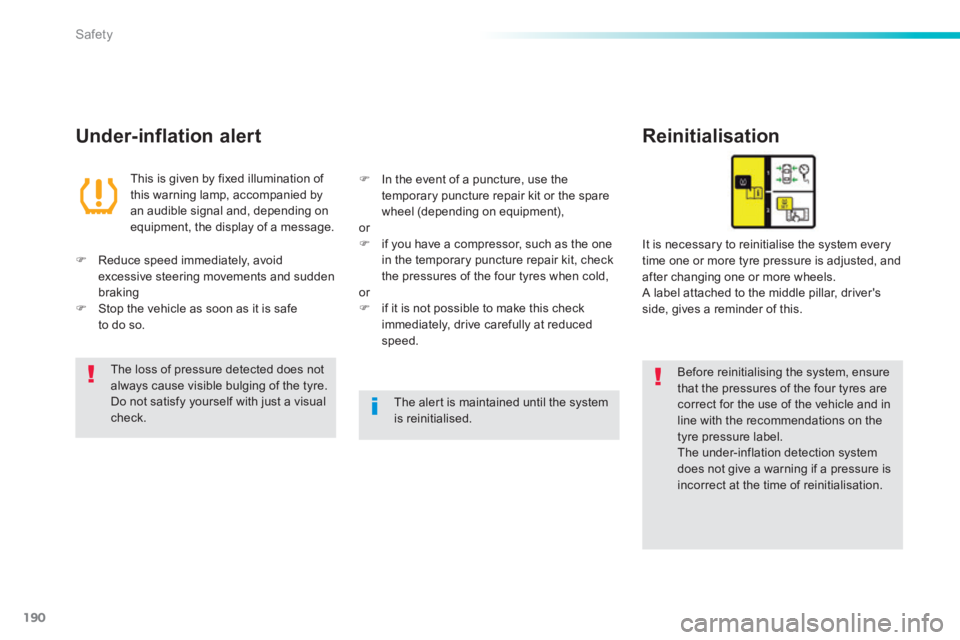
It is necessary to reinitialise the system every time one or more tyre pressure is adjusted, and after changing one or more wheels. A label attached to the middle pillar, driver's side, gives a reminder of this.
Reduce speed immediately, avoid excessive steering movements and sudden braking Stop the vehicle as soon as it is safe to do so.
In the event of a puncture, use the temporary puncture repair kit or the spare wheel (depending on equipment), or if you have a compressor, such as the one in the temporary puncture repair kit, check the pressures of the four tyres when cold, or if it is not possible to make this check immediately, drive carefully at reduced speed.
The loss of pressure detected does not always cause visible bulging of the tyre. Do not satisfy yourself with just a visual check. The alert is maintained until the system is reinitialised.
Page 197 of 400
195
6
Safety
308_EN_CHAP06_SECURITE_ED02-2013
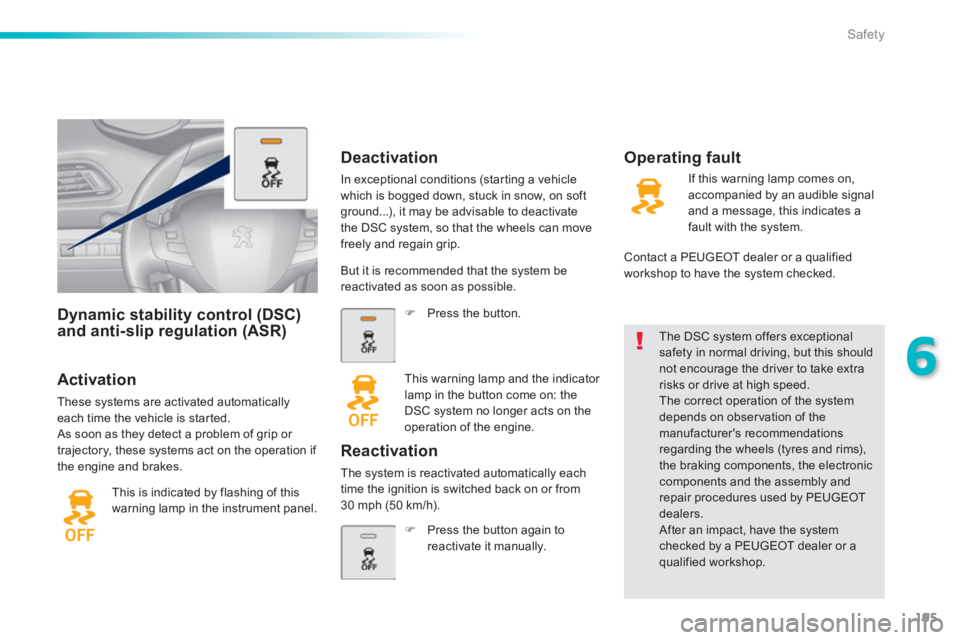
Dynamic stability control (DSC) and anti-slip regulation (ASR)
Activation
These systems are activated automatically each time the vehicle is started. As soon as they detect a problem of grip or trajectory, these systems act on the operation if the engine and brakes.
This is indicated by flashing of this warning lamp in the instrument panel.
The DSC system offers exceptional safety in normal driving, but this should not encourage the driver to take extra risks or drive at high speed. The correct operation of the system depends on observation of the manufacturer's recommendations regarding the wheels (tyres and rims), the braking components, the electronic components and the assembly and repair procedures used by PEUGEOT dealers. After an impact, have the system checked by a PEUGEOT dealer or a qualified workshop.
Deactivation
In exceptional conditions (starting a vehicle which is bogged down, stuck in snow, on soft ground...), it may be advisable to deactivate the DSC system, so that the wheels can move freely and regain grip.
Operating fault
But it is recommended that the system be reactivated as soon as possible.
Press the button.
This warning lamp and the indicator lamp in the button come on: the DSC system no longer acts on the operation of the engine.
Reactivation
The system is reactivated automatically each time the ignition is switched back on or from 30 mph (50 km/h).
Press the button again to reactivate it manually.
If this warning lamp comes on, accompanied by an audible signal and a message, this indicates a
fault with the system.
Contact a PEUGEOT dealer or a qualified workshop to have the system checked.
Page 201 of 400
199
6
Safety
308_EN_CHAP06_SECURITE_ED02-2013
Airbags
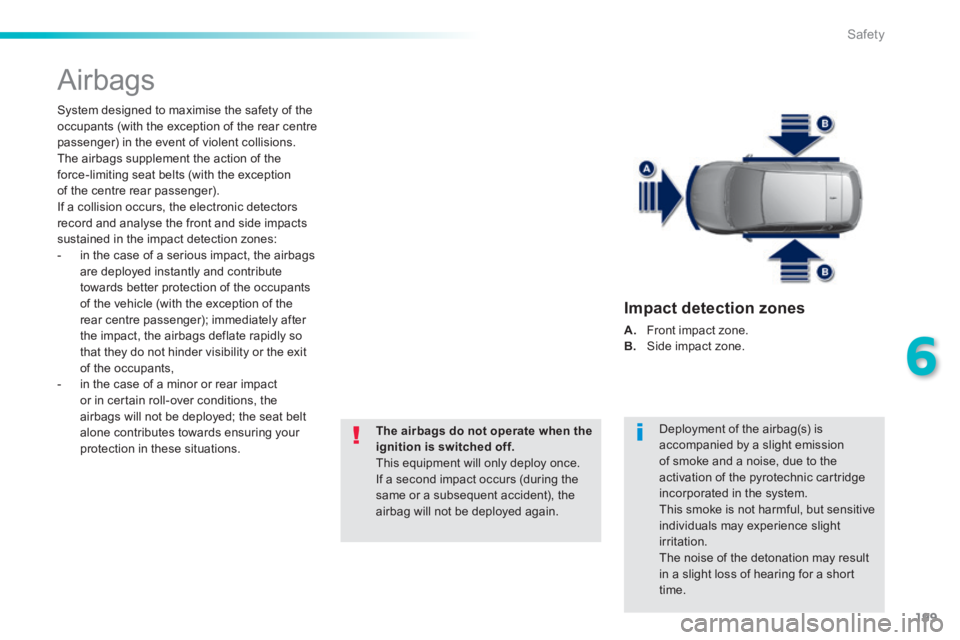
System designed to maximise the safety of the occupants (with the exception of the rear centre passenger) in the event of violent collisions. The airbags supplement the action of the force-limiting seat belts (with the exception of the centre rear passenger). If a collision occurs, the electronic detectors record and analyse the front and side impacts sustained in the impact detection zones: - in the case of a serious impact, the airbags are deployed instantly and contribute towards better protection of the occupants of the vehicle (with the exception of the rear centre passenger); immediately after the impact, the airbags deflate rapidly so that they do not hinder visibility or the exit of the occupants, - in the case of a minor or rear impact or in certain roll-over conditions, the airbags will not be deployed; the seat belt alone contributes towards ensuring your protection in these situations.
The airbags do not operate when the ignition is switched off. This equipment will only deploy once. If a second impact occurs (during the same or a subsequent accident), the airbag will not be deployed again.
Deployment of the airbag(s) is accompanied by a slight emission of smoke and a noise, due to the activation of the pyrotechnic cartridge incorporated in the system. This smoke is not harmful, but sensitive individuals may experience slight irritation. The noise of the detonation may result in a slight loss of hearing for a short time.
Impact detection zones
A. Front impact zone. B. Side impact zone.
Page 204 of 400
202
Safety
308_EN_CHAP06_SECURITE_ED02-2013
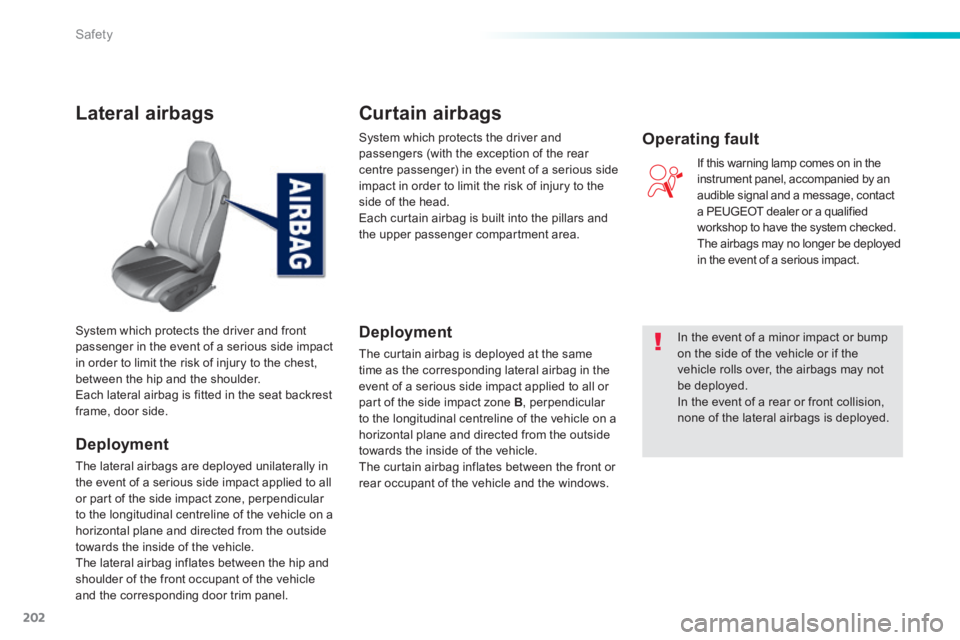
Lateral airbags
Deployment
The lateral airbags are deployed unilaterally in the event of a serious side impact applied to all or part of the side impact zone, perpendicular to the longitudinal centreline of the vehicle on a horizontal plane and directed from the outside towards the inside of the vehicle. The lateral airbag inflates between the hip and shoulder of the front occupant of the vehicle and the corresponding door trim panel.
System which protects the driver and front passenger in the event of a serious side impact in order to limit the risk of injury to the chest, between the hip and the shoulder. Each lateral airbag is fitted in the seat backrest frame, door side.
System which protects the driver and passengers (with the exception of the rear centre passenger) in the event of a serious side impact in order to limit the risk of injury to the side of the head. Each curtain airbag is built into the pillars and the upper passenger compartment area.
Deployment
The curtain airbag is deployed at the same time as the corresponding lateral airbag in the event of a serious side impact applied to all or part of the side impact zone B , perpendicular to the longitudinal centreline of the vehicle on a
horizontal plane and directed from the outside towards the inside of the vehicle. The curtain airbag inflates between the front or rear occupant of the vehicle and the windows.
In the event of a minor impact or bump on the side of the vehicle or if the vehicle rolls over, the airbags may not be deployed. In the event of a rear or front collision, none of the lateral airbags is deployed.
If this warning lamp comes on in the instrument panel, accompanied by an audible signal and a message, contact a PEUGEOT dealer or a qualified workshop to have the system checked. The airbags may no longer be deployed in the event of a serious impact.
Operating fault
Curtain airbags