engine Peugeot 508 RXH 2014 Repair Manual
[x] Cancel search | Manufacturer: PEUGEOT, Model Year: 2014, Model line: 508 RXH, Model: Peugeot 508 RXH 2014Pages: 338, PDF Size: 10.81 MB
Page 129 of 338
127
508RXH_en_Chap04_conduite_ed01-2014
You must press the brake pedal when
starting the engine.
Whatever the circumstances, you must
manually apply the parking brake when
parking, unless the parking brake is
programmed in automatic mode.
When immobilising the vehicle, with the
hybrid system active, you must place
the gear selector in neutral N
.
Before carrying out any work in the
engine compartment, check that the
gear selector is in neutral N and that the
parking brake is applied.
Stopping the vehicle
With the ignition on, the
flashing of this warning lamp,
accompanied by an audible
signal and a message in the instrument panel
screen, indicates a malfunction of the gearbox.
Have it checked by a P
e
uge
Ot
dealer or a
qualified workshop.
Before switching off the engine, you can
choose to:
-
m
ove to position N to engage neutral,
-
l
eave the gear engaged; in this case, it will
not be possible to move the vehicle.
In both cases, you should apply the parking
brake to immobilise the vehicle, unless it has
been programmed in automatic mode.
Operating fault
this function facilitates manoeuvring of the
vehicle at low speed (when parking, in traffic
jams, …).
With the hybrid system active and the parking
brake released, if position A , M or R is
selected, the vehicle moves as soon as you
take your foot off the brake pedal (even without
any action on the accelerator).
Creep function (moving
without the accelerator)
Never leave children unsupervised
in the vehicle with the hybrid system
active.
For your safety, this function will only be
activated if you press the brake pedal when
engaging forward drive or reverse.
th
is function is deactivated if the driver's door
is opened. t
o r
eactivate it, close the door and
then press the brake or accelerator pedal.
4
Driving
Page 132 of 338
130
508RXH_en_Chap04_conduite_ed01-2014
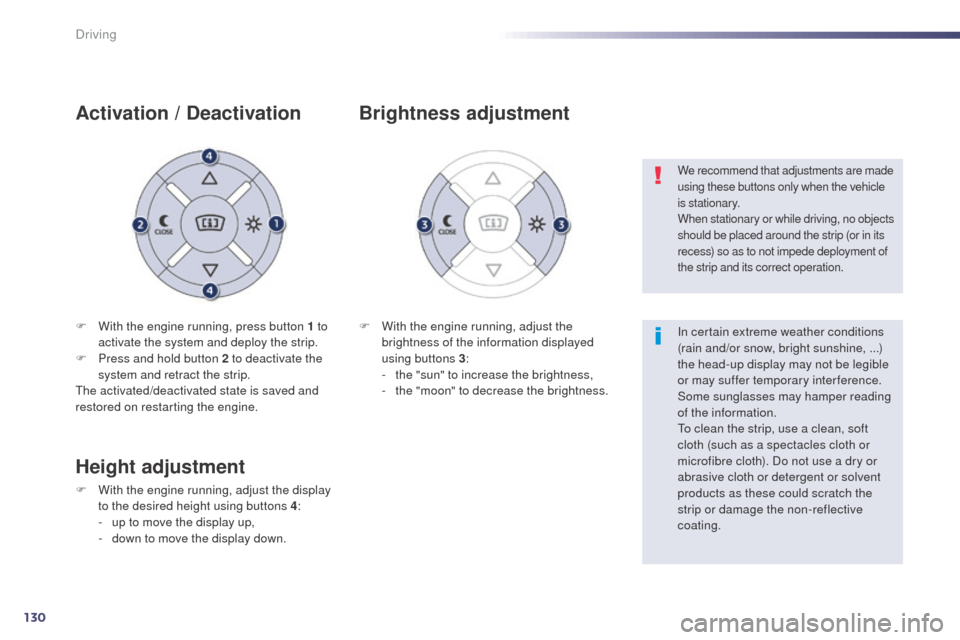
F With the engine running, press button 1 to activate the system and deploy the strip.
F
P
ress and hold button 2 to deactivate the
system and retract the strip.
th
e activated/deactivated state is saved and
restored on restarting the engine.
Activation / Deactivation
F With the engine running, adjust the brightness of the information displayed
using buttons 3 :
-
t
he "sun" to increase the brightness,
-
t
he "moon" to decrease the brightness.
Brightness adjustment
We recommend that adjustments are made
using these buttons only when the vehicle
is stationary.
When stationary or while driving, no objects
should be placed around the strip (or in its
recess) so as to not impede deployment of
the strip and its correct operation.
In certain extreme weather conditions
(rain and/or snow, bright sunshine, ...)
the head-up display may not be legible
or may suffer temporary interference.
Some sunglasses may hamper reading
of the information.
to c
lean the strip, use a clean, soft
cloth (such as a spectacles cloth or
microfibre cloth). Do not use a dry or
abrasive cloth or detergent or solvent
products as these could scratch the
strip or damage the non-reflective
coating.
Height adjustment
F With the engine running, adjust the display to the desired height using buttons 4 :
-
u
p to move the display up,
-
d
own to move the display down.
Driving
Page 134 of 338
132
508RXH_en_Chap04_conduite_ed01-2014
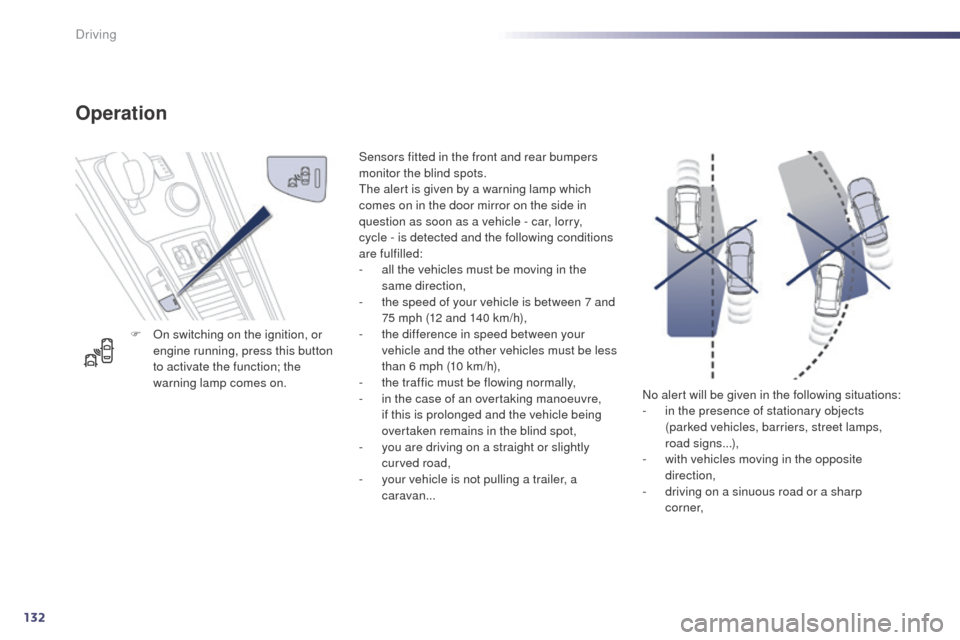
No alert will be given in the following situations:
- i n the presence of stationary objects
(parked vehicles, barriers, street lamps,
road signs...),
-
w
ith vehicles moving in the opposite
direction,
-
d
riving on a sinuous road or a sharp
c o r n e r,
Operation
F On switching on the ignition, or engine running, press this button
to activate the function; the
warning lamp comes on. Sensors fitted in the front and rear bumpers
monitor the blind spots.
th
e alert is given by a warning lamp which
comes on in the door mirror on the side in
question as soon as a vehicle - car, lorry,
cycle - is detected and the following conditions
are fulfilled:
-
a
ll the vehicles must be moving in the
same direction,
-
t
he speed of your vehicle is between 7 and
75 mph (12 and 140 km/h),
- t he difference in speed between your
vehicle and the other vehicles must be less
than 6 mph (10 km/h),
-
t
he traffic must be flowing normally,
-
i
n the case of an overtaking manoeuvre,
if this is prolonged and the vehicle being
overtaken remains in the blind spot,
-
y
ou are driving on a straight or slightly
curved road,
-
y
our vehicle is not pulling a trailer, a
caravan...
Driving
Page 147 of 338
145
508RXH_en_Chap05_visibilite_ed01-2014
Lighting left on audible signal
An audible signal when a front door
is opened warns the driver that the
vehicle's exterior lighting is on, with the
ignition off and in manual lighting mode.
In this case, switching off the lighting
stops the audible signal.
With the ignition off, if the dipped
headlamps remain on, the vehicle goes
into "
eC
O" mode to avoid discharging
the battery.
In some weather conditions (e.g. low
temperature or humidity), the presence
of misting on the internal sur face of the
glass of the headlamps and rear lamps
is normal; it disappears after the lamps
have been on for a few minutes. Daytime lighting, compulsory in certain
countries, which comes on automatically when
the engine is started making the vehicle more
visible to other road users.
Daytime running lamps
this function is assured:
-
i n countries where it is imposed by
regulations, by illumination of the dipped
beam headlamps with the sidelamps and
number plate lamps.
-
f
or other countries where it is provided, by
the use of dedicated lamps.
th
e lighting goes off when you switch
off the ignition, but you can always
switch it on again using the lighting
control stalk.
*
f
unction that can be set in the vehicle
configuration menu.
LED lamps
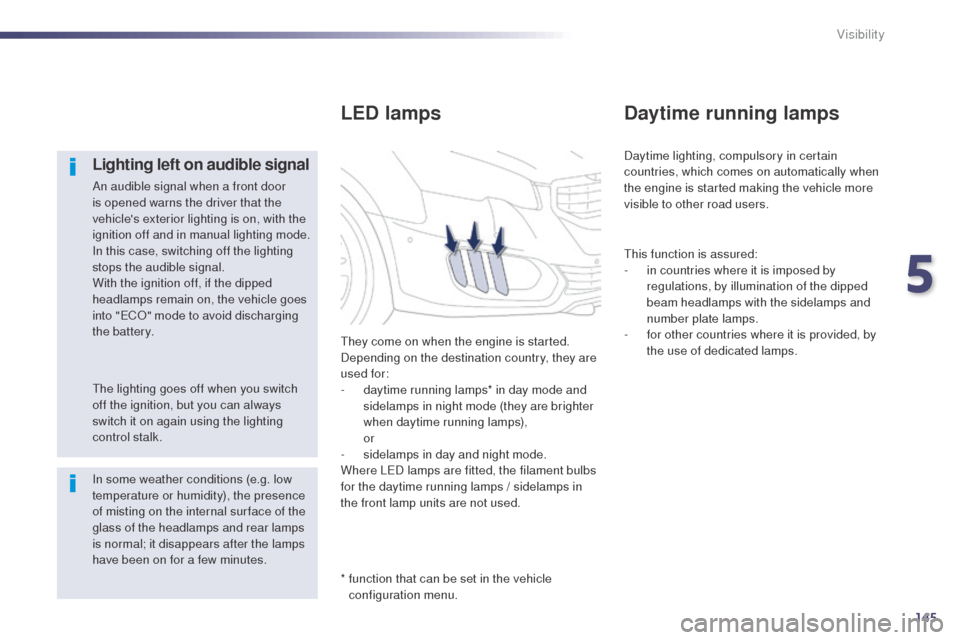
they come on when the engine is started.
Depending on the destination country, they are
used for:
-
d
aytime running lamps* in day mode and
sidelamps in night mode (they are brighter
when daytime running lamps),
or
-
s
idelamps in day and night mode.
Where L
eD l
amps are fitted, the filament bulbs
for the daytime running lamps / sidelamps in
the front lamp units are not used.
5
Visibility
Page 179 of 338
177
508RXH_en_Chap07_securite_ed01-2014
A set of the following electronic Stability
systems:
-
a
nti-lock braking system (ABS) and
electronic brake force distribution (
eB
FD),
-
em
ergency braking assistance,
-
w
heel anti-slip regulation (ASR) or traction
control,
-
d
ynamic stability control (DSC).
electronic stability control (eS C)
Definitions
Anti-lock braking system (ABS)
and electronic brake force
distribution (EBFD)
these systems improve the stability and
manoeuvrability of your vehicle when braking
and contribute towards improved control in
corners, in particular on poor or slippery road
surfaces.
th
e ABS prevents wheel lock in the event of
emergency braking.
th
e electronic brake force distribution system
manages the braking pressure wheel by wheel.
Emergency braking assistance
In an emergency, this system enables you to
reach the optimum braking pressure more
quickly and therefore reduce the stopping
distance.
It is triggered in relation to the speed at which
the brake pedal is pressed.
t
h
is is felt by a
reduction in the resistance of the pedal and an
increase in the effectiveness of the braking.
Anti-slip regulation (ASR)
this system (also known as tr action Control)
optimises traction in order to avoid wheel
slip by acting on the brakes of the driving
wheels and on the engine. It also improves
the directional stability of the vehicle on
acceleration.
Dynamic stability control (DSC)
If there is a difference between the path
followed by the vehicle and that required by the
driver, this system monitors each wheel and
automatically acts on the brake of one or more
wheels and on the engine to return the vehicle
to the required path, within the limits of the laws
of physics.
7
Safety
Page 181 of 338
179
508RXH_en_Chap07_securite_ed01-2014
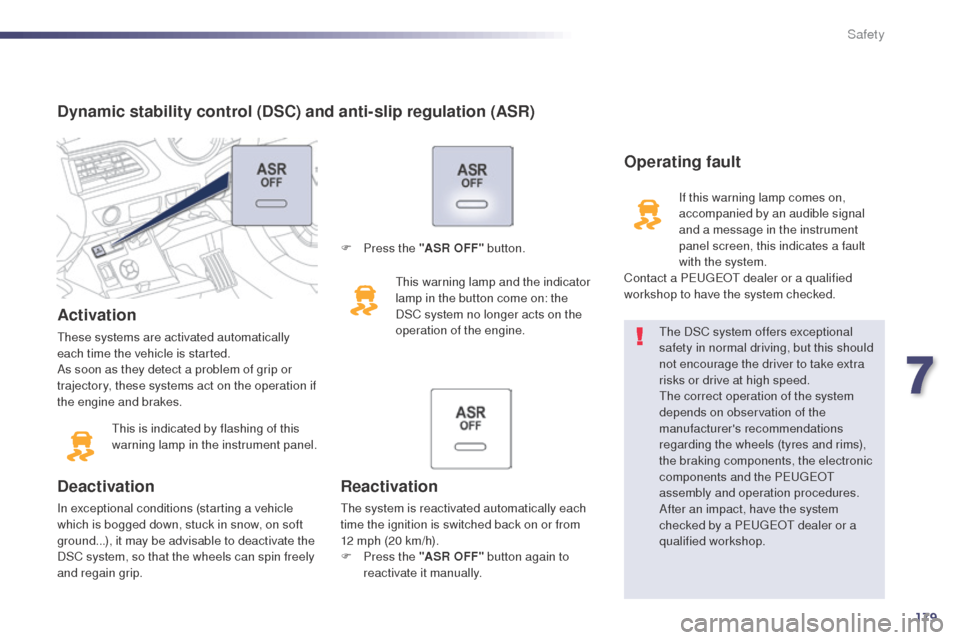
Dynamic stability control (DSC) and anti-slip regulation (ASR)
Activation
these systems are activated automatically
each time the vehicle is started.
As soon as they detect a problem of grip or
trajectory, these systems act on the operation if
the engine and brakes.
th
is is indicated by flashing of this
warning lamp in the instrument panel.
Deactivation
In exceptional conditions (starting a vehicle
which is bogged down, stuck in snow, on soft
ground...), it may be advisable to deactivate the
DSC system, so that the wheels can spin freely
and regain grip.
th
e DSC system offers exceptional
safety in normal driving, but this should
not encourage the driver to take extra
risks or drive at high speed.
th
e correct operation of the system
depends on observation of the
manufacturer's recommendations
regarding the wheels (tyres and rims),
the braking components, the electronic
components and the P
e
uge
Ot
assembly and operation procedures.
After an impact, have the system
checked by a P
e
uge
Ot
dealer or a
qualified workshop.
Operating fault
If this warning lamp comes on,
accompanied by an audible signal
and a message in the instrument
panel screen, this indicates a fault
with the system.
Contact a P
e
uge
Ot
dealer or a qualified
workshop to have the system checked.
Reactivation
the system is reactivated automatically each
time the ignition is switched back on or from
12
mph (20 km/h).
F
P
ress the "AS R O FF " button again to
reactivate it manually.
F
P
ress the "AS R O FF "
button.
th
is warning lamp and the indicator
lamp in the button come on: the
DSC system no longer acts on the
operation of the engine.
7
Safety
Page 191 of 338
189
508RXH_en_Chap08_info-pratiques_ed01-2014
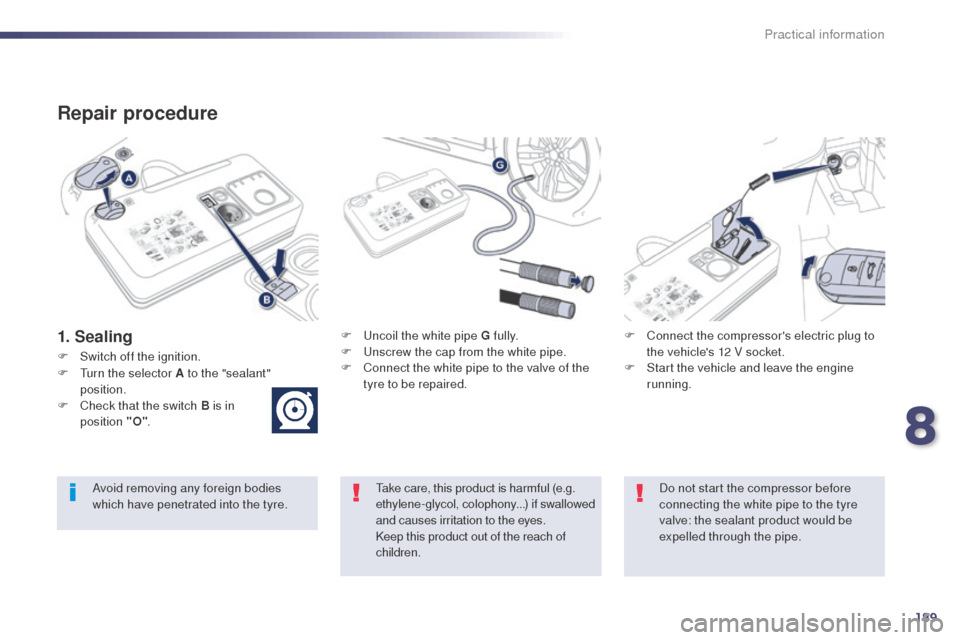
Repair procedure
1. SealingF uncoil the white pipe G fully.
F un screw the cap from the white pipe.
F
C
onnect the white pipe to the valve of the
tyre to be repaired. F
C onnect the compressor's electric plug to
the vehicle's 12 V socket.
F
S
tart the vehicle and leave the engine
running.
ta
ke care, this product is harmful (e.g.
ethylene-glycol, colophony...) if swallowed
and causes irritation to the eyes.
Keep this product out of the reach of
children.
Avoid removing any foreign bodies
which have penetrated into the tyre.
F
S
witch off the ignition.
F
t
u
rn the selector A to the "sealant"
position.
F
C
heck that the switch B is in
position "O" .
Do not start the compressor before
connecting the white pipe to the tyre
valve: the sealant product would be
expelled through the pipe.
8
Practical information
Page 193 of 338
191
508RXH_en_Chap08_info-pratiques_ed01-2014
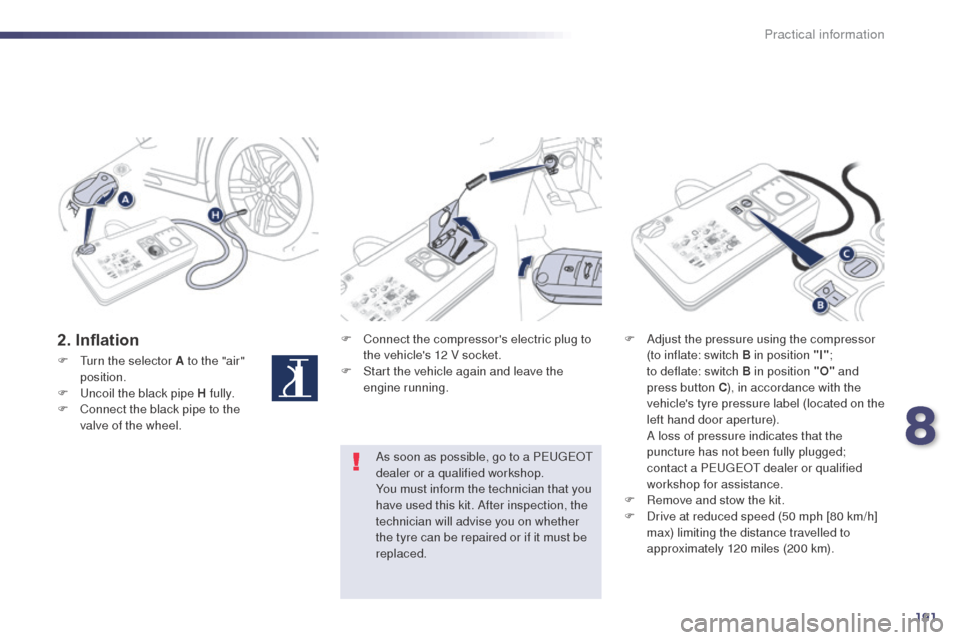
2. InflationF Connect the compressor's electric plug to the vehicle's 12 V socket.
F
S
tart the vehicle again and leave the
engine running. F
A djust the pressure using the compressor
(to inflate: switch B in position "I" ;
to
deflate: switch B in position "O" and
press button C ), in accordance with the
vehicle's tyre pressure label (located on the
left hand door aperture).
A l
oss of pressure indicates that the
puncture has not been fully plugged;
contact a P
e
uge
Ot
dealer or qualified
workshop for assistance.
F
R
emove and stow the kit.
F
D
rive at reduced speed (50 mph [80 km/h]
max) limiting the distance travelled to
approximately 120 miles (200 km).
As soon as possible, go to a P
e
uge
Ot
dealer or a qualified workshop.
You must inform the technician that you
have used this kit. After inspection, the
technician will advise you on whether
the tyre can be repaired or if it must be
replaced.
F
t
u
rn the selector A to the "air"
position.
F
u
n
coil the black pipe H fully.
F
C
onnect the black pipe to the
valve of the wheel.
8
Practical information
Page 194 of 338
192
508RXH_en_Chap08_info-pratiques_ed01-2014
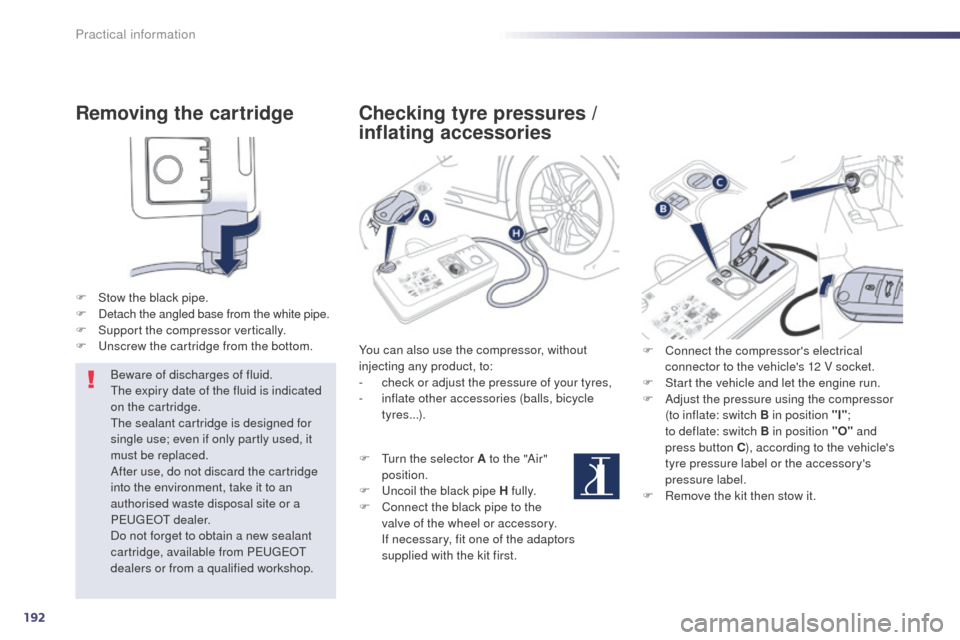
Removing the cartridge
F Stow the black pipe.
F D etach the angled base from the white pipe.
F
S
upport the compressor vertically.
F
u
n
screw the cartridge from the bottom.
Beware of discharges of fluid.
th
e expiry date of the fluid is indicated
on the cartridge.
th
e sealant cartridge is designed for
single use; even if only partly used, it
must be replaced.
After use, do not discard the cartridge
into the environment, take it to an
authorised waste disposal site or a
P
e
uge
Ot d
ealer.
Do not forget to obtain a new sealant
cartridge, available from P
e
uge
Ot
dealers or from a qualified workshop.
Checking tyre pressures /
inflating accessories
You can also use the compressor, without
injecting any product, to:
-
c
heck or adjust the pressure of your tyres,
-
i
nflate other accessories (balls, bicycle
tyres...).
F
t
u
rn the selector A to the "Air"
position.
F
u
n
coil the black pipe H fully.
F
C
onnect the black pipe to the
valve of the wheel or accessory.
I
f necessary, fit one of the adaptors
supplied with the kit first. F
C onnect the compressor's electrical
connector to the vehicle's 12 V socket.
F
S
tart the vehicle and let the engine run.
F
A
djust the pressure using the compressor
(to inflate: switch B in position "I" ;
to
deflate: switch B in position "O" and
press button C ), according to the vehicle's
tyre pressure label or the accessory's
pressure label.
F
R
emove the kit then stow it.
Practical information
Page 195 of 338
193
508RXH_en_Chap08_info-pratiques_ed01-2014
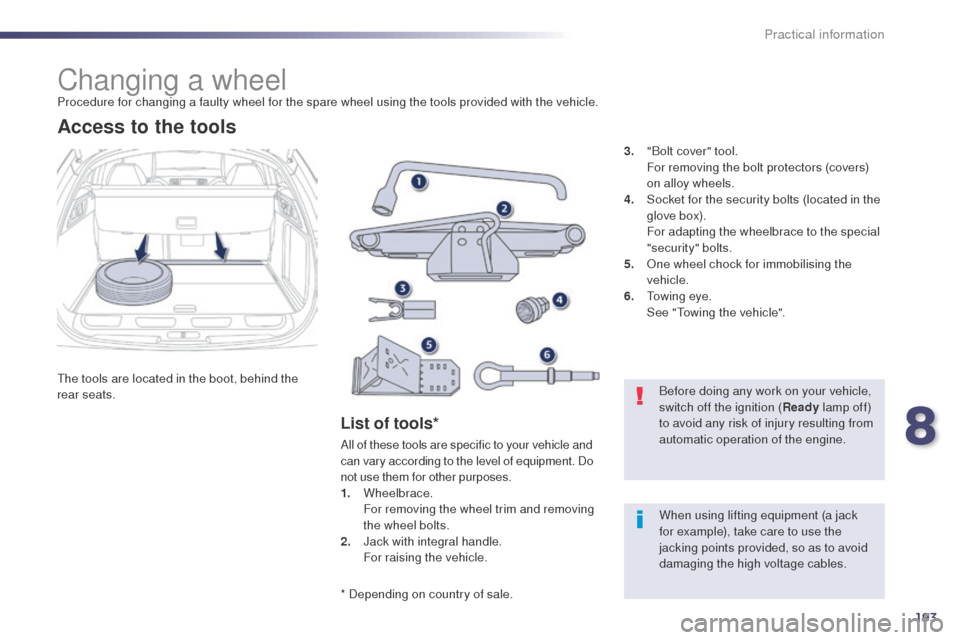
Changing a wheelProcedure for changing a faulty wheel for the spare wheel using the tools provided with the vehicle.
th
e tools are located in the boot, behind the
rear seats.
Access to the tools
List of tools*
3. "Bolt cover" tool. F or removing the bolt protectors (covers)
on alloy wheels.
4.
S
ocket for the security bolts (located in the
glove box).
F
or adapting the wheelbrace to the special
"security" bolts.
5.
O
ne wheel chock for immobilising the
vehicle.
6.
t
o
wing eye.
S
ee "
to
wing the vehicle".
Before doing any work on your vehicle,
switch off the ignition ( Ready lamp off)
to avoid any risk of injury resulting from
automatic operation of the engine.
When using lifting equipment (a jack
for example), take care to use the
jacking points provided, so as to avoid
damaging the high voltage cables.
All of these tools are specific to your vehicle and
can vary according to the level of equipment. Do
not use them for other purposes.
1.
Wheelbrace.
F
or removing the wheel trim and removing
the wheel bolts.
2.
J
ack with integral handle.
F
or raising the vehicle.
* Depending on country of sale.
8
Practical information