wheel Peugeot 807 2013 Owner's Guide
[x] Cancel search | Manufacturer: PEUGEOT, Model Year: 2013, Model line: 807, Model: Peugeot 807 2013Pages: 234, PDF Size: 9.8 MB
Page 106 of 234
104
Towing a trailer
On the contrary, use a high gear to
lower the engine speed and reduce
your speed.
In all cases, pay attention to the
coolant temperature.
Brakes:
towing increases the braking
distance. Drive at a moderate speed,
change down early and brake
gradually. Please contact a PEUGEOT dealer
fi rst for further information.
Automatic adjustment
For vehicles with Xenon bulbs, and if
the change in load makes it necessary,
this system automatically corrects the
height of the beam after approximately
2 minutes. The driver is then assured
of having optimum lighting and not
causing a nuisance to other road
users.
In certain cases of particularly
arduous use (towing the
maximum load up a steep slope
in high temperatures), the engine
automatically limits its power. In this
case, cutting off the air conditioning
allows the engine power to be
recovered, and therefore the towing
speed to be signifi cantly increased
(approximately 12 mph [20 km/h]
more). Sequential control of the
gearbox may also become unavailable.
Lighting
Bicycle carrier
Refer to the "Identifi cation
features" section of chapter 8. Refer to the "Steering wheel
controls" section of chapter 3.
When using a trailer connection,
you must add a fuse. Refer to
the "Changing a fuse" section of
chapter 7.
If the coolant temperature warning light
comes on, stop the vehicle and switch
off the engine as soon as possible.
Tyres:
check the tyre pressures of
the towing vehicle and of the trailer,
observing the recommended pressure.
Side wind:
sensitivity to side wind is
increased. Drive smoothly and at a
moderate speed.
Towbar
We recommend the use of original
PEUGEOT towbars, which have been
tested for endurance from the design
stage of your vehicle.
Towing equipment must be fi tted in
accordance with the manufacturer's
instructions, with particular attention to
the towing capacities of your vehicle,
the load towed, the nose weight and
the electrical connection. As this fi tting
should be carried out by a professional,
we recommend that you entrust the
fi tting of this equipment to a PEUGEOT
dealer.
In accordance with the general
instructions referred to above, we draw
your attention to the risk connected
with fi tting a towbar or other electrical
accessory which is not recommended
by the PEUGEOT network. Fitting such
equipment could result in a failure of
your vehicle's electronic system.
Manual adjustment
Adjust your headlamps so as not to
dazzle other road users. Check the
electrical signalling of the trailer.
If you fi t a bicycle carrier on
the tailgate, deactivate the
rear wiper from the display's
confi guration menu.
Page 109 of 234
107
Other accessories
ACCESSORIES
5
OTHER ACCESSORIES
These accessories and parts, after
being tested and approved for reliability
and safety, are all adapted to your
vehicle. A wide choice of recommended
accessories and original parts is offered
by the PEUGEOT Marque. To avoid any jamming under the
pedals:
- ensure that the mat and its fi xings
are positioned correctly,
- never place one mat on top of
another.
Compatible portable equipment
For the hands-free kit audio
equipment, the fi tting of an RCA
auxiliary socket is offered specifi cally
by the Network.
The audio cable for connection to
the auxiliary socket (RCA yellow-red
located in the glove box) is also offered
by the network.
Following connection of the cable and
selection of the AUX mode, via the
source button, your portable equipment
is ready to operate.
Set the portable equipment to half
volume to avoid saturating the audio
system sound. Then use the audio
system volume button.
Audio systems, telephone,
hands-free kit, speakers, CD
changer, navigation system,
DVD player, ...
Alloy wheels, trims,
aluminium interior trim kit,
mud fl aps, ...
Seat covers compatible with
side airbags, mats, boot tray,
sunroof, luggage net, door
defl ectors, cool box secured
on the slides, clip armrest, load
carrying roof bars, roof box,
snow chains, ski carrier, tailgate
bicycle carrier, interior bicycle carrier,
booster seats and child seats, Isofi x
seats, side sun blinds and rear blind, ...
Trailer towbar which must be fi tted by a
PEUGEOT dealer.
The fi tting of electrical equipment
or accessories which are not
recommended by PEUGEOT
may result in a failure of your vehicle’s
electronic system.
Please note this specifi c warning. You
are advised to contact a representative
of the Marque to be shown the range
of recommended equipment or
accessories.
Depending on the country in which
the vehicle is sold, it is compulsory to
have a safety jacket, warning triangle
and replacement bulbs available in the
vehicle.
Screenwash, interior and
exterior maintenance
and cleaning products,
replacement bulbs, ...
When using a tailgate bicycle
carrier, deactivate the rear
wiper from the display
confi guration menu.
Before installing a radiocommunication
transmitter with aerial, contact a
PEUGEOT dealer who will inform you
of the specifi cations of the transmitters
which can be fi tted, in accordance with
the Motor Vehicle Electromagnetic
Compatibility Directive (2004/104/EC).
A further range is also available,
structured around comfort, leisure and
maintenance:
Anti-theft alarm, window
engraving,
fi rst aid kit, safety
jacket, rear parking assistance,
warning triangle, ...
Page 114 of 234
11 2
Under the bonnet
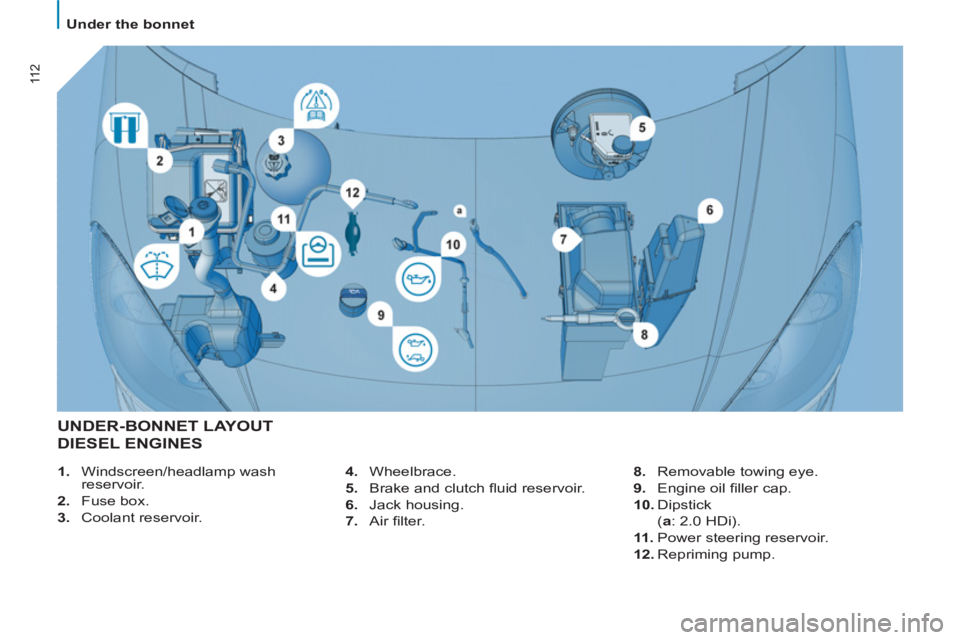
UNDER-BONNET LAYOUT
DIESEL ENGINES
1.
Windscreen/headlamp wash
reservoir.
2.
Fuse box.
3.
Coolant reservoir.
4.
Wheelbrace.
5.
Brake and clutch fl uid reservoir.
6.
Jack housing.
7.
Air fi lter.
8.
Removable towing eye.
9.
Engine oil fi ller cap.
10.
Dipstick
( a
: 2.0 HDi).
11 .
Power steering reservoir.
12.
Repriming pump.
Page 119 of 234
11 7
QUICK HELP
7
Changing a wheel
CHANGING A WHEEL
1. PARKING THE VEHICLE
- If possible, park the vehicle on
level, stable and non-slippery
ground.
- It is imperative that you ensure
that the occupants get out of the
vehicle and wait in a safe location.
Depending on the country of
sale and for your own safety, use
the safety jackets and warning
triangles.
- Apply the handbrake, switch off the
ignition and engage fi rst or reverse
gear (position P
for the automatic
gearbox).
- If possible, place a chock under the
wheel diagonally opposite the one
to be changed.
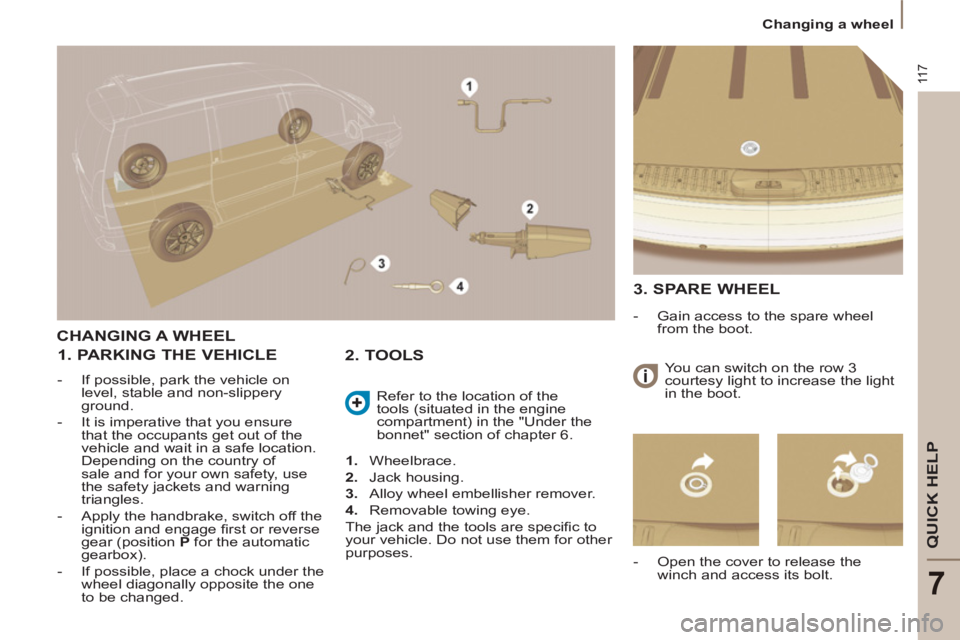
1.
Wheelbrace.
2.
Jack housing.
3.
Alloy wheel embellisher remover.
4.
Removable towing eye.
The jack and the tools are specifi c to
your vehicle. Do not use them for other
purposes. Refer to the location of the
tools (situated in the engine
compartment) in the "Under the
bonnet" section of chapter 6.
2. TOOLS
3. SPARE WHEEL
- Gain access to the spare wheel
from the boot.
- Open the cover to release the
winch and access its bolt. You can switch on the row 3
courtesy light to increase the light
in the boot.
Page 120 of 234
11 8
Changing a wheel
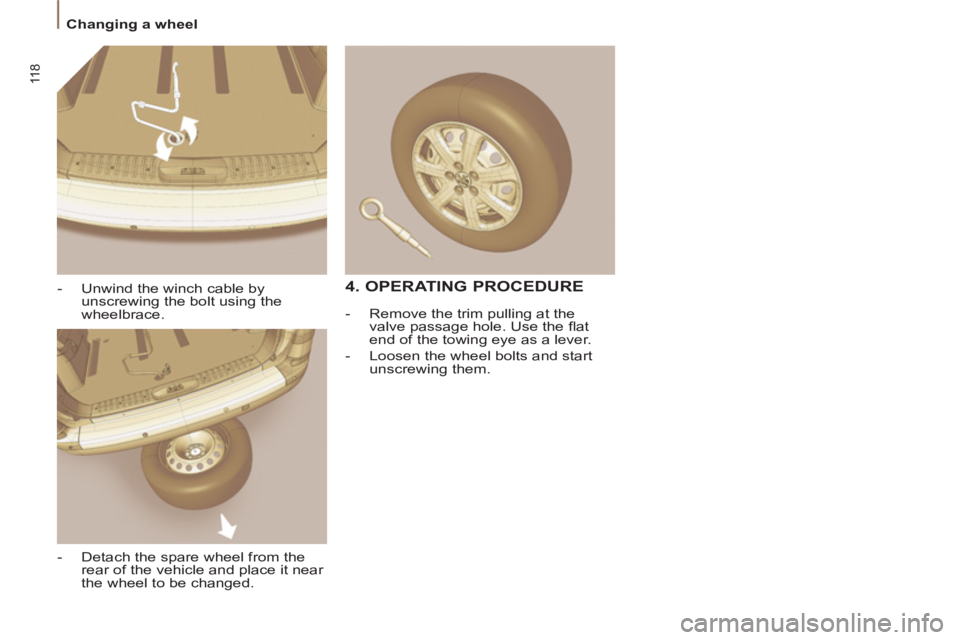
- Unwind the winch cable by
unscrewing the bolt using the
wheelbrace.
- Detach the spare wheel from the
rear of the vehicle and place it near
the wheel to be changed.
4. OPERATING PROCEDURE
- Remove the trim pulling at the
valve passage hole. Use the fl at
end of the towing eye as a lever.
- Loosen the wheel bolts and start
unscrewing them.
Page 121 of 234
11 9
QUICK HELP
7
Changing a wheel
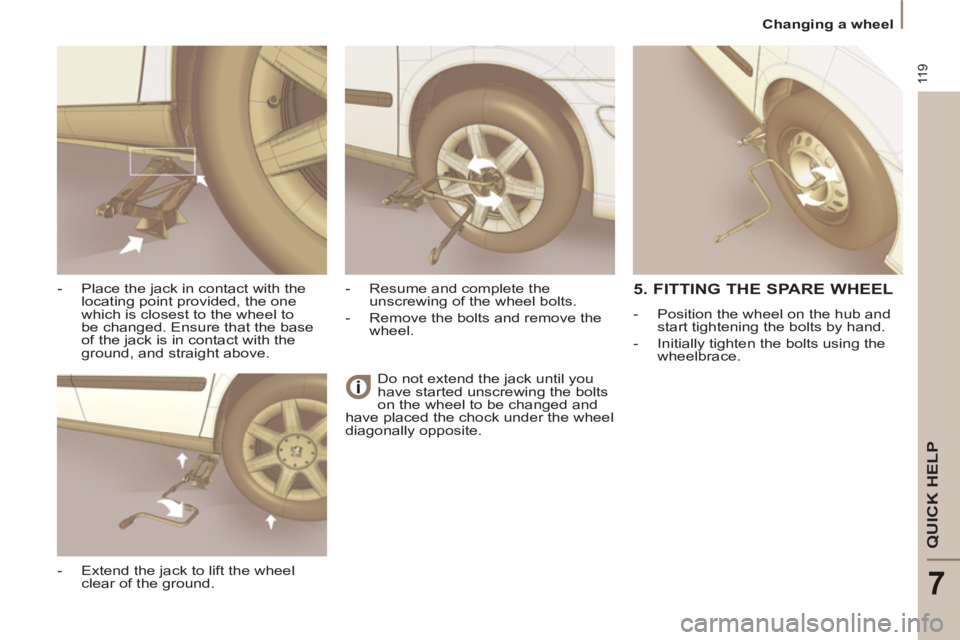
Do not extend the jack until you
have started unscrewing the bolts
on the wheel to be changed and
have placed the chock under the wheel
diagonally opposite.
- Place the jack in contact with the
locating point provided, the one
which is closest to the wheel to
be changed. Ensure that the base
of the jack is in contact with the
ground, and straight above.
- Extend the jack to lift the wheel
clear of the ground.
- Resume and complete the
unscrewing of the wheel bolts.
- Remove the bolts and remove the
wheel.
5. FITTING THE SPARE WHEEL
- Position the wheel on the hub and
start tightening the bolts by hand.
- Initially tighten the bolts using the
wheelbrace.
Page 122 of 234
120
Changing a wheel
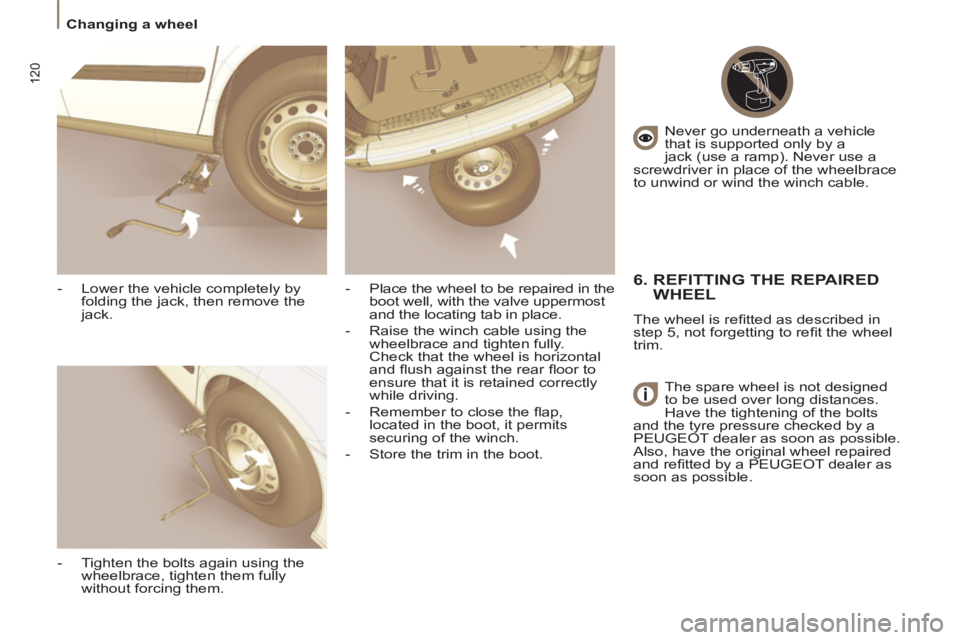
- Lower the vehicle completely by
folding the jack, then remove the
jack.
- Tighten the bolts again using the
wheelbrace, tighten them fully
without forcing them.
- Place the wheel to be repaired in the
boot well, with the valve uppermost
and the locating tab in place.
- Raise the winch cable using the
wheelbrace and tighten fully.
Check that the wheel is horizontal
and fl ush against the rear fl oor to
ensure that it is retained correctly
while driving.
- Remember to close the fl ap,
located in the boot, it permits
securing of the winch.
- Store the trim in the boot. Never go underneath a vehicle
that is supported only by a
jack (use a ramp). Never use a
screwdriver in place of the wheelbrace
to unwind or wind the winch cable.
6. REFITTING THE REPAIRED
WHEEL
The wheel is refi tted as described in
step 5, not forgetting to refi t the wheel
trim.
The spare wheel is not designed
to be used over long distances.
Have the tightening of the bolts
and the tyre pressure checked by a
PEUGEOT dealer as soon as possible.
Also, have the original wheel repaired
and refi tted by a PEUGEOT dealer as
soon as possible.
Page 127 of 234
125
QUICK HELP
7
Changing a fuse
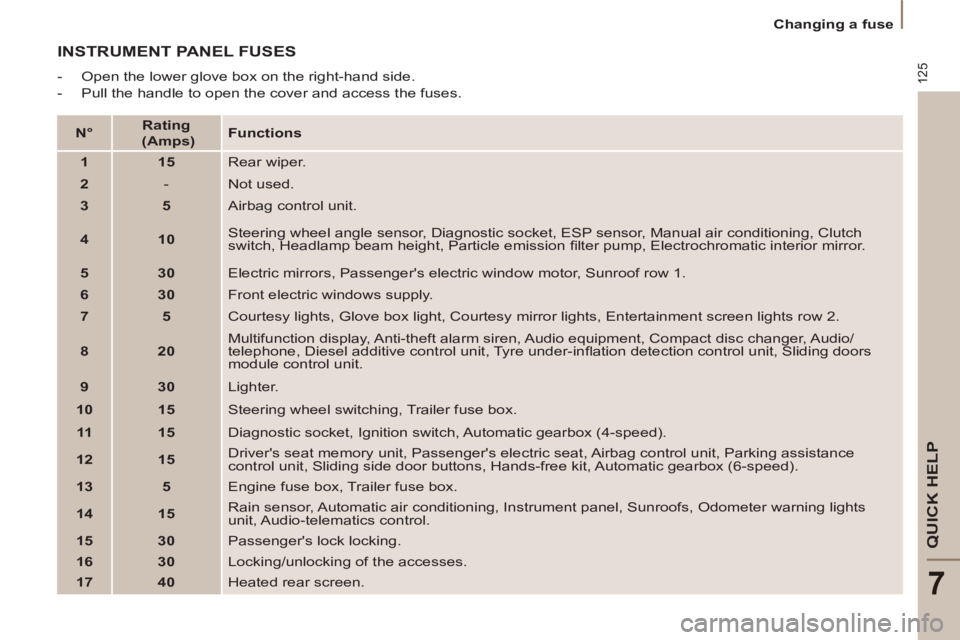
INSTRUMENT PANEL FUSES
- Open the lower glove box on the right-hand side.
- Pull the handle to open the cover and access the fuses.
N°
Rating
(Amps)
Functions
1
15
Rear wiper.
2
- Not used.
3
5
Airbag control unit.
4
10
Steering wheel angle sensor, Diagnostic socket, ESP sensor, Manual air conditioning, Clutch
switch, Headlamp beam height, Particle emission fi lter pump, Electrochromatic interior mirror.
5
30
Electric mirrors, Passenger's electric window motor, Sunroof row 1.
6
30
Front electric windows supply.
7
5
Courtesy lights, Glove box light, Courtesy mirror lights, Entertainment screen lights row 2.
8
20
Multifunction display, Anti-theft alarm siren, Audio equipment, Compact disc changer, Audio/
telephone, Diesel additive control unit, Tyre under-infl ation detection control unit, Sliding doors
module control unit.
9
30
Lighter.
10
15
Steering wheel switching, Trailer fuse box.
11
15
Diagnostic socket, Ignition switch, Automatic gearbox (4-speed).
12
15
Driver's seat memory unit, Passenger's electric seat, Airbag control unit, Parking assistance
control unit, Sliding side door buttons, Hands-free kit, Automatic gearbox (6-speed).
13
5
Engine fuse box, Trailer fuse box.
14
15
Rain sensor, Automatic air conditioning, Instrument panel, Sunroofs, Odometer warning lights
unit, Audio-telematics control.
15
30
Passenger's lock locking.
16
30
Locking/unlocking of the accesses.
17
40
Heated rear screen.
Page 133 of 234
131
QUICK HELP
7
Having your vehicle towed
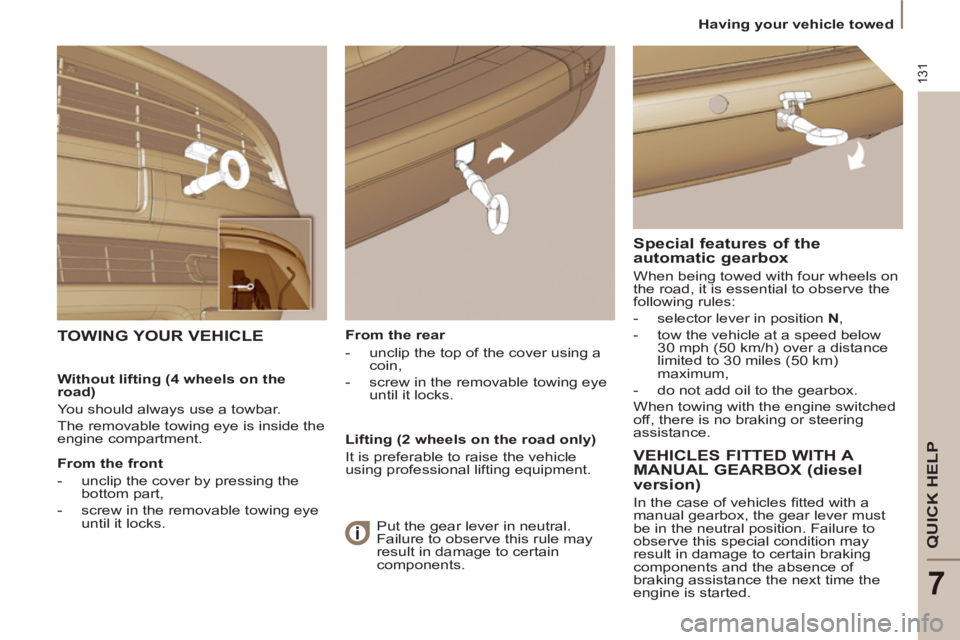
From the rear
- unclip the top of the cover using a
coin,
- screw in the removable towing eye
until it locks.
TOWING YOUR VEHICLE
Special features of the
automatic gearbox
When being towed with four wheels on
the road, it is essential to observe the
following rules:
- selector lever in position N
,
- tow the vehicle at a speed below
30 mph (50 km/h) over a distance
limited to 30 miles (50 km)
maximum,
- do not add oil to the gearbox.
When towing with the engine switched
off, there is no braking or steering
assistance.
Without lifting (4 wheels on the
road)
You should always use a towbar.
The removable towing eye is inside the
engine compartment.
From the front
- unclip the cover by pressing the
bottom part,
- screw in the removable towing eye
until it locks.
Lifting (2 wheels on the road only)
It is preferable to raise the vehicle
using professional lifting equipment.
VEHICLES FITTED WITH A
MANUAL GEARBOX (diesel
version)
In the case of vehicles fi tted with a
manual gearbox, the gear lever must
be in the neutral position. Failure to
observe this special condition may
result in damage to certain braking
components and the absence of
braking assistance the next time the
engine is started. Put the gear lever in neutral.
Failure to observe this rule may
result in damage to certain
components.
Page 136 of 234
Diesel technical data
134
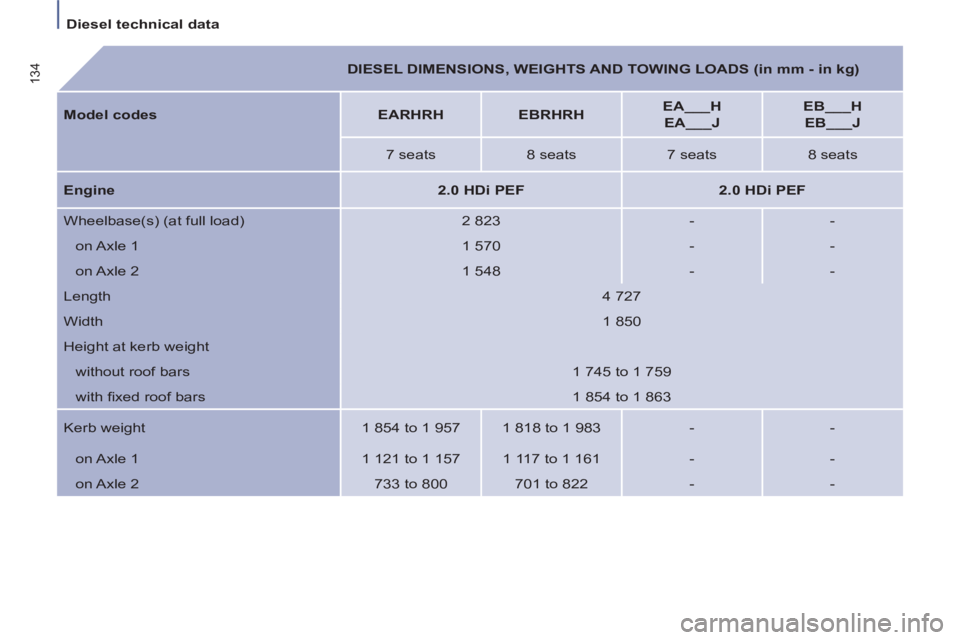
DIESEL DIMENSIONS, WEIGHTS AND TOWING LOADS (in mm - in kg)
Model codes
EARHRH
EBRHRH
EA___H
EA___J
EB___H
EB___J
7 seats
8 seats
7 seats
8 seats
Engine
2.0 HDi PEF
2.0 HDi PEF
Wheelbase(s) (at full load)
2 823
-
-
on Axle 1
1 570
-
-
on Axle 2
1 548
-
-
Length
4 727
Width
1 850
Height at kerb weight
without roof bars
1 745 to 1 759
with fi xed roof bars
1 854 to 1 863
Kerb weight
1 854 to 1 957
1 818 to 1 983
-
-
on Axle 1
1 121 to 1 157
1 117 to 1 161
-
-
on Axle 2
733 to 800
701 to 822
-
-