roof PEUGEOT PARTNER 2022 Owner's Manual
[x] Cancel search | Manufacturer: PEUGEOT, Model Year: 2022, Model line: PARTNER, Model: PEUGEOT PARTNER 2022Pages: 324, PDF Size: 9.42 MB
Page 192 of 324
190
Practical information
In the event of loading a 7-seat model
(not exceeding 40 cm in height) on the
roof, do not exceed the following loads:
–
Three transverse bars bolted to the roof:
100
kg.
–
An aluminium rack: 70
kg.
–
A
steel rack: 65 kg.
As a safety measure and to avoid damaging the roof, it is essential to use
the roof bars and racks approved for your
vehicle.
Observe the instructions on fitting and use
contained in the guide supplied with the roof
bars and racks.
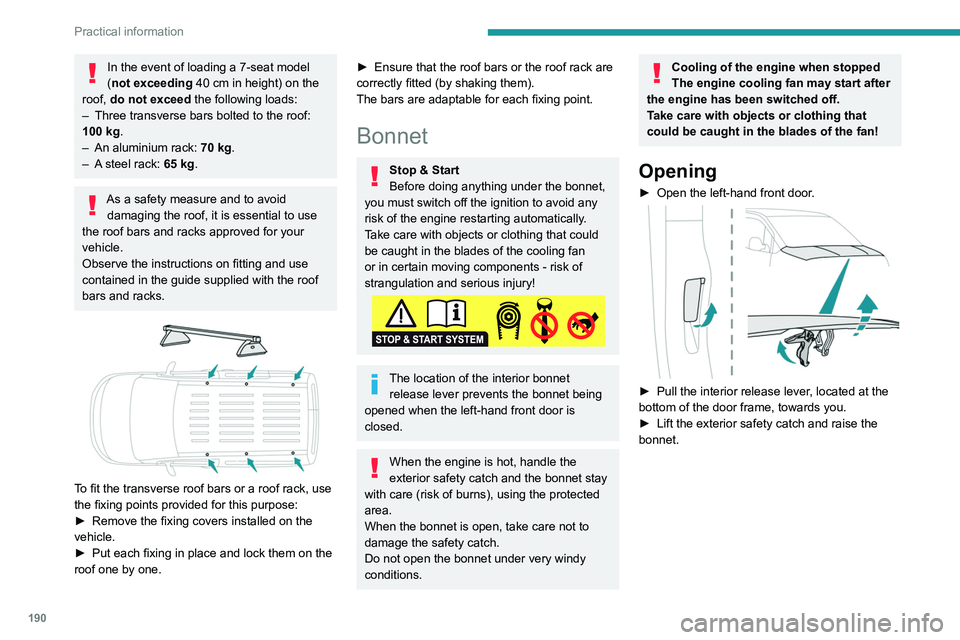
To fit the transverse roof bars or a roof rack, use
the fixing points provided for this purpose:
►
Remove the fixing covers installed on the
vehicle.
►
Put each fixing in place and lock them on the
roof one by one.
► Ensure that the roof bars or the roof rack are
correctly fitted (by shaking them).
The bars are adaptable for each fixing point.
Bonnet
Stop & Start
Before doing anything under the bonnet,
you must switch off the ignition to avoid any
risk of the engine restarting automatically.
Take care with objects or clothing that could
be caught in the blades of the cooling fan
or in certain moving components - risk of
strangulation and serious injury!
The location of the interior bonnet release lever prevents the bonnet being
opened when the left-hand front door is
closed.
When the engine is hot, handle the
exterior safety catch and the bonnet stay
with care (risk of burns), using the protected
area.
When the bonnet is open, take care not to
damage the safety catch.
Do not open the bonnet under very windy
conditions.
Cooling of the engine when stopped
The engine cooling fan may start after
the engine has been switched off.
Take care with objects or clothing that
could be caught in the blades of the fan!
Opening
► Open the left-hand front door.
► Pull the interior release lever , located at the
bottom of the door frame, towards you.
►
Lift the exterior safety catch and raise the
bonnet.
Page 217 of 324
215
In the event of a breakdown
8If this label is present, use only a 12 V
charger to avoid causing irreversible
damage to the electrical components.
24V
12V
Frozen battery
Never try to charge a frozen battery - risk
of explosion!
If the battery has frozen, have it checked by a
PEUGEOT dealer or by a qualified workshop,
who will verify that the internal components
have not been damaged and that the case
has not cracked, which could lead to a risk of
leakage of toxic and corrosive acid.
Disconnecting/reconnecting
the battery
In order to maintain an adequate state of
charge for starting the engine, we recommend
disconnecting the battery if the vehicle is to be
unused for an extended period.
Before disconnecting the battery:
►
Close all openings (doors, tailgate, windows,
roof).
►
Switch off all electricity-consuming devices
(audio system, wipers, lamps, etc.). ►
Switch off the ignition and wait for 4
minutes.
After accessing the battery, it is only necessary
to disconnect the (+) terminal.
Quick-release terminal clamp
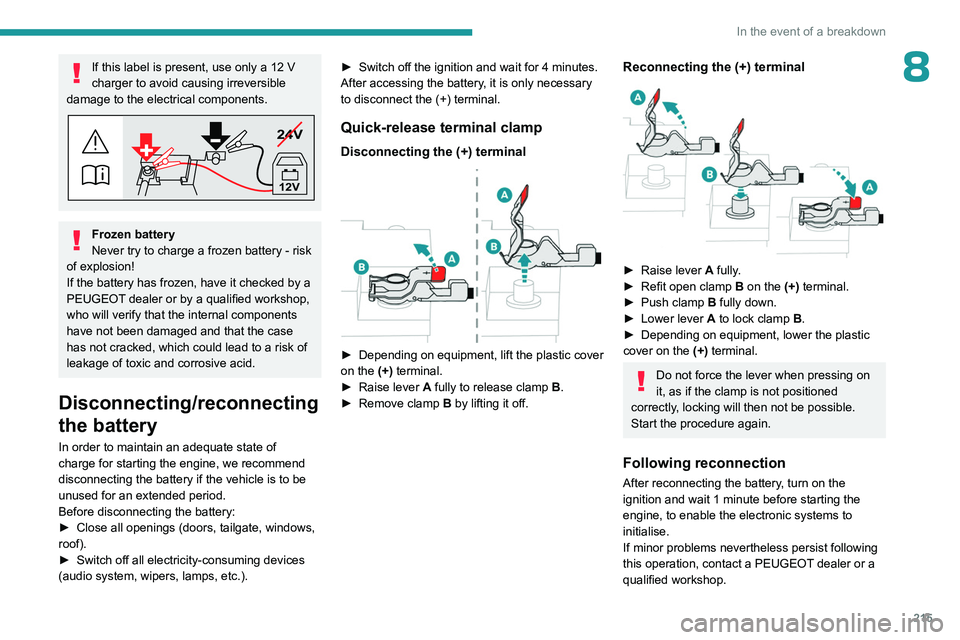
Disconnecting the (+) terminal
► Depending on equipment, lift the plastic cover
on the (+) terminal.
►
Raise lever
A
fully to release clamp
B
.
►
Remove clamp
B
by lifting it off.
Reconnecting the (+) terminal
► Raise lever A fully.
► Refit open clamp B on the (+) terminal.
►
Push clamp
B fully down.
►
Lower lever
A
to lock clamp B.
►
Depending on equipment, lower the plastic
cover on the
(+) terminal.
Do not force the lever when pressing on
it, as if the clamp is not positioned
correctly, locking will then not be possible.
Start the procedure again.
Following reconnection
After reconnecting the battery, turn on the
ignition and wait 1 minute before starting the
engine, to enable the electronic systems to
initialise.
If minor problems nevertheless persist following
this operation, contact a PEUGEOT dealer or a
qualified workshop.
Page 224 of 324
222
Technical data
Vehicle length
Standard (L1) Long (L2)
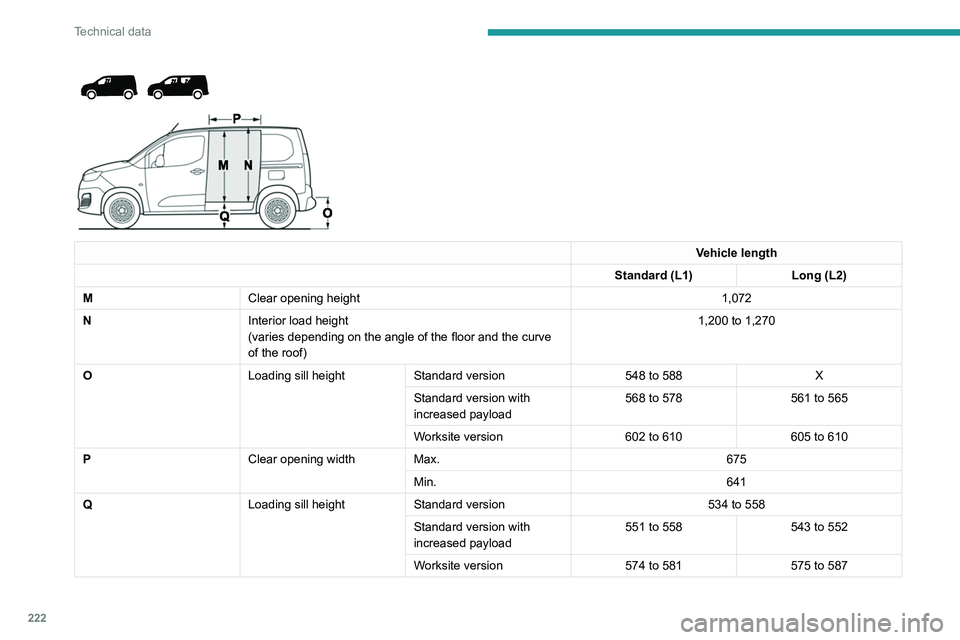
M Clear opening height 1,072
N Interior load height
(varies depending on the angle of the floor and the curve
of the roof) 1,200 to 1,270 O
Loading sill height
Standard version 548 to 588X
Standard version with
increased payload 568 to 578
561 to 565
Worksite version 602 to 610605 to 610
P Clear opening width Max. 675
Min. 641
Q Loading sill heightStandard version 534 to 558
Standard version with
increased payload 551 to 558
543 to 552
Worksite version 574 to 581575 to 587
Page 226 of 324
224
Technical data
Vehicle length
Standard (L1) Long (L2)
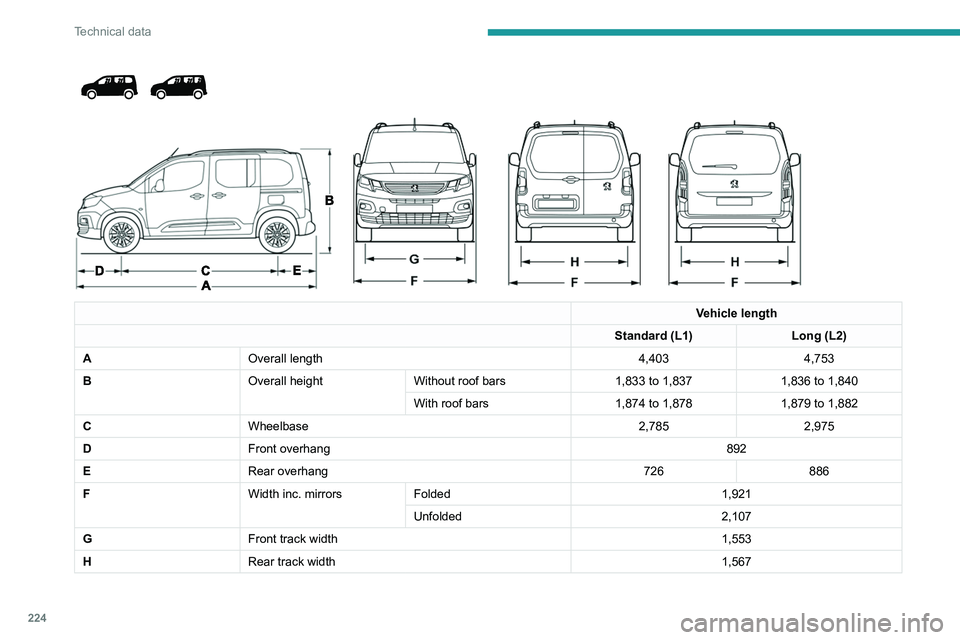
A Overall length 4,4034,753
B Overall heightWithout roof bars 1,833 to 1,8371,836 to 1,840
With roof bars 1,874 to 1,8781,879 to 1,882
C Wheelbase 2,7852,975
D Front overhang 892
E Rear overhang 726886
F Width inc. mirrorsFolded 1,921
Unfolded 2,107
G Front track width 1,553
H Rear track width 1,567
Page 263 of 324
261
PEUGEOT Connect Nav
12Voice commands
Steering wheel-mounted
controls
Voice commands:
Voice commands can be issued from any
screen page after a short press on the "Voice
commands" button located on the steering
wheel or at the end of the lighting control stalk
(depending on equipment), as long as there is no
telephone call in progress.
To ensure that voice commands are always recognised by the system, please
follow these recommendations:
–
use natural language in a normal tone
without breaking up words or raising your
voice.
–
always wait for the "beep" (audible signal)
before speaking.
–
for best results, closing the windows and
sunroof is recommended, to avoid extraneous
interference (depending on version).
–
before issuing a voice command, ask any
other passengers to refrain from speaking.
First steps
Example of a "voice command" for
navigation:
"Navigate to address 11 regent street,
London"
Example of a "voice command" for the radio and
media:
"Play artist Madonna"
Example of a "voice command" for the
telephone:
"Call David Miller"
The voice commands, with a choice of 17 languages (Arabic, Brazilian, Czech,
Danish, Dutch, English, Farsi, French,
German, Italian, Norwegian, Polish,
Portuguese, Russian, Spanish, Swedish,
Turkish), are made using the language
previously chosen and set in the system.
For some voice commands, there are
alternative synonyms.
Example: Guide to / Navigate to / Go to / ...
The voice commands in Arabic for: "Navigate
to address" and "Display POI in the city", are
not available.
Information - Using the
system
When voice commands are activated, by
briefly pressing the button, help is
displayed on the touch screen, offering various
menus and enabling voice-based interaction with
the system.
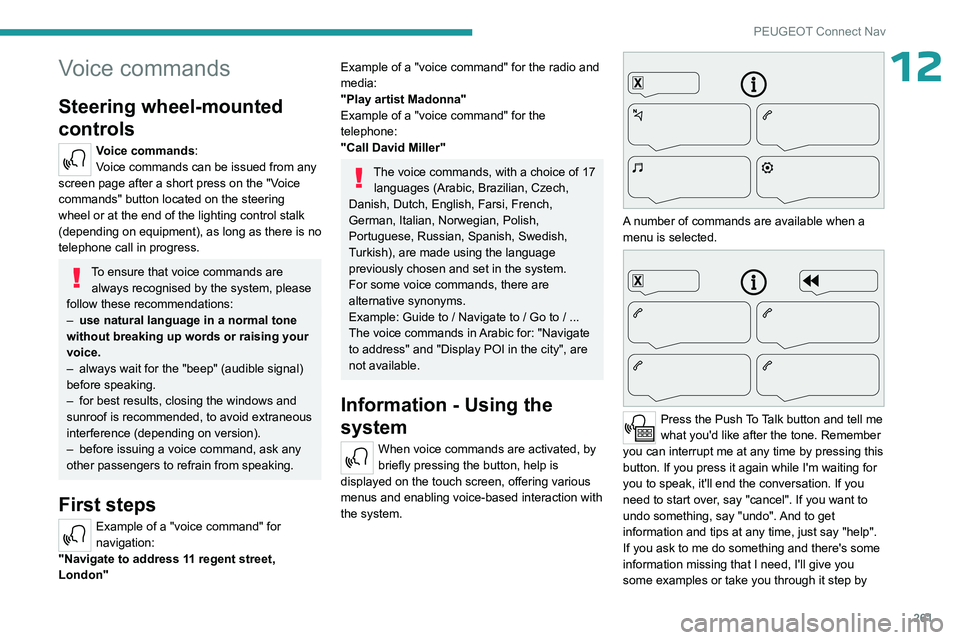
A number of commands are available when a
menu is selected.
Press the Push To Talk button and tell me
what you'd like after the tone. Remember
you can interrupt me at any time by pressing this
button. If you press it again while I'm waiting for
you to speak, it'll end the conversation. If you
need to start over, say "cancel". If you want to
undo something, say "undo". And to get
information and tips at any time, just say "help".
If you ask to me do something and there's some
information missing that I need, I'll give you
some examples or take you through it step by
Page 290 of 324
288
Alphabetical index
E
EBFD 95
Eco-driving (advice)
8
ECO mode
134
Economy mode
185
Electric motor
5, 9, 30, 174, 188,
191, 213, 216, 234
Electric windows
47
Electronic brake force distribution (EBFD)
95
Emergency braking assistance (EBA)
95
Emergency call
92–93
Emergency warning lamps
67, 94
Emissions control system, SCR
195
Energy economy mode
185
Energy flows
30
Energy recovery
133
Engine compartment
191
Engine, Diesel
172, 191, 200, 227–229, 233
Engine, petrol
191, 225–226
Engines
225–229, 233
Environment
8, 40, 81, 118
ESC (electronic stability control)
95
Expanded traffic sign recognition
142
Exterior lighting
86
F
Fatigue detection 158
Filling the AdBlue® tank
193, 197
Filling the fuel tank
172–173
Filter, air 194
Filter, oil
194
Filter, particle
193–194
Filter, passenger compartment
73, 194
Finisher
207
Fitting a wheel
205–206
Fitting roof bars
189–190
Fittings, interior
60, 64
Flap, fuel filler
172–173
Flap, removable
69
Flashing indicators
84, 211
Fluid, brake
193
Fluid, engine coolant
193
Foglamp, rear
2 11
Foglamps
210
Foglamps, front
83, 208
Foglamps, rear
83
Folding the rear seats
56–57
Frequency (radio)
272
Fuel
8, 172
Fuel consumption
8
Fuel tank
172–174
Fuses
212
G
Gauge, fuel 172–173
Gearbox, automatic
126–132, 195, 214
Gearbox, manual
126–127, 194
Gear lever, automatic gearbox
127–129
Gear lever, manual gearbox
126–127
Gear shift indicator ~ Gear efficiency
indicator
134
Glove box
60
G.P.S.
266
H
Hazard warning lamps 67, 94
Headlamp adjustment
88
Headlamps, automatic dipping
86–87
Headlamps, automatic illumination
84–86
Headlamps, dipped beam
83, 208–209
Headlamps, halogen
208
Headlamps, main beam
83, 86, 208, 210
Head restraints, front
59
Head restraints, rear
56–57
Heating
73–75, 79–80
Heating, additional
46, 79–80
Heating, programmable
46, 79–81
High voltage
174
Hill Assist Descent Control (HADC)
98
Hill start assist
126
Histogramme, fuel consumption
30
Horn
95
I
Ignition 121–122, 276
Ignition on
122
Immobiliser, electronic
119
Page 292 of 324
290
Alphabetical index
O
Obstacle detection 159
Oil change
192
Oil consumption
192
OIl, engine
192
On-board tools
200–201
Opening the bonnet
190
Opening the boot
32–33
Opening the doors
32–33
Overhead storage
60
P
Pads, brake 195
Paint
199, 234
Paint colour code
234
Park Assist
167
Parking brake
123, 195
Parking brake, electric
123–125, 195
Parking sensors, audible and visual
159
Parking sensors, front
160
Parking sensors, rear
159
Passenger compartment temperature pre-
conditioning (Electric)
81
Passenger's air bag
70
Pedestrian horn (Electric)
95, 118
Personalisation
12–13
Plates, identification
234
Player, Apple®
239, 251, 274
Player, USB
239, 250, 273
Port, USB 62, 239, 250–251, 269, 273
Power indicator (Electric)
9
Pressures, tyres
195, 204, 207, 234
Pre-tensioning seat belts
102
Priming pump
200
Priming the fuel system
200
Profiles
254, 278
Programmable cruise control
145
Protecting children
104, 106–108, 110, 114–116
Public fast charging station
177, 183
Puncture
202, 204
R
Radar (warnings) 138
Radio
237–239, 248–249, 272
Radio, digital (Digital Audio
Broadcasting - DAB)
238, 250, 273
Range, AdBlue®
193
RDS
238, 249, 272
Rear screen, demisting
78
Recharging the battery
214–215
Recharging the traction battery
178
Recharging the traction battery
(Electric)
174, 181, 183, 185
Recirculation, air
75–76
Recovery
216
Recovery of the vehicle
216
Reduction of electrical load
186
Regeneration of the particle filter
194
Regenerative braking (deceleration
by engine braking)
132–133
Reinitialisation of the under-inflation
detection system
137
Reinitialising the remote control
41
Reminder, key in ignition
121
Reminder, lighting on
84
Remote control
32–35, 37–38, 119
Remotely operable functions (Electric)
81, 184
Removing a wheel
205–206
Removing the mat
60
Replacing bulbs
207–208
Replacing fuses
212
Replacing the air filter
194
Replacing the oil filter
194
Replacing the passenger compartment
filter
194
Reservoir, screenwash
193
Rev counter
10, 12
Reversing camera
138, 161, 165–166
Reversing lamps
2 11
Roof
60
Roof bars
189–190
Roof flap
44
Running out of fuel (Diesel)
200
S
Safety, children 104, 106–108, 110, 114–116
Saturation of the particle filter (Diesel)
194
Screen, cold climate
186