battery PEUGEOT PARTNER TEPEE ELECTRIC 2017 Owners Manual
[x] Cancel search | Manufacturer: PEUGEOT, Model Year: 2017, Model line: PARTNER TEPEE ELECTRIC, Model: PEUGEOT PARTNER TEPEE ELECTRIC 2017Pages: 252, PDF Size: 9.89 MB
Page 3 of 252
1
.
Instrument panel 3
I ndicators 3
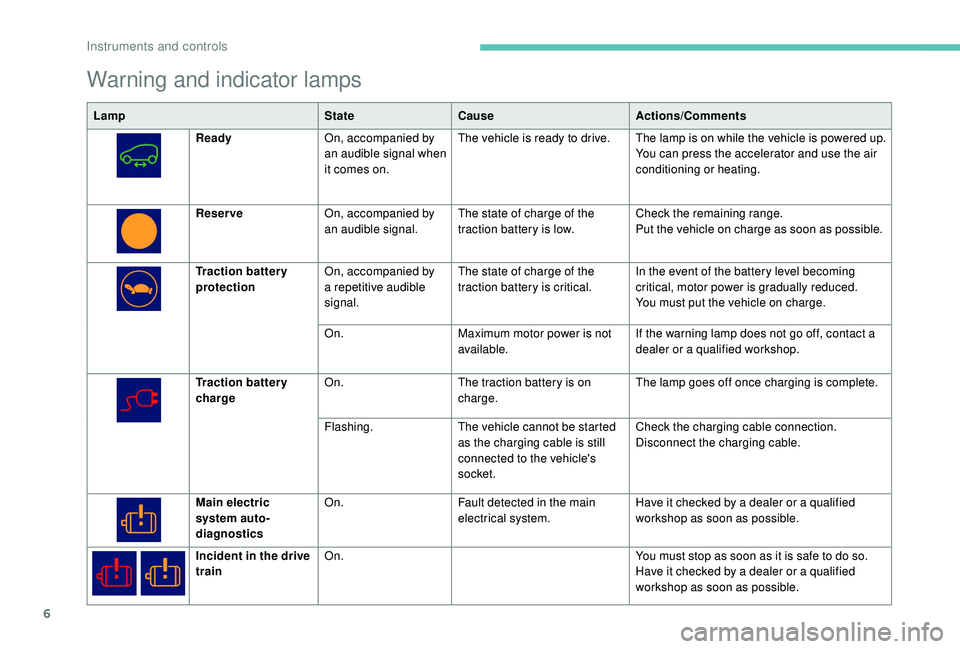
Warning and indicator lamps
6
D
isplays
7
Starting procedure
8
E
co-driving
10
Eco-comfort
11
Manual air conditioning and heating
1
2Charging the traction battery
1
4
Normal charging procedure
2
0
Fast charging procedure
2
2
Other information
2
4
Ancillaries battery 2 7
Fuses
30
Towing the vehicle
3
0
Motor and traction battery
3
1
Identification markings
3
2
Presentation
Instruments and controls
Eco-comfort Charging the traction battery
Supplement for electric mode Ancillaries batteryThis supplement is specific to the electric
drive mode. For any other information, refer
to the vehicle's handbook and the warranty
and maintenance guide. You can also visit
the manufacturer's website for the latest
information.
The driver must be par ticularly vigilant
when driving the electric vehicle as it
makes ver y little noise when moving.
Key
Safety warning
Additional information
Warning of safety issues for people
and equipment.
For any work on your vehicle, go to a qualified
workshop that has the technical information,
competence and equipment required, which
the Manufacturer's dealer network is able to
provide.
Contents
.
Contents
Page 4 of 252
2
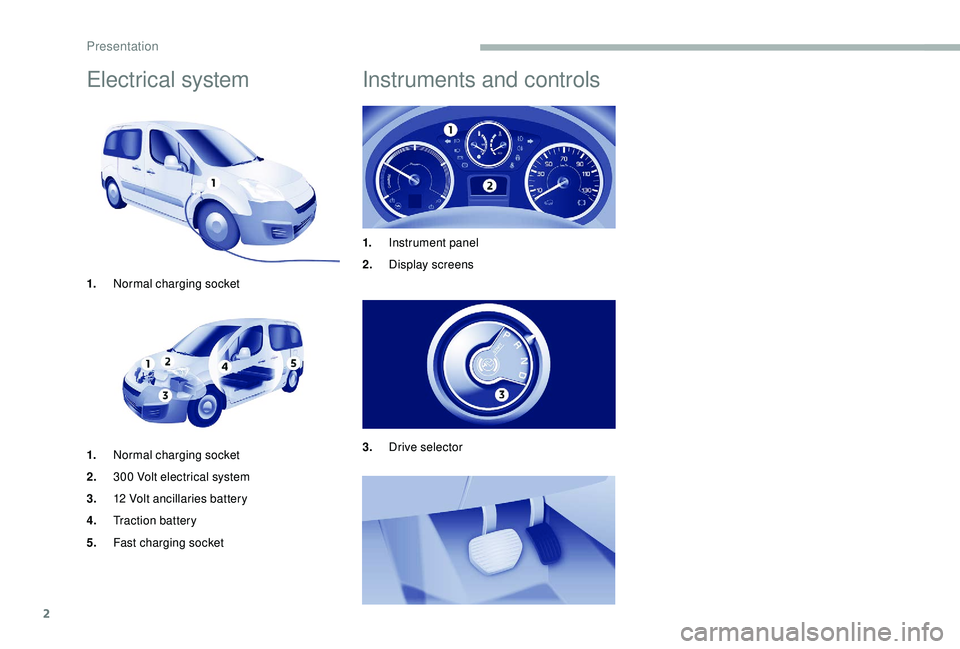
Electrical system
1.Normal charging socket
1. Normal charging socket
2. 300
Volt electrical system
3. 12
Volt ancillaries battery
4. Traction battery
5. Fast charging socket
Instruments and controls
1.Instrument panel
2. Display screens
3. Drive selector
Presentation
Page 5 of 252
3
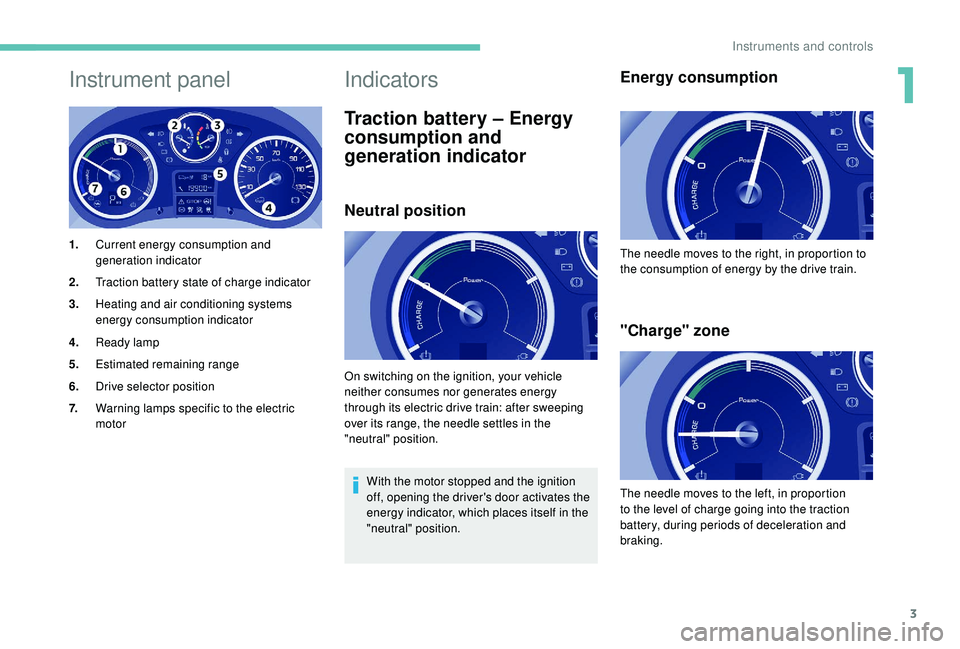
Instrument panel
1.Current energy consumption and
generation indicator
2. Traction battery state of charge indicator
3. Heating and air conditioning systems
energy consumption indicator
4. Ready lamp
5. Estimated remaining range
6. Drive selector position
7. Warning lamps specific to the electric
motor
Indicators
Traction battery – Energy
consumption and
generation indicator
Neutral position
With the motor stopped and the ignition
off, opening the driver's door activates the
energy indicator, which places itself in the
"neutral" position.
Energy consumption
"Charge" zone
On switching on the ignition, your vehicle
neither consumes nor generates energy
through its electric drive train: after sweeping
over its range, the needle settles in the
"neutral" position. The needle moves to the right, in proportion to
the consumption of energy by the drive train.
The needle moves to the left, in proportion
to the level of charge going into the traction
battery, during periods of deceleration and
braking.
1
Instruments and controls
Page 6 of 252
4
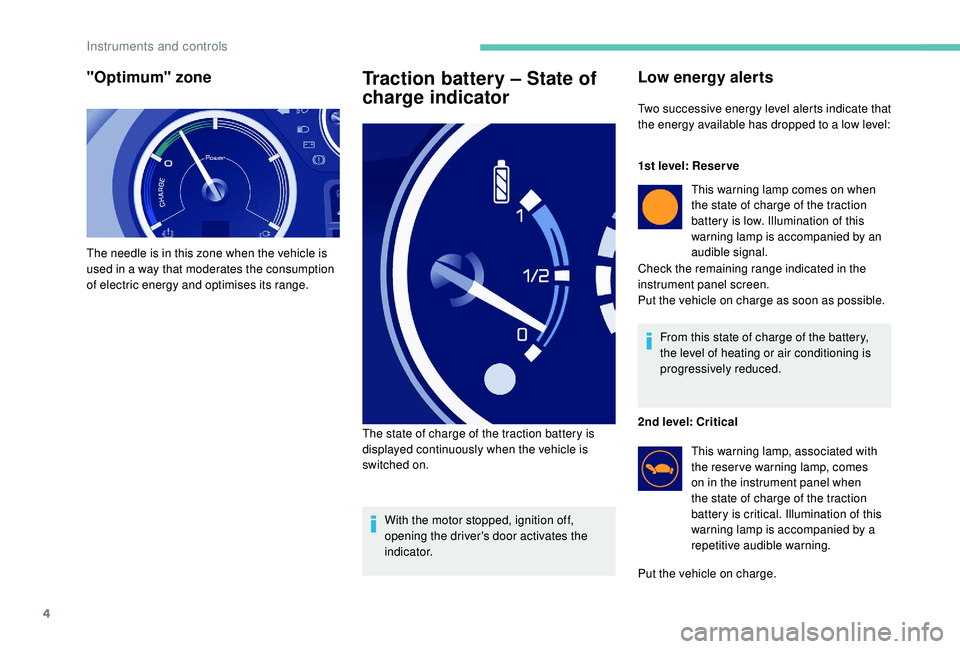
"Optimum" zone
The needle is in this zone when the vehicle is
used in a way that moderates the consumption
of electric energy and optimises its range.
Traction battery – State of
charge indicator
With the motor stopped, ignition off,
opening the driver's door activates the
i n d i c a t o r.
The state of charge of the traction battery is
displayed continuously when the vehicle is
switched on.
Low energy alerts
Two successive energy level alerts indicate that
the energy available has dropped to a low level:
1st level: Reser ve
This warning lamp comes on when
the state of charge of the traction
battery is low. Illumination of this
warning lamp is accompanied by an
audible signal.
Check the remaining range indicated in the
instrument panel screen.
Put the vehicle on charge as soon as possible.
From this state of charge of the battery,
the level of heating or air conditioning is
progressively reduced.
2nd level: Critical This warning lamp, associated with
the reser ve warning lamp, comes
on in the instrument panel when
the state of charge of the traction
battery is critical. Illumination of this
warning lamp is accompanied by a
repetitive audible warning.
Put the vehicle on charge.
Instruments and controls
Page 8 of 252
6
Warning and indicator lamps
LampStateCause Actions/Comments
Ready On, accompanied by
an audible signal when
it comes on. The vehicle is ready to drive. The lamp is on while the vehicle is powered up.
You can press the accelerator and use the air
conditioning or heating.
Reser ve On, accompanied by
an audible signal. The state of charge of the
traction battery is low. Check the remaining range.
Put the vehicle on charge as soon as possible.
Traction battery
protection On, accompanied by
a repetitive audible
signal. The state of charge of the
traction battery is critical.
In the event of the battery level becoming
critical, motor power is gradually reduced.
You must put the vehicle on charge.
On. Maximum motor power is not
available. If the warning lamp does not go off, contact a
dealer or a qualified workshop.
Traction battery
charge On.
The traction battery is on
charge. The lamp goes off once charging is complete.
Flashing. The vehicle cannot be started
as the charging cable is still
connected to the vehicle's
socket. Check the charging cable connection.
Disconnect the charging cable.
Main electric
system auto-
diagnostics On.
Fault detected in the main
electrical system. Have it checked by a dealer or a qualified
workshop as soon as possible.
Incident in the drive
train On.
You must stop as soon as it is safe to do so.
Have it checked by a dealer or a qualified
workshop as soon as possible.
Instruments and controls
Page 10 of 252
8
Starting procedure
Starting the vehicle
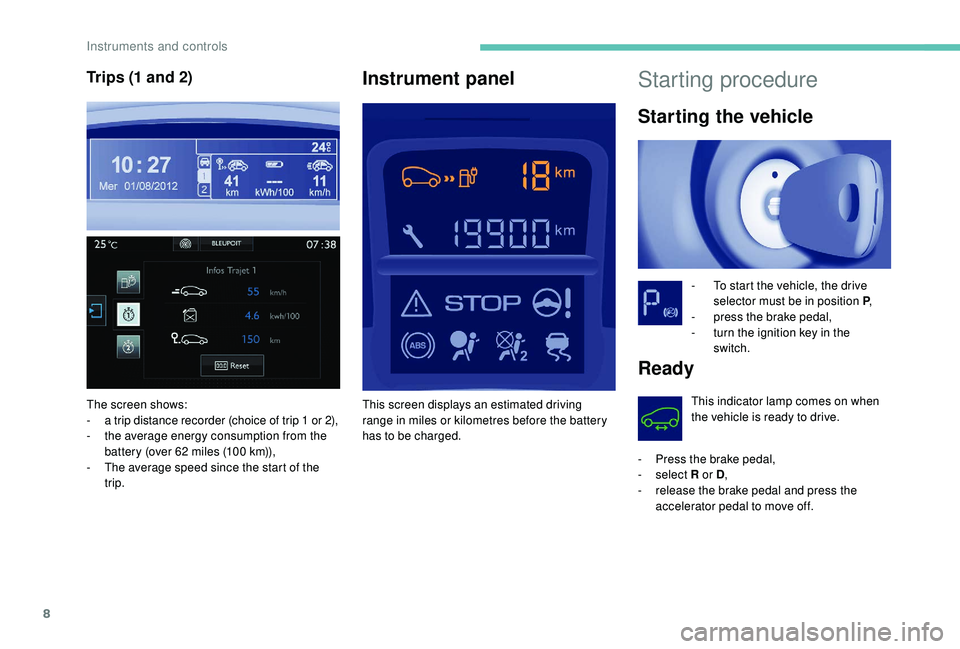
- To start the vehicle, the drive selector must be in position P ,
-
p
ress the brake pedal,
-
t
urn the ignition key in the
switch.
Ready
This indicator lamp comes on when
the vehicle is ready to drive.
-
P
ress the brake pedal,
-
select R or D,
-
r
elease the brake pedal and press the
accelerator pedal to move off.
Instrument panel
The screen shows:
- a t rip distance recorder (choice of trip 1 or 2),
-
t
he average energy consumption from the
battery (over 62
miles (100 km)),
-
T
he average speed since the start of the
trip. This screen displays an estimated driving
range in miles or kilometres before the battery
has to be charged.
Trips (1 and 2)
Instruments and controls
Page 13 of 252
11
Eco-comfort
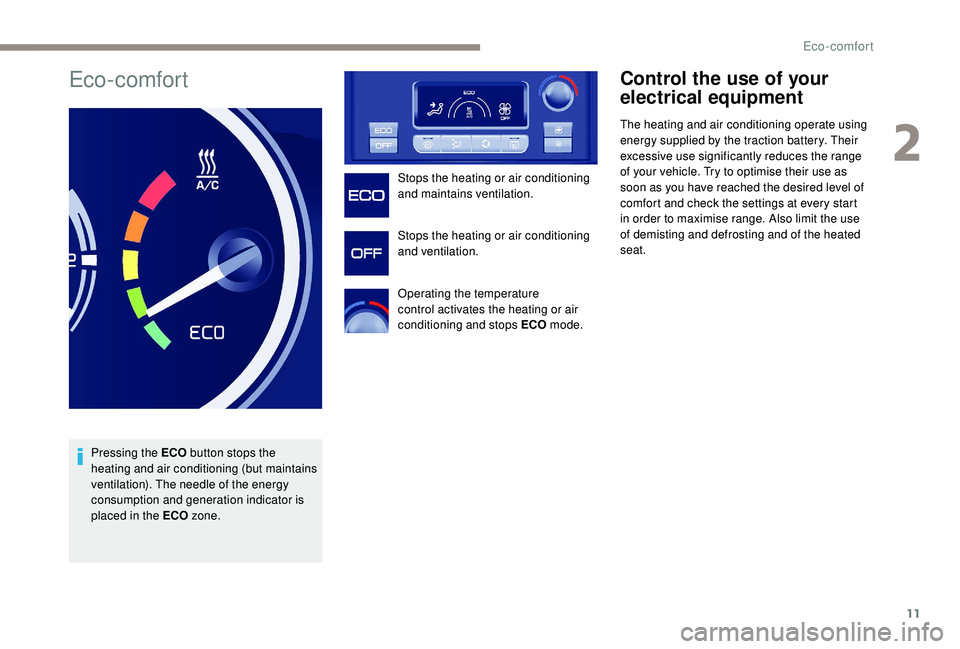
Pressing the ECO button stops the
heating and air conditioning (but maintains
ventilation). The needle of the energy
consumption and generation indicator is
placed in the ECO zone. Stops the heating or air conditioning
and maintains ventilation.
Stops the heating or air conditioning
and ventilation.
Operating the temperature
control activates the heating or air
conditioning and stops ECO mode.
Control the use of your
electrical equipment
The heating and air conditioning operate using
energy supplied by the traction battery. Their
excessive use significantly reduces the range
of your vehicle. Try to optimise their use as
soon as you have reached the desired level of
comfort and check the settings at every start
in order to maximise range. Also limit the use
of demisting and defrosting and of the heated
seat.
2
Eco-comfort
Page 16 of 252
14
Charging the traction
battery
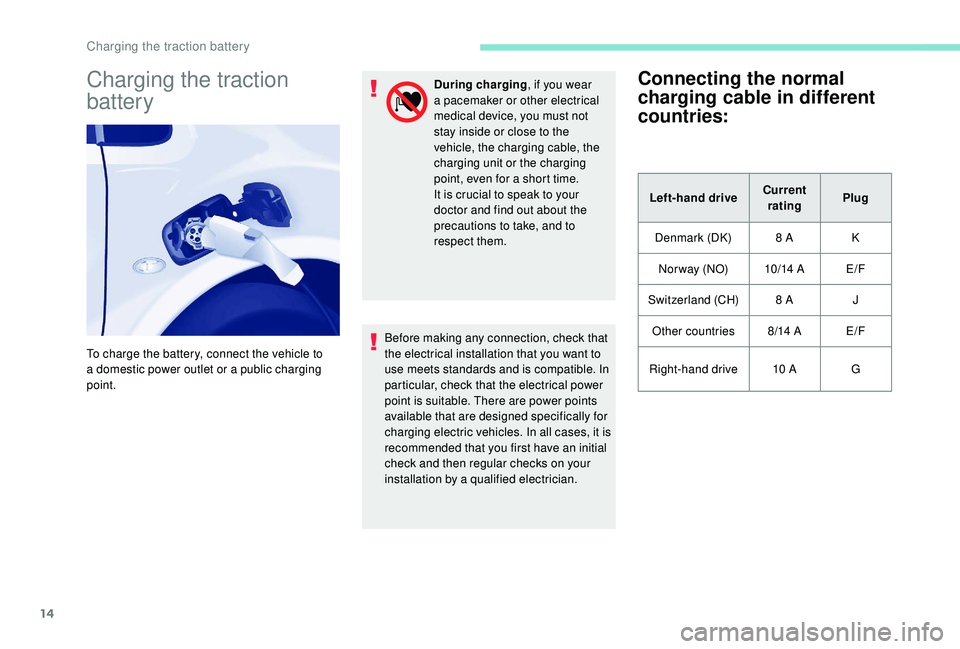
To charge the battery, connect the vehicle to
a domestic power outlet or a public charging
point.During charging
, if you wear
a pacemaker or other electrical
medical device, you must not
stay inside or close to the
vehicle, the charging cable, the
charging unit or the charging
point, even for a short time.
It is crucial to speak to your
doctor and find out about the
precautions to take, and to
respect them.
Before making any connection, check that
the electrical installation that you want to
use meets standards and is compatible. In
particular, check that the electrical power
point is suitable. There are power points
available that are designed specifically for
charging electric vehicles. In all cases, it is
recommended that you first have an initial
check and then regular checks on your
installation by a qualified electrician.
Connecting the normal
charging cable in different
countries:
Left-hand drive Current
rating Plug
Denmark (DK) 8
A K
Nor way (NO) 10/14
AE/F
Switzerland (CH) 8
AJ
Other countries 8/14
AE/F
Right-hand drive 10
AG
Charging the traction battery
Page 17 of 252
15
In most European countries the
manufacturer has established a
partnership with a specialist company
that can offer a check and update of
your electrical installation. For more
information, contact a franchised dealer.
Use:
-
t
he charging cable supplied with the
vehicle,
-
a p
ower point (with earth, clean and in
good condition).
Normal charging time
7 hours 30 minutes to 15 hours is needed for a
c omplete charge. Charging can be interrupted
at any time. It stops automatically when the
battery is fully charged.
Cables for normal charging
As the installers of electrical installations
in buildings are not subject to international
standards, check the compatibility of the
domestic electrical installations to which you
wish to connect the domestic charging cable
supplied with your vehicle for each of the
countries you intend to travel in.
Make the same prior checks for charging at
public terminals, bearing in mind that certain
public terminals have their own charging cable.
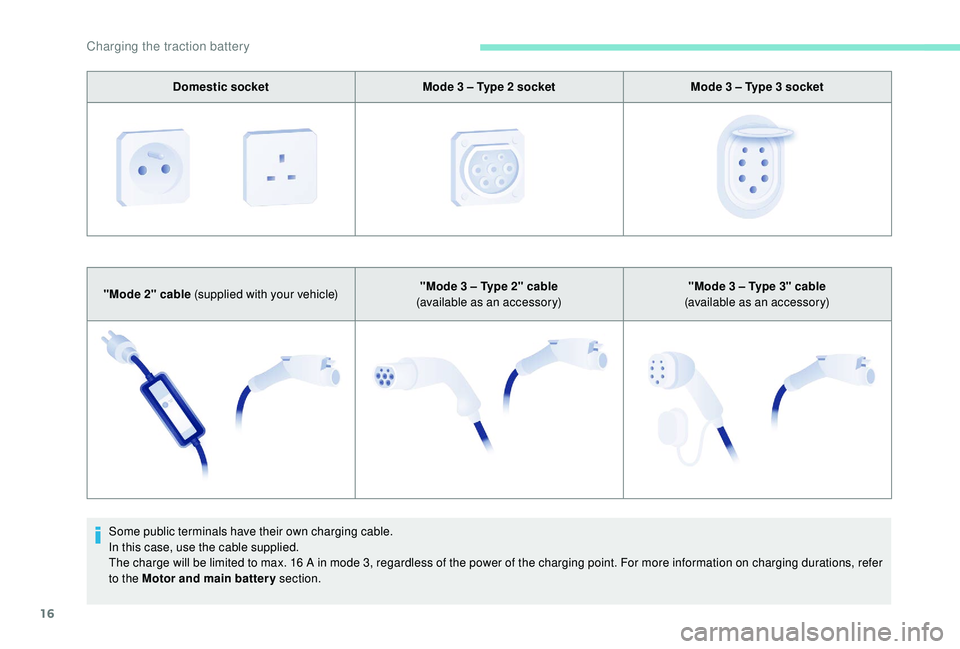
Several types of electrical cable for charging
at public charging points or at domestic power
outlets are available as accessories.
On delivery of the vehicle, the charging cable
is compatible with the country’s power supply.
If you go abroad, refer to the following table
to check the compatibility of local power
supplies with your charging cable. Consult a
franchised dealer or a qualified workshop for
the appropriate charging cable(s).
Do not use an electrical
extension, multi-socket, adapter
or timer.
3
Charging the traction battery
Page 18 of 252
16
Domestic socketMode 3 – Type 2 socketMode 3 – Type 3 socket
"Mode 2" cable (supplied with your vehicle) "Mode 3
– Type 2" cable
(available as an accessory) "Mode 3
– Type 3" cable
(available as an accessory)
Some public terminals have their own charging cable.
In this case, use the cable supplied.
The charge will be limited to max. 16
A in mode 3, regardless of the power of the charging point. For more information on charging durations, refer
to the Motor and main battery section.
Charging the traction battery