warning SUBARU FORESTER 2004 Service Repair Manual
[x] Cancel search | Manufacturer: SUBARU, Model Year: 2004, Model line: FORESTER, Model: SUBARU FORESTER 2004Pages: 2870, PDF Size: 38.67 MB
Page 1011 of 2870
CO(H4SO)-28
COOLING
Radiator
6. Radiator
A: REMOVAL
1. NON-TURBO MODEL
WARNING:
The radiator is pressurized. Wait until the en-
gine cools down before working on the radia-
tor.
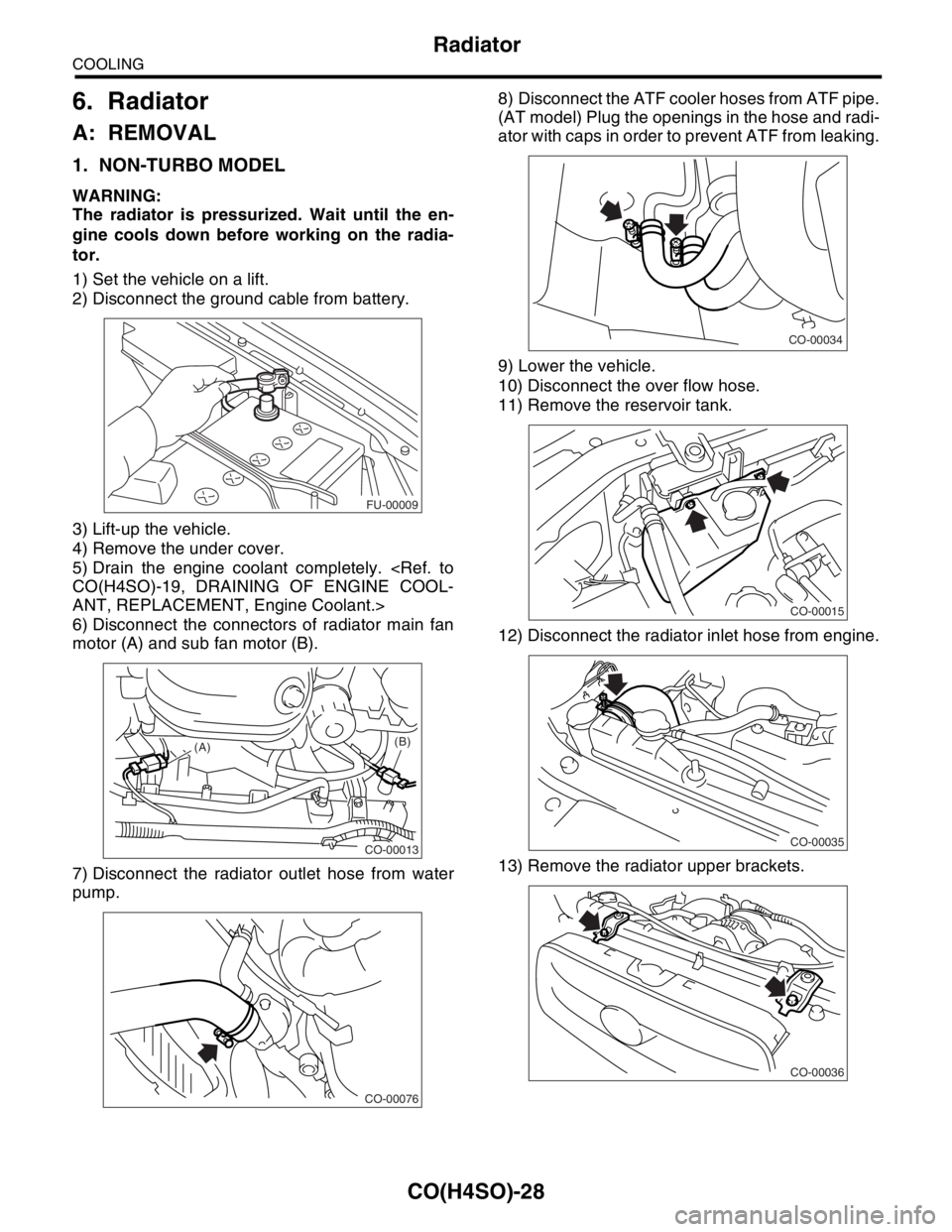
1) Set the vehicle on a lift.
2) Disconnect the ground cable from battery.
3) Lift-up the vehicle.
4) Remove the under cover.
5) Drain the engine coolant completely.
ANT, REPLACEMENT, Engine Coolant.>
6) Disconnect the connectors of radiator main fan
motor (A) and sub fan motor (B).
7) Disconnect the radiator outlet hose from water
pump.8) Disconnect the ATF cooler hoses from ATF pipe.
(AT model) Plug the openings in the hose and radi-
ator with caps in order to prevent ATF from leaking.
9) Lower the vehicle.
10) Disconnect the over flow hose.
11) Remove the reservoir tank.
12) Disconnect the radiator inlet hose from engine.
13) Remove the radiator upper brackets.
FU-00009
CO-00013
(A)(B)
CO-00076
CO-00034
CO-00015
CO-00035
CO-00036
Page 1012 of 2870
CO(H4SO)-29
COOLING
Radiator
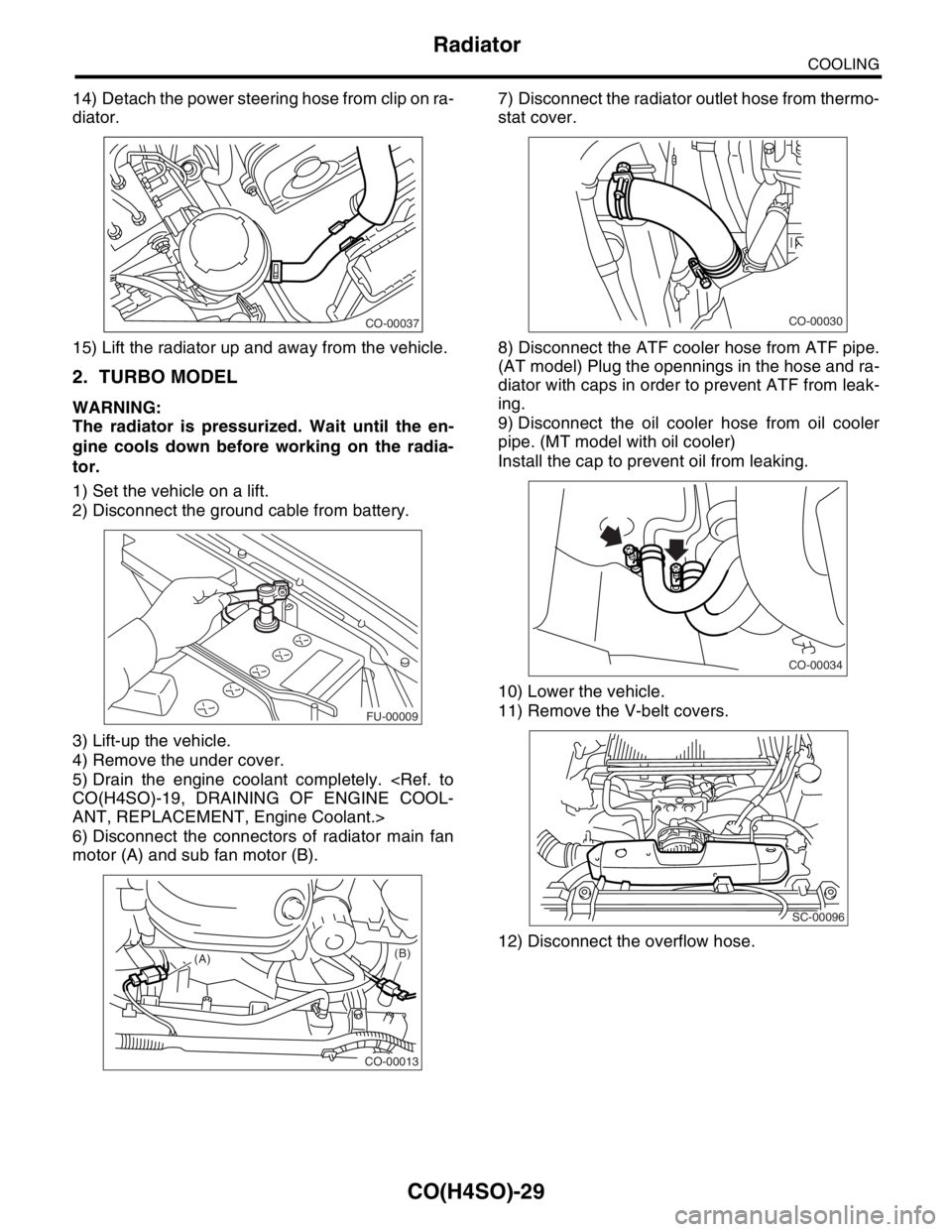
14) Detach the power steering hose from clip on ra-
diator.
15) Lift the radiator up and away from the vehicle.
2. TURBO MODEL
WARNING:
The radiator is pressurized. Wait until the en-
gine cools down before working on the radia-
tor.
1) Set the vehicle on a lift.
2) Disconnect the ground cable from battery.
3) Lift-up the vehicle.
4) Remove the under cover.
5) Drain the engine coolant completely.
ANT, REPLACEMENT, Engine Coolant.>
6) Disconnect the connectors of radiator main fan
motor (A) and sub fan motor (B).7) Disconnect the radiator outlet hose from thermo-
stat cover.
8) Disconnect the ATF cooler hose from ATF pipe.
(AT model) Plug the opennings in the hose and ra-
diator with caps in order to prevent ATF from leak-
ing.
9) Disconnect the oil cooler hose from oil cooler
pipe. (MT model with oil cooler)
Install the cap to prevent oil from leaking.
10) Lower the vehicle.
11) Remove the V-belt covers.
12) Disconnect the overflow hose.
CO-00037
FU-00009
CO-00013
(A)(B)
CO-00030
CO-00034
SC-00096
Page 1025 of 2870
CO(H4SO)-42
COOLING
Coolant Filler Tank
11.Coolant Filler Tank
A: REMOVAL
WARNING:
The radiator is pressurized. Wait until the en-
gine cools down before working on the radia-
tor.
1) Drain the coolant about 3.02 (3.2 US qt, 2.6 Imp
qt).
ant.>
2) Remove the air cleaner upper cover and air in-
take boot.
3) Remove the air cleaner element.
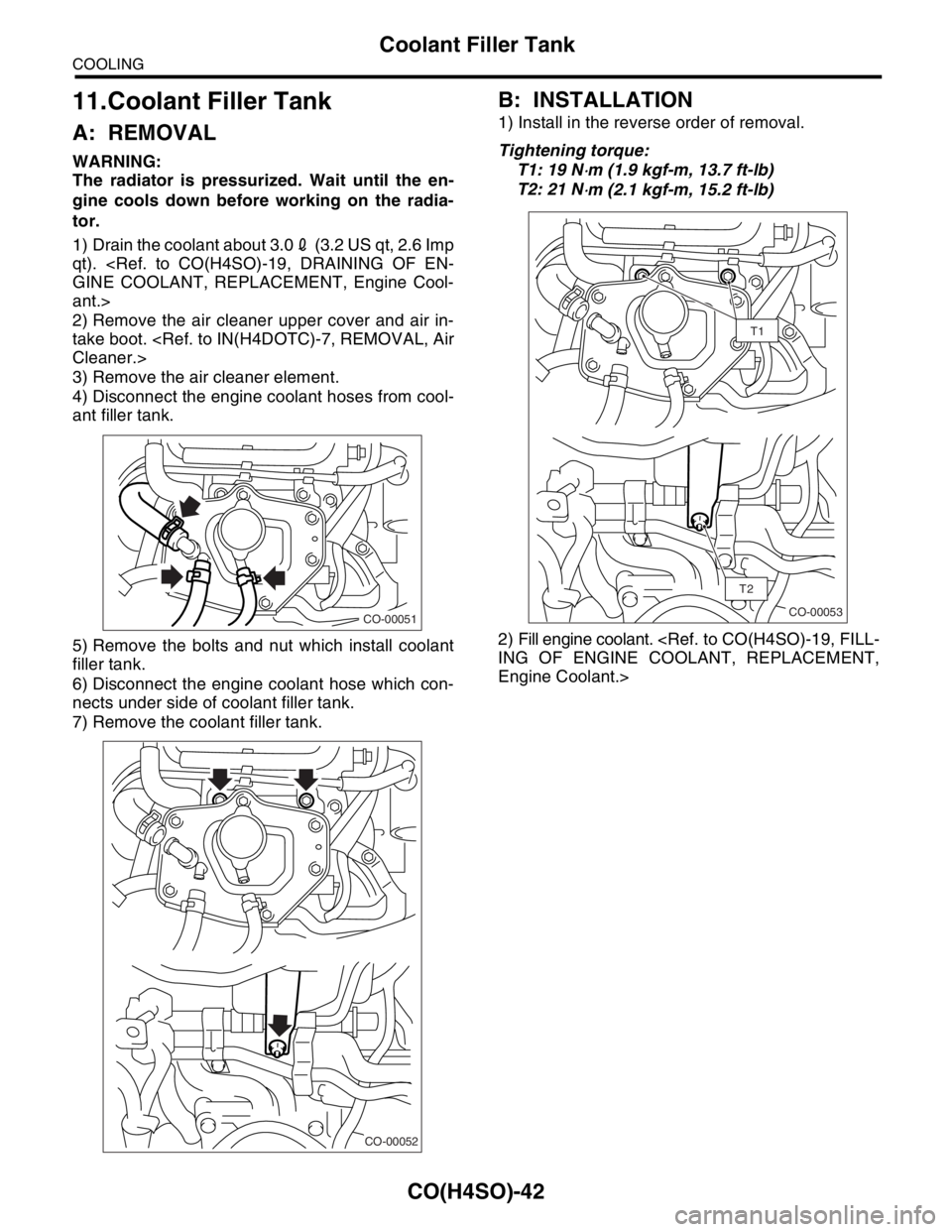
4) Disconnect the engine coolant hoses from cool-
ant filler tank.
5) Remove the bolts and nut which install coolant
filler tank.
6) Disconnect the engine coolant hose which con-
nects under side of coolant filler tank.
7) Remove the coolant filler tank.
B: INSTALLATION
1) Install in the reverse order of removal.
Tightening torque:
T1: 19 N
⋅m (1.9 kgf-m, 13.7 ft-lb)
T2: 21 N
⋅m (2.1 kgf-m, 15.2 ft-lb)
2) Fill engine coolant.
Engine Coolant.>
CO-00051
CO-00052
T2
T1
CO-00053
Page 1030 of 2870

LU(H4SO)-2
LUBRICATION
General Description
1. General Description
A: SPECIFICATION
Lubrication methodForced lubrication
Oil pumpPump type Trochoid type
Number of teethInner rotor 9
Outer rotor 10
Outer rotor diameter×thicknessNon-turbo model 78×7 mm (3.07×0.28 in)
Turbo model 78×10 mm (3.07×0.39 in)
Tip clearance between inner and outer rotorStandard 0.04 — 0.14 mm (0.0016 — 0.0055 in)
Limit 0.18 mm (0.0071 in)
Side clearance between inner rotor and pump
caseStandard 0.02 — 0.07 mm (0.0008 — 0.0028 in)
Limit 0.12 mm (0.0047 in)
Case clearance between outer rotor and pump
caseStandard 0.10 — 0.175 mm (0.0039 — 0.0069 in)
Limit 0.20 mm (0.0079 in)
Capacity at
80°C (176°F)Non-turbo
model
600 rpmDischarge
pressure98 kPa (1.0 kg/cm
2, 14 psi)
Discharge
quantity3.22 (3.4 US qt, 2.8 Imp qt)/min.
5,000 rpmDischarge
pressure294 kPa (3.0 kg/cm
2, 43 psi)
Discharge
quantity32.62 (34.4 US qt, 28.7 Imp qt)/min.
Turbo model
600 rpmDischarge
pressure98 kPa (1.0 kg/cm
2, 14 psi)
Discharge
quantity4.62 (4.9 US qt, 4.0 Imp qt)/min.
5,000 rpmDischarge
pressure294 kPa (3.0 kg/cm
2, 43 psi)
Discharge
quantity47.02 (49.7 US qt, 41.4 Imp qt)/min.
Relief valve operation pressureNon-turbo model
490 kPa (5.0 kg/cm
2, 71 psi)
Turbo model
588 kPa (6.0 kg/cm
2, 85 psi)
Oil filterTy p eFull-flow filter type
Filtration areaNon-turbo
760 cm
2 (118 sq in)
Tu r b o
800 cm
2 (124 sq in)
By-pass valve opening pressureNon-turbo
157 kPa (1.60 kg/cm
2, 22.8 psi)
Tu r b o
160 kPa (1.63 kg/cm
2, 23.2 psi)
Outer diameter×widthNon-turbo 80×70 mm (3.15×2.76 in)
Tu r b o 6 8×65 mm (2.68×2.56 in)
Oil filter to engine thread size M 20×1.5
Oil pressure
switchType Immersed contact point type
Working voltage — wattage 12 V — 3.4 W or less
Warning light activation pressure
14.7 kPa (0.15 kg/cm
2, 2.1 psi)
Proof pressure
More than 981 kPa (10 kg/cm
2, 142 psi)
Oil capacity (at replacement) 4.02 (4.2 US qt, 3.5 Imp qt)
Page 1036 of 2870
LU(H4SO)-8
LUBRICATION
Oil Pressure System
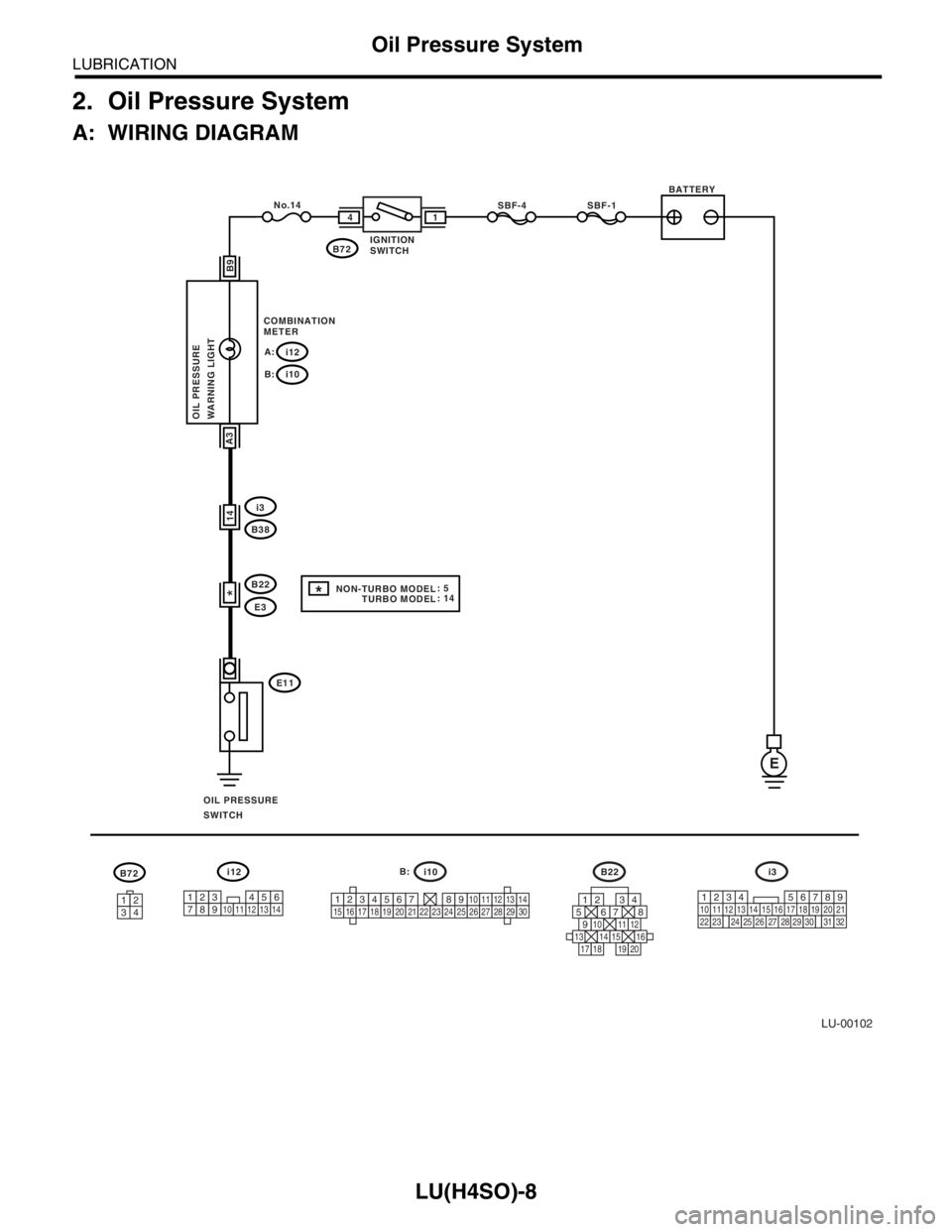
2. Oil Pressure System
A: WIRING DIAGRAM
LU-00102
E
i12
i10
i3
B38
B9
A3
B22
E3
14
E11
A:
B:
B:
i10
123456789101112131415161718192021222324252627282930219
32
1234 5610 11 12 13 14 15716
23 3019 20
22 26 27 28 29817
24 3118
25
i3B22
125678
131415169101112
34
17181920
**: 5
: 14
No.14SBF-4SBF-1
B72
14
B72i12
12345678910111213143412
TURBO MODEL NON-TURBO MODELBATTERY
IGNITION
SWITCH
COMBINATION
METER
OIL PRESSURE
WARNING LIGHT
OIL PRESSURE
SWITCH
Page 1037 of 2870

LU(H4SO)-9
LUBRICATION
Oil Pressure System
B: INSPECTION
Step Check Yes No
1 CHECK COMBINATION METER.
1) Turn the ignition switch to ON. (engine
OFF)
2) Check other warning lights.Does the warning lights illumi-
nate?Go to step 2.Repair or replace
the combination
meter.
Combination
Meter System.>
2 CHECK HARNESS CONNECTOR BETWEEN
COMBINATION METER AND OIL PRES-
SURE SWITCH.
1) Turn the ignition switch to OFF.
2) Disconnect the connector from oil pressure
switch.
3) Turn the ignition switch to ON.
4) Measure the voltage of harness between
the combination meter connector and chassis
ground.
Connector & terminal
(E11) No. 1 (+) — Chassis ground (
−):Is the voltage more than 10 V? Replace the oil
pressure switch.Go to step 3.
3 CHECK COMBINATION METER.
1) Turn the ignition switch to OFF.
2) Remove the combination meter.
3) Measure the resistance of combination
meter.
Te r m i n a l
No. B9 — No. A3:Is the resistance less than 10
Ω?Replace the har-
ness connector
between combina-
tion meter and oil
pressure switch.Repair or replace
the combination
meter and the oil
pressure switch
warning light bulb.
Page 1052 of 2870

LU(H4SO)-24
LUBRICATION
Engine Lubrication System Trouble in General
9. Engine Lubrication System Trouble in General
A: INSPECTION
Before performing diagnostics, make sure that the engine oil level is correct and no oil leakage exists.
Trouble Possible cause Corrective action
1. Warning light remains
on.1) Oil pressure switch
failureCracked diaphragm or oil leakage within switch Replace.
Broken spring or seized contacts Replace.
2) Low oil pressureClogged oil filter Replace.
Malfunction of oil by-pass valve of oil filter Clean or replace.
Malfunction of oil relief valve of oil pump Clean or replace.
Clogged oil passage Clean.
Excessive tip clearance and side clearance of oil
pump rotor and gearReplace.
Clogged oil strainer or broken pipe Clean or replace.
3) No oil pressureInsufficient engine oil Replenish.
Broken pipe of oil strainer Replace.
Stuck oil pump rotor Replace.
2. Warning light does
not go on.1) Malfunction of combination meter Replace.
2) Poor contact of switch contact points Replace.
3) Disconnection of wiring Repair.
3. Warning light flickers
momentarily.1) Poor contact at terminals Repair.
2) Defective wiring harness Repair.
3) Low oil pressureCheck for the same
possible causes as
listed in 1. — 2).
Page 1096 of 2870
SC(H4SO)-21
STARTING/CHARGING SYSTEM
Battery
4. Battery
A: REMOVAL
1) Disconnect the positive (+) cable after discon-
necting the ground (−) cable of battery.
2) Remove the flange nuts from battery rods, and
then take off the battery holder.
3) Remove the battery.
B: INSTALLATION
Install in the reverse order of removal.
Tightening torque:
3.4 N
⋅m (0.35 kgf-m, 2.5 ft-lb)
NOTE:
Clean the battery cable terminals, and then apply
grease to retard formation of corrosion.
Connect the positive (+) cable of battery and then
the ground (−) cable of battery.
C: INSPECTION
WARNING:
Electrolyte has toxicity; be careful handling
the fluid.
Avoid contact with skin, eyes or clothing. Es-
pecially at contact with eyes, blush with water
for 15 minutes and get prompt medical atten-
tion.
Batteries produce explosive gasses. Keep
sparks, flame, cigarettes away.
Ventilate when charging or using in enclosed
space.
For safety, in case an explosion does occur,
wear eye protection or shield your eyes when
working near any battery. Never lean over a bat-
tery.
Do not let the battery fluid contact eyes, skin,
fabrics, or paint-work because battery fluid is
corrosive acid.
To lessen the risk of sparks, remove rings,
metal watch-bands, and other metal jewelry.
Never allow metal tools to contact the positive
battery terminal and anything connected to it
while you are at the same time in contact with
any other metallic portion of the vehicle be-
cause a short circuit will be caused.
1. EXTERNAL PARTS:
Check for the existence of dirt or cracks on battery
case, top cover, vent plugs, and terminal posts. If
necessary, clean with water and wipe with a dry
cloth.
Apply a thin coat of grease on the terminal posts to
prevent corrosion.
2. ELECTROLYTE LEVEL:
Check the electrolyte level in each cell. If the level
is below MIN LEVEL, bring the level to MAX LEVEL
by pouring distilled water into the battery cell. Do
not fill beyond MAX LEVEL.
3. SPECIFIC GRAVITY OF ELECTROLYTE:
1) Measure the specific gravity of electrolyte using
a hydrometer and a thermometer.
Specific gravity varies with temperature of electro-
lyte so that it must be corrected at 20°C (68°F) us-
ing the following equation:
S
20 = St+0.0007×(t−20)
S
20: Specific gravity corrected at electrolyte
temperature of 20
°C
St: Measured specific gravity
t: Measured temperature (
°C)
Determine whether or not battery must be
charged, according to corrected specific
gravity.
Standard specific gravity: 1.220 — 1.290 [at
20
°C (68°F)]
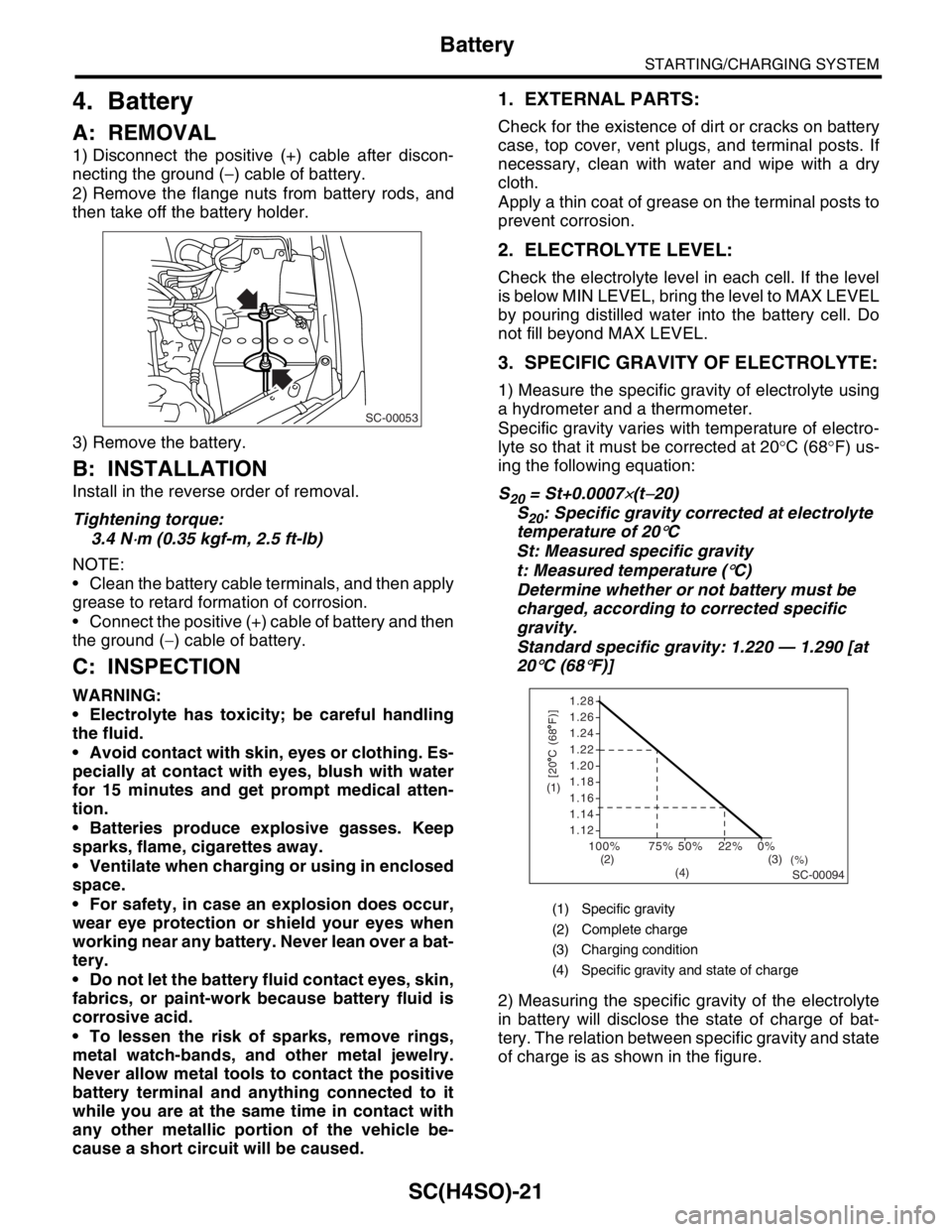
2) Measuring the specific gravity of the electrolyte
in battery will disclose the state of charge of bat-
tery. The relation between specific gravity and state
of charge is as shown in the figure.
SC-00053
(1) Specific gravity
(2) Complete charge
(3) Charging condition
(4) Specific gravity and state of charge
1.28
1.26
1.24
1.22
1.20
1.18
1.16
1.14
1.12
100%
(%)75% 50% 22% 0%
SC-00094
[20 C (68 F)](1)
(2) (3)
(4)
Page 1097 of 2870

SC(H4SO)-22
STARTING/CHARGING SYSTEM
Battery
D: MEASUREMENT
WARNING:
Do not bring an open flame close to the bat-
tery at this time.
CAUTION:
Prior to charging, corroded terminals should
be cleaned with a brush and common baking
soda solution.
Be careful since the battery electrolyte over-
flows while charging the battery.
Observe the instructions when handling bat-
tery charger.
Before charging the battery on vehicle, dis-
connect battery ground terminal. Failure to fol-
low this rule may damage alternator’s diodes or
other electrical units.
1. JUDGMENT OF BATTERY IN CHARGED
CONDITION
1) Specific gravity of electrolyte is held at a specific
value in a range from 1.250 to 1.290 for more than
one hour.
2) Voltage per battery cell is held at a specific value
in a range from 2.5 to 2.8 volts for more than one
hour.
2. CHECK HYDROMETER FOR STATE OF
CHARGE
3. NORMAL CHARGING
Charge the battery at current value specified by
manufacturer or at approx. 1/10 of battery’s am-
pere-hour rating.
4. QUICK CHARGING
Quick charging is a method in which the battery is
charged in a short period of time with a relatively
large current by using a quick charger.
Since a large current flow raises electrolyte temper-
ature, the battery is subject to damage if large cur-
rent is used for prolonged time. For this reason, the
quick charging must be carried out within a current
range that will not increase the electrolyte temper-
ature above 40°C (104°F).
It should be also remembered that the quick charg-
ing is a temporary means to bring battery voltage
up to a fair value and, as a rule, a battery should be
charged slowly with a low current.CAUTION:
Observe the items in 3. NORMAL CHARGING.
Never use more than 10 amperes when
charging the battery because that will shorten
battery life.
Hydrometer
indicatorState of charge Required action
Green dot Above 65% Load test
Dark dot Below 65% Charge battery
Clear dot Low electrolyteReplace battery*
(If cranking complaint)
*: Check electrical system before replacement.
Page 1100 of 2870

EN(H4SO)-2
ENGINE (DIAGNOSTIC)
Basic Diagnostics Procedure
1. Basic Diagnostics Procedure
A: PROCEDURE
1. ENGINE
Step Check Yes No
1 CHECK ENGINE START FAILURE.
1) Ask the customer when and how the trou-
ble occurred using the interview check list.
2) Start the engine.Does the engine start? Go to step 2.Inspection using
“Diagnostics for
Engine Starting
Failure”.
Diagnostics for
Engine Starting
Fai lu r e.>
2 CHECK ILLUMINATION OF MALFUNCTION
INDICATOR LIGHT.Does malfunction indicator
light illuminate?Go to step 3.Inspection using
“General Diagnos-
tic Table”.
INSPECTION,
General Diagnos-
tic Table.>
3 CHECK INDICATION OF DTC ON DISPLAY
1) Turn the ignition switch to OFF.
2) Connect the Subaru Select Monitor or the
OBD-II general scan tool to data link connec-
tor.
3) Turn the ignition switch to ON and the Sub-
aru Select Monitor or OBD-II general scan tool
switch to ON.
4) Read the DTC on the Subaru Select Moni-
tor or OBD-II general scan tool.Does the Subaru Select Moni-
tor or OBD-II general scan tool
indicate DTC?Record the DTC.
Repair the trouble
cause.
of Diagnostic Trou-
ble Code (DTC).>
Go to step 4.Repair the related
parts.
N
OTE:
If DTC is not shown
on display although
the engine warning
light illuminates, per-
form the diagnostics
of engine warning
light circuit or combi-
nation meter.
Malfunction Indica-
tor Light.>
4 PERFORM THE DIAGNOSIS.
1) Perform the Clear Memory Mode.
2) Perform the Inspection Mode.
tor or OBD-II general scan tool
indicate DTC?Check on “Diag-
nostic Procedure
with Diagnostic
Trouble Code
(DTC)”
Diagnostic Proce-
dure with Diagnos-
tic Trouble Code
(DTC).>Finish the diagno-
sis.