Gas TOYOTA 86 2017 User Guide
[x] Cancel search | Manufacturer: TOYOTA, Model Year: 2017, Model line: 86, Model: TOYOTA 86 2017Pages: 428, PDF Size: 5.25 MB
Page 238 of 428
2384-1. Maintenance and care
WARNING■ When washing the vehicle
Do not apply water to the inside of the engine compartment. Doing so may
cause the electrical components etc. to catch fire.
■ Precautions regarding the exhaust pipes
Exhaust gasses cause the exhaust pipes and rear bumper diffusers to
become quite hot.
When washing the vehicle, be careful not to touch the pipes and diffusers
until they have cooled sufficiently, as touching hot exhaust pipes and rear
bumper diffusers can cause burns.
NOTICE■ To prevent paint deterioration and corrosion on the body and compo-
nents (aluminum wheels etc.)
● Wash the vehicle immediately in the following cases:
• After driving near the sea coast
• After driving on salted roads
• If you see coal tar or tree sap on the paint surface
• If you see dead insects, insect droppings or bird droppings on the paint
• After driving in an area contaminated with soot, oily smoke, mine dust,
iron powder or chemical substances
• If the vehicle becomes heavily soiled in dust or mud
• If liquids such as benzene and gasoline are spilled on the paint surface
● If the paint is chipped or scratched, have it repaired immediately.
● To prevent the wheels from corroding, remove any dirt and store in a place
with low humidity when storing the wheels.
■ Protective film for side sill plates
Make sure to remove the protective film. Failure to do so may cause rust,
depending on conditions.
Page 242 of 428
2424-1. Maintenance and care
NOTICE■ Cleaning detergents
● Do not use organic substances such as benzene or gasoline, acidic or
alkaline solutions, dye, bleach or other detergent. Doing so may discolor
the vehicle interior or cause streaks or damage to painted surfaces.
● Do not use polish wax or polish cleaner. The instrument panel's or other
interior part’s painted surface may be damaged.
● Do not use a chemical agent containing silicone (highly-polymerized sili-
con compound) when cleaning any of the electrical appliances such as the
air conditioning, all switches and their surrounding areas.
If silicon (highly-polymerized silicon compound) contacts these compo-
nents, it may cause the electrical appliances to malfunction.
■ Preventing damage to leather surfaces
Observe the following precautions to avoid damage to and deterioration of
leather surfaces.
● Remove any dust, dirt, sand, oil spots etc. on leather surfaces immedi-
ately.
● Do not expose the vehicle to direct sunlight for extended periods of time.
Park the vehicle in the shade, especially during summer.
● Do not place items made of vinyl, plastic, or that contain wax on the uphol-
stery, as they may stick to the leather surface if the vehicle interior heats
up significantly.
■ Water on the floor
Do not wash the vehicle floor with water.
Vehicle systems such as the audio system may be damaged if water comes
into contact with electrical components under the floor of the vehicle, and
may also cause the body to rust.
Page 266 of 428
2664-3. Do-it-yourself maintenance
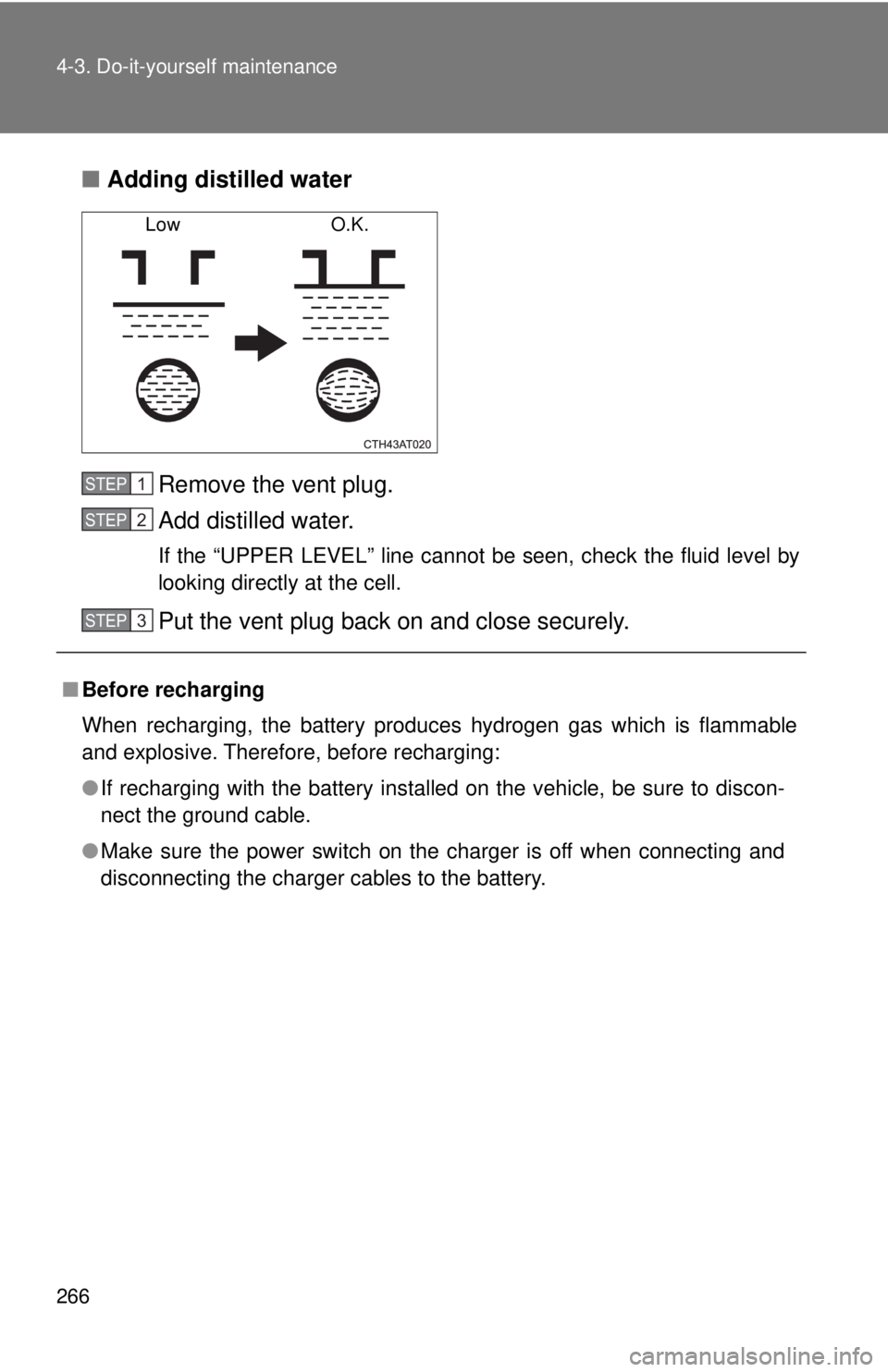
■ Adding distilled water
Remove the vent plug.
Add distilled water. If the “UPPER LEVEL” line cannot be seen, check the fluid level by
looking directly at the cell.
Put the vent plug back on and close securely. Low O.K.
■ Before recharging
When recharging, the battery produces hydrogen gas which is flammable
and explosive. Therefore, before recharging:
● If recharging with the battery installed on the vehicle, be sure to discon-
nect the ground cable.
● Make sure the power switch on the charger is off when connecting and
disconnecting the charger cables to the battery. STEP 1
STEP 2
STEP 3
Page 267 of 428
2674-3. Do-it-yourself maintenance
4
Maintenance and care WARNING■ Chemicals in the battery
A battery contains poisonous and corrosive sulfuric acid and may produce
hydrogen gas which is flammable and explosive. To reduce the risk of death
or serious injury, take the following precautions while working on or near the
battery:
● Do not cause sparks by touching the battery terminals with tools.
● Do not smoke or light a match near the battery.
● Avoid contact with eyes, skin and clothes.
● Never inhale or swallow electrolyte.
● Wear protective safety glasses when working near the battery.
● Keep children away from the battery.
■ Where to safely charge the battery
Always charge the battery in an open area. Do not charge the battery in a
garage or closed room where there is not sufficient ventilation.
■ Emergency measures regarding electrolyte
● If electrolyte gets in your eyes
Flush your eyes with clean water for at least 15 minutes and get immedi-
ate medical attention. If possible, continue to apply water with a sponge or
cloth while traveling to the nearest medical facility.
● If electrolyte gets on your skin
Wash the affected area thoroughly. If you feel pain or burning, get medical
attention immediately.
● If electrolyte gets on your clothes
It can soak through clothing on to your skin. Immediately take off the cloth-
ing and follow the procedure above if necessary.
● If you accidentally swallow electrolyte
Drink a large quantity of water or milk. Get emergency medical attention
immediately.
Page 343 of 428
5
When trouble arises
3435-2. Steps to take in an emergency
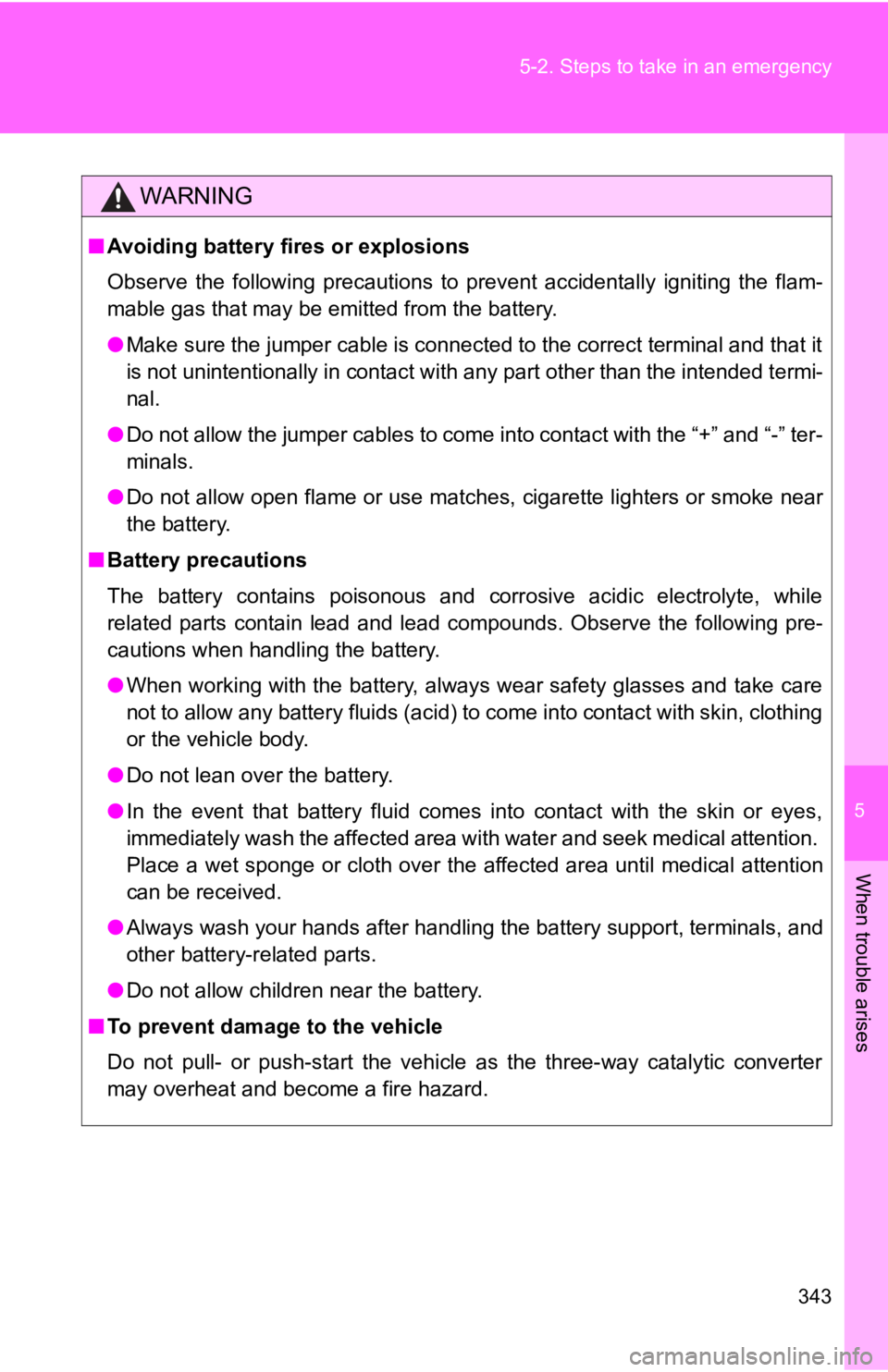
WARNING■ Avoiding battery fires or explosions
Observe the following precautions to prevent accidentally igniting the flam-
mable gas that may be emitted from the battery.
● Make sure the jumper cable is connected to the correct terminal and that it
is not unintentionally in contact with any part other than the intended termi-
nal.
● Do not allow the jumper cables to come into contact with the “+” and “-” ter-
minals.
● Do not allow open flame or use matc hes, cigarette lighters or smoke near
the battery.
■ Battery precautions
The battery contains poisonous and corrosive acidic electrolyte, while
related parts contain lead and lead compounds. Observe the following pre-
cautions when handling the battery.
● When working with the battery, always wear safety glasses and take care
not to allow any battery fluids (acid) to come into contact with skin, clothing
or the vehicle body.
● Do not lean over the battery.
● In the event that battery fluid comes into contact with the skin or eyes,
immediately wash the affected area with water and seek medical attention.
Place a wet sponge or cloth over the affected area until medical attention
can be received.
● Always wash your hands after handling the battery support, terminals, and
other battery-related parts.
● Do not allow children near the battery.
■ To prevent damage to the vehicle
Do not pull- or push-start the vehicle as the three-way catalytic converter
may overheat and become a fire hazard.
Page 357 of 428
3576-1. Specifications
6
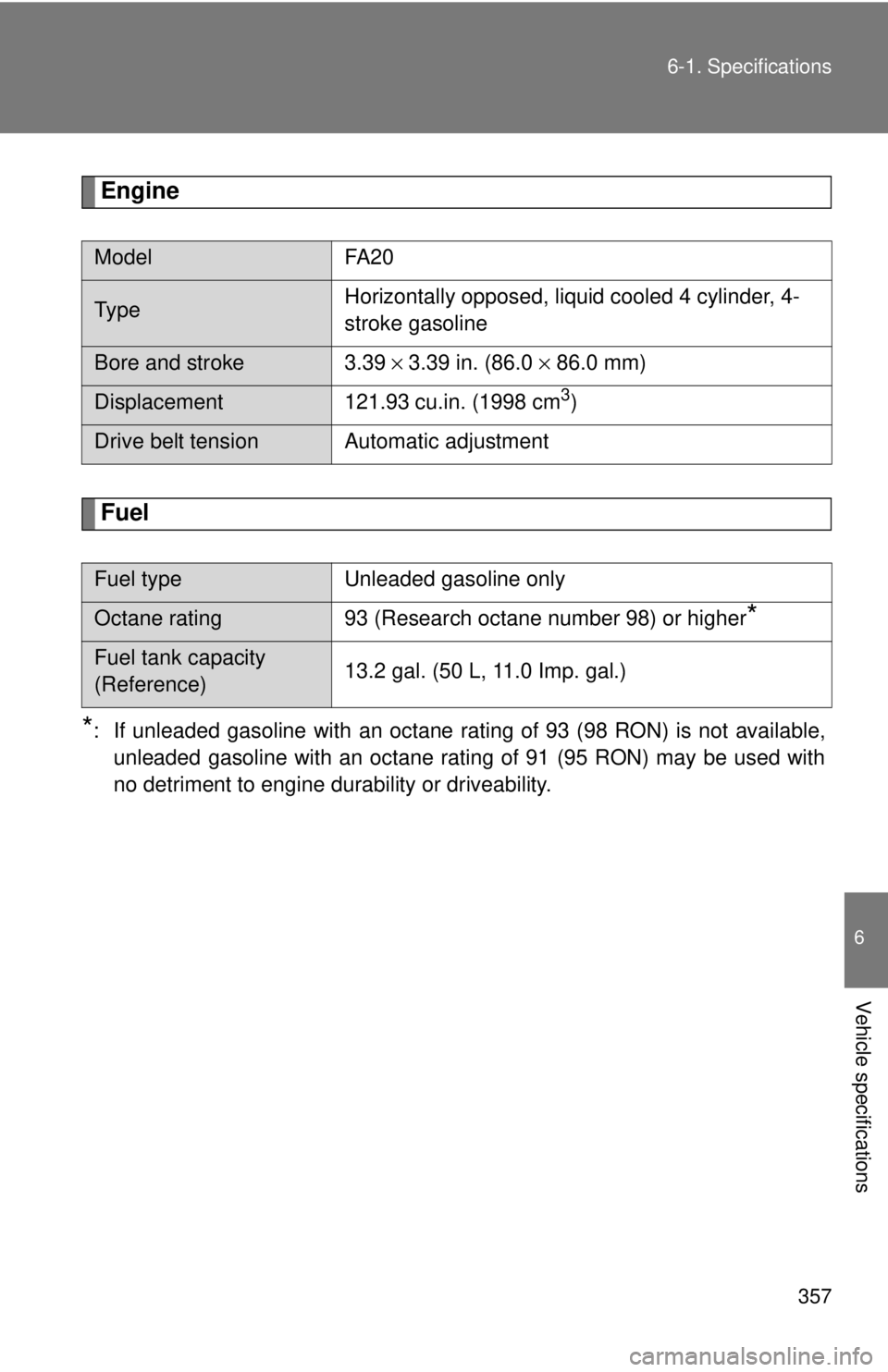
Vehicle specifications Engine
Fuel
* : If unleaded gasoline with an octane rating of 93 (98 RON) is not available,
unleaded gasoline with an octane rating of 91 (95 RON) may be used with
no detriment to engine durability or driveability.Model FA20
Ty p e Horizontally opposed, liquid cooled 4 cylinder, 4-
stroke gasoline
Bore and stroke 3.39 × 3.39 in. (86.0 × 86.0 mm)
Displacement 121.93 cu.in. (1998 cm 3
)
Drive belt tension Automatic adjustment
Fuel type Unleaded gasoline only
Octane rating 93 (Research octane number 98) or higher
*Fuel tank capacity
(Reference) 13.2 gal. (50 L, 11.0 Imp. gal.)
Page 366 of 428
3666-1. Specifications
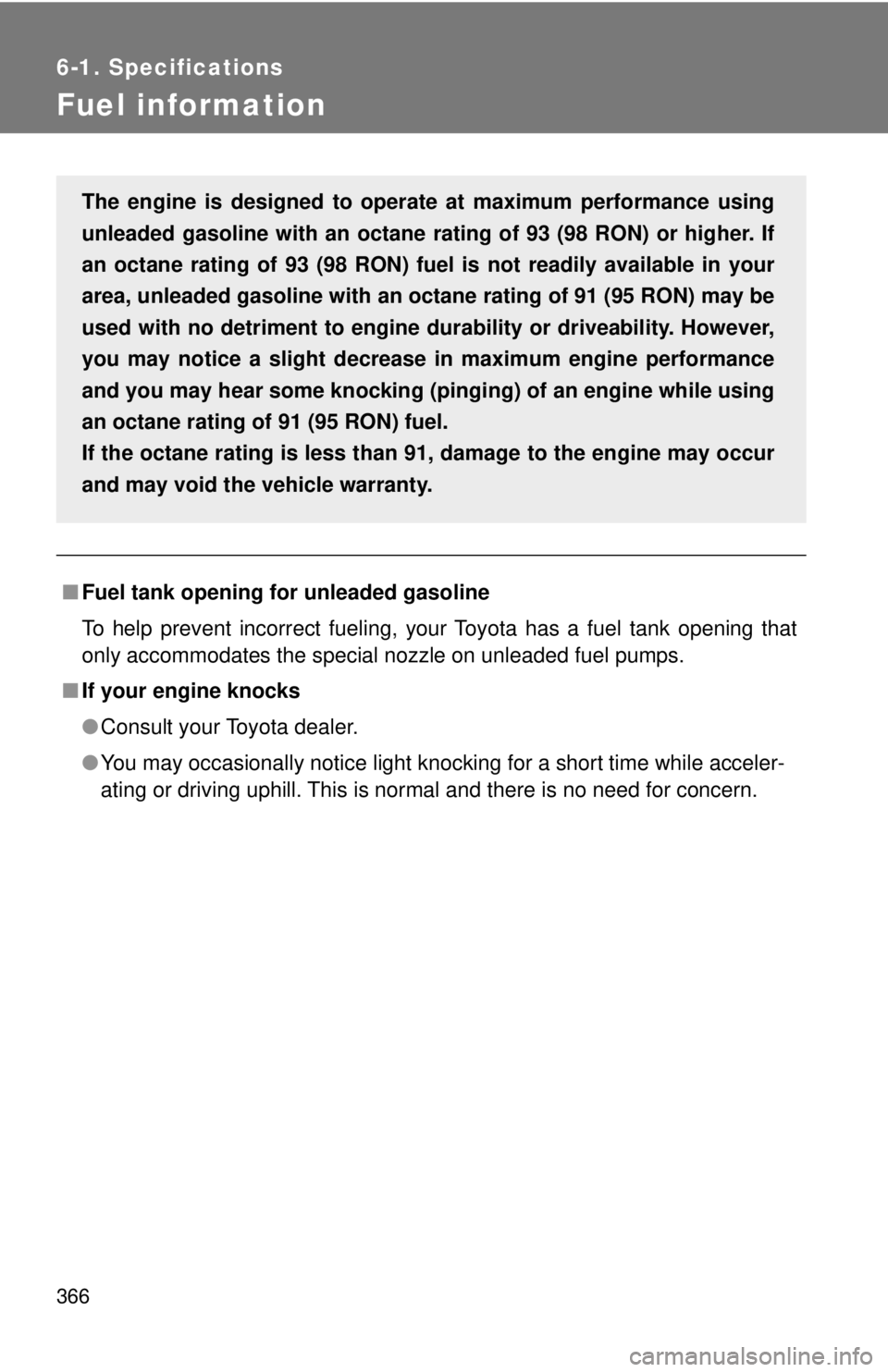
Fuel information
■ Fuel tank opening for unleaded gasoline
To help prevent incorrect fueling, your Toyota has a fuel tank opening that
only accommodates the special nozzle on unleaded fuel pumps.
■ If your engine knocks
● Consult your Toyota dealer.
● You may occasionally notice light knocking for a short time while acceler-
ating or driving uphill. This is normal and there is no need for concern.The engine is designed to operate at maximum performance using
unleaded gasoline with an octane ra ting of 93 (98 RON) or higher. If
an octane rating of 93 (98 RON) fuel is not readily available in your
area, unleaded gasoline with an octane rating of 91 (95 RON) may be
used with no detriment to engine dur ability or driveability. However,
you may notice a slight decrease in maximum engine performance
and you may hear some knocking (pin ging) of an engine while using
an octane rating of 91 (95 RON) fuel.
If the octane rating is less than 91, damage to the engine may occur
and may void the vehicle warranty.
Page 367 of 428
3676-1. Specifications
6
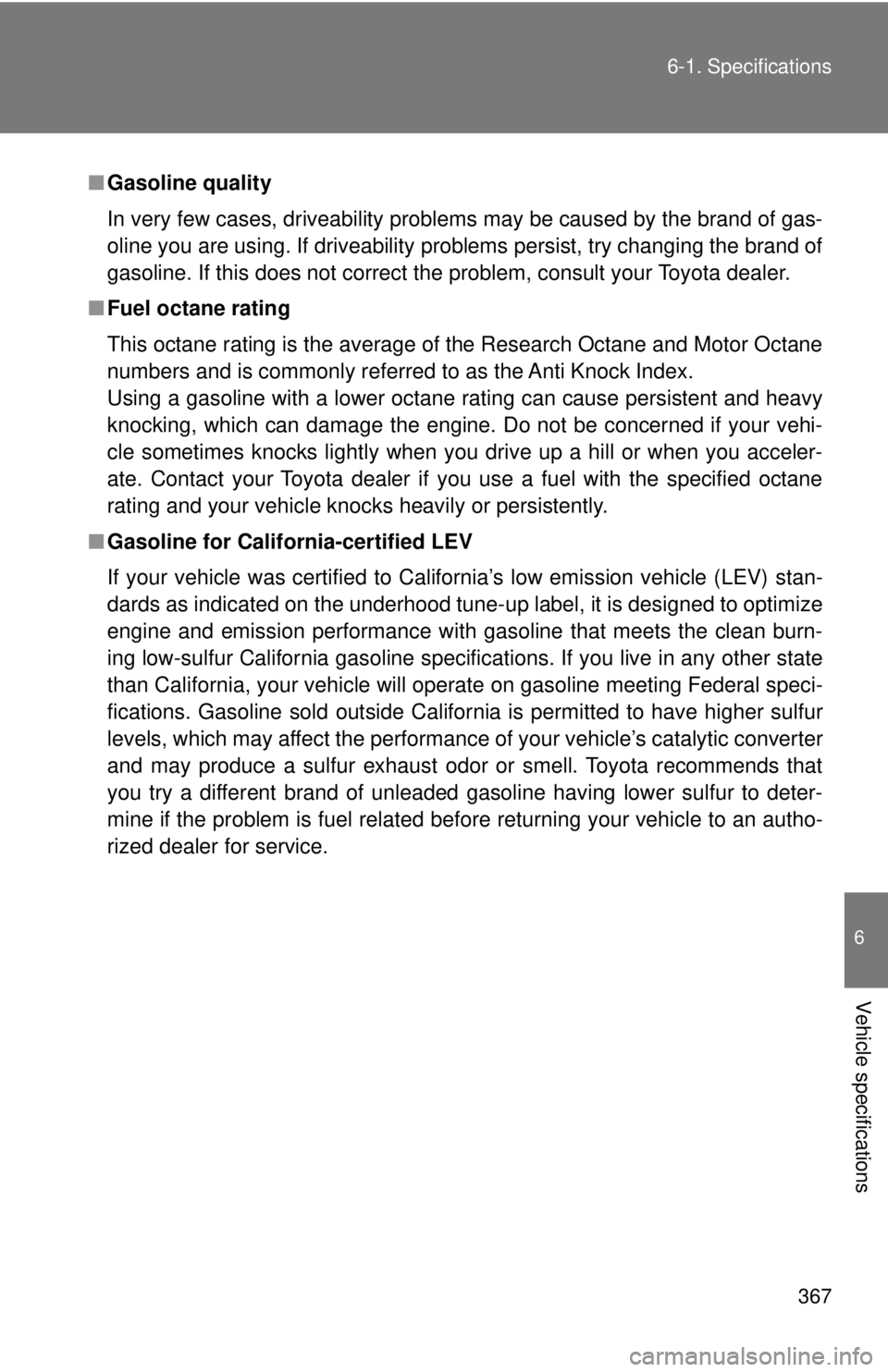
Vehicle specifications ■ Gasoline quality
In very few cases, driveability problems may be caused by the brand of gas-
oline you are using. If driveability problems persist, try changing the brand of
gasoline. If this does not correct the problem, consult your Toyota dealer.
■ Fuel octane rating
This octane rating is the average of the Research Octane and Motor Octane
numbers and is commonly referred to as the Anti Knock Index.
Using a gasoline with a lower octane rating can cause persistent and heavy
knocking, which can damage the engine. Do not be concerned if your vehi-
cle sometimes knocks lightly when you drive up a hill or when you acceler-
ate. Contact your Toyota dealer if you use a fuel with the specified octane
rating and your vehicle knocks heavily or persistently.
■ Gasoline for California-certified LEV
If your vehicle was certified to California’s low emission vehicle (LEV) stan-
dards as indicated on the underhood tune-up label, it is designed to optimize
engine and emission performance with gasoline that meets the clean burn-
ing low-sulfur California gasoline specifications. If you live in any other state
than California, your vehicle will operate on gasoline meeting Federal speci-
fications. Gasoline sold outside California is permitted to have higher sulfur
levels, which may affect the performance of your vehicle’s catalytic converter
and may produce a sulfur exhaust odor or smell. Toyota recommends that
you try a different brand of unleaded gasoline having lower sulfur to deter-
mine if the problem is fuel related before returning your vehicle to an autho-
rized dealer for service.
Page 368 of 428
3686-1. Specifications
■ Toyota recommends the use of g asoline containing detergent additives
● Toyota recommends the use of gasoline that contains detergent additives
to avoid build-up of engine deposits.
● All gasoline sold in the U.S.A. contains minimum detergent additives to
clean and/or keep clean intake systems, per EPA’s lowest additives con-
centration program.
● Toyota strongly recommends the use of Top Tier Detergent Gasoline. For
more information on Top Tier Detergent Gasoline and a list of marketers,
please go to the official website www.toptiergas.com.
■ Toyota recommends the use of cleaner burning gasoline
Cleaner burning gasoline, including reformulated gasoline that contains oxy-
genates such as ethanol or MTBE (Methyl Tertiary Butyl Ether) is available in
many areas.
Toyota recommends the use of cleaner burning gasoline and appropriately
blended reformulated gasoline. These types of gasoline provide excellent
vehicle performance, reduce vehicle emissions and improve air quality.
■ Non-recommendation of the use of blended gasoline
● If you use gasohol in your vehicle, be sure that it has an octane rating no
lower than 93.
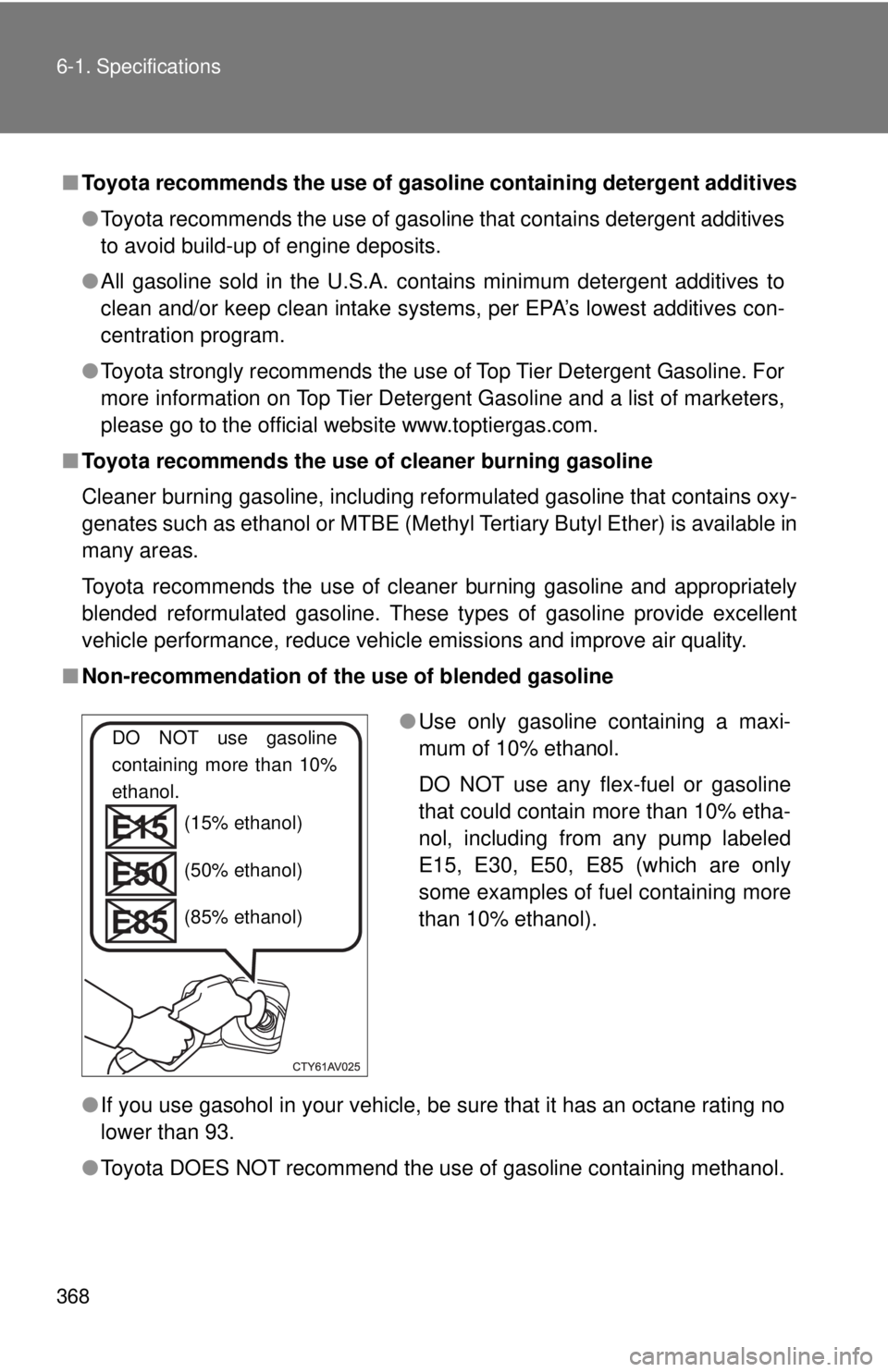
● Toyota DOES NOT recommend the use of gasoline containing methanol. ● Use only gasoline containing a maxi-
mum of 10% ethanol.
DO NOT use any flex-fuel or gasoline
that could contain more than 10% etha-
nol, including from any pump labeled
E15, E30, E50, E85 (which are only
some examples of fuel containing more
than 10% ethanol).DO NOT use gasoline
containing more than 10%
ethanol.
(15% ethanol)
(50% ethanol)
(85% ethanol)
Page 369 of 428
3696-1. Specifications
6
Vehicle specifications ■ Toyota does not recommend gasoline containing MMT
Some gasoline contains octane enhancing additive called MMT (Methylcy-
clopentadienyl Manganese Tricarbonyl).
Toyota DOES NOT recommend the use of gasoline that contains MMT. If
fuel containing MMT is used, your emission control system may be
adversely affected.
The malfunction indicator lamp on the instrument cluster may come on. If
this happens, contact your Toyota dealer for service.
NOTICE■ Notice on fuel quality
● Do not use improper fuels. If improper fuels are used the engine will be
damaged.
● Do not use leaded gasoline.
Leaded gasoline can cause damage to your vehicle’s three-way catalytic
converters causing the emission control system to malfunction.
● Do not use gasohol other than the type previously stated.
Other gasohol may cause fuel system damage or vehicle performance
problems.
● Using unleaded gasoline with an octane number or rating lower than the
level previously stated may cause persistent heavy knocking.
At worst, this may lead to engine damage and will void the vehicle war-
ranty.
■ Fuel-related poor driveability
If after using a different type of fuel, poor driveability is encountered (poor
hot starting, vaporization, engine knocking, etc.), discontinue the use of that
type of fuel.
■ When refueling with gasohol
Take care not to spill gasohol. It can damage your vehicle's paint.