engine TOYOTA RAV4 2006 Service Repair Manual
[x] Cancel search | Manufacturer: TOYOTA, Model Year: 2006, Model line: RAV4, Model: TOYOTA RAV4 2006Pages: 2000, PDF Size: 45.84 MB
Page 706 of 2000
2GR-FE ENGINE MECHANICAL – ENGINE UNITEM–69
EM
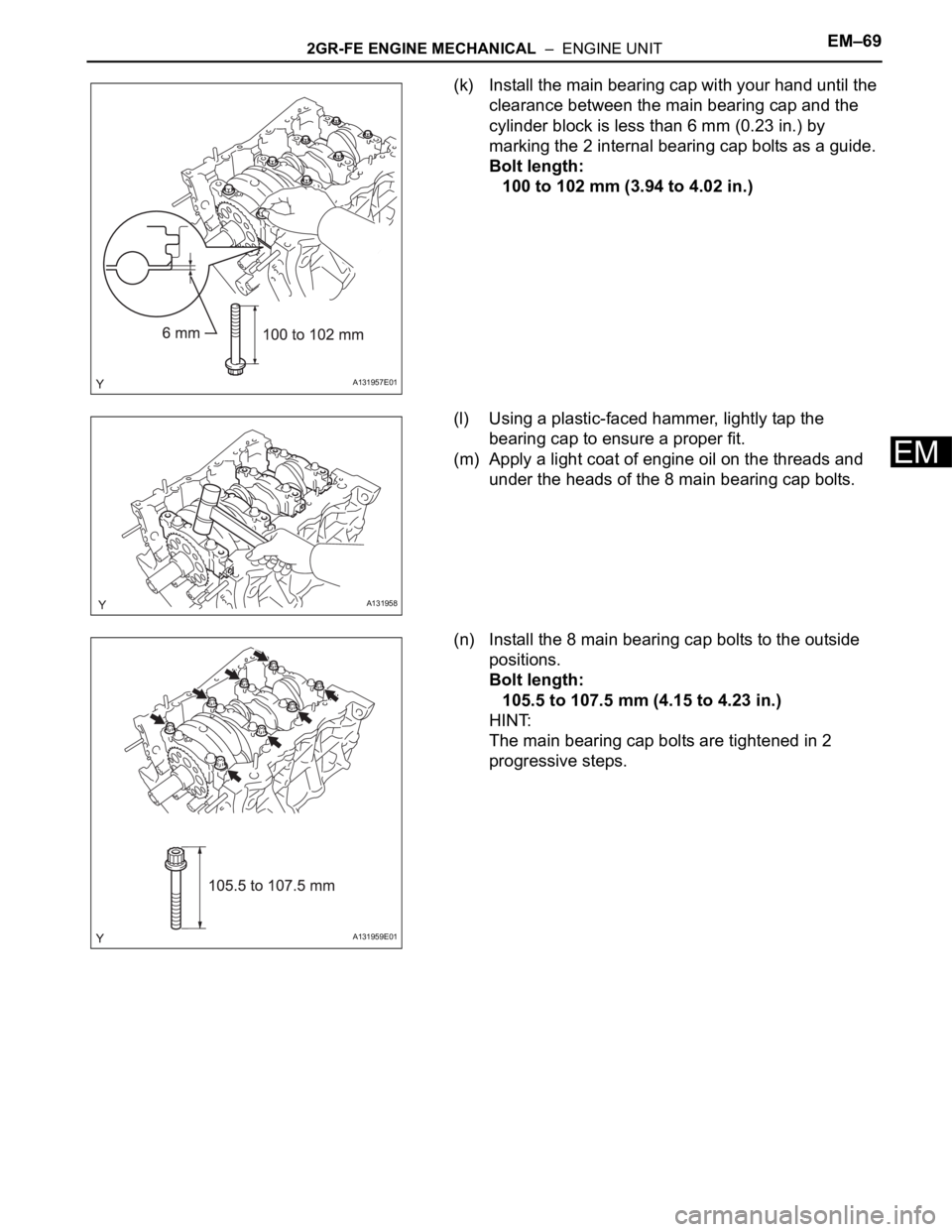
(k) Install the main bearing cap with your hand until the
clearance between the main bearing cap and the
cylinder block is less than 6 mm (0.23 in.) by
marking the 2 internal bearing cap bolts as a guide.
Bolt length:
100 to 102 mm (3.94 to 4.02 in.)
(l) Using a plastic-faced hammer, lightly tap the
bearing cap to ensure a proper fit.
(m) Apply a light coat of engine oil on the threads and
under the heads of the 8 main bearing cap bolts.
(n) Install the 8 main bearing cap bolts to the outside
positions.
Bolt length:
105.5 to 107.5 mm (4.15 to 4.23 in.)
HINT:
The main bearing cap bolts are tightened in 2
progressive steps.
A131957E01
A131958
A131959E01
Page 707 of 2000
EM–702GR-FE ENGINE MECHANICAL – ENGINE UNIT
EM
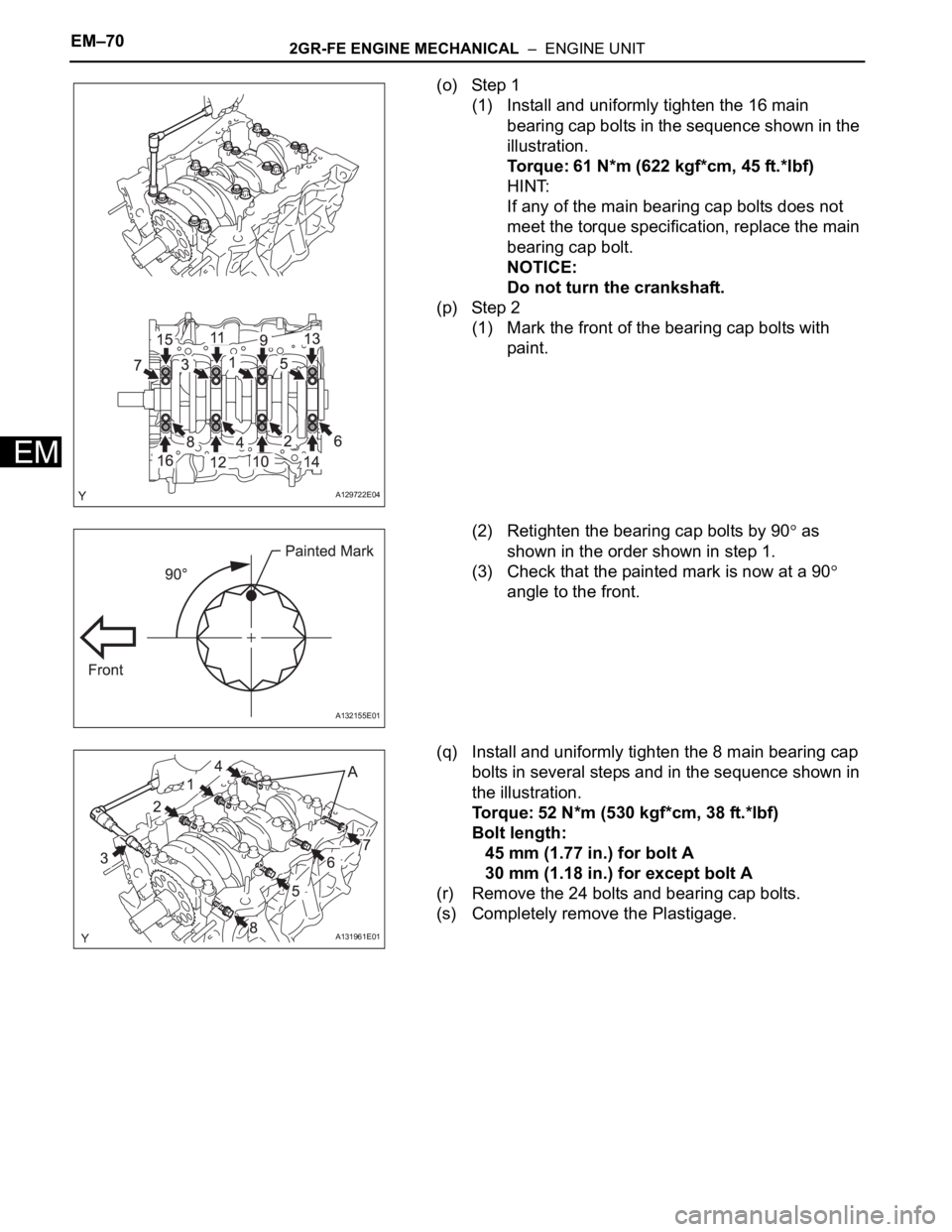
(o) Step 1
(1) Install and uniformly tighten the 16 main
bearing cap bolts in the sequence shown in the
illustration.
Torque: 61 N*m (622 kgf*cm, 45 ft.*lbf)
HINT:
If any of the main bearing cap bolts does not
meet the torque specification, replace the main
bearing cap bolt.
NOTICE:
Do not turn the crankshaft.
(p) Step 2
(1) Mark the front of the bearing cap bolts with
paint.
(2) Retighten the bearing cap bolts by 90
as
shown in the order shown in step 1.
(3) Check that the painted mark is now at a 90
angle to the front.
(q) Install and uniformly tighten the 8 main bearing cap
bolts in several steps and in the sequence shown in
the illustration.
Torque: 52 N*m (530 kgf*cm, 38 ft.*lbf)
Bolt length:
45 mm (1.77 in.) for bolt A
30 mm (1.18 in.) for except bolt A
(r) Remove the 24 bolts and bearing cap bolts.
(s) Completely remove the Plastigage.
A129722E04
A132155E01
A131961E01
Page 708 of 2000
2GR-FE ENGINE MECHANICAL – ENGINE UNITEM–71
EM
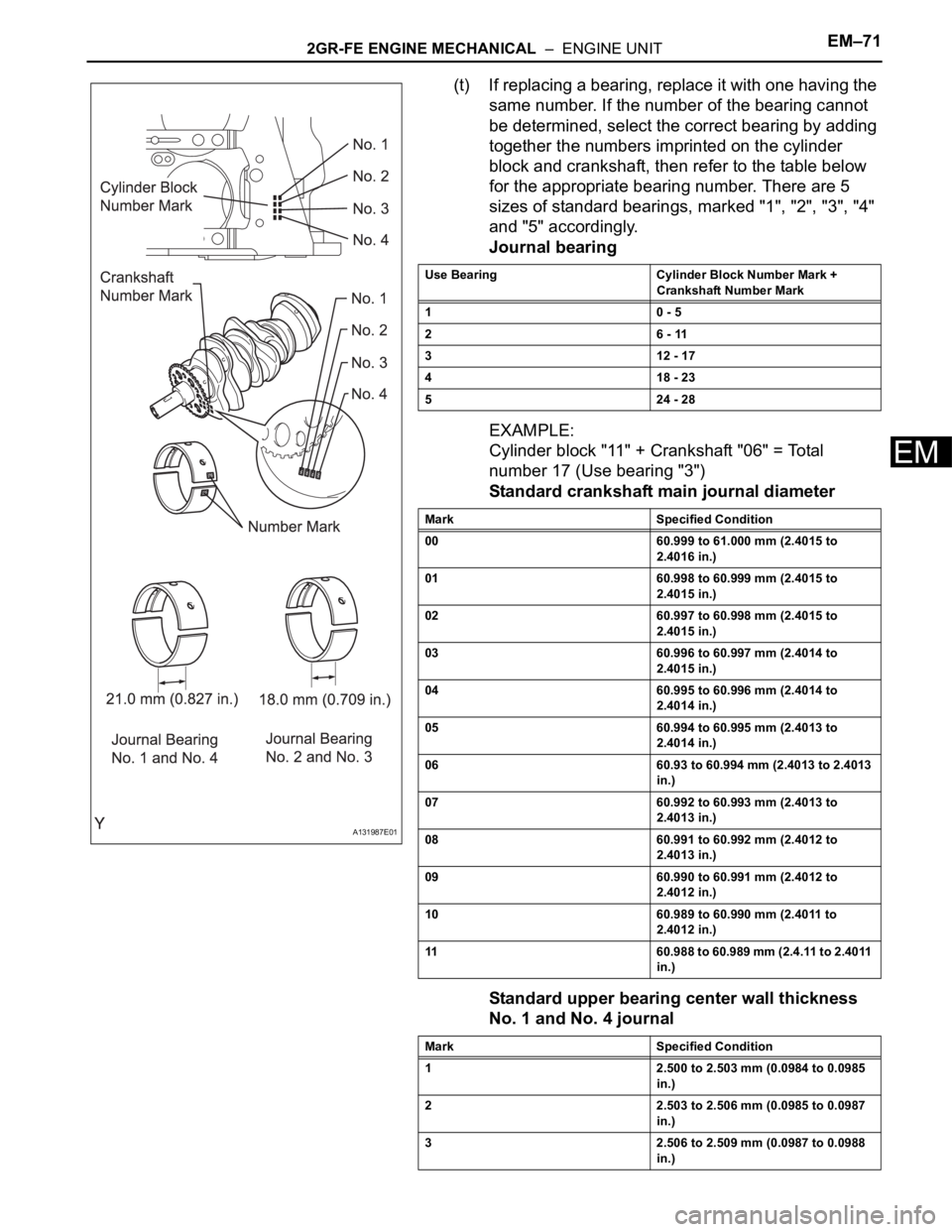
(t) If replacing a bearing, replace it with one having the
same number. If the number of the bearing cannot
be determined, select the correct bearing by adding
together the numbers imprinted on the cylinder
block and crankshaft, then refer to the table below
for the appropriate bearing number. There are 5
sizes of standard bearings, marked "1", "2", "3", "4"
and "5" accordingly.
Journal bearing
EXAMPLE:
Cylinder block "11" + Crankshaft "06" = Total
number 17 (Use bearing "3")
Standard crankshaft main journal diameter
Standard upper bearing center wall thickness
No. 1 and No. 4 journal
A131987E01
Use Bearing Cylinder Block Number Mark +
Crankshaft Number Mark
1 0 - 5
2 6 - 11
312 - 17
418 - 23
524 - 28
Mark Specified Condition
00 60.999 to 61.000 mm (2.4015 to
2.4016 in.)
01 60.998 to 60.999 mm (2.4015 to
2.4015 in.)
02 60.997 to 60.998 mm (2.4015 to
2.4015 in.)
03 60.996 to 60.997 mm (2.4014 to
2.4015 in.)
04 60.995 to 60.996 mm (2.4014 to
2.4014 in.)
05 60.994 to 60.995 mm (2.4013 to
2.4014 in.)
06 60.93 to 60.994 mm (2.4013 to 2.4013
in.)
07 60.992 to 60.993 mm (2.4013 to
2.4013 in.)
08 60.991 to 60.992 mm (2.4012 to
2.4013 in.)
09 60.990 to 60.991 mm (2.4012 to
2.4012 in.)
10 60.989 to 60.990 mm (2.4011 to
2.4012 in.)
11 60.988 to 60.989 mm (2.4.11 to 2.4011
in.)
Mark Specified Condition
1 2.500 to 2.503 mm (0.0984 to 0.0985
in.)
2 2.503 to 2.506 mm (0.0985 to 0.0987
in.)
3 2.506 to 2.509 mm (0.0987 to 0.0988
in.)
Page 709 of 2000

EM–722GR-FE ENGINE MECHANICAL – ENGINE UNIT
EM
No. 2 and No. 3 journal
Standard lower bearing center wall thickness
No. 1 and No. 4 journal
No. 2 and No. 3 journal
(u) Lift out the crankshaft.
4 2.509 to 2.512 mm (0.0988 to 0.0989
in.)
5 2.512 to 2.515 mm (0.0989 to 0.0990
in.)
Mark Specified Condition
1 2.478 to 2.481 mm (0.0976 to 0.0977
in.)
2 2.481 to 2.484 mm (0.0977 to 0.0978
in.)
3 2.484 to 2.487 mm (0.0978 to 0.0979
in.)
4 2.487to 2.490 mm (0.0979 to 0.0980
in.)
5 2.490 to 2.493 mm (0.0980 to 0.0981
in.)
Mark Specified Condition
1 2.478 to 2.481 mm (0.0976 to 0.0977
in.)
2 2.481 to 2.484 mm (0.0977 to 0.0780
in.)
3 2.484 to 2.487 mm (0.0978 to 0.0979
in.)
4 2.487 to 2.490 mm (0.0979 to 0.0980
in.)
5 2.490 to 2.493 mm (0.0980 to 0.0981
in.)
Mark Specified Condition
1 2.500 to 2.503 mm (0.0984 to 0.0985
in.)
2 2.503 to 2.506 mm (0.0985 to 0.0987
in.)
3 2.506 to 2.509 mm (0.0987 to 0.0988
in.)
4 2.509 to 2.512 mm (0.0988 to 0.0989
in.)
5 2.512 to 2.515 mm (0.0989 to 0.0990
in.) Mark Specified Condition
Page 710 of 2000
2GR-FE ENGINE MECHANICAL – ENGINE UNITEM–73
EM
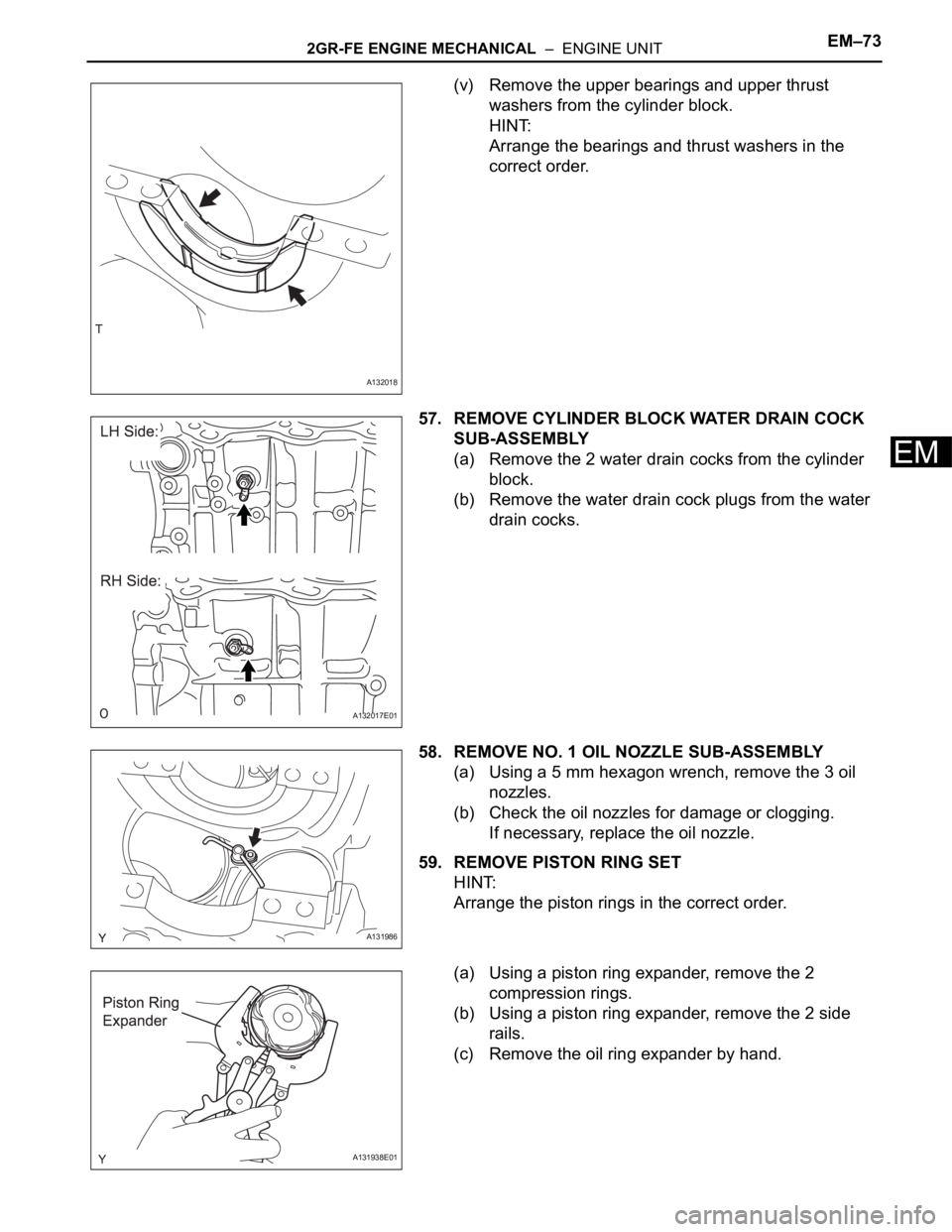
(v) Remove the upper bearings and upper thrust
washers from the cylinder block.
HINT:
Arrange the bearings and thrust washers in the
correct order.
57. REMOVE CYLINDER BLOCK WATER DRAIN COCK
SUB-ASSEMBLY
(a) Remove the 2 water drain cocks from the cylinder
block.
(b) Remove the water drain cock plugs from the water
drain cocks.
58. REMOVE NO. 1 OIL NOZZLE SUB-ASSEMBLY
(a) Using a 5 mm hexagon wrench, remove the 3 oil
nozzles.
(b) Check the oil nozzles for damage or clogging.
If necessary, replace the oil nozzle.
59. REMOVE PISTON RING SET
HINT:
Arrange the piston rings in the correct order.
(a) Using a piston ring expander, remove the 2
compression rings.
(b) Using a piston ring expander, remove the 2 side
rails.
(c) Remove the oil ring expander by hand.
A132018
A132017E01
A131986
A131938E01
Page 711 of 2000
EM–742GR-FE ENGINE MECHANICAL – ENGINE UNIT
EM
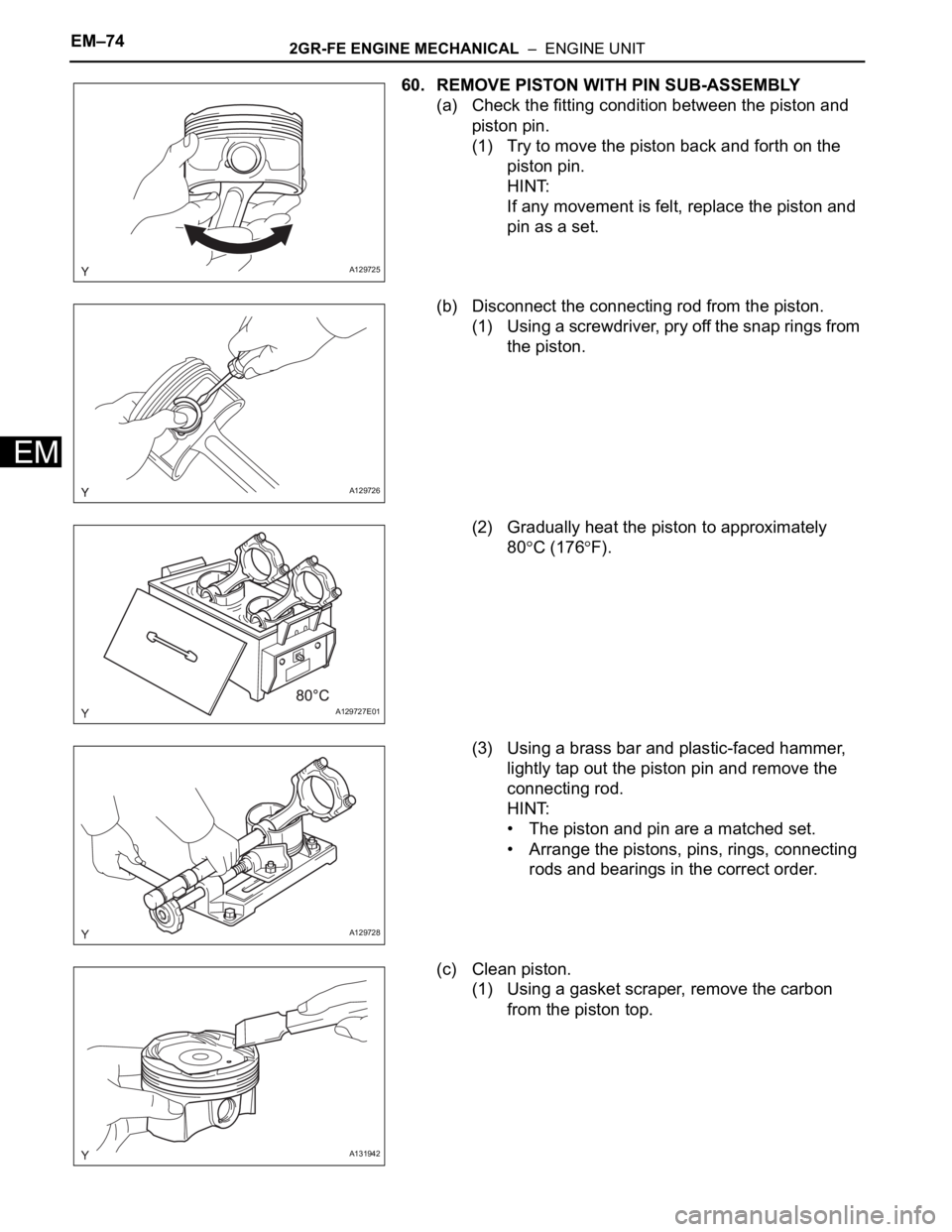
60. REMOVE PISTON WITH PIN SUB-ASSEMBLY
(a) Check the fitting condition between the piston and
piston pin.
(1) Try to move the piston back and forth on the
piston pin.
HINT:
If any movement is felt, replace the piston and
pin as a set.
(b) Disconnect the connecting rod from the piston.
(1) Using a screwdriver, pry off the snap rings from
the piston.
(2) Gradually heat the piston to approximately
80
C (176F).
(3) Using a brass bar and plastic-faced hammer,
lightly tap out the piston pin and remove the
connecting rod.
HINT:
• The piston and pin are a matched set.
• Arrange the pistons, pins, rings, connecting
rods and bearings in the correct order.
(c) Clean piston.
(1) Using a gasket scraper, remove the carbon
from the piston top.
A129725
A129726
A129727E01
A129728
A131942
Page 712 of 2000
2GR-FE ENGINE MECHANICAL – ENGINE UNITEM–75
EM
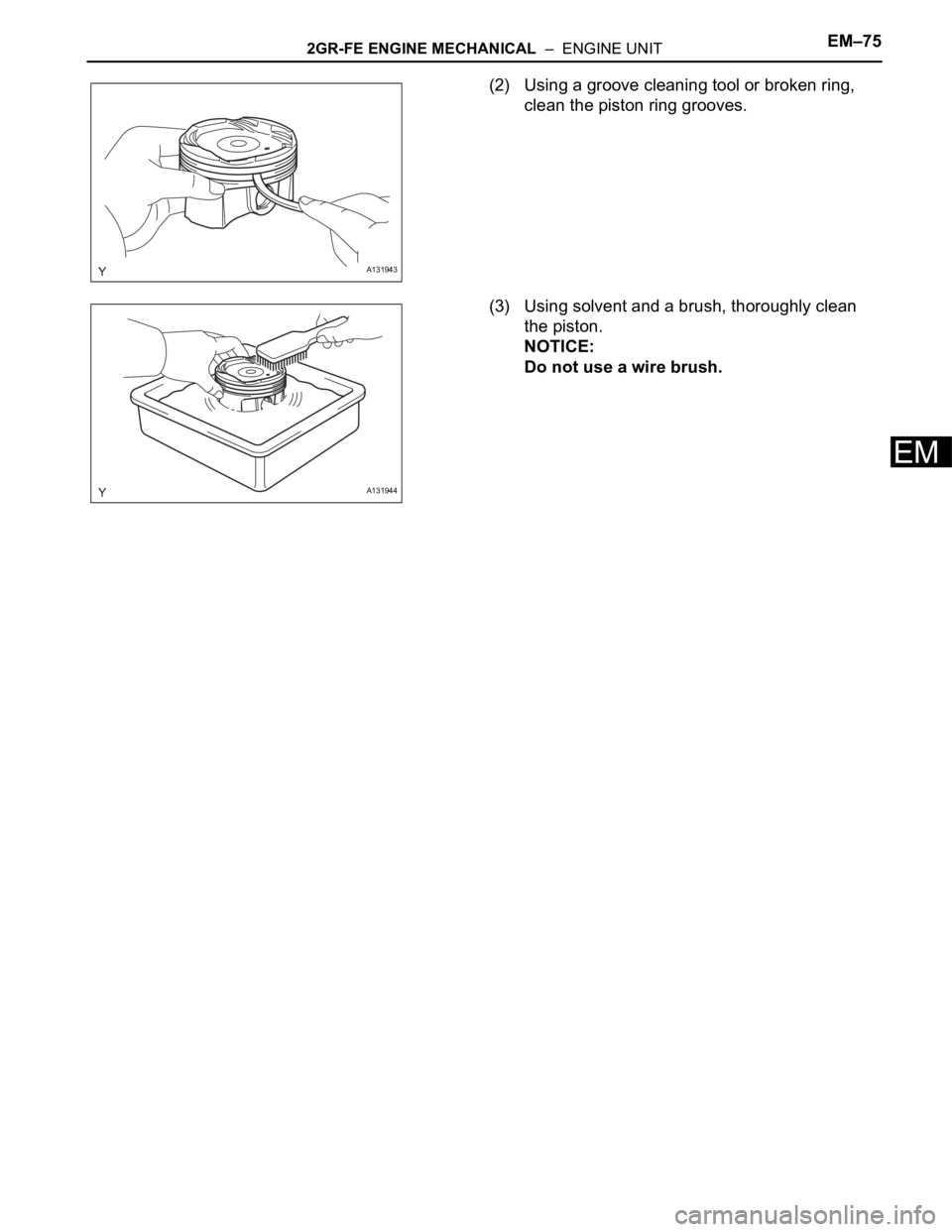
(2) Using a groove cleaning tool or broken ring,
clean the piston ring grooves.
(3) Using solvent and a brush, thoroughly clean
the piston.
NOTICE:
Do not use a wire brush.
A131943
A131944
Page 713 of 2000
EM–762GR-FE ENGINE MECHANICAL – ENGINE UNIT
EM
INSPECTION
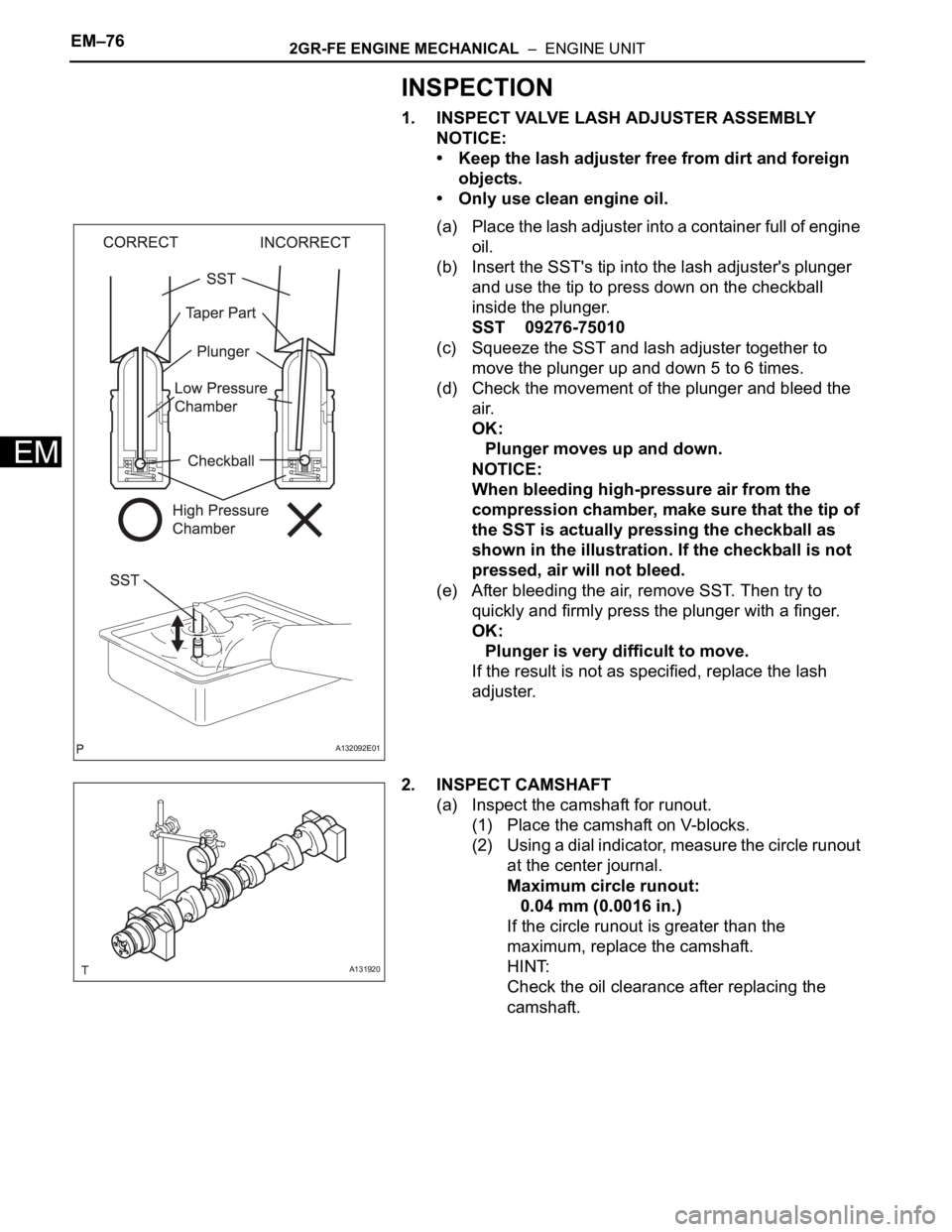
1. INSPECT VALVE LASH ADJUSTER ASSEMBLY
NOTICE:
• Keep the lash adjuster free from dirt and foreign
objects.
• Only use clean engine oil.
(a) Place the lash adjuster into a container full of engine
oil.
(b) Insert the SST's tip into the lash adjuster's plunger
and use the tip to press down on the checkball
inside the plunger.
SST 09276-75010
(c) Squeeze the SST and lash adjuster together to
move the plunger up and down 5 to 6 times.
(d) Check the movement of the plunger and bleed the
air.
OK:
Plunger moves up and down.
NOTICE:
When bleeding high-pressure air from the
compression chamber, make sure that the tip of
the SST is actually pressing the checkball as
shown in the illustration. If the checkball is not
pressed, air will not bleed.
(e) After bleeding the air, remove SST. Then try to
quickly and firmly press the plunger with a finger.
OK:
Plunger is very difficult to move.
If the result is not as specified, replace the lash
adjuster.
2. INSPECT CAMSHAFT
(a) Inspect the camshaft for runout.
(1) Place the camshaft on V-blocks.
(2) Using a dial indicator, measure the circle runout
at the center journal.
Maximum circle runout:
0.04 mm (0.0016 in.)
If the circle runout is greater than the
maximum, replace the camshaft.
HINT:
Check the oil clearance after replacing the
camshaft.
A132092E01
A131920
Page 714 of 2000
2GR-FE ENGINE MECHANICAL – ENGINE UNITEM–77
EM
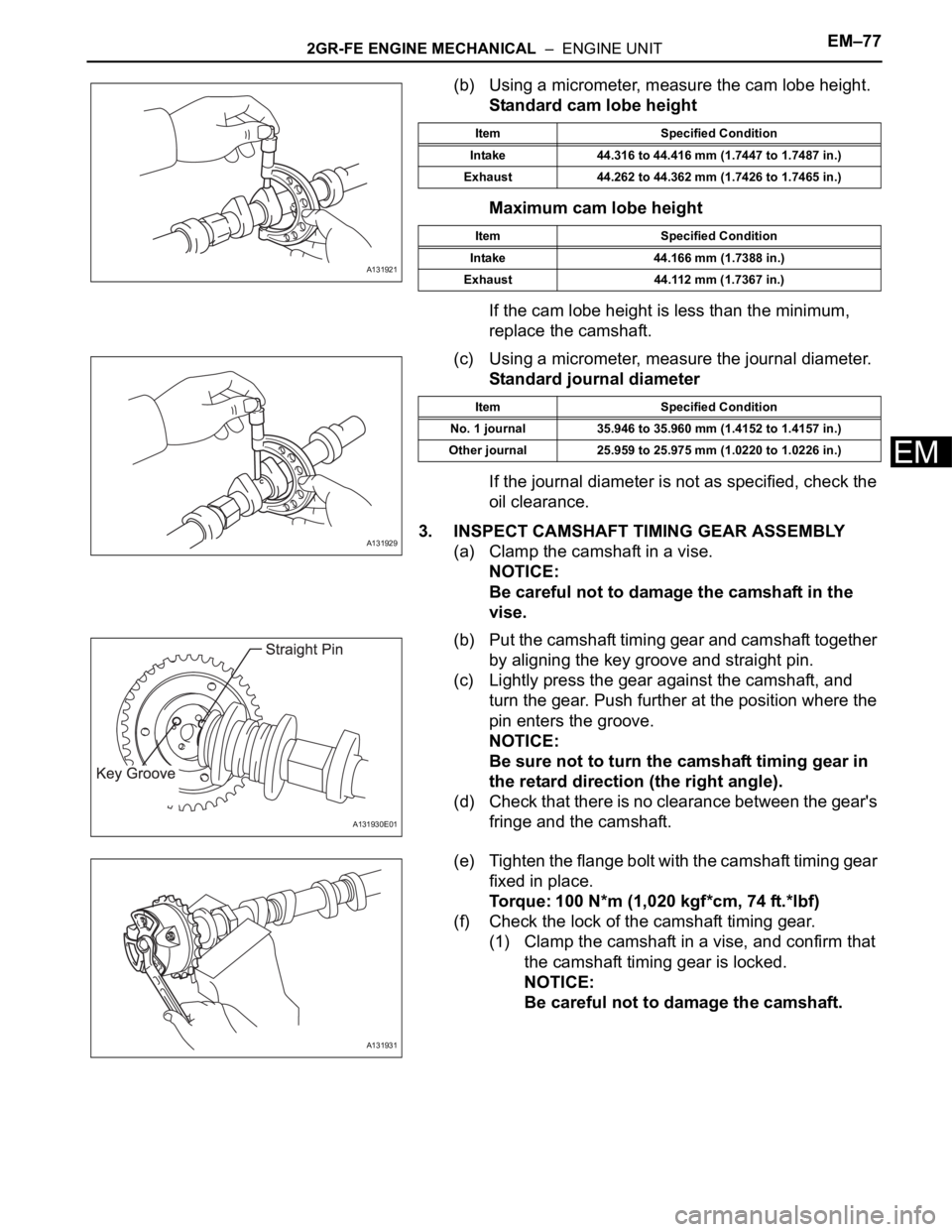
(b) Using a micrometer, measure the cam lobe height.
Standard cam lobe height
Maximum cam lobe height
If the cam lobe height is less than the minimum,
replace the camshaft.
(c) Using a micrometer, measure the journal diameter.
Standard journal diameter
If the journal diameter is not as specified, check the
oil clearance.
3. INSPECT CAMSHAFT TIMING GEAR ASSEMBLY
(a) Clamp the camshaft in a vise.
NOTICE:
Be careful not to damage the camshaft in the
vise.
(b) Put the camshaft timing gear and camshaft together
by aligning the key groove and straight pin.
(c) Lightly press the gear against the camshaft, and
turn the gear. Push further at the position where the
pin enters the groove.
NOTICE:
Be sure not to turn the camshaft timing gear in
the retard direction (the right angle).
(d) Check that there is no clearance between the gear's
fringe and the camshaft.
(e) Tighten the flange bolt with the camshaft timing gear
fixed in place.
Torque: 100 N*m (1,020 kgf*cm, 74 ft.*lbf)
(f) Check the lock of the camshaft timing gear.
(1) Clamp the camshaft in a vise, and confirm that
the camshaft timing gear is locked.
NOTICE:
Be careful not to damage the camshaft.
A131921
Item Specified Condition
Intake 44.316 to 44.416 mm (1.7447 to 1.7487 in.)
Exhaust 44.262 to 44.362 mm (1.7426 to 1.7465 in.)
Item Specified Condition
Intake 44.166 mm (1.7388 in.)
Exhaust 44.112 mm (1.7367 in.)
A131929
Item Specified Condition
No. 1 journal 35.946 to 35.960 mm (1.4152 to 1.4157 in.)
Other journal 25.959 to 25.975 mm (1.0220 to 1.0226 in.)
A131930E01
A131931
Page 715 of 2000
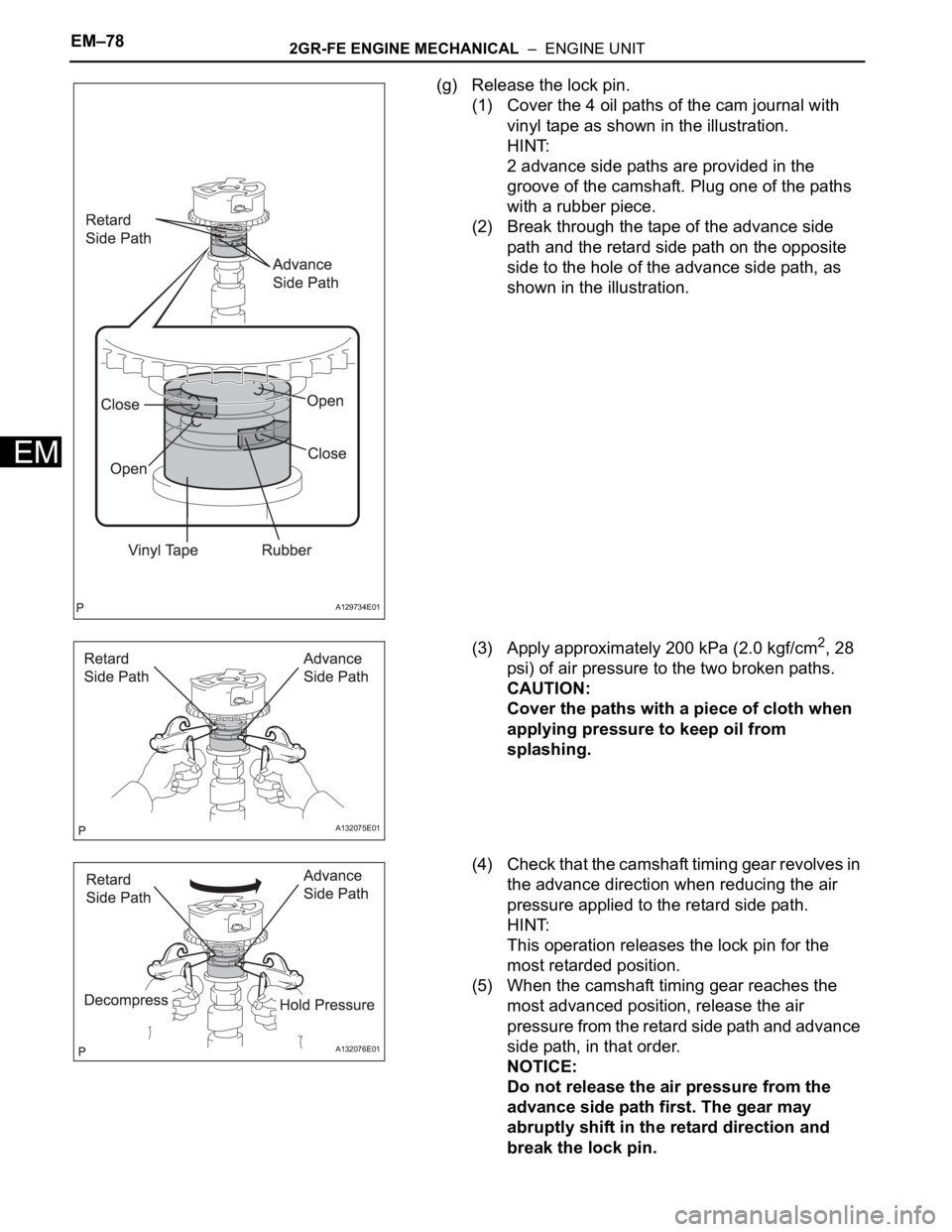
EM–782GR-FE ENGINE MECHANICAL – ENGINE UNIT
EM
(g) Release the lock pin.
(1) Cover the 4 oil paths of the cam journal with
vinyl tape as shown in the illustration.
HINT:
2 advance side paths are provided in the
groove of the camshaft. Plug one of the paths
with a rubber piece.
(2) Break through the tape of the advance side
path and the retard side path on the opposite
side to the hole of the advance side path, as
shown in the illustration.
(3) Apply approximately 200 kPa (2.0 kgf/cm
2, 28
psi) of air pressure to the two broken paths.
CAUTION:
Cover the paths with a piece of cloth when
applying pressure to keep oil from
splashing.
(4) Check that the camshaft timing gear revolves in
the advance direction when reducing the air
pressure applied to the retard side path.
HINT:
This operation releases the lock pin for the
most retarded position.
(5) When the camshaft timing gear reaches the
most advanced position, release the air
pressure from the retard side path and advance
side path, in that order.
NOTICE:
Do not release the air pressure from the
advance side path first. The gear may
abruptly shift in the retard direction and
break the lock pin.
A129734E01
A132075E01
A132076E01