parking brake TOYOTA RAV4 2006 Service Service Manual
[x] Cancel search | Manufacturer: TOYOTA, Model Year: 2006, Model line: RAV4, Model: TOYOTA RAV4 2006Pages: 2000, PDF Size: 45.84 MB
Page 1549 of 2000
BC–46BRAKE CONTROL – VEHICLE STABILITY CONTROL SYSTEM
BC
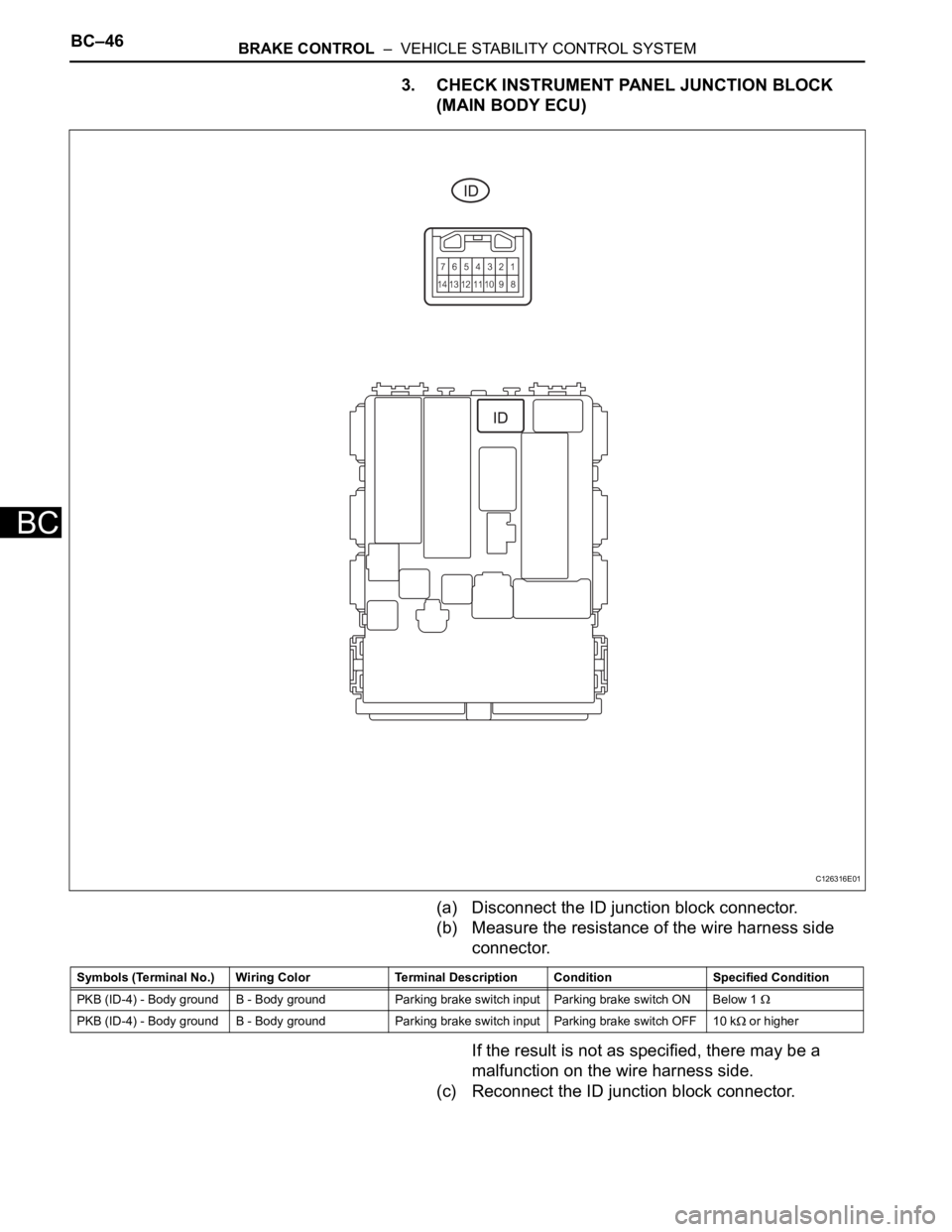
3. CHECK INSTRUMENT PANEL JUNCTION BLOCK
(MAIN BODY ECU)
(a) Disconnect the ID junction block connector.
(b) Measure the resistance of the wire harness side
connector.
If the result is not as specified, there may be a
malfunction on the wire harness side.
(c) Reconnect the ID junction block connector.
C126316E01
Symbols (Terminal No.) Wiring Color Terminal Description ConditionSpecified Condition
PKB (ID-4) - Body ground B - Body ground Parking brake switch input Parking brake switch ON Below 1
PKB (ID-4) - Body ground B - Body ground Parking brake switch input Parking brake switch OFF 10 k or higher
Page 1550 of 2000

BRAKE CONTROL – VEHICLE STABILITY CONTROL SYSTEMBC–47
BC
(d) Measure the voltage of the wire harness side
connector.
If the result is not as specified, the junction block
(ECU) may be a malfunction.
Symbols (Terminal No.) Wiring Color Terminal Description ConditionSpecified Condition
PKB (ID-4) - Body ground B - Body ground Parking brake switch input Parking brake switch ON Below 1 V
PKB (ID-4) - Body ground B - Body ground Parking brake switch input Parking brake switch OFF 10 to 14 V
Page 1552 of 2000
BRAKE CONTROL – VEHICLE STABILITY CONTROL SYSTEMBC–49
BC
• *4: w/ 16-inch disc
• The DTCs can be read by connecting SST (09843-
18040) between the TC and CG terminals of the
DLC3 and observing the blinking pattern of the ABS
and VSC warning lights, or by using an intelligent
tester (see page BC-47).
• This system has a sensor signal check function (see
page BC-28).
2. CHECK WARNING LIGHT AND INDICATOR LIGHT
(a) Release the parking brake lever.
NOTICE:
Before releasing the parking brake lever, set
chocks to hold the vehicle for safety.
HINT:
When the parking brake is applied or the brake fluid
level is low, the brake warning light comes on.
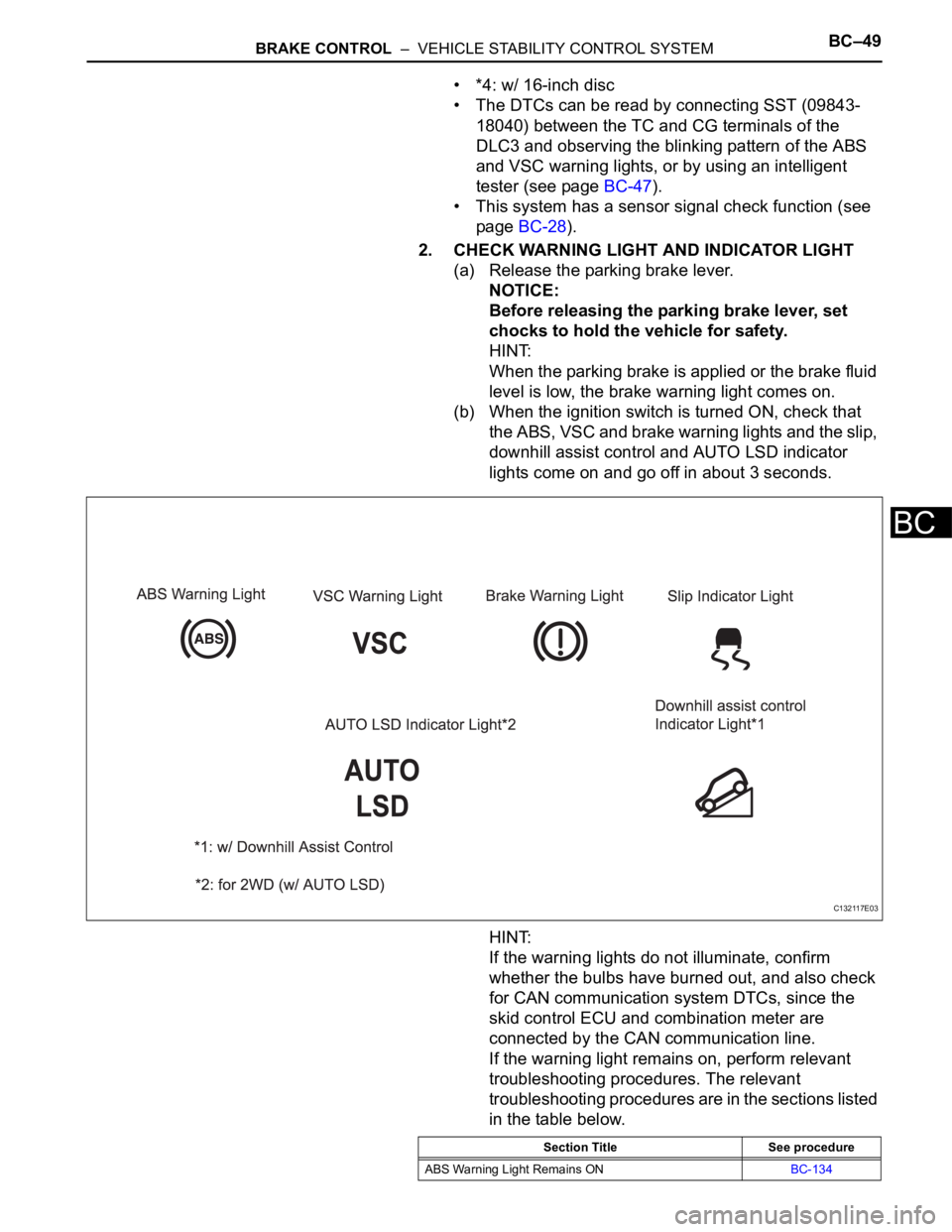
(b) When the ignition switch is turned ON, check that
the ABS, VSC and brake warning lights and the slip,
downhill assist control and AUTO LSD indicator
lights come on and go off in about 3 seconds.
HINT:
If the warning lights do not illuminate, confirm
whether the bulbs have burned out, and also check
for CAN communication system DTCs, since the
skid control ECU and combination meter are
connected by the CAN communication line.
If the warning light remains on, perform relevant
troubleshooting procedures. The relevant
troubleshooting procedures are in the sections listed
in the table below.
C132117E03
Section Title See procedure
ABS Warning Light Remains ONBC-134
Page 1556 of 2000
BRAKE CONTROL – VEHICLE STABILITY CONTROL SYSTEMBC–53
BC
FREEZE FRAME DATA
1. FREEZE FRAME DATA
HINT:
• Whenever a DTC is detected or the ABS operates,
the skid control ECU stores the current vehicle
(sensor) state as freeze frame data.
• The skid control ECU stores the number of times
(maximum: 31) the ignition switch has been turned
from OFF to ON since the last time the ABS was
activated. However, if the vehicle was stationary or
running at a low speed (7 km/h [4.3 mph] or less), or if
a DTC is detected, the skid control ECU stops
counting.
• Freeze frame data at the time the ABS operates:
The skid control ECU stores and updates the data
whenever the ABS system operates.
When the ECU stores data at the time a DTC is
detected, the data stored when the ABS operated is
erased.
• Freeze frame data at the time a DTC is detected:
When the skid control ECU stores data at the time a
DTC is detected, no updates will be performed until
the data is cleared.
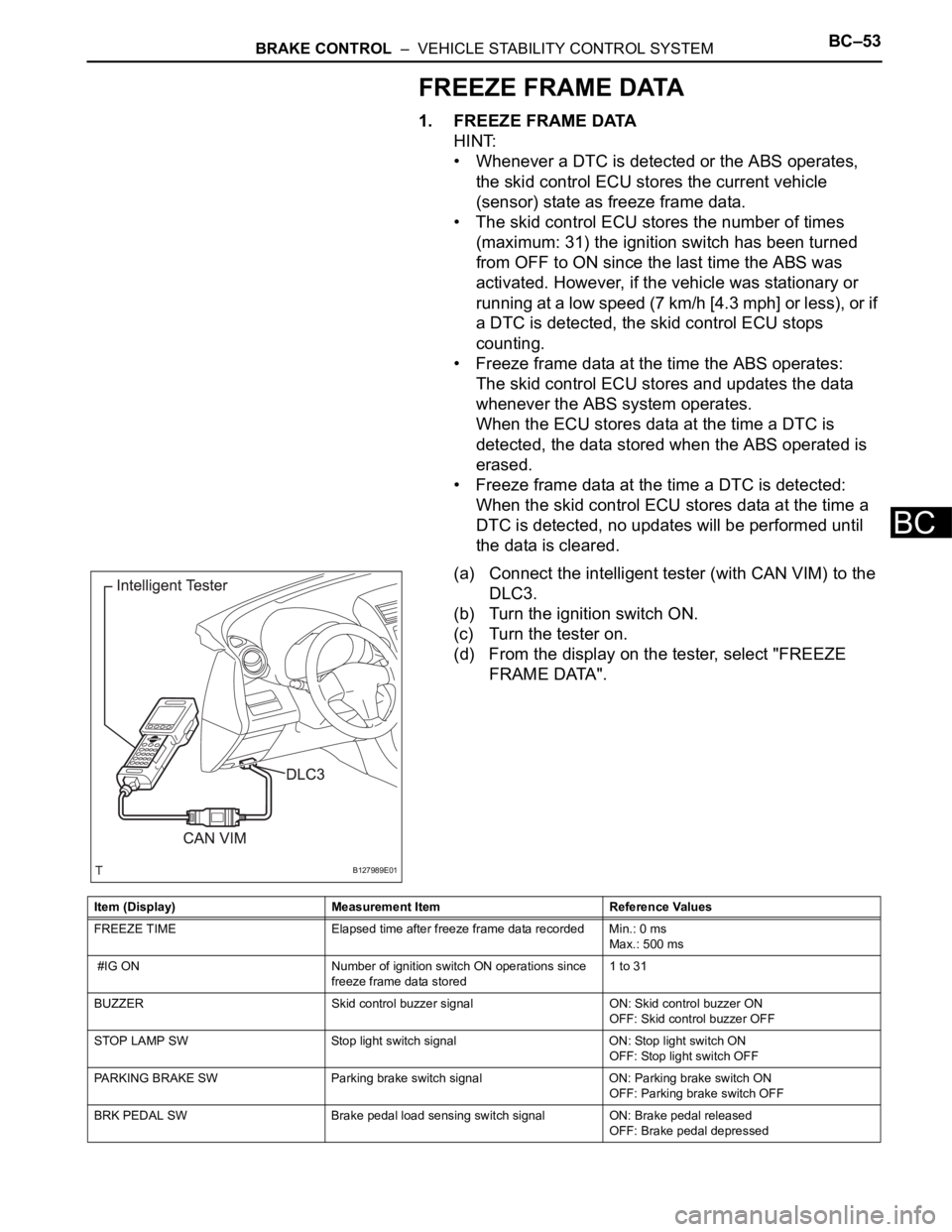
(a) Connect the intelligent tester (with CAN VIM) to the
DLC3.
(b) Turn the ignition switch ON.
(c) Turn the tester on.
(d) From the display on the tester, select "FREEZE
FRAME DATA".
B127989E01
Item (Display) Measurement Item Reference Values
FREEZE TIME Elapsed time after freeze frame data recorded Min.: 0 ms
Max.: 500 ms
#IG ON Number of ignition switch ON operations since
freeze frame data stored1 to 31
BUZZER Skid control buzzer signal ON: Skid control buzzer ON
OFF: Skid control buzzer OFF
STOP LAMP SW Stop light switch signal ON: Stop light switch ON
OFF: Stop light switch OFF
PARKING BRAKE SW Parking brake switch signal ON: Parking brake switch ON
OFF: Parking brake switch OFF
BRK PEDAL SW Brake pedal load sensing switch signal ON: Brake pedal released
OFF: Brake pedal depressed
Page 1559 of 2000

BC–56BRAKE CONTROL – VEHICLE STABILITY CONTROL SYSTEM
BC
DATA LIST / ACTIVE TEST
1. READ DATA LIST
HINT:
Using the intelligent tester's DATA LIST allows switch,
sensor, actuator and other item values to be read without
out removing any parts. Reading the DATA LIST early in
troubleshooting is one way to save time.
(a) Connect the intelligent tester (with CAN VIM) to the
DLC3.
(b) Turn the ignition switch ON.
(c) Turn the intelligent tester on.
(d) Read the DATA LIST according to the display on the
tester.
Skid control ECU
Tester Display Measurement Item/Range Normal Condition Diagnostic Note
ABS WARN LAMP ABS warning light / ON or OFF ON: ABS warning light ON
OFF: ABS warning light OFF-
VSC WARN LAMP VSC warning light / ON or OFF ON: VSC warning light ON
OFF: VSC warning light OFF-
BRAKE WARN LAMP Brake warning light / ON or OFF ON: Brake warning light ON
OFF: Brake warning light OFF-
SLIP INDI LAMP Slip indicator light / ON or OFF ON: Slip indicator light ON
OFF: Slip indicator light OFF-
D-HILL LIGHT*9 Downhill assist control indicator
light / ON or OFFON: Downhill assist control switch
ON
OFF: Downhill assist control
switch OFF-
AUTO LSD LAMP*10 AUTO LSD indicator light / ON or
OFFON: Traction control switch ON
OFF: Traction control switch OFF-
BUZZER Skid control buzzer / ON or OFF ON: Buzzer ON
OFF: Buzzer OFF-
STOP LAMP SW Stop light switch / ON or OFF ON: Brake pedal depressed
OFF: Brake pedal released-
PARKING BRAKE SW Parking brake switch / ON or OFF ON: Parking brake applied
OFF: Parking brake released-
BRK PEDAL SW Brake pedal load sensing switch /
ON or OFFON: Brake pedal depressed
beyond the specified point
OFF: Brake pedal not depressed
beyond the specified point-
IDLE SW Main idle switch / ON or OFF ON: Accelerator pedal released
OFF: Accelerator pedal
depressed-
DAC SW*9 Downhill assist control switch /
ON or OFFON: Downhill assist control switch
ON
ON: Downhill assist control switch
ON-
AUTO LSD SW*10 AUTO LSD switch / ON or OFF ON: AUTO LSD switch ON
ON: AUTO LSD switch ON-
GEAR POSITION Gear position information / P/N,
R, 1st-6th, FAIL, NOT R--
LEVER POSITION Shift lever position information / P/
N, R, D/M, 1st-6th/B, FAIL--
SHIFT INFO Shift information / ON or OFF ON: During gear change -
MAS CYL PRESS 1 Master cylinder pressure sensor 1
reading / min.: 0 V, max.: 5 VWhen brake pedal released: 0.3
to 0.9 VReading increases when brake
pedal depressed
ZERO M/C SEN Memorized zero point value of
master cylinder pressure sensor /
min.: -12.5 MPa, max.: 12.4 MPaMin.: -12.5 MPa
Max.: 12.4 MPa-
Page 1565 of 2000
BRAKE – BRAKE SYSTEMBR–5
BR
PROBLEM SYMPTOMS TABLE
(2006/01- )
HINT:
Use the table below to help determine the cause of the
problem symptom. The potential causes of the symptoms are
listed in order of probability in the "Suspected Area" column
of the table. Check each symptom by checking the suspected
areas in the order they are listed. Replace parts as
necessary.
Brake system
Symptom Suspected Area See page
Low pedal or spongy pedal1. Fluid leaks in brake system -
2. Air in brake systemBR-6
3. Front brake piston seals (worn or damaged)BR-40
4. Rear brake piston seals (worn or damaged)BR-55
5. Brake master cylinder (faulty)BR-22
6. Booster push rod (adjustment necessary)BR-24
Brake drag1. Brake pedal free play (minimum)BR-15
2. Parking brake lever travel (adjustment necessary)PB-1
3. Parking brake cable (sticking)PB-8
4. Parking brake shoe clearance (adjustment necessary)PB-17
5. Front brake pad (cracked or distorted)BR-40
6. Rear brake pad (cracked or distorted)BR-55
7. Parking brake lining (cracked or distorted)PB-13
8. Front brake piston (stuck or frozen)BR-40
9. Rear brake piston (stuck or frozen)BR-55
10. Parking brake shoe return tension springPB-13
11. Booster push rod (adjustment necessary)BR-24
12. Vacuum leaks in booster systemBR-29
13. Brake master cylinder (faulty)BR-22
Brake pull1. Front brake piston (stuck or frozen)BR-40
2. Rear brake piston (stuck or frozen)BR-55
3. Front brake pad (oily, cracked or distorted)BR-40
4. Rear brake pad (oily, cracked or distorted)BR-55
5. Parking brake lining (oily, cracked or distorted)PB-13
6. Front brake disc (uneven wear)BR-40
7. Rear brake disc (uneven wear)BR-55
Hard pedal but braking inefficient1. Front brake pad (worn, cracked, distorted, oily or glazed)BR-40
2. Rear brake pad (worn, cracked, distorted, oily or glazed)BR-55
3. Parking brake lining (worn, cracked, distorted, oily or
glazed)PB-13
4. Front brake disc (uneven wear)BR-40
5. Rear brake disc (uneven wear)BR-55
6. Booster push rod (adjustment necessary)BR-24
7. Vacuum leaks in booster systemBR-29
Page 1566 of 2000
BR–6BRAKE – BRAKE SYSTEM
BR
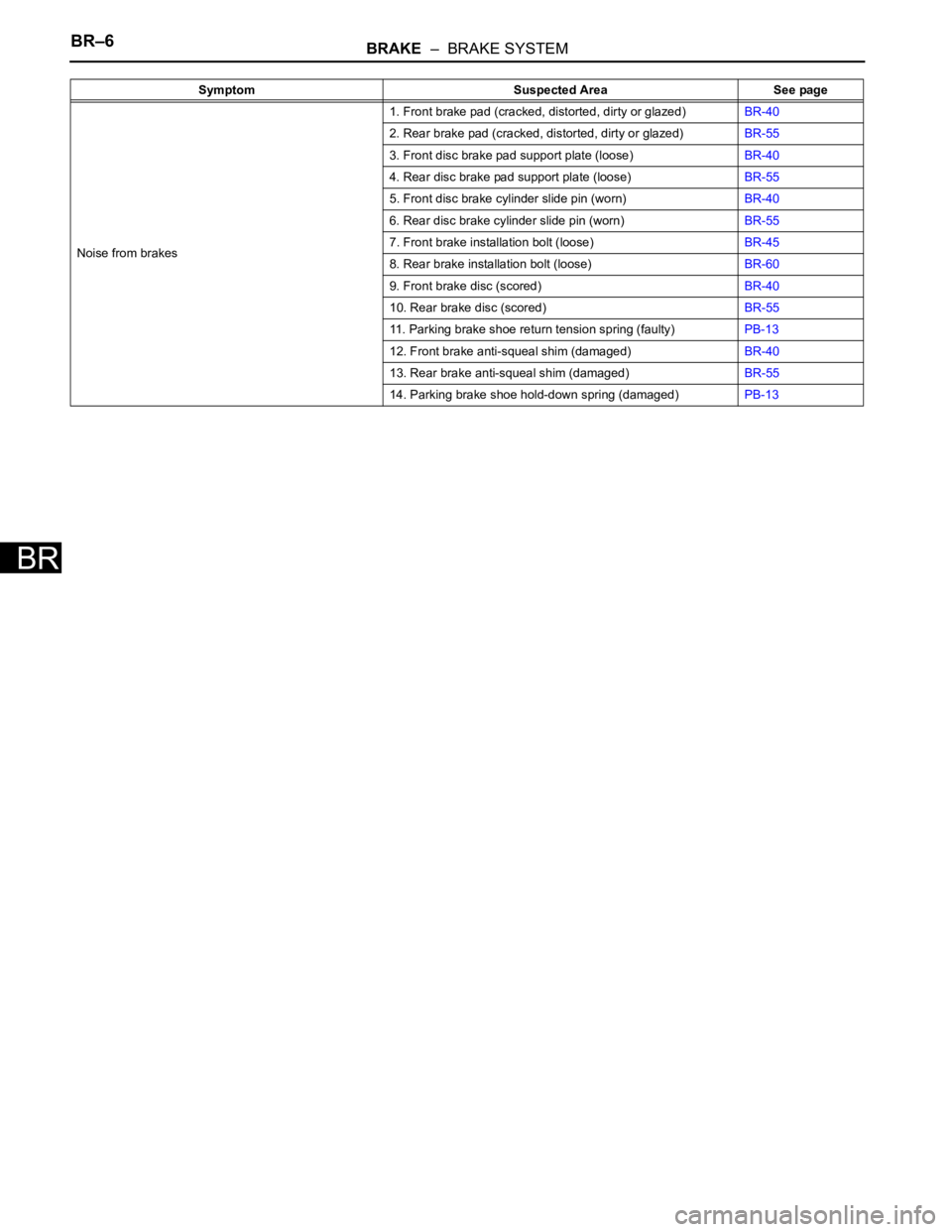
Noise from brakes1. Front brake pad (cracked, distorted, dirty or glazed)BR-40
2. Rear brake pad (cracked, distorted, dirty or glazed)BR-55
3. Front disc brake pad support plate (loose)BR-40
4. Rear disc brake pad support plate (loose)BR-55
5. Front disc brake cylinder slide pin (worn)BR-40
6. Rear disc brake cylinder slide pin (worn)BR-55
7. Front brake installation bolt (loose)BR-45
8. Rear brake installation bolt (loose)BR-60
9. Front brake disc (scored)BR-40
10. Rear brake disc (scored)BR-55
11. Parking brake shoe return tension spring (faulty)PB-13
12. Front brake anti-squeal shim (damaged)BR-40
13. Rear brake anti-squeal shim (damaged)BR-55
14. Parking brake shoe hold-down spring (damaged)PB-13 Symptom Suspected Area See page
Page 1570 of 2000
BRAKE – BRAKE PEDALBR–15
BR
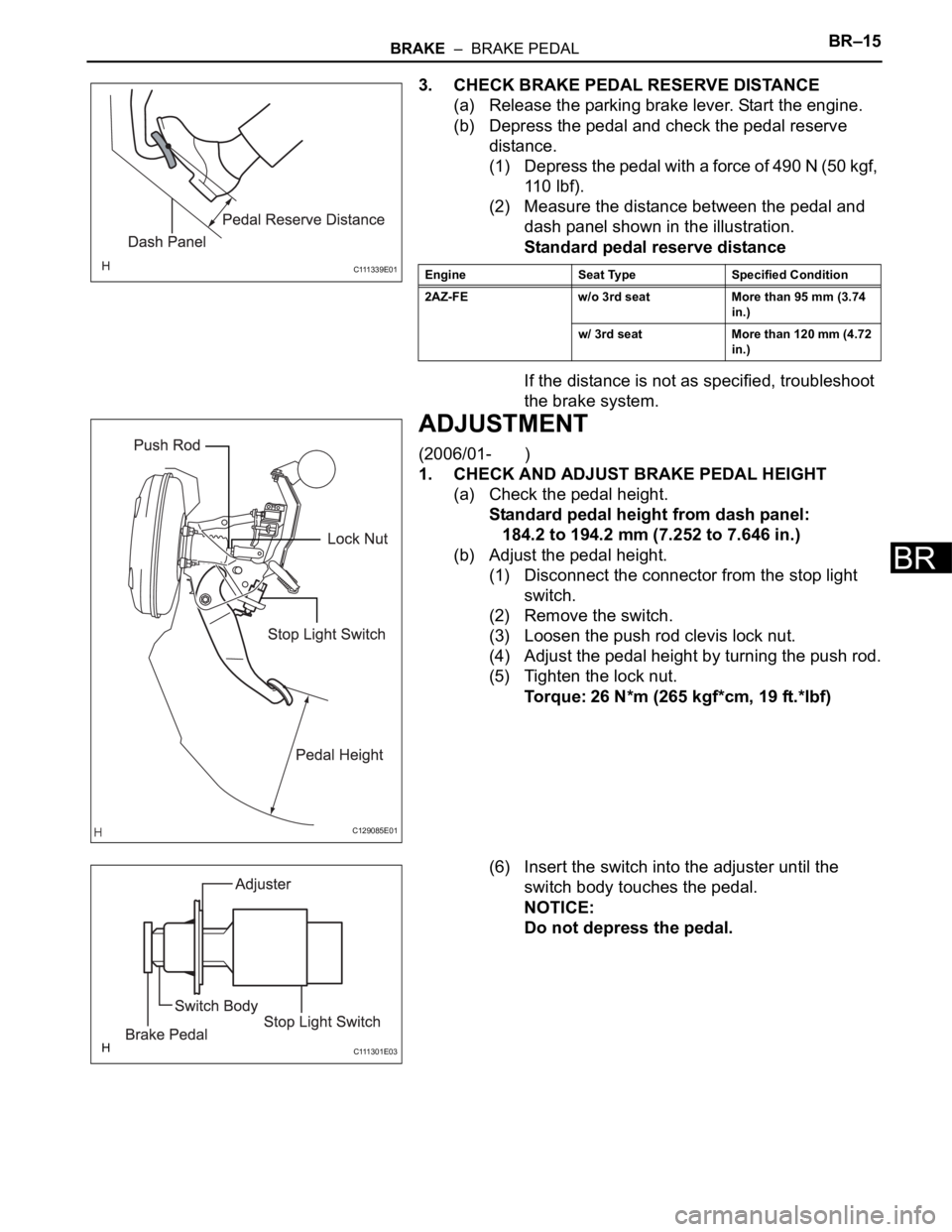
3. CHECK BRAKE PEDAL RESERVE DISTANCE
(a) Release the parking brake lever. Start the engine.
(b) Depress the pedal and check the pedal reserve
distance.
(1) Depress the pedal with a force of 490 N (50 kgf,
11 0 l b f ) .
(2) Measure the distance between the pedal and
dash panel shown in the illustration.
Standard pedal reserve distance
If the distance is not as specified, troubleshoot
the brake system.
ADJUSTMENT
(2006/01- )
1. CHECK AND ADJUST BRAKE PEDAL HEIGHT
(a) Check the pedal height.
Standard pedal height from dash panel:
184.2 to 194.2 mm (7.252 to 7.646 in.)
(b) Adjust the pedal height.
(1) Disconnect the connector from the stop light
switch.
(2) Remove the switch.
(3) Loosen the push rod clevis lock nut.
(4) Adjust the pedal height by turning the push rod.
(5) Tighten the lock nut.
Torque: 26 N*m (265 kgf*cm, 19 ft.*lbf)
(6) Insert the switch into the adjuster until the
switch body touches the pedal.
NOTICE:
Do not depress the pedal.
C 111 3 3 9 E 0 1Engine Seat Type Specified Condition
2AZ-FE w/o 3rd seat More than 95 mm (3.74
in.)
w/ 3rd seat More than 120 mm (4.72
in.)
C129085E01
C 111 3 0 1 E 0 3
Page 1571 of 2000
BR–16BRAKE – BRAKE PEDAL
BR
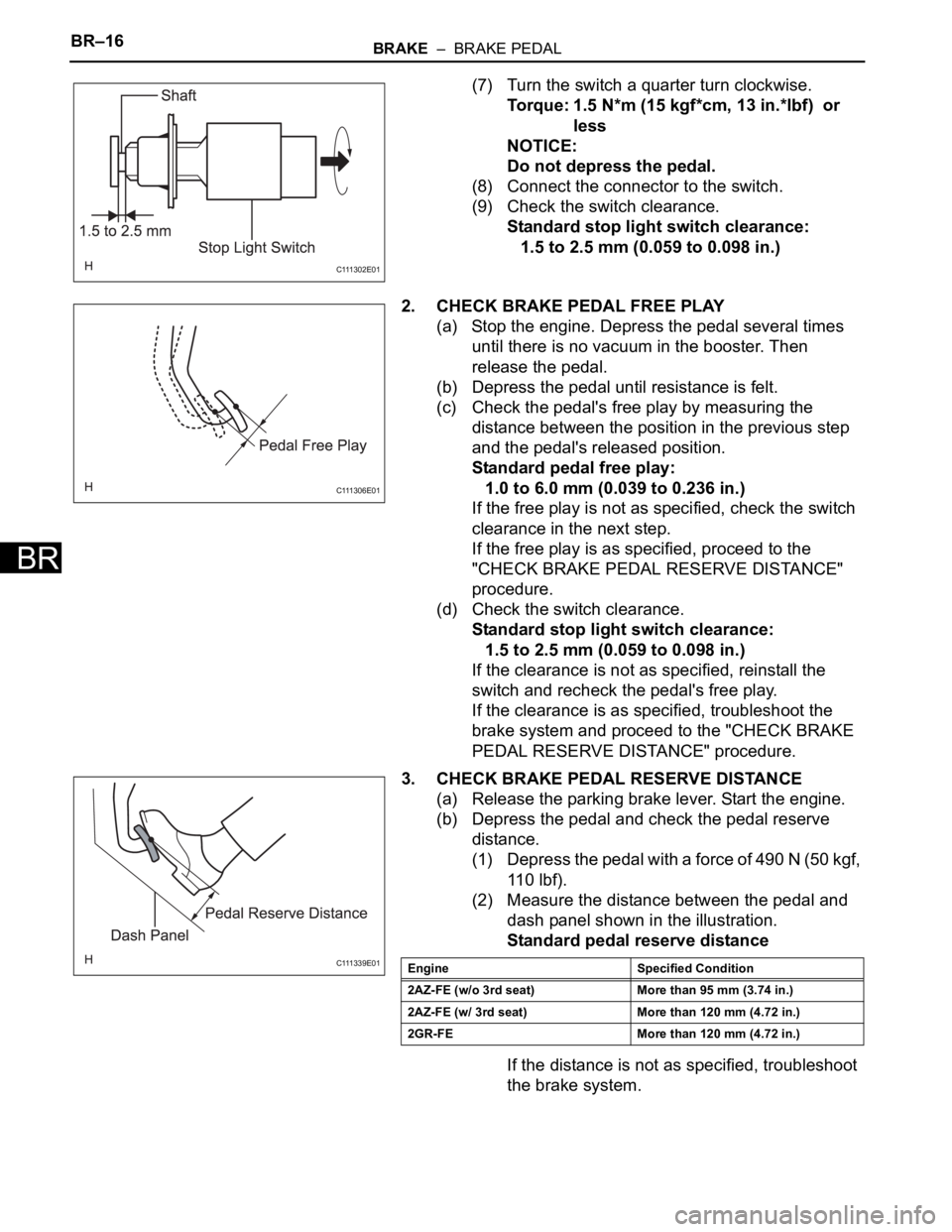
(7) Turn the switch a quarter turn clockwise.
Torque: 1.5 N*m (15 kgf*cm, 13 in.*lbf) or
less
NOTICE:
Do not depress the pedal.
(8) Connect the connector to the switch.
(9) Check the switch clearance.
Standard stop light switch clearance:
1.5 to 2.5 mm (0.059 to 0.098 in.)
2. CHECK BRAKE PEDAL FREE PLAY
(a) Stop the engine. Depress the pedal several times
until there is no vacuum in the booster. Then
release the pedal.
(b) Depress the pedal until resistance is felt.
(c) Check the pedal's free play by measuring the
distance between the position in the previous step
and the pedal's released position.
Standard pedal free play:
1.0 to 6.0 mm (0.039 to 0.236 in.)
If the free play is not as specified, check the switch
clearance in the next step.
If the free play is as specified, proceed to the
"CHECK BRAKE PEDAL RESERVE DISTANCE"
procedure.
(d) Check the switch clearance.
Standard stop light switch clearance:
1.5 to 2.5 mm (0.059 to 0.098 in.)
If the clearance is not as specified, reinstall the
switch and recheck the pedal's free play.
If the clearance is as specified, troubleshoot the
brake system and proceed to the "CHECK BRAKE
PEDAL RESERVE DISTANCE" procedure.
3. CHECK BRAKE PEDAL RESERVE DISTANCE
(a) Release the parking brake lever. Start the engine.
(b) Depress the pedal and check the pedal reserve
distance.
(1) Depress the pedal with a force of 490 N (50 kgf,
11 0 l b f ) .
(2) Measure the distance between the pedal and
dash panel shown in the illustration.
Standard pedal reserve distance
If the distance is not as specified, troubleshoot
the brake system.
C 111 3 0 2 E 0 1
C 111 3 0 6 E 0 1
C 111 3 3 9 E 0 1Engine Specified Condition
2AZ-FE (w/o 3rd seat) More than 95 mm (3.74 in.)
2AZ-FE (w/ 3rd seat) More than 120 mm (4.72 in.)
2GR-FE More than 120 mm (4.72 in.)
Page 1590 of 2000
PB–10PARKING BRAKE – PARKING BRAKE CABLE
PB
INSTALLATION
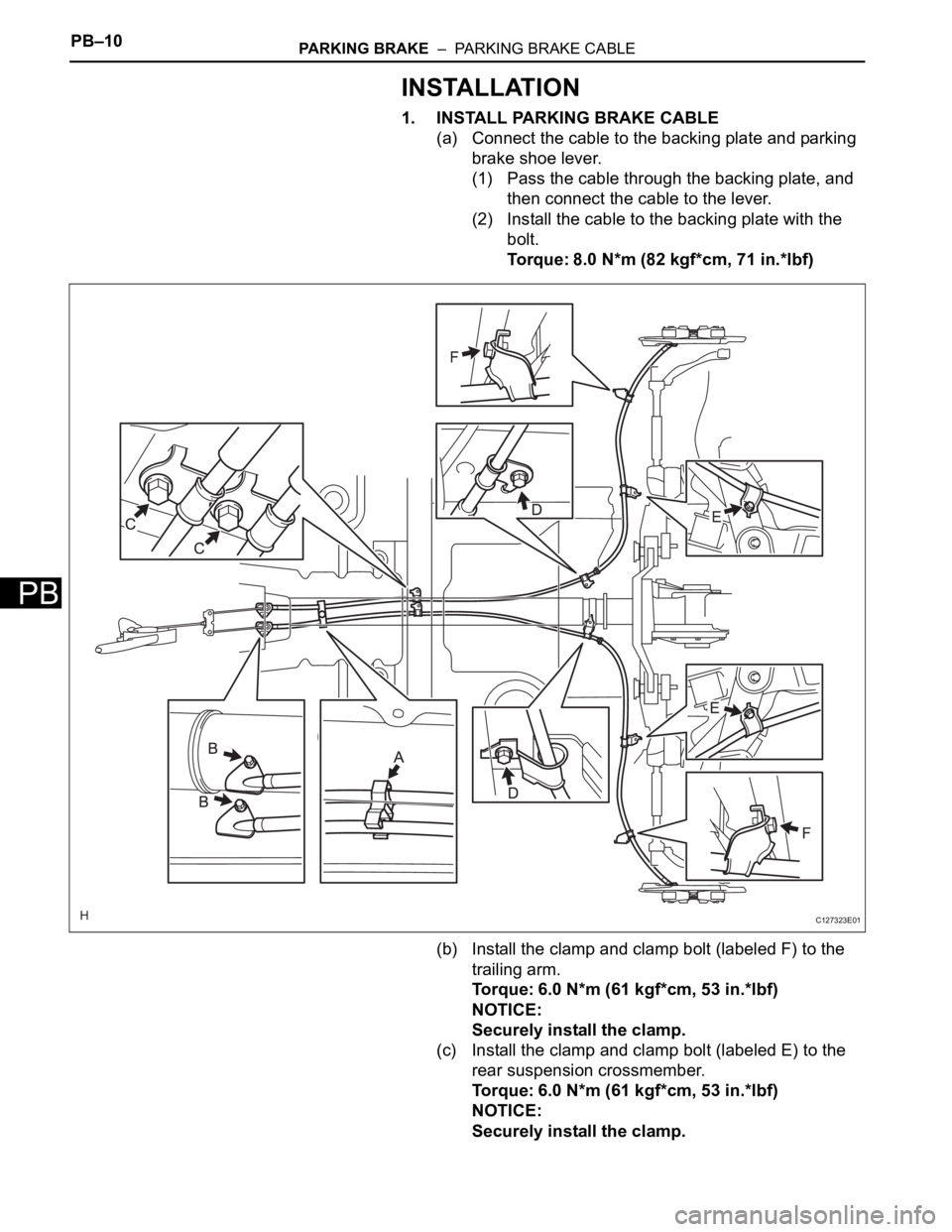
1. INSTALL PARKING BRAKE CABLE
(a) Connect the cable to the backing plate and parking
brake shoe lever.
(1) Pass the cable through the backing plate, and
then connect the cable to the lever.
(2) Install the cable to the backing plate with the
bolt.
Torque: 8.0 N*m (82 kgf*cm, 71 in.*lbf)
(b) Install the clamp and clamp bolt (labeled F) to the
trailing arm.
Torque: 6.0 N*m (61 kgf*cm, 53 in.*lbf)
NOTICE:
Securely install the clamp.
(c) Install the clamp and clamp bolt (labeled E) to the
rear suspension crossmember.
Torque: 6.0 N*m (61 kgf*cm, 53 in.*lbf)
NOTICE:
Securely install the clamp.
C127323E01