ECO mode TOYOTA RAV4 PLUG-IN HYBRID 2021 Workshop Manual
[x] Cancel search | Manufacturer: TOYOTA, Model Year: 2021, Model line: RAV4 PLUG-IN HYBRID, Model: TOYOTA RAV4 PLUG-IN HYBRID 2021Pages: 666, PDF Size: 161.28 MB
Page 456 of 666
4546-1. Using the air conditioning system and defogger
switch to outside air mode if the recircu -
lated air mode is us ed. (It may switch
automatically.)
To defog the winds hield and the side
windows quickly, turn the air flow and
temperature up.
To return to the p revious mode, press
the windshield defogger switch again
when the windshi eld is defogged.
When the windshield defogger switch is
on, the indicator illuminates on the
windshield defogger switch.
■Defogging the rear window
and outside rear view mirrors
Defoggers are us ed to defog the
rear window, and to remove rain -
drops, dew and frost from the out -
side rear view mirrors.
Press the rear window defogger
and outside rear view mirror defog -
gers switch.
The defoggers will automatically turn off
after 15 minutes.
When the rear window defogger and
outside rear view mirror defoggers
switch is on, the indicator illuminates on
the rear window defogger and outside
rear view mirror defoggers switch.
■Blower customization
The fan speed can be adjusted
according to your preference.
1 Press the automatic mode or
airflow mode control switch.
2 Press the blower customization
switch.
3 Each time the blower customi-
zation switch is pressed, the fan
speed changes as follows.
Normal → “ECO” → “FAST”
■Heating
●In HV mode, the gasoline engine may
operate in order to extract heat from the engine coolant via the heater.
●In EV mode, heating is done by a heat pump system.
• When the outside t emperature is low
or it is snowing, compared to conven - tional vehicles, heating may be less
effective and warm air may not come
out. • When the outside heat exchanger is
frosted over, fan speed declines and it
may become harder to heat the inte- rior. However, it is not a malfunction.
In this situat ion, the air temperature
from the outlets may not change even though the set tem perature is raised.
• If frost has formed of the outside heat
exchanger, the heating performance will decline. The frost can be removed
from the outside heat exchanger by
operating the Remote Air Conditioning System before driving ( →P.460).
When frosted over, the heating opera -
tion of the Remote Air Conditioning System starts after defrosting.
• When “AUTO” switch is turned on, the
heating is controlle d optimally. There- fore, the set heating performance may
not be achieved even if the fan speed
setting is increased.
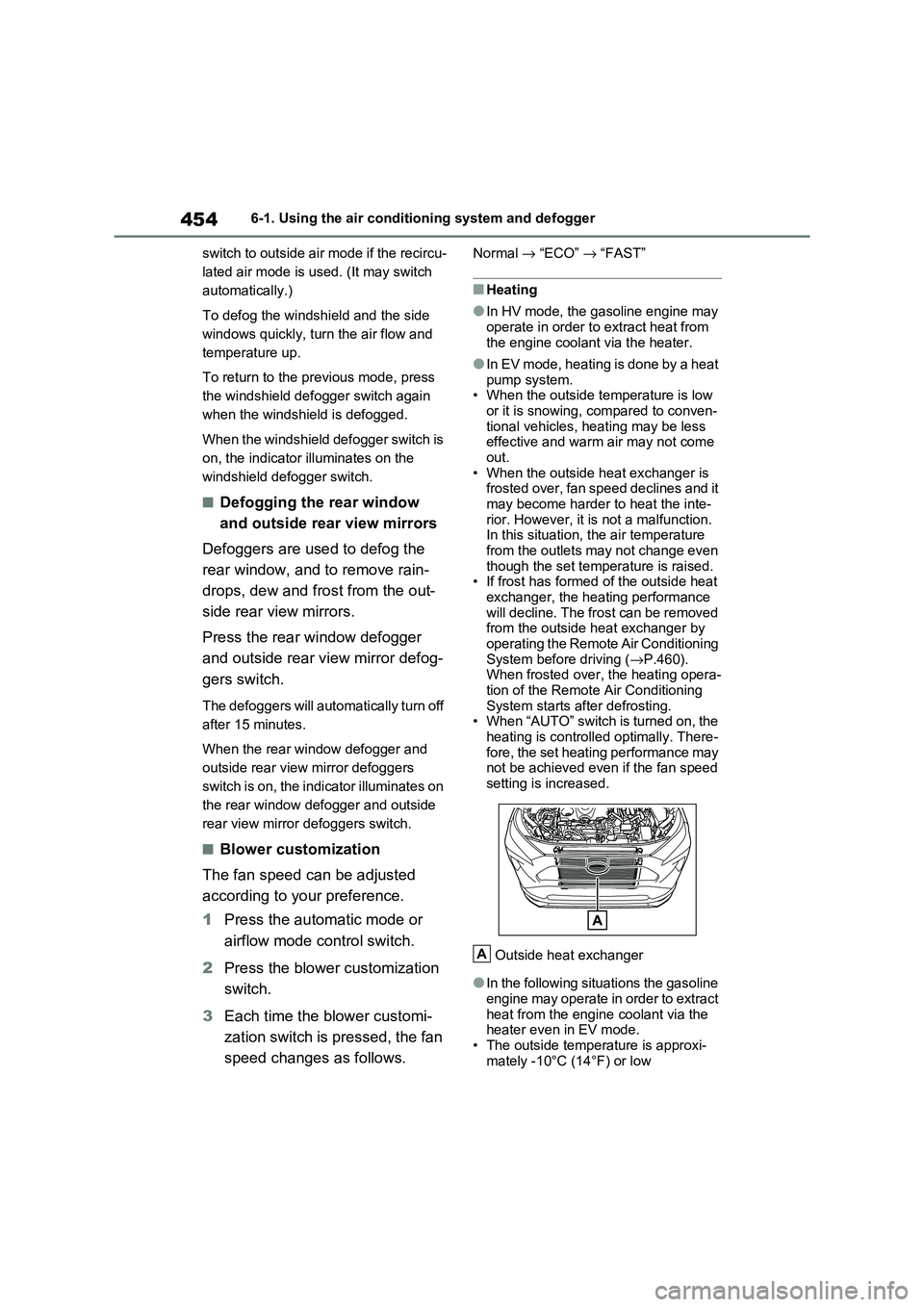
Outside heat exchanger
●In the following situations the gasoline
engine may operate in order to extract heat from the engine coolant via the
heater even in EV mode.
• The outside temperature is approxi -
mately -10°C (14°F) or low
A
Page 457 of 666
455
6
6-1. Using the air conditi oning system and defogger
Interior features
• is operating
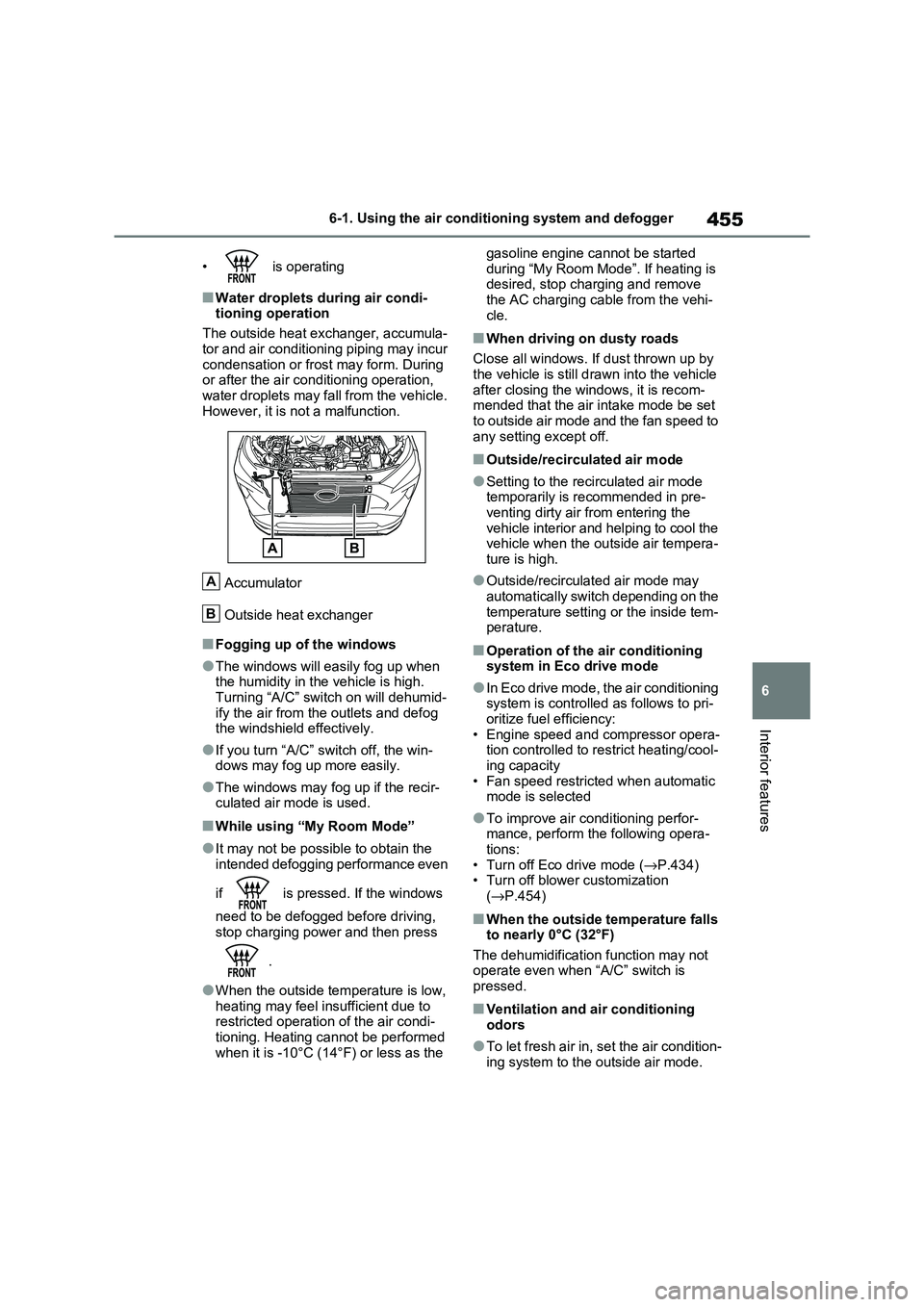
■Water droplets during air condi-
tioning operation
The outside heat exchanger, accumula -
tor and air conditioning piping may incur
condensation or frost may form. During or after the air conditioning operation,
water droplets may fall from the vehicle.
However, it is not a malfunction.
Accumulator
Outside heat exchanger
■Fogging up of the windows
●The windows will ea sily fog up when
the humidity in the vehicle is high.
Turning “A/C” s witch on will dehumid- ify the air from the outlets and defog
the windshield effectively.
●If you turn “A/C” switch off, the win -
dows may fog up more easily.
●The windows may fog up if the recir -
culated air mode is used.
■While using “My Room Mode”
●It may not be possible to obtain the
intended defogging performance even
if is pressed. If the windows
need to be defogged before driving,
stop charging powe r and then press
.
●When the outside te mperature is low,
heating may feel insufficient due to
restricted operation of the air condi -
tioning. Heating cannot be performed when it is -10°C (14° F) or less as the
gasoline engine cannot be started
during “My Room Mode”. If heating is desired, stop charging and remove
the AC charging cable from the vehi -
cle.
■When driving o n dusty roads
Close all windows. If dust thrown up by
the vehicle is still d rawn into the vehicle
after closing the windows, it is recom - mended that the air intake mode be set
to outside air mode and the fan speed to
any setting except off.
■Outside/recirculated air mode
●Setting to the recir culated air mode
temporarily is recommended in pre - venting dirty air from entering the
vehicle interior and helping to cool the
vehicle when the ou tside air tempera- ture is high.
●Outside/recirculated air mode may automatically switch depending on the
temperature setting or the inside tem-
perature.
■Operation of the air conditioning system in Eco drive mode
●In Eco drive mode, the air conditioning system is controlled as follows to pri -
oritize fuel efficiency:
• Engine speed and compressor opera - tion controlled to res trict heating/cool-
ing capacity
• Fan speed restrict ed when automatic mode is selected
●To improve air conditioning perfor - mance, perform the following opera -
tions:
• Turn off Eco drive mode ( →P.434) • Turn off blower customization
( →P.454)
■When the outside temperature falls
to nearly 0°C (32°F)
The dehumidification function may not operate even when “A/C” switch is
pressed.
■Ventilation and air conditioning
odors
●To let fresh air in, set the air condition -
ing system to the outside air mode.
A
B
Page 458 of 666
4566-1. Using the air conditioning system and defogger
●During use, various odors from inside
and outside the vehicle may enter into and accumulate in the air conditioning
system. This may t hen cause odor to
be emitted from the vents.
●To reduce potential odors from occur -
ring: • It is recommended that the air condi-
tioning system be se t to outside air
mode prior to turning the vehicle off. • The start timing o f the blower may be
delayed for a short period of time
immediately after t he air conditioning system is started in automatic mode.
●When parking, the system automati- cally switches to outside air mode to
encourage better air circulation
throughout the vehicle, helping to reduce odors that occur when starting
the vehicle.
■Air conditioning filter
→ P.532
■Noise from air conditioning system
Approximately 90 seconds after the
power switch turned to OFF, you may
hear sound coming from air conditioning system. This is the sound of a air condi -
tioning system initial ize and, it does not
indicate a malfunction.
■Customization
Settings (e.g. A/C Auto switch opera-
tion) can be changed.
(Customizable features: →P.640)
1Press the “AUTO” switch.
The dehumidification function begins to
operate. Air outlets and fan speed are automatically adjusted according to the
temperature setting and humidity.
2 Adjust the temperature setting.
3 To stop the operation, press the
“OFF” switch.
If the fan speed se tting or air flow
modes are operated, the automatic
mode indicator goes off. However,
automatic mode for functions other
than that operated is maintained.
■Using automatic mode
Fan speed is adjusted automatically
according to the temperature setting and
the ambient conditions.
WARNING
■Cautions for using “My Room Mode”
Do not leave children, people who
need assistance, or pets inside the vehicle. The system may turn off
automatically and the interior tem-
perature may become high or low, resulting in heat stroke, dehydration
or hypothermia. Fa ilure to do so may
result in death or serious injury.
■To prevent the windshield from fogging up
Do not use the wi ndshield defogger
switch during cool air operation in extremely humid weather.
The difference bet ween the tempera-
ture of the outside air and that of the windshield can cause the outer sur -
face of the windshield to fog up,
blocking your vision.
■When the outside rear view mir -
ror defoggers are operating
Do not touch the rear view mirror sur -
faces when the out side rear view mir-
ror defoggers are on.
NOTICE
■To prevent 12-volt battery dis - charge
Do not leave the ai r conditioning sys-
tem on longer than necessary when the hybrid system is off.
Using automatic mode
Page 459 of 666
457
6
6-1. Using the air conditi oning system and defogger
Interior features
Therefore, the fan may stop for a while
until warm or cool ai r is ready to flow immediately after the “AUTO” switch is
pressed.
■Windshield fog detection function
When automatic mode is set, the humid- ity sensor detects fog on the windshield
and controls the air conditioning system
to prevent fog.
This feature is used to prevent ice
from building up on the windshield
and wiper blades.
Press the switch to turn the system
on/off.
The indicator come s on when the sys-
tem is on.
Vehicles with windshield wiper de-icer:
The windshield wiper de-icer will auto-
matically turn off after a period of time.
Vehicles with Heated Windshield
Defroster:
The Heated Windshield
Defroster will automatically turn
off in 4 minutes.
The Heated Windshield
Defroster will not operate if the
outside temperat ure is 5°C
(41°F) or higher.
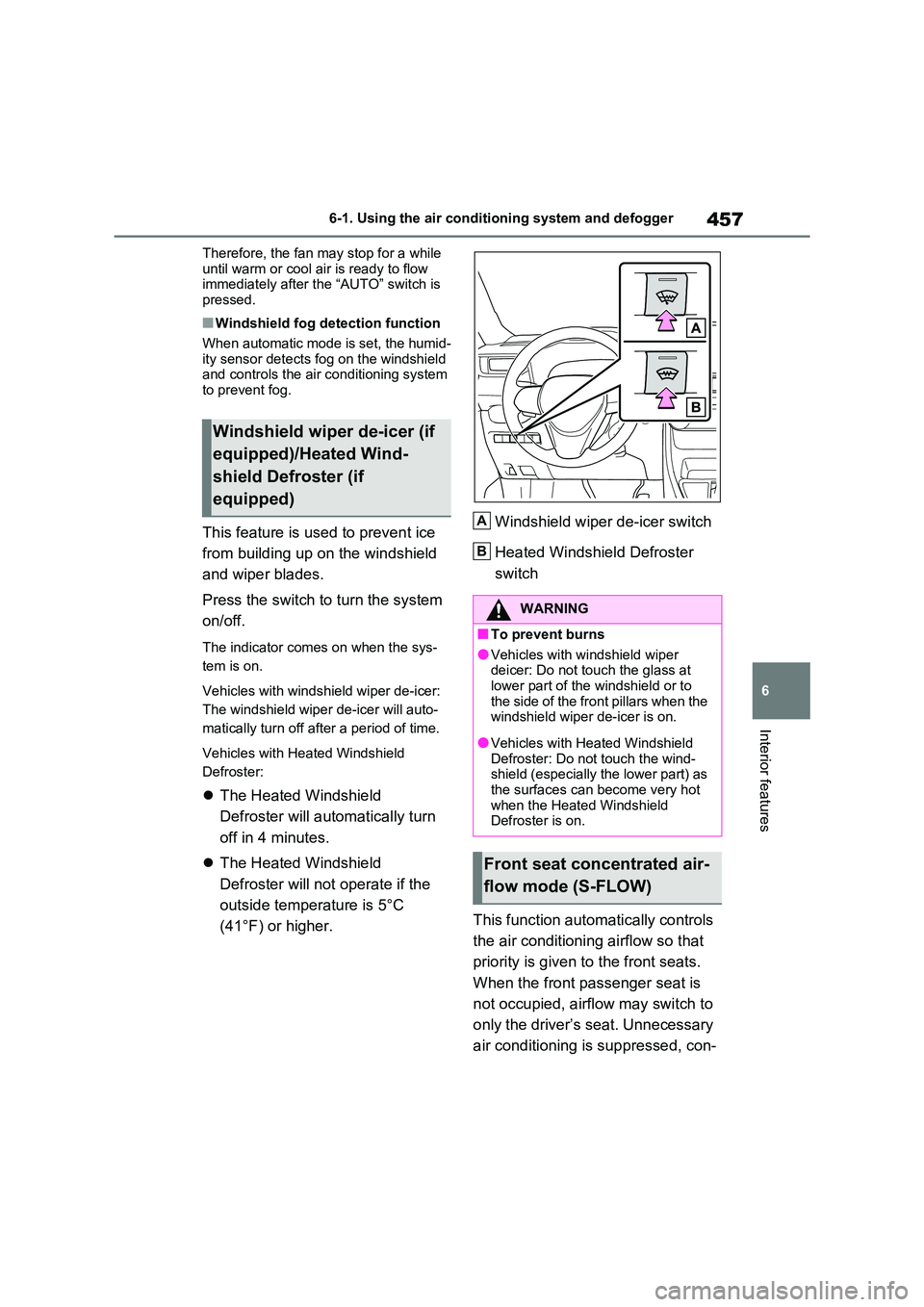
Windshield wiper de-icer switch
Heated Windshield Defroster
switch
This function automatically controls
the air conditioning airflow so that
priority is given to the front seats.
When the front passenger seat is
not occupied, airflow may switch to
only the driver’s seat. Unnecessary
air conditioning is suppressed, con -
Windshield wiper de-icer (if
equipped)/Heated Wind -
shield Defroster (if
equipped)
WARNING
■To prevent burns
●Vehicles with windshield wiper
deicer: Do not touc h the glass at lower part of the windshield or to
the side of the front pillars when the
windshield wiper de-icer is on.
●Vehicles with Heated Windshield
Defroster: Do not touch the wind - shield (especially the lower part) as
the surfaces can become very hot
when the Heated Windshield Defroster is on.
Front seat concentrated air -
flow mode (S-FLOW)
A
B
Page 468 of 666
4666-2. Using the interior lights
Turns the switch to the door posi-
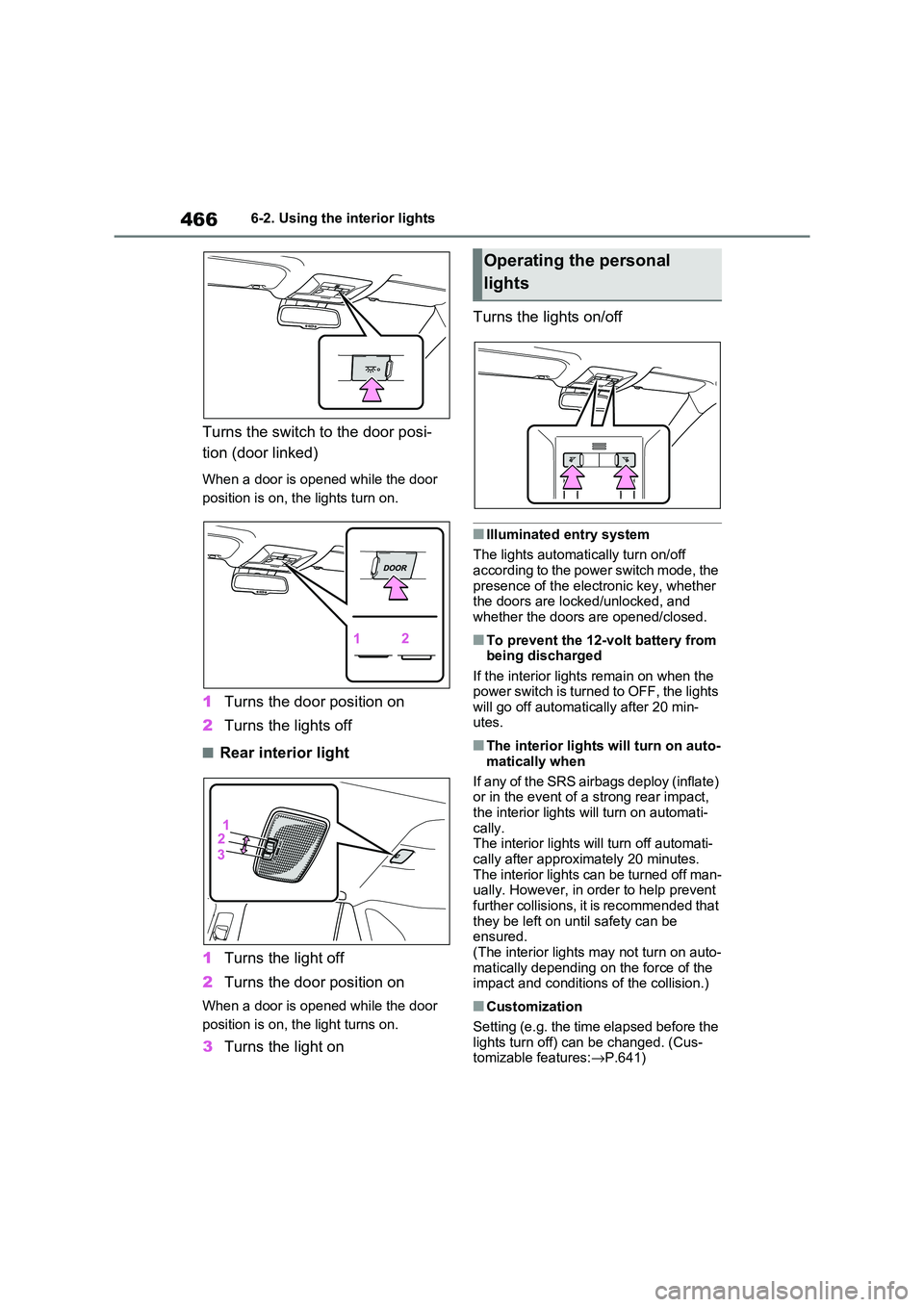
tion (door linked)
When a door is opened while the door
position is on, the lights turn on.
1 Turns the door position on
2 Turns the lights off
■Rear interior light
1 Turns the light off
2 Turns the door position on
When a door is opened while the door
position is on, t he light turns on.
3Turns the light on
Turns the lights on/off
■Illuminated entry system
The lights automati cally turn on/off
according to the power switch mode, the presence of the electronic key, whether
the doors are locked/unlocked, and
whether the doors are opened/closed.
■To prevent the 12-volt battery from being discharged
If the interior lights remain on when the
power switch is turned to OFF, the lights will go off automati cally after 20 min-
utes.
■The interior lights will turn on auto -
matically when
If any of the SRS airbags deploy (inflate)
or in the event of a strong rear impact,
the interior lights will turn on automati- cally.
The interior lights w ill turn off automati-
cally after approximately 20 minutes. The interior lights can be turned off man -
ually. However, in order to help prevent
further collisions, it is recommended that
they be left on un til safety can be ensured.
(The interior lights may not turn on auto -
matically depending on the force of the impact and conditions of the collision.)
■Customization
Setting (e.g. the time elapsed before the
lights turn off) can be changed. (Cus - tomizable features: →P.641)
Operating the personal
lights
Page 490 of 666
4887-1. Maintenance and care
7-1.Maintenance and care
Working from top to bottom, lib-
erally apply water to the vehicle
body, wheel wells and underside
of the vehicle to remove any dirt
and dust.
Wash the vehicle body using a
sponge or soft cloth, such as a
chamois.
For hard-to-remove marks, use
car wash soap and rinse thor -
oughly with water.
Wipe away any water.
Wax the vehicle when the water-
proof coating deteriorates.
If water does not bead on a clean sur -
face, apply wax when the vehicle body
is cool.
■Before car washes
Check that the fuel filler door and charging port lid on your vehicle are
closed properly.
■Automatic car washes
●Before washing the vehicle:
• Fold the mirrors
• Turn off the power back door (if equipped)
Start washing from t he front of the vehi-
cle. Make sure to extend the mirrors
before driving.
●Brushes used in automatic car
washes may scratch the vehicle sur - face, parts (wheel, etc.) and harm
your vehicle’s paint.
●Rear spoiler may not be washable in
some automatic c ar washes. There
may also be an increased risk of dam - age to vehicle.
■High pressure car washes
As water may enter the cabin, do not
bring the nozzle tip near the gaps around the doors or perimeter of the
windows, or spray th ese areas continu-
ously.
■Note for a smart e ntry & start sys- tem
If the door handle becomes wet while
the electronic key is within the effective range, the door may lock and unlock
repeatedly. In that c ase, follow the fol-
lowing correction procedures to wash the vehicle:
●Place the key in a position 2 m (6 ft.) or more separate from the vehicle
while the vehicle is being washed.
(Take care to ensur e that the key is not stolen.)
●Set the electronic key to battery-sav - ing mode to disable the smart entry &
start system. ( →P.224)
■Wheels and wheel ornaments
●Remove any dirt immediately by using
a neutral detergent.
●Wash detergent of f with water imme-
diately after use.
●To protect the paint from damage,
make sure to observe the following
precautions. • Do not use acidic, alkaline or abrasive
detergent.
• Do not use hard brushes.
• Do not use deterg ent on the wheels when they are hot, such as after driv -
ing or parking in hot weather.
Cleaning and protecting
the vehicle exterior
Perform the following to pro -
tect the vehicle and maintain it
in prime condition:
Cleaning instructions
Page 507 of 666
505
7
7-3. Do-it-yours elf maintenance
Maintenance and care
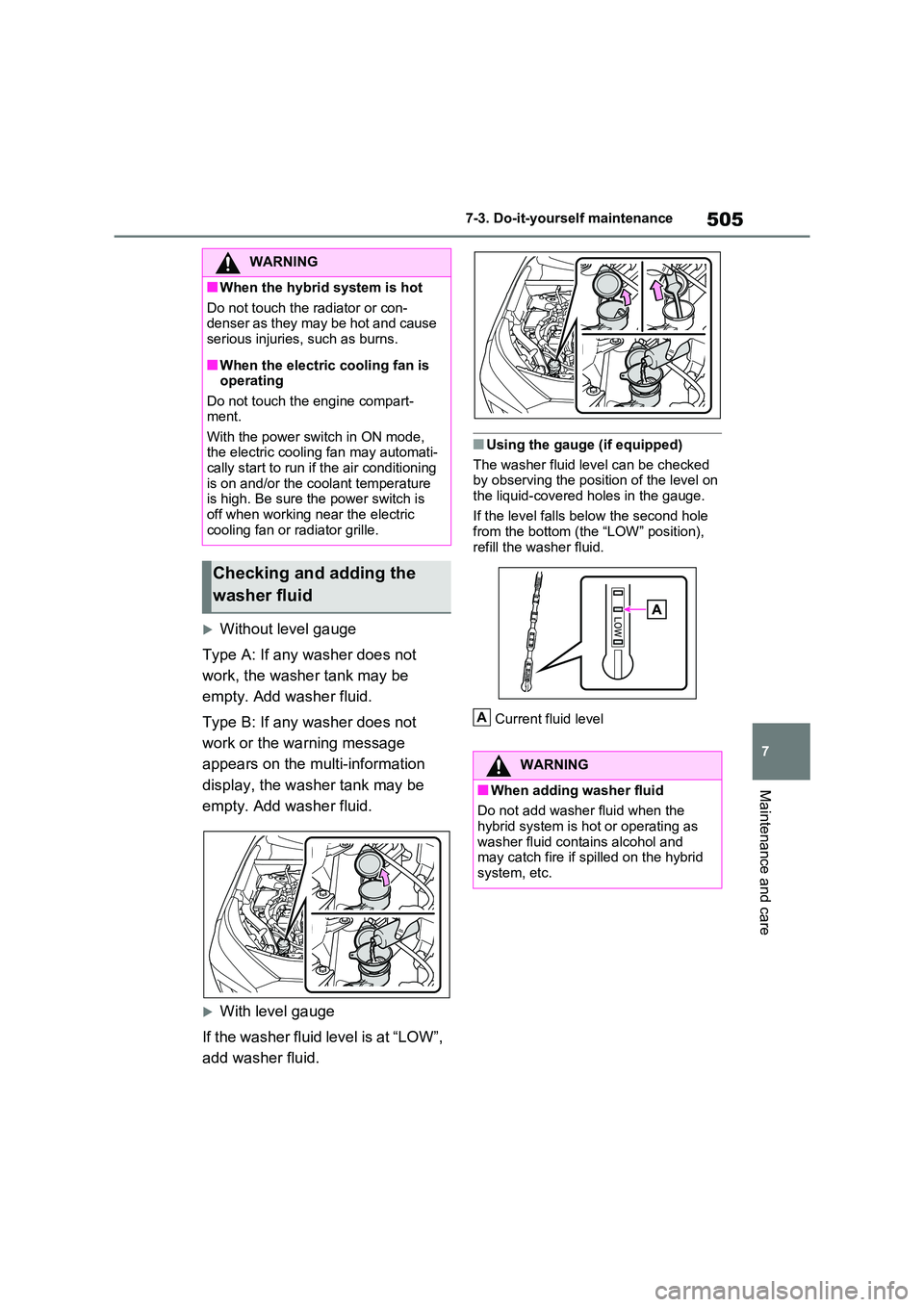
Without level gauge
Type A: If any washer does not
work, the washer tank may be
empty. Add washer fluid.
Type B: If any washer does not
work or the wa rning message
appears on the multi-information
display, the washer tank may be
empty. Add washer fluid.
With level gauge
If the washer fluid level is at “LOW”,
add washer fluid.
■Using the gauge (if equipped)
The washer fluid level can be checked
by observing the position of the level on
the liquid-covered holes in the gauge.
If the level falls below the second hole
from the bottom (the “LOW” position),
refill the washer fluid.
Current fluid level
WARNING
■When the hybrid system is hot
Do not touch the radiator or con -
denser as they may be hot and cause serious injuries, such as burns.
■When the electric cooling fan is operating
Do not touch the engine compart -
ment.
With the power swi tch in ON mode, the electric cooli ng fan may automati-
cally start to run if t he air conditioning
is on and/or the c oolant temperature is high. Be sure the power switch is
off when working near the electric
cooling fan or radiator grille.
Checking and adding the
washer fluid
WARNING
■When adding washer fluid
Do not add washer fluid when the
hybrid system is hot or operating as
washer fluid contains alcohol and may catch fire if sp illed on the hybrid
system, etc.
A
Page 509 of 666
507
7
7-3. Do-it-yours elf maintenance
Maintenance and care
doors.
●Start the hybrid system with the power
switch in ACC. The hybrid system
may not start with the power switch turned off. Howeve r, the hybrid sys-
tem will operate normally from the
second attempt.
●The power switch mode is recorded
by the vehicle. If the 12-volt battery is reconnected, the vehicle will return
the power switch mode to the status it
was in before the 12-volt battery was disconnected. Make sure to turn off
the power switch b efore disconnect
the 12-volt battery. Take extra care when connecting the 12-volt battery if
the power switch m ode prior to dis-
charge is unknown.
If the hybrid system will not start even
after multiple attem pts at all methods
above, contact any authorized Toyota retailer or Toyota authorized repairer, or
any reliable repairer.
WARNING
■Chemicals in the 12-volt battery
The 12-volt battery contains poison - ous and corrosive sulfuric acid and
may produce hydrogen gas which is
flammable and expl osive. To reduce the risk of death or serious injury, take
the following precautions while work -
ing on or near the 12-volt battery:
●Do not cause sparks by touching
the 12-volt batter y terminals with tools.
●Do not smoke or light a match near the 12-volt battery.
●Avoid contact with eyes, skin and clothes.
●Never inhale or swallow electrolyte.
●Wear protective safety glasses
when working near the 12-volt bat- tery.
●Keep children away from the 12-volt battery.
■Where to safely charge the 12-volt battery
Always charge the 12-volt battery in
an open area. Do not charge the 12- volt battery in a garage or closed
room where there is not sufficient
ventilation.
■Emergency measures regarding
electrolyte
●If electrolyte gets in your eyes
Flush your eyes with clean water for
at least 15 minutes and get immediate
medical attention. If possible, con-
tinue to apply wate r with a sponge or
cloth while traveling to the nearest
medical facility.
●If electrolyte g ets on your skin
Wash the affec ted area thoroughly. If
you feel pain or burning, get medical
attention immediately.
●If electrolyte gets on your clothes
It can soak through clothing on to
your skin. Immediat ely take off the
clothing and follow the procedure
above if necessary.
●If you accidentally swallow electro -
lyte
Drink a large quantity of water or milk.
Get emergency medical attention
immediately.
■When there is insu fficient 12-volt
battery fluid
Do not use if there is insufficient fluid in the 12-volt battery. There is a pos -
sible danger that the 12-volt battery
may explode.
Page 512 of 666
5107-3. Do-it-yourself maintenance
molded into the sidewall of each tire.
Replace the tires if the treadwear indi -
cators are showing on a tire.
■When to replace your vehicle’s
tires
Tires should be replaced if:
●The treadwear indicators are showing on a tire.
●You have tire damage such as cuts, splits, cracks deep enough to expose
the fabric, and bulges indicating inter -
nal damage.
●A tire goes flat repeatedly or cannot
be properly repaired due to the size or location of a cut or other damage.
If you are not sure, consult with any
authorized Toyota retailer or Toyota authorized repairer, or any reliable
repairer.
■Tire life
Any tire over 6 y ears old must be checked by a qualified technician even if
it has seldom or never been used or
damage is not obvious.
■If the tread on snow tires wears down below 4 mm (0.16 in.)
The effectiveness of t he tires as snow
tires is lost.
Rotate the tires in the order shown.
To equalize tire wear and help extend
tire life, Toyota re commends that tire
rotation is carried out approximately
WARNING
■When inspecting or replacing tires
Observe the following precautions to
prevent accidents. Failure to do so may cause damage
to parts of the driv e train as well as
dangerous handling c haracteristics, which may lead to an accident result -
ing in death or serious injury.
●Do not mix tires of different makes, models or tread patterns.
Also, do not mix tires of remarkably
different treadwear.
●Do not use tire sizes other than those recommended by Toyota.
●Do not mix differently constructed tires (radial, bias-belted or bias-ply
tires).
●Do not mix summer, all season and
snow tires.
●Do not use tires that have been
used on another vehicle.
Do not use tires if you do not know how they were used previously.
●Vehicles with compact spare tire: Do not tow if your vehicle has a
compact spare tire installed.
●Vehicles with emergency tire punc -
ture repair kit: Do not tow anything
if a tire that has been repaired using the emergency tire puncture repair
kit is installed. The load on the tire
may cause unexpec ted damage to the tire.
NOTICE
■Driving on rough roads
Take particular care when driving on
roads with loose sur faces or potholes. These conditions may cause losses in
tire inflation pressure, reducing the
cushioning ability of the tires. In addi - tion, driving on rough roads may
cause damage to the tires them -
selves, as well as the vehicle’s wheels and body.
■If tire inflation pressure of each tire becomes low while driving
Do not continue drivi ng, or your tires
and/or wheels may be ruined.
Tire rotation
Page 608 of 666
6068-2. Steps to take in an emergency
played on the multi-information
display.
4 Press the power switch shortly
and firmly.
In the event that the hybrid system
still cannot be st arted, contact any
authorized Toyota retailer or Toyota
authorized repairer, or any reliable
repairer.
■Stopping the hybrid system
Shift the shift lever to P, set the parking
brake and press the power switch as you normally do when stopping the
hybrid system.
■Replacing the key battery
As the above procedure is a temporary measure, it is rec ommended that the
electronic key battery be replaced
immediately when the battery is depleted. ( →P.543)
■Alarm (if equipped)
Using the mechanical key to lock the
doors will not set the alarm system.
If a door is unlocked using the mechani -
cal key when the al arm system is set,
the alarm may be triggered. ( →P.78)
■Changing power switch modes
Release the brake pedal and press the power switch in step 3 above.
The hybrid system does not start and
modes will be changed each time the switch is pressed. ( →P.320)
If you have a set of jumper (or
booster) cables an d a second vehi-
cle with a 12-volt battery, you can
jump start your vehicle by following
the steps below.
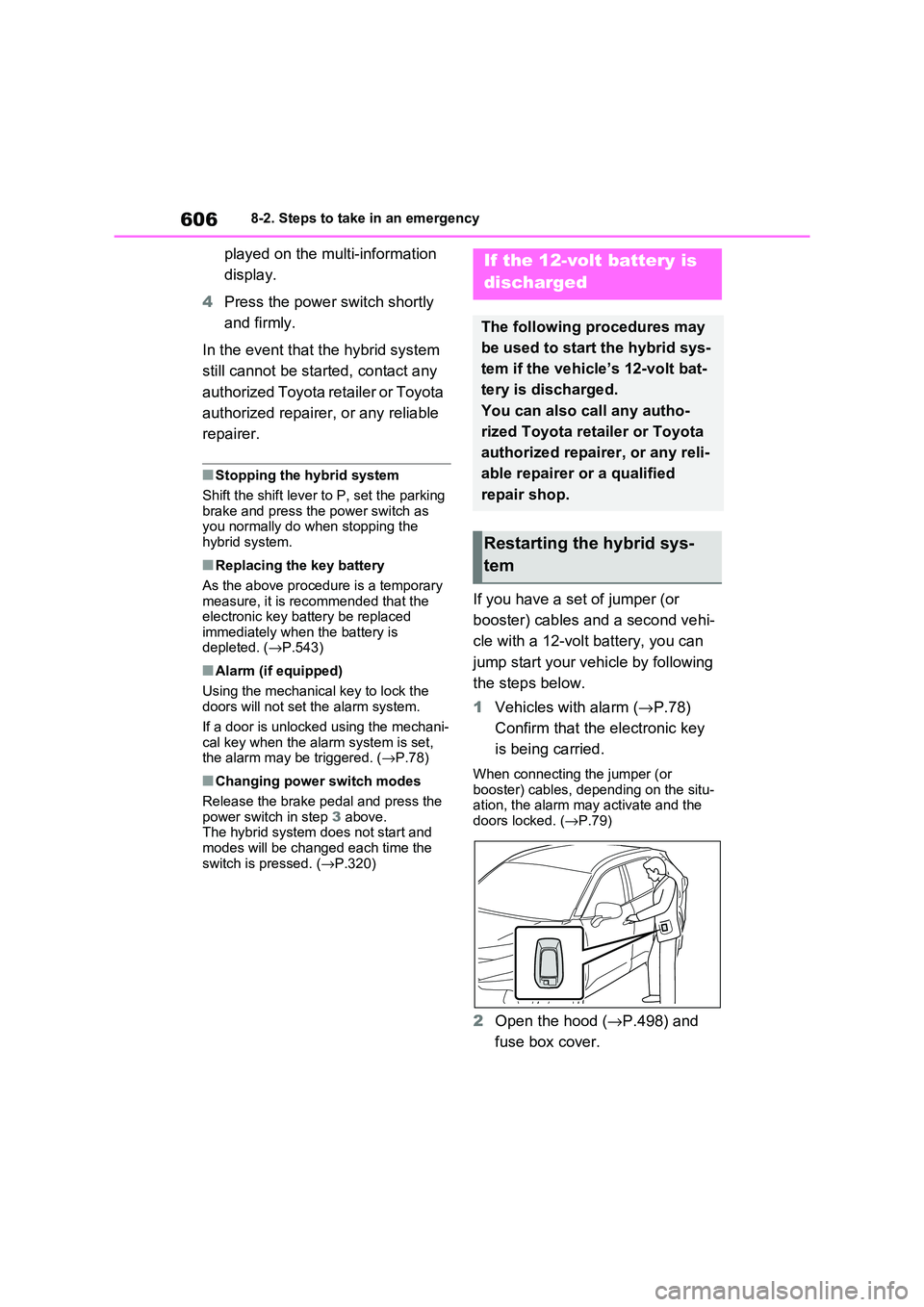
1 Vehicles with alarm (→P.78)
Confirm that the electronic key
is being carried.
When connecting the jumper (or booster) cables, depending on the situ -
ation, the alarm ma y activate and the
doors locked. ( →P.79)
2Open the hood (→P.498) and
fuse box cover.
If the 12-volt battery is
discharged
The following procedures may
be used to start the hybrid sys -
tem if the vehicle’s 12-volt bat -
tery is discharged.
You can also call any autho -
rized Toyota ret ailer or Toyota
authorized repairer, or any reli -
able repairer or a qualified
repair shop.
Restarting the hybrid sys -
tem