boot TOYOTA SUPRA 2022 Owner's Manual
[x] Cancel search | Manufacturer: TOYOTA, Model Year: 2022, Model line: SUPRA, Model: TOYOTA SUPRA 2022Pages: 498, PDF Size: 104.06 MB
Page 279 of 498
277
3
3-1. CONTROLS
CONTROLS
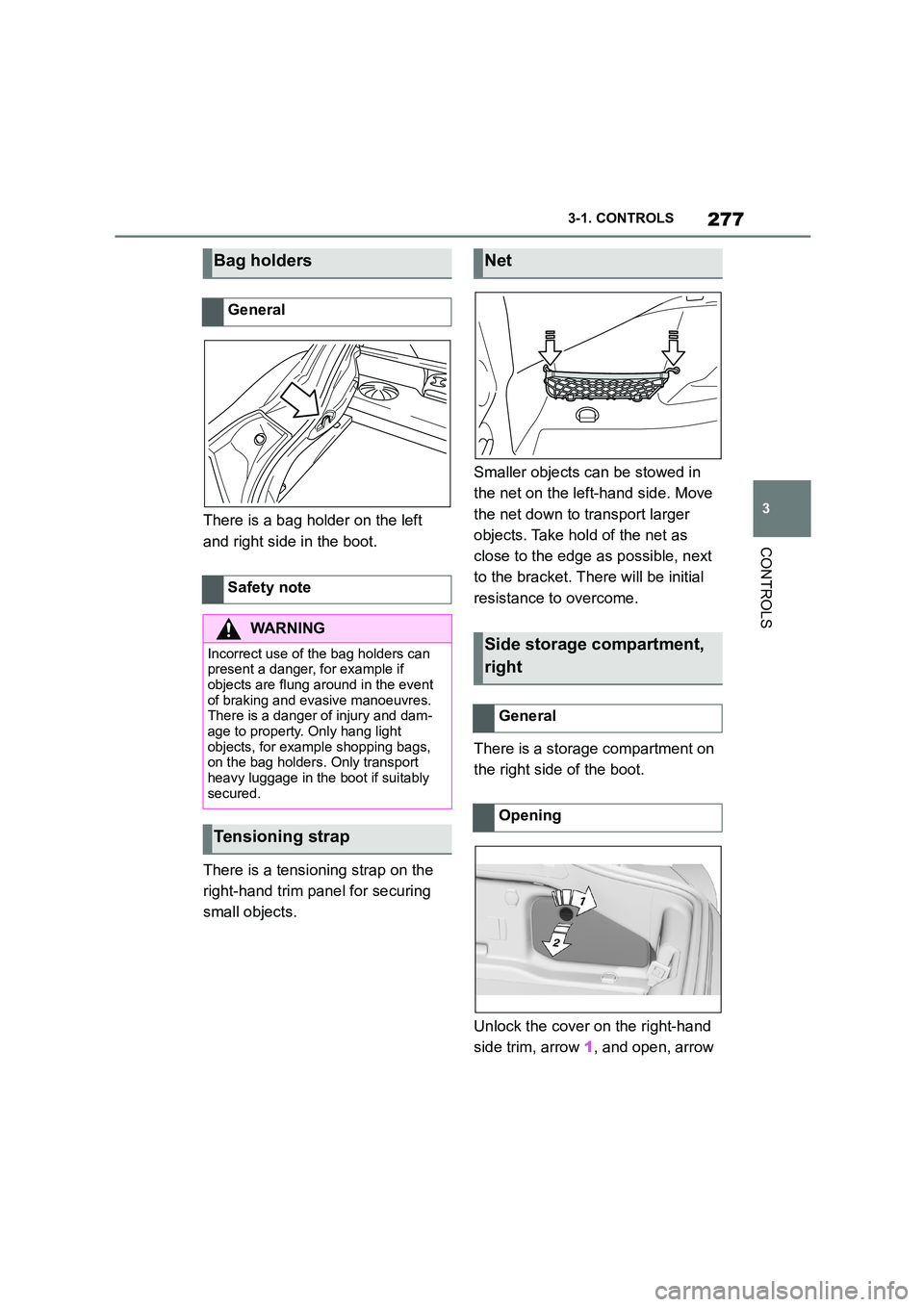
There is a bag holder on the left
and right side in the boot.
There is a tensioning strap on the
right-hand trim panel for securing
small objects.
Smaller objects can be stowed in
the net on the left-hand side. Move
the net down to transport larger
objects. Take hold of the net as
close to the edge as possible, next
to the bracket. Th ere will be initial
resistance to overcome.
There is a storage compartment on
the right side of the boot.
Unlock the cover on the right-hand
side trim, arrow 1, and open, arrow
Bag holders
General
Safety note
WA R N I N G
Incorrect use of the bag holders can
present a danger, for example if
objects are flung around in the event of braking and evasive manoeuvres.
There is a danger of injury and dam-
age to property. Only hang light objects, for example shopping bags,
on the bag holders. Only transport
heavy luggage in the boot if suitably secured.
Tensioning strap
Net
Side storage compartment,
right
General
Opening
Page 283 of 498
281
4
4-1. DRIVING HINTS
DRIVING HINTS
Brake discs and pads only achieve
their full effectiveness after approxi-
mately 500 km, 300 miles. Drive
moderately during this running-in
period.
Please comply with the running-in
procedures again if the compo-
nents previously referred to are
renewed.
The exhaust gas particle filter col-
lects soot particles. The soot parti-
cles are burned at high
Brake system
After fitting new parts
General driving information
Closing the boot lid
Safety note
WA R N I N G
When open, the boot lid protrudes above the vehicle, and in the event of
an accident, braking or evasive
manoeuvres, it can endanger vehicle occupants and other road users, or
damage the vehicle. Exhaust fumes
may also enter the passenger com- partment. There is a danger of injury
or damage to property. Do not drive
with the boot lid open.
Ice on the windows
NOTICE
The window lowers a little when the
door handle is pulled. If there is frost, the window may freeze up and cannot
then be lowered. There is a risk of
material damage. Make sure that the window lowers when the door handle
is pulled. Remove any snow or ice
from the window. Do not open the
door by force.
Hot exhaust system
WA R N I N G
High temperatures can be generated
under the body during driving, for example because of the exhaust sys-
tem. Contact with the exhaust system
can lead to burns. There is a risk of injury. Do not touch the hot exhaust
system, including th e exhaust pipe.
WA R N I N G
If flammable materials, for example leaves or grass, come into contact
with hot parts of the exhaust system,
these materials can catch fire. There is a risk of fire and injury. Never
remove the heat shields fitted here or
apply underbody protection to them. Make sure that when driving, idling or
parking, no flammable materials can
come into contact with hot vehicle parts.
Exhaust gas particle filter
Principle
Page 295 of 498
293
5
5-1. MOBILITY
MOBILITY
ized Toyota reta iler or Toyota
authorized repairer, or any reliable
repairer.
The tyre inflation pressure appropri-
ate for the respective load condi-
tions should be used. For example,
if the vehicle is partially loaded, use
the tyre inflation pressure specified
for a partially loaded vehicle.
The current tire pr essure of each
installed wheel can be displayed on
the control display.
To ensure that they are displayed
correctly, the tyre sizes must be
stored in the system and must have
been set, see page 304, for the
mounted tyres.
The current tyre inflation pressure
value is shown on each tyre.
Tyres heat up while driving. The
tyre inflation pressure increases
with the temperature of the tyre.
Tyres have a natural, uniform loss
of tyre inflation pressure.
Inflating devices can display a pres-
sure that may be up to 0.1 bar too
low.
The tyre inflation pressure inscrip-
tions on the tyre inflation pressure
sign on the door pillar only relate to
cold tyres or tyres at the same tem-
perature as the ambient tempera-
ture.
Only check the tyre inflation pres-
sures when the tyres are cold, i.e.:
• If the vehicle has been driven a
distance of no more than 2 km,
1.25 miles.
• If the vehicle has not moved
again for at least 2 hours after a
journey.
Regularly check the tyre inflation
pressure of the emergency wheel in
the boot and correct the pressure if
necessary.
1 Determine the specified tyre
inflation pressures for the tyres
installed on the vehicle.
For Australia/New Zealand
WA R N I N G
The inflation pressures on the tyre
label are applicable only for tyres
explicitly mentioned on the label. Inflation pressures for tyres that may
be covered by the label – by size,
speed category and load rating/load index – but not explicitly mentioned
on the label may be different. Please
obtain adequate inflation pressures in accordance with the tyre manufac-
turer's specifications from your tyre
dealer.
On the Control Display
Checking the tyre inflation
pressure
General
Checking using tyre inflation pres-
sure inscriptions on the door pillar
Page 302 of 498
3005-1. MOBILITY
check the tyre inflation pressure.
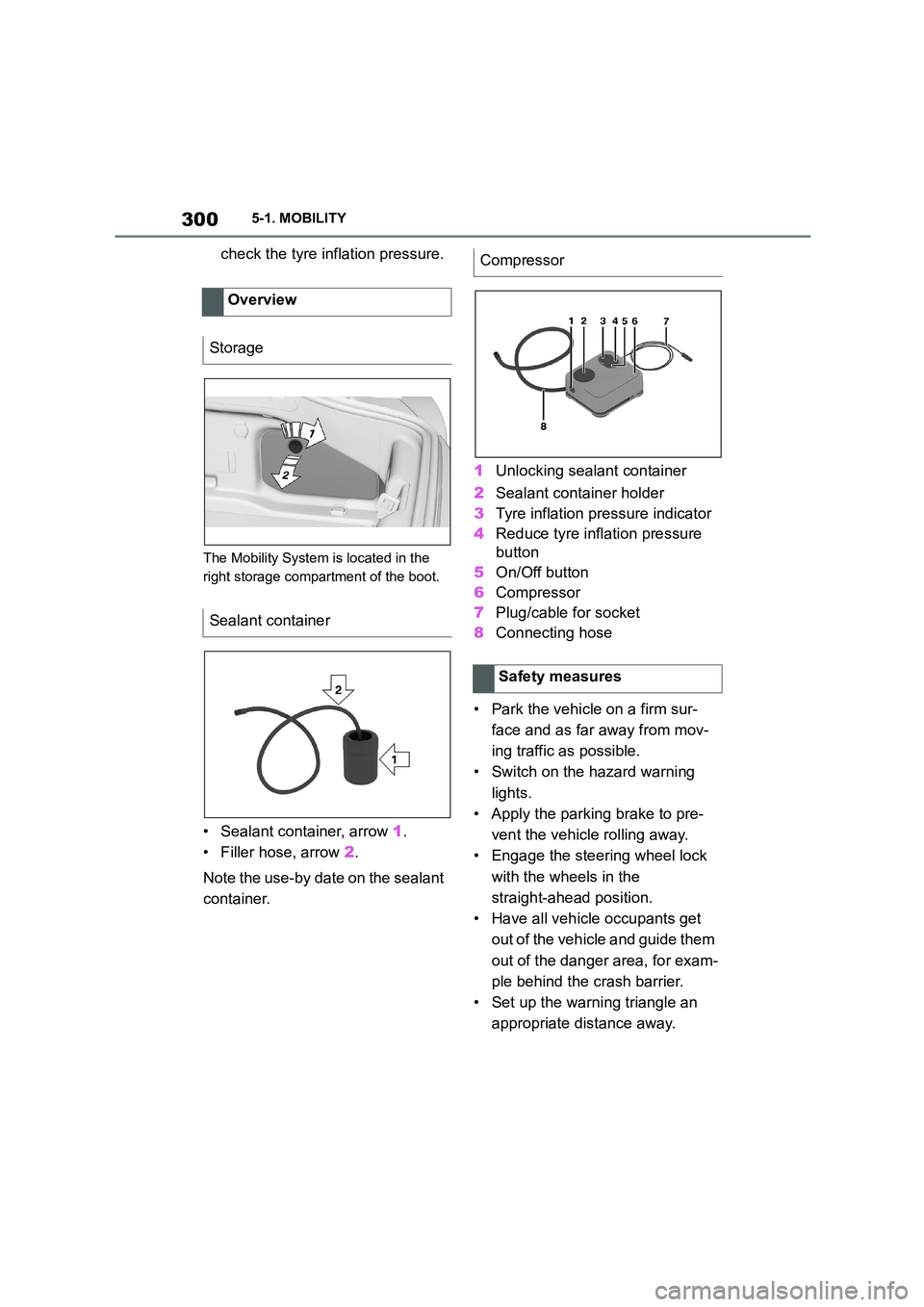
The Mobility System is located in the
right storage compartment of the boot.
• Sealant container, arrow 1.
• Filler hose, arrow 2.
Note the use-by date on the sealant
container.
1 Unlocking sealant container
2 Sealant container holder
3 Tyre inflation pressure indicator
4 Reduce tyre inflation pressure
button
5 On/Off button
6 Compressor
7 Plug/cable for socket
8 Connecting hose
• Park the vehicle on a firm sur-
face and as far away from mov-
ing traffic as possible.
• Switch on the hazard warning
lights.
• Apply the parking brake to pre-
vent the vehicle rolling away.
• Engage the steering wheel lock
with the wheels in the
straight-ahead position.
• Have all vehicle occupants get
out of the vehicle and guide them
out of the danger area, for exam-
ple behind the crash barrier.
• Set up the warning triangle an
appropriate distance away.
Overview
Storage
Sealant container
Compressor
Safety measures
Page 304 of 498
3025-1. MOBILITY
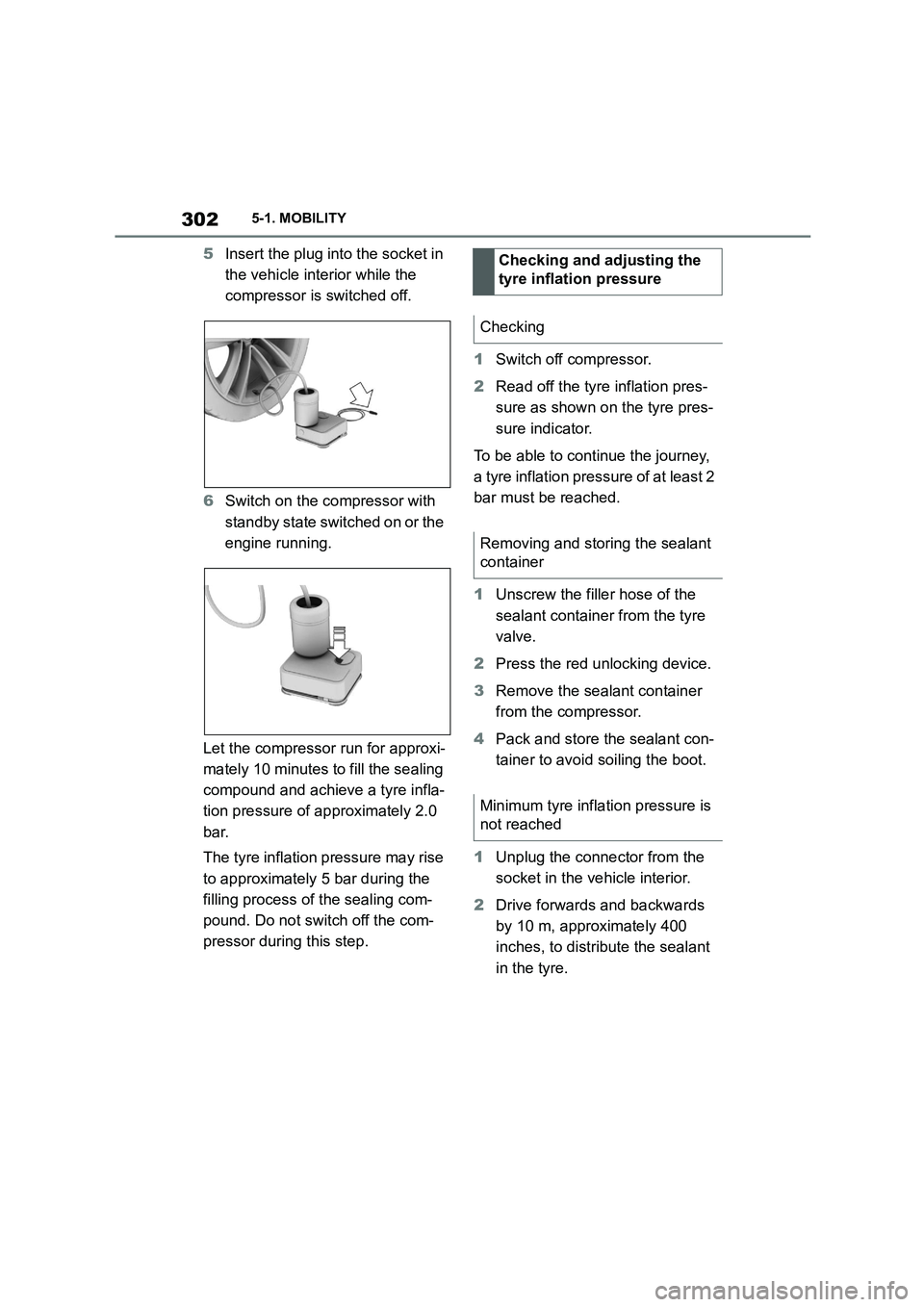
5Insert the plug into the socket in
the vehicle interior while the
compressor is switched off.
6 Switch on the compressor with
standby state switched on or the
engine running.
Let the compressor run for approxi-
mately 10 minutes to fill the sealing
compound and achieve a tyre infla-
tion pressure of approximately 2.0
bar.
The tyre inflation pressure may rise
to approximately 5 bar during the
filling process of the sealing com-
pound. Do not switch off the com-
pressor during this step.
1 Switch off compressor.
2 Read off the tyre inflation pres-
sure as shown on the tyre pres-
sure indicator.
To be able to continue the journey,
a tyre inflation pressure of at least 2
bar must be reached.
1 Unscrew the filler hose of the
sealant container from the tyre
valve.
2 Press the red unlocking device.
3 Remove the sealant container
from the compressor.
4 Pack and store the sealant con-
tainer to avoid soiling the boot.
1 Unplug the connector from the
socket in the vehicle interior.
2 Drive forwards and backwards
by 10 m, approximately 400
inches, to distribute the sealant
in the tyre.
Checking and adjusting the
tyre inflation pressure
Checking
Removing and storing the sealant
container
Minimum tyre inflation pressure is
not reached
Page 319 of 498
317
5
5-1. MOBILITY
MOBILITY
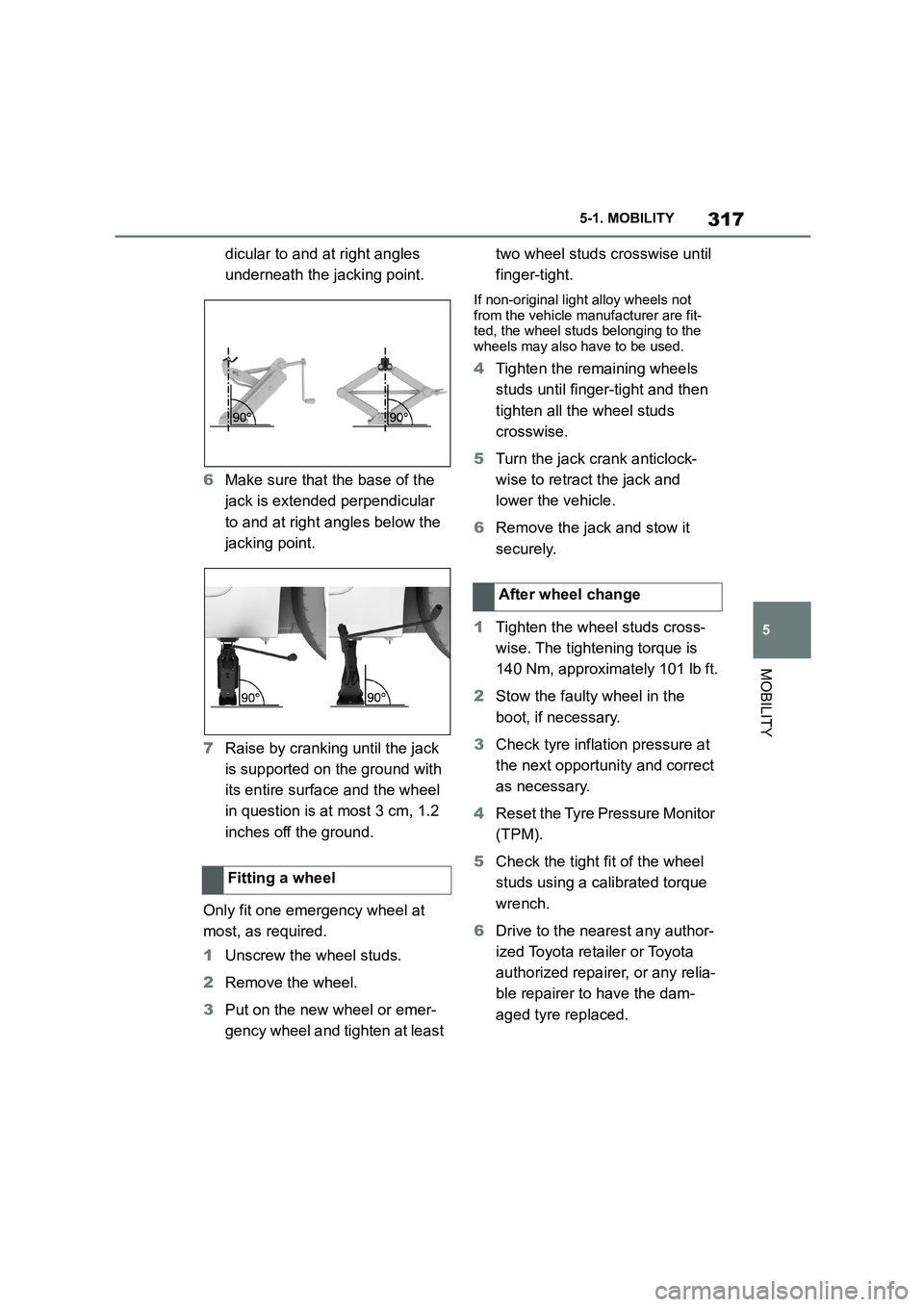
dicular to and at right angles
underneath the jacking point.
6 Make sure that the base of the
jack is extended perpendicular
to and at right angles below the
jacking point.
7 Raise by cranking until the jack
is supported on the ground with
its entire surface and the wheel
in question is at most 3 cm, 1.2
inches off the ground.
Only fit one emergency wheel at
most, as required.
1 Unscrew the wheel studs.
2 Remove the wheel.
3 Put on the new wheel or emer-
gency wheel and tighten at least
two wheel studs crosswise until
finger-tight.
If non-original light alloy wheels not
from the vehicle manufacturer are fit- ted, the wheel studs belonging to the
wheels may also have to be used.
4 Tighten the remaining wheels
studs until finger-tight and then
tighten all the wheel studs
crosswise.
5 Turn the jack crank anticlock-
wise to retract the jack and
lower the vehicle.
6 Remove the jack and stow it
securely.
1 Tighten the wheel studs cross-
wise. The tightening torque is
140 Nm, approximately 101 lb ft.
2 Stow the faulty wheel in the
boot, if necessary.
3 Check tyre inflation pressure at
the next opportunity and correct
as necessary.
4 Reset the Tyre Pressure Monitor
(TPM).
5 Check the tight fit of the wheel
studs using a calibrated torque
wrench.
6 Drive to the nearest any author-
ized Toyota reta iler or Toyota
authorized repairer, or any relia-
ble repairer to have the dam-
aged tyre replaced.
Fitting a wheel
After wheel change
Page 320 of 498
3185-1. MOBILITY
*: if equipped
In case of a flat tyre, the emergency
wheel can be used as a replace-
ment for the defective tyre. The
emergency wheel is intended for
short-term use until the defective
wheel has been replaced.
Only fit one emergency wheel at
most.
Additionally, regularly check the
tyre inflation pressure of the emer-
gency wheel in the boot and correct
the pressure if necessary.
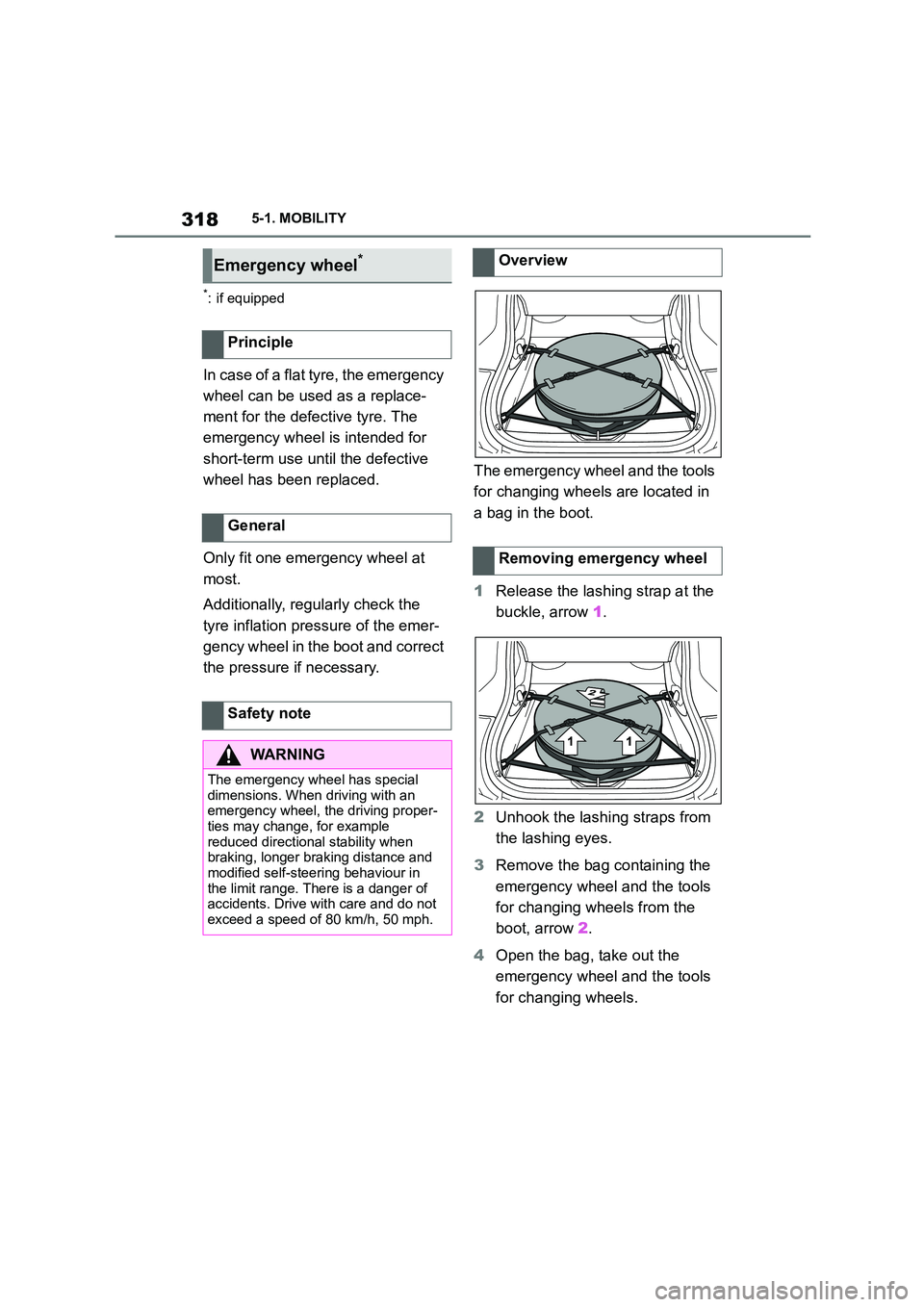
The emergency wheel and the tools
for changing wheels are located in
a bag in the boot.
1 Release the lashing strap at the
buckle, arrow 1.
2 Unhook the lashing straps from
the lashing eyes.
3 Remove the bag containing the
emergency wheel and the tools
for changing wheels from the
boot, arrow 2.
4 Open the bag, take out the
emergency wheel and the tools
for changing wheels.
Emergency wheel*
Principle
General
Safety note
WA R N I N G
The emergency wheel has special
dimensions. When driving with an emergency wheel, the driving proper-
ties may change, for example
reduced directional stability when braking, longer braking distance and
modified self-steering behaviour in
the limit range. There is a danger of accidents. Drive with care and do not
exceed a speed of 80 km/h, 50 mph.
Overview
Removing emergency wheel
Page 321 of 498
319
5
5-1. MOBILITY
MOBILITY
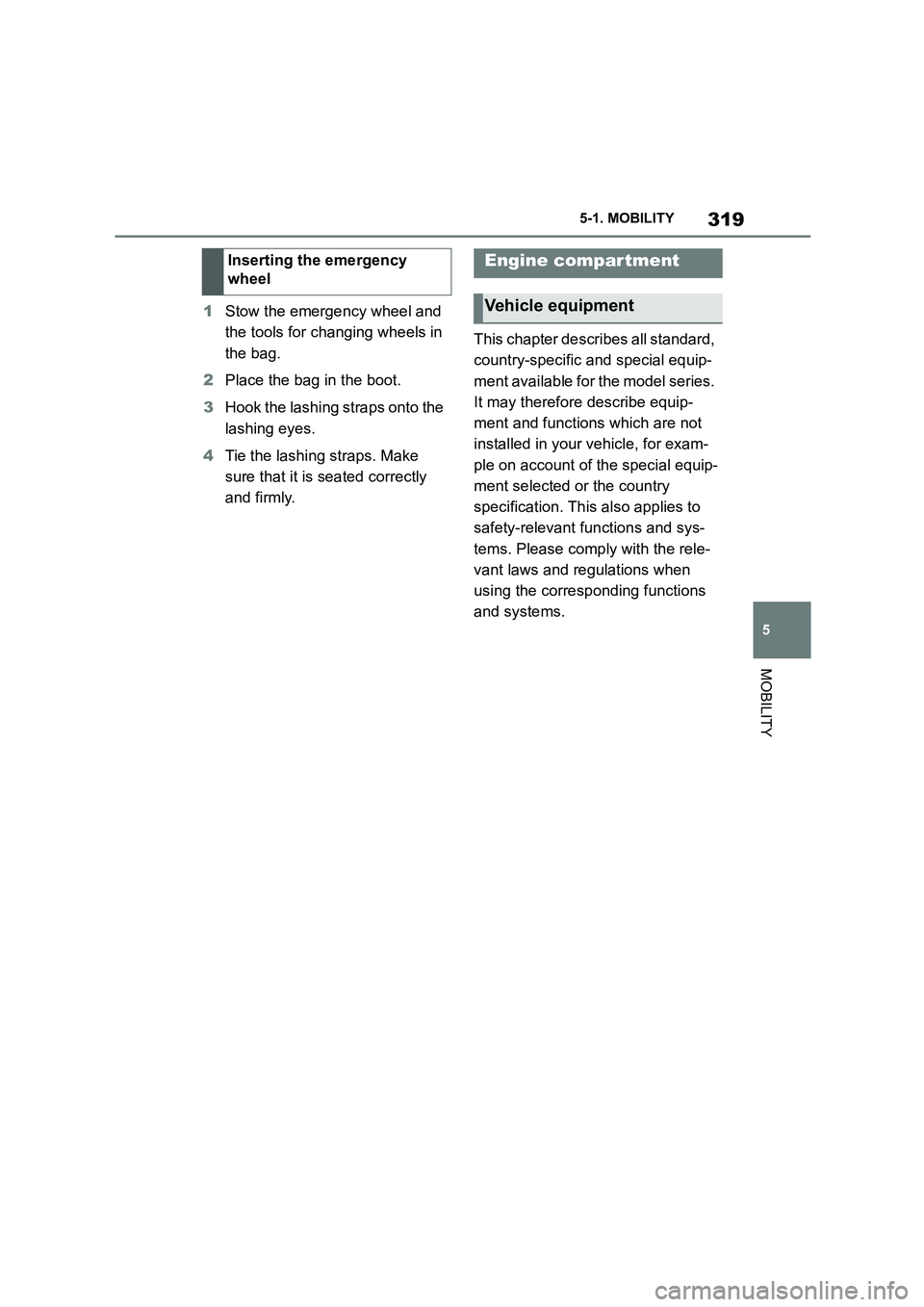
1 Stow the emergency wheel and
the tools for changing wheels in
the bag.
2 Place the bag in the boot.
3 Hook the lashing straps onto the
lashing eyes.
4 Tie the lashing straps. Make
sure that it is seated correctly
and firmly.
This chapter describes all standard,
country-specific and special equip-
ment available for the model series.
It may therefore describe equip-
ment and functions which are not
installed in your vehicle, for exam-
ple on account of the special equip-
ment selected or the country
specification. This also applies to
safety-relevant functions and sys-
tems. Please comply with the rele-
vant laws and regulations when
using the corresponding functions
and systems.
Inserting the emergency
wheel
Engine compar tment
Vehicle equipment
Page 341 of 498
339
5
5-1. MOBILITY
MOBILITY
This chapter describes all standard,
country-specific and special equip-
ment available for the model series.
It may therefore describe equip-
ment and functions which are not
installed in your vehicle, for exam-
ple on account of the special equip-
ment selected or the country
specification. This also applies to
safety-relevant functions and sys-
tems. Please comply with the rele-
vant laws and regulations when
using the corresponding functions
and systems.
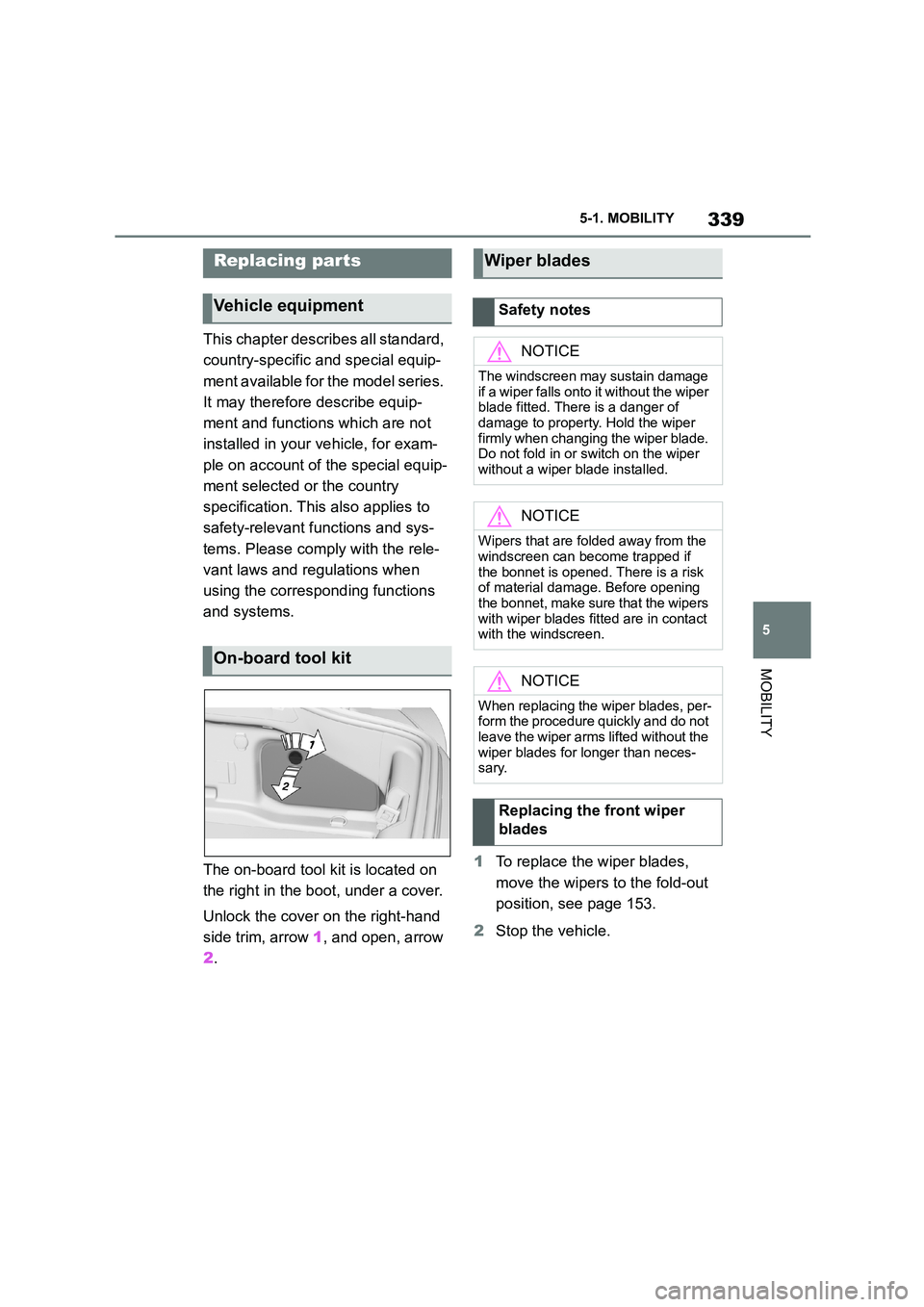
The on-board tool kit is located on
the right in the boot, under a cover.
Unlock the cover on the right-hand
side trim, arrow 1, and open, arrow
2 .
1 To replace the wiper blades,
move the wipers to the fold-out
position, see page 153.
2 Stop the vehicle.
Replacing par ts
Vehicle equipment
On-board tool kit
Wiper blades
Safety notes
NOTICE
The windscreen may sustain damage
if a wiper falls onto it without the wiper
blade fitted. There is a danger of
damage to property. Hold the wiper firmly when changing the wiper blade.
Do not fold in or switch on the wiper
without a wiper blade installed.
NOTICE
Wipers that are folded away from the
windscreen can become trapped if the bonnet is opened. There is a risk
of material damage. Before opening
the bonnet, make sure that the wipers with wiper blades fitted are in contact
with the windscreen.
NOTICE
When replacing the wiper blades, per- form the procedure quickly and do not
leave the wiper arms lifted without the
wiper blades for longer than neces- sary.
Replacing the front wiper
blades
Page 346 of 498
3445-1. MOBILITY
Undo fastenings, arrow, and open
cover.
The fuse box is lo cated at the front
right.
The fuses are located behind a
cover on the right-hand side in the
boot.
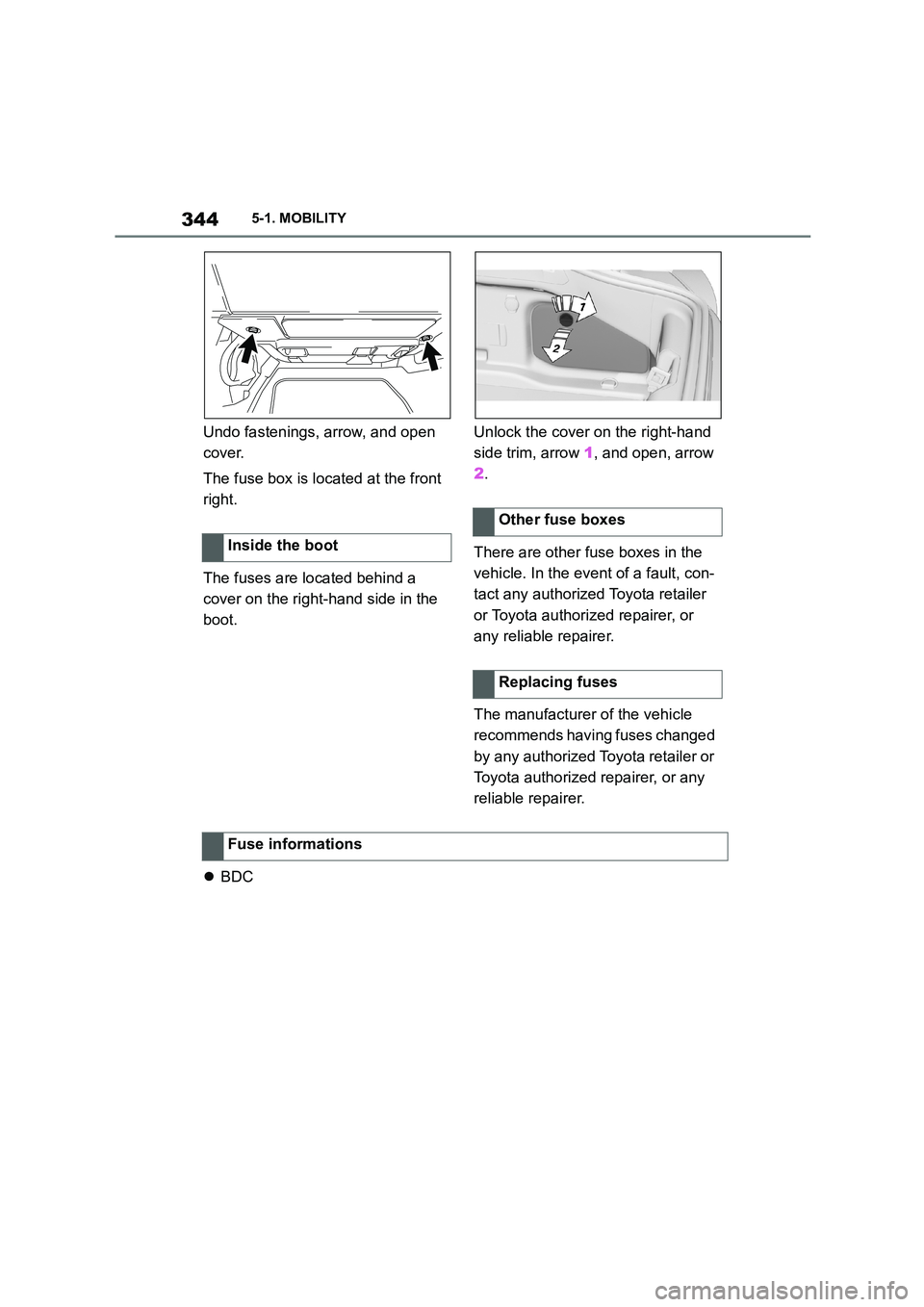
Unlock the cover on the right-hand
side trim, arrow 1, and open, arrow
2 .
There are other fuse boxes in the
vehicle. In the event of a fault, con-
tact any authorized Toyota retailer
or Toyota authorized repairer, or
any reliable repairer.
The manufacturer of the vehicle
recommends having fuses changed
by any authorized Toyota retailer or
Toyota authorized repairer, or any
reliable repairer.
BDC
Inside the boot
Other fuse boxes
Replacing fuses
Fuse informations