tow TOYOTA SUPRA 2022 Owner's Manual
[x] Cancel search | Manufacturer: TOYOTA, Model Year: 2022, Model line: SUPRA, Model: TOYOTA SUPRA 2022Pages: 498, PDF Size: 104.06 MB
Page 279 of 498
277
3
3-1. CONTROLS
CONTROLS
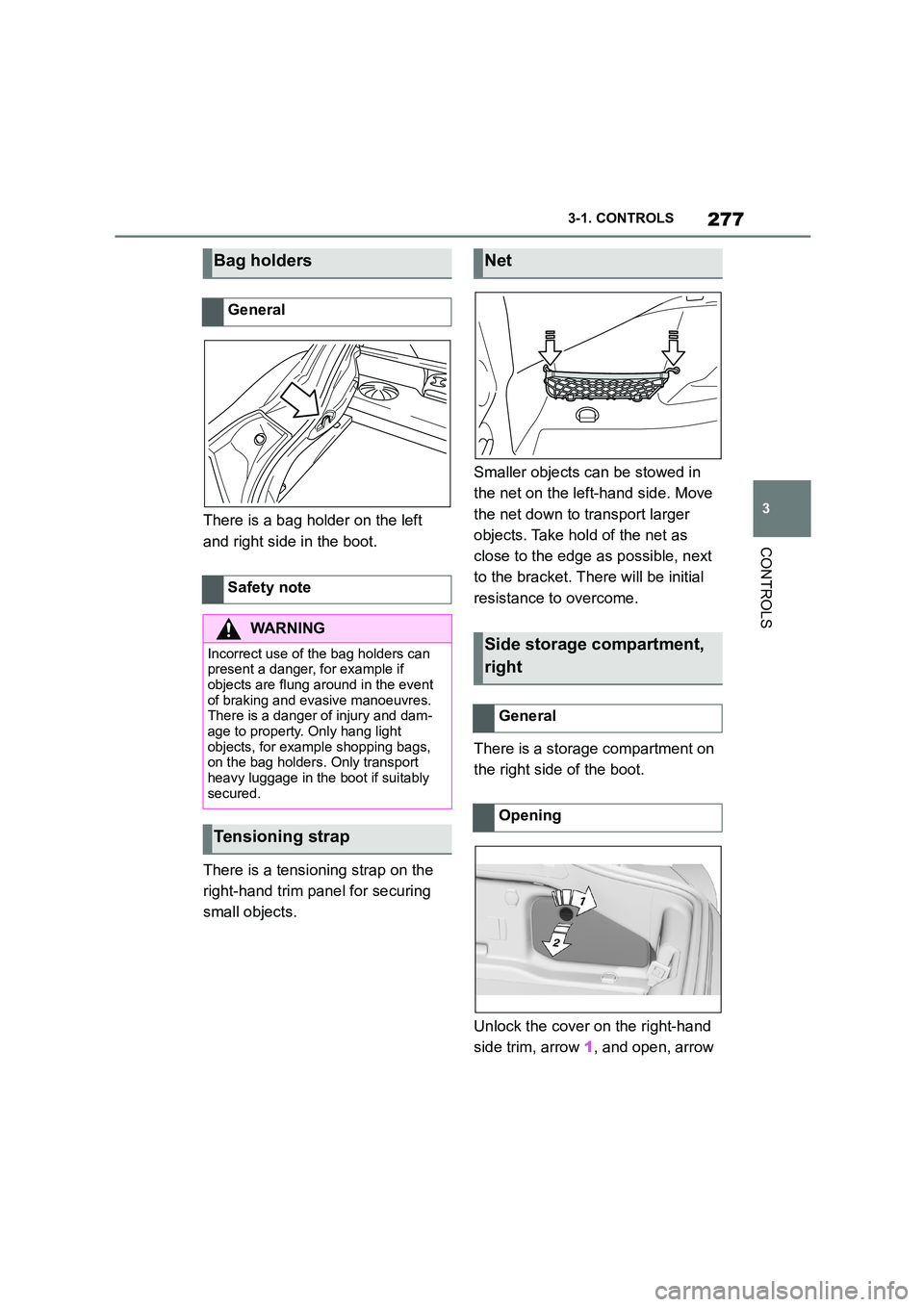
There is a bag holder on the left
and right side in the boot.
There is a tensioning strap on the
right-hand trim panel for securing
small objects.
Smaller objects can be stowed in
the net on the left-hand side. Move
the net down to transport larger
objects. Take hold of the net as
close to the edge as possible, next
to the bracket. Th ere will be initial
resistance to overcome.
There is a storage compartment on
the right side of the boot.
Unlock the cover on the right-hand
side trim, arrow 1, and open, arrow
Bag holders
General
Safety note
WA R N I N G
Incorrect use of the bag holders can
present a danger, for example if
objects are flung around in the event of braking and evasive manoeuvres.
There is a danger of injury and dam-
age to property. Only hang light objects, for example shopping bags,
on the bag holders. Only transport
heavy luggage in the boot if suitably secured.
Tensioning strap
Net
Side storage compartment,
right
General
Opening
Page 280 of 498
2783-1. CONTROLS
2.
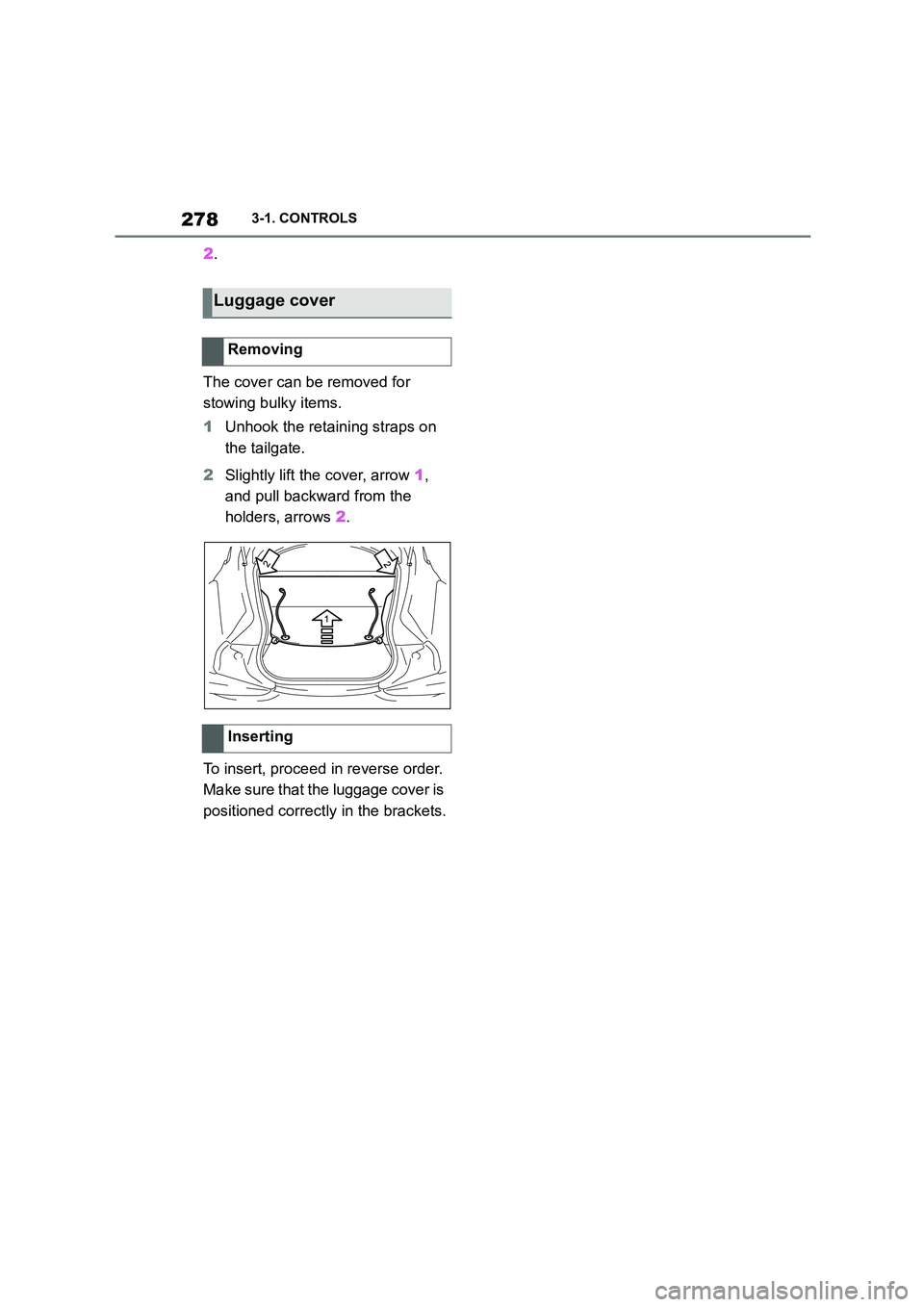
The cover can be removed for
stowing bulky items.
1 Unhook the retaining straps on
the tailgate.
2 Slightly lift the cover, arrow 1,
and pull backward from the
holders, arrows 2.
To insert, proceed in reverse order.
Make sure that the luggage cover is
positioned correctly in the brackets.
Luggage cover
Removing
Inserting
Page 286 of 498
2844-1. DRIVING HINTS
This situation, known as aquaplan-
ing, means that the tyre can actu-
ally lose contact completely with
the road surface and the vehicle
can neither be steered, nor the
brakes properly applied.
Please comply with the following
when driving through water:
Deactivate the Automatic
Start/Stop function.
Only drive through still water.
Only drive through water up to a
max. depth of 25 cm, 9.8 in.
Drive through water at a walking
speed of no more than 5 km/h, 3
mph.
The vehicle is equipped with the
Anti-lock Brake System ABS as
standard.
Perform full brakin g in situations
that require it.
The vehicle remains steerable. Any
obstacles can be avoided by steer-
ing as smoothly as possible.
A pulsing of the brake pedal and
hydraulic regulating sounds indi-
cate that the anti-lock brake system
ABS is functioning.
In certain braking situations, the
perforated brake discs can cause
functional noise. However, func-
tional noises have no effect on the
efficiency and operational safety of
the brakes.
In wet weather, on gritted roads and
in heavy rain, apply the brakes
lightly every few kilometres/miles.
Driving through water
General
Safety note
NOTICE
Driving through excessively deep water too fast can result in water
entering the engine compartment,
electrical system or transmission. There is a danger of damage to prop-
erty. When driving through water, do
not exceed the maximum water depth and speed specified above.
Safe braking
General
Objects in the range of movement
of the pedals
WA R N I N G
Objects in the driver's footwell can
restrict the pedal travel or block a
pedal that has been pressed. There is a risk of accident. Ensure that items in
the vehicle are stowed securely and
cannot get into the driver's footwell. Only use floor mats that are suitable
for the vehicle and can be securely
fastened to the floor. Do not use loose floor mats, and do not place several
floor mats on top of one another.
Make sure that there is sufficient space for the pedals. Ensure that floor
mats are securely reattached after
removal, for example for cleaning.
Wet roads
Page 297 of 498
295
5
5-1. MOBILITY
MOBILITY
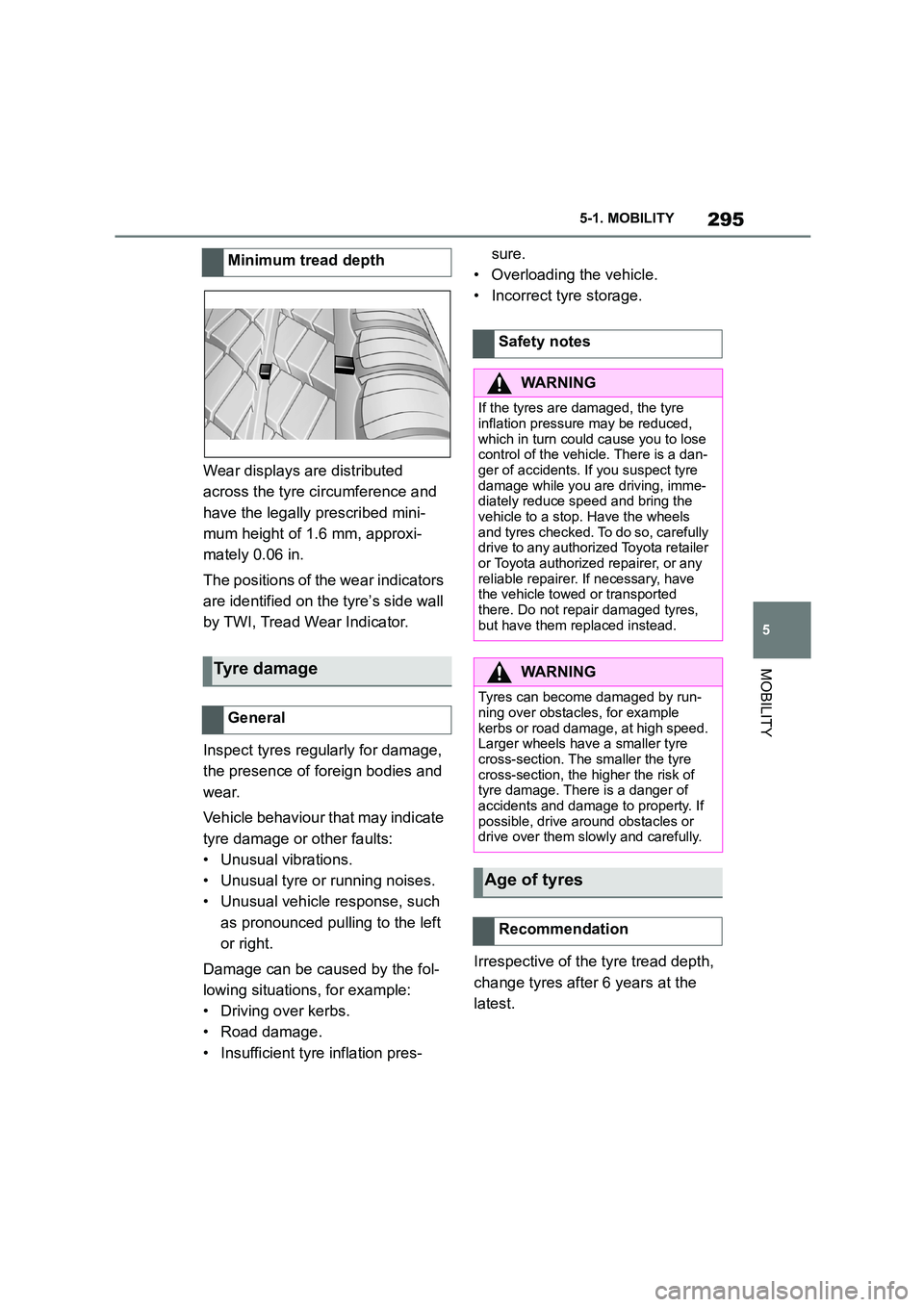
Wear displays are distributed
across the tyre circumference and
have the legally prescribed mini-
mum height of 1.6 mm, approxi-
mately 0.06 in.
The positions of the wear indicators
are identified on the tyre’s side wall
by TWI, Tread Wear Indicator.
Inspect tyres regularly for damage,
the presence of foreign bodies and
wear.
Vehicle behaviour that may indicate
tyre damage or other faults:
• Unusual vibrations.
• Unusual tyre or running noises.
• Unusual vehicle response, such
as pronounced pu lling to the left
or right.
Damage can be caused by the fol-
lowing situations, for example:
• Driving over kerbs.
• Road damage.
• Insufficient tyre inflation pres-
sure.
• Overloading the vehicle.
• Incorrect tyre storage.
Irrespective of the tyre tread depth,
change tyres after 6 years at the
latest.
Minimum tread depth
Tyre damage
General
Safety notes
WA R N I N G
If the tyres are damaged, the tyre
inflation pressure may be reduced,
which in turn could cause you to lose control of the vehicle. There is a dan-
ger of accidents. If you suspect tyre
damage while you are driving, imme- diately reduce speed and bring the
vehicle to a stop. Have the wheels
and tyres checked. To do so, carefully drive to any authorized Toyota retailer
or Toyota authorized repairer, or any
reliable repairer. If necessary, have the vehicle towed or transported
there. Do not repair damaged tyres,
but have them replaced instead.
WA R N I N G
Tyres can become damaged by run-
ning over obstacles, for example
kerbs or road damage, at high speed. Larger wheels have a smaller tyre
cross-section. The smaller the tyre
cross-section, the higher the risk of tyre damage. There is a danger of
accidents and damage to property. If
possible, drive around obstacles or drive over them slowly and carefully.
Age of tyres
Recommendation
Page 317 of 498
315
5
5-1. MOBILITY
MOBILITY
cial coding. The bolts can only be
released with the adapter that
matches the coding.
The adapter of the locking wheel
bolts can be found in the on-board
tool kit or in an oddments tray in the
on-board tool kit.
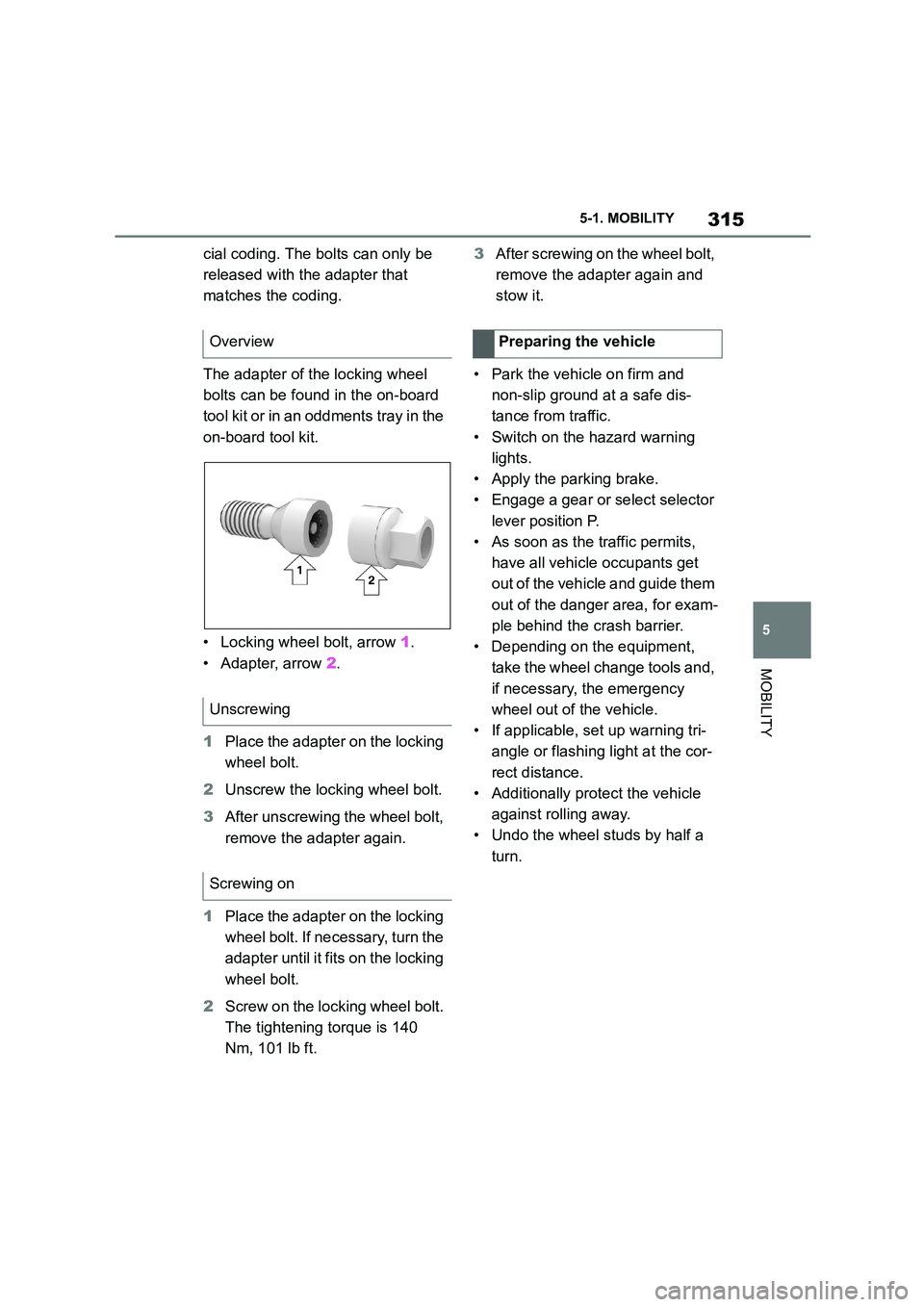
• Locking wheel bolt, arrow 1.
• Adapter, arrow 2.
1 Place the adapter on the locking
wheel bolt.
2 Unscrew the locking wheel bolt.
3 After unscrewing the wheel bolt,
remove the adapter again.
1 Place the adapter on the locking
wheel bolt. If necessary, turn the
adapter until it fi ts on the locking
wheel bolt.
2 Screw on the locking wheel bolt.
The tightening torque is 140
Nm, 101 lb ft.
3 After screwing on the wheel bolt,
remove the adapter again and
stow it.
• Park the vehicle on firm and
non-slip ground at a safe dis-
tance from traffic.
• Switch on the hazard warning
lights.
• Apply the parking brake.
• Engage a gear or select selector
lever position P.
• As soon as the traffic permits,
have all vehicle occupants get
out of the vehicle and guide them
out of the danger area, for exam-
ple behind the crash barrier.
• Depending on the equipment,
take the wheel change tools and,
if necessary, the emergency
wheel out of the vehicle.
• If applicable, set up warning tri-
angle or flashing light at the cor-
rect distance.
• Additionally protect the vehicle
against rolling away.
• Undo the wheel studs by half a
turn.
Overview
Unscrewing
Screwing on
Preparing the vehicle
Page 319 of 498
317
5
5-1. MOBILITY
MOBILITY
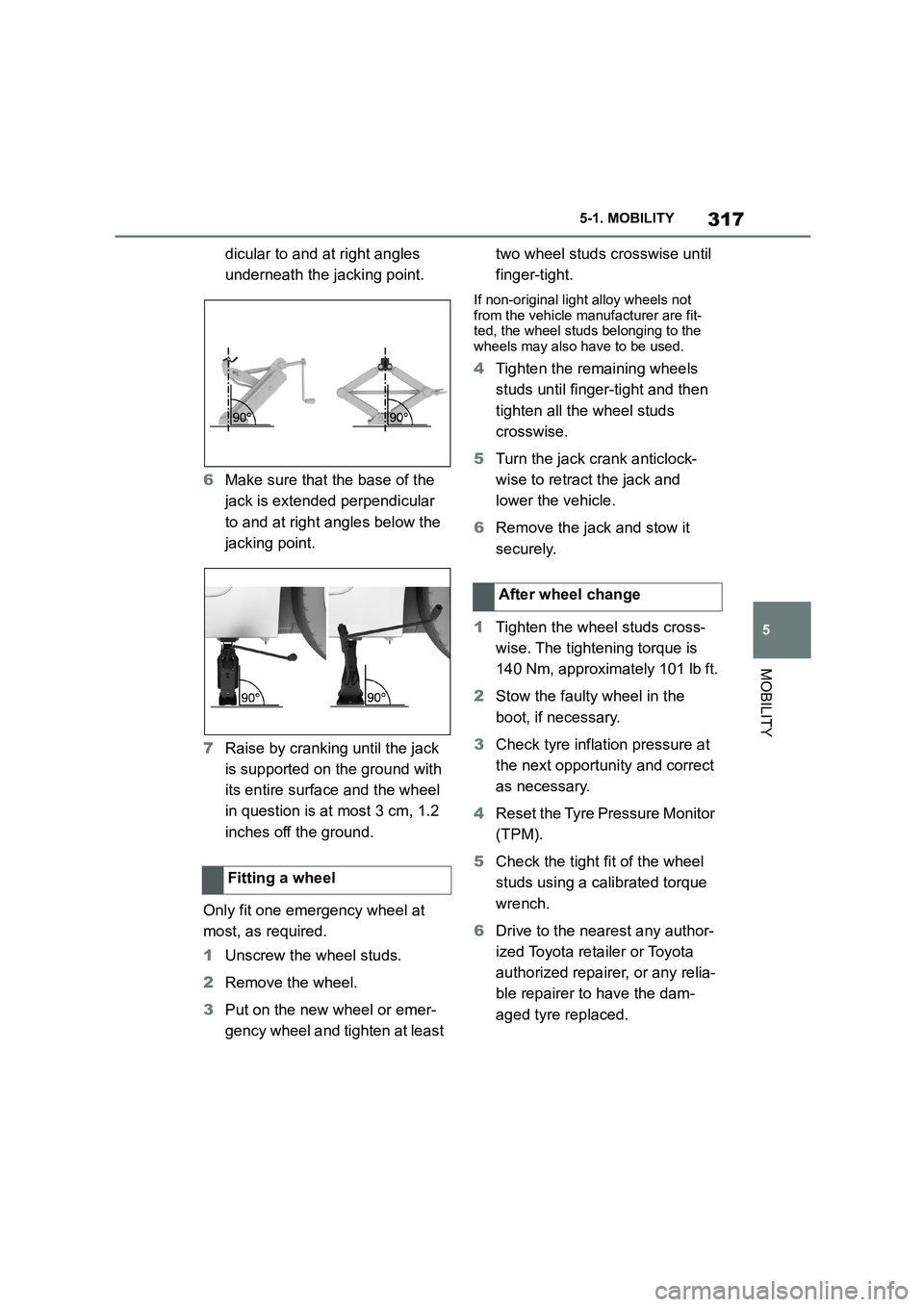
dicular to and at right angles
underneath the jacking point.
6 Make sure that the base of the
jack is extended perpendicular
to and at right angles below the
jacking point.
7 Raise by cranking until the jack
is supported on the ground with
its entire surface and the wheel
in question is at most 3 cm, 1.2
inches off the ground.
Only fit one emergency wheel at
most, as required.
1 Unscrew the wheel studs.
2 Remove the wheel.
3 Put on the new wheel or emer-
gency wheel and tighten at least
two wheel studs crosswise until
finger-tight.
If non-original light alloy wheels not
from the vehicle manufacturer are fit- ted, the wheel studs belonging to the
wheels may also have to be used.
4 Tighten the remaining wheels
studs until finger-tight and then
tighten all the wheel studs
crosswise.
5 Turn the jack crank anticlock-
wise to retract the jack and
lower the vehicle.
6 Remove the jack and stow it
securely.
1 Tighten the wheel studs cross-
wise. The tightening torque is
140 Nm, approximately 101 lb ft.
2 Stow the faulty wheel in the
boot, if necessary.
3 Check tyre inflation pressure at
the next opportunity and correct
as necessary.
4 Reset the Tyre Pressure Monitor
(TPM).
5 Check the tight fit of the wheel
studs using a calibrated torque
wrench.
6 Drive to the nearest any author-
ized Toyota reta iler or Toyota
authorized repairer, or any relia-
ble repairer to have the dam-
aged tyre replaced.
Fitting a wheel
After wheel change
Page 321 of 498
319
5
5-1. MOBILITY
MOBILITY
1 Stow the emergency wheel and
the tools for changing wheels in
the bag.
2 Place the bag in the boot.
3 Hook the lashing straps onto the
lashing eyes.
4 Tie the lashing straps. Make
sure that it is seated correctly
and firmly.
This chapter describes all standard,
country-specific and special equip-
ment available for the model series.
It may therefore describe equip-
ment and functions which are not
installed in your vehicle, for exam-
ple on account of the special equip-
ment selected or the country
specification. This also applies to
safety-relevant functions and sys-
tems. Please comply with the rele-
vant laws and regulations when
using the corresponding functions
and systems.
Inserting the emergency
wheel
Engine compar tment
Vehicle equipment
Page 359 of 498
357
5
5-1. MOBILITY
MOBILITY
Open the buckles on the retaining
strap.
To use the fire extinguisher, follow
the manufacturer's instructions on
the fire extinguisher and the infor-
mation supplied with it.
1 Insert the fire extinguisher into
the holder.
2 Hook in and close the buckles.
Have the fire extinguisher checked
every 2 years by any authorized
Toyota retailer or Toyota authorized
repairer, or any reliable repairer.
Take note of the next maintenance
date for the fire extinguisher.
Replace the fire extinguisher after
use or have it refilled.
If the vehicle battery is discharged,
the engine can be started from
another vehicle's battery using two
jump leads. Only use jump leads
with fully insulated terminal clamps.
1 Check whether the battery in the
other vehicle shows 12 volts.
Information about the voltage is
provided on the battery.
2 Switch off the engine of the
other vehicle.
WA R N I N G
Objects in the driver's footwell can
restrict the pedal travel or block a
pedal that has been pressed. There is a risk of accident. Ensure that items in
the vehicle are stowed securely and
cannot get into the driver's footwell.
Taking out the fire extin-
guisher
Using the fire extinguisher
Stowing the fire extinguisher
Maintenance and refilling
Starting assistance
General
Safety notes
WA R N I N G
Touching live components can result
in an electric shock. There is a danger
of injury or even death. Do not touch any components that could be live.
WA R N I N G
Connecting the jump leads in the wrong sequence can cause sparks.
There is a danger of injury. Please
comply with the correct sequence
when connecting up.
NOTICE
Contact between the bodywork of the
two vehicles can result in a short cir- cuit during starting assistance. There
is a danger of damage to property.
Make sure there is no contact between the bodywork.
Preparations
Page 361 of 498
359
5
5-1. MOBILITY
MOBILITY
Do not have the vehicle towed.
To remove a broken-down vehicle
from a dangerous area, it can be
pushed for a short distance.
To roll or push the vehicle, see
page 156.
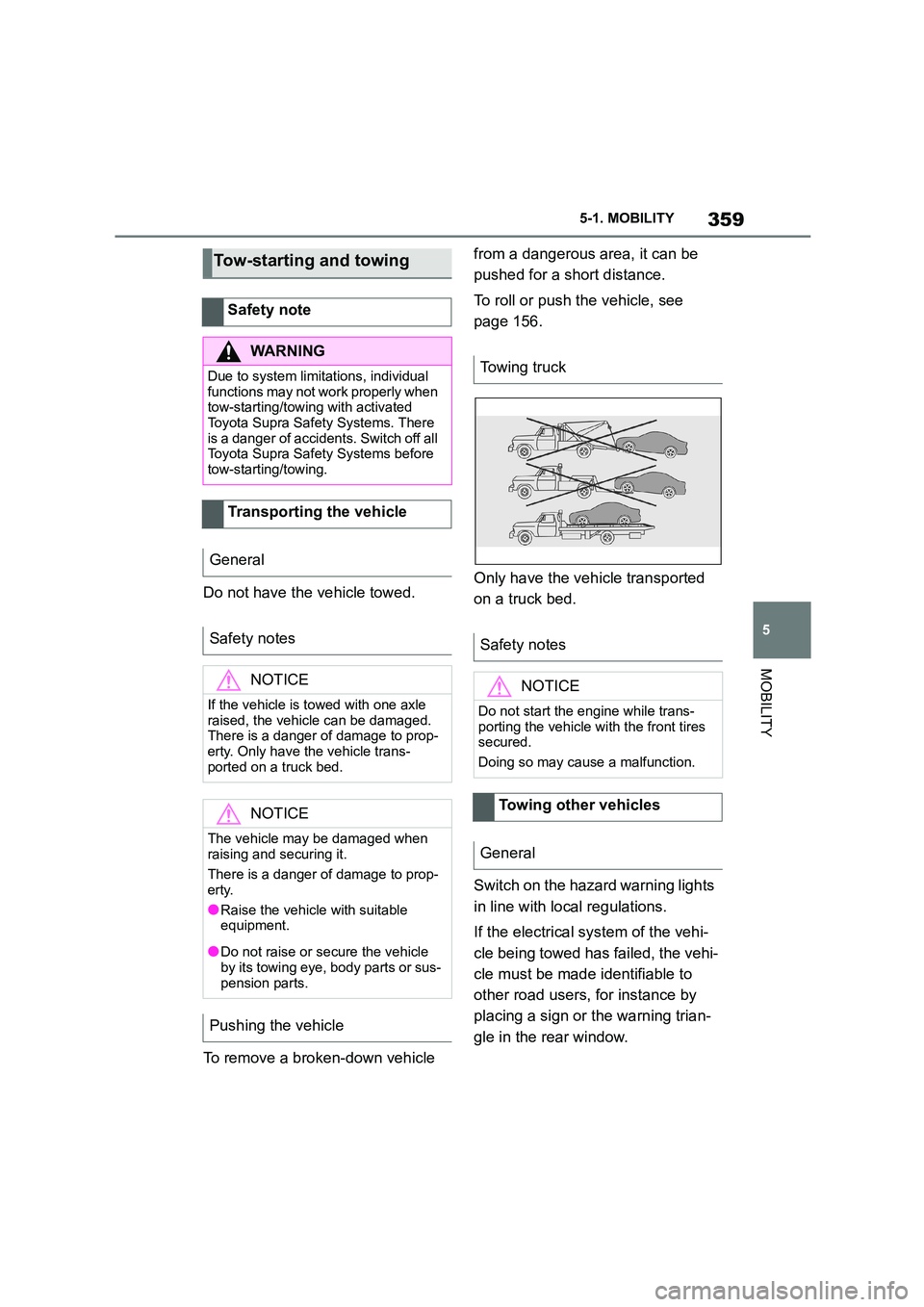
Only have the vehicle transported
on a truck bed.
Switch on the hazard warning lights
in line with local regulations.
If the electrical system of the vehi-
cle being towed has failed, the vehi-
cle must be made identifiable to
other road users, for instance by
placing a sign or the warning trian-
gle in the rear window.
Tow-starting and towing
Safety note
WA R N I N G
Due to system limitations, individual
functions may not work properly when
tow-starting/towing with activated
Toyota Supra Safety Systems. There is a danger of accidents. Switch off all
Toyota Supra Safety Systems before
tow-starting/towing.
Transporting the vehicle
General
Safety notes
NOTICE
If the vehicle is towed with one axle raised, the vehicle can be damaged.
There is a danger of damage to prop-
erty. Only have the vehicle trans- ported on a truck bed.
NOTICE
The vehicle may be damaged when raising and securing it.
There is a danger of damage to prop-
erty.
●Raise the vehicle with suitable
equipment.
●Do not raise or secure the vehicle by its towing eye, body parts or sus-
pension parts.
Pushing the vehicle
Towing truck
Safety notes
NOTICE
Do not start the engine while trans-
porting the vehicle with the front tires secured.
Doing so may cause a malfunction.
Towing other vehicles
General
Page 362 of 498
3605-1. MOBILITY
The towing eyes of both vehicles
should be on the same side.
If it is impossible to avoid attaching
the tow bar at an angle, note the
following:
Tow bar clearance may be lim-
ited when cornering.
The tow bar will generate lateral
forces if it is attached at an
angle.
Note the following if using a towing
rope:
• Use nylon ropes or straps that
will allow the vehi cle to be towed
smoothly.
• Fasten the towing rope so it is
not twisted.
• Check the towing eye and towing
rope fastening regularly.
• Do not exceed a towing speed of
50 km/h, 30 mph.
• Do not exceed a towing distance
of 5 km, 3 miles.
• Ensure that the towing rope is
taut when the towing vehicle
drives off.
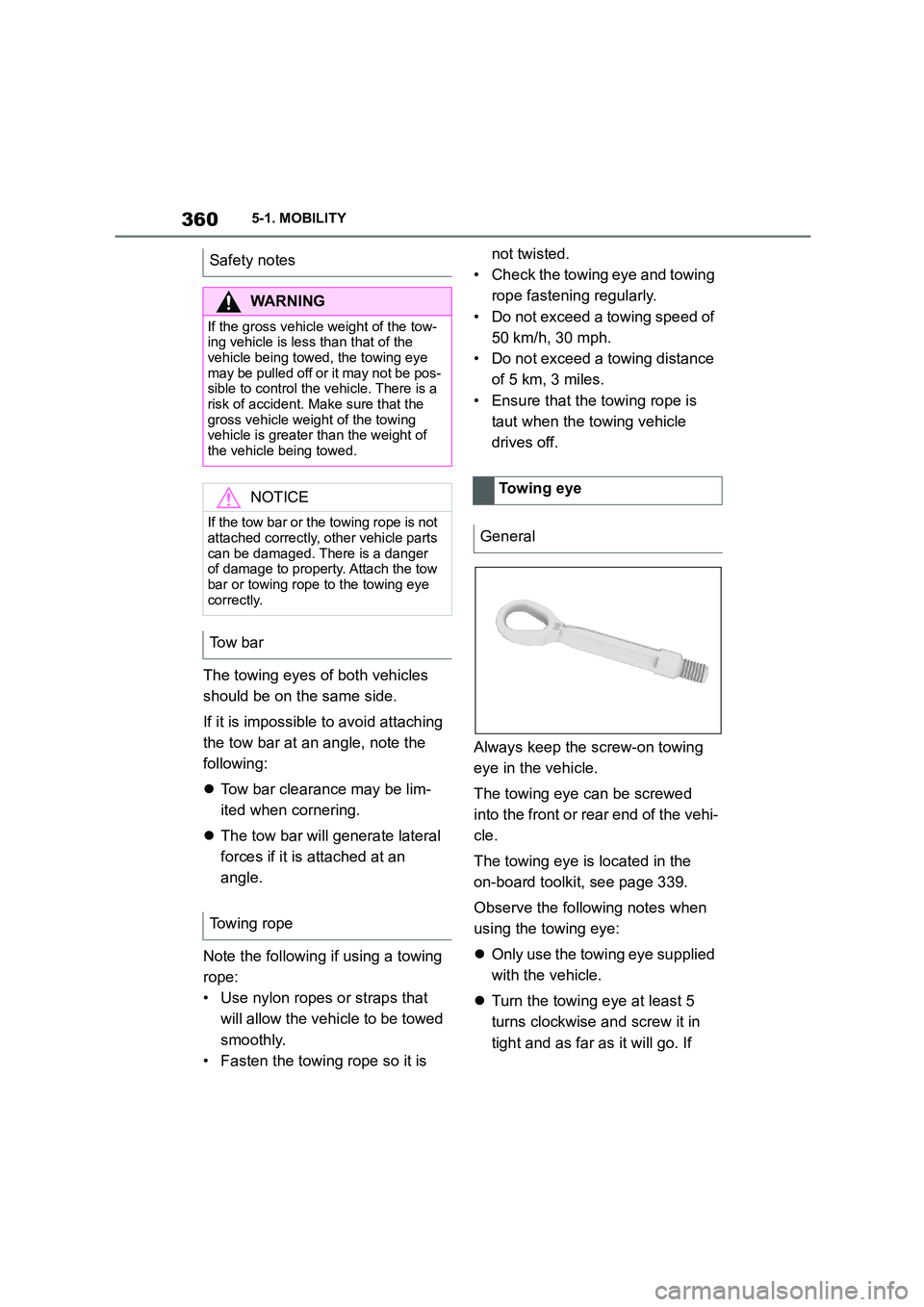
Always keep the screw-on towing
eye in the vehicle.
The towing eye can be screwed
into the front or rear end of the vehi-
cle.
The towing eye is located in the
on-board toolkit, see page 339.
Observe the following notes when
using the towing eye:
Only use the towing eye supplied
with the vehicle.
Turn the towing eye at least 5
turns clockwise an d screw it in
tight and as far as it will go. If
Safety notes
WA R N I N G
If the gross vehicle weight of the tow-
ing vehicle is less than that of the vehicle being towed, the towing eye
may be pulled off or it may not be pos-
sible to control the vehicle. There is a risk of accident. Ma ke sure that the
gross vehicle weight of the towing
vehicle is greater than the weight of
the vehicle being towed.
NOTICE
If the tow bar or the towing rope is not
attached correctly, other vehicle parts can be damaged. There is a danger
of damage to property. Attach the tow
bar or towing rope to the towing eye correctly.
To w b a r
Towing rope
Towing eye
General