clock TOYOTA SUPRA 2022 Owners Manual
[x] Cancel search | Manufacturer: TOYOTA, Model Year: 2022, Model line: SUPRA, Model: TOYOTA SUPRA 2022Pages: 498, PDF Size: 104.06 MB
Page 42 of 498
402-1. QUICK REFERENCE
Pull the wiper lever.
1 Tap the rear edge of the fuel
filler flap to open it.
2 Turn the fuel tank cap anticlock-
wise.
3 Place the fuel tank cap in the
holder on the fuel filler flap.
For optimal fuel consumption, the
petrol should be sulphur-free or low
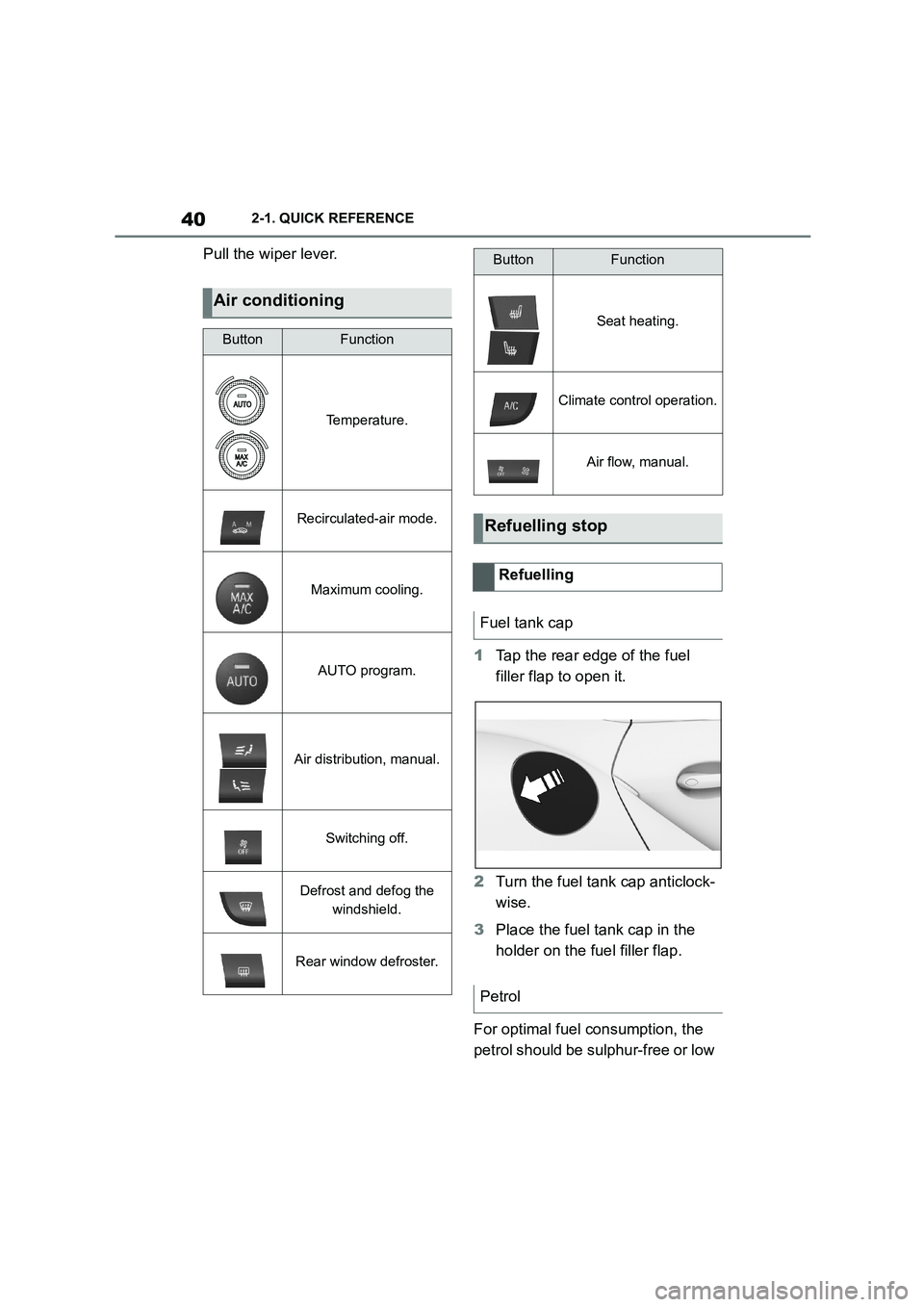
Air conditioning
ButtonFunction
Temperature.
Recirculated-air mode.
Maximum cooling.
AUTO program.
Air distribution, manual.
Switching off.
Defrost and defog the
windshield.
Rear window defroster.
Seat heating.
Climate control operation.
Air flow, manual.
Refuelling stop
Refuelling
Fuel tank cap
Petrol
ButtonFunction
Page 196 of 498
1943-1. CONTROLS
collision, for example, in minor acci-
dents.
Keep your distance from the
airbags.
Always grip the steering wheel
on the steering wheel rim. Place
your hands in the 3 o'clock and 9
o'clock positions to minimise the
risk of injury to hands or arms
when the airbag deploys.
Adjust the seat and steering
wheel so the driver can reach
over the steering wheel diago-
nally. Select the settings so that,
when reaching over, the shoul-
ders stay in contact with the
backrest and the upper body
stays as far away from the steer-
ing wheel as possible.
Make sure that the front-seat
passenger is sitting correctly, i.e.
with their feet and legs in the
footwell, not resting on the dash-
board.
Make sure that vehicle occu-
pants keep their head away from
the side airbag.
Do not place any other persons,
pets or objects between the
airbags and occupants.
Keep the dashboard and wind-
screen area on the passenger
side clear, for example do not
attach adhesive foil or covers
and do not fit brackets for navi-
gation devices or mobile tele-
phones.
Do not glue the airbag covers
and do not cover or modify them
in any way.
Do not use the front airbag cover
on the front passenger's side as
a tray.
Do not install seat covers, cush-
ions or other objects on the front
seats if they are not specifically
designed for use on seats with
integral side airbags.
Do not hang items of clothing for
example coats or jackets over
the backrests.
Do not modify individual compo-
nents of the system or its wiring
in any way. This also applies to
the covers of the steering wheel,
the dashboard and seats.
Do not dismantle the airbag sys-
tem.
Even if all this information is
observed, depending on the cir-
cumstances in which an accident
occurs, certain injuries as a result
of contact with the airbag cannot be
Notes on achieving optimum
airbag effectiveness
WA R N I N G
If the seat position is wrong or the
deployment area of the airbag is
restricted, the airbag system cannot provide the intended protection or
may cause additional injuries when it
deploys. There is a danger of injury or even death. Observe the following to
achieve optimum protective effect.
Page 264 of 498
2623-1. CONTROLS
Press any button, with the following
exceptions:
Switch off.
Rear window heating.
Seat heating.
Complete system:
The automatic air conditioning
adjusts to the set temperature as
quickly as possible, using maxi-
mum cooling or heating power if
necessary. The temperature is then
maintained.
Via Toyota Supra Command:
1 "My Vehicle"
2 "Vehicle settings"
3 "Climate comfort"
4 "Temperature adjustment, upper
body"
5 Set the desired temperature.
Avoid switching between different
temperature settings in rapid suc-
cession. The automatic air condi-
tioning may not have sufficient time
to establish the temperature
selected.
Interior air is cooled and dried, then
reheated to suit the temperature
setting.
The interior can only be cooled
when drive-ready state is switched
on.
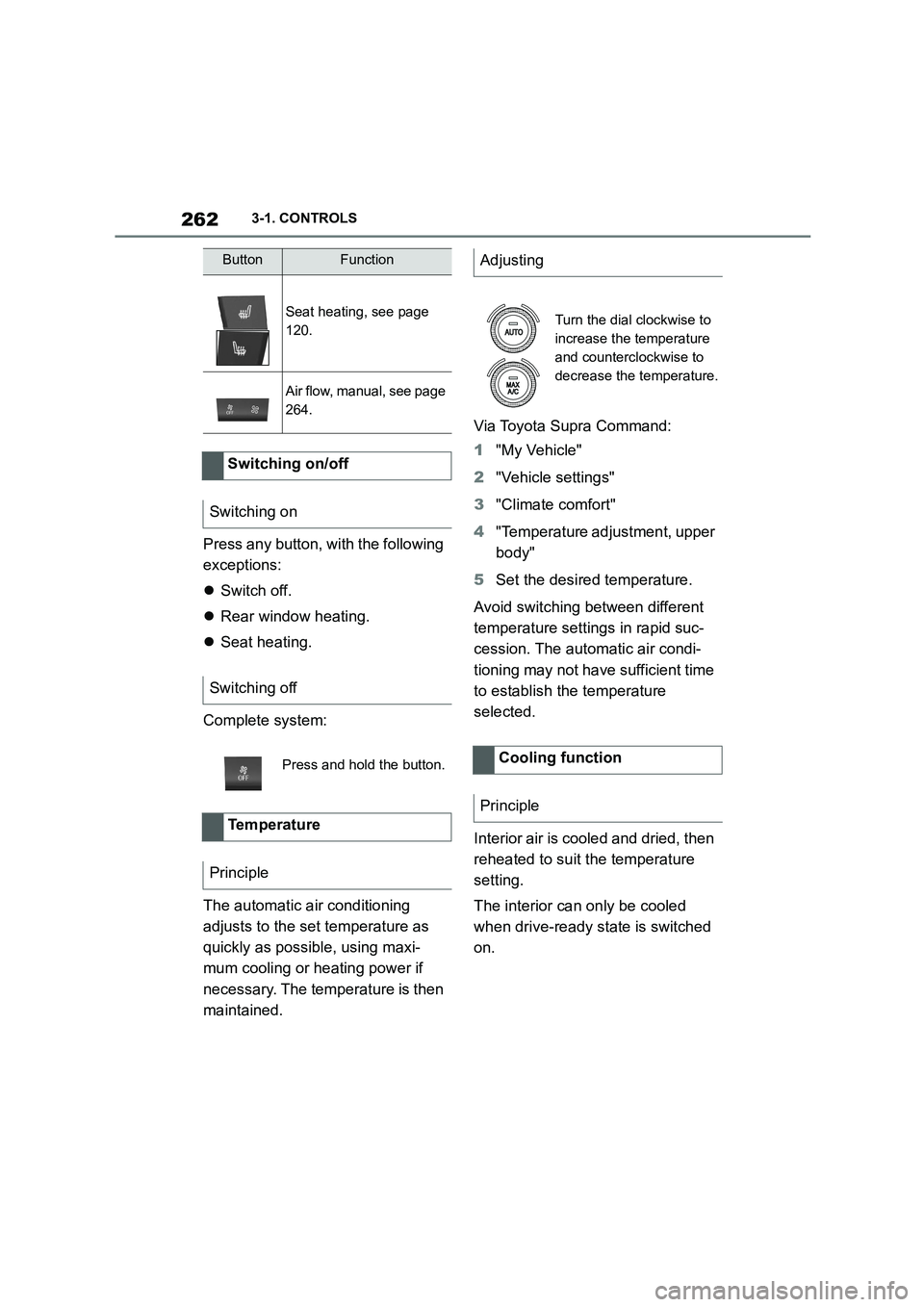
Seat heating, see page
120.
Air flow, manual, see page
264.
Switching on/off
Switching on
Switching off
Press and hold the button.
Temperature
Principle
ButtonFunctionAdjusting
Turn the dial clockwise to
increase the temperature
and counterclockwise to
decrease the temperature.
Cooling function
Principle
Page 293 of 498
291
5
5-1. MOBILITY
MOBILITY
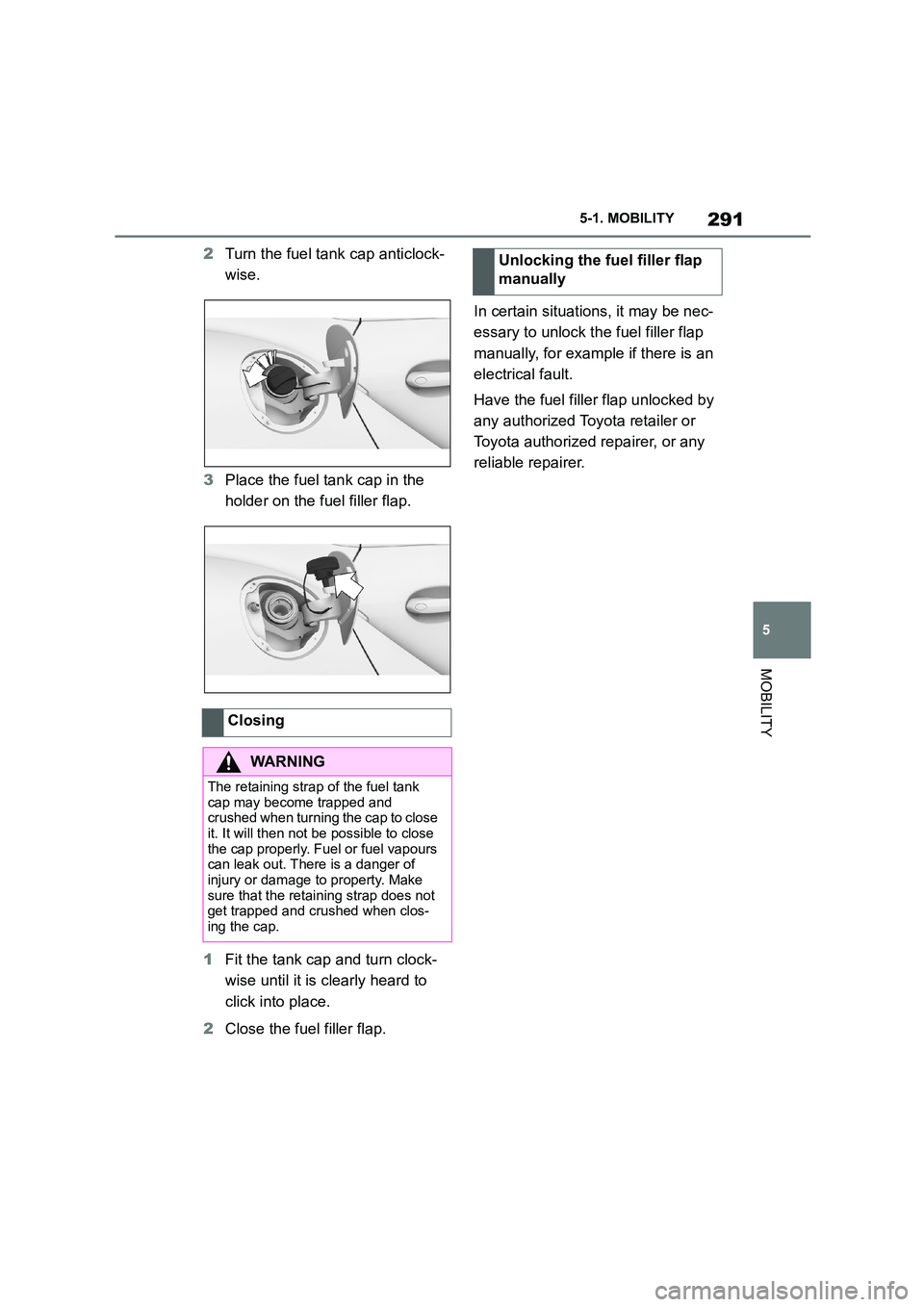
2 Turn the fuel tank cap anticlock-
wise.
3 Place the fuel tank cap in the
holder on the fuel filler flap.
1 Fit the tank cap and turn clock-
wise until it is clearly heard to
click into place.
2 Close the fuel filler flap.
In certain situations, it may be nec-
essary to unlock th e fuel filler flap
manually, for example if there is an
electrical fault.
Have the fuel filler flap unlocked by
any authorized Toyota retailer or
Toyota authorized repairer, or any
reliable repairer.
Closing
WA R N I N G
The retaining strap of the fuel tank
cap may become trapped and crushed when turning the cap to close
it. It will then not be possible to close
the cap properly. Fuel or fuel vapours can leak out. There is a danger of
injury or damage to property. Make
sure that the retaining strap does not get trapped and crushed when clos-
ing the cap.
Unlocking the fuel filler flap
manually
Page 318 of 498
3165-1. MOBILITY
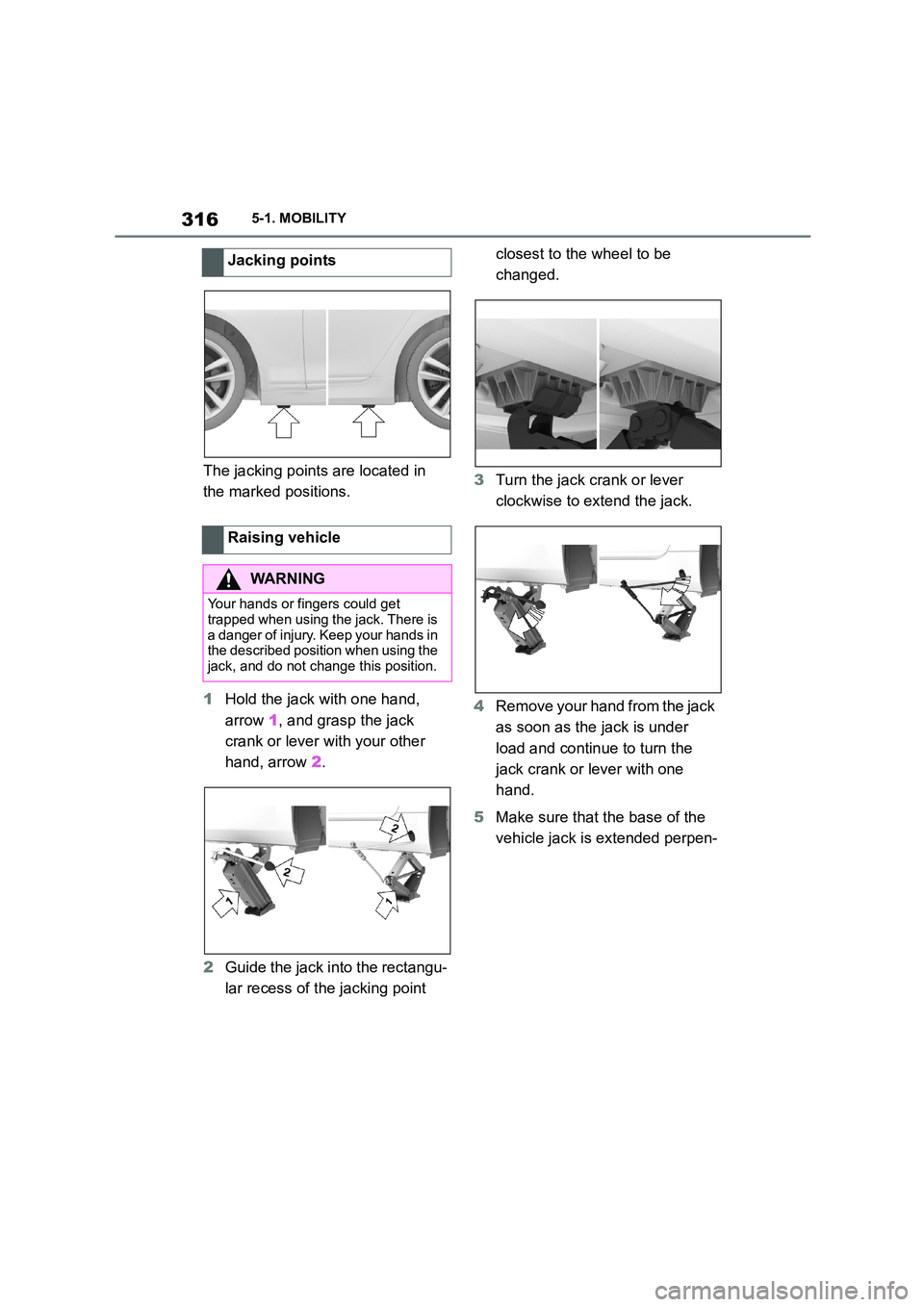
The jacking points are located in
the marked positions.
1 Hold the jack with one hand,
arrow 1, and grasp the jack
crank or lever with your other
hand, arrow 2.
2 Guide the jack into the rectangu-
lar recess of the jacking point
closest to the wheel to be
changed.
3 Turn the jack crank or lever
clockwise to extend the jack.
4 Remove your hand from the jack
as soon as the jack is under
load and continue to turn the
jack crank or lever with one
hand.
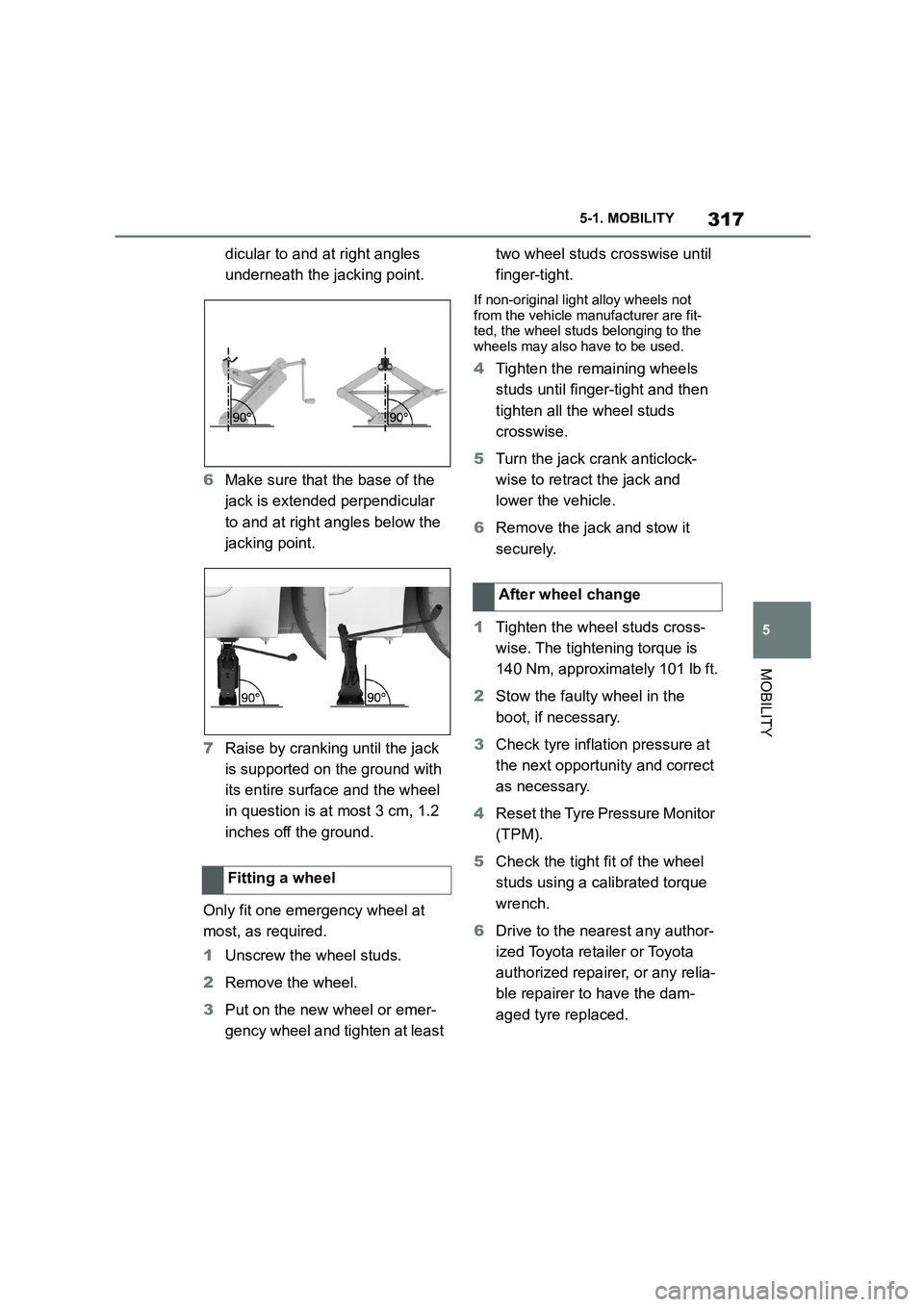
5 Make sure that the base of the
vehicle jack is extended perpen-
Jacking points
Raising vehicle
WA R N I N G
Your hands or fingers could get
trapped when using the jack. There is a danger of injury. Keep your hands in
the described position when using the
jack, and do not change this position.
Page 319 of 498
317
5
5-1. MOBILITY
MOBILITY
dicular to and at right angles
underneath the jacking point.
6 Make sure that the base of the
jack is extended perpendicular
to and at right angles below the
jacking point.
7 Raise by cranking until the jack
is supported on the ground with
its entire surface and the wheel
in question is at most 3 cm, 1.2
inches off the ground.
Only fit one emergency wheel at
most, as required.
1 Unscrew the wheel studs.
2 Remove the wheel.
3 Put on the new wheel or emer-
gency wheel and tighten at least
two wheel studs crosswise until
finger-tight.
If non-original light alloy wheels not
from the vehicle manufacturer are fit- ted, the wheel studs belonging to the
wheels may also have to be used.
4 Tighten the remaining wheels
studs until finger-tight and then
tighten all the wheel studs
crosswise.
5 Turn the jack crank anticlock-
wise to retract the jack and
lower the vehicle.
6 Remove the jack and stow it
securely.
1 Tighten the wheel studs cross-
wise. The tightening torque is
140 Nm, approximately 101 lb ft.
2 Stow the faulty wheel in the
boot, if necessary.
3 Check tyre inflation pressure at
the next opportunity and correct
as necessary.
4 Reset the Tyre Pressure Monitor
(TPM).
5 Check the tight fit of the wheel
studs using a calibrated torque
wrench.
6 Drive to the nearest any author-
ized Toyota reta iler or Toyota
authorized repairer, or any relia-
ble repairer to have the dam-
aged tyre replaced.
Fitting a wheel
After wheel change
Page 328 of 498
3265-1. MOBILITY
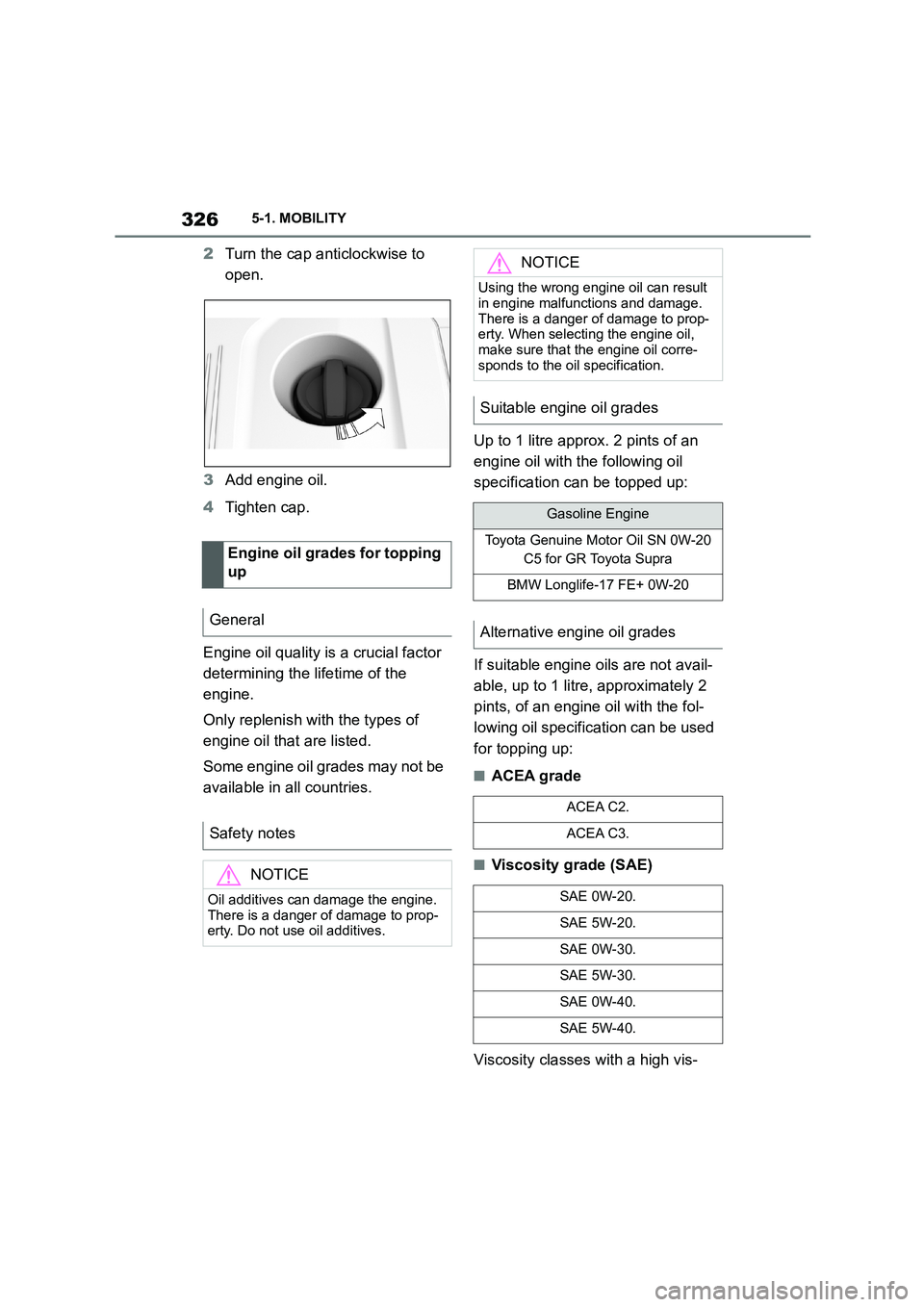
2Turn the cap anticlockwise to
open.
3 Add engine oil.
4 Tighten cap.
Engine oil quality is a crucial factor
determining the lifetime of the
engine.
Only replenish with the types of
engine oil that are listed.
Some engine oil grades may not be
available in all countries.
Up to 1 litre approx. 2 pints of an
engine oil with the following oil
specification can be topped up:
If suitable engine oils are not avail-
able, up to 1 litre, approximately 2
pints, of an engine oil with the fol-
lowing oil specification can be used
for topping up:
■ACEA grade
■Viscosity grade (SAE)
Viscosity classes with a high vis-
Engine oil grades for topping
up
General
Safety notes
NOTICE
Oil additives can damage the engine.
There is a danger of damage to prop- erty. Do not use oil additives.
NOTICE
Using the wrong engine oil can result
in engine malfunctions and damage.
There is a danger of damage to prop- erty. When selecting the engine oil,
make sure that the engine oil corre-
sponds to the oil specification.
Suitable engine oil grades
Gasoline Engine
Toyota Genuine Motor Oil SN 0W-20
C5 for GR Toyota Supra
BMW Longlife-17 FE+ 0W-20
Alternative engine oil grades
ACEA C2.
ACEA C3.
SAE 0W-20.
SAE 5W-20.
SAE 0W-30.
SAE 5W-30.
SAE 0W-40.
SAE 5W-40.
Page 330 of 498
3285-1. MOBILITY
be overfilled in the coolant tank.
The normal level of the coolant
level is achieved by prolonging the
operating time.
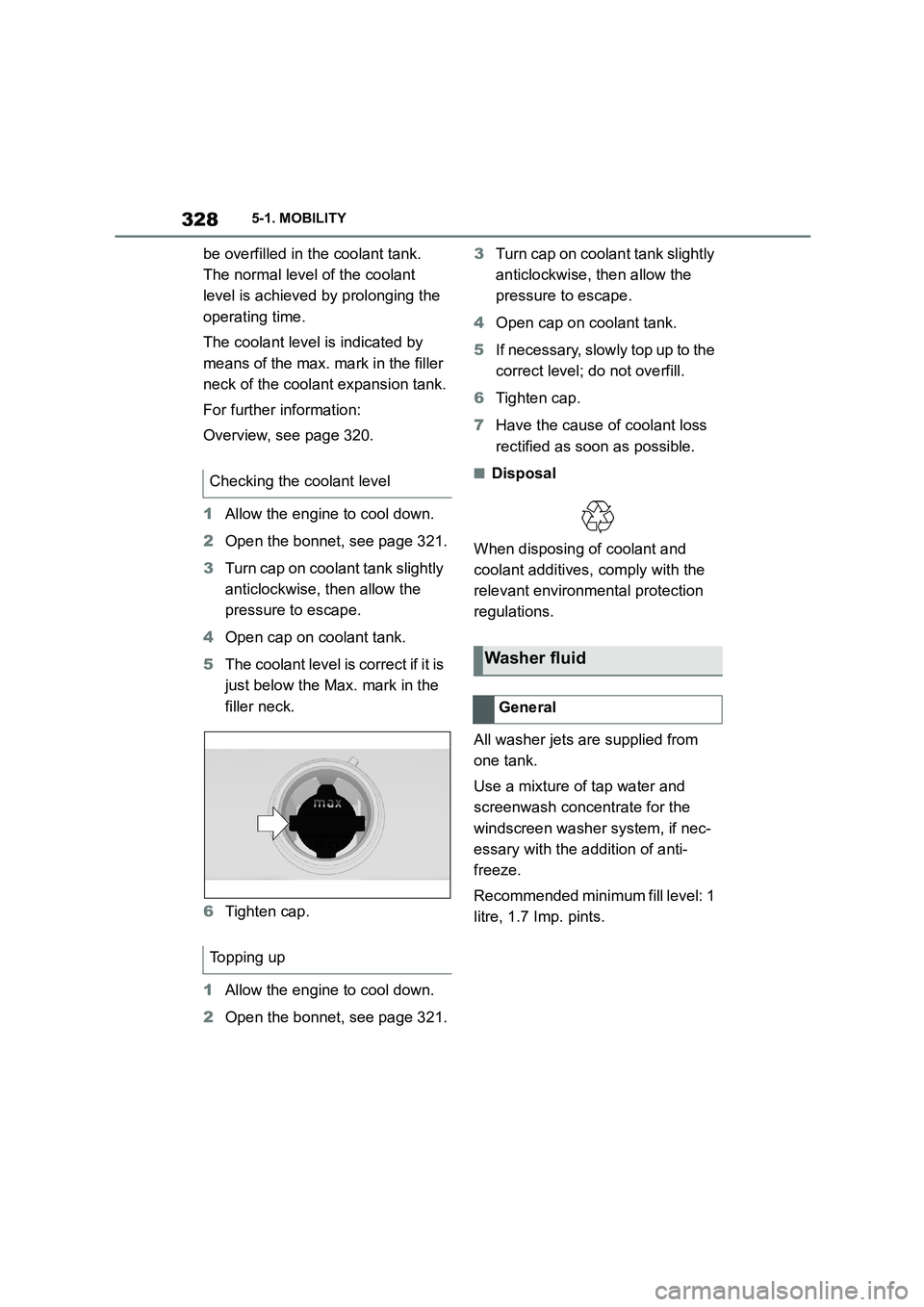
The coolant level is indicated by
means of the max. mark in the filler
neck of the coolant expansion tank.
For further information:
Overview, see page 320.
1 Allow the engine to cool down.
2 Open the bonnet, see page 321.
3 Turn cap on coolant tank slightly
anticlockwise, then allow the
pressure to escape.
4 Open cap on coolant tank.
5 The coolant level is correct if it is
just below the Max. mark in the
filler neck.
6 Tighten cap.
1 Allow the engine to cool down.
2 Open the bonnet, see page 321.
3 Turn cap on coolant tank slightly
anticlockwise, then allow the
pressure to escape.
4 Open cap on coolant tank.
5 If necessary, slowly top up to the
correct level; do not overfill.
6 Tighten cap.
7 Have the cause of coolant loss
rectified as soon as possible.
■Disposal
When disposing of coolant and
coolant additives, comply with the
relevant environmental protection
regulations.
All washer jets are supplied from
one tank.
Use a mixture of tap water and
screenwash concentrate for the
windscreen washer system, if nec-
essary with the addition of anti-
freeze.
Recommended minim um fill level: 1
litre, 1.7 Imp. pints.
Checking the coolant level
Topping up
Washer fluid
General
Page 362 of 498
3605-1. MOBILITY
The towing eyes of both vehicles
should be on the same side.
If it is impossible to avoid attaching
the tow bar at an angle, note the
following:
Tow bar clearance may be lim-
ited when cornering.
The tow bar will generate lateral
forces if it is attached at an
angle.
Note the following if using a towing
rope:
• Use nylon ropes or straps that
will allow the vehi cle to be towed
smoothly.
• Fasten the towing rope so it is
not twisted.
• Check the towing eye and towing
rope fastening regularly.
• Do not exceed a towing speed of
50 km/h, 30 mph.
• Do not exceed a towing distance
of 5 km, 3 miles.
• Ensure that the towing rope is
taut when the towing vehicle
drives off.
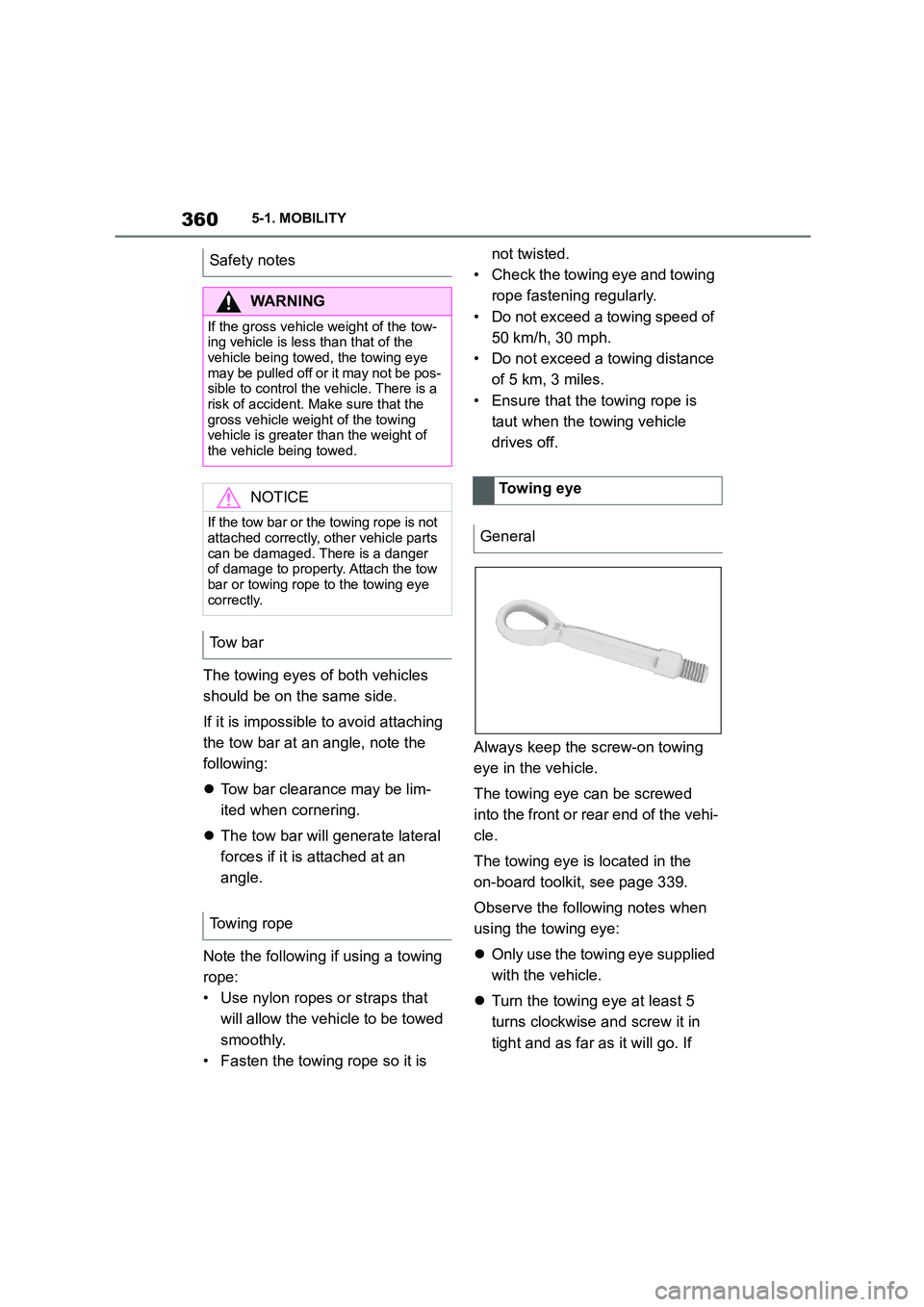
Always keep the screw-on towing
eye in the vehicle.
The towing eye can be screwed
into the front or rear end of the vehi-
cle.
The towing eye is located in the
on-board toolkit, see page 339.
Observe the following notes when
using the towing eye:
Only use the towing eye supplied
with the vehicle.
Turn the towing eye at least 5
turns clockwise an d screw it in
tight and as far as it will go. If
Safety notes
WA R N I N G
If the gross vehicle weight of the tow-
ing vehicle is less than that of the vehicle being towed, the towing eye
may be pulled off or it may not be pos-
sible to control the vehicle. There is a risk of accident. Ma ke sure that the
gross vehicle weight of the towing
vehicle is greater than the weight of
the vehicle being towed.
NOTICE
If the tow bar or the towing rope is not
attached correctly, other vehicle parts can be damaged. There is a danger
of damage to property. Attach the tow
bar or towing rope to the towing eye correctly.
To w b a r
Towing rope
Towing eye
General
Page 363 of 498
361
5
5-1. MOBILITY
MOBILITY
necessary, tighten with a suitable
object.
After use, unscrew the towing
eye in an anticlockwise direction.
Only use the towing eye for tow-
ing on paved roads.
Avoid transverse loads on the
towing eye, for example do not
raise the vehicle by the towing
eye.
Check the towing eye fastening
regularly.
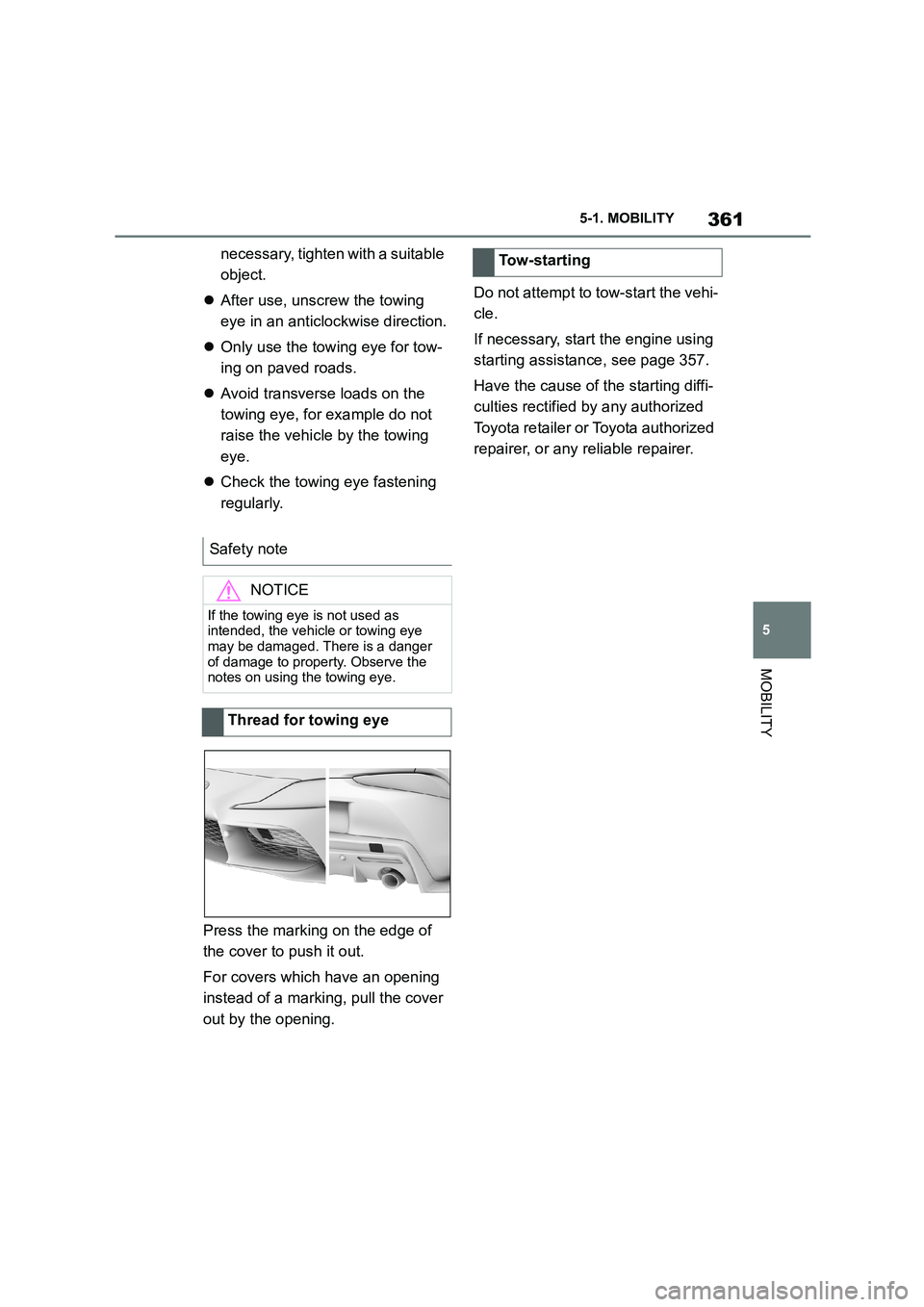
Press the marking on the edge of
the cover to push it out.
For covers which have an opening
instead of a marking, pull the cover
out by the opening.
Do not attempt to tow-start the vehi-
cle.
If necessary, start the engine using
starting assistance, see page 357.
Have the cause of the starting diffi-
culties rectified by any authorized
Toyota retailer or Toyota authorized
repairer, or any reliable repairer.
Safety note
NOTICE
If the towing eye is not used as
intended, the vehicle or towing eye
may be damaged. There is a danger of damage to property. Observe the
notes on using the towing eye.
Thread for towing eye
To w - s t a r t i n g