width TOYOTA SUPRA 2022 Owners Manual
[x] Cancel search | Manufacturer: TOYOTA, Model Year: 2022, Model line: SUPRA, Model: TOYOTA SUPRA 2022Pages: 498, PDF Size: 104.06 MB
Page 34 of 498
322-1. QUICK REFERENCE
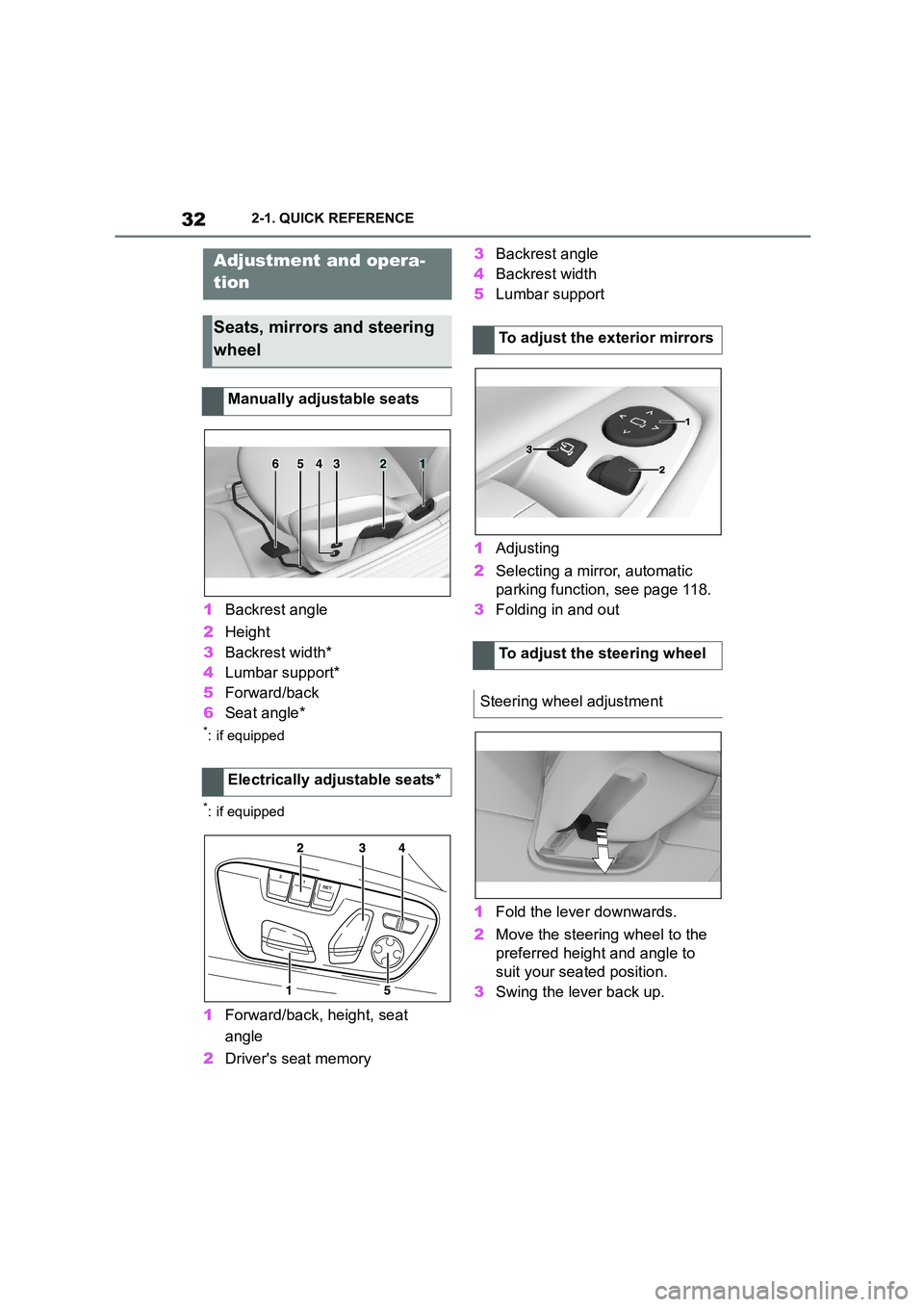
1Backrest angle
2 Height
3 Backrest width*
4 Lumbar support*
5 Forward/back
6 Seat angle*
*: if equipped
*: if equipped
1Forward/back, height, seat
angle
2 Driver's seat memory
3 Backrest angle
4 Backrest width
5 Lumbar support
1 Adjusting
2 Selecting a mirror, automatic
parking function, see page 118.
3 Folding in and out
1 Fold the lever downwards.
2 Move the steering wheel to the
preferred height and angle to
suit your seated position.
3 Swing the lever back up.
Adjustment and opera-
tion
Seats, mirrors and steering
wheel
Manually adjustable seats
Electrically adjustable seats*
654321
To adjust the exterior mirrors
To adjust the steering wheel
Steering wheel adjustment
Page 110 of 498
1083-1. CONTROLS
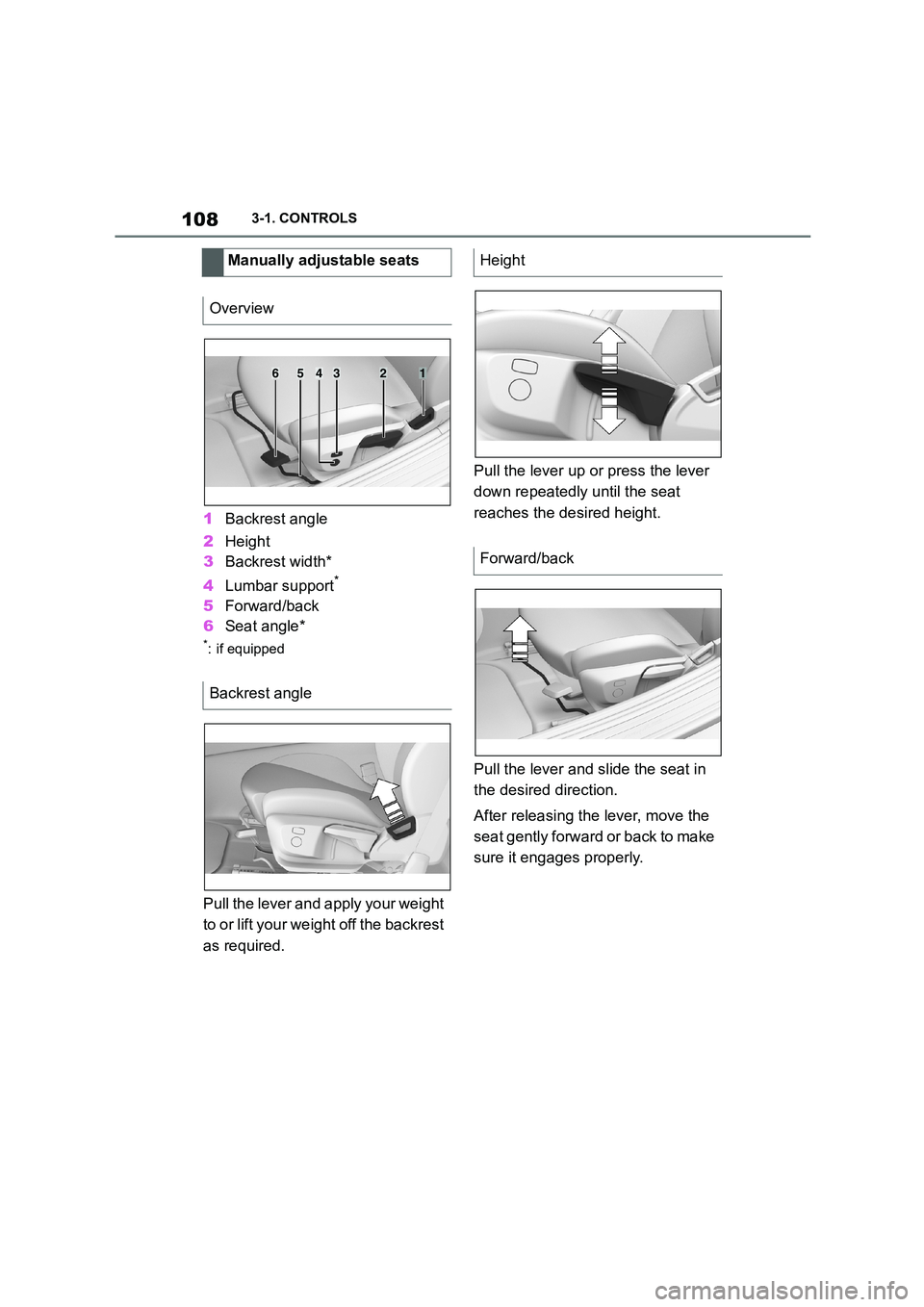
1Backrest angle
2 Height
3 Backrest width*
4 Lumbar support*
5Forward/back
6 Seat angle*
*: if equipped
Pull the lever and apply your weight
to or lift your weight off the backrest
as required.
Pull the lever up or press the lever
down repeatedly until the seat
reaches the desired height.
Pull the lever and slide the seat in
the desired direction.
After releasing the lever, move the
seat gently forward or back to make
sure it engages properly.
Manually adjustable seats
Overview
Backrest angle
654321
Height
Forward/back
Page 111 of 498
109
3
3-1. CONTROLS
CONTROLS
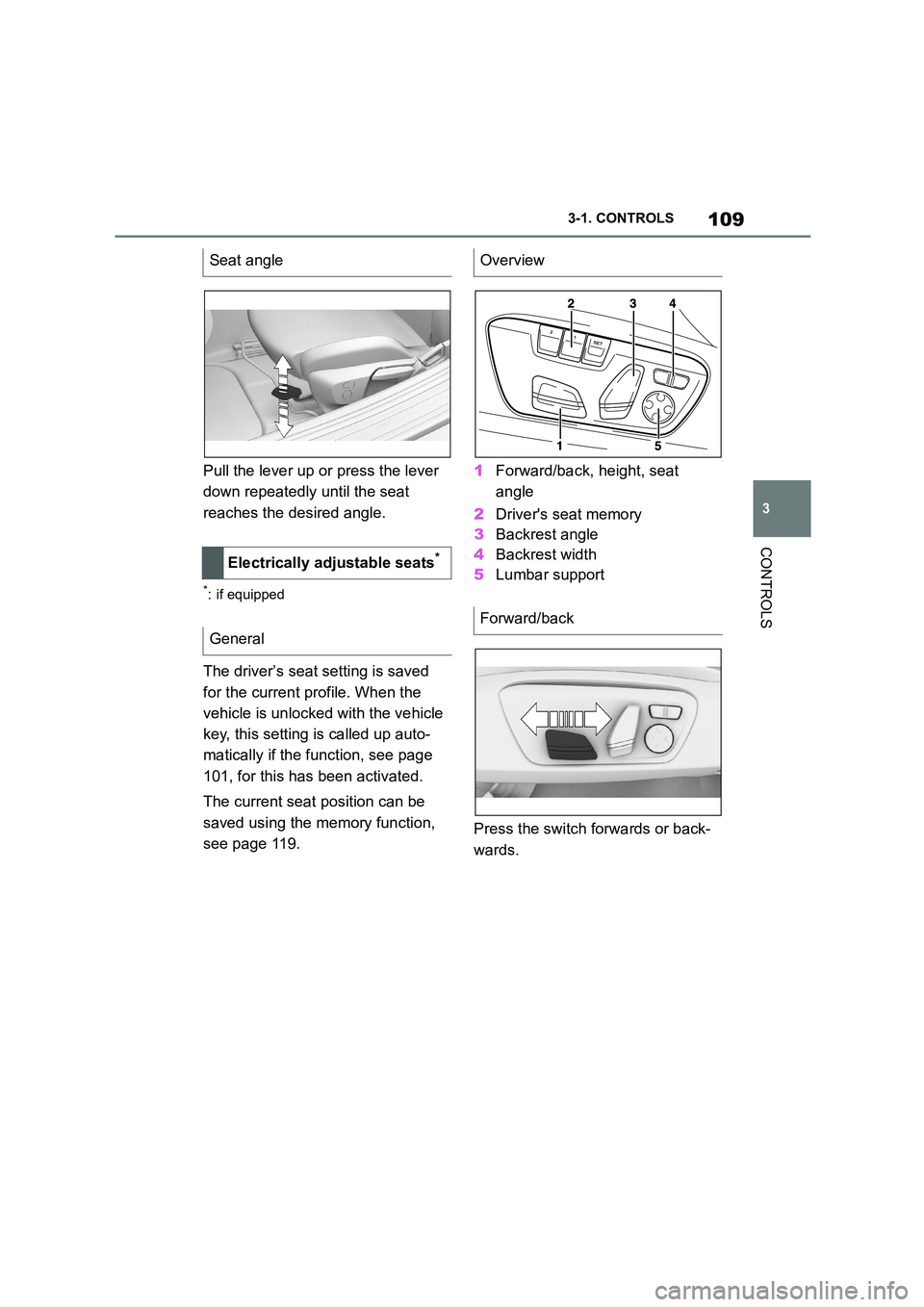
Pull the lever up or press the lever
down repeatedly until the seat
reaches the desired angle.
*: if equipped
The driver’s seat setting is saved
for the current profile. When the
vehicle is unlocked with the vehicle
key, this setting is called up auto-
matically if the f unction, see page
101, for this has been activated.
The current seat position can be
saved using the memory function,
see page 119.
1 Forward/back, height, seat
angle
2 Driver's seat memory
3 Backrest angle
4 Backrest width
5 Lumbar support
Press the switch forwards or back-
wards.
Seat angle
Electrically adjustable seats*
General
Overview
Forward/back
Page 112 of 498
1103-1. CONTROLS
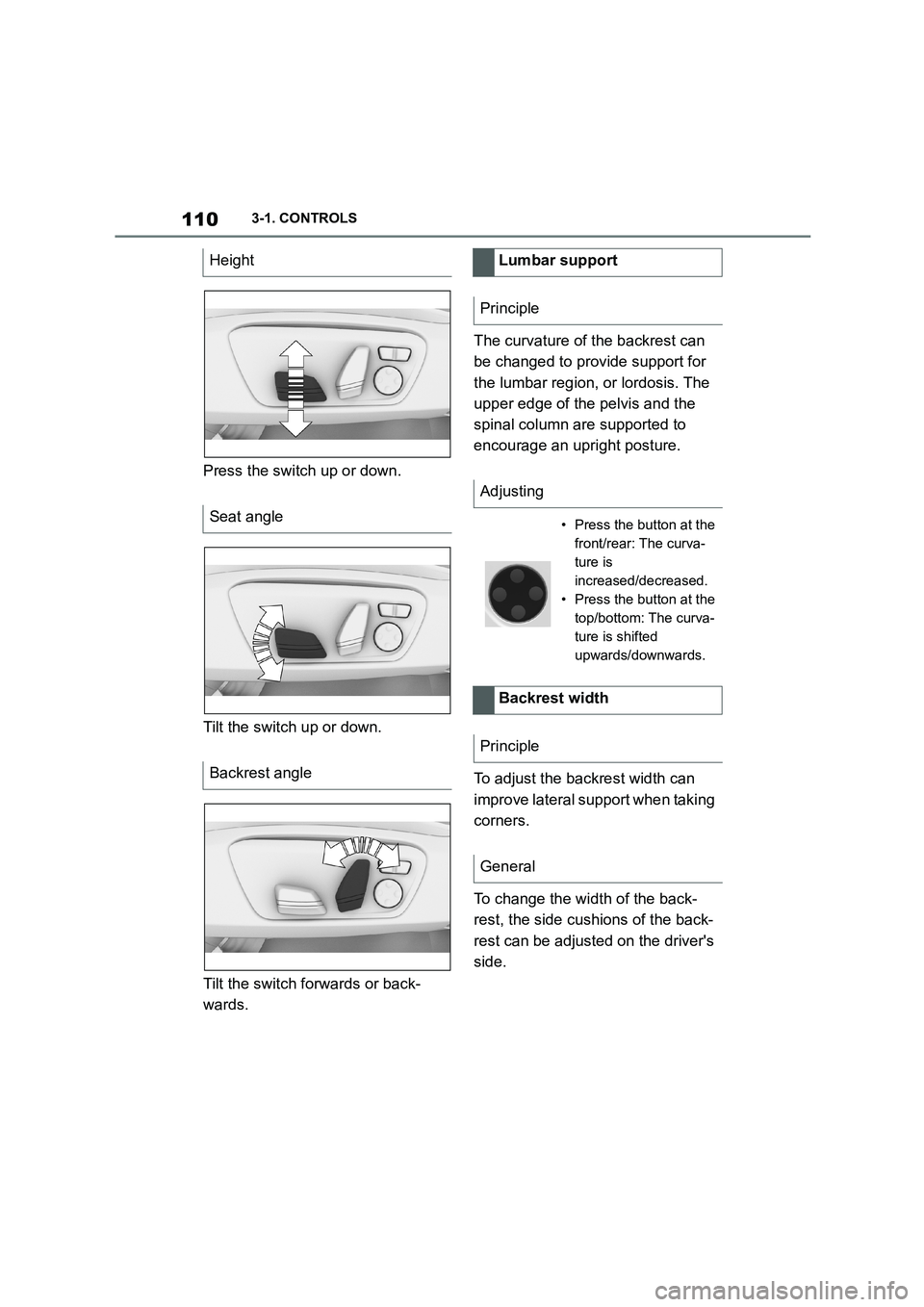
Press the switch up or down.
Tilt the switch up or down.
Tilt the switch forwards or back-
wards.
The curvature of the backrest can
be changed to provide support for
the lumbar region, or lordosis. The
upper edge of the pelvis and the
spinal column are supported to
encourage an upright posture.
To adjust the backrest width can
improve lateral support when taking
corners.
To change the width of the back-
rest, the side cushions of the back-
rest can be adjusted on the driver's
side.
Height
Seat angle
Backrest angle
Lumbar support
Principle
Adjusting
• Press the button at the
front/rear: The curva-
ture is
increased/decreased.
• Press the button at the
top/bottom: The curva-
ture is shifted
upwards/downwards.
Backrest width
Principle
General
Page 113 of 498
111
3
3-1. CONTROLS
CONTROLS
For the safety of the vehicle occu-
pants, the vehicle is equipped with
two seat belts. However, they can
only provide effective protection
when worn correctly.
Before a journey, always make sure
that all occupants have fastened
their seat belts. The airbags sup-
plement the seat belts as an addi-
tional safety device. The airbags
are not a substitute for the seat
belts.
All belt fastening points are
designed to achieve the best possi-
ble protective effe ct of the seat
belts with proper use of the seat
belts and correct seat setting.
Notes on sitting safely, see page
P.107.
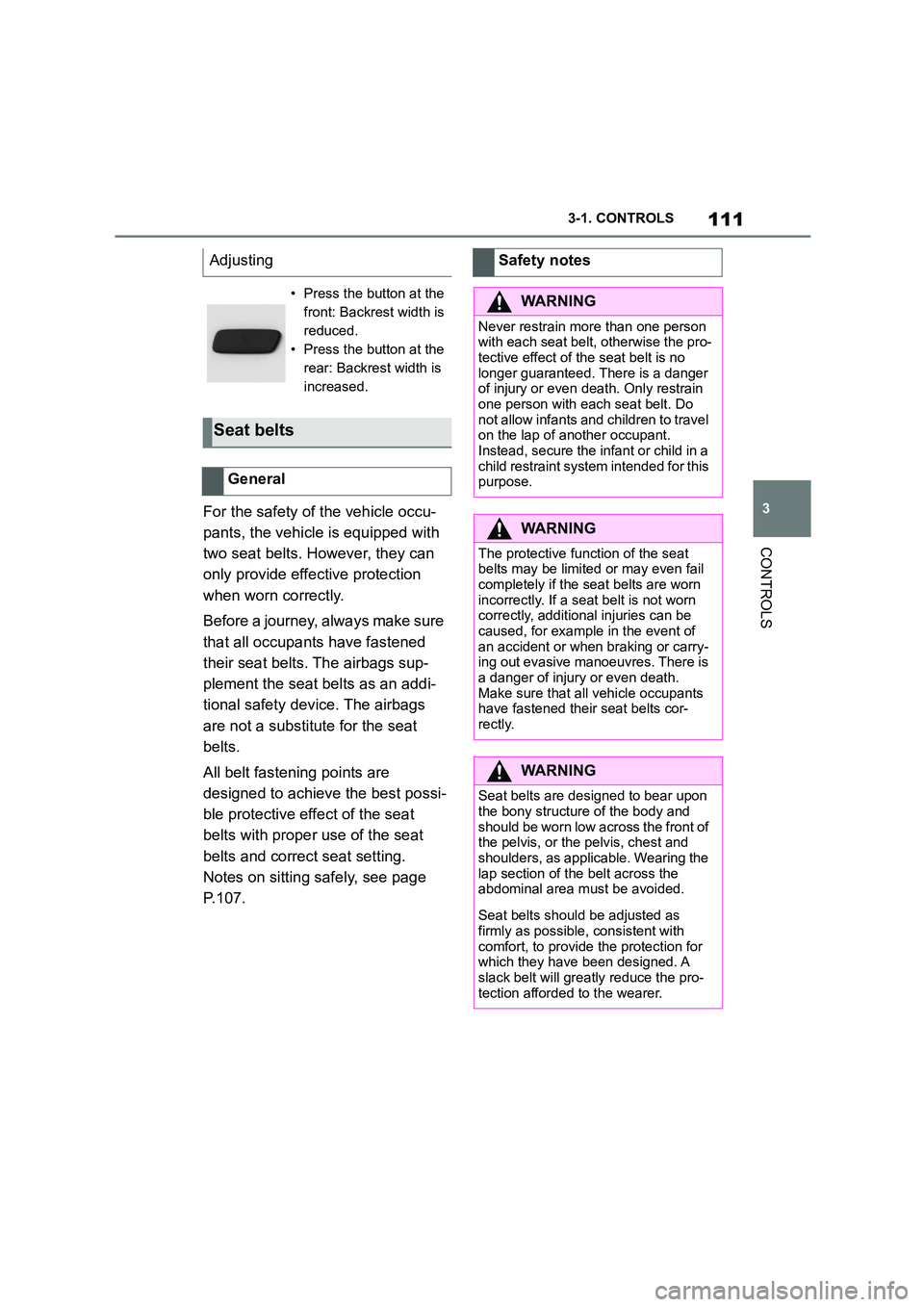
Adjusting
• Press the button at the
front: Backrest width is
reduced.
• Press the button at the
rear: Backrest width is
increased.
Seat belts
General
Safety notes
WA R N I N G
Never restrain more than one person
with each seat belt, otherwise the pro- tective effect of the seat belt is no
longer guaranteed. There is a danger
of injury or even death. Only restrain one person with each seat belt. Do
not allow infants and children to travel
on the lap of another occupant.
Instead, secure the infant or child in a child restraint system intended for this
purpose.
WA R N I N G
The protective function of the seat
belts may be limited or may even fail
completely if the seat belts are worn incorrectly. If a seat belt is not worn
correctly, additional injuries can be
caused, for example in the event of an accident or when braking or carry-
ing out evasive manoeuvres. There is
a danger of injury or even death.
Make sure that al l vehicle occupants have fastened their seat belts cor-
rectly.
WA R N I N G
Seat belts are designed to bear upon
the bony structure of the body and
should be worn low across the front of the pelvis, or the pelvis, chest and
shoulders, as applicable. Wearing the
lap section of the belt across the abdominal area must be avoided.
Seat belts should be adjusted as firmly as possible, consistent with
comfort, to provide the protection for
which they have been designed. A
slack belt will greatly reduce the pro- tection afforded to the wearer.
Page 120 of 498
1183-1. CONTROLS
In the event of an electrical fault,
press the edges of the mirror glass
to adjust the mirror.
Press the button.
Folding in is possible up to a speed
of approx. 20 km/h, 15 mph.
Folding the mirrors in and out is
useful in the following situations:
•In car washes.
• In narrow streets.
Folded-in mirrors automatically fold
out when the vehicle reaches a
speed of approx. 40 km/h, 25 mph.
If required, both exterior mirrors are
automatically heated when
drive-ready state is switched on.
The exterior mirror on the driver's
side is automatically dimmed. Pho-
tocells in the rear -view mirror, see
page 118, to control this function.
When reverse gear is engaged, the
mirror glass on the front passenger
side is tilted downwards. This
improves the view of the kerb or
other obstacles near the ground, for
example when parking.
1 Push the switch to the
driver's mirror position.
2 Engage selector lever position
R.
Push the switch to the front passen-
ger's mirror position.
The rear-view mirror is dimmed
automatically.
The function is controlled by photo-
cells:
• In the mirror glass.
• On the back of the mirror.
Malfunction
Folding in and out
NOTICE
Because of its width, the vehicle could
sustain damage in car washes. There is a danger of damage to property.
Before washing, fold the mirrors in
manually or with the button.
Automatic heating
Automatically dimming
Automatic parking function,
exterior mirror
Principle
Activating
Deactivating
Rear-view mirror, automatic
dim
General
Page 121 of 498
119
3
3-1. CONTROLS
CONTROLS
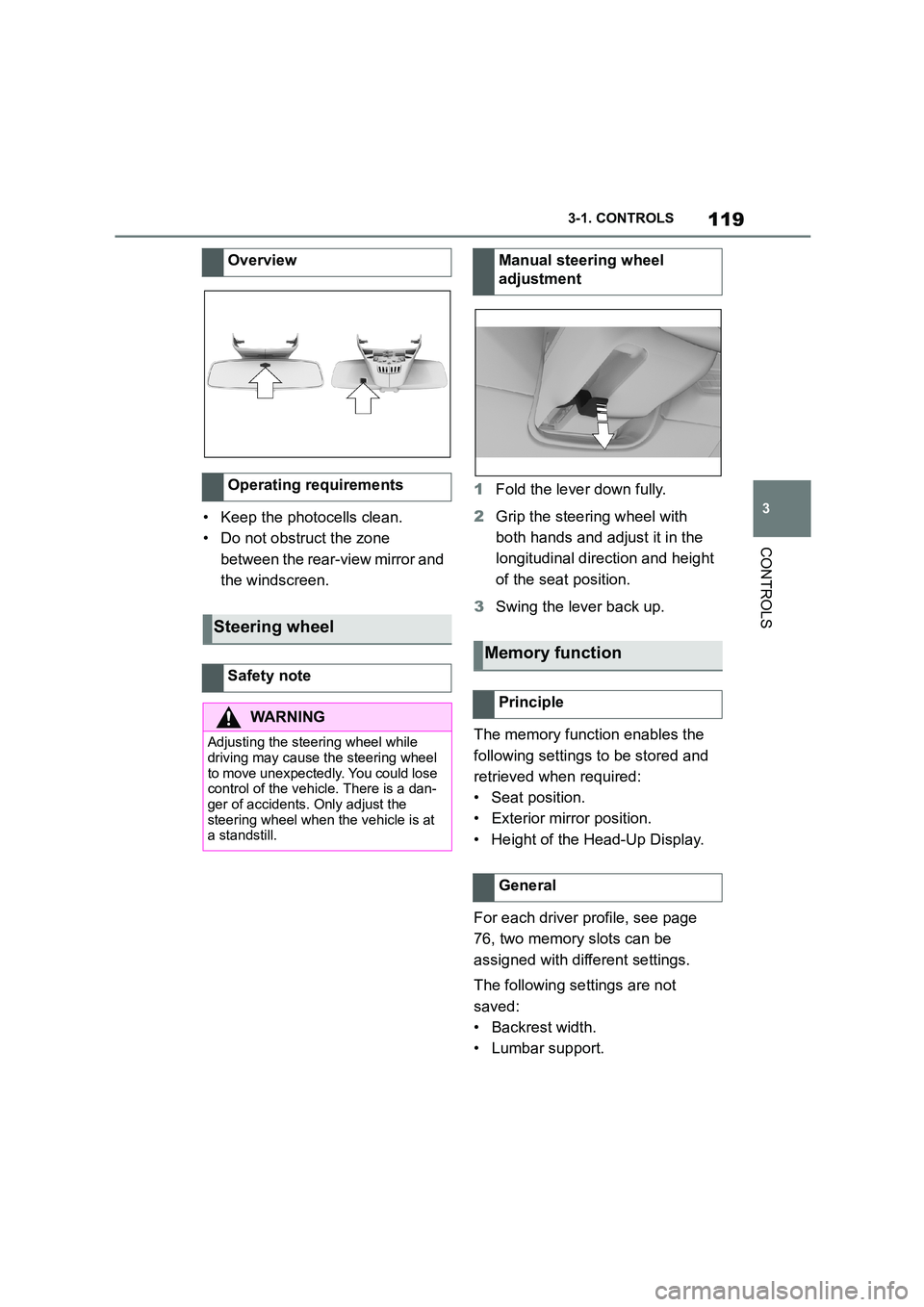
• Keep the photocells clean.
• Do not obstruct the zone
between the rear-view mirror and
the windscreen.
1 Fold the lever down fully.
2 Grip the steering wheel with
both hands and adjust it in the
longitudinal direction and height
of the seat position.
3 Swing the lever back up.
The memory function enables the
following settings to be stored and
retrieved when required:
• Seat position.
• Exterior mirror position.
• Height of the Head-Up Display.
For each driver profile, see page
76, two memory slots can be
assigned with different settings.
The following settings are not
saved:
• Backrest width.
• Lumbar support.
Overview
Operating requirements
Steering wheel
Safety note
WA R N I N G
Adjusting the steering wheel while
driving may cause the steering wheel
to move unexpectedly. You could lose control of the vehicle. There is a dan-
ger of accidents. Only adjust the
steering wheel when the vehicle is at a standstill.
Manual steering wheel
adjustment
Memory function
Principle
General
Page 127 of 498
125
3
3-1. CONTROLS
CONTROLS
Follow the information on the front
passenger sun visor.
NEVER use a rearwa rd facing child
restraint on a seat protected by an
ACTIVE AIRBAG in front of it,
DEATH or SERIOUS INJURY to
the CHILD can occur.
Except for ASEAN countries, South
Africa, Australia and New Zealand
without ISOFIX lower anchorage
and airbag manual on-off switch:
After installing a universal child
restraint system, move the front
passenger seat as fa r back as it will
go and adjust it to the upper most
position. This seat position and
height achieves the best possible
routing of the belt and protection in
the event of an accident.
If the upper attachment point of the
seat belt is located ahead of the
child seat's belt guide, carefully
move the front passenger seat for-
wards until the best possible belt
guidance is achieved.
With adjustable backrest width:
before fitting a child restraint sys-
tem on the front passenger seat,
fully open the backrest width. Do
not change the backrest width from
this point on and do not call up a
memory position.
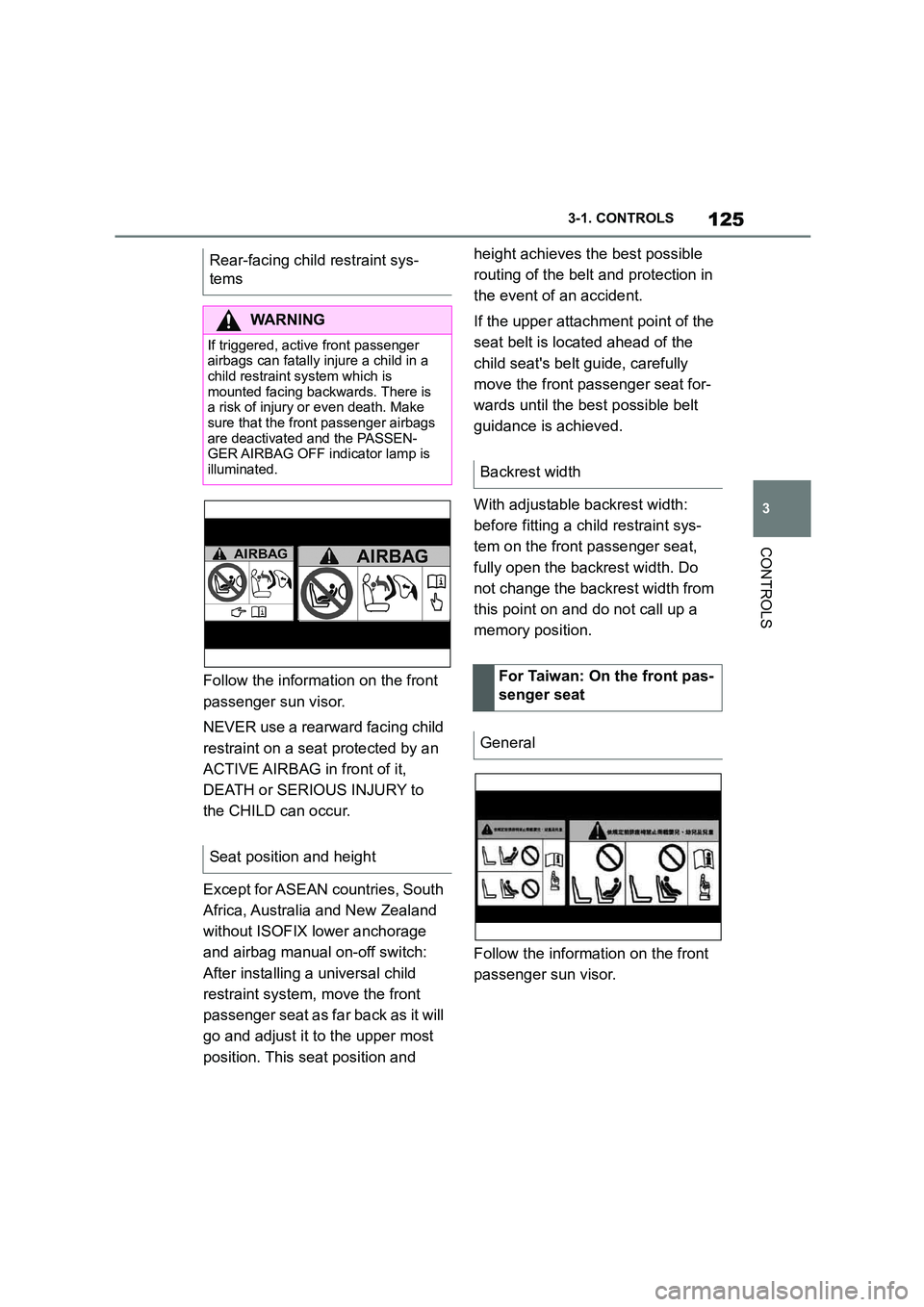
Follow the informat ion on the front
passenger sun visor.
Rear-facing child restraint sys-
tems
WA R N I N G
If triggered, active front passenger
airbags can fatally injure a child in a child restraint system which is
mounted facing backwards. There is
a risk of injury or even death. Make
sure that the front passenger airbags are deactivated and the PASSEN-
GER AIRBAG OFF indicator lamp is
illuminated.
Seat position and height
Backrest width
For Taiwan: On the front pas-
senger seat
General
Page 128 of 498
1263-1. CONTROLS
Before fitting a child restraint on the
front passenger seat, make sure
that the front and side airbags on
the passenger side are disabled.
Deactivating the front passenger
airbags with key switch, see page
202.
After installing a universal child
restraint system, move the front
passenger seat as far back as it will
go and adjust to a mid-height posi-
tion. This seat position and height
achieves the best possible routing
of the belt and protection in the
event of an accident.
If the upper attachment point of the
seat belt is located ahead of the
child seat's belt guide, carefully
move the front passenger seat for-
wards until the best possible belt
guidance is achieved.
With adjustable backrest width:
before fitting a child restraint sys-
tem on the front passenger seat,
fully open the backrest width. Do
not change the backrest width from
this point on and do not call up a
memory position.
Note for Australia: ISOFIX child
seats are not permitted for road use
in Australia at the time of printing.
However, also since a change of
the respective regulations is also
expected in the future, lower
ISOFIX anchorages are supplied in
line with applicable ADRs also for
WA R N I N G
Attention: follow the information on
the front passenger sun visor. Accord-
ing to road traffic safety regulations, children must be transported in the
rear. It is strictly prohibited for infants,
small children and children to be transported on the front passenger
seat. Attention: this regulation applies
to vehicles intended for sale in Tai-
wan.
Deactivating airbags
WA R N I N G
Active front passenger airbags can
injure a child in a child restraint sys- tem if they are deployed. There is a
danger of injury. Make sure that the
front passenger airbags are deacti- vated and the PASSENGER AIRBAG
OFF indicator lamp is illuminated.
Rearward-facing child restraints
WA R N I N G
If triggered, active front passenger
airbags can fatally injure a child in a
child restraint system which is
mounted facing backwards. There is a danger of injury or even death.
Make sure that the front passenger
airbags are deactivated and the PAS- SENGER AIRBAG OFF indicator
lamp is illuminated.
Seat position and height
Backrest width
ISOFIX child seat mountings
General
Page 365 of 498
363
5
5-1. MOBILITY
MOBILITY
■Safety note
■General
In a car wash, the vehicle must be
able to roll freely.
To roll or push the vehicle, see
page 156.
Some car washes require you to
get out of the vehicle. It is not possi-
ble to lock the vehicle from the out-
side in selector lever position N. If
an attempt is made to lock the vehi-
cle, a signal sounds.
Ensure that the remote control is
located in the vehicle.
Switch on drive-ready state, see
page 55.
Do not rub wet headlights dry and
do not use abrasive or corrosive
cleaning agents.
Soak impurities such as insect resi-
dues with shampoo and wash off
with water.
Remove ice with a de-icer spray; do
not use an ice scraper.
After the vehicle has been washed,
briefly apply the brakes to dry them
otherwise braking effectiveness
may be temporarily reduced. The
heat generated by braking dries the
brake discs and br ake pads and
Automatic car washes
Safety notes
NOTICE
If high-pressure washers are used, water may penetrate the area around
the windows. There is a danger of
damage to property. Avoid high pres-
sure washers.
NOTICE
The vehicle can be damaged if auto-
matic washing bays or car washes are used incorrectly. There is a dan-
ger of damage to property. Observe
the following notes:
●Textile car washes or systems
using soft brushes are preferable,
to avoid damage to the paintwork.
●Avoid washing bays or car washes
with guide rails higher than 10 cm,
4 in, to avoid damage to the body.
●Note the maximum tyre width of the
guide rail to avoid damage to tyres and rims.
●Fold in the exterior mirrors to avoid damaging them.
●Deactivate the wipers and the rain sensor (if fitted) to avoid damage to
the wiper system.
Entering a car wash
NOTICE
Selector lever position P is automati-
cally engaged when standby state is
switched off. There is a danger of damage to property. Do not switch off
standby state in car washes.
Exiting from a car wash
Headlights
After washing the vehicle