warning TOYOTA SUPRA 2023 Owners Manual
[x] Cancel search | Manufacturer: TOYOTA, Model Year: 2023, Model line: SUPRA, Model: TOYOTA SUPRA 2023Pages: 372, PDF Size: 6.32 MB
Page 314 of 372
3145-1. MOBILITY
Charge the battery only when
the engine is off and via the
starting aid terminals, refer to
page 325, in the engine com-
partment.
After a power loss, some equip-
ment needs to be newly initial-
ized or individual settings
updated, for example:
Memory function: store the
positions again.
Time: update.
Date: update.
Maintain the battery in an
upright position for transport and storage. Secure the battery so
that it does not tip over during
transport.
The fuses are located at differ-
ent places in the vehicle.
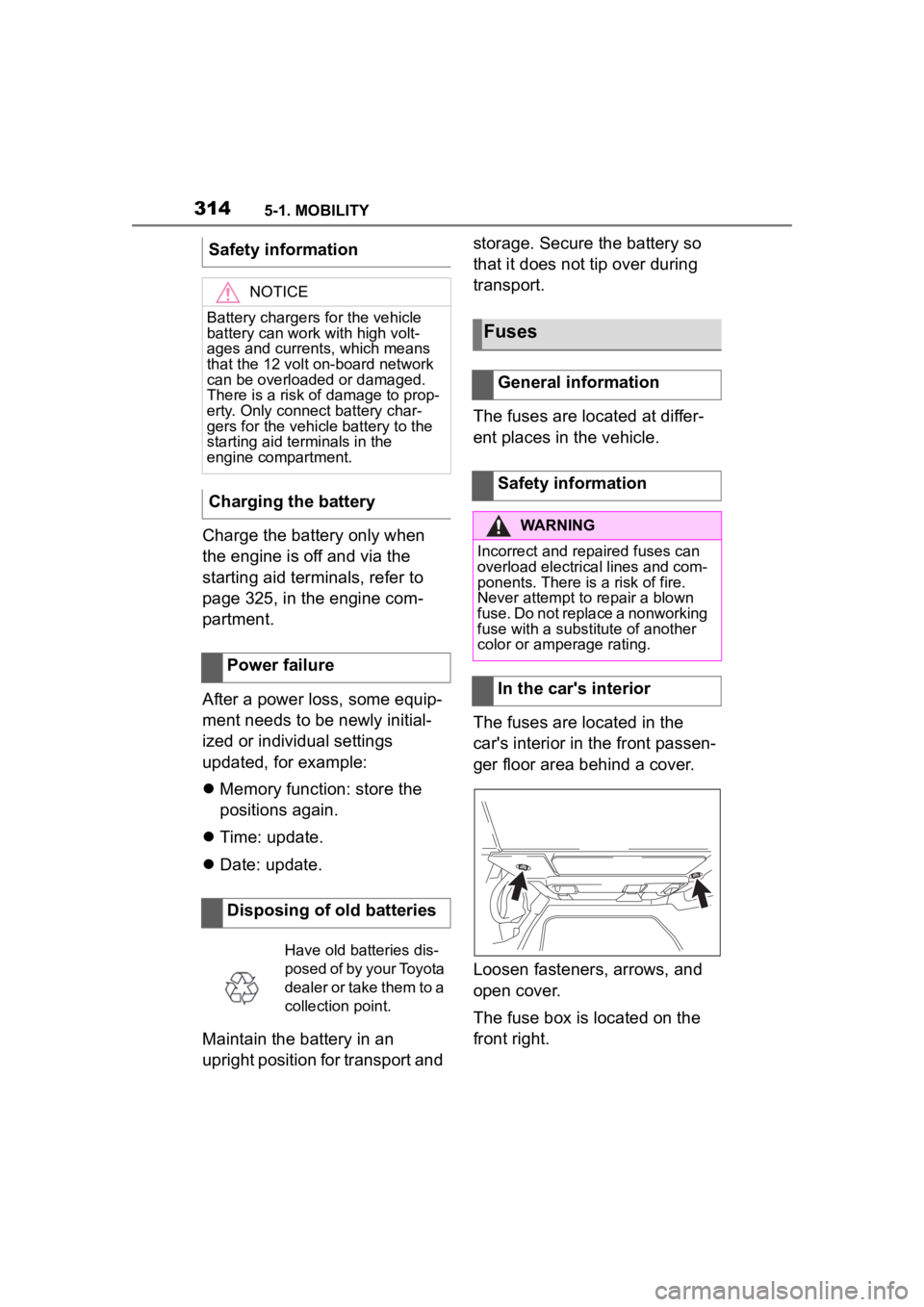
The fuses are located in the
car's interior in the front passen-
ger floor area behind a cover.
Loosen fasteners, arrows, and
open cover.
The fuse box is located on the
front right.
Safety information
NOTICE
Battery chargers for the vehicle
battery can work with high volt-
ages and currents, which means
that the 12 volt on-board network
can be overloaded or damaged.
There is a risk of damage to prop-
erty. Only connect battery char-
gers for the vehi
cle battery to the
starting aid terminals in the
engine compartment.
Charging the battery
Power failure
Disposing of old batteries
Have old batteries dis-
posed of by your Toyota
dealer or take them to a
collection point.
Fuses
General information
Safety information
WARNING
Incorrect and repaired fuses can
overload electrical lines and com-
ponents. There is a risk of fire.
Never attempt to repair a blown
fuse. Do not replace a nonworking
fuse with a substitute of another
color or amperage rating.
In the car's interior
Page 320 of 372
3205-1. MOBILITY
This chapter describes all stan-
dard, country-specific and
optional features offered with
the series. It also describes fea-
tures and functions that are not
necessarily available in your
vehicle, e.g., due to the selected
options or country versions. This
also applies to safety-related
functions and systems. When
using these functions and sys-
tems, the applicable laws and
regulations must be observed.
Telematic Communica-
tion Box, Exterior door
handle electronics
Electric fan, Rear Power
distributor
Engine control
Switching center column,
Light switch element,
Body Domain Controller
Control panels centre
console, Interior light in
the glove box, Interior
light, Interior light in the
sunvisor, Exterior mirror,
Selector lever
Telematic Communica-
tion Box, Exterior door
handle electronics pas-
senger side
Switcher block driver's
door, Exterior mirror
SymbolMeaningBreakdown assistance
Vehicle features and
options
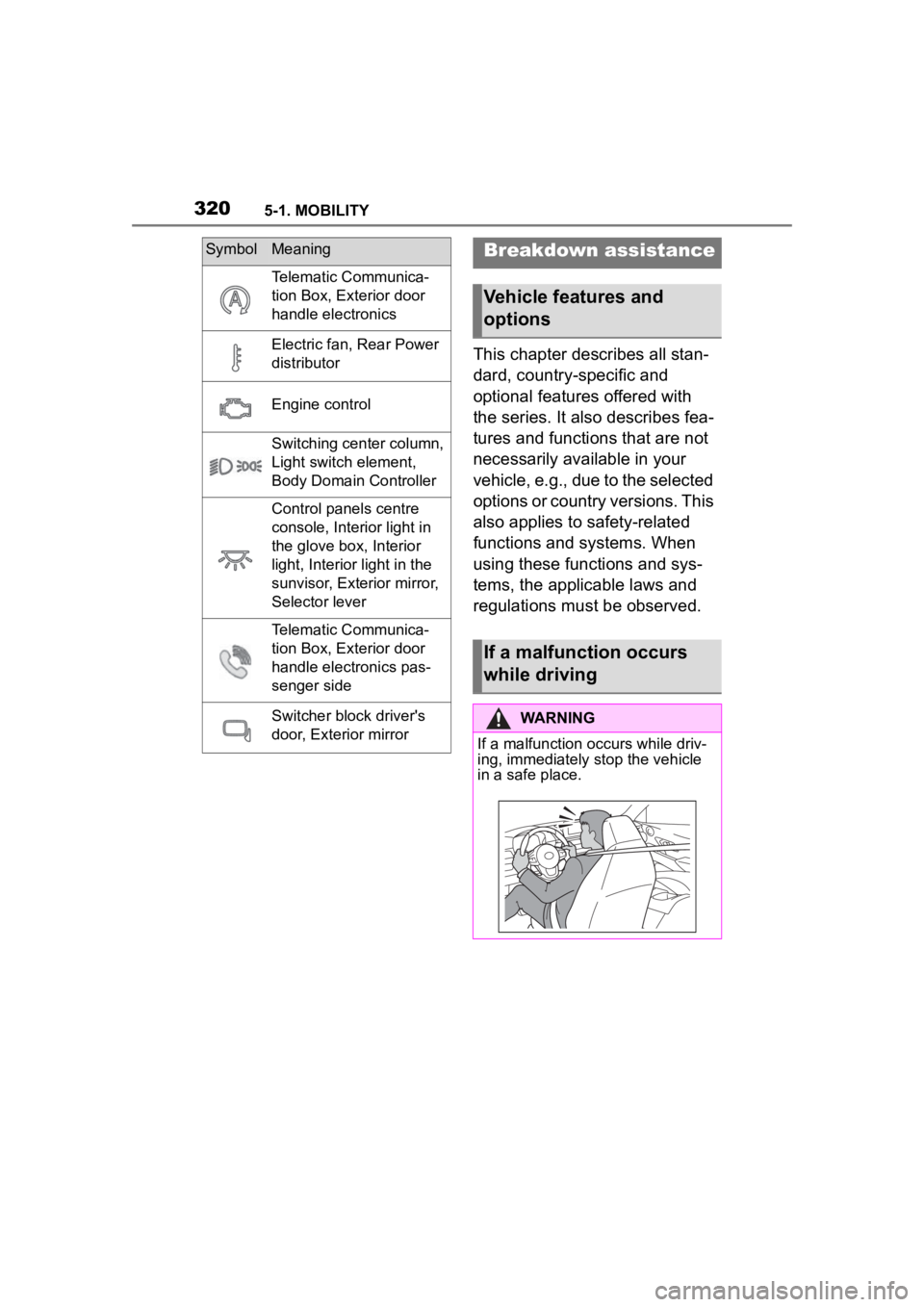
If a malfunction occurs
while driving
WARNING
If a malfunction occurs while driv-
ing, immediately stop the vehicle
in a safe place.
Page 321 of 372
3215-1. MOBILITY
5
MOBILITY
WARNING
If a warning light illuminates or
flashes, or a warning message is
displayed, immediately stop the
vehicle in a safe place. Do not
open the hood to inspect the
engine, as doing so may lead to
serious injury, such as steam
burns. If a warning message is
displayed, perform the necessary
procedures according to the dis-
played message or explanation in
the owner
Page 322 of 372
3225-1. MOBILITY
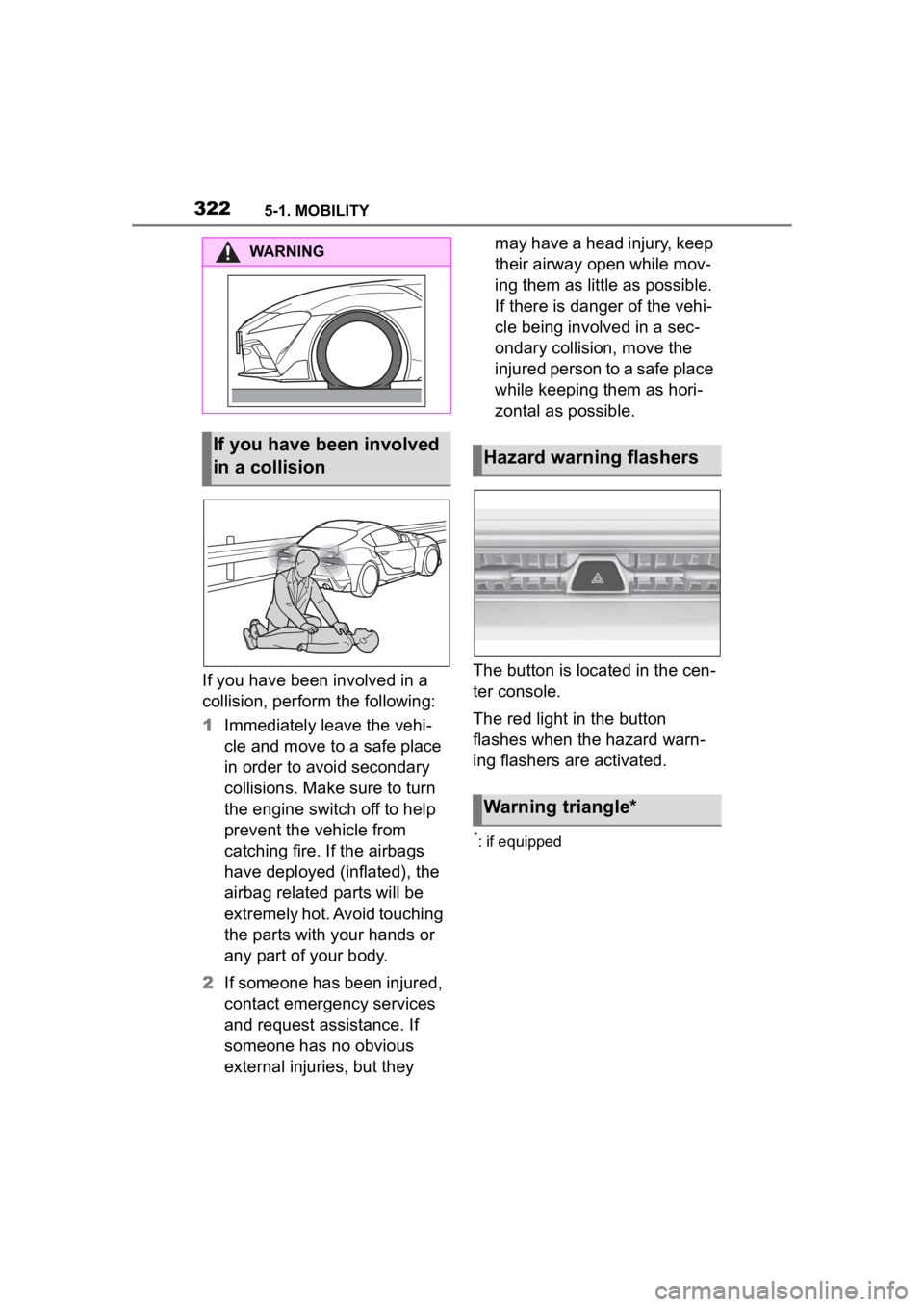
If you have been involved in a
collision, perform the following:
1Immediately leave the vehi-
cle and move to a safe place
in order to avoid secondary
collisions. Make sure to turn
the engine switch off to help
prevent the vehicle from
catching fire. If the airbags
have deployed (inflated), the
airbag related parts will be
extremely hot. Avoid touching
the parts with your hands or
any part of your body.
2 If someone has been injured,
contact emergency services
and request assistance. If
someone has no obvious
external injuries, but they may have a head injury, keep
their airway open while mov-
ing them as little as possible.
If there is danger of the vehi-
cle being involved in a sec-
ondary collision, move the
injured person to a safe place
while keeping them as hori-
zontal as possible.
The button is located in the cen-
ter console.
The red light in the button
flashes when the hazard warn-
ing flashers are activated.
*: if equipped
WARNING
If you have been involved
in a collisionHazard warning flashers
Warning triangle*
Page 323 of 372
3235-1. MOBILITY
5
MOBILITY
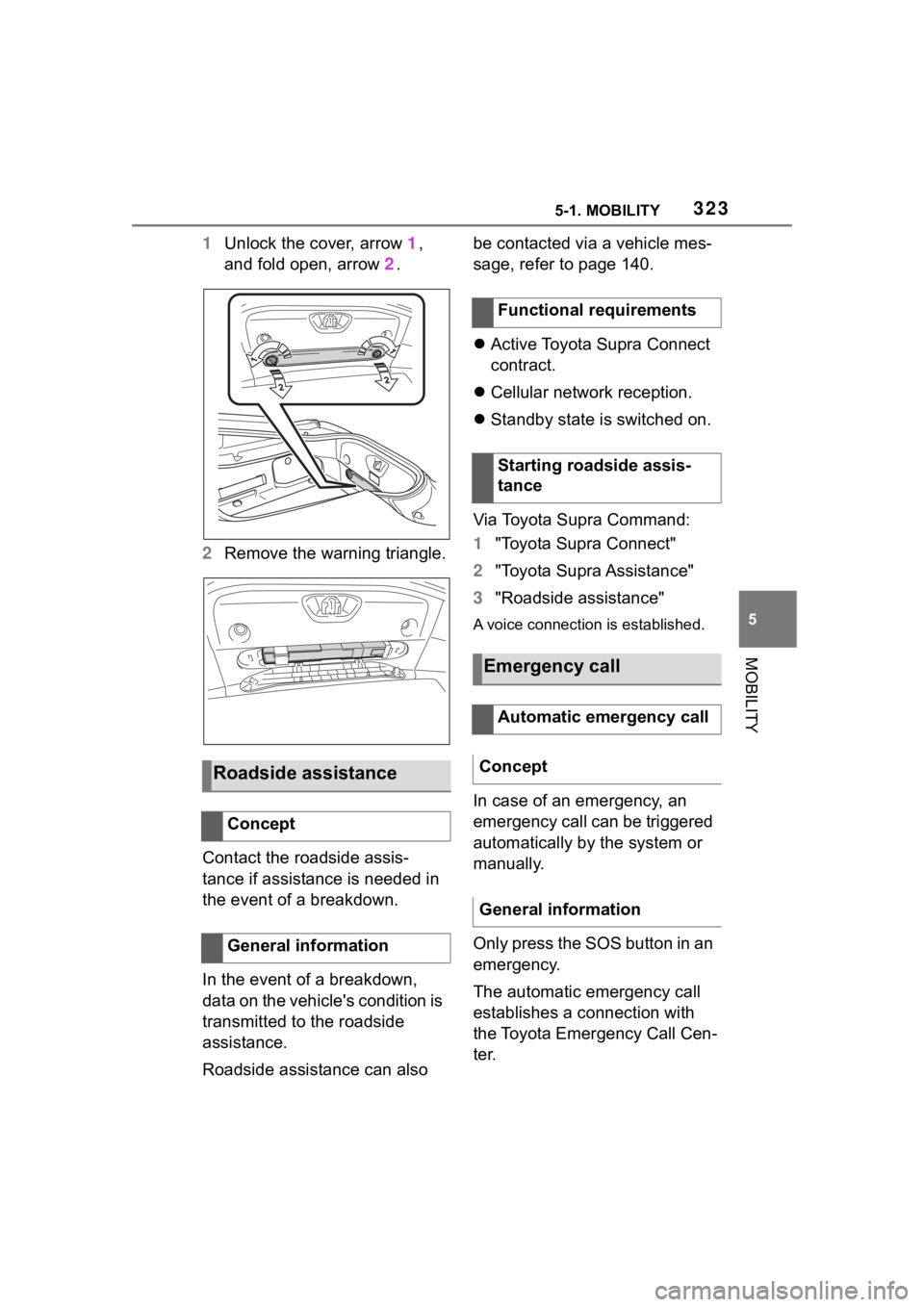
1Unlock the cover, arrow 1,
and fold open, arrow 2.
2 Remove the warning triangle.
Contact the roadside assis-
tance if assistance is needed in
the event of a breakdown.
In the event of a breakdown,
data on the vehicle's condition is
transmitted to the roadside
assistance.
Roadside assist ance can also be contacted via a vehicle mes-
sage, refer to page 140.
Active Toyota Supra Connect
contract.
Cellular network reception.
Standby state is switched on.
Via Toyota Supra Command:
1 "Toyota Supra Connect"
2 "Toyota Supra Assistance"
3 "Roadside assistance"
A voice connection is established.
In case of an emergency, an
emergency call can be triggered
automatically by the system or
manually.
Only press the SOS button in an
emergency.
The automatic emergency call
establishes a connection with
the Toyota Emergency Call Cen-
ter.
Roadside assistance
Concept
General information
Functional requirements
Starting roadside assis-
tance
Emergency call
Automatic emergency call
Concept
General information
Page 325 of 372
3255-1. MOBILITY
5
MOBILITY
gency Call Center may still be able
to hear the occupants of the vehi-
cle.
The Toyota Emergency Call
Center ends the Emergency
call.
If the battery is discharged, the
engine can be started using the
battery of another vehicle and
two jumper cables. Only use
jumper cables with fully insu-
lated clamp handles. 1
Check whether the battery of
the other vehicle has a volt-
age of 12 volts. The voltage
information can be found on
the battery.
2 Switch off the engine of the
assisting vehicle.
3 Switch off any electronic sys-
tems/power consumers in
both vehicles.
The starting aid terminal in the
engine compartment acts as the
positive battery terminal.
A special connection on the
body in the engine compartment
acts as the negative battery ter-
minal.
Additional information:
Overview of engine compart-
ment, refer topage 298.
Open the cover of the positive
battery terminal.
Before you begin, switch off all
unnecessary electronic sys-
tems/power consumers, such as
the radio, on the assisting and
receiving vehicle.
1 Open the cover of the starting
aid terminal.
Jump-starting
General information
Safety information
WARNING
Contact with live components can
lead to an electric shock. There is
a risk of injuries or danger to life.
Do not touch any components
that are under voltage.
WARNING
If the jumper cables are con-
nected in the incorrect order,
sparking may occur. There is a
risk of injury. Pay attention to the
correct order during connection.
NOTICE
In the case of body contact
between the two vehicles, a short
circuit can occur during
jump-starting. There is a risk of
damage to property. Make sure
that no body contact occurs.
Preparation
Starting aid terminals
Connecting the cables
Page 326 of 372
3265-1. MOBILITY
2Attach one terminal clamp of
the positive jumper cable to
the positive terminal of the
battery, or to the correspond-
ing starting aid terminal of the
vehicle providing assistance.
3 Attach the terminal clamp on
the other end of the cable to
the positive terminal of the
battery, or to the correspond-
ing starting aid terminal of the
vehicle to be started.
4 Attach one terminal clamp of
the negative jumper cable to
the negative terminal of the
battery, or to the correspond-
ing engine or body ground of
assisting vehicle.
5 Attach the second terminal
clamp to the negative termi-
nal of the battery, or to the
corresponding engine or
body ground of the vehicle to
be started.
Never use spray fluids to start
the engine.
1 Start the engine of the assist-
ing vehicle and let it run for
several minutes at an
increased idle speed.
2 Start the engine of the vehicle
that is to be started in the
usual way.
If the first starting attempt is not
successful, wait a few minutes
before making another attempt in order to allow the discharged bat-
tery to recharge.
3
Let both engines run for sev-
eral minutes.
4 Disconnect the jumper
cables in the reverse order.
Check the battery and recharge,
if needed.
Starting the engine
Tow-starting and towing
Safety information
WARNING
Due to system limits, individual
functions can malfunction during
tow-starting/towing with the Toy-
ota Supra Safety systems acti-
vated. There is a risk of an
accident. Switch all Toyota Supra
Safety systems off prior to
tow-starting/towing.
Manual transmission
Safety information
NOTICE
The vehicle can become dam-
aged when lifting and securing it.
There is a risk of damage to prop-
erty.
●Lift the vehicle using suitable
means.
●Do not lift or secure the vehicle
by its tow fitting, body parts, or
suspension parts.
Page 328 of 372
3285-1. MOBILITY
To remove a broken-down vehi-
cle from the hazardous area,
push it for a short distance at a
speed of no more than 6 mph/10
km/h.
For rolling or pushing the vehi-
cle, refer to page 133.
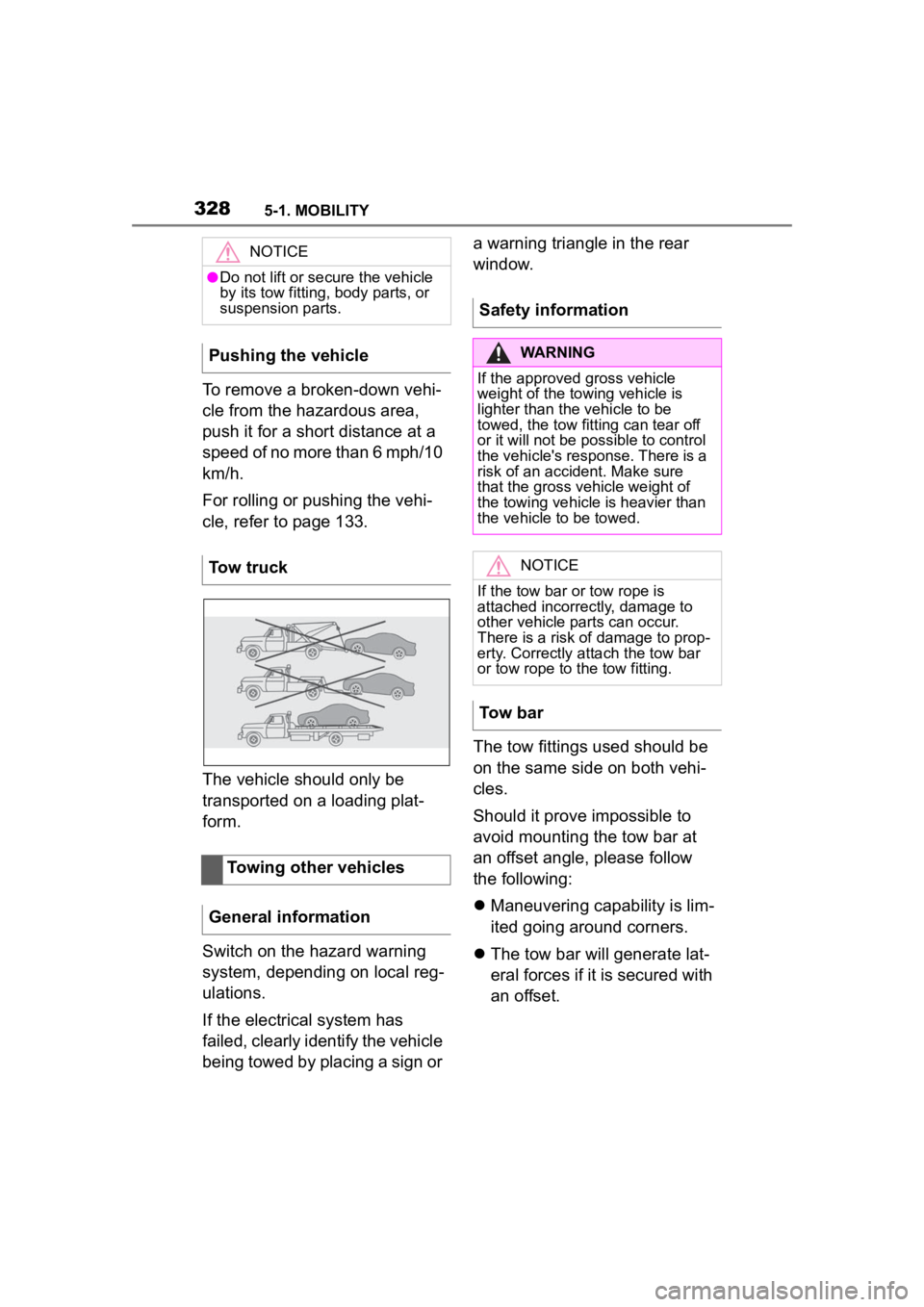
The vehicle should only be
transported on a loading plat-
form.
Switch on the hazard warning
system, depending on local reg-
ulations.
If the electrical system has
failed, clearly identify the vehicle
being towed by placing a sign or a warning triangle in the rear
window.
The tow fittings used should be
on the same side on both vehi-
cles.
Should it prove impossible to
avoid mounting the tow bar at
an offset angle, please follow
the following:
Maneuvering capability is lim-
ited going around corners.
The tow bar will generate lat-
eral forces if it is secured with
an offset.
NOTICE
●Do not lift or se cure the vehicle
by its tow fitting, body parts, or
suspension parts.
Pushing the vehicle
Tow truck
Towing other vehicles
General information
Safety information
WARNING
If the approved gross vehicle
weight of the towing vehicle is
lighter than the vehicle to be
towed, the tow fitting can tear off
or it will not be possible to control
the vehicle's response. There is a
risk of an accident. Make sure
that the gross v ehicle weight of
the towing vehicle is heavier than
the vehicle to be towed.
NOTICE
If the tow bar or tow rope is
attached incorrectly, damage to
other vehicle pa rts can occur.
There is a risk of damage to prop-
erty. Correctly a ttach the tow bar
or tow rope to the tow fitting.
Tow bar
Page 331 of 372
3315-1. MOBILITY
5
MOBILITY
Maximum temperature: 140
°F/60 °C.
Minimum distance from sen-
sors, cameras, seals, and
lights: 12 in/30 cm.Safety information
WARNING
When washing with an open fuel
filler flap, damage may occur.
There is a danger of damage to
property. Close the fuel filler flap
before washing. Clean dirt behind
the fuel filler flap with a cloth.
Steam blaster and
high-pressure washer
Safety information
NOTICE
When cleaning with high-pressure
washers, components can be
damaged due to the pressure or
temperatures being too high.
There is a risk of damage to prop-
erty. Maintain sufficient distance
and do not spray too long continu-
ously. Follow the operating
instructions for the high-pressure
washer.
Distances and temperature
Automatic vehicle washes
Safety information
NOTICE
Water can penetrate in the wind-
shield area due to high-pressure
washers. There i s a risk of dam-
age to property. Avoid high-pres-
sure washers.
NOTICE
Improper use of automatic vehicle
washes can cause damage to the
vehicle. There is a risk of damage
to property. Follo w the following
instructions:
●Give preference to cloth vehicle
washes or those that use soft
brushes in order to avoid paint
damage.
●Avoid vehicle washes with
guide rails higher than 4 in/10
cm to avoid damage to the
chassis.
●Observe the tire width of the
guide rail to avoid damage to
tires and rims.
●Fold in exterior mirrors to avoid
damage to the exterior mirrors.
●Deactivate the wiper and, if nec-
essary, rain sensor to avoid
damage to the wiper system.
●Do not treat the convertible top
with wax. Ensure that a cycle
without wax or a special cycle
for convertibles is available to
avoid damage to the convertible
top.
Page 332 of 372
3325-1. MOBILITY
■Safety information
■General information
In a vehicle wash, the vehicle
must be able to roll freely.
To roll or push the vehicle, refer
to page 133.
Some vehicle washes do not
permit persons in the vehicle.
The vehicle cannot be locked
from the outside when in selec-
tor lever position N. A signal
sounds when an attempt is
made to lock the vehicle.
Make sure that the remote con-
trol is in the vehicle.
Switch on drive-ready state,
refer to page 46.
Do not rub wet lights dry and do
not use abrasive, acidic clean-
ing agents or cleaning agents
containing alcohol.
Soak areas that have been dirt-
ied, for instance from insects,
with shampoo and wash off with water.
Thaw ice with de-icing spray; do
not use an ice scraper.
After washing the vehicle, apply
the brakes briefly to dry them;
otherwise, braking action can be
reduced. The heat generated
during braking dries brake discs
and brake pads and protects
them against corrosion.
Completely remove all residues
on the windows, to minimize
loss of visibility due to smearing
and to reduce wiper noises and
wiper blade wear.
Regular care contributes to driv-
Driving into a vehicle wash
NOTICE
Selector lever position P is auto-
matically engaged when standby
state is switched off. There is a
risk of damage to property. Do not
switch standby state off in vehicle
washes.
Driving out of a vehicle wash
Lights
After washing the vehicle
Vehicle care
Vehicle care products
Safety information
WARNING
Cleansers can contain sub-
stances that are dangerous and
harmful to your health. There is a
risk of injury. When cleaning the
interior, open the doors or win-
dows. Only use products intended
for cleaning vehicles. Follow the
instructions on the container.
Vehicle paint
General information