warning TOYOTA SUPRA 2023 Owners Manual
[x] Cancel search | Manufacturer: TOYOTA, Model Year: 2023, Model line: SUPRA, Model: TOYOTA SUPRA 2023Pages: 372, PDF Size: 6.32 MB
Page 258 of 372
2584-1. DRIVING TIPS
4-1.DRIVING TIPS
This chapter describes all stan-
dard, country-specific and
optional features offered with
the series. It also describes fea-
tures and functions that are not
necessarily available in your
vehicle, e.g., due to the selected
options or country versions. This
also applies to safety-related
functions and systems. When
using these functions and sys-
tems, the applicable laws and
regulations must be observed.
Moving parts need to begin
working together smoothly.
The following instructions will
help you to achieve a long vehi-
cle life and good efficiency.
During break-in, do not use the
Launch Control, refer to page
135.Do not exceed the maximum
engine and road speed:
For gasoline engine 4,500
rpm and 100 mph/160 km/h.
Avoid full load or kickdown
under all circumstances.
The engine and vehicle speed
can gradually be increased.
Tire traction is not optimal due to
manufacturing circumstances
when tires are brand-new; they
achieve their full traction poten-
tial after a break-in time.
Drive conservatively for the first
200 miles/300 km.
Things to remember
when driving
Vehicle features and
options
Breaking-in period
General information
Safety information
WARNING
Due to new parts and compo-
nents, safety and driver assis-
tance systems ca n react with a
delay. There is a risk of an acci-
dent. After installing new parts or
with a new vehicle, drive conser-
vatively and intervene early if nec-
essary. Observe the break-in
procedures of the respective parts
and components.
Engine, transmission, and
axle drive
Up to 1,200 miles/2,000 km
From 1,200 miles/2,000 km
Tires
Page 259 of 372
2594-1. DRIVING TIPS
4
DRIVING TIPS
Brake discs and brake pads only
reach their full effectiveness
after approx. 300 miles/500 km.
Drive moderately during this
break-in period.
Observe the break-in proce-
dures again, if components
mentioned above are replaced.Brake system
Following part replace-
ment
General driving notes
Closing the trunk lid
Safety information
WARNING
An open trunk lid protrudes from
the vehicle and can endanger
occupants and other traffic partici-
pants or damage the vehicle in
the event of an a ccident, braking
or evasive maneu vers. In addi-
tion, exhaust fumes may enter the
car's interior. There is a risk of
injury or risk of damage to prop-
erty. Do not drive with the trunk lid
open.
Ice on window glass
NOTICE
The window will be lowered
slightly when pulling on the door
handle. In the eve nt of frost, the
window may freeze up and not be
lowered. There is a risk of dam-
age to property. When pulling on
the door handle, make sure that
the window is lowered. If neces-
sary, remove snow and ice from
the window. Do not open the door
with force.
Hot exhaust gas system
WARNING
High temperatures can occur
underneath the body, for instance
caused by the exhaust gas sys-
tem, while driving. Contact with
the exhaust gas system can
cause burns. The re is a risk of
injury. Do not touch the hot
exhaust gas system, including the
exhaust pipe.
WARNING
If combustible materials, such as
leaves or grass, come in contact
with hot parts of the exhaust gas
system, these materials can
ignite. There is a risk of fire and
injuries. Do not r emove the heat
shields installed and never apply
undercoating to them. Make sure
that no combustible materials can
come in contact with hot vehicle
parts in driving operation, idle or
during parking.
Page 260 of 372
2604-1. DRIVING TIPS
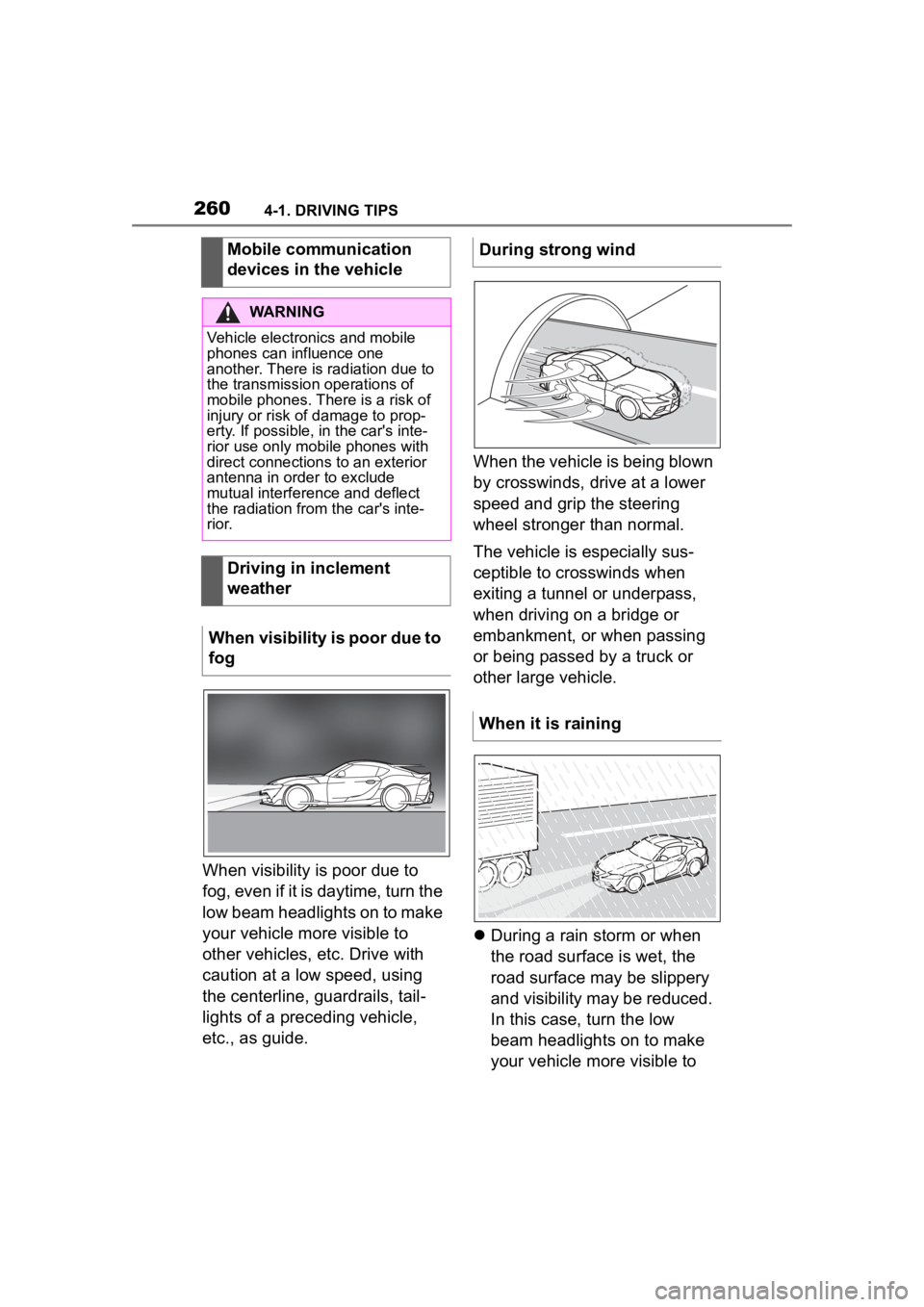
When visibility is poor due to
fog, even if it is daytime, turn the
low beam headlights on to make
your vehicle more visible to
other vehicles, etc. Drive with
caution at a low speed, using
the centerline, guardrails, tail-
lights of a preceding vehicle,
etc., as guide.When the vehicle is being blown
by crosswinds, drive at a lower
speed and grip the steering
wheel stronger than normal.
The vehicle is especially sus-
ceptible to crosswinds when
exiting a tunnel or underpass,
when driving on a bridge or
embankment, or when passing
or being passed by a truck or
other large vehicle.
During a rain storm or when
the road surface is wet, the
road surface may be slippery
and visibility may be reduced.
In this case, turn the low
beam headlights on to make
your vehicle more visible to
Mobile communication
devices in the vehicle
WARNING
Vehicle electronics and mobile
phones can influence one
another. There is radiation due to
the transmission operations of
mobile phones. There is a risk of
injury or risk of
damage to prop-
erty. If possible, in the car's inte-
rior use only mobile phones with
direct connections to an exterior
antenna in order to exclude
mutual interference and deflect
the radiation from the car's inte-
r i o r.
Driving in inclement
weather
When visibility is poor due to
fog
During strong wind
When it is raining
Page 262 of 372

2624-1. DRIVING TIPS
perforated brake discs can emit
functional noises. However,
functional noises have no effect
on the performance and opera-
tional reliability of the brake.
When roads are wet, salted, or
in heavy rain, gently press the
brake pedal every few miles.
Ensure that this action does not
endanger other traffic.
The heat generated during brak-
ing dries brake discs and brake
pads and protects them against
corrosion.
In this way braking efficiency will
be available when you need it.
■General information
Drive long or steep downhill gra-
dients in the gear that requires
least braking effort. Otherwise,
the brakes may overheat and
reduce brake efficiency.
You can increase the engine's
braking effect by shifting down,
going all the way to first gear, if
needed.
■Safety information
Corrosion on the brake discs
and contamination on the brake
pads are increased by the fol-
lowing circumstances:
Low mileage.
Extended periods when the
vehicle is not used at all.
Objects in the area around
the pedals
WARNING
Objects in the dri
ver's floor area
can limit the peda l distance or
block a depressed pedal. There is
a risk of an accident. Stow objects
in the vehicle such that they are
secured and cannot enter into the
driver's floor area. Use floor mats
that are suitable for the vehicle
and can be safely attached to the
floor. Do not use loose floor mats
and do not layer several floor
mats. Make sure that there is suf-
ficient clearance for the pedals.
Ensure that the floor mats are
securely fastened again after they
were removed, fo r instance for
cleaning.
Driving in wet conditions
Hills
WARNING
Light but consis tent brake pres-
sure can lead to high tempera-
tures, brakes wearing out and
possibly even brake failure. There
is a risk of an accident. Avoid
placing excessive stress on the
brake system.
WARNING
In idle state or with the engine
switched off, safety functions, for
instance engine braking effect,
braking assistance and steering
assistance, may not be available.
There is a risk of accident. Do not
attempt to drive in idle state or
with the engine switched off.
Brake disc corrosion
Page 269 of 372
2695-1. MOBILITY
5
MOBILITY
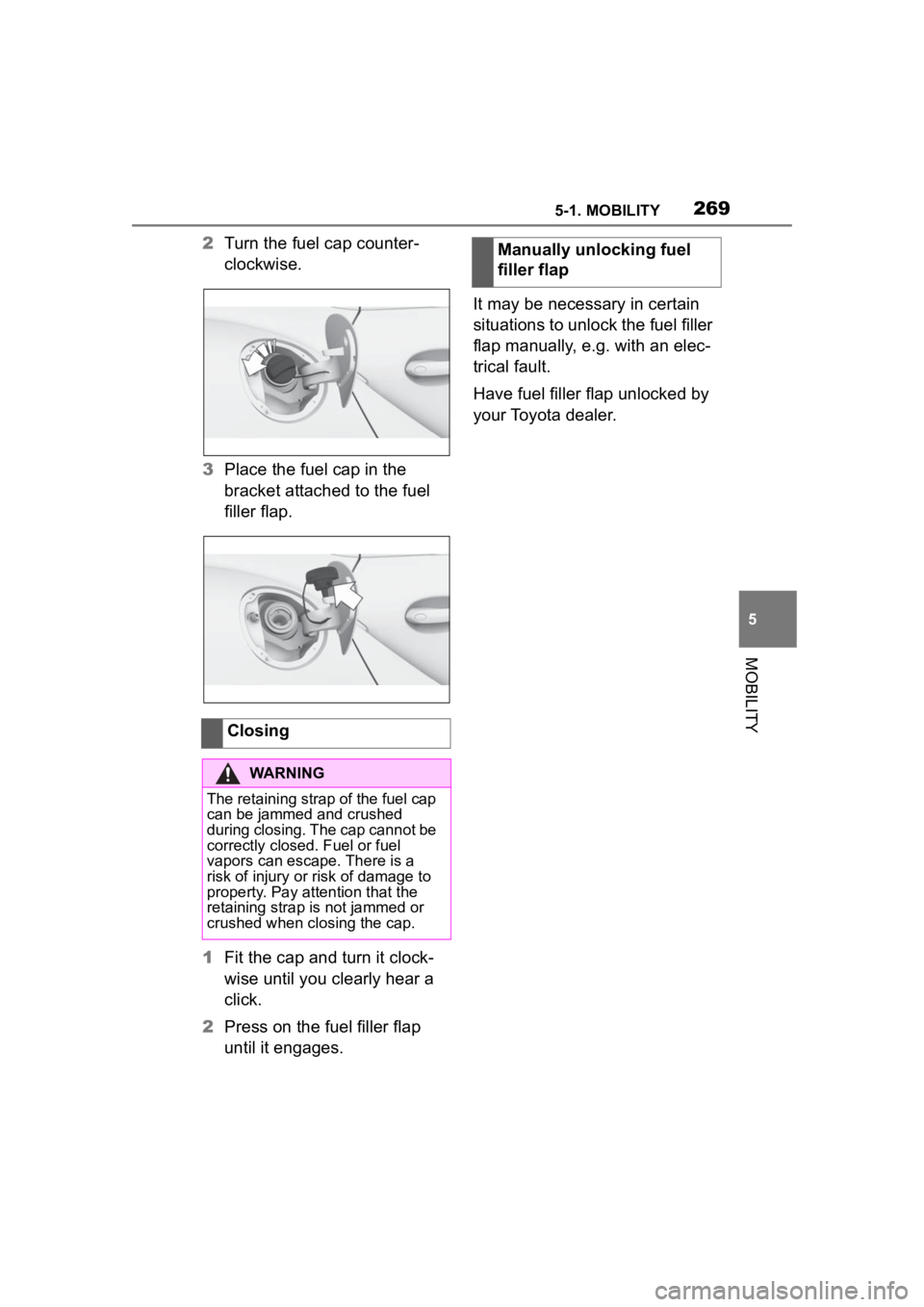
2Turn the fuel cap counter-
clockwise.
3 Place the fuel cap in the
bracket attached to the fuel
filler flap.
1 Fit the cap and turn it clock-
wise until you clearly hear a
click.
2 Press on the fuel filler flap
until it engages. It may be necessary in certain
situations to unlock the fuel filler
flap manually, e.g. with an elec-
trical fault.
Have fuel filler flap unlocked by
your Toyota dealer.
Closing
WARNING
The retaining strap of the fuel cap
can be jammed and crushed
during closing. The cap cannot be
correctly closed. Fuel or fuel
vapors can escape. There is a
risk of injury or risk of damage to
property. Pay attention that the
retaining strap is not jammed or
crushed when closing the cap.
Manually unlocking fuel
filler flap
Page 270 of 372
2705-1. MOBILITY
This chapter describes all stan-
dard, country-specific and
optional features offered with
the series. It also describes fea-
tures and functions that are not
necessarily available in your
vehicle, e.g., due to the selected
options or country versions. This
also applies to safety-related
functions and systems. When
using these functions and sys-
tems, the applicable laws and
regulations must be observed.
The tire characteristics and tire
inflation pressure influence the
following:
• The service life of the tires.
• Road safety.
• Driving comfort.
• Fuel consumption.The tire inflation pressure table,
refer to page 273, contains all
tire inflation pressure specifica-
tions for the specified tire sizes
at the ambient temperature. The
tire inflation pressure values
apply to tire sizes approved by
the manufacturer of the vehicle
for the vehicle type.
To identify the correct tire infla-
tion pressure, please note the
following:
If the tire's speed code cannot
be found, then the tire inflation
pressure for the corresponding
tire size applies.
• Tire sizes of your vehicle.
• Maximum permitted driving
speed.
Wheels and tires
Vehicle features and
options
Tire inflation pressure
General information
Safety information
WARNING
A tire with too little or no tire infla-
tion pressure may heat up signifi-
cantly and sustain damage. This
will have a negative impact on
aspects of handling, such as
steering and braking response.
There is a risk of an accident.
Regularly check the tire inflation
pressure, and correct it as
needed, for instance twice a
month and before a long trip.
Tire inflation pressure
specifications
In the tire inflation pressure
table
Page 274 of 372

2745-1. MOBILITY
For speeds over 100 mph/160
km/h and for optimum driving
comfort, note the pressure val-
ues in the tire inflation pressure
table, refer to page 275, and
adjust as necessary.Tire inflation pressures at
max. speeds above 100
mph/160 km/h
WARNING
In order to drive at maximum
speeds in excess of 100 mph/160
km/h, please obser
ve, and, if nec-
essary, adjust tir e pressures for
speeds exceeding 100 mph/160
km/h from t he relevant table on
the following pages. Otherwise,
tire damage and accidents could
occur.
Page 278 of 372
2785-1. MOBILITY
Winter and all-season tires with
better cold weather performance
than summer tires.
Do not drive with a tire tread of
less than 0.12 in/3 mm, other-
wise there is an increased risk
of hydroplaning.
Do not drive with a tire tread of
less than 0.16 in/4 mm, as such
tires are less suitable for winter
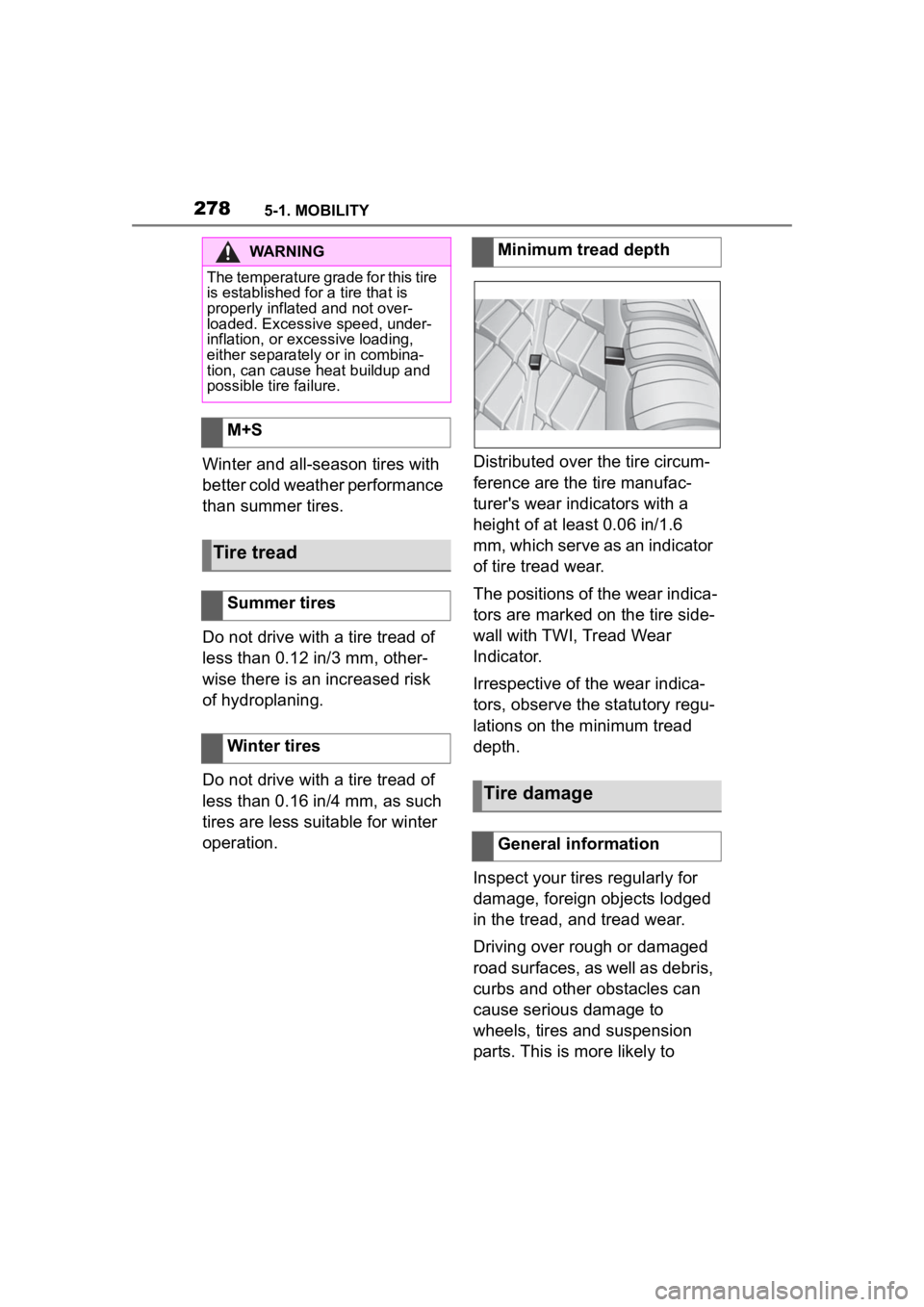
operation.Distributed over the tire circum-
ference are the tire manufac-
turer's wear indicators with a
height of at least 0.06 in/1.6
mm, which serve as an indicator
of tire tread wear.
The positions of the wear indica-
tors are marked on the tire side-
wall with TWI, Tread Wear
Indicator.
Irrespective of the wear indica-
tors, observe the statutory regu-
lations on the minimum tread
depth.
Inspect your tires regularly for
damage, foreign objects lodged
in the tread, and tread wear.
Driving over rough or damaged
road surfaces, as well as debris,
curbs and other obstacles can
cause serious damage to
wheels, tires and suspension
parts. This is more likely to
WARNING
The temperature grade for this tire
is established for a tire that is
properly inflated and not over-
loaded. Excessive speed, under-
inflation, or excessive loading,
either separately or in combina-
tion, can cause heat buildup and
possible tire failure.
M+S
Tire tread
Summer tires
Winter tires
Minimum tread depth
Tire damage
General information
Page 279 of 372
2795-1. MOBILITY
5
MOBILITY
occur with low-profile tires,
which provide less cushioning
between the wheel and the
road. Be careful to avoid road
hazards and reduce your speed,
especially if your vehicle is
equipped with low-profile tires.
Indications of tire damage or
other vehicle malfunctions:
• Unusual vibrations.
• Unusual tire or running noises.
• Unusual handling such as a strong tendency to pull to the
left or right.
• Uneven wear pattern, e.g., increased wear in the area of
the tire shoulder.
Damage can be caused by the
following situations, for instance:
• Driving over curbs.
• Road damage.
• Tire inflation pressure too low.
• Vehicle overloading.
• Incorrect tire storage. Have mounting and wheel bal-
ancing carried out by your Toy-
ota dealer.
The following properties are rec-
ommended and approved by the
manufacturer of the vehicle for
the approved wheels and tires
per vehicle type and special
equipment:
• Wheel and tire combinations.
• Rim designs.
• Tire sizes.
• Tire brands.
You can ask your Toyota dealer
about the approved wheels and
tires for the vehicle and the spe-
cial equipment.
Safety information
WARNING
Damaged tires can lose tire infla-
tion pressure, which can lead to
loss of vehicle control. There is a
risk of an accident. If tire damage
is suspected while driving, imme-
diately reduce speed and stop.
Have wheels and tires checked.
For this purpose, drive carefully to
the nearest your Toyota dealer.
Have vehicle towed or trans-
ported as needed. Do not repair
damaged tires, but have them
replaced.
WARNING
Tires can become damaged by
driving over obstacles, e.g., curbs
or road damage, at high speed.
Larger wheels have a smaller tire
crosssection. The smaller the tire
cross-section, the
higher the risk
of tire damage. There is a danger
of accidents and property dam-
age. If possible, avoid driving over
objects or road conditions that
may damage tires, or drive over
them slowly and carefully.
Changing wheels and
tires
Mounting and wheel bal-
ancing
Approved wheels and tires
General information
Page 280 of 372
2805-1. MOBILITY
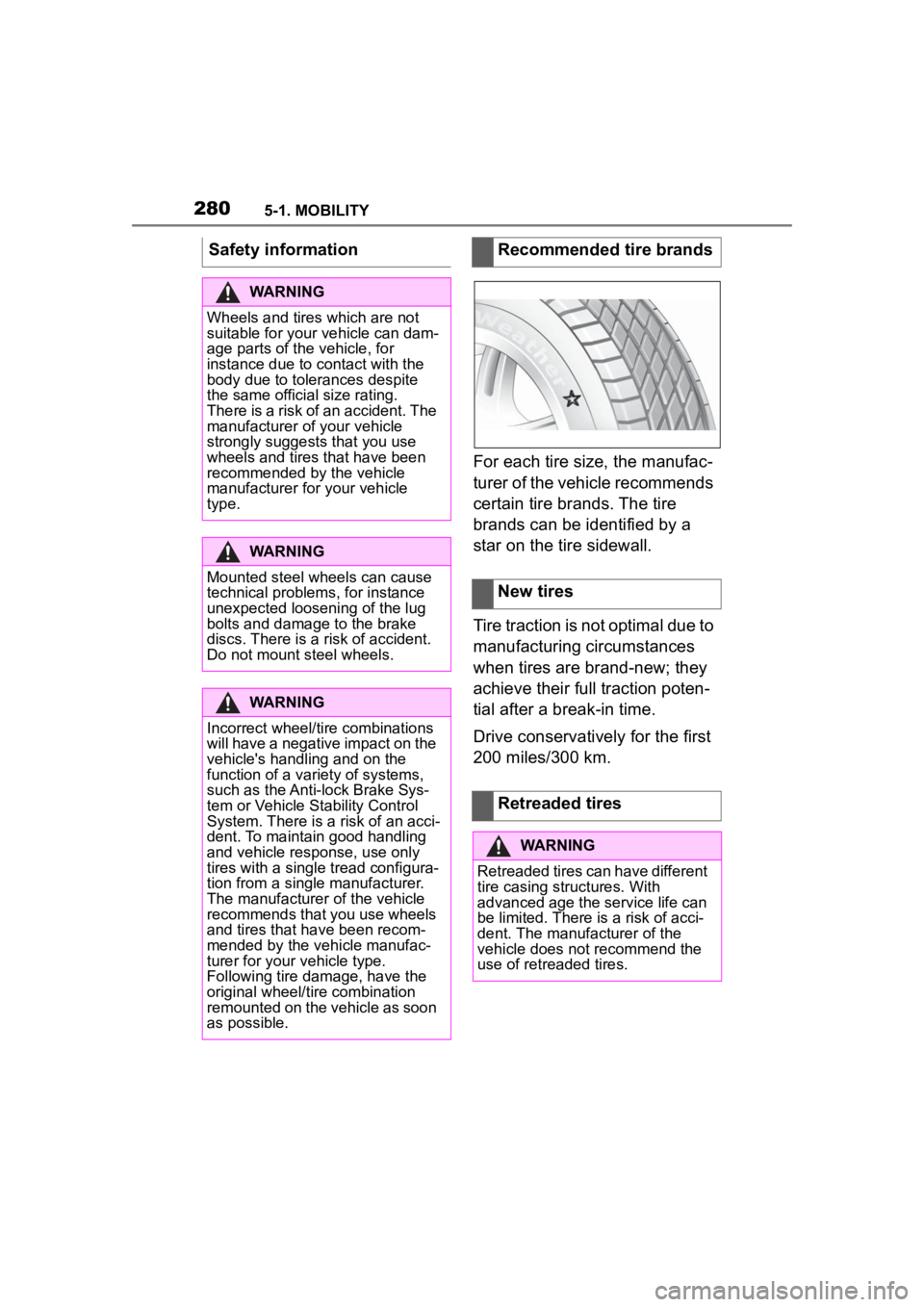
For each tire size, the manufac-
turer of the vehicle recommends
certain tire brands. The tire
brands can be identified by a
star on the tire sidewall.
Tire traction is not optimal due to
manufacturing circumstances
when tires are brand-new; they
achieve their full traction poten-
tial after a break-in time.
Drive conservatively for the first
200 miles/300 km.
Safety information
WARNING
Wheels and tires which are not
suitable for your
vehicle can dam-
age parts of the vehicle, for
instance due to contact with the
body due to tolerances despite
the same official size rating.
There is a risk of an accident. The
manufacturer of your vehicle
strongly suggests that you use
wheels and tires that have been
recommended by the vehicle
manufacturer for your vehicle
type.
WARNING
Mounted steel wheels can cause
technical problem s, for instance
unexpected loosening of the lug
bolts and damage to the brake
discs. There is a risk of accident.
Do not mount steel wheels.
WARNING
Incorrect wheel/tire combinations
will have a negative impact on the
vehicle's handling and on the
function of a variety of systems,
such as the Anti-lock Brake Sys-
tem or Vehicle S tability Control
System. There is a risk of an acci-
dent. To maintain good handling
and vehicle response, use only
tires with a single tread configura-
tion from a single manufacturer.
The manufacturer of the vehicle
recommends that you use wheels
and tires that have been recom-
mended by the vehicle manufac-
turer for your vehicle type.
Following tire damage, have the
original wheel/tire combination
remounted on the vehicle as soon
as possible.
Recommended tire brands
New tires
Retreaded tires
WARNING
Retreaded tires can have different
tire casing structures. With
advanced age the service life can
be limited. There is a risk of acci-
dent. The manufacturer of the
vehicle does not recommend the
use of retreaded tires.