ESP VOLVO V90 2017 Workshop Manual
[x] Cancel search | Manufacturer: VOLVO, Model Year: 2017, Model line: V90, Model: VOLVO V90 2017Pages: 594, PDF Size: 15.07 MB
Page 338 of 594
||
DRIVER SUPPORT
336The following further criteria must also be fulfil- led:
• your car must be travelling at no less than4 km/h (3 mph)
• your car must turn to the left in markets withright-hand traffic (or to the right in left-handtraffic)
• the oncoming vehicle must have its head-lamps switched on.
WARNING
City Safety is an aid and does not work in all driving situations, traffic, weather and roadconditions. Warnings and brake interventions due to a collision risk with an oncoming vehicle oftencome very late. The driver is always responsible for maintain- ing the correct distance and speed - neverwait for a collision warning or for City Safetyto intervene.
Limitations in cross trafficIn some cases City Safety may have difficulty helping the driver deal with collision risks due tooncoming cross traffic. Examples are:
• stability control ESC intervenes in the eventof slippery driving conditions
• if the oncoming vehicle is detected too late •
if the oncoming vehicle is obscured by some-thing
• if the oncoming vehicle has headlampsswitched off
• if the oncoming vehicle drives in an unpre-dictable manner, for example, abruptlychanges lanes at a late stage.
Related information
•
City Safety (p. 330)
City Safety when evasive manoeuvres are prevented City Safety has the facility to assist the driver by automatically braking the car earlier when it isnot possible to avoid a collision by only steeringaway.
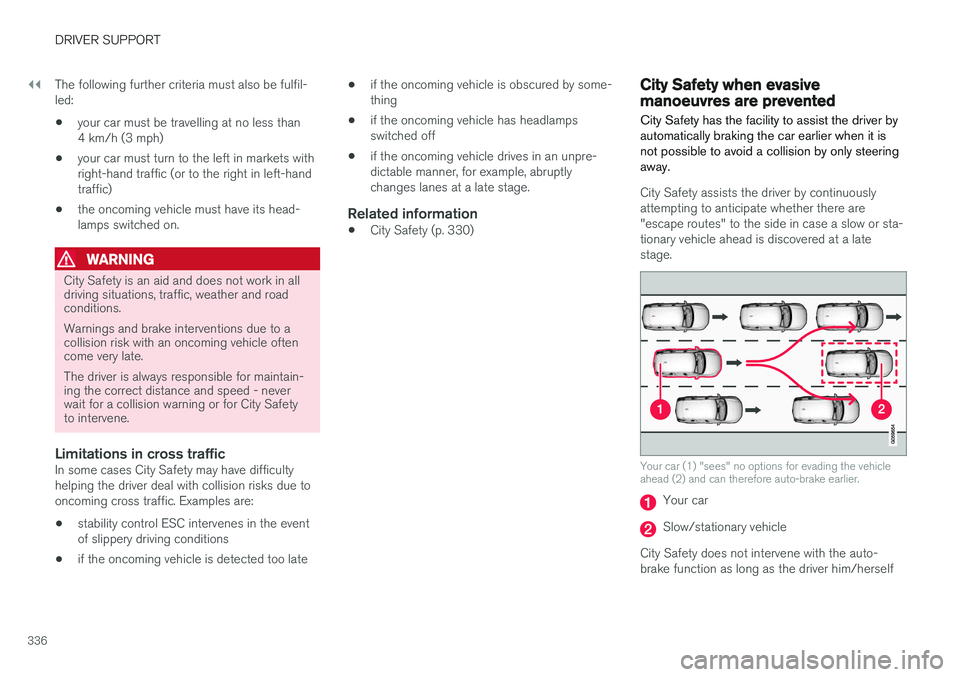
City Safety assists the driver by continuously attempting to anticipate whether there are"escape routes" to the side in case a slow or sta-tionary vehicle ahead is discovered at a latestage.
Your car (1) "sees" no options for evading the vehicle ahead (2) and can therefore auto-brake earlier.
Your car
Slow/stationary vehicle
City Safety does not intervene with the auto- brake function as long as the driver him/herself
Page 339 of 594
DRIVER SUPPORT
}}
337
has the opportunity to avoid a collision via a steering manoeuvre. However, if City Safety anticipates that an evasive manoeuvre is not possible due to traffic in anadjacent lane, the function can assist the driverby automatically starting to brake at an earlierstage.
WARNING
City Safety's ability to anticipate a certain sit- uation is an aid, and does not work in all driv-ing situations or traffic, weather and road con-ditions. The driver always bears ultimate responsibility for ensuring that the vehicle is driven safelyand that applicable laws and road traffic regu-lations are followed.
Related information
•
City Safety (p. 330)
• Limitations of City Safety (p. 337)
Limitations of City Safety
The City Safety function may have limitations in certain situations.
Surroundings
Low objects
Low-hanging objects, e.g. a flag/pennant for pro- jecting load, or accessories such as auxiliarylamps and bull bars that are higher than the bon-net limit the function.
Skidding
On slippery road surfaces the braking distance is extended, which may reduce the capacity of CitySafety to avoid a collision. In such situations, theanti-lock brakes and the stability control ESC willgive the best possible braking force with main-tained stability.
Oncoming light
The visual warning signal in the windscreen may be difficult to notice in the event of strong sun-light, reflections, when sunglasses are beingworn or if the driver is not looking straight ahead.
Heat
In the event of high passenger compartment temperature caused by e.g. strong sunlight, thevisual warning signal in the windscreen may betemporarily disengaged.
The camera and radar unit's field of view
The camera's field of vision is limited, which is why pedestrians, large animals, cyclists and vehi- cles in some situations cannot be detected, orthey are detected later than anticipated. Dirty vehicles may be detected later than others and if it is dark, motorcycles may be detected lateor not at all. If a text message in the driver display indicates that the camera and radar unit is obstructed, CitySafety may be unable to detect pedestrians, largeanimals, cyclists, vehicles or road lines ahead ofthe car. This means that the functionality of CitySafety may be reduced. However, an error message is not shown in all situations where the windscreen sensors areobstructed. The driver must therefore take care tokeep the area of windscreen in front of the cam-era and radar unit clear.
IMPORTANT
Maintenance and replacement of City Safety components must only be performed by aworkshop - an authorised Volvo workshop isrecommended.
Driver intervention
Reversing
When your own car is reversing, City Safety is temporarily deactivated.
Page 340 of 594
||
DRIVER SUPPORT
338
Low speed
City Safety is not activated at very low speeds - below 4 km/h (3 mph) - and the system there-fore does not intervene in situations where yourcar is approaching a vehicle ahead very slowly,e.g. when parking.
Active driver
Driver commands are always prioritised, which is why City Safety does not intervene or postponewarning/intervention in situations where thedriver is steering and accelerating in a decisivemanner, even if a collision is unavoidable. Active and aware driving behaviour can therefore delay a collision warning and intervention in orderto minimise unnecessary warnings.
Miscellaneous
WARNING
Warnings and brake interventions could be implemented late or not at all if a traffic situa-tion or external influences mean that the cam-era and radar unit cannot detect pedestrians,cyclists, large animals or vehicles correctly. For vehicles to be detected at night, their headlamps and rear lamp cluster must beswitched on and shining clearly. The camera and radar unit has a limited range for pedestrians and cyclists. The system canprovide effective warnings and brake interven-tions as long as the relative speed is below50 km/h (30 mph). For stationary or slow-moving vehicles, warnings and brake interven-tions are effective at vehicle speeds up to70 km/h (43 mph). Speed reduction for largeanimals is less than 15 km/h (9 mph) andcan be achieved at vehicle speeds above70 km/h (43 mph). The warning and brakeintervention for large animals is less effectiveat lower speeds. Warnings for stationary or slow-moving vehi- cles and large animals could be disengageddue to darkness or poor visibility. Warnings and brake interventions for pedes- trians and cyclists are deactivated at vehiclespeeds exceeding 70 km/h (43 mph). Do not place, stick or mount anything on the outside or inside of the windscreen in front ofor around the camera and radar unit — thiscan interfere with camera-dependent func-tions.
Objects, snow, ice or dirt in the area of the camera sensor may reduce its function, fullydeactivate it or give incorrect functionresponse.
NOTE
The function uses the car's camera unit, which has some general limitations, see the"Limitations for camera unit" section.
NOTE
The function uses the car's radar unit, which has some general limitations, see the "Limita-tions for radar unit" section.
Related information
•City Safety (p. 330)
• Limitations of the camera unit (p. 327)
• Limitations of the radar unit (p. 319)
Page 343 of 594
DRIVER SUPPORT
}}
341
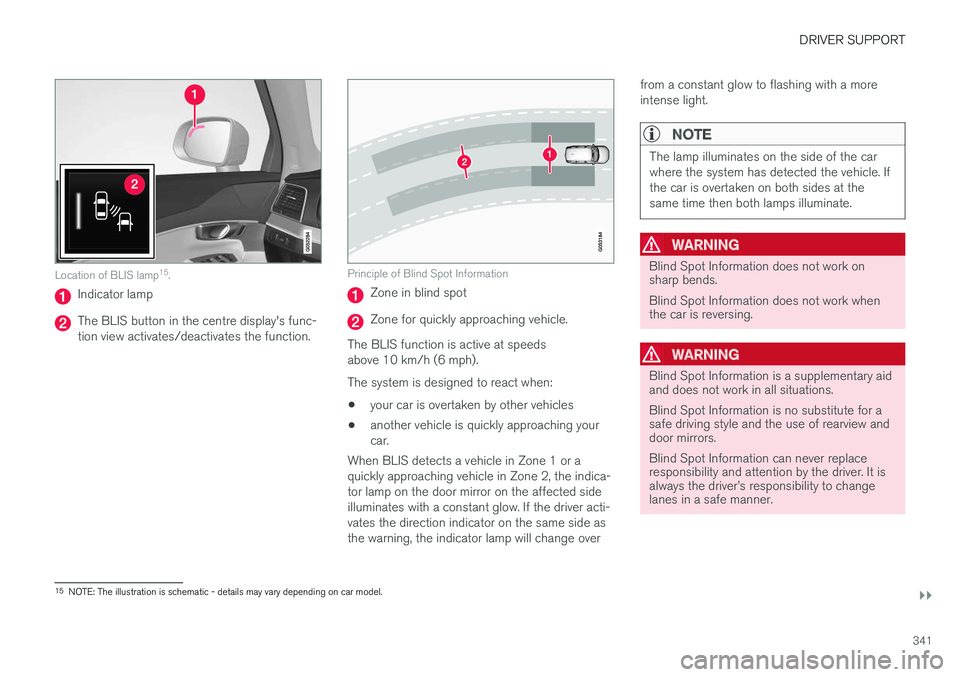
Location of BLIS lamp15
.
Indicator lamp
The BLIS button in the centre display's func- tion view activates/deactivates the function.
Principle of Blind Spot Information
Zone in blind spot
Zone for quickly approaching vehicle.
The BLIS function is active at speeds above 10 km/h (6 mph). The system is designed to react when: • your car is overtaken by other vehicles
• another vehicle is quickly approaching your car.
When BLIS detects a vehicle in Zone 1 or aquickly approaching vehicle in Zone 2, the indica-tor lamp on the door mirror on the affected sideilluminates with a constant glow. If the driver acti-vates the direction indicator on the same side asthe warning, the indicator lamp will change over from a constant glow to flashing with a moreintense light.
NOTE
The lamp illuminates on the side of the car where the system has detected the vehicle. Ifthe car is overtaken on both sides at thesame time then both lamps illuminate.
WARNING
Blind Spot Information does not work on sharp bends. Blind Spot Information does not work when the car is reversing.
WARNING
Blind Spot Information is a supplementary aid and does not work in all situations. Blind Spot Information is no substitute for a safe driving style and the use of rearview anddoor mirrors. Blind Spot Information can never replace responsibility and attention by the driver. It isalways the driver
Page 344 of 594
||
DRIVER SUPPORT
* Option/accessory.
342
WARNING
The system is a supplement to, not a replace- ment for, a safe driving style and use of therearview mirrors. It can never replace the driv-er's attention and responsibility. The responsi-bility for changing lanes safely always restswith the driver.
Related information
• Activate/deactivate Blind Spot Information
*
(p. 342)
• Limitations of Blind Spot Information
*
(p. 343)
• Messages for Blind Spot Information
* and
Cross Traffic Alert * (p. 347)
• Cross Traffic Alert
* (p. 343)
Activate/deactivate Blind Spot Information *
The Blind Spot Information (BLIS) function can be activated/deactivated.
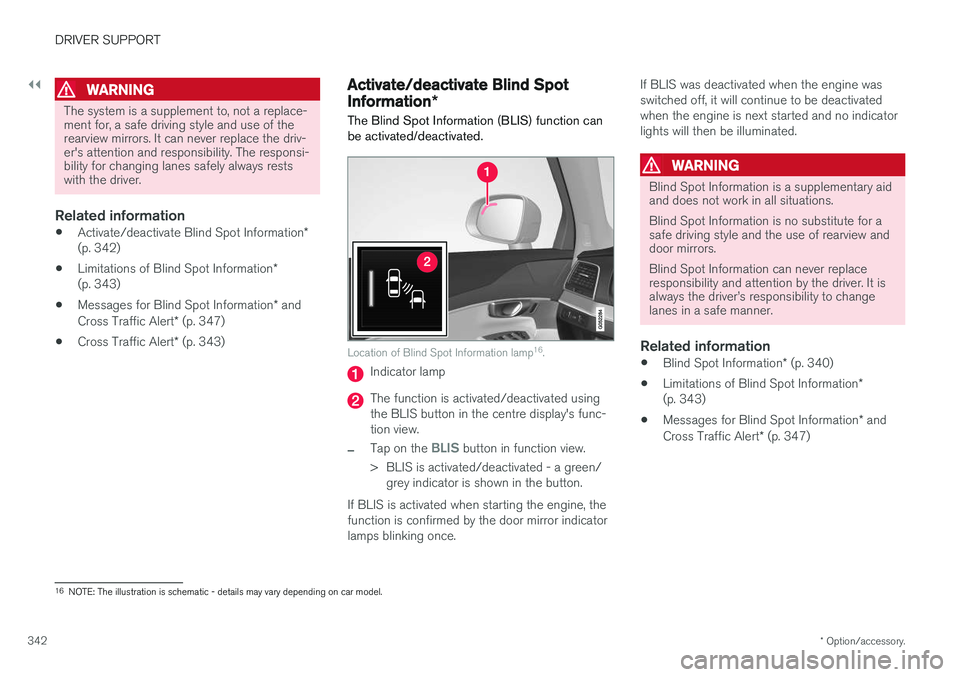
Location of Blind Spot Information lamp 16
.
Indicator lamp
The function is activated/deactivated using the BLIS button in the centre display's func-tion view.
–Tap on the BLIS button in function view.
> BLIS is activated/deactivated - a green/ grey indicator is shown in the button.
If BLIS is activated when starting the engine, the function is confirmed by the door mirror indicatorlamps blinking once. If BLIS was deactivated when the engine wasswitched off, it will continue to be deactivatedwhen the engine is next started and no indicatorlights will then be illuminated.
WARNING
Blind Spot Information is a supplementary aid and does not work in all situations. Blind Spot Information is no substitute for a safe driving style and the use of rearview anddoor mirrors. Blind Spot Information can never replace responsibility and attention by the driver. It isalways the driver
Page 346 of 594
||
DRIVER SUPPORT
* Option/accessory.
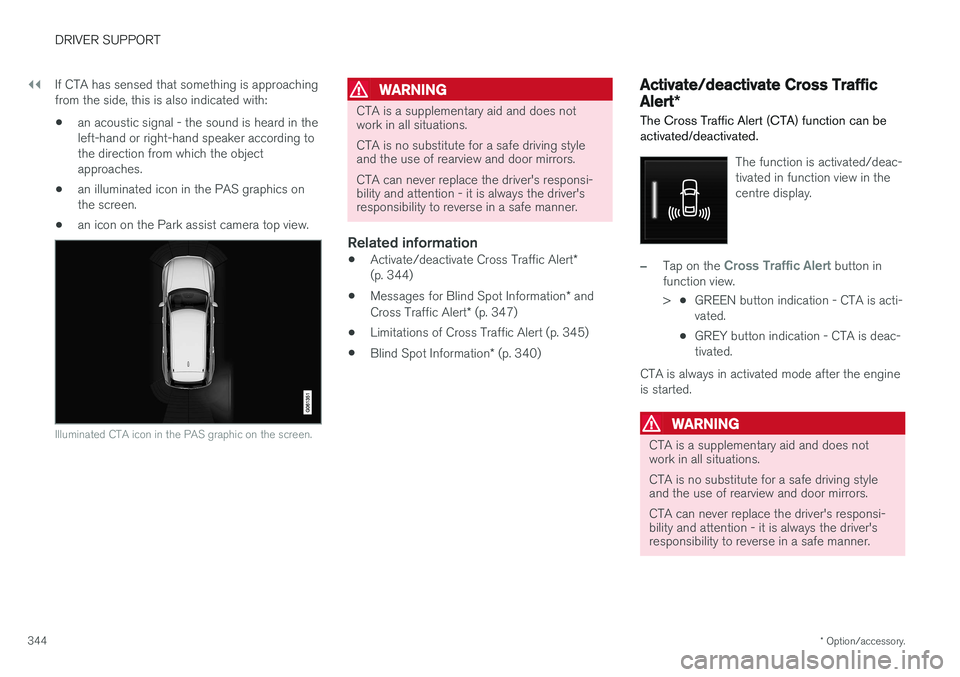
344 If CTA has sensed that something is approaching from the side, this is also indicated with:
• an acoustic signal - the sound is heard in theleft-hand or right-hand speaker according tothe direction from which the objectapproaches.
• an illuminated icon in the PAS graphics onthe screen.
• an icon on the Park assist camera top view.
Illuminated CTA icon in the PAS graphic on the screen.
WARNING
CTA is a supplementary aid and does not work in all situations. CTA is no substitute for a safe driving style and the use of rearview and door mirrors. CTA can never replace the driver's responsi- bility and attention - it is always the driver'sresponsibility to reverse in a safe manner.
Related information
•
Activate/deactivate Cross Traffic Alert
*
(p. 344)
• Messages for Blind Spot Information
* and
Cross Traffic Alert * (p. 347)
• Limitations of Cross Traffic Alert (p. 345)
• Blind Spot Information
* (p. 340)
Activate/deactivate Cross Traffic Alert *
The Cross Traffic Alert (CTA) function can be activated/deactivated.
The function is activated/deac- tivated in function view in thecentre display.
–Tap on the Cross Traffic Alert button in
function view. > •GREEN button indication - CTA is acti- vated.
• GREY button indication - CTA is deac-tivated.
CTA is always in activated mode after the engine
is started.
WARNING
CTA is a supplementary aid and does not work in all situations. CTA is no substitute for a safe driving style and the use of rearview and door mirrors. CTA can never replace the driver's responsi- bility and attention - it is always the driver'sresponsibility to reverse in a safe manner.
Page 350 of 594
DRIVER SUPPORT
* Option/accessory.
348
Road Sign Information *
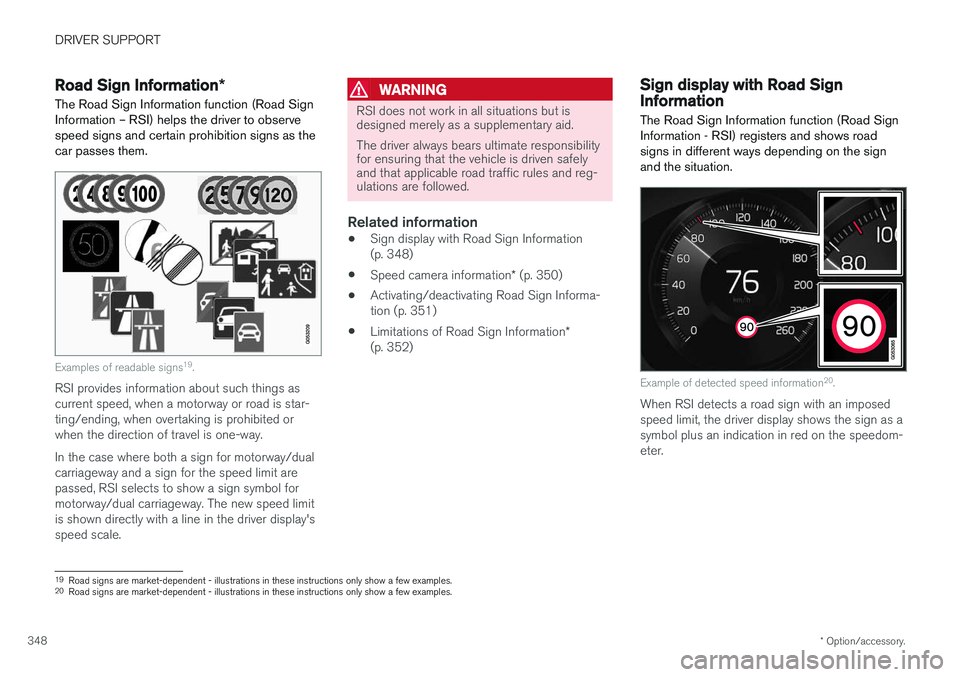
The Road Sign Information function (Road Sign Information – RSI) helps the driver to observespeed signs and certain prohibition signs as thecar passes them.
Examples of readable signs 19
.
RSI provides information about such things as current speed, when a motorway or road is star-ting/ending, when overtaking is prohibited orwhen the direction of travel is one-way. In the case where both a sign for motorway/dual carriageway and a sign for the speed limit arepassed, RSI selects to show a sign symbol formotorway/dual carriageway. The new speed limitis shown directly with a line in the driver display'sspeed scale.
WARNING
RSI does not work in all situations but is designed merely as a supplementary aid. The driver always bears ultimate responsibility for ensuring that the vehicle is driven safelyand that applicable road traffic rules and reg-ulations are followed.
Related information
• Sign display with Road Sign Information (p. 348)
• Speed camera information
* (p. 350)
• Activating/deactivating Road Sign Informa-tion (p. 351)
• Limitations of Road Sign Information
*
(p. 352)
Sign display with Road Sign Information
The Road Sign Information function (Road Sign
Information - RSI) registers and shows roadsigns in different ways depending on the signand the situation.
Example of detected speed information 20
.
When RSI detects a road sign with an imposed speed limit, the driver display shows the sign as asymbol plus an indication in red on the speedom-eter.
19 Road signs are market-dependent - illustrations in these instructions only show a few examples.
20 Road signs are market-dependent - illustrations in these instructions only show a few examples.
Page 351 of 594
DRIVER SUPPORT
}}
* Option/accessory.349
Besides the speed limit symbol an additional sign may beshown as well, such as "noovertaking".
If the driver enters a road marked with a no-entry sign atthe roadside, the symbol forthis sign flashes on and off onthe driver display as a warning.
If the car is equipped with Sensus Navigation
*
then information from the map is also used to determine whether the car is being driven in thewrong direction. The driver can also get an acoustic warning when driving towards a no-entry entrance if the
Audio
Warning function is activated - see the heading
"Activating/deactivating the acoustic warning" in the section "Activating/deactivating Road SignInformation".
End of restriction or motorwayIf RSI detects a sign which may imply the end ofa speed limit, such as the end of a motorway, thedriver display shows the corresponding road signfor 10–30 seconds. Examples of such signs are: End of all restrictions.
End of motorway.
Following which, the sign information is hidden until the next speed-related sign is detected.
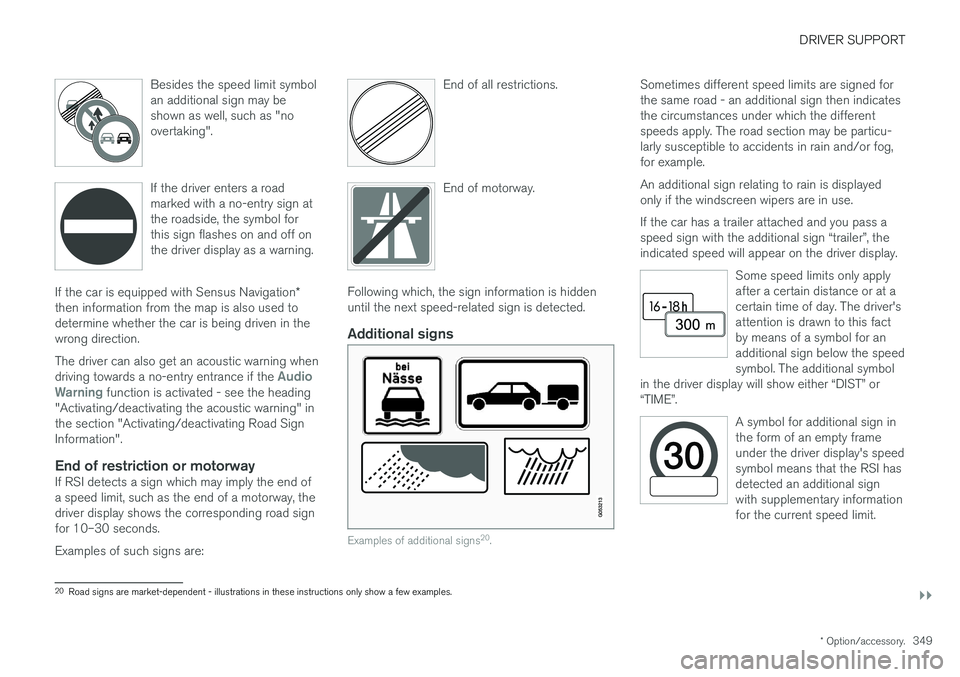
Additional signs
Examples of additional signs
20
.
Sometimes different speed limits are signed for the same road - an additional sign then indicatesthe circumstances under which the differentspeeds apply. The road section may be particu-larly susceptible to accidents in rain and/or fog,for example. An additional sign relating to rain is displayed only if the windscreen wipers are in use. If the car has a trailer attached and you pass a speed sign with the additional sign “trailer”, theindicated speed will appear on the driver display.
Some speed limits only applyafter a certain distance or at acertain time of day. The driver'sattention is drawn to this factby means of a symbol for anadditional sign below the speedsymbol. The additional symbol
in the driver display will show either “DIST” or“TIME”.
A symbol for additional sign in the form of an empty frameunder the driver display's speedsymbol means that the RSI hasdetected an additional signwith supplementary informationfor the current speed limit.
20 Road signs are market-dependent - illustrations in these instructions only show a few examples.
Page 355 of 594
DRIVER SUPPORT
}}
353
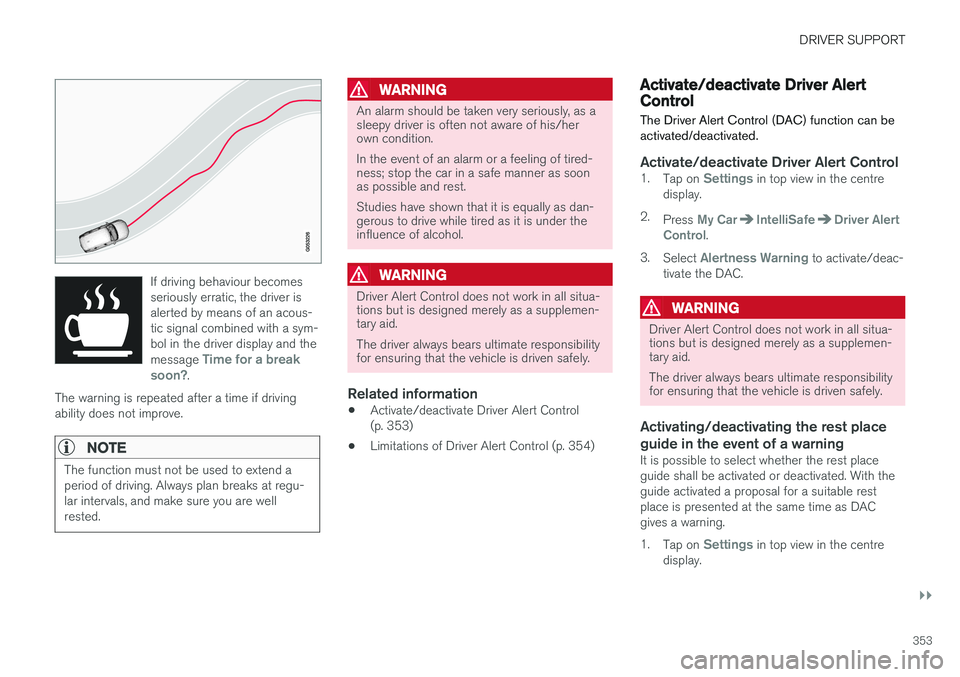
If driving behaviour becomes seriously erratic, the driver isalerted by means of an acous-tic signal combined with a sym-bol in the driver display and the message
Time for a break
soon?.
The warning is repeated after a time if driving ability does not improve.
NOTE
The function must not be used to extend a period of driving. Always plan breaks at regu-lar intervals, and make sure you are wellrested.
WARNING
An alarm should be taken very seriously, as a sleepy driver is often not aware of his/herown condition. In the event of an alarm or a feeling of tired- ness; stop the car in a safe manner as soonas possible and rest. Studies have shown that it is equally as dan- gerous to drive while tired as it is under theinfluence of alcohol.
WARNING
Driver Alert Control does not work in all situa- tions but is designed merely as a supplemen-tary aid. The driver always bears ultimate responsibility for ensuring that the vehicle is driven safely.
Related information
• Activate/deactivate Driver Alert Control (p. 353)
• Limitations of Driver Alert Control (p. 354)
Activate/deactivate Driver Alert Control
The Driver Alert Control (DAC) function can be activated/deactivated.
Activate/deactivate Driver Alert Control1. Tap on Settings in top view in the centre
display.
2. Press
My CarIntelliSafeDriver Alert
Control.
3. Select
Alertness Warning to activate/deac-
tivate the DAC.
WARNING
Driver Alert Control does not work in all situa- tions but is designed merely as a supplemen-tary aid. The driver always bears ultimate responsibility for ensuring that the vehicle is driven safely.
Activating/deactivating the rest place guide in the event of a warning
It is possible to select whether the rest place guide shall be activated or deactivated. With theguide activated a proposal for a suitable restplace is presented at the same time as DACgives a warning. 1. Tap on
Settings in top view in the centre
display.
Page 356 of 594
||
DRIVER SUPPORT
* Option/accessory.
354 2.
Press
My CarIntelliSafeDriver Alert
Control.
3. Select
Rest Stop Guidance to activate/
deactivate the rest place guide.
Related information
• Driver Alert Control (p. 352)
• Limitations of Driver Alert Control (p. 354)
Limitations of Driver Alert Control
The Driver Alert Control (DAC) function may have limitations in certain situations.
In some cases, driving behaviour may not be affected, despite the driver being tired - e.g. whenusing the Pilot Assist function - with the resultthat the driver is then not given a warning fromDAC. For this reason, it is always very importantto stop and take a break in the event of theslightest sign of driver fatigue, regardless ofwhether DAC has given a warning. In some cases the system may issue a warning despite driving ability not deteriorating, for exam-ple:
• in strong side winds
• on rutted road surfaces.
NOTE
The function uses the car's camera unit, which has some general limitations, see the"Limitations for camera unit" section.
Related information
•
Driver Alert Control (p. 352)
• Activate/deactivate Driver Alert Control (p. 353)
• Limitations of the camera unit (p. 327)
• Pilot Assist
* (p. 304)
Lane Keeping Aid
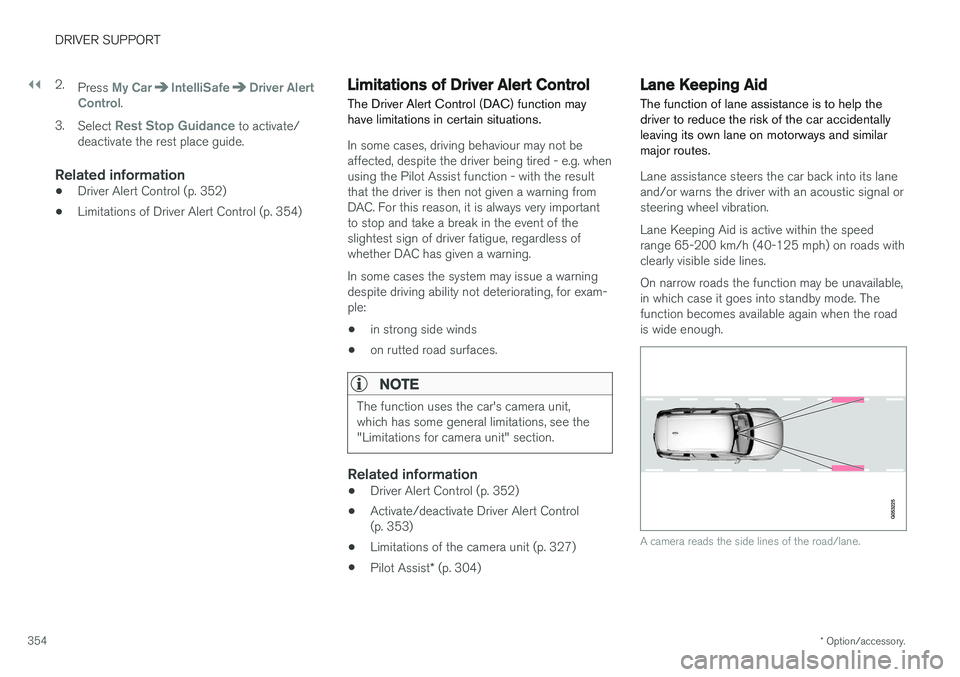
The function of lane assistance is to help the driver to reduce the risk of the car accidentallyleaving its own lane on motorways and similarmajor routes.
Lane assistance steers the car back into its lane and/or warns the driver with an acoustic signal orsteering wheel vibration. Lane Keeping Aid is active within the speed range 65-200 km/h (40-125 mph) on roads withclearly visible side lines. On narrow roads the function may be unavailable, in which case it goes into standby mode. Thefunction becomes available again when the roadis wide enough.
A camera reads the side lines of the road/lane.