4-1 YAMAHA TMAX 2016 User Guide
[x] Cancel search | Manufacturer: YAMAHA, Model Year: 2016, Model line: TMAX, Model: YAMAHA TMAX 2016Pages: 110, PDF Size: 6.26 MB
Page 39 of 110
Instrument and control functions
4-14
1
2
3
4
5
6
7
8
9
10
11
12
13
14
EAU63691
Fuel tank cap
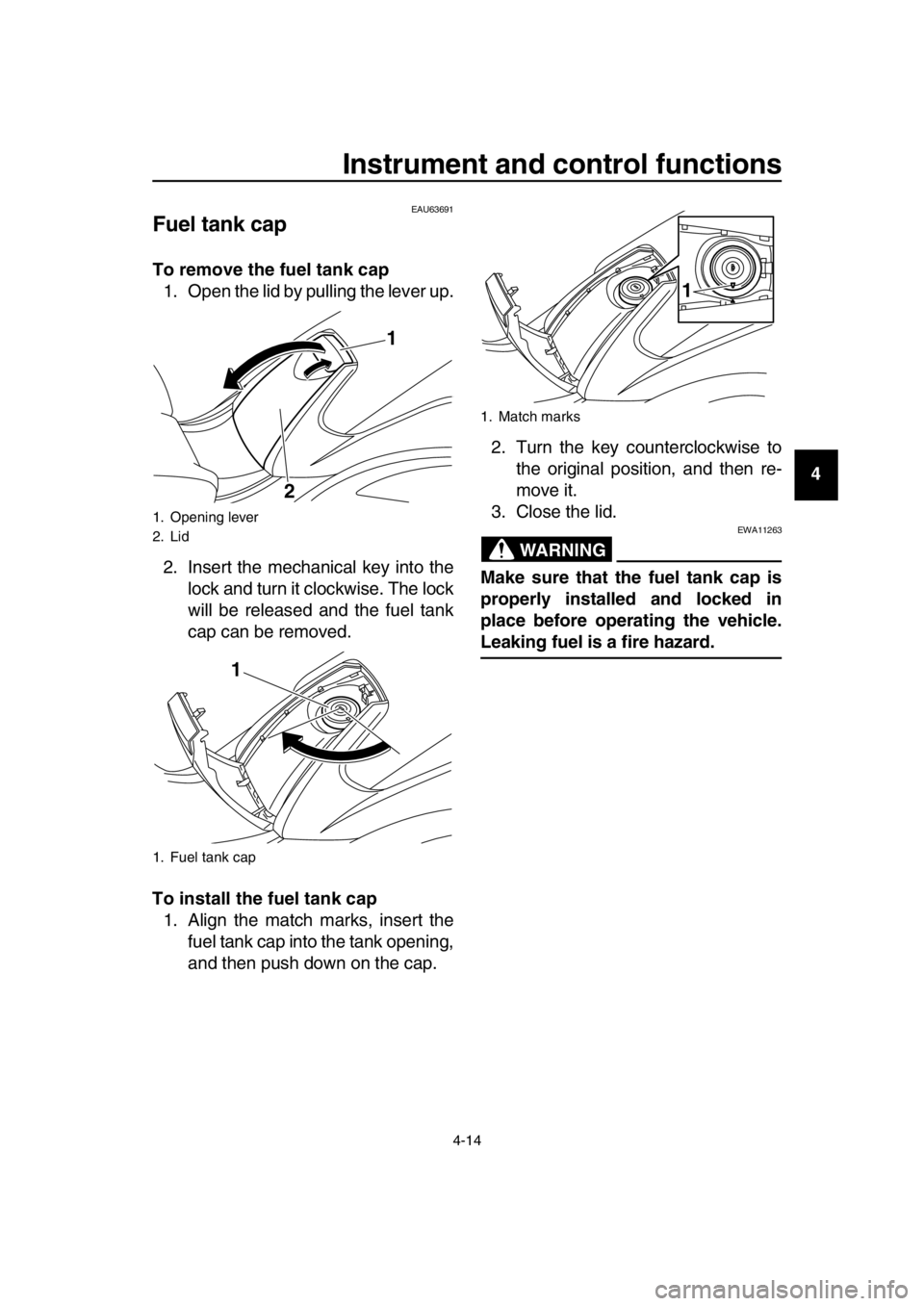
To remove the fuel tank cap 1. Open the lid by pulling the lever up.
2. Insert the mechanical key into the lock and turn it clockwise. The lock
will be released and the fuel tank
cap can be removed.
To install the fuel tank cap 1. Align the match marks, insert the fuel tank cap into the tank opening,
and then push down on the cap. 2. Turn the key counterclockwise to
the original position, and then re-
move it.
3. Close the lid.
WARNING
EWA11263
Make sure that the fuel tank cap is
properly installed and locked in
place before operating the vehicle.
Leaking fuel is a fire hazard.
1. Opening lever
2. Lid
1. Fuel tank cap
1
2
1
1. Match marks
1
2PW-9-E1.book 14 ページ 2015年9月10日 木曜日 午後5時17分
Page 40 of 110
Instrument and control functions
4-15
1
2
3
4
5
6
7
8
9
10
11
12
13
14
EAU13222
Fuel
Make sure there is sufficient gasoline in
the tank.
WARNING
EWA10882
Gasoline and gasoline vapors are
extremely flammable. To avoid fires
and explosions and to reduce the
risk of injury when refueling, follow
these instructions. 1. Before refueling, turn off the en- gine and be sure that no one is sit-
ting on the vehicle. Never refuel
while smoking, or while in the vicin-
ity of sparks, open flames, or other
sources of ignition such as the pilot
lights of water heaters and clothes
dryers.
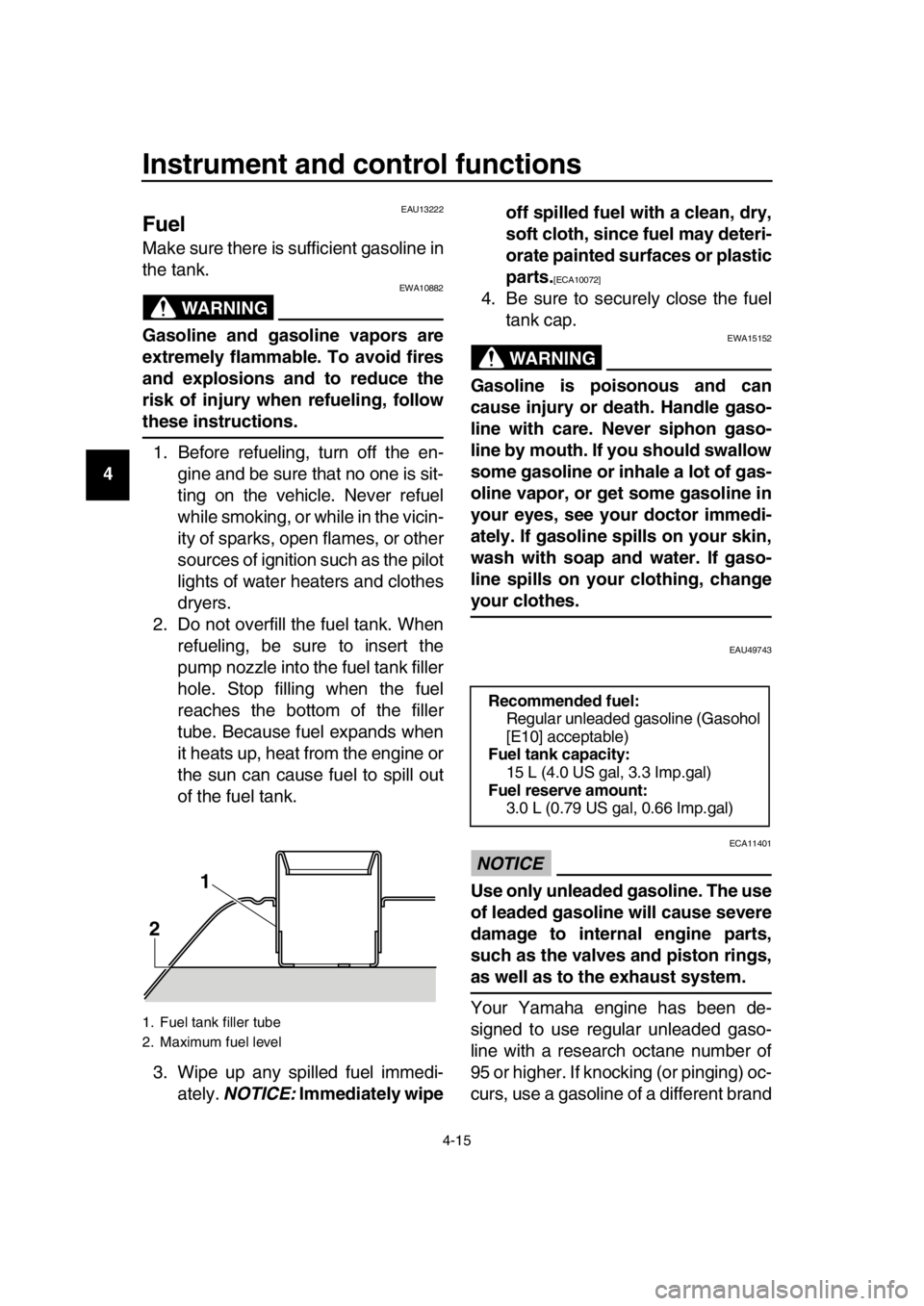
2. Do not overfill the fuel tank. When refueling, be sure to insert the
pump nozzle into the fuel tank filler
hole. Stop filling when the fuel
reaches the bottom of the filler
tube. Because fuel expands when
it heats up, heat from the engine or
the sun can cause fuel to spill out
of the fuel tank.
3. Wipe up any spilled fuel immedi- ately. NOTICE: Immediately wipe off spilled fuel with a clean, dry,
soft cloth, since fuel may deteri-
orate painted surfaces or plastic
parts.
[ECA10072]
4. Be sure to securely close the fuel
tank cap.
WARNING
EWA15152
Gasoline is poisonous and can
cause injury or death. Handle gaso-
line with care. Never siphon gaso-
line by mouth. If you should swallow
some gasoline or inhale a lot of gas-
oline vapor, or get some gasoline in
your eyes, see your doctor immedi-
ately. If gasoline spills on your skin,
wash with soap and water. If gaso-
line spills on your clothing, change
your clothes.
EAU49743
NOTICE
ECA11401
Use only unleaded gasoline. The use
of leaded gasoline will cause severe
damage to internal engine parts,
such as the valves and piston rings,
as well as to the exhaust system.
Your Yamaha engine has been de-
signed to use regular unleaded gaso-
line with a research octane number of
95 or higher. If knocking (or pinging) oc-
curs, use a gasoline of a different brand
1. Fuel tank filler tube
2. Maximum fuel level
2 1
Recommended fuel:
Regular unleaded gasoline (Gasohol
[E10] acceptable)
Fuel tank capacity:
15 L (4.0 US gal, 3.3 Imp.gal)
Fuel reserve amount: 3.0 L (0.79 US gal, 0.66 Imp.gal)
2PW-9-E1.book 15 ページ 2015年9月10日 木曜日 午後5時17分
Page 41 of 110
Instrument and control functions
4-16
1
2
3
4
5
6
7
8
9
10
11
12
13
14
or premium unleaded fuel. Use of un-
leaded fuel will extend spark plug life
and reduce maintenance costs.
Gasohol
There are two types of gasohol: gaso-
hol containing ethanol and that contain-
ing methanol. Gasohol containing
ethanol can be used if the ethanol con-
tent does not exceed 10% (E10). Gas-
ohol containing methanol is not
recommended by Yamaha because it
can cause damage to the fuel system
or vehicle performance problems.
EAU13434
Catalytic converter
This model is equipped with a catalytic
converter in the exhaust system.
WARNING
EWA10863
The exhaust system is hot after op-
eration. To prevent a fire hazard or
burns:
Do not park the vehicle near
possible fire hazards such as
grass or other materials that
easily burn.
Park the vehicle in a place
where pedestrians or children
are not likely to touch the hot
exhaust system.
Make sure that the exhaust sys-
tem has cooled down before do-
ing any maintenance work.
Do not allow the engine to idle
more than a few minutes. Long
idling can cause a build-up of
heat.
NOTICE
ECA10702
Use only unleaded gasoline. The use
of leaded gasoline will cause unre-
pairable damage to the catalytic
converter.
2PW-9-E1.book 16 ページ 2015年9月10日 木曜日 午後5時17分
Page 42 of 110
Instrument and control functions
4-17
1
2
3
4
5
6
7
8
9
10
11
12
13
14
EAU63600
Adjusting the rider backrest
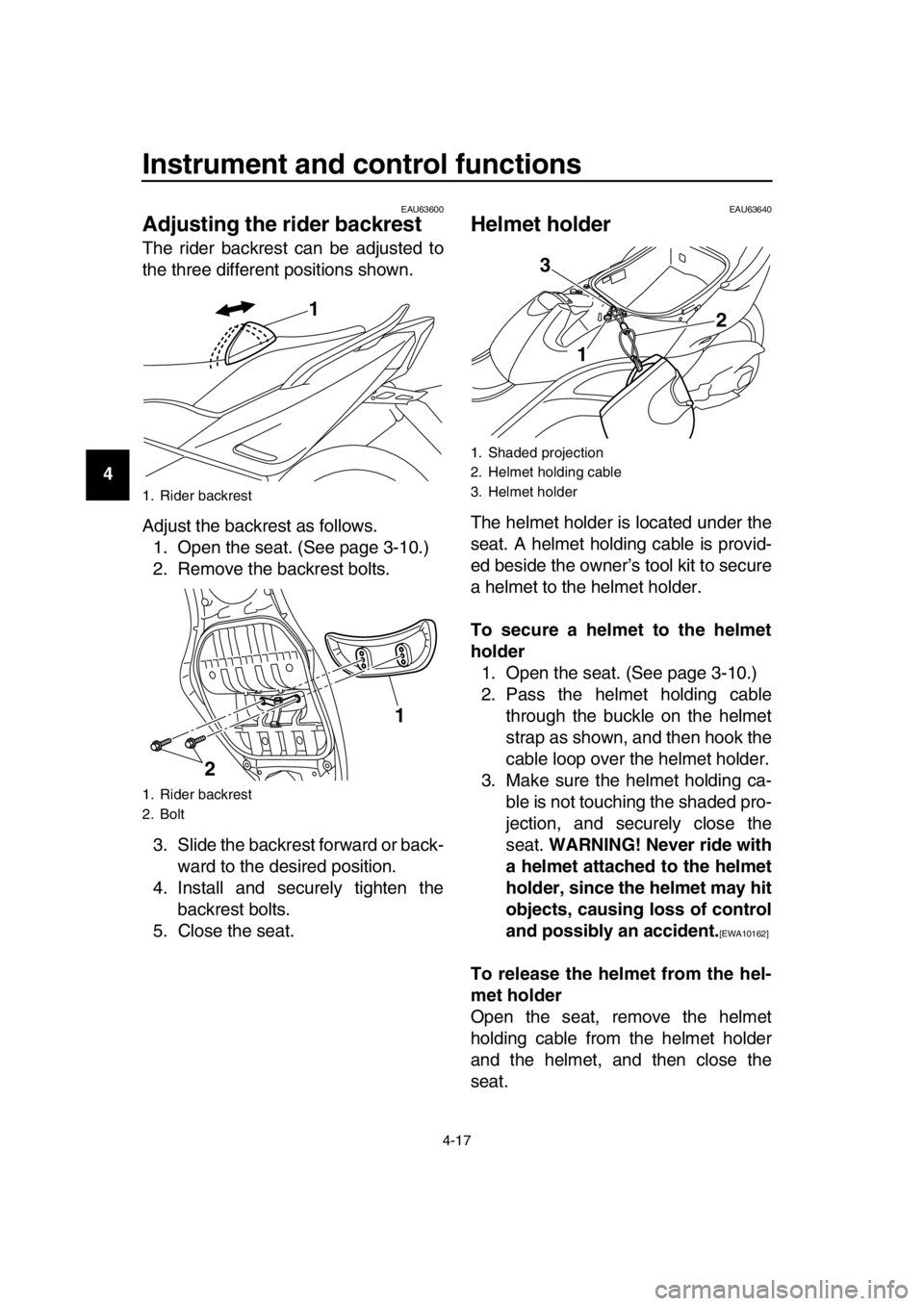
The rider backrest can be adjusted to
the three different positions shown.
Adjust the backrest as follows. 1. Open the seat. (See page 3-10.)
2. Remove the backrest bolts.
3. Slide the backrest forward or back- ward to the desired position.
4. Install and securely tighten the backrest bolts.
5. Close the seat.
EAU63640
Helmet holder
The helmet holder is located under the
seat. A helmet holding cable is provid-
ed beside the owner’s tool kit to secure
a helmet to the helmet holder.
To secure a helmet to the helmet
holder 1. Open the seat. (See page 3-10.)
2. Pass the helmet holding cable through the buckle on the helmet
strap as shown, and then hook the
cable loop over the helmet holder.
3. Make sure the helmet holding ca- ble is not touching the shaded pro-
jection, and securely close the
seat. WARNING! Never ride with
a helmet attached to the helmet
holder, since the helmet may hit
objects, causing loss of control
and possibly an accident.
[EWA10162]
To release the helmet from the hel-
met holder
Open the seat, remove the helmet
holding cable from the helmet holder
and the helmet, and then close the
seat.
1. Rider backrest
1. Rider backrest
2. Bolt
1
1
2
1. Shaded projection
2. Helmet holding cable
3. Helmet holder
3
1
2
2PW-9-E1.book 17 ページ 2015年9月10日 木曜日 午後5時17分
Page 43 of 110
Instrument and control functions
4-18
1
2
3
4
5
6
7
8
9
10
11
12
13
14
EAU63510
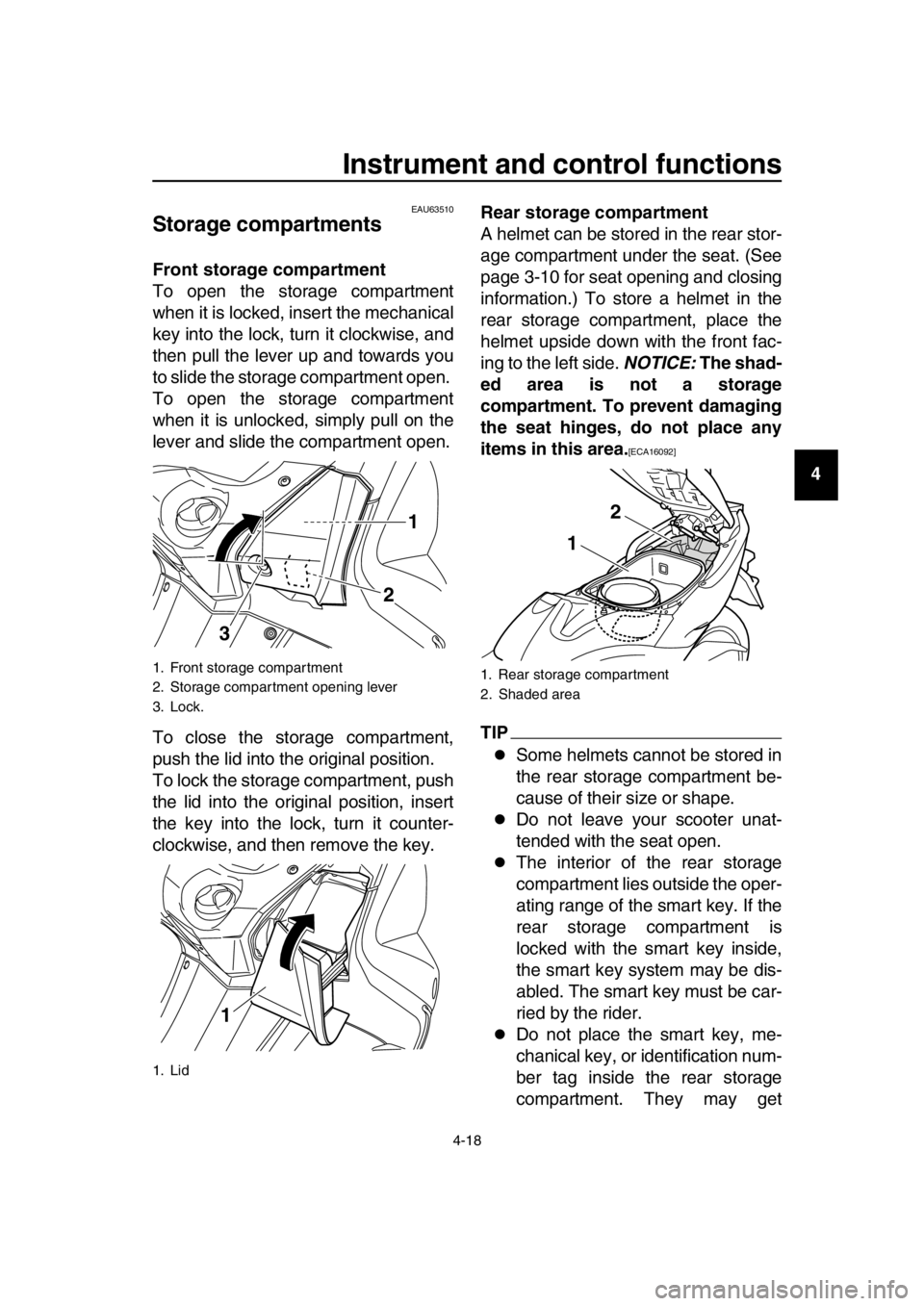
Storage compartments
Front storage compartment
To open the storage compartment
when it is locked, insert the mechanical
key into the lock, turn it clockwise, and
then pull the lever up and towards you
to slide the storage compartment open.
To open the storage compartment
when it is unlocked, simply pull on the
lever and slide the compartment open.
To close the storage compartment,
push the lid into the original position.
To lock the storage compartment, push
the lid into the original position, insert
the key into the lock, turn it counter-
clockwise, and then remove the key. Rear storage compartment
A helmet can be stored in the rear stor-
age compartment under the seat. (See
page 3-10 for seat opening and closing
information.) To store a helmet in the
rear storage compartment, place the
helmet upside down with the front fac-
ing to the left side.
NOTICE: The shad-
ed area is not a storage
compartment. To prevent damaging
the seat hinges, do not place any
items in this area.
[ECA16092]
TIP
Some helmets cannot be stored in
the rear storage compartment be-
cause of their size or shape.
Do not leave your scooter unat-
tended with the seat open.
The interior of the rear storage
compartment lies outside the oper-
ating range of the smart key. If the
rear storage compartment is
locked with the smart key inside,
the smart key system may be dis-
abled. The smart key must be car-
ried by the rider.
Do not place the smart key, me-
chanical key, or identification num-
ber tag inside the rear storage
compartment. They may get
1. Front storage compartment
2. Storage compartment opening lever
3. Lock.
1. Lid
1
2
3
1
1. Rear storage compartment
2. Shaded area
1
2
2PW-9-E1.book 18 ページ 2015年9月10日 木曜日 午後5時17分
Page 44 of 110
Instrument and control functions
4-19
1
2
3
4
5
6
7
8
9
10
11
12
13
14 locked inside and the smart key
system may not operate normally.
NOTICE
ECA15963
Do not leave the seat open for
an extended period of time, oth-
erwise the light may cause the
battery to discharge.
Since the storage compartment
may get wet while the scooter is
being washed, wrap any articles
stored in the compartment in a
plastic bag.
To avoid humidity from spread-
ing through the storage com-
partment and to discourage
possible mold growth, wrap wet
articles in a plastic bag before
storing them in the compart-
ment.
Do not keep anything valuable
or breakable in the storage com-
partment.
Since the storage compartment
accumulates heat from the en-
gine and from direct sunlight,
do not store anything suscepti-
ble to heat, such as food or
flammable items, inside the
compartment.
WARNING
EWA15861
Do not exceed the following loading
limits:
Front storage compartment: 1
kg (2 lb)
Rear storage compartment: 5 kg
(11 lb)
Maximum load for the vehicle:
193 kg (425 lb) (XP500A)
196 kg (432 lb) (XP500)
EAU52212
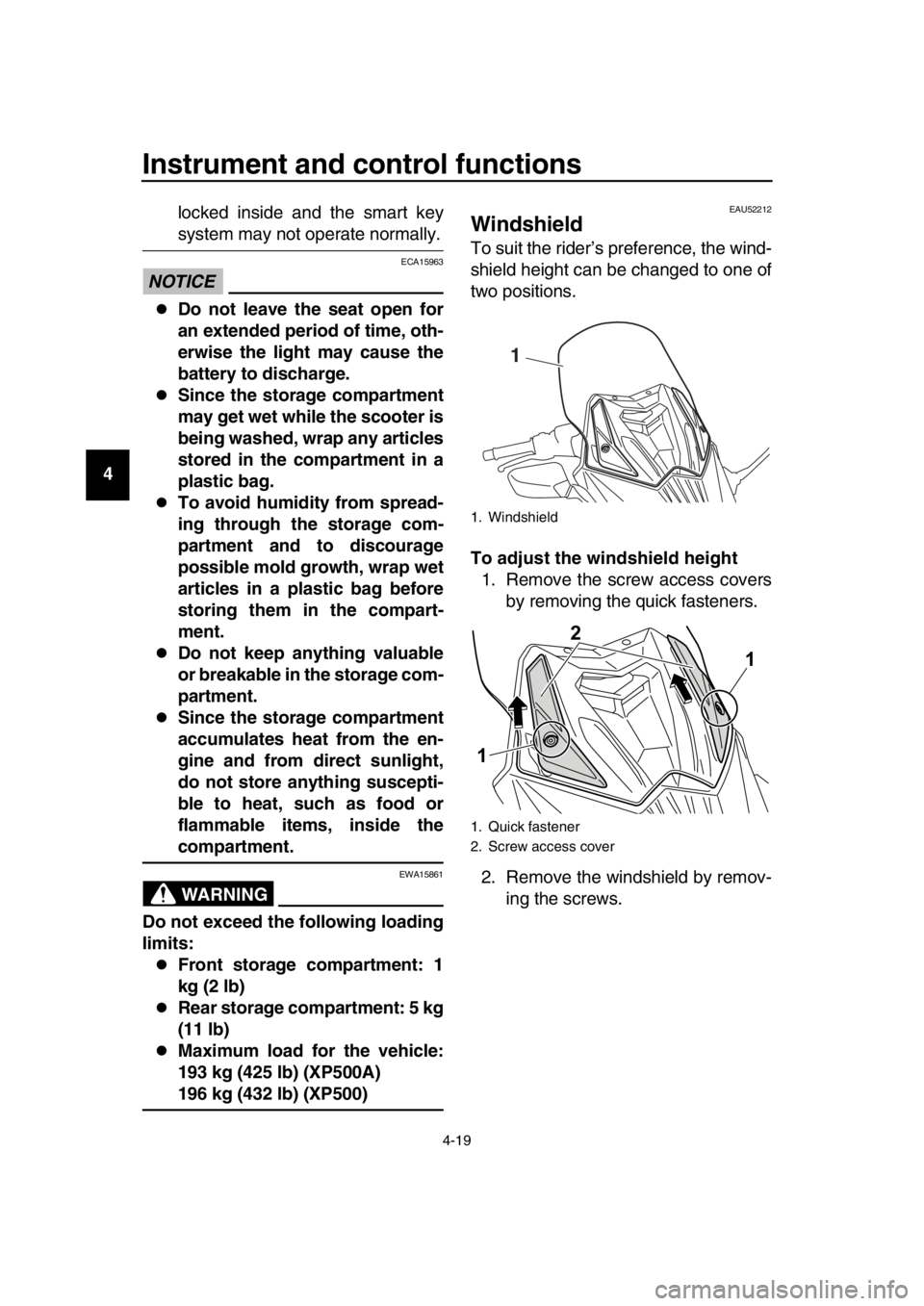
Windshield
To suit the rider’s preference, the wind-
shield height can be changed to one of
two positions.
To adjust the windshield height
1. Remove the screw access covers by removing the quick fasteners.
2. Remove the windshield by remov- ing the screws.
1. Windshield
1. Quick fastener
2. Screw access cover
1
1
2
1
2PW-9-E1.book 19 ページ 2015年9月10日 木曜日 午後5時17分
Page 50 of 110
5-1
1
2
3
4
5
6
7
8
9
10
11
12
13
14
For your safety – pre-operation checks
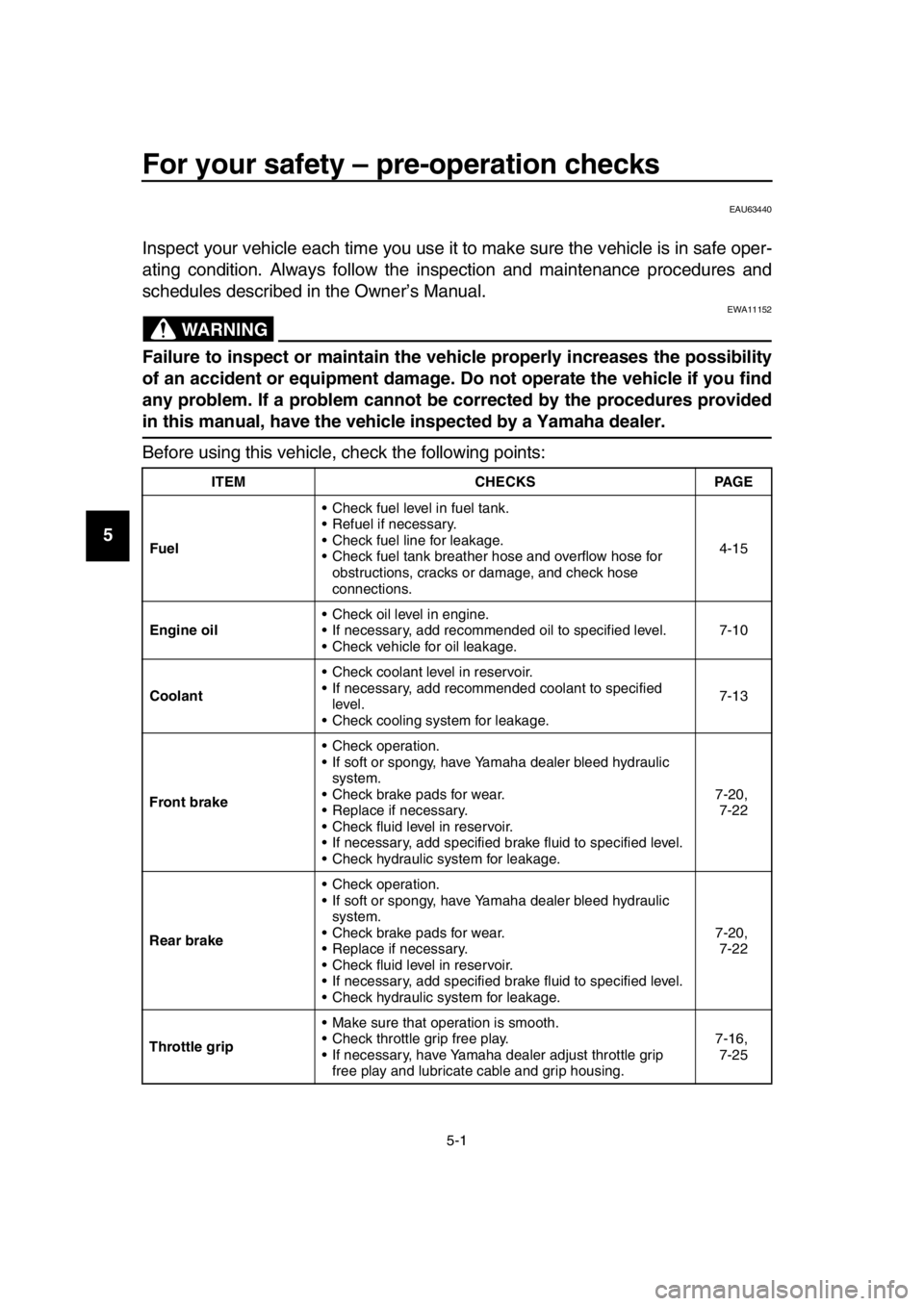
EAU63440
Inspect your vehicle each time you use it to make sure the vehicle is in safe oper-
ating condition. Always follow the inspection and maintenance procedures and
schedules described in the Owner’s Manual.
WARNING
EWA11152
Failure to inspect or maintain the vehicle properly increases the possibility
of an accident or equipment damage. Do not operate the vehicle if you find
any problem. If a problem cannot be corrected by the procedures provided
in this manual, have the vehicle inspected by a Yamaha dealer.
Before using this vehicle, check the following points:
ITEM CHECKSPAGE
Fuel Check fuel level in fuel tank.
Refuel if necessary.
Check fuel line for leakage.
Check fuel tank breather hose and overflow hose for
obstructions, cracks or damage, and check hose
connections. 4-15
Engine oil Check oil level in engine.
If necessary, add recommended oil to specified level.
Check vehicle for oil leakage. 7-10
Coolant Check coolant level in reservoir.
If necessary, add recomm
ended coolant to specified
level.
Check cooling system for leakage. 7-13
Front brake Check operation.
If soft or spongy, have Yamaha dealer bleed hydraulic
system.
Check brake pads for wear.
Replace if necessary.
Check fluid level in reservoir.
If necessary, add specified brake fluid to specified level.
Check hydraulic system for leakage. 7-20,
7-22
Rear brake Check operation.
If soft or spongy, have Yamaha dealer bleed hydraulic
system.
Check brake pads for wear.
Replace if necessary.
Check fluid level in reservoir.
If necessary, add specified brake fluid to specified level.
Check hydraulic system for leakage. 7-20,
7-22
Throttle grip Make sure that operation is smooth.
Check throttle grip free play.
If necessary, have Yamaha dealer adjust throttle grip
free play and lubricate cable and grip housing. 7-16,
7-25
2PW-9-E1.book 1 ページ 2015年9月10日 木曜日 午後5時17分
Page 53 of 110
Operation and important riding points
6-2
1
2
3
4
5
6
7
8
9
10
11
12
13
14
EAU61552
Starting the engine
NOTICE
ECA10251
See page 6-5 for engine break-in in-
structions prior to operating the ve-
hicle for the first time.
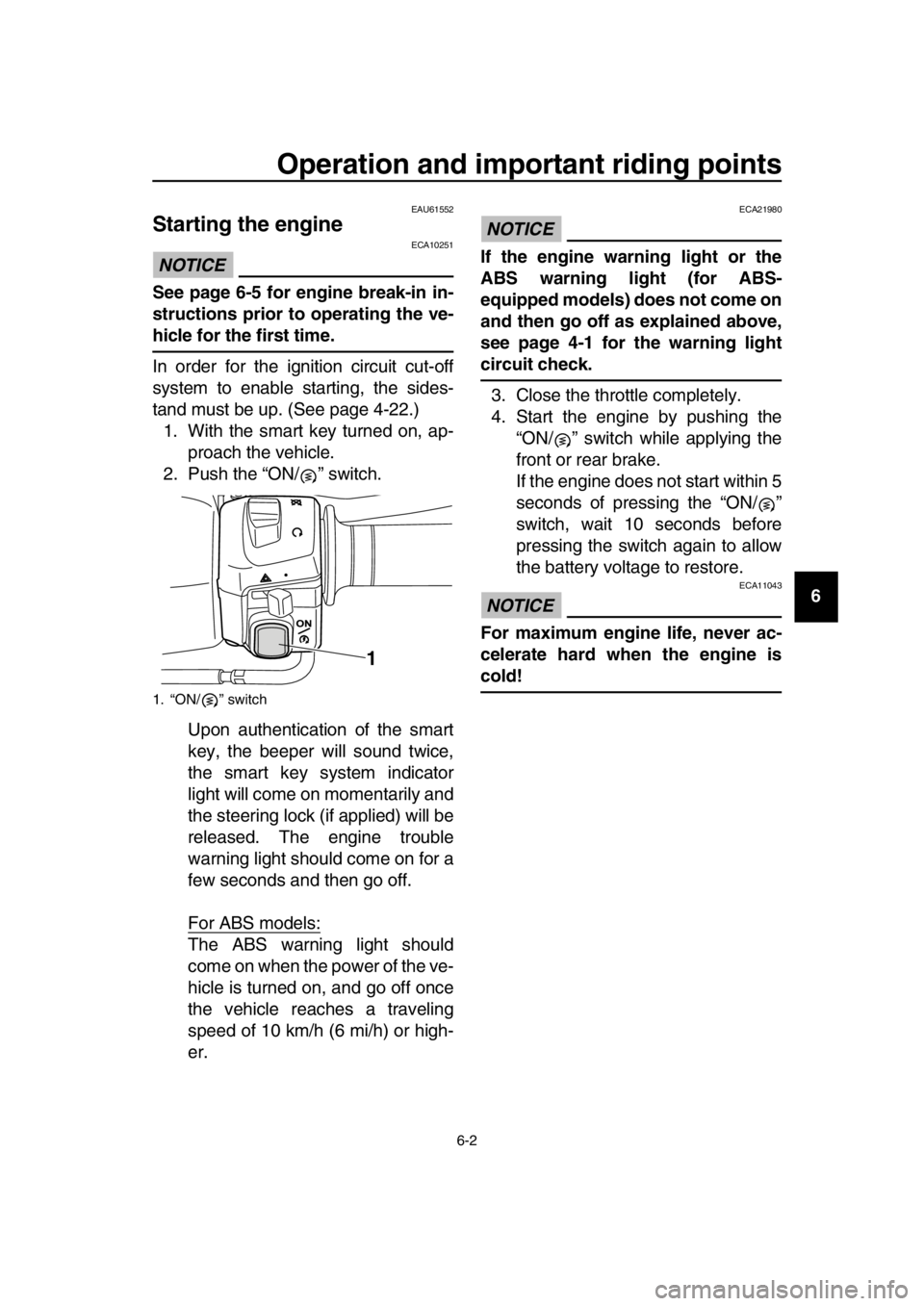
In order for the ignition circuit cut-off
system to enable starting, the sides-
tand must be up. (See page 4-22.) 1. With the smart key turned on, ap- proach the vehicle.
2. Push the “ON/ ” switch.
Upon authentication of the smart
key, the beeper will sound twice,
the smart key system indicator
light will come on momentarily and
the steering lock (if applied) will be
released. The engine trouble
warning light should come on for a
few seconds and then go off.
For ABS models:
The ABS warning light should
come on when the power of the ve-
hicle is turned on, and go off once
the vehicle reaches a traveling
speed of 10 km/h (6 mi/h) or high-
er.
NOTICE
ECA21980
If the engine warning light or the
ABS warning light (for ABS-
equipped models) does not come on
and then go off as explained above,
see page 4-1 for the warning light
circuit check.3. Close the throttle completely.
4. Start the engine by pushing the “ON/ ” switch while applying the
front or rear brake.
If the engine does not start within 5
seconds of pressing the “ON/ ”
switch, wait 10 seconds before
pressing the switch again to allow
the battery voltage to restore.
NOTICE
ECA11043
For maximum engine life, never ac-
celerate hard when the engine is
cold!
1. “ON/ ” switch
1
2PW-9-E1.book 2 ページ 2015年9月10日 木曜日 午後5時17分
Page 106 of 110
Consumer information
10-2
1
2
3
4
5
6
7
8
9
10
11
12
13
14
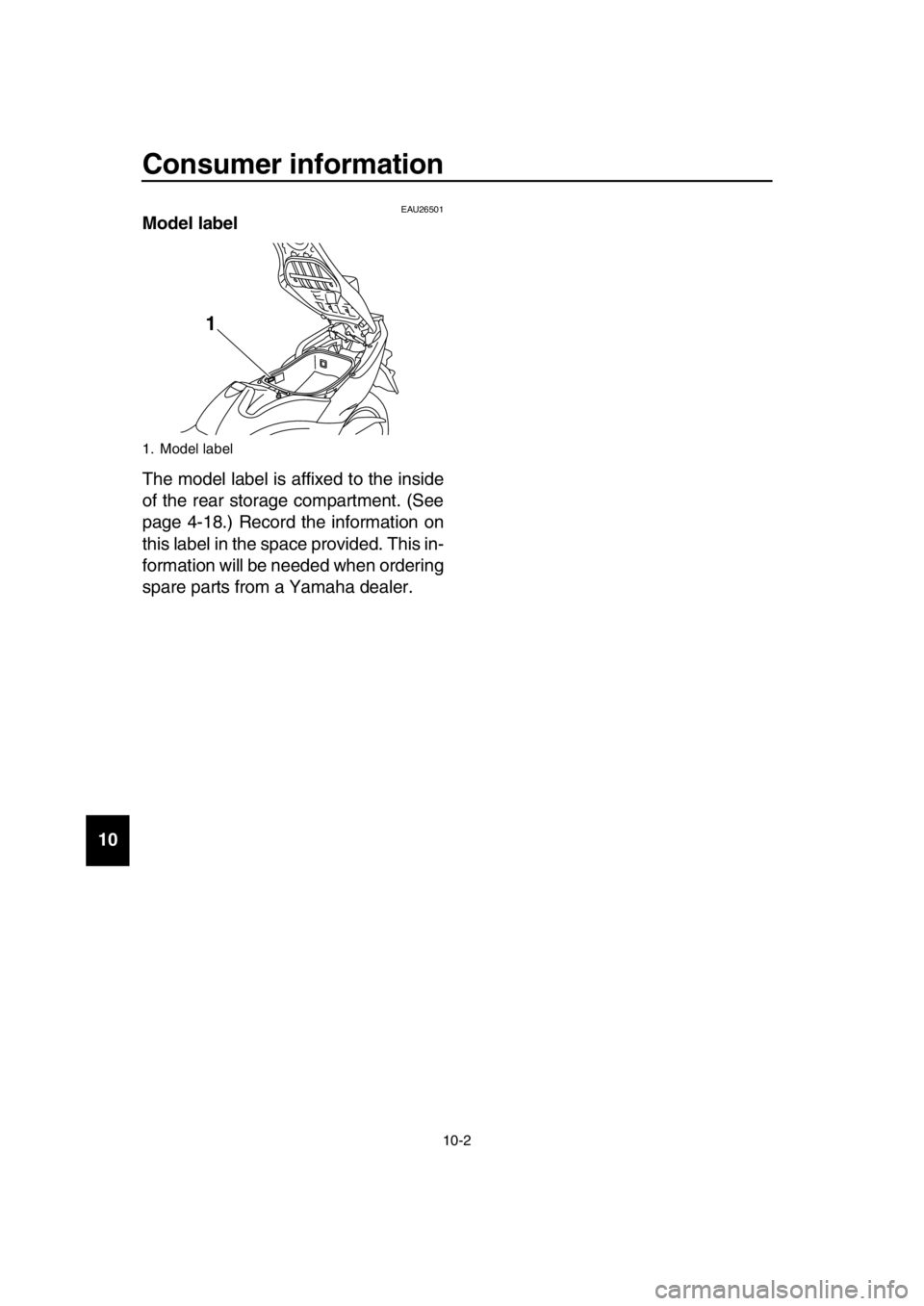
EAU26501Model label
The model label is affixed to the inside
of the rear storage compartment. (See
page 4-18.) Record the information on
this label in the space provided. This in-
formation will be needed when ordering
spare parts from a Yamaha dealer.
1. Model label
1
2PW-9-E1.book 2 ページ 2015年9月10日 木曜日 午後5時17分
Page 107 of 110

11-1
1
2
3
4
5
6
7
8
9
10
11
12
13
14
Index
A
ABS (for ABS models) ...........................4-13
ABS warning light (for ABS models)........4-1
Acceleration and deceleration .................6-3
Air filter element, replacing ....................7-15
Auxiliary DC jack ...................................4-24
Auxiliary lights .......................................7-32
B
Battery ...................................................7-28
Brake fluid, changing .............................7-23
Brake fluid level, checking .....................7-22
Brake lever, front ...................................4-11
Brake lever, rear ....................................4-12
Brake levers, lubricating ........................7-25
Braking ....................................................6-4
C
Cables, checking and lubricating...........7-24
Care.........................................................8-1
Catalytic converter.................................4-16
Centerstand and sidestand, checking and lubricating .....................7-26
Coolant ..................................................7-13
D
Dimmer switch .......................................4-10
Drive belt slack ......................................7-24
E
Emergency mode ..................................7-38
Engine break-in .......................................6-5
Engine idling speed ...............................7-16
Engine oil and oil filter cartridge ............7-10
Engine serial number ............................10-1
Engine stop switch ................................4-10
Engine trouble warning light ....................4-1
F
Front and rear brake lever free play,
checking ..............................................7-20
Front and rear brake pads, checking.....7-22
Front fork, checking ...............................7-26
Fuel .......................................................4-15
Fuel consumption, tips for reducing ........6-5
Fuel tank cap .........................................4-14
Fuses, replacing ....................................7-29
H
Handlebar switches ...............................4-10
Hazard switch ........................................4-10
Headlights .............................................7-31
Helmet holder ........................................4-17
High beam indicator light .........................4-1
Horn switch............................................4-10
How to lock the steering ........................3-10
I
Identification numbers ........................... 10-1
Ignition circuit cut-off system................. 4-22
Indicator lights and warning lights ........... 4-1
K
Key, handling of smart and mechanical
key ........................................................ 3-3
L
License plate light bulb, replacing ......... 7-34
M
Maintenance and lubrication, periodic .... 7-4
Maintenance, emission control system ... 7-3
Matte color, caution................................. 8-1
Model label............................................ 10-2
Multi-function display .............................. 4-3
O
ON/Start switch ..................................... 4-10
Operating range of the smart key system .................................................. 3-2
P
Panels, removing and installing .............. 7-7
Parking .................................................... 6-6
Parking mode ........................................ 3-11
Part locations .......................................... 2-1
Pass switch ........................................... 4-10
Powering off the vehicle .......................... 3-9
R
Rear brake lock cable, adjusting ........... 7-21
Rear brake lock, checking..................... 7-21
Rear brake lock lever ............................ 4-12
Rear view mirrors .................................. 4-21
Rider backrest, adjusting ...................... 4-17
S
Safe-riding points .................................... 1-5
Safety information ................................... 1-1
Seat opening and closing...................... 3-10
Shock absorber assembly..................... 4-21
Sidestand .............................................. 4-22
Smart key ................................................ 3-5
Smart key battery, replacing ................... 3-6
Smart key system ................................... 3-1
Smart key system indicator light ............. 4-2
Spark plugs, checking ............................. 7-9
Specifications .......................................... 9-1
Speedometer .......................................... 4-2
Starting off............................................... 6-3
Starting the engine .................................. 6-2
Steering, checking ................................ 7-27
Storage ................................................... 8-4
Storage compartments.......................... 4-18
2PW-9-E1.book 1 ページ 2015年9月10日 木曜日 午後5時17分