ABS YAMAHA XSR 900 2022 User Guide
[x] Cancel search | Manufacturer: YAMAHA, Model Year: 2022, Model line: XSR 900, Model: YAMAHA XSR 900 2022Pages: 114, PDF Size: 4.36 MB
Page 54 of 114
Instrument and control functions
4-31
1
2
34
5
6
7
8
9
10
11
12
13 tains highly pressurized nitrogen
gas. Read and understand the fol-
lowing information before handling
the shock absorber assembly.
Do not tamper with or attempt to
open the cylinder assembly.
Do not subject the shock ab-
sorber assembly to an open
flame or other high heat source.
This may cause the unit to ex-
plode due to excessive gas
pressure.
Do not deform or damage the
cylinder in any way. Cylinder
damage will result in poor
damping performance.
Do not dispose of a damaged or
worn-out shock absorber as-
sembly yourself. Take the shock
absorber assembly to a Yamahadealer for any service.
EAU77390
Auxiliary DC connectorsThis vehicle is equipped with an auxilia-
ry DC connector and a grip warmer DC
connector. Consult your Yamaha deal-
er before installing any accessories.
EAU15306
SidestandThe sidestand is located on the left side
of the frame. Raise the sidestand or
lower it with your foot while holding the
vehicle upright.TIPThe built-in sidestand switch is part of
the ignition circuit cu
t-off system, which
cuts the ignition in certain situations.
(See the following section for an expla-
nation of the ignition circuit cut-off sys-tem.)
WARNING
EWA10242
The vehicle must not be ridden with
the sidestand down, or if the sides-
tand cannot be properly moved up
(or does not stay up), otherwise the
sidestand could contact the ground
and distract the operator, resulting
in a possible loss of control.
Yamaha’s ignition circuit cut-off
system has been designed to assist
the operator in fulfilling the respon-
sibility of raising the sidestand be-
fore starting off. Therefore, check
this system regularly and have a
BEA-28199-E0.book 31 ページ 2021年12月1日 水曜日 午後7時8分
Page 60 of 114
Operation and important riding points
6-2
1
2
3
4
56
7
8
9
10
11
12
13
EAU91411
Starting the engineThe ignition circuit cut-off system will
enable starting when:
the transmission is in the neutral
position or
the transmission is in gear, the sid-
estand is up, and the clutch lever is
pulled.
To start the engine
1. Turn the main switch on and set the engine stop switch to the run
position.
2. Confirm the indicator and warning light(s) come on for a few seconds,
and then go off. (See page 4-5.)TIP
Do not start the engine if the mal-
function indicator light remains on.
The oil pressure and coolant tem-
perature warning light should
come on and stay on until the en-
gine is started.
The ABS warning light should
come on and stay on until the vehi-
cle reaches a speed of 5 km/h (3mi/h).
NOTICE
ECA24110
If a warning or indicator light does
not work as described above, have aYamaha dealer check the vehicle.
3. Shift the transmission into the neu- tral position.
4. Start the engine by pushing the start switch.
5. Release the start switch when the engine starts, or after 5 seconds.
Wait 10 seconds before pressing
the switch again to allow battery
voltage to restore.TIPIf the engine fails to start, try again with
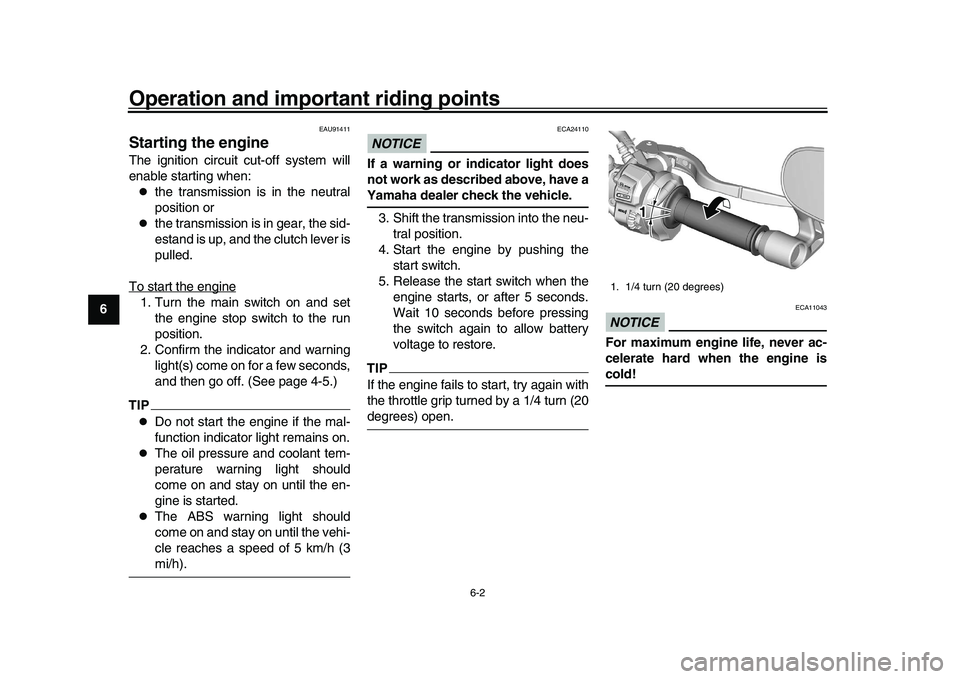
the throttle grip turned by a 1/4 turn (20degrees) open.
NOTICE
ECA11043
For maximum engine life, never ac-
celerate hard when the engine iscold!1. 1/4 turn (20 degrees)
111
BEA-28199-E0.book 2 ページ 2021年12月1日 水曜日 午後7時8分
Page 68 of 114
Periodic maintenance and adjustment
7-5
1
2
3
4
5
67
8
9
10
11
12
13
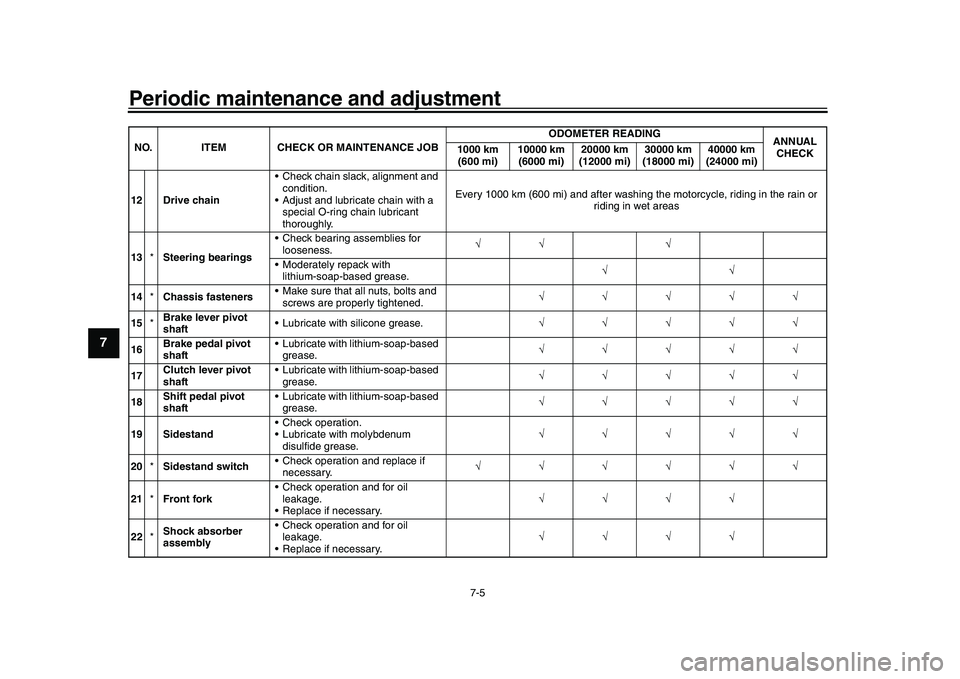
12 Drive chain Check chain slack, alignment and
condition.
Adjust and lubricate chain with a special O-ring chain lubricant
thoroughly. Every 1000 km (600 mi) and after washing the motorcycle, riding in the rain or
riding in wet areas
13 *Steering bearings Check bearing assemblies for
looseness.
Moderately repack with lithium-soap-based grease.
14 *Chassis fasteners Make sure that all nuts, bolts and
screws are properly tightened.
15 *Brake lever pivot
shaft Lubricate with silicone grease.
16 Brake pedal pivot
shaft Lubricate with lithium-soap-based
grease.
17 Clutch lever pivot
shaft Lubricate with lithium-soap-based
grease.
18 Shift pedal pivot
shaft Lubricate with lithium-soap-based
grease.
19 Sidestand Check operation.
Lubricate with molybdenum
disulfide grease.
20 *Sidestand switch Check operation and replace if
necessary.
21 *Front fork Check operation and for oil
leakage.
Replace if necessary.
22 *Shock absorber
assembly Check operation and for oil
leakage.
Replace if necessary.
NO. ITEM CHECK OR MAINTENANCE JOB
ODOMETER READING
ANNUAL
CHECK
1000 km
(600 mi) 10000 km
(6000 mi) 20000 km
(12000 mi) 30000 km
(18000 mi) 40000 km
(24000 mi)BEA-28199-E0.book 5 ページ 2021年12月1日 水曜日 午後7時8分
Page 85 of 114
Periodic maintenance and adjustment7-22
1
2
3
4
5
678
9
10
11
12
13
may deteriorate, causing leak-
age.
Refill with the same type of
brake fluid. Adding a brake fluid
other than DOT 4 may result in a
harmful chemical reaction.
Be careful that water or dust
does not enter the brake fluid
reservoir when refilling. Water
will significantly lower the boil-
ing point of the fluid and may re-
sult in vapor lock, and dirt may
clog the ABS hydraulic unitvalves.
NOTICE
ECA17641
Brake fluid may damage painted sur-
faces or plastic parts. Always cleanup spilled fluid immediately.
As the brake pads wear, it is normal for
the brake fluid level to gradually go
down. A low brake fluid level may indi-
cate worn brake pads and/or brake sys-
tem leakage; therefore, be sure to
check the brake pads for wear and the
brake system for leakage. If the brake
fluid level goes down suddenly, have a
Yamaha dealer check the cause before further riding.
EAU22734
Changing the brake fluidHave a Yamaha dealer change the
brake fluid every 2 years. In addition,
have the seals of the master cylinders
and brake calipers, as well as the brake
hoses replaced at the intervals listed
below or sooner if they are damaged or
leaking.
Brake seals: every 2 years
Brake hoses: every 4 years
BEA-28199-E0.book 22 ページ 2021年12月1日 水曜日 午後7時8分
Page 95 of 114
Periodic maintenance and adjustment7-32
1
2
3
4
5
678
9
10
11
12
13
EAU91572
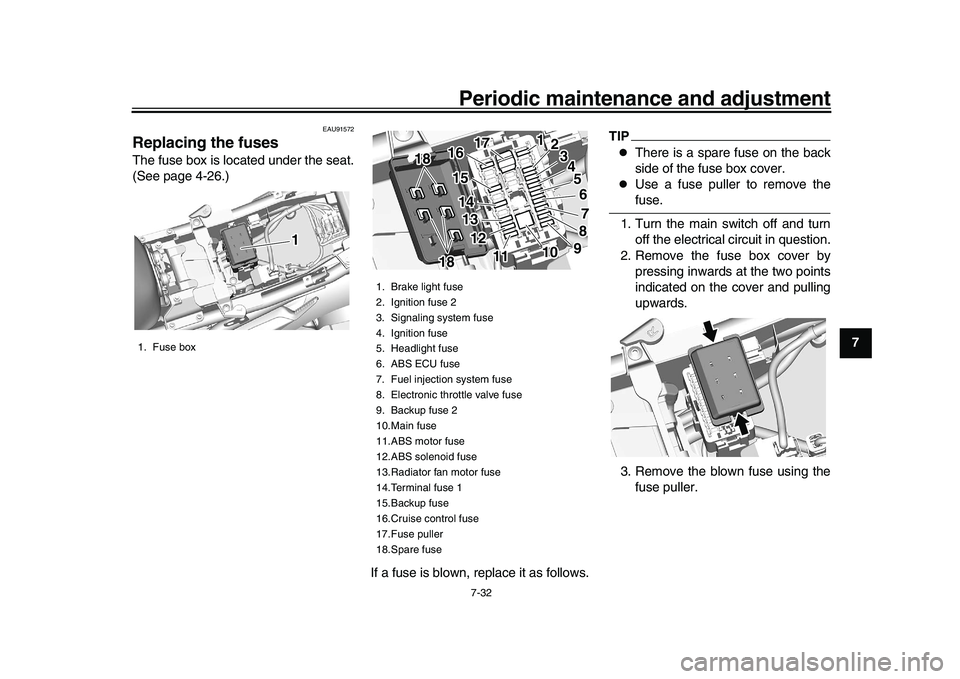
Replacing the fusesThe fuse box is located under the seat.
(See page 4-26.)
If a fuse is blown, replace it as follows.
TIP
There is a spare fuse on the back
side of the fuse box cover.
Use a fuse puller to remove thefuse.
1. Turn the main switch off and turn off the electrical circuit in question.
2. Remove the fuse box cover by pressing inwards at the two points
indicated on the cover and pulling
upwards.
3. Remove the blown fuse using the fuse puller.
1. Fuse box
1 1 1
1. Brake light fuse
2. Ignition fuse 2
3. Signaling system fuse
4. Ignition fuse
5. Headlight fuse
6. ABS ECU fuse
7. Fuel injection system fuse
8. Electronic throttle valve fuse
9. Backup fuse 2
10.Main fuse
11.ABS motor fuse
12.ABS solenoid fuse
13.Radiator fan motor fuse
14.Terminal fuse 1
15.Backup fuse
16.Cruise control fuse
17.Fuse puller
18.Spare fuse
2234
5
6
7
8
92
11 34
5
6
7
8
9
1010
1111
1212131314141515
1818
1818
10
11
12
13
14
15
18
1816
1616
17
1717
BEA-28199-E0.book 32 ページ 2021年12月1日 水曜日 午後7時8分
Page 96 of 114
Periodic maintenance and adjustment
7-33
1
2
3
4
5
67
8
9
10
11
12
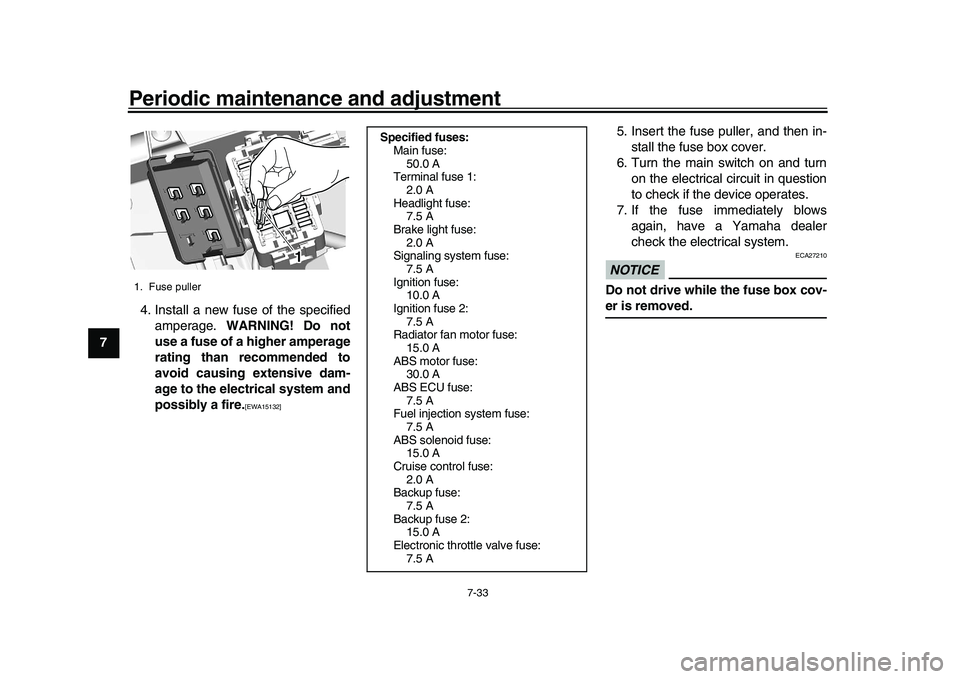
13 4. Install a new fuse of the specified
amperage. WARNING! Do not
use a fuse of a higher amperage
rating than recommended to
avoid causing extensive dam-
age to the electrical system and
possibly a fire.
[EWA15132]
5. Insert the fuse puller, and then in- stall the fuse box cover.
6. Turn the main switch on and turn on the electrical circuit in question
to check if the device operates.
7. If the fuse immediately blows again, have a Yamaha dealer
check the electrical system.NOTICE
ECA27210
Do not drive while the fuse box cov-er is removed.
1. Fuse puller
111
Specified fuses:Main fuse:50.0 A
Terminal fuse 1:
2.0 A
Headlight fuse: 7.5 A
Brake light fuse: 2.0 A
Signaling system fuse:
7.5 A
Ignition fuse: 10.0 A
Ignition fuse 2: 7.5 A
Radiator fan motor fuse:
15.0 A
ABS motor fuse: 30.0 A
ABS ECU fuse: 7.5 A
Fuel injection system fuse:
7.5 A
ABS solenoid fuse: 15.0 A
Cruise control fuse: 2.0 A
Backup fuse: 7.5 A
Backup fuse 2: 15.0 A
Electronic throttle valve fuse:
7.5 A
BEA-28199-E0.book 33 ページ 2021年12月1日 水曜日 午後7時8分
Page 102 of 114
Motorcycle care and storage
8-2
1
2
3
4
5
6
78
9
10
11
12
13 gasoline, rust removers, brake
fluid, or antifreeze, etc.
Before washing 1. Park the vehicle out of direct sun- light and allow it to cool. This will
help avoid water spots.
2. Make sure all caps, covers, electri- cal couplers and connectors are
tightly installed.
3. Cover the muffler end with a plas- tic bag and a strong rubber band.
4. Pre-soak stubborn stains like in- sects or bird droppings with a wet
towel for a few minutes.
5. Remove road grime and oil stains with a quality degreasing agent
and a plastic-bristle brush or
sponge. NOTICE: Do not use de-
greasing agent on areas requir-
ing lubrication such as seals,
gaskets, and wheel axles. Fol-
low product instructions.
[ECA26290]
Washing 1. Rinse off any degreaser and spray down the vehicle with a garden
hose. Use only enough pressure to do the job. Avoid spraying water
directly into the muffler, instrument
panel, air inlet, or other inner areas
such as underseat storage com-
partments.
2. Wash the vehicle with a quality au- tomotive-type detergent mixed
with cool water and a soft, clean
towel or sponge. Use an old tooth-
brush or plastic-bristle brush for
hard-to-reach places. NOTICE:
Use cold water if the vehicle has
been exposed to salt. Warm wa-
ter will increase salt’s corrosive
properties.
[ECA26301]
3. For windshield-equipped vehicles: Clean the windshield with a soft
towel or sponge dampened with
water and a pH neutral detergent.
If necessary, use a high-quality
windshield cleaner or polish for
motorcycles. NOTICE: Never use
any strong chemicals to clean
the windshield. Additionally,
some cleaning compounds for
plastic may scratch the wind-
shield, so be sure to test all
cleaning products before gener-
al application.
[ECA26310]
4. Rinse off thoroughly with clean wa- ter. Be sure to remove all deter-
gent residues, as they can be
harmful to plastic parts.
After washing 1. Dry the vehicle with a chamois or
absorbent towel, preferably micro-
fiber terrycloth.
2. For drive chain-equipped models: Dry and then lubricate the drive
chain to prevent rust.
3. Use a chrome polish to shine chrome, aluminum, and stainless
steel parts. Often the thermally in-
duced discoloring of stainless steel
exhaust systems can be removed
through polishing.
4. Apply a corrosion protection spray on all metal parts including chrome
or nickel-plated surfaces.
WARNING! Do not apply
silicone or oil spray to seats,
hand grips, rubber foot pegs or
tire treads. Otherwise these
parts will become slippery,
which could cause loss of con-
trol. Thoroughly clean the sur-
faces of these parts before
BEA-28199-E0.book 2 ページ 2021年12月1日 水曜日 午後7時8分
Page 110 of 114
11-1
1
2
3
4
5
6
7
8
9
1011
12
13
IndexAABS warning light.................................... 4-7
Air filter element .................................... 7-15
Auxiliary DC connectors........................ 4-31
Auxiliary system warning light ................. 4-8BBattery................................................... 7-29
BC ........................................................... 3-6
Brake and clutch levers, checking and lubricating ........................................... 7-27
Brake and shift pedals, checking and lubricating ........................................... 7-26
Brake control system (BC) .................... 4-21
Brake fluid, changing ............................ 7-22
Brake fluid level, checking .................... 7-21
Brake lever ............................................ 4-20
Brake lever free play, checking ............. 7-19
Brake light switches .............................. 7-20
Brake pedal ........................................... 4-21CCables, checking and lubricating .......... 7-25
Canister................................................. 7-12
Care ........................................................ 8-1
Catalytic converter ................................ 4-25
Clutch lever ........................................... 4-19
Clutch lever free play, adjusting ............ 7-19
Coolant.................................................. 7-13
Cruise control indicator lights .................. 4-6
Cruise control switches ........................... 4-4
Cruise control system ............................. 3-1DData recording, vehicle ......................... 10-2
Diagnostic connector ............................ 10-2
Dimmer/Pass switch ............................... 4-3 Display .................................................... 4-9
Display, menu screen ........................... 4-15
D-MODE ................................................. 3-3
Drive chain, cleaning and lubricating .... 7-25
Drive chain slack .................................. 7-23
EEngine break-in ...................................... 6-1
Engine idling speed, checking .............. 7-15
Engine oil .............................................. 7-12
Engine overheating............................... 7-37
Engine serial number............................ 10-1FFront and rear brake
pads, checking .... 7-20
Front fork, adjusting .............................. 4-27
Front fork, checking .............................. 7-28
Fuel....................................................... 4-23
Fuel consumption, tips for reducing........ 6-4
Fuel level warning light ........................... 4-6
Fuel tank cap ........................................ 4-22
Fuel tank overflow hose........................ 4-25
Fuses, replacing ................................... 7-32HHandlebar position, adjusting ............... 4-27
Handlebar switches ................................ 4-3
Hazard switch ......................................... 4-4
High beam indicator light ........................ 4-6
Horn switch ............................................. 4-4IIdentification numbers .......................... 10-1
Ignition circuit cut-off system ................ 4-32
Immobilizer system ................................. 4-1
Immobilizer system indicator light........... 4-7
Indicator lights and warning lights .......... 4-5
LLicense plate light ................................. 7-34MMain switch/steering lock ........................ 4-2
Maintenance and lubrication, periodic..... 7-4
Maintenance, emission control system ... 7-3
Malfunction indicator light (MIL) .............. 4-6
Matte color, caution ................................. 8-1
Model label ............................................ 10-2NNeutral indicator light .............................. 4-6OOil pressure and Coolant temperature warning light.......................................... 4-8PParking .................................................... 6-5
Part locations .......................................... 2-1QQuick shifter ............................................ 3-6RRider footrest position, adjusting ........... 4-26SSafety information ................................... 1-1
Seat ....................................................... 4-26
Shifting .................................................... 6-3
Shift pedal ............................................. 4-20
Shock absorber assembly, adjusting .... 4-29
Side cover ............................................... 7-8
Sidestand .............................................. 4-31
Sidestand, checking an d lubricating...... 7-27
Spark plugs, checking ........................... 7-11
Special features ...................................... 3-1
Specifications .......................................... 9-1
Stability control indicator light.................. 4-7
BEA-28199-E0.book 1 ページ 2021年12月1日 水曜日 午後7時8分