Pressure YAMAHA XSR 900 2022 User Guide
[x] Cancel search | Manufacturer: YAMAHA, Model Year: 2022, Model line: XSR 900, Model: YAMAHA XSR 900 2022Pages: 114, PDF Size: 4.36 MB
Page 58 of 114
For your safety – pre-operation checks
5-2
1
2
3
45
6
7
8
9
10
11
12
13
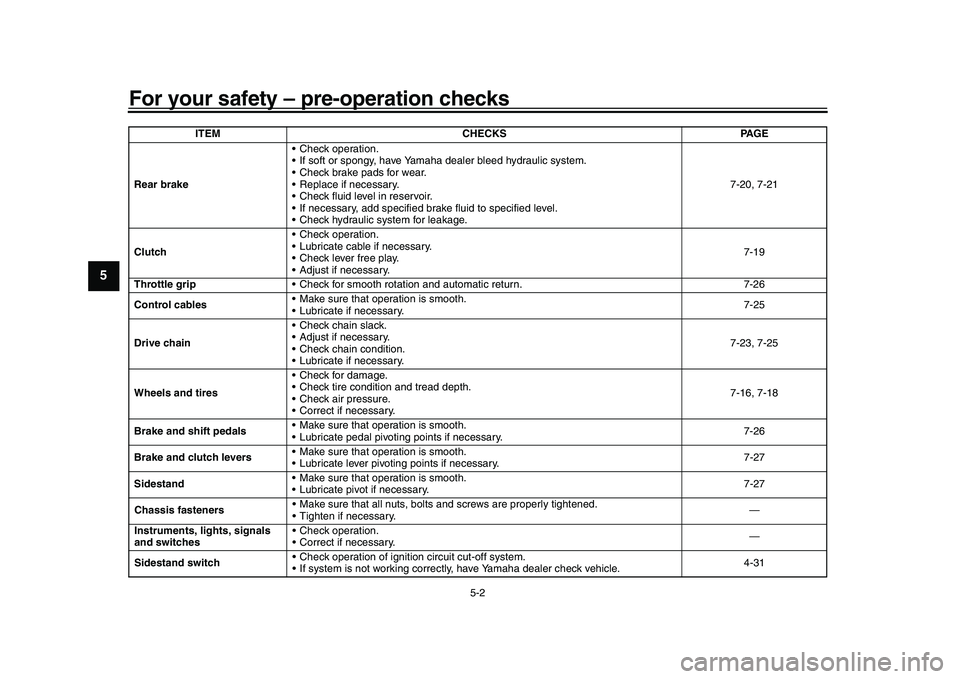
Rear brake Check operation.
If soft or spongy, have Yamaha dealer bleed hydraulic system.
Check brake pads for wear.
Replace if necessary.
Check fluid level in reservoir.
If necessary, add specified brake fluid to specified level.
Check hydraulic system for leakage. 7-20, 7-21
Clutch Check operation.
Lubricate cable if necessary.
Check lever free play.
Adjust if necessary. 7-19
Throttle grip Check for smooth rotation and automatic return. 7-26
Control cables Make sure that operation is smooth.
Lubricate if necessary. 7-25
Drive chain Check chain slack.
Adjust if necessary.
Check chain condition.
Lubricate if necessary. 7-23, 7-25
Wheels and tires Check for damage.
Check tire condition and tread depth.
Check air pressure.
Correct if necessary. 7-16, 7-18
Brake and shift pedals Make sure that operation is smooth.
Lubricate pedal pivoting points if necessary. 7-26
Brake and clutch levers Make sure that operation is smooth.
Lubricate lever pivoting points if necessary. 7-27
Sidestand Make sure that operation is smooth.
Lubricate pivot if necessary. 7-27
Chassis fasteners Make sure that all nuts, bolts
and screws are properly tightened.
Tighten if necessary. —
Instruments, lights, signals
and switches Check operation.
Correct if necessary.
—
Sidestand switch Check operation of ignition circuit cut-off system.
If system is not working correctly, have Yamaha dealer check vehicle. 4-31
ITEM CHECKS PAGE
BEA-28199-E0.book 2 ページ 2021年12月1日 水曜日 午後7時8分
Page 60 of 114
Operation and important riding points
6-2
1
2
3
4
56
7
8
9
10
11
12
13
EAU91411
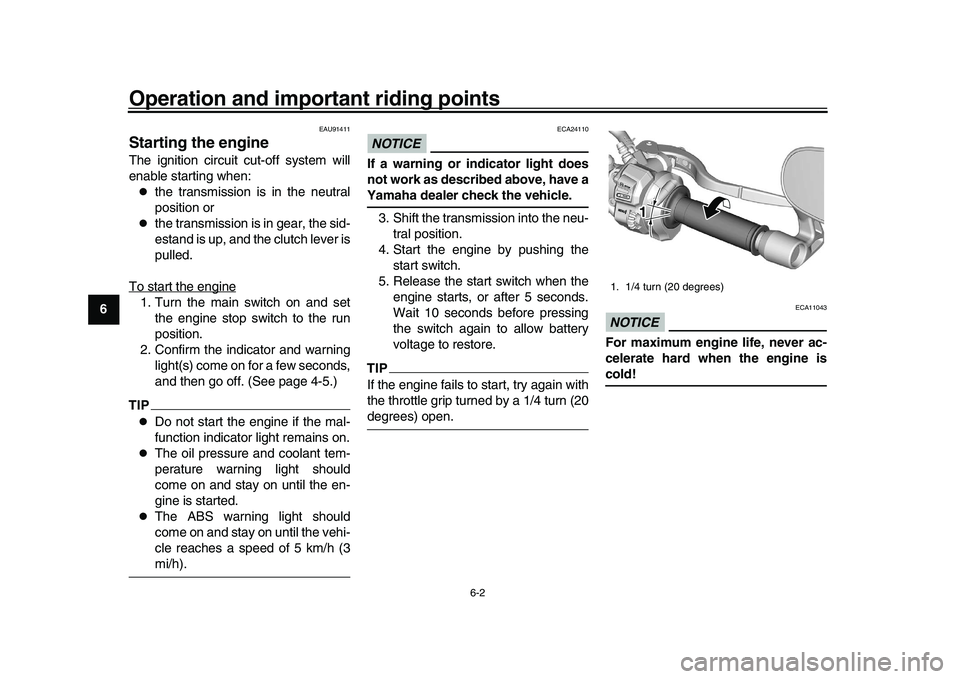
Starting the engineThe ignition circuit cut-off system will
enable starting when:
the transmission is in the neutral
position or
the transmission is in gear, the sid-
estand is up, and the clutch lever is
pulled.
To start the engine
1. Turn the main switch on and set the engine stop switch to the run
position.
2. Confirm the indicator and warning light(s) come on for a few seconds,
and then go off. (See page 4-5.)TIP
Do not start the engine if the mal-
function indicator light remains on.
The oil pressure and coolant tem-
perature warning light should
come on and stay on until the en-
gine is started.
The ABS warning light should
come on and stay on until the vehi-
cle reaches a speed of 5 km/h (3mi/h).
NOTICE
ECA24110
If a warning or indicator light does
not work as described above, have aYamaha dealer check the vehicle.
3. Shift the transmission into the neu- tral position.
4. Start the engine by pushing the start switch.
5. Release the start switch when the engine starts, or after 5 seconds.
Wait 10 seconds before pressing
the switch again to allow battery
voltage to restore.TIPIf the engine fails to start, try again with
the throttle grip turned by a 1/4 turn (20degrees) open.
NOTICE
ECA11043
For maximum engine life, never ac-
celerate hard when the engine iscold!1. 1/4 turn (20 degrees)
111
BEA-28199-E0.book 2 ページ 2021年12月1日 水曜日 午後7時8分
Page 67 of 114
Periodic maintenance and adjustment
7-4
1
2
3
4
5
678
9
10
11
12
13
EAU71353
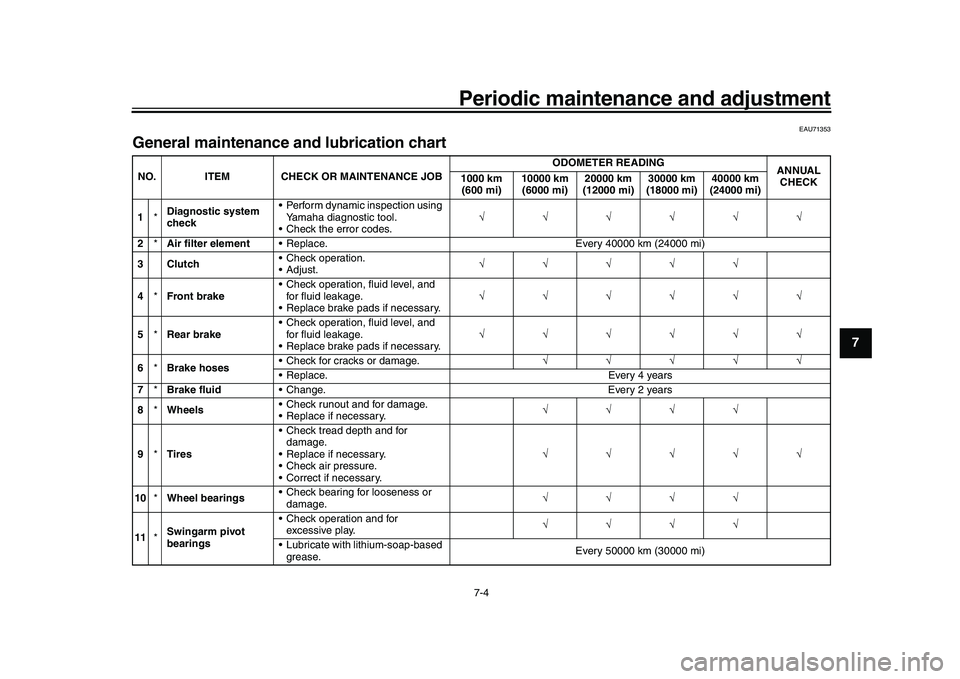
General maintenance an d lubrication chartNO. ITEM CHECK OR MAINTENANCE JOB ODOMETER READING
ANNUAL
CHECK
1000 km
(600 mi) 10000 km
(6000 mi) 20000 km
(12000 mi) 30000 km
(18000 mi) 40000 km
(24000 mi)
1 *Diagnostic system
check Perform dynamic inspection using
Yamaha diagnostic tool.
Check the error codes.
2 *Air filter element Replace. Every 40000 km (24000 mi)
3Clutch Check operation.
Adjust.
4 *Front brake Check operation, fluid level, and
for fluid leakage.
Replace brake pads if necessary.
5 *Rear brake Check operation, fluid level, and
for fluid leakage.
Replace brake pads if necessary.
6 *Brake hoses Check for cracks or damage.
Replace. Every 4 years
7 *Brake fluid Change. Every 2 years
8 *Wheels Check runout and for damage.
Replace if necessary.
9 *Tires Check tread depth and for
damage.
Replace if necessary.
Check air pressure.
Correct if necessary.
10 *Wheel bearings Check bearing for looseness or
damage.
11 *Swingarm pivot
bearings Check operation and for
excessive play.
Lubricate with lithium-soap-based grease. Every 50000 km (30000 mi)
BEA-28199-E0.book 4 ページ 2021年12月1日 水曜日 午後7時8分
Page 79 of 114
Periodic maintenance and adjustment7-16
1
2
3
4
5
678
9
10
11
12
13
EAU64412
TiresTires are the only contact between the
vehicle and the road. Safety in all con-
ditions of riding depends on a relatively
small area of road contact. Therefore, it
is essential to maintain the tires in good
condition at all times and replace them
at the appropriate time with the speci-
fied tires.
Tire air pressure
The tire air pressure should be checked
and, if necessary, adjusted before each
ride.
WARNING
EWA10504
Operation of this vehicle with im-
proper tire pressure may cause se-
vere injury or death from loss of
control.
The tire air pressure must be
checked and adjusted on cold
tires (i.e., when the temperature
of the tires equals the ambient
temperature).
The tire air pressure must be ad-
justed in accordance with the
riding speed and with the total weight of rider, passenger, car-
go, and accessories approved
for this model.WARNING
EWA10512
Never overload your vehicle. Opera-
tion of an overloaded vehicle couldcause an accident.
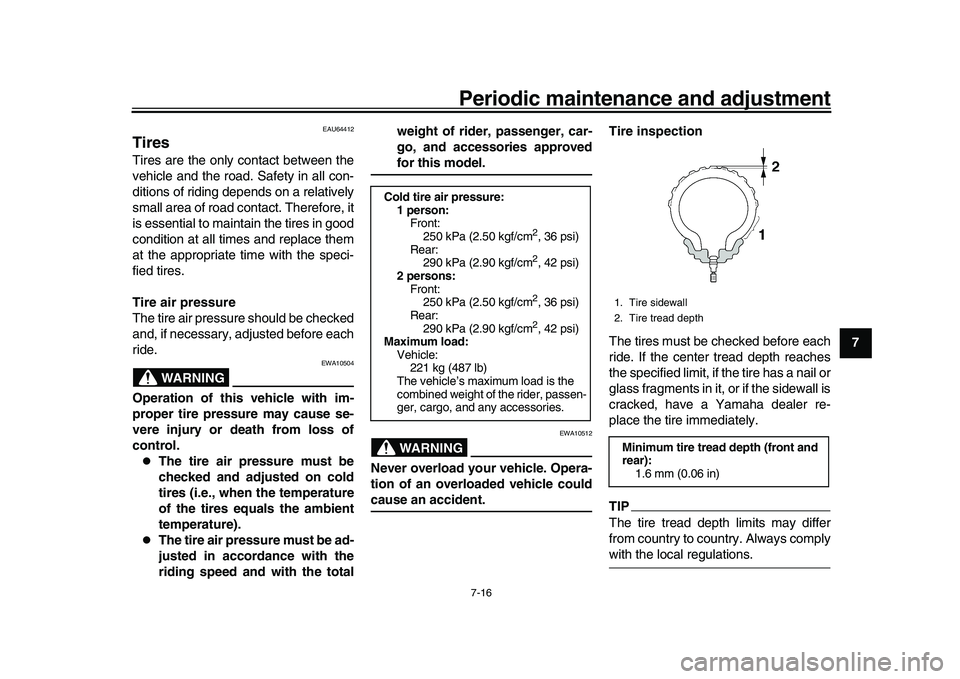
Tire inspection
The tires must be checked before each
ride. If the center tread depth reaches
the specified limit, if the tire has a nail or
glass fragments in it, or if the sidewall is
cracked, have a Yamaha dealer re-
place the tire immediately.
TIPThe tire tread depth limits may differ
from country to country. Always complywith the local regulations.
Cold tire air pressure:
1 person:
Front: 250 kPa (2.50 kgf/cm
2, 36 psi)
Rear:
290 kPa (2.90 kgf/cm2, 42 psi)
2 persons: Front:
250 kPa (2.50 kgf/cm2, 36 psi)
Rear: 290 kPa (2.90 kgf/cm2, 42 psi)
Maximum load: Vehicle:221 kg (487 lb)
The vehicle’s maximum load is the
combined weight of the rider, passen-
ger, cargo, and any accessories.
1. Tire sidewall
2. Tire tread depthMinimum tire tread depth (front and
rear): 1.6 mm (0.06 in)
BEA-28199-E0.book 16 ページ 2021年12月1日 水曜日 午後7時8分
Page 80 of 114
Periodic maintenance and adjustment
7-17
1
2
3
4
5
67
8
9
10
11
12
13
WARNING
EWA10472
Have a Yamaha dealer replace
excessively worn tires. Besides
being illegal, operating the vehi-
cle with excessively worn tires
decreases riding stability and
can lead to loss of control.
The replacement of all wheel
and brake-related parts, includ-
ing the tires, should be left to a
Yamaha dealer, who has the
necessary professional knowl-
edge and experience to do so.
Ride at moderate speeds after
changing a tire since the tire
surface must first be “broken
in” for it to develop its optimalcharacteristics. Tire information
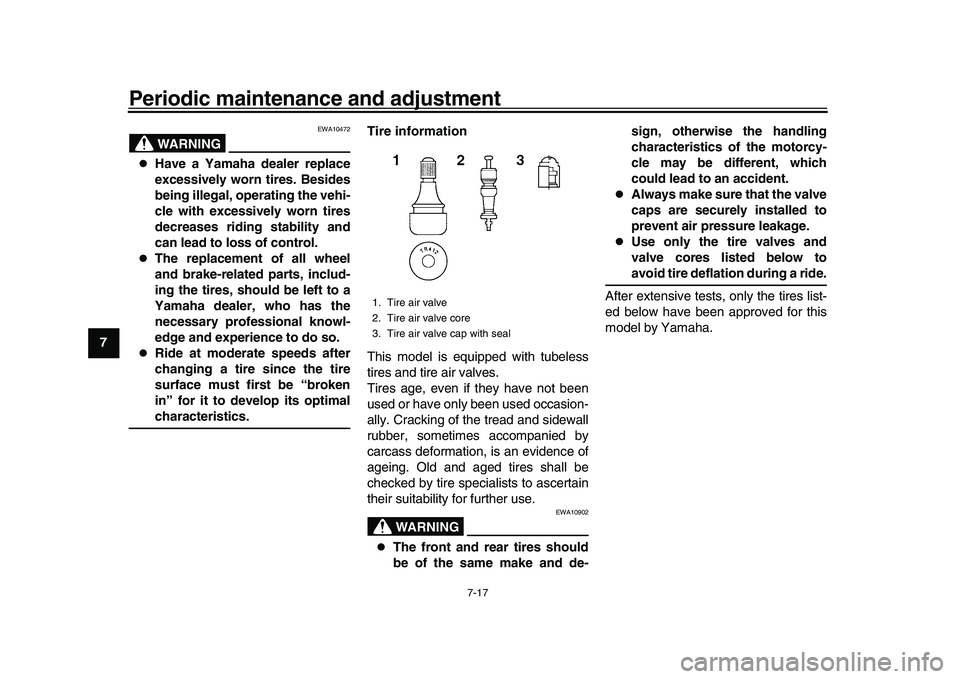
This model is equipped with tubeless
tires and tire air valves.
Tires age, even if they have not been
used or have only been used occasion-
ally. Cracking of the tread and sidewall
rubber, sometimes accompanied by
carcass deformation, is an evidence of
ageing. Old and aged tires shall be
checked by tire specialists to ascertain
their suitability for further use.
WARNING
EWA10902
The front and rear tires should
be of the same make and de- sign, otherwise the handling
characteristics of the motorcy-
cle may be different, which
could lead to an accident.
Always make sure that the valve
caps are securely installed to
prevent air pressure leakage.
Use only the tire valves and
valve cores listed below toavoid tire deflation during a ride.
After extensive tests, only the tires list-
ed below have been approved for this
model by Yamaha.
1. Tire air valve
2. Tire air valve core
3. Tire air valve cap with seal
BEA-28199-E0.book 17 ページ 2021年12月1日 水曜日 午後7時8分
Page 88 of 114
Periodic maintenance and adjustment
7-25
1
2
3
4
5
67
8
9
10
11
12
13
EAU23027
Cleaning and l ubricating the
drive chainThe drive chain must be cleaned and
lubricated at the intervals specified in
the periodic maintenance and lubrica-
tion chart, otherwise it will quickly wear
out, especially when riding in dusty or
wet areas. Service the drive chain as
follows.NOTICE
ECA10584
The drive chain must be lubricated
after washing the motorcycle, ridingin the rain or riding in wet areas.
1. Clean the drive chain with a drive chain cleaner and a small soft
brush. NOTICE: To prevent dam-
aging the O-rings, do not clean
the drive chain with steam
cleaners, high-pressure wash-
ers or inappropriate sol-
vents.
[ECA11122]
2. Wipe the drive chain dry.
3. Thoroughly lubricate the drive chain with a special O-ring chain
lubricant. NOTICE: Do not use
engine oil or any other lubri- cants for the drive chain, as they
may contain substances that
could damage the O-rings.
[ECA11112]
EAU23098
Checking and lubricating the
cablesThe operation of all control cables and
the condition of the cables should be
checked before each ride, and the ca-
bles and cable ends should be lubricat-
ed if necessary. If a cable is damaged
or does not move smoothly, have a
Yamaha dealer check or replace it.
WARNING! Damage to the outer
housing of cables may result in in-
ternal rusting and cause interfer-
ence with cable movement. Replace
damaged cables as soon as possi-
ble to prevent unsafe condi-
tions.
[EWA10712]
Recommended lubricant:
Yamaha cable lubricant or other suit-
able cable lubricant
BEA-28199-E0.book 25 ページ 2021年12月1日 水曜日 午後7時8分
Page 100 of 114
Periodic maintenance and adjustment
7-37
1
2
3
4
5
67
8
9
10
11
12
13
EAU86420
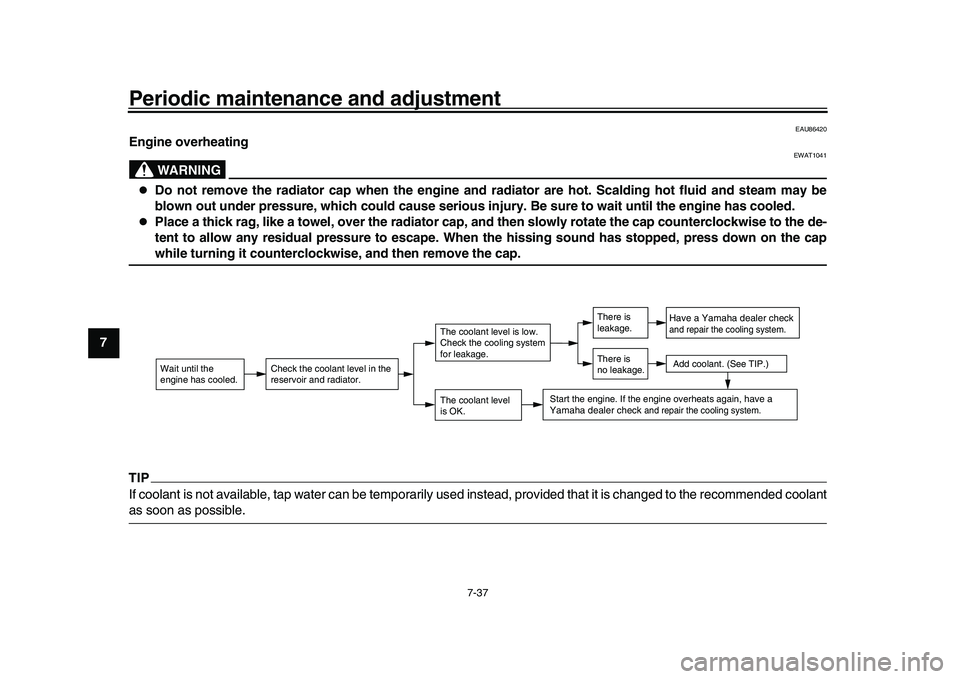
Engine overheating
WARNING
EWAT1041
Do not remove the radiator cap when the engine and radiator are hot. Scalding hot fluid and steam may be
blown out under pressure, which could cause serious injury. Be sure to wait until the engine has cooled.
Place a thick rag, like a towel, over the radiator cap, and then slowly rotate the cap counterclockwise to the de-
tent to allow any residual pressure to escape. When the hissing sound has stopped, press down on the capwhile turning it counterclockwise, and then remove the cap.
TIPIf coolant is not available, tap water can be temporarily us ed instead, provided that it is changed to the recommended coolantas soon as possible.
Wait until the
engine has cooled.
Check the coolant level in the
reservoir and radiator.
The coolant level
is OK.The coolant level is low.
Check the cooling system
for leakage.
Have a Yamaha dealer checkand repair the cooling system.Add coolant. (See TIP.)
Start the engine. If the engine overheats again,
have a
Yamaha dealer check
and repair the cooling system.
There is
leakage.
There is
no leakage.
BEA-28199-E0.book 37 ページ 2021年12月1日 水曜日 午後7時8分
Page 101 of 114
8-1
1
2
3
4
5
6
789
10
11
12
13
Motorcycle care and storage
EAU37834
Matte color cautionNOTICE
ECA15193
Some models are equipped with
matte colored finished parts. Be
sure to consult a Yamaha dealer for
advice on what products to use be-
fore cleaning the vehicle. Using a
brush, harsh chemical products or
cleaning compounds when cleaning
these parts will scratch or damage
their surface. Wax also should not
be applied to any matte colored fin-ished parts.
EAU83443
CareFrequent, thorough cleaning of the ve-
hicle will not only enhance its appear-
ance but also will improve its general
performance and extend the useful life
of many components. Washing, clean-
ing, and polishing will also give you a
chance to inspect the condition of the
vehicle more frequently. Be sure to
wash the vehicle after riding in the rain
or near the sea, because salt is corro-
sive to metals.TIP
The roads of heavy snowfall areas
may be sprayed with salt as a
de-icing method. This salt can stay
on the roads well into spring, so be
sure to wash the underside and
chassis parts after riding in such
areas.
Genuine Yamaha care and main-
tenance products are sold under
the YAMALUBE brand in many
markets worldwide.
See your Yamaha dealer for addi-tional cleaning tips.
NOTICE
ECA26280
Improper cleaning can cause cos-
metic and mechanical damage. Do
not use:
high-pressure washers or
steam-jet cleaners. Excessive
water pressure may cause water
seepage and deterioration of
wheel bearings, brakes, trans-
mission seals and electrical de-
vices. Avoid high-pressure
detergent applications such as
those available in coin-operated
car washers.
harsh chemicals, including
strong acidic wheel cleaners,
especially on spoke or magne-
sium wheels.
harsh chemicals, abrasive
cleaning compounds, or wax on
matte-finished parts. Brushes
can scratch and damage the
matte-finish, use soft sponge or
towel only.
towels, sponges, or brushes
contaminated with abrasive
cleaning products or strong
chemicals such as, solvents,
BEA-28199-E0.book 1 ページ 2021年12月1日 水曜日 午後7時8分
Page 102 of 114
Motorcycle care and storage
8-2
1
2
3
4
5
6
78
9
10
11
12
13 gasoline, rust removers, brake
fluid, or antifreeze, etc.
Before washing 1. Park the vehicle out of direct sun- light and allow it to cool. This will
help avoid water spots.
2. Make sure all caps, covers, electri- cal couplers and connectors are
tightly installed.
3. Cover the muffler end with a plas- tic bag and a strong rubber band.
4. Pre-soak stubborn stains like in- sects or bird droppings with a wet
towel for a few minutes.
5. Remove road grime and oil stains with a quality degreasing agent
and a plastic-bristle brush or
sponge. NOTICE: Do not use de-
greasing agent on areas requir-
ing lubrication such as seals,
gaskets, and wheel axles. Fol-
low product instructions.
[ECA26290]
Washing 1. Rinse off any degreaser and spray down the vehicle with a garden
hose. Use only enough pressure to do the job. Avoid spraying water
directly into the muffler, instrument
panel, air inlet, or other inner areas
such as underseat storage com-
partments.
2. Wash the vehicle with a quality au- tomotive-type detergent mixed
with cool water and a soft, clean
towel or sponge. Use an old tooth-
brush or plastic-bristle brush for
hard-to-reach places. NOTICE:
Use cold water if the vehicle has
been exposed to salt. Warm wa-
ter will increase salt’s corrosive
properties.
[ECA26301]
3. For windshield-equipped vehicles: Clean the windshield with a soft
towel or sponge dampened with
water and a pH neutral detergent.
If necessary, use a high-quality
windshield cleaner or polish for
motorcycles. NOTICE: Never use
any strong chemicals to clean
the windshield. Additionally,
some cleaning compounds for
plastic may scratch the wind-
shield, so be sure to test all
cleaning products before gener-
al application.
[ECA26310]
4. Rinse off thoroughly with clean wa- ter. Be sure to remove all deter-
gent residues, as they can be
harmful to plastic parts.
After washing 1. Dry the vehicle with a chamois or
absorbent towel, preferably micro-
fiber terrycloth.
2. For drive chain-equipped models: Dry and then lubricate the drive
chain to prevent rust.
3. Use a chrome polish to shine chrome, aluminum, and stainless
steel parts. Often the thermally in-
duced discoloring of stainless steel
exhaust systems can be removed
through polishing.
4. Apply a corrosion protection spray on all metal parts including chrome
or nickel-plated surfaces.
WARNING! Do not apply
silicone or oil spray to seats,
hand grips, rubber foot pegs or
tire treads. Otherwise these
parts will become slippery,
which could cause loss of con-
trol. Thoroughly clean the sur-
faces of these parts before
BEA-28199-E0.book 2 ページ 2021年12月1日 水曜日 午後7時8分
Page 110 of 114
11-1
1
2
3
4
5
6
7
8
9
1011
12
13
IndexAABS warning light.................................... 4-7
Air filter element .................................... 7-15
Auxiliary DC connectors........................ 4-31
Auxiliary system warning light ................. 4-8BBattery................................................... 7-29
BC ........................................................... 3-6
Brake and clutch levers, checking and lubricating ........................................... 7-27
Brake and shift pedals, checking and lubricating ........................................... 7-26
Brake control system (BC) .................... 4-21
Brake fluid, changing ............................ 7-22
Brake fluid level, checking .................... 7-21
Brake lever ............................................ 4-20
Brake lever free play, checking ............. 7-19
Brake light switches .............................. 7-20
Brake pedal ........................................... 4-21CCables, checking and lubricating .......... 7-25
Canister................................................. 7-12
Care ........................................................ 8-1
Catalytic converter ................................ 4-25
Clutch lever ........................................... 4-19
Clutch lever free play, adjusting ............ 7-19
Coolant.................................................. 7-13
Cruise control indicator lights .................. 4-6
Cruise control switches ........................... 4-4
Cruise control system ............................. 3-1DData recording, vehicle ......................... 10-2
Diagnostic connector ............................ 10-2
Dimmer/Pass switch ............................... 4-3 Display .................................................... 4-9
Display, menu screen ........................... 4-15
D-MODE ................................................. 3-3
Drive chain, cleaning and lubricating .... 7-25
Drive chain slack .................................. 7-23
EEngine break-in ...................................... 6-1
Engine idling speed, checking .............. 7-15
Engine oil .............................................. 7-12
Engine overheating............................... 7-37
Engine serial number............................ 10-1FFront and rear brake
pads, checking .... 7-20
Front fork, adjusting .............................. 4-27
Front fork, checking .............................. 7-28
Fuel....................................................... 4-23
Fuel consumption, tips for reducing........ 6-4
Fuel level warning light ........................... 4-6
Fuel tank cap ........................................ 4-22
Fuel tank overflow hose........................ 4-25
Fuses, replacing ................................... 7-32HHandlebar position, adjusting ............... 4-27
Handlebar switches ................................ 4-3
Hazard switch ......................................... 4-4
High beam indicator light ........................ 4-6
Horn switch ............................................. 4-4IIdentification numbers .......................... 10-1
Ignition circuit cut-off system ................ 4-32
Immobilizer system ................................. 4-1
Immobilizer system indicator light........... 4-7
Indicator lights and warning lights .......... 4-5
LLicense plate light ................................. 7-34MMain switch/steering lock ........................ 4-2
Maintenance and lubrication, periodic..... 7-4
Maintenance, emission control system ... 7-3
Malfunction indicator light (MIL) .............. 4-6
Matte color, caution ................................. 8-1
Model label ............................................ 10-2NNeutral indicator light .............................. 4-6OOil pressure and Coolant temperature warning light.......................................... 4-8PParking .................................................... 6-5
Part locations .......................................... 2-1QQuick shifter ............................................ 3-6RRider footrest position, adjusting ........... 4-26SSafety information ................................... 1-1
Seat ....................................................... 4-26
Shifting .................................................... 6-3
Shift pedal ............................................. 4-20
Shock absorber assembly, adjusting .... 4-29
Side cover ............................................... 7-8
Sidestand .............................................. 4-31
Sidestand, checking an d lubricating...... 7-27
Spark plugs, checking ........................... 7-11
Special features ...................................... 3-1
Specifications .......................................... 9-1
Stability control indicator light.................. 4-7
BEA-28199-E0.book 1 ページ 2021年12月1日 水曜日 午後7時8分