engine ACURA NSX 1991 Service Repair Manual
[x] Cancel search | Manufacturer: ACURA, Model Year: 1991, Model line: NSX, Model: ACURA NSX 1991Pages: 1640, PDF Size: 60.48 MB
Page 1109 of 1640
System Description
The fuel supply system consists of a fuel tank, in-tank high pressure fuel pump, fuel pump relay, fuel pump
resistor, PGM-FI main relay, fuel filter, fuel pressureregulator, fuel injectors and fuel injector resistor.
This system delivers pressure-regulated fuel to the fuel injectors and cuts the fuel delivery when the engine is
not running. Fuel Pressure
Relieving
Do not smoke while working on the fuel system.
Keep open flames or sparks away from your work
area.
Be sure to relieve fuel pressure while the engine is
off.
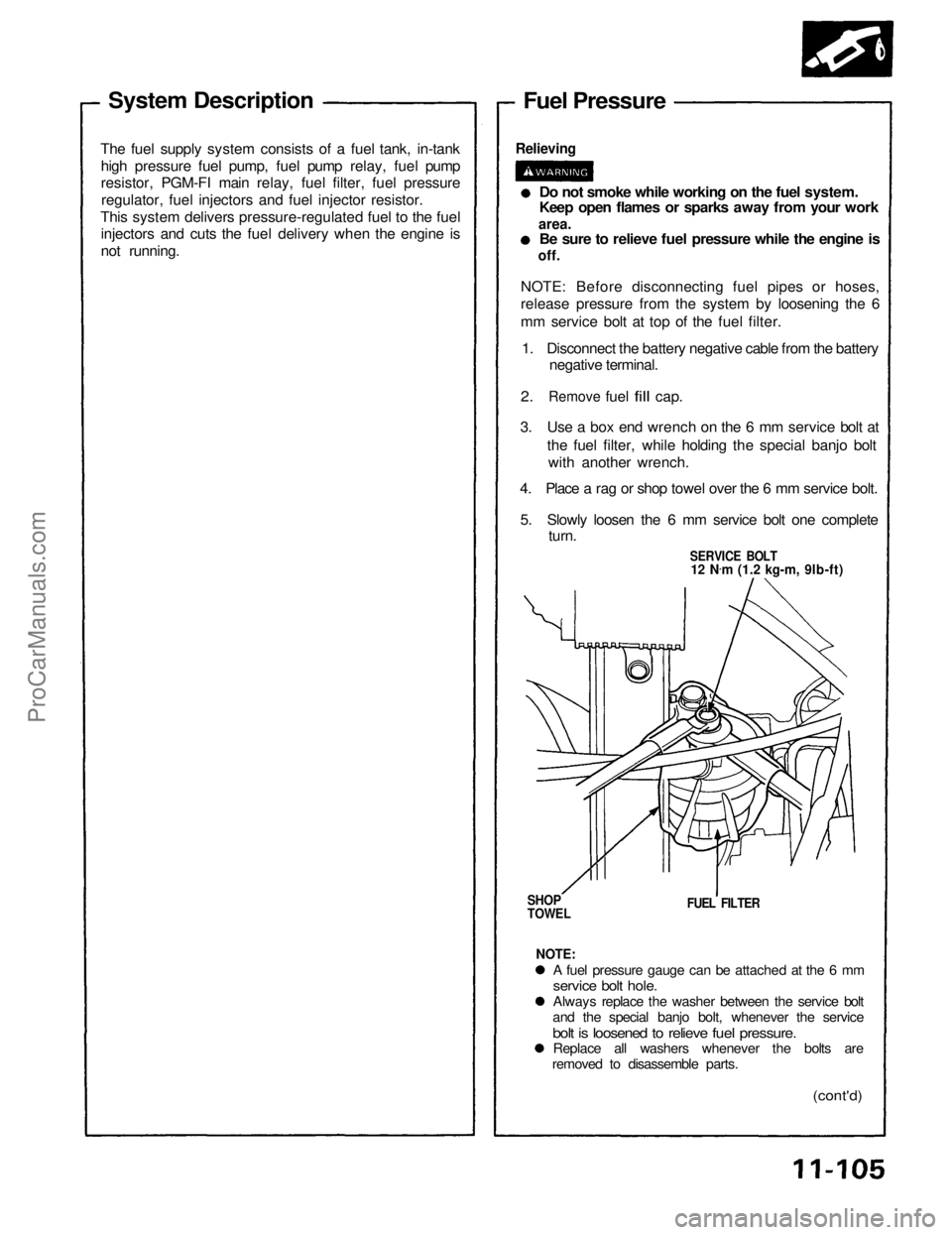
NOTE: Before disconnecting fuel pipes or hoses,
release pressure from the system by loosening the 6
mm service bolt at top of the fuel filter. 1. Disconnect the battery negative cable from the battery negative terminal.
2.
Remove
fuel
fill
cap.
3. Use a box end wrench on the 6 mm service bolt at the fuel filter, while holding the special banjo boltwith another wrench.
4. Place a rag or shop towel over the 6 mm service bolt.
5. Slowly loosen the 6 mm service bolt one complete turn.
SERVICE BOLT
12 N .
m (1.2 kg-m, 9lb-ft)
SHOP
TOWEL
FUEL FILTER
NOTE:
A fuel pressure gauge can be attached at the 6 mm
service bolt hole.
Always replace the washer between the service bolt
and the special banjo bolt, whenever the service
bolt is loosened to relieve fuel pressure.
Replace all washers whenever the bolts are
removed to disassemble parts.
(cont'd)ProCarManuals.com
Page 1110 of 1640
Fuel Supply System
Fuel Pressure (cont'd)
Inspection 1. Relieve fuel pressure (see page 11-105).
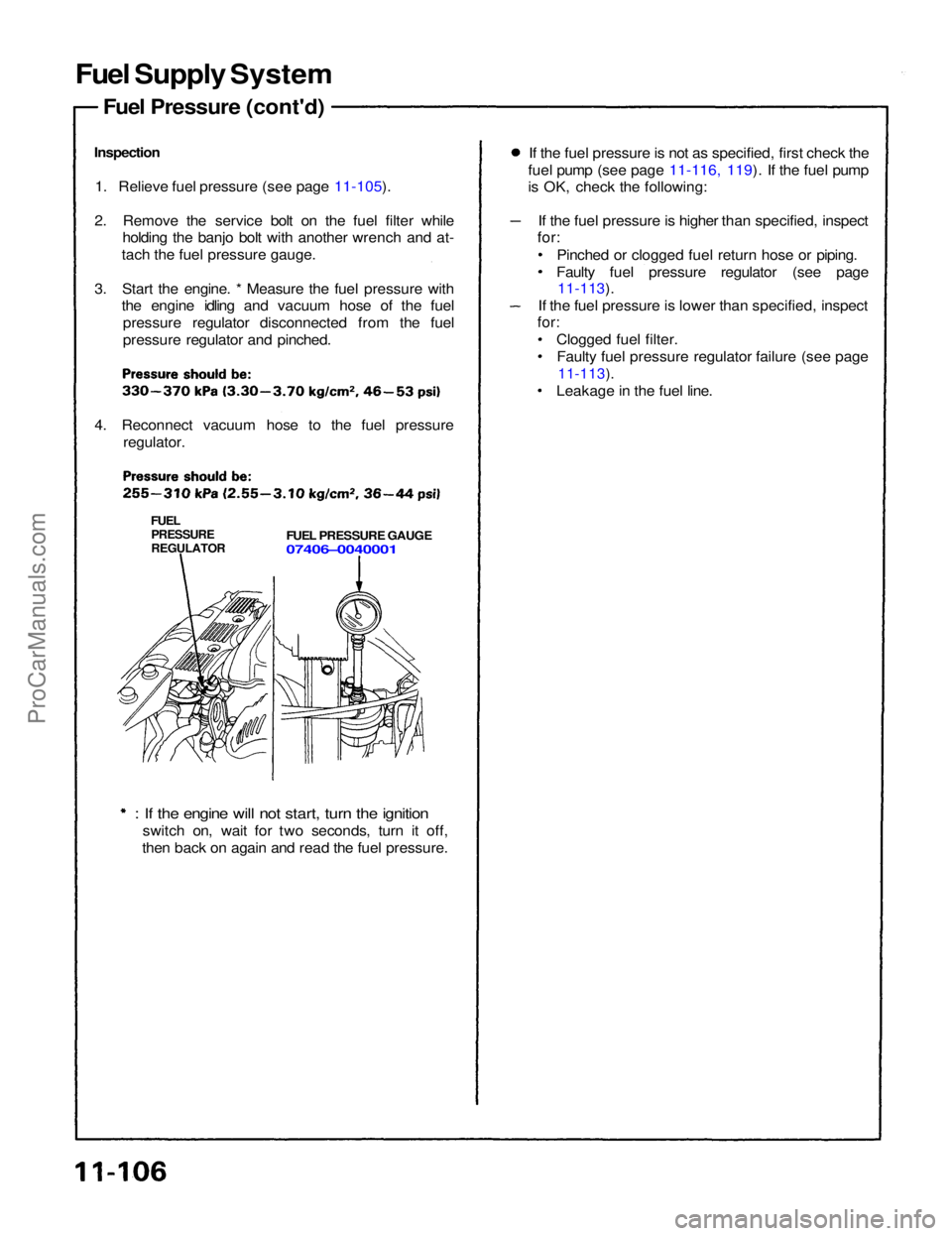
2. Remove the service bolt on the fuel filter while holding the banjo bolt with another wrench and at-
tach the fuel pressure gauge.
3. Start the engine. * Measure the fuel pressure with the engine idling and vacuum hose of the fuel
pressure regulator disconnected from the fuel
pressure regulator and pinched.
4. Reconnect vacuum hose to the fuel pressure regulator.
FUEL
PRESSURE
REGULATOR
FUEL PRESSURE GAUGE
07406–0040001
: If the engine will not start, turn the ignition
switch on, wait for two seconds, turn it off,
then back on again and read the fuel pressure. If the fuel pressure is not as specified, first check the
fuel pump (see page 11-116, 119). If the fuel pump
is OK, check the following:
If the fuel pressure is higher than specified, inspect
for:
Pinched or clogged fuel return hose or piping.
Faulty fuel pressure regulator (see page
11-113).
If the fuel pressure is lower than specified, inspect
for:
Clogged fuel filter.Faulty fuel pressure regulator failure (see page
11-113).
Leakage in the fuel line.ProCarManuals.com
Page 1111 of 1640
Fuel Supply System
Fuel Injectors (cont'd)
Replacement
Do not smoke during the work. Keep open flames away from your work area.
1. Relieve fuel pressure (see page 11-105).
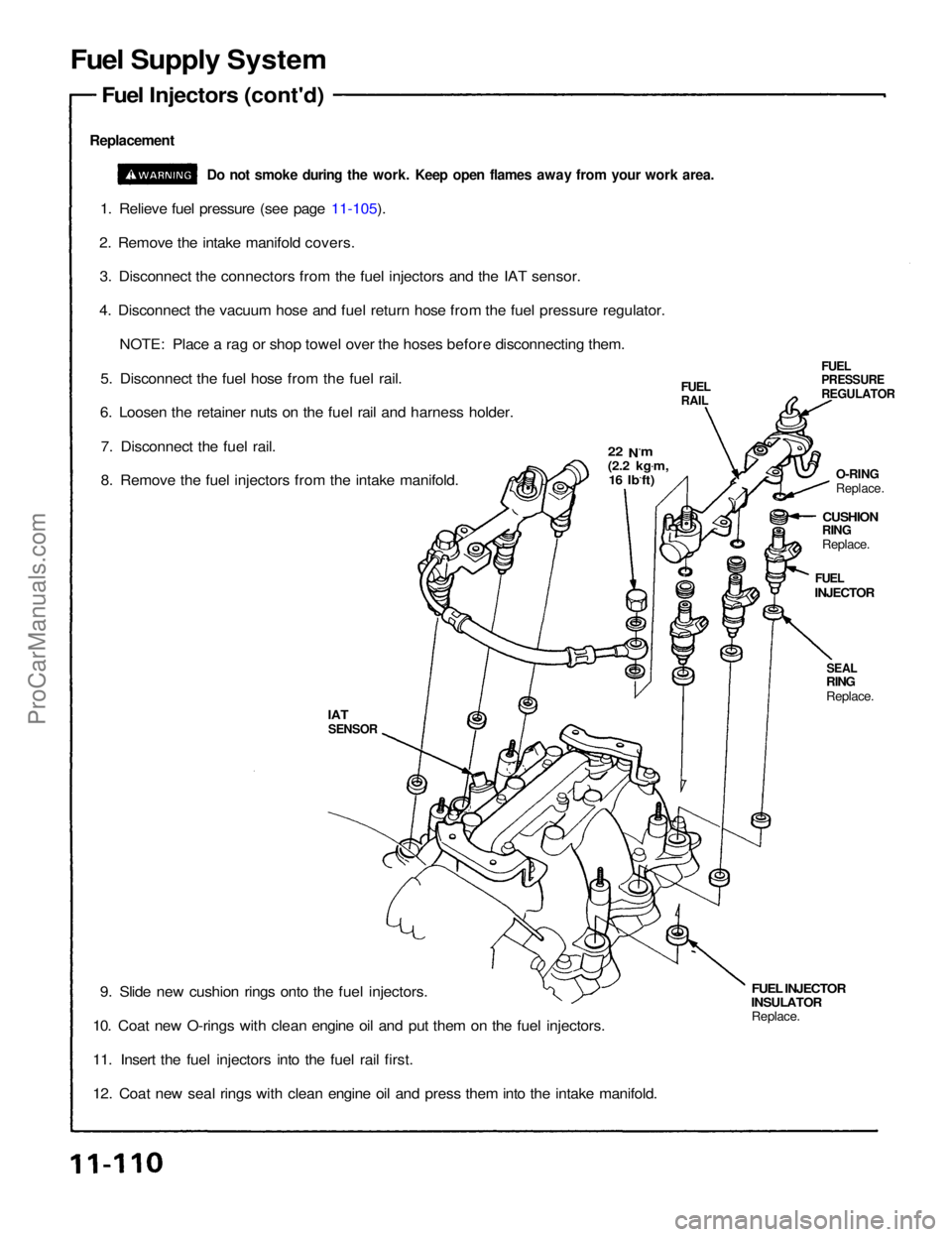
2. Remove the intake manifold covers. 3. Disconnect the connectors from the fuel injectors and the IAT sensor.
4. Disconnect the vacuum hose and fuel return hose from the fuel pressure regulator. NOTE: Place a rag or shop towel over the hoses before disconnecting them.
5. Disconnect the fuel hose from the fuel rail.
6. Loosen the retainer nuts on the fuel rail and harness holder.
7. Disconnect the fuel rail.
8. Remove the fuel injectors from the intake manifold.
FUEL
PRESSURE
REGULATOR
22 N.m
(2.2 kg .
m,
16 Ib.ft)
FUEL
RAIL
O-RING
Replace.
CUSHION
RING
Replace.
FUEL
INJECTOR
SEAL
RING
Replace.
FUEL INJECTOR
INSULATOR
Replace.
IAT
SENSOR
9. Slide new cushion rings onto the fuel injectors.
10. Coat new O-rings with clean engine oil and put them on the fuel injectors.
11. Insert the fuel injectors into the fuel rail first.
12. Coat new seal rings with clean engine oil and press them into the intake manifold.ProCarManuals.com
Page 1115 of 1640
Fuel Supply System
Fuel Pressure Regulator (cont'd)
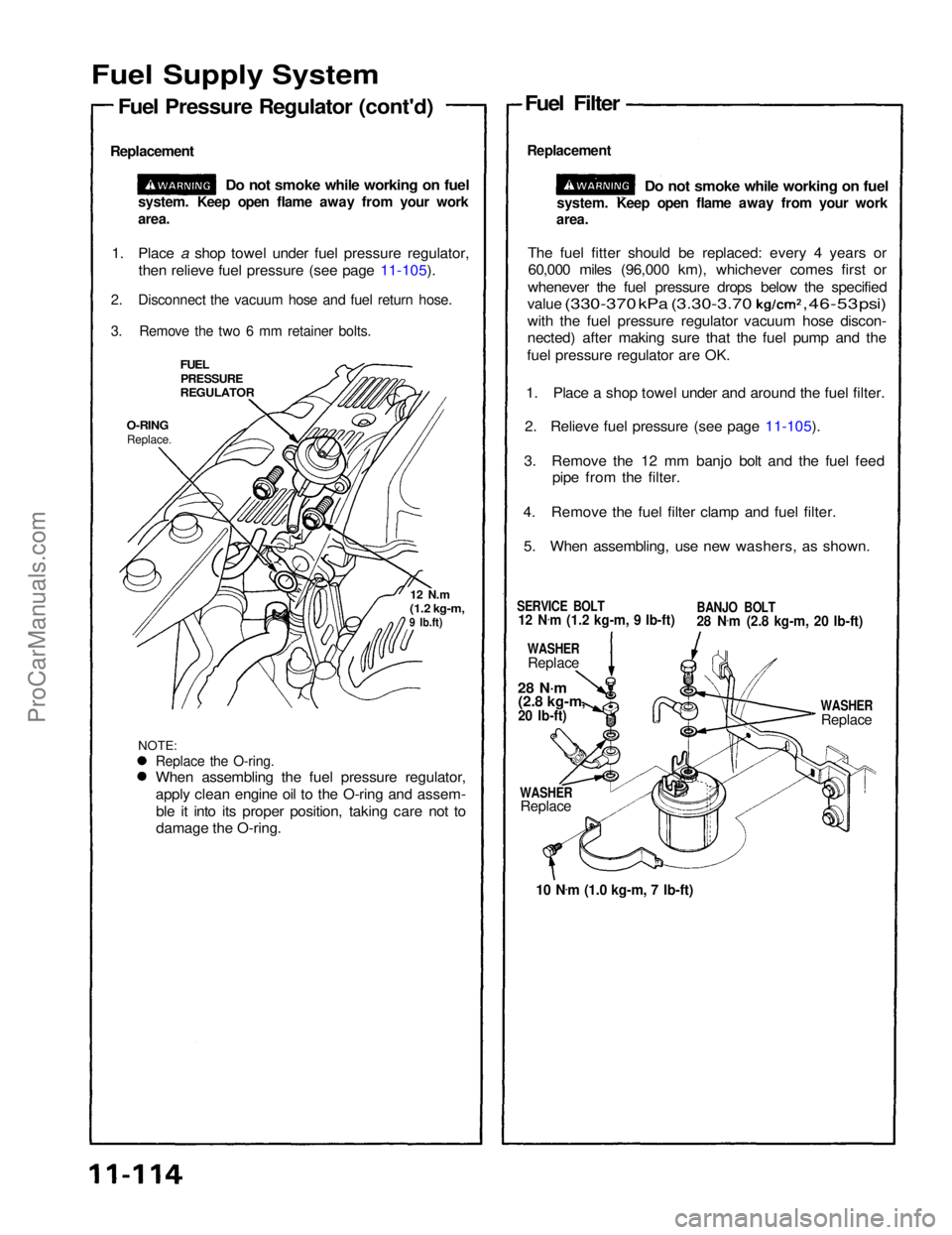
Replacement
Do not smoke while working on fuel Fuel Filter
Replacement
Do not smoke while working on fuel
The fuel fitter should be replaced: every 4 years or 60,000 miles (96,000 km), whichever comes first or
whenever the fuel pressure drops below the specified value
(330-370
kPa
(3.30-3.70
,
46-53
psi)
with the fuel pressure regulator vacuum hose discon-
nected) after making sure that the fuel pump and the
fuel pressure regulator are OK.
1. Place a shop towel under and around the fuel filter.
2. Relieve fuel pressure (see page 11-105).
3. Remove the 12 mm banjo bolt and the fuel feed pipe from the filter.
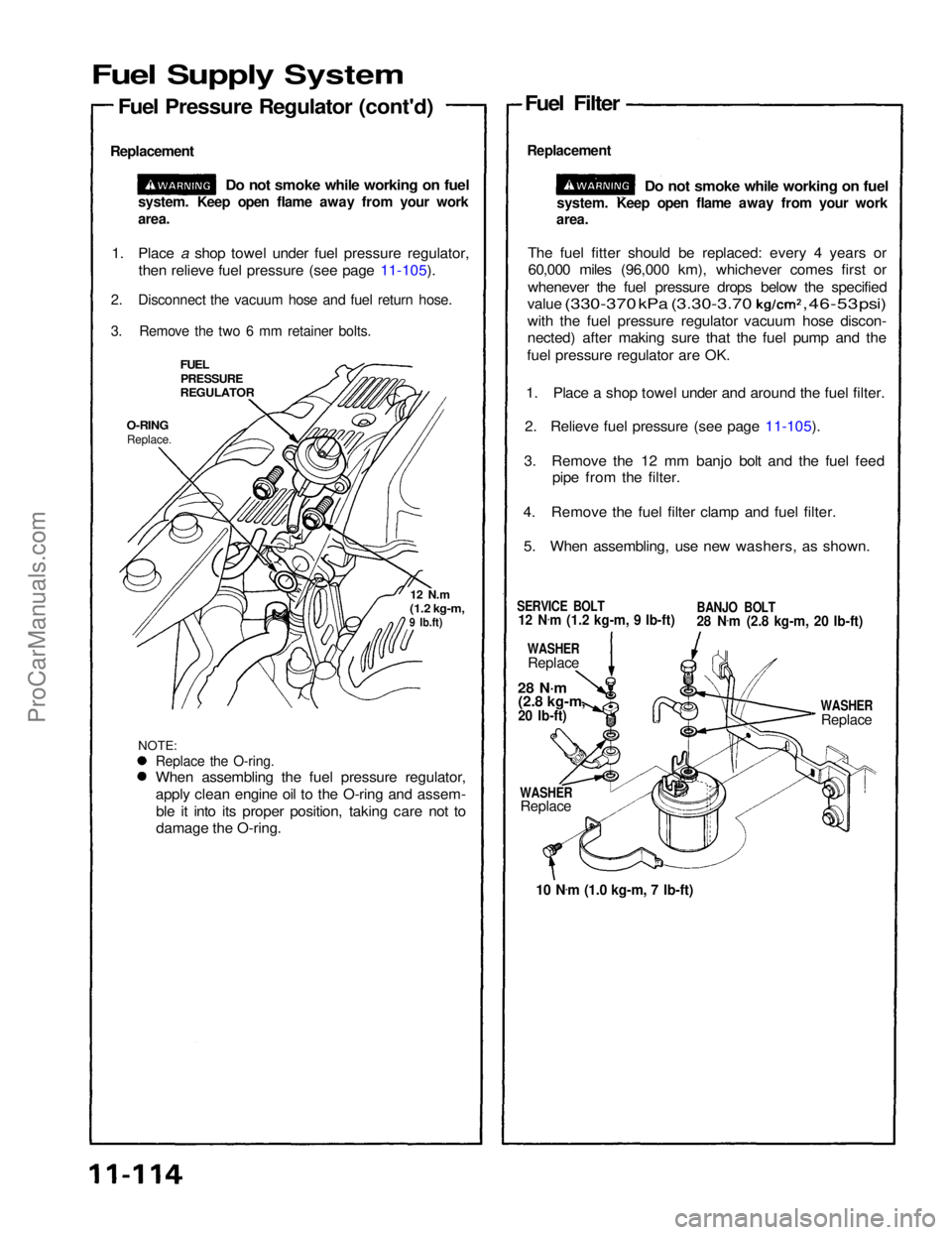
4. Remove the fuel filter clamp and fuel filter. 5. When assembling, use new washers, as shown.
1. Place a shop towel under fuel pressure regulator,
then relieve fuel pressure (see page 11-105).
2. Disconnect the vacuum hose and fuel return hose.
3. Remove the two 6 mm retainer bolts.
FUEL
PRESSURE
REGULATOR
O-RING
Replace.
NOTE:
12 N.m
(1.2 kg-m,
9 Ib.ft)
SERVICE BOLT
12 N .
m (1.2 kg-m, 9 Ib-ft)
BANJO BOLT
28 N
.
m (2.8 kg-m, 20 Ib-ft)
WASHER
Replace
28 N·m
(2.8 kg-m,
20 Ib-ft)
WASHER
Replace
10 N .
m (1.0 kg-m, 7 Ib-ft)
WASHER
Replace
system. Keep open flame away from your work
area.
system. Keep open flame away from your work
area.
Replace the O-ring.
When assembling the fuel pressure regulator,
apply clean engine oil to the O-ring and assem-ble it into its proper position, taking care not to
damage the O-ring.ProCarManuals.com
Page 1116 of 1640
Fuel Supply System
Fuel Pressure Regulator (cont'd)
Replacement
Do not smoke while working on fuel Fuel Filter
Replacement
Do not smoke while working on fuel
The fuel fitter should be replaced: every 4 years or 60,000 miles (96,000 km), whichever comes first or
whenever the fuel pressure drops below the specified value
(330-370
kPa
(3.30-3.70
,
46-53
psi)
with the fuel pressure regulator vacuum hose discon-
nected) after making sure that the fuel pump and the
fuel pressure regulator are OK.
1. Place a shop towel under and around the fuel filter.
2. Relieve fuel pressure (see page 11-105).
3. Remove the 12 mm banjo bolt and the fuel feed pipe from the filter.
4. Remove the fuel filter clamp and fuel filter. 5. When assembling, use new washers, as shown.
1. Place a shop towel under fuel pressure regulator,
then relieve fuel pressure (see page 11-105).
2. Disconnect the vacuum hose and fuel return hose.
3. Remove the two 6 mm retainer bolts.
FUEL
PRESSURE
REGULATOR
O-RING
Replace.
NOTE:
12 N.m
(1.2 kg-m,
9 Ib.ft)
SERVICE BOLT
12 N .
m (1.2 kg-m, 9 Ib-ft)
BANJO BOLT
28 N
.
m (2.8 kg-m, 20 Ib-ft)
WASHER
Replace
28 N·m
(2.8 kg-m,
20 Ib-ft)
WASHER
Replace
10 N .
m (1.0 kg-m, 7 Ib-ft)
WASHER
Replace
system. Keep open flame away from your work
area.
system. Keep open flame away from your work
area.
Replace the O-ring.
When assembling the fuel pressure regulator,
apply clean engine oil to the O-ring and assem-ble it into its proper position, taking care not to
damage the O-ring.ProCarManuals.com
Page 1117 of 1640
Fuel Pump
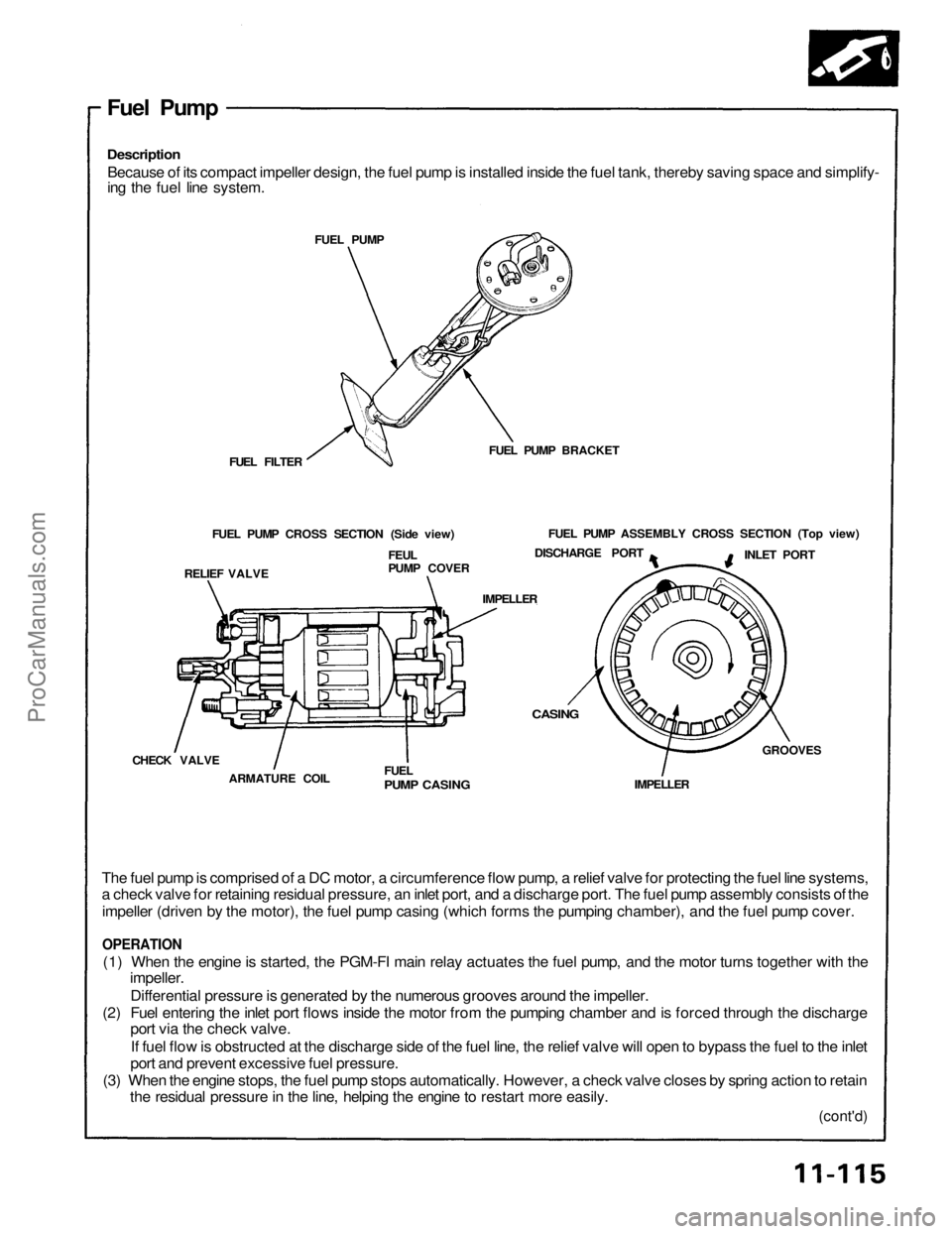
Description
Because of its compact impeller design, the fuel pump is installed inside the fuel tank, thereby saving space and simplify-
ing the fuel line system.
FUEL PUMP
FUEL PUMP BRACKET
FUEL FILTER
FUEL PUMP CROSS SECTION (Side view)
RELIEF VALVE
FEUL
PUMP COVER
FUEL PUMP ASSEMBLY CROSS SECTION (Top view)
DISCHARGE PORT
INLET PORT
IMPELLER
CHECK VALVE
ARMATURE COIL
FUEL
PUMP CASING
IMPELLER
GROOVES
CASING
The fuel pump is comprised of a DC motor, a circumference flow pump, a relief valve for protecting the fuel line systems,
a check valve for retaining residual pressure, an inlet port, and a discharge port. The fuel pump assembly consists of the
impeller (driven by the motor), the fuel pump casing (which forms the pumping chamber), and the fuel pump cover.
OPERATION
(1) When the engine is started, the PGM-FI main relay actuates the fuel pump, and the motor turns together with the
impeller.
Differential pressure is generated by the numerous grooves around the impeller.
(2) Fuel entering the inlet port flows inside the motor from the pumping chamber and is forced through the discharge
port via the check valve.
If fuel flow is obstructed at the discharge side of the fuel line, the relief valve will open to bypass the fuel to the inlet
port and prevent excessive fuel pressure.
(3) When the engine stops, the fuel pump stops automatically. However, a check valve closes by spring action to retain
the residual pressure in the line, helping the engine to restart more easily.
(cont'd)ProCarManuals.com
Page 1119 of 1640
Fuel Supply System
Description
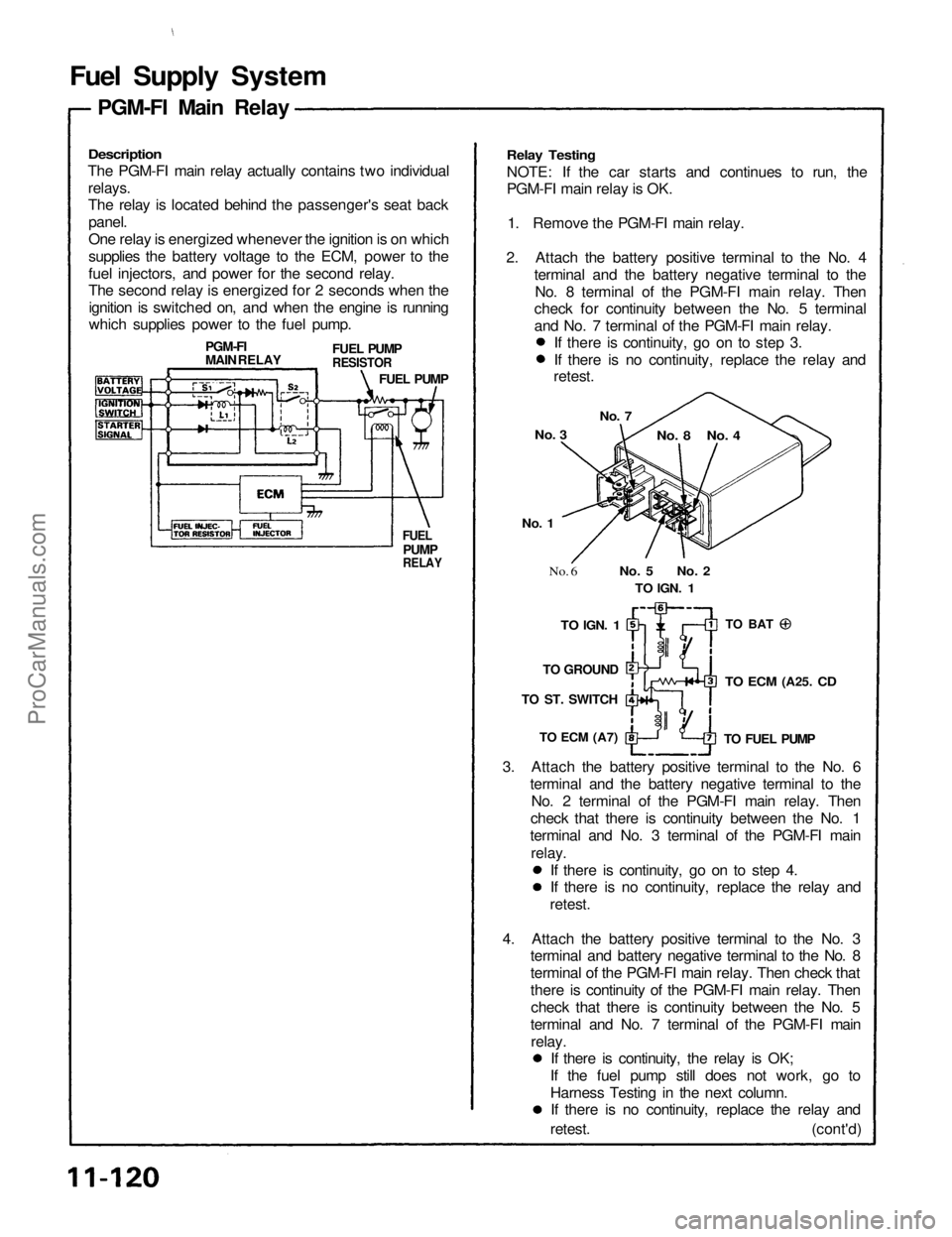
The PGM-FI main relay actually contains two individual
relays.
The relay is located behind the passenger's seat backpanel.
One relay is energized whenever the ignition is on which
supplies the battery voltage to the ECM, power to the
fuel injectors, and power for the second relay.
The second relay is energized for 2 seconds when theignition is switched on, and when the engine is running
which supplies power to the fuel pump.
Relay Testing
NOTE: If the car starts and continues to run, the
PGM-FI main relay is OK.
1. Remove the PGM-FI main relay.
2. Attach the battery positive terminal to the No. 4 terminal and the battery negative terminal to theNo. 8 terminal of the PGM-FI main relay. Then
check for continuity between the No. 5 terminal
and No. 7 terminal of the PGM-FI main relay.
3. Attach the battery positive terminal to the No. 6 terminal and the battery negative terminal to theNo. 2 terminal of the PGM-FI main relay. Then
check that there is continuity between the No. 1
terminal and No. 3 terminal of the PGM-FI main
relay.
FUEL
PUMP
RELAY
FUEL PUMP
RESISTOR
FUEL PUMP
PGM-FI
MAIN RELAY
No. 3
No. 7
No. 8 No. 4
No. 1
No. 6
No. 5 No. 2
TO
IGN.
1
TO BAT
TO
IGN.
1
TO GROUND
TO ST. SWITCH
TO ECM
(A7)
TO ECM
(A25.
CD
TO FUEL PUMP
PGM-FI Main Relay
If there is continuity, go on to step 4.
If there is no continuity, replace the relay and
retest.
4. Attach the battery positive terminal to the No. 3 terminal and battery negative terminal to the No. 8
terminal of the PGM-FI main relay. Then check that
there is continuity of the PGM-FI main relay. Then
check that there is continuity between the No. 5
terminal and No. 7 terminal of the PGM-FI main relay. If there is continuity, the relay is OK;
If the fuel pump still does not work, go to
Harness Testing in the next column. If there is no continuity, replace the relay and
retest. (cont'd) If there is continuity, go on to step 3.
If there is no continuity, replace the relay and
retest.ProCarManuals.com
Page 1120 of 1640
Fuel Supply System
PGM-FI Main Relay (cont'd)
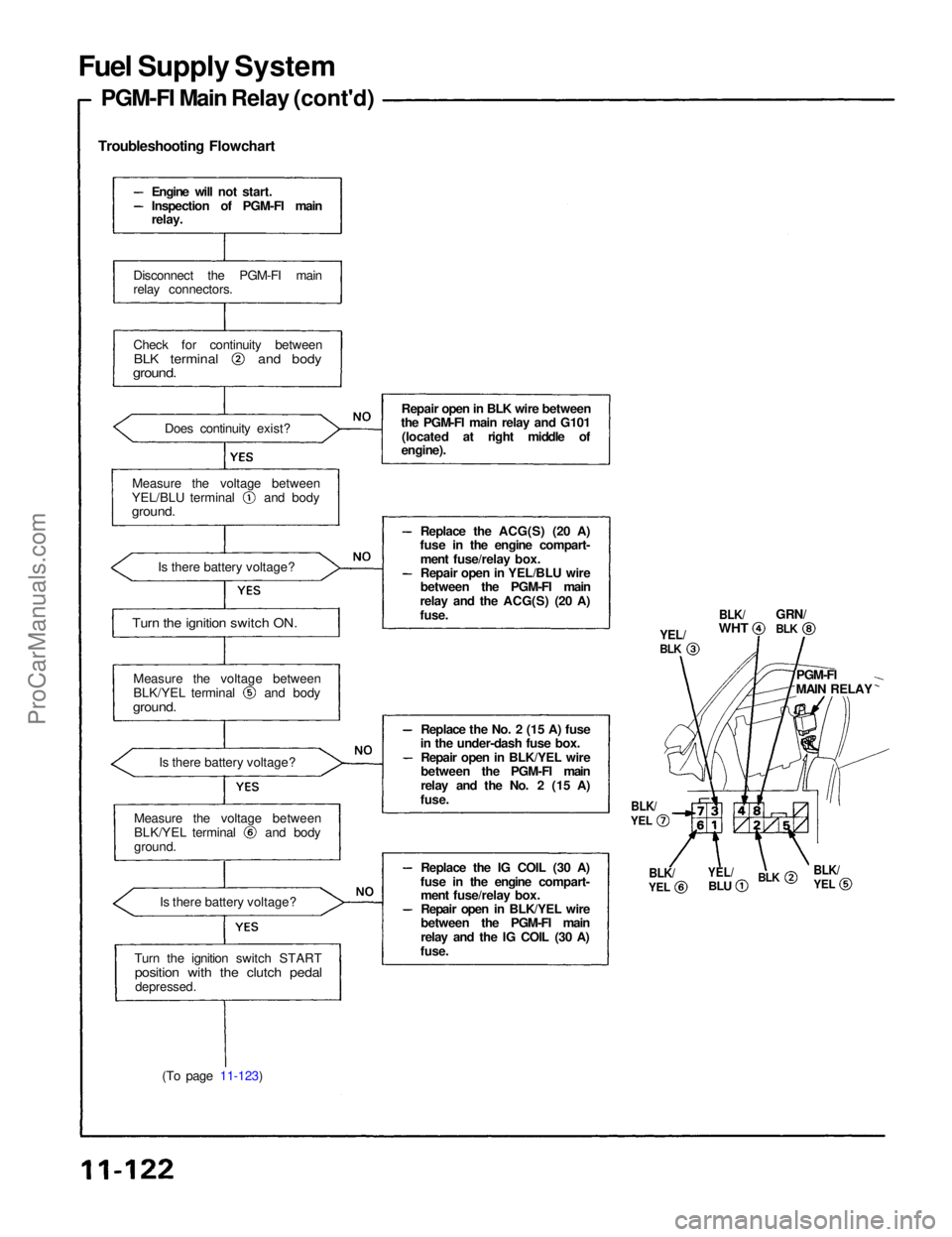
Troubleshooting Flowchart
(To page 11-123)
BLK/
WHT
GRN/
YEL/
BLK
PGM-FI
MAIN RELAY
BLK/
YEL
BLK
YEL/
BLU
BLK/
YEL
BLK/
YEL
BLK
Engine will not start.
Inspection of PGM-FI main
relay.
Disconnect the PGM-FI main
relay connectors.
Check for continuity between
BLK terminal and body
ground.
Does continuity exist?
Measure the voltage between YEL/BLU terminal and body
ground.
Is there battery voltage?
Turn the ignition switch ON.
Measure the voltage between BLK/YEL terminal and body
ground.
Is there battery voltage?
Measure the voltage between BLK/YEL terminal and body
ground.
Is there battery voltage?
Turn the ignition switch START
position with the clutch pedal
depressed.
Repair open in BLK wire between
the PGM-FI main relay and G101
(located at right middle of
engine).
Replace the ACG(S) (20 A)
fuse in the engine compart-
ment fuse/relay box.
Repair open in YEL/BLU wire
between the PGM-FI main
relay and the ACG(S) (20 A)
fuse.
Replace the No. 2 (15 A) fuse
in the under-dash fuse box.
Repair open in BLK/YEL wire
between the PGM-FI main
relay and the No. 2 (15 A)
fuse.
Replace the IG COIL (30 A)
fuse in the engine compart- ment fuse/relay box.
Repair open in BLK/YEL wire
between the PGM-FI main
relay and the IG COIL (30 A)
fuse.ProCarManuals.com
Page 1121 of 1640
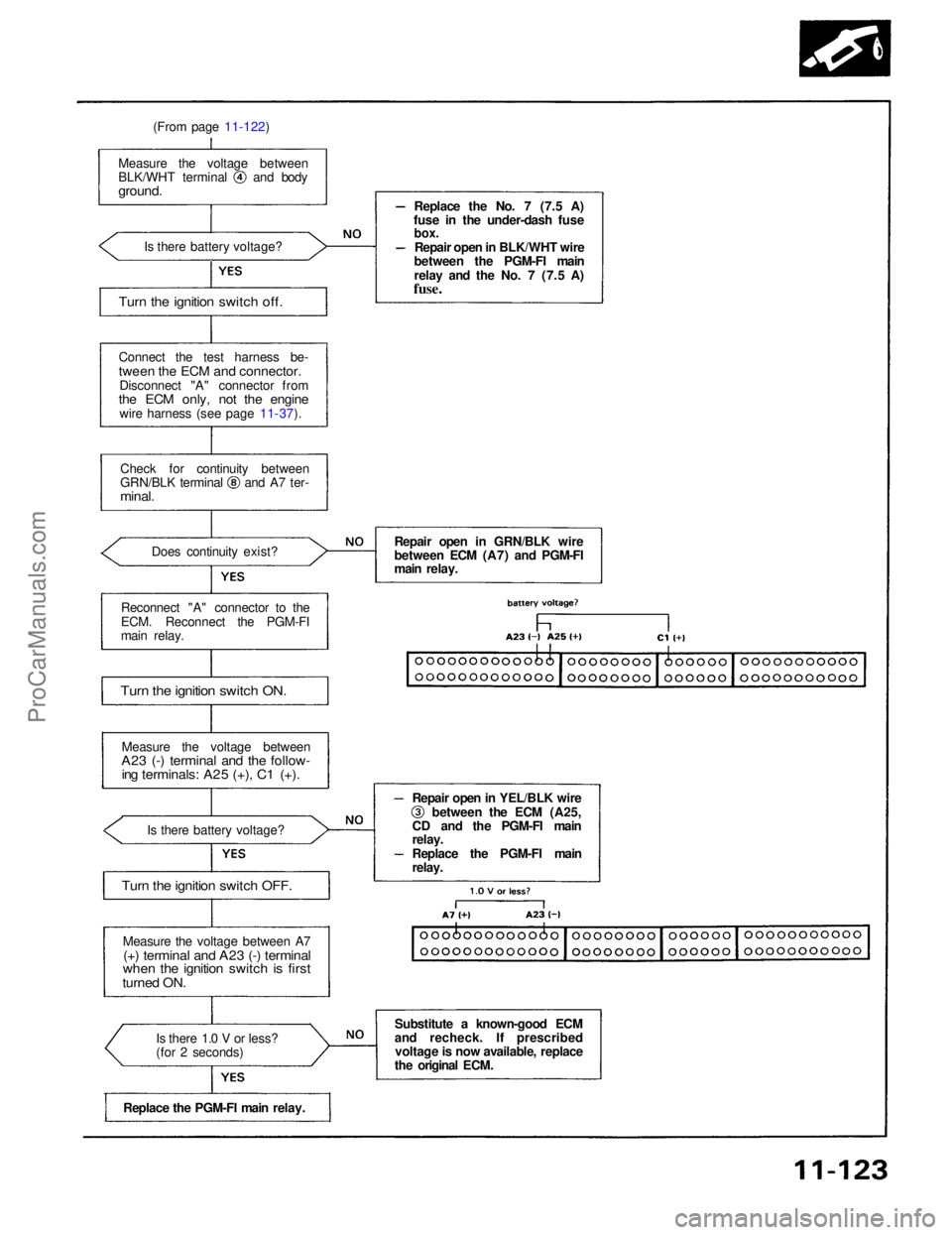
(From page 11-122)
Connect the test harness be-
tween the ECM and connector.
Disconnect "A" connector from
the ECM only, not the engine
wire harness (see page 11-37).
Measure the voltage between BLK/WHT terminal and body
ground.
Is there battery voltage?
Check for continuity between GRN/BLK terminal and A7 ter-
minal.
Does continuity exist?
Reconnect "A" connector to the
ECM. Reconnect the PGM-FI
main relay.
Turn the ignition switch ON.
Measure the voltage between
A23 (-) terminal and the follow-
ing terminals: A25 (+), C1 (+).
Is there battery voltage?
Turn the ignition switch OFF.
Measure the voltage between A7
(+) terminal and A23 (-) terminal
when the ignition switch is first
turned ON.
Is there 1.0 V or less?
(for 2 seconds)
Replace the PGM-FI main relay. Replace the No. 7 (7.5 A)
fuse in the under-dash fuse
box.
Repair open in BLK/WHT wire
between the PGM-FI main
relay and the No. 7 (7.5 A)
fuse.
Repair open in GRN/BLK wire
between ECM (A7) and PGM-FI
main relay. Repair open in YEL/BLK wire between the ECM (A25,
CD and the PGM-FI main
relay.
Replace the PGM-FI main
relay.
Substitute a known-good ECM
and recheck. If prescribed voltage is now available, replace
the original ECM.
Turn the ignition switch off.ProCarManuals.com
Page 1122 of 1640
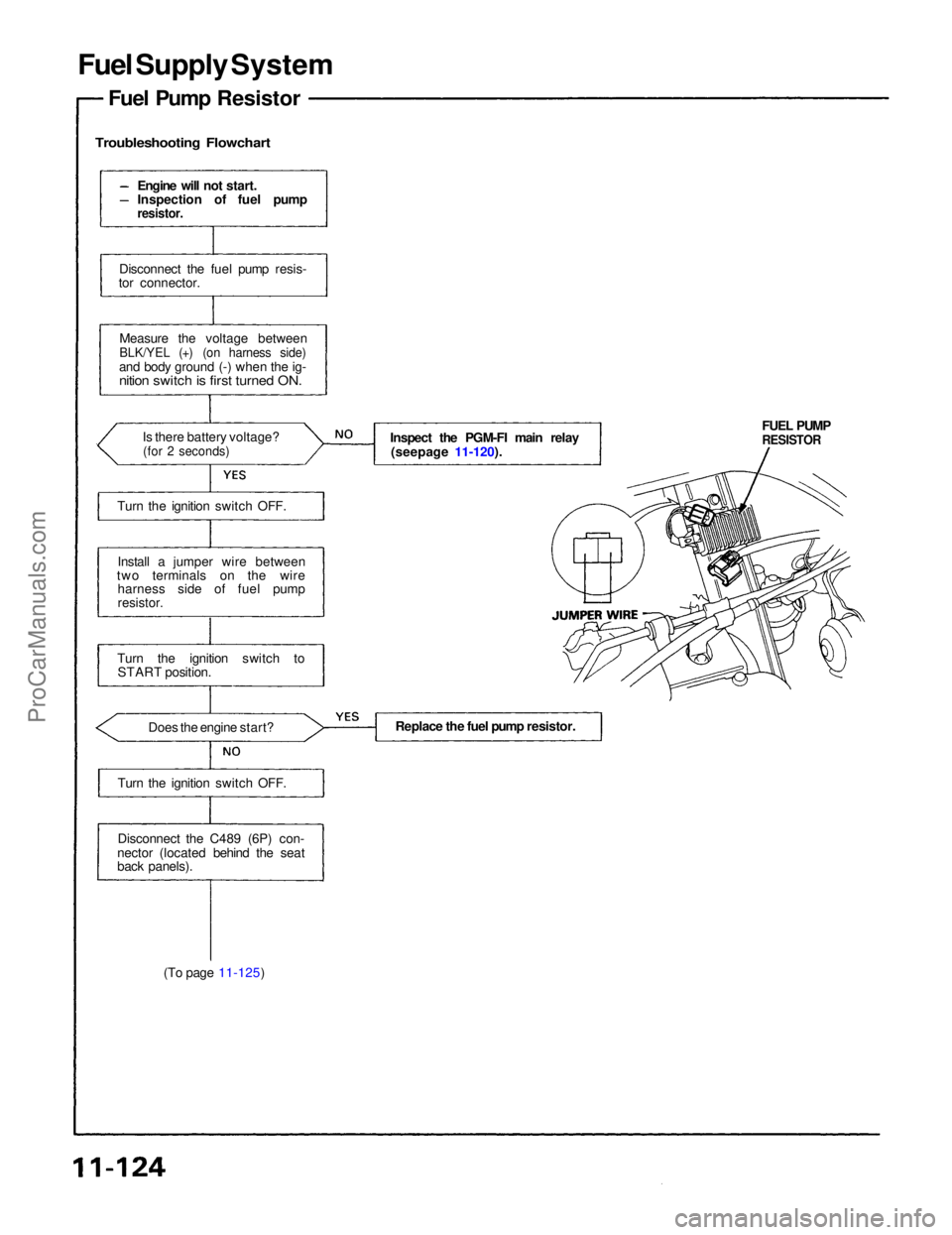
Fuel Supply System
Fuel Pump Resistor
Troubleshooting Flowchart
(To page 11-125) FUEL PUMP
RESISTOR
Inspect the PGM-FI main relay
(seepage 11-120).
Engine will not start.
Inspection of fuel pump
resistor.
Disconnect the fuel pump resis-
tor connector.
Measure the voltage between
BLK/YEL (+) (on harness side)
and body ground (-) when the ig-
nition switch is first turned ON.
Is there battery voltage?
(for 2 seconds)
Turn the ignition switch OFF.
Install a jumper wire between
two terminals on the wire harness side of fuel pump
resistor.
Turn the ignition switch to START position.
Does the engine start?
Turn the ignition switch OFF.
Disconnect the C489 (6P) con-
nector (located behind the seat
back panels). Replace the fuel pump resistor.ProCarManuals.com