engine ACURA NSX 1991 Service Repair Manual
[x] Cancel search | Manufacturer: ACURA, Model Year: 1991, Model line: NSX, Model: ACURA NSX 1991Pages: 1640, PDF Size: 60.48 MB
Page 1200 of 1640
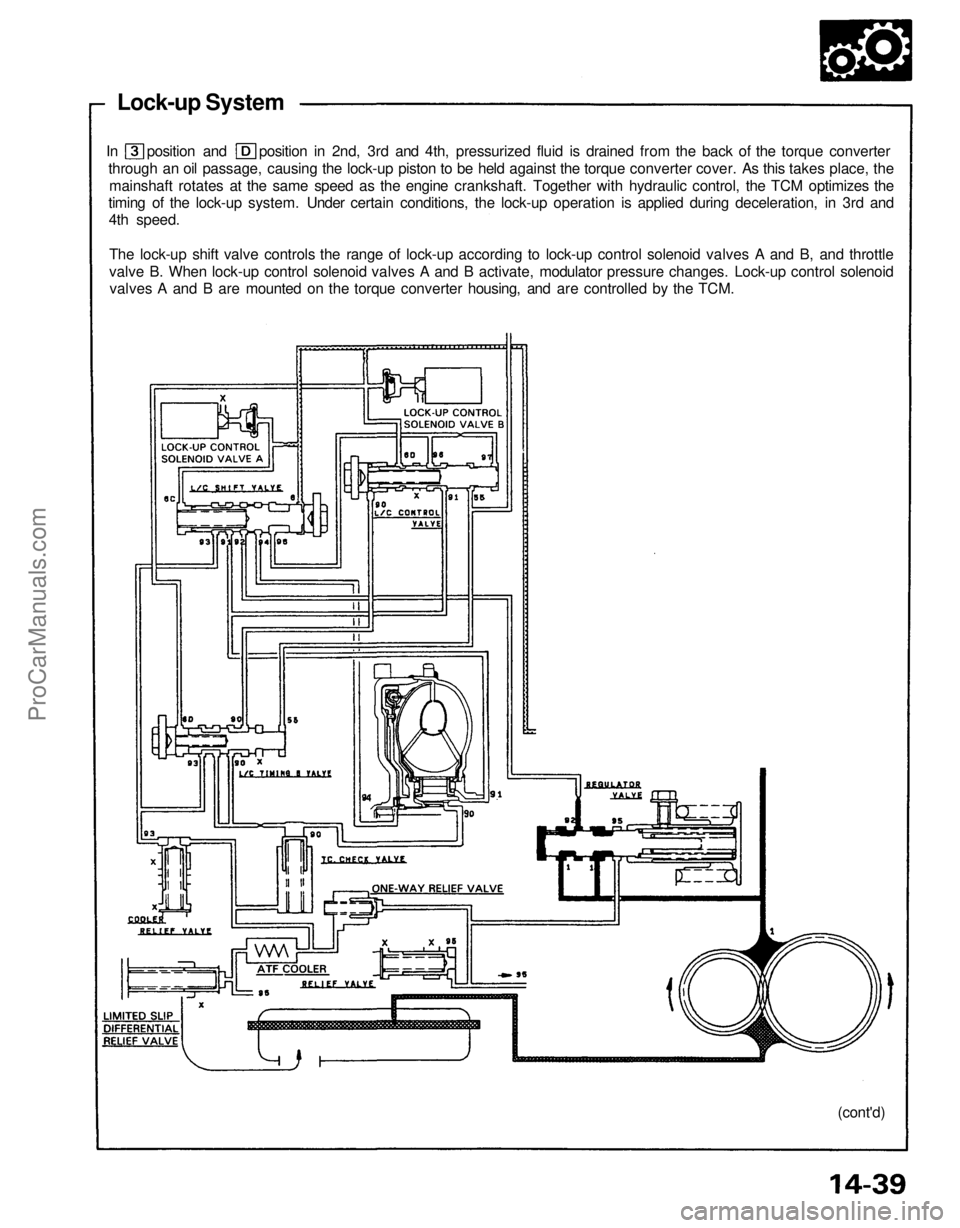
Lock-up System
In position and position in 2nd, 3rd and 4th, pressurized fluid is drained from the back of the torque converter
through an oil passage, causing the lock-up piston to be held against the torque converter cover. As this takes place, themainshaft rotates at the same speed as the engine crankshaft. Together with hydraulic control, the TCM optimizes the
timing of the lock-up system. Under certain conditions, the lock-up operation is applied during deceleration, in 3rd and 4th speed.
The lock-up shift valve controls the range of lock-up according to lock-up control solenoid valves A and B, and throttle
valve B. When lock-up control solenoid valves A and B activate, modulator pressure changes. Lock-up control solenoidvalves A and B are mounted on the torque converter housing, and are controlled by the TCM.
(cont'd)ProCarManuals.com
Page 1206 of 1640
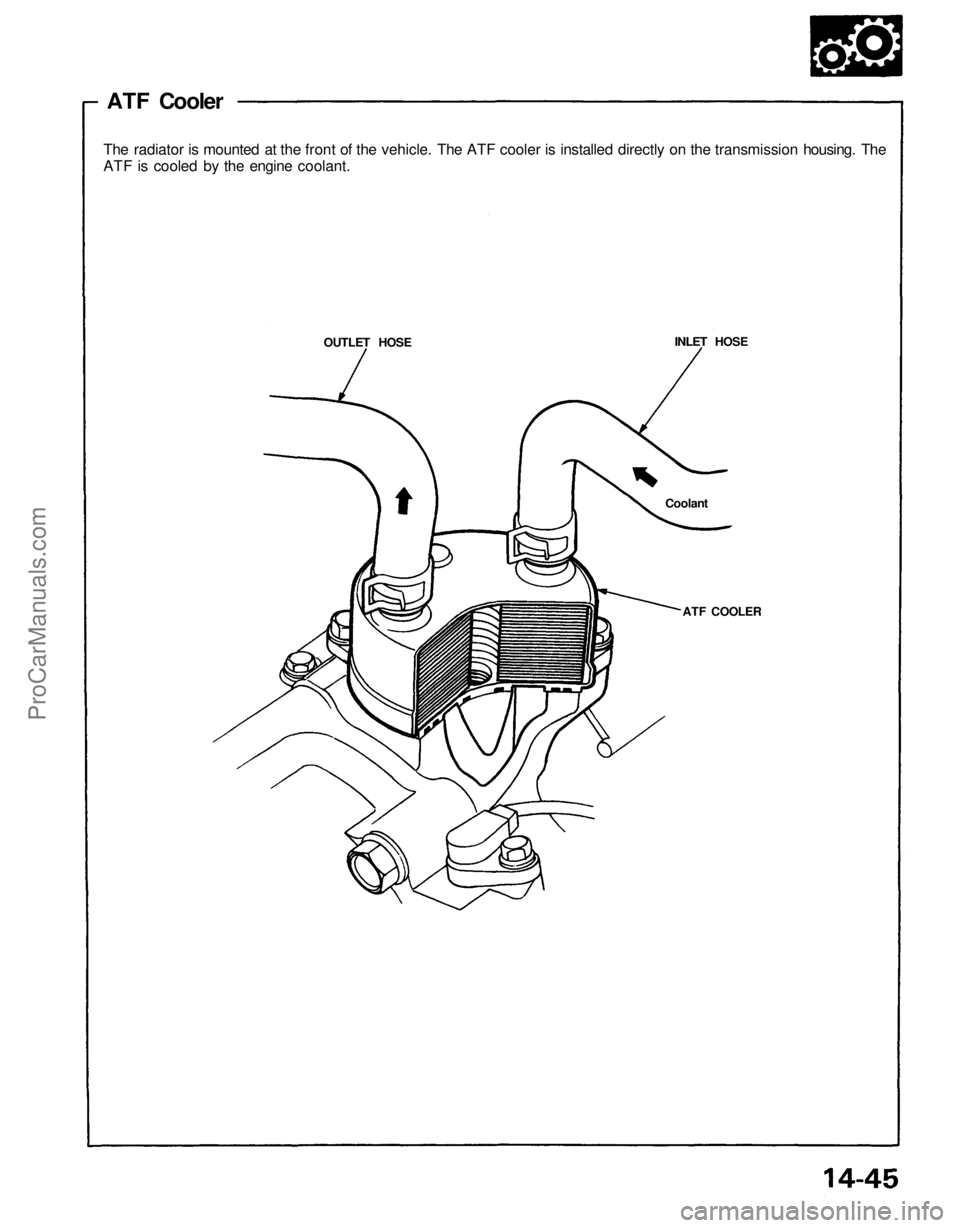
ATF Cooler
The radiator is mounted at the front of the vehicle. The ATF cooler is installed directly on the transmission housing. The
ATF is cooled by the engine coolant.
OUTLET HOSE
INLET HOSE
Coolant
ATF COOLERProCarManuals.com
Page 1207 of 1640
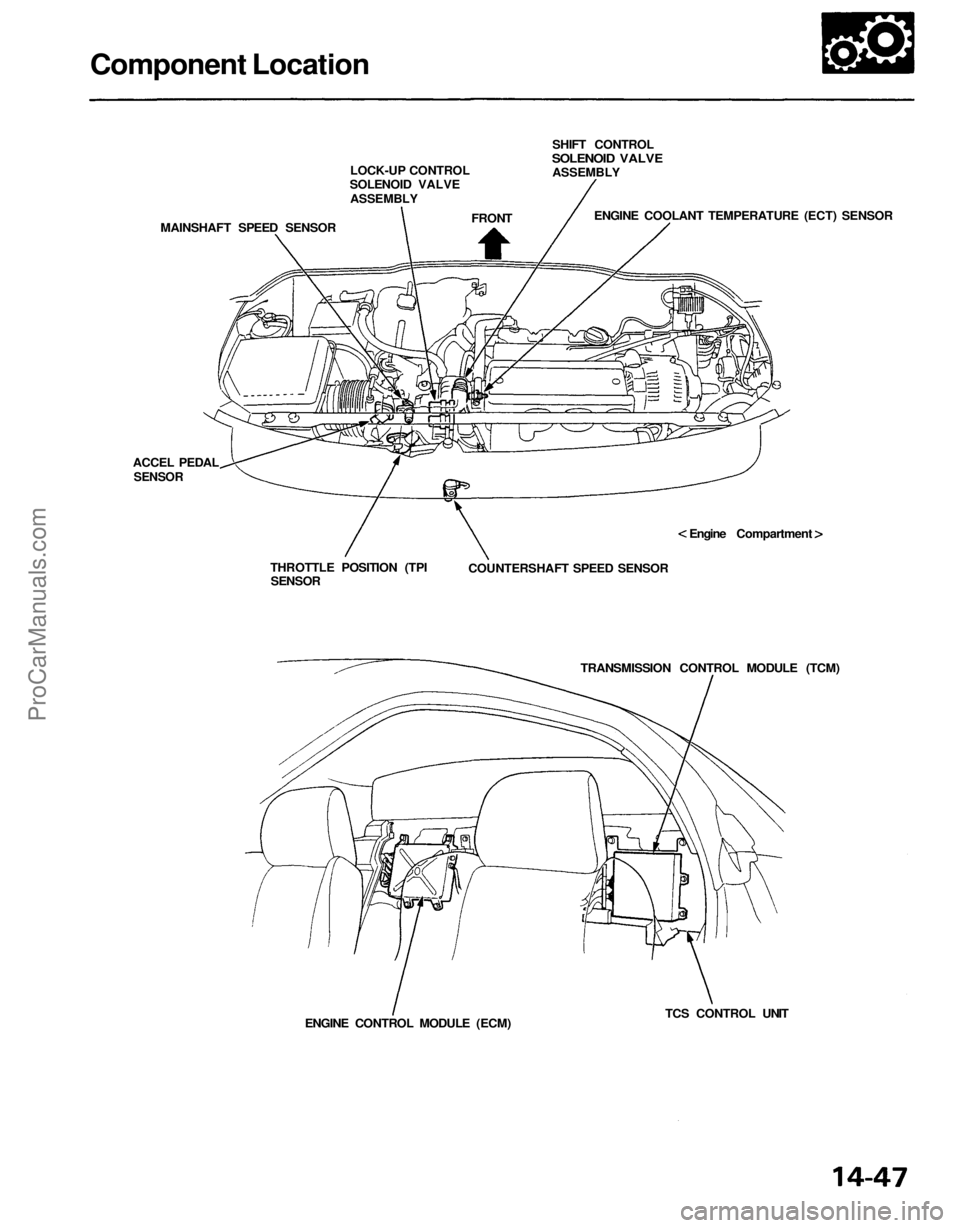
Component Location
LOCK-UP CONTROL
SOLENOID VALVE
ASSEMBLY
MAINSHAFT SPEED SENSOR
FRONT
SHIFT CONTROL
SOLENOID VALVE
ASSEMBLY
ENGINE COOLANT TEMPERATURE (ECT) SENSOR
Engine Compartment
COUNTERSHAFT SPEED SENSOR
TRANSMISSION CONTROL MODULE (TCM)
TCS CONTROL UNIT
ENGINE CONTROL MODULE (ECM)
THROTTLE POSITION (TPI
SENSOR
ACCEL PEDAL
SENSORProCarManuals.com
Page 1210 of 1640
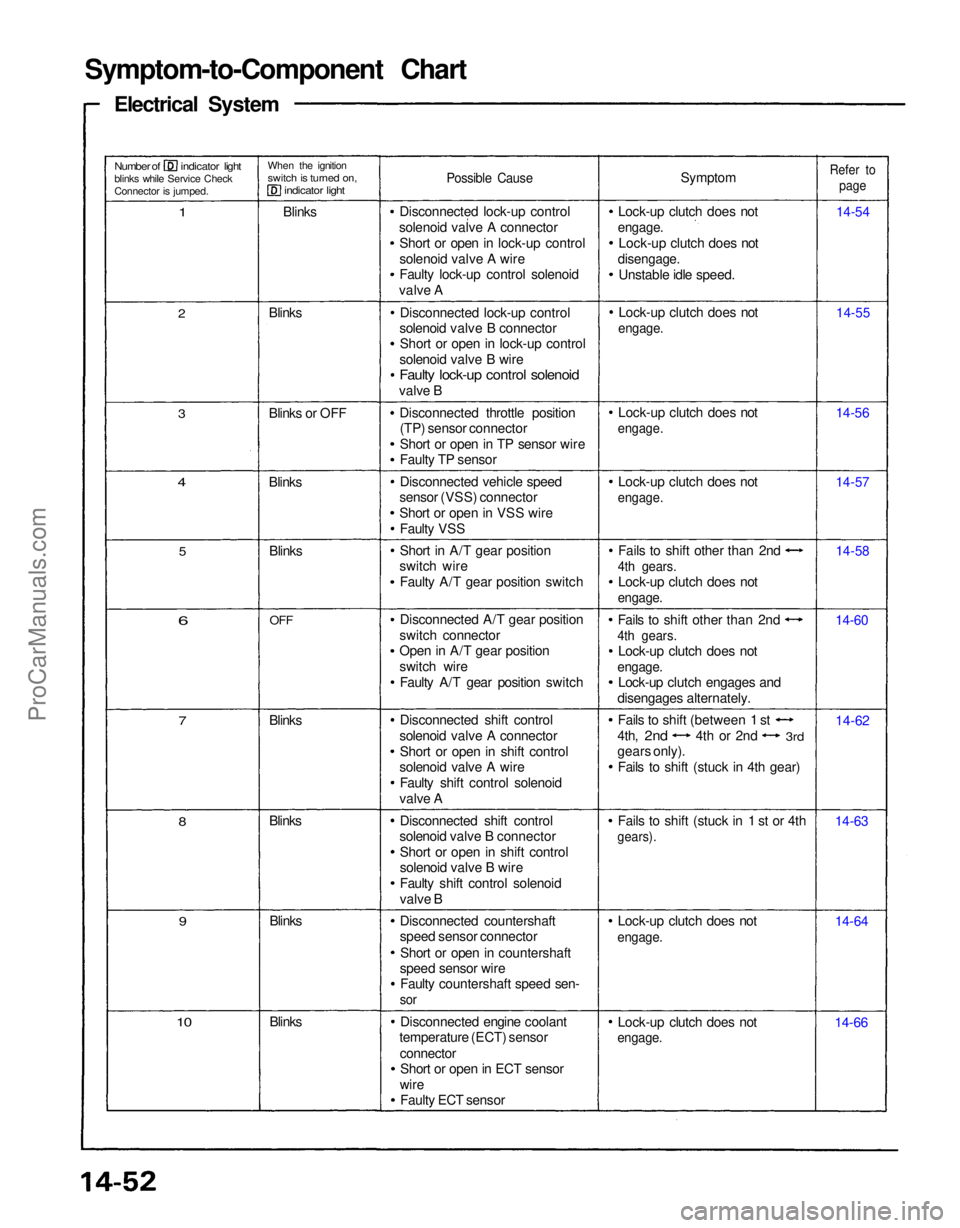
Symptom-to-Component Chart
Electrical System
Number of indicator light
blinks while Service Check
Connector is jumped.
When the ignition
switch is turned on,
indicator light
1
Blinks
Possible Cause
Symptom
Lock-up clutch does not
engage.
Lock-up clutch does not
disengage.
Unstable idle speed.
Refer to
page
14-54
14-55
14-56
14-57
14-58
14-60
14-62
14-63
14-64
14-66
Lock-up clutch does not
engage.
Lock-up clutch does not
engage.
Fails to shift (stuck in 1 st or 4th
gears).
Fails to shift other than 2nd
4th gears.
Lock-up clutch does not
engage.
Lock-up clutch engages and
disengages alternately. Fails to shift other than 2nd
4th gears.
Lock-up clutch does not
engage.
Lock-up clutch does not
engage.
Lock-up clutch does not
engage.
Lock-up clutch does not
engage.
Disconnected lock-up control
solenoid valve A connector Short or open in lock-up control
solenoid valve A wire
Faulty lock-up control solenoid
valve A
Disconnected lock-up control
solenoid valve B connector Short or open in lock-up control
solenoid valve B wire
Faulty lock-up control solenoid
valve B
Disconnected throttle position(TP) sensor connector
Short or open in TP sensor wire
Faulty TP sensor
Disconnected vehicle speed
sensor (VSS) connector
Short or open in VSS wire
Faulty VSS
Short in A/T gear position
switch wire
Faulty A/T gear position switch
Disconnected A/T gear position
switch connector
Open in A/T gear position
switch wire Faulty A/T gear position switch
Disconnected shift control
solenoid valve A connector Short or open in shift control
solenoid valve A wire
Faulty shift control solenoid
valve A
Disconnected shift control
solenoid valve B connector
Short or open in shift control
solenoid valve B wire
Faulty shift control solenoid
valve B
Disconnected countershaft
speed sensor connector
Short or open in countershaft
speed sensor wire Faulty countershaft speed sen-
sor
Disconnected engine coolant
temperature (ECT) sensor
connectorShort or open in ECT sensor
wire Faulty ECT sensor
Blinks
10
9
Blinks
Blinks
8
7
Blinks
6
OFF
Blinks
5
4
Blinks
3
Blinks or OFF Blinks
2
Fails to shift (between 1 st
4th,
2nd
4th or 2nd
3rd
gears only).
Fails to shift (stuck in 4th gear)ProCarManuals.com
Page 1211 of 1640
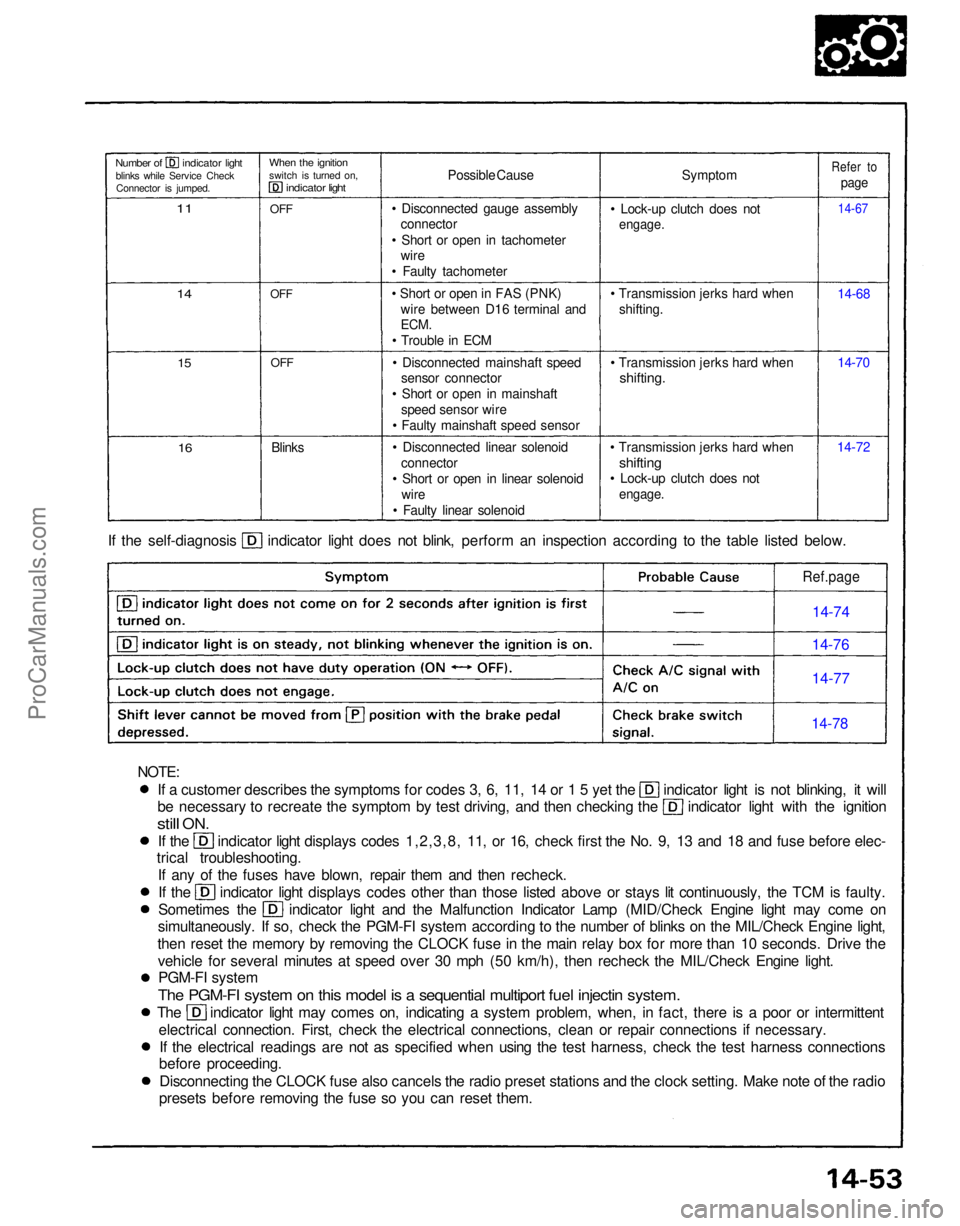
If a customer describes the symptoms for codes 3, 6, 11, 14 or 1 5 yet the indicator light is not blinking, it will
be necessary to recreate the symptom by test driving, and then checking the indicator light with the ignition
still
ON.
If the indicator light displays codes 1,2,3,8, 11, or 16, check first the No. 9, 13 and 18 and fuse before elec-
trical troubleshooting.
If any of the fuses have blown, repair them and then recheck. If the indicator light displays codes other than those listed above or stays lit continuously, the TCM is faulty.
Sometimes the indicator light and the Malfunction Indicator Lamp (MID/Check Engine light may come on
simultaneously. If so, check the PGM-FI system according to the number of blinks on the MIL/Check Engine light,
then reset the memory by removing the CLOCK fuse in the main relay box for more than 10 seconds. Drive the vehicle for several minutes at speed over 30 mph (50 km/h), then recheck the MIL/Check Engine light.PGM-FI system
The PGM-FI system on this model is a sequential multiport fuel injectin system.
The indicator light may comes on, indicating a system problem, when, in fact, there is a poor or intermittent
electrical connection. First, check the electrical connections, clean or repair connections if necessary.If the electrical readings are not as specified when using the test harness, check the test harness connections
before proceeding.
Disconnecting the CLOCK fuse also cancels the radio preset stations and the clock setting. Make note of the radio
presets before removing the fuse so you can reset them. If the self-diagnosis indicator light does not blink, perform an inspection according to the table listed below.
Symptom
• Lock-up clutch does not
engage.
• Transmission jerks hard when shifting.
• Transmission jerks hard when
shifting.
• Transmission jerks hard when
shifting
• Lock-up clutch does not
engage.
14-7214-70 14-68
14-67
Refer to
page
Possible Cause
• Disconnected gauge assembly connector
• Short or open in tachometer wire
• Faulty tachometer
• Short or open in FAS (PNK) wire between D16 terminal and
ECM.
• Trouble in ECM
• Disconnected mainshaft speed sensor connector
• Short or open in mainshaft speed sensor wire
• Faulty mainshaft speed sensor
• Disconnected linear solenoid connector
• Short or open in linear solenoid wire
• Faulty linear solenoid
Blinks
OFF
OFF
OFF
When the ignition
switch is turned on,
indicator light
Number of indicator light
blinks while Service CheckConnector is jumped.
11
14
15
16
Ref.page
14-74
14-76
14-77
14-78
NOTE:ProCarManuals.com
Page 1221 of 1640
Road Test
NOTE:
Warm up the engine to normal operating temperature (the cooling fan comes on).
When the engine coolant temperature is below normal operating temperature, the shift point is higher than specifiedvehicle speed.
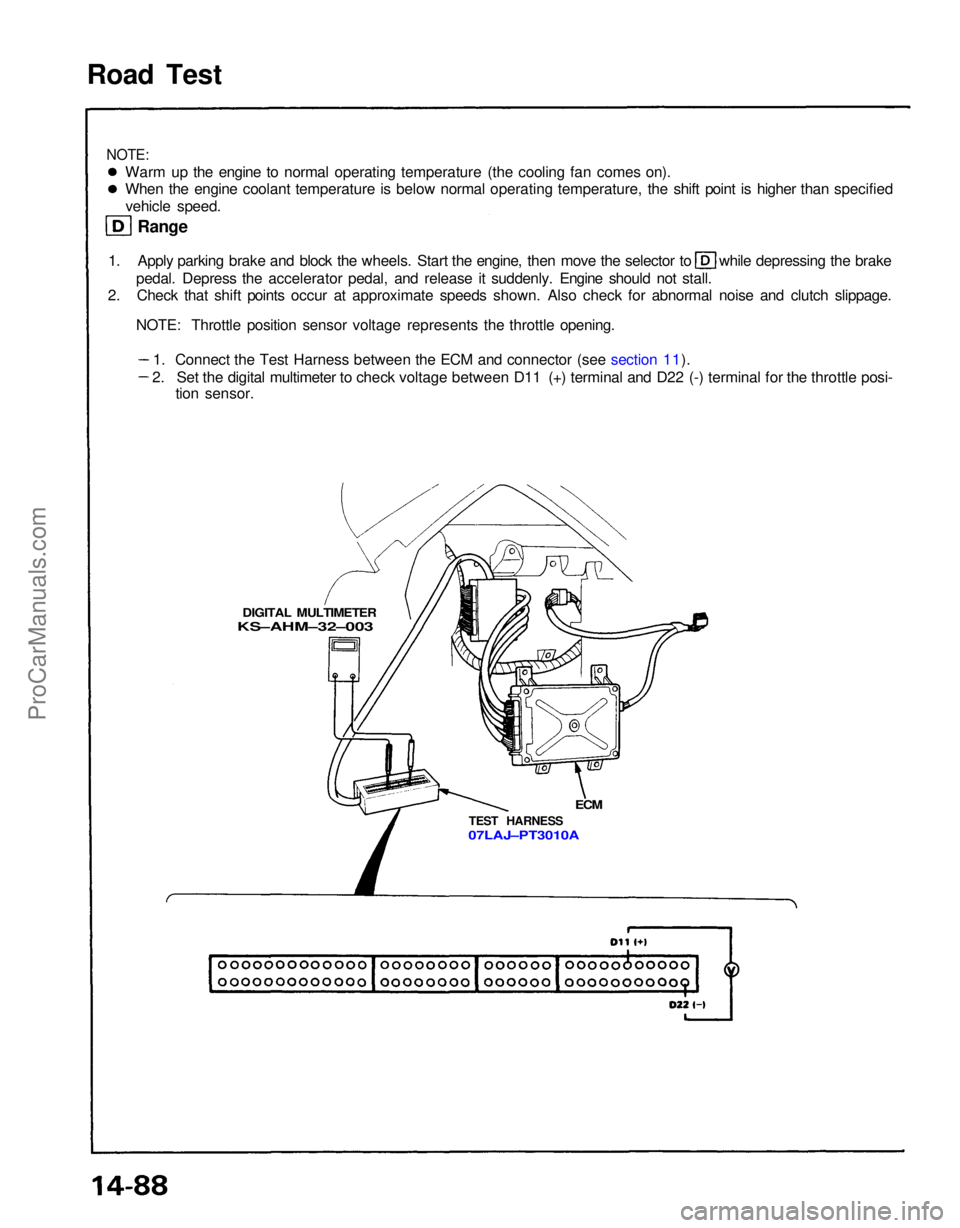
Range 1. Apply parking brake and block the wheels. Start the engine, then move the selector to while depressing the brake
pedal. Depress the accelerator pedal, and release it suddenly. Engine should not stall.
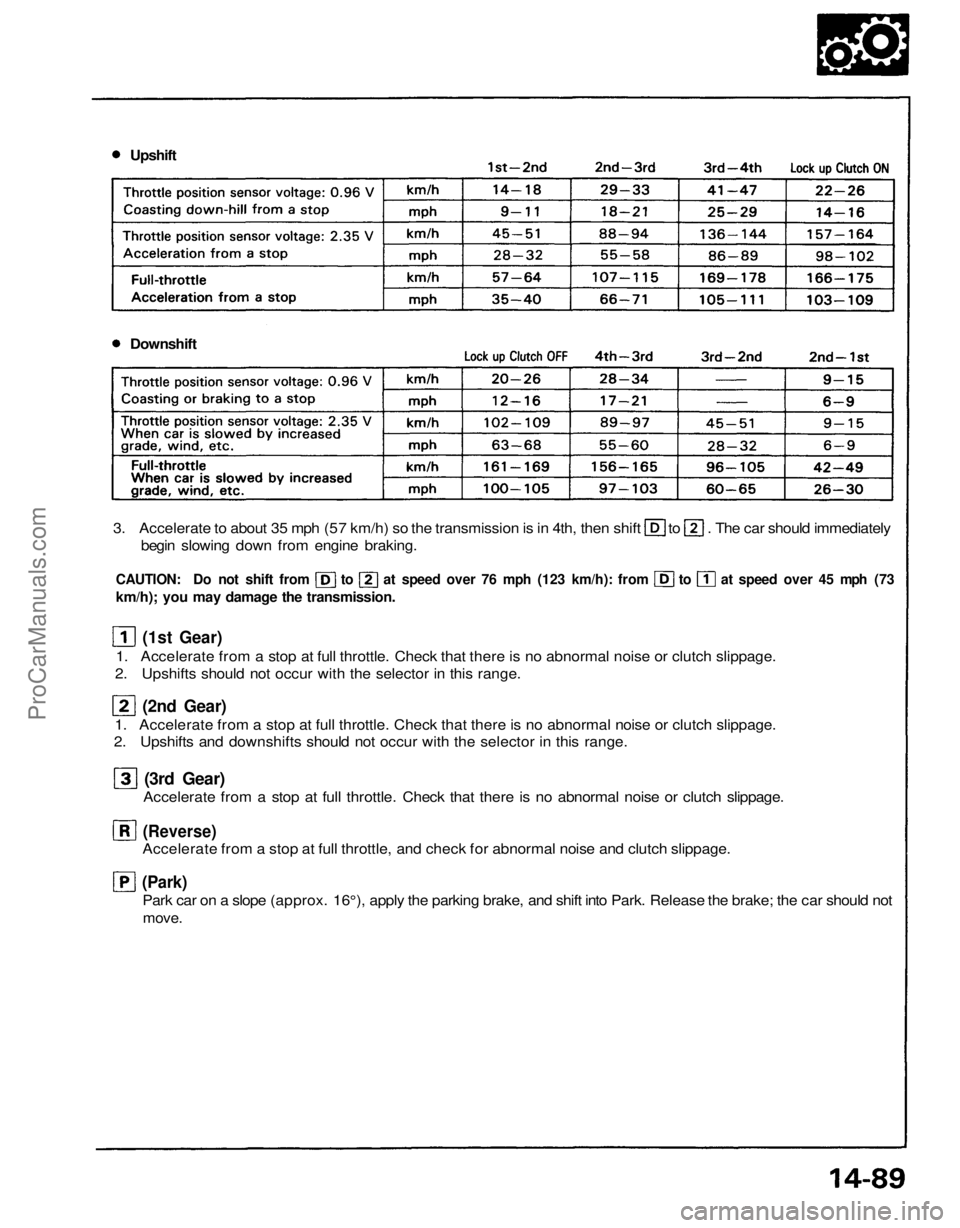
2. Check that shift points occur at approximate speeds shown. Also check for abnormal noise and clutch slippage.
NOTE: Throttle position sensor voltage represents the throttle opening.
DIGITAL MULTIMETER
KS–AHM–32–003
ECM
TEST HARNESS
07LAJ–PT3010A
1. Connect the Test Harness between the ECM and connector (see section 11).
2. Set the digital multimeter to check voltage between D11 (+) terminal and D22 (-) terminal for the throttle posi- tion sensor.ProCarManuals.com
Page 1222 of 1640
Upshift
Downshift
3. Accelerate to about 35 mph (57 km/h) so the transmission is in 4th, then shift to . The car should immediately
begin slowing down from engine braking.
CAUTION: Do not shift from to at speed over 76 mph (123 km/h): from to at speed over 45 mph (73
km/h); you may damage the transmission.
(1st Gear)
1. Accelerate from a stop at full throttle. Check that there is no abnormal noise or clutch slippage.
2. Upshifts should not occur with the selector in this range.
(2nd Gear)
1. Accelerate from a stop at full throttle. Check that there is no abnormal noise or clutch slippage.
2. Upshifts and downshifts should not occur with the selector in this range.
(3rd Gear)
Accelerate from a stop at full throttle. Check that there is no abnormal noise or clutch slippage.
(Reverse)
Accelerate from a stop at full throttle, and check for abnormal noise and clutch slippage.
(Park)
Park car on a slope (approx. 16°), apply the parking brake, and shift into Park. Release the brake; the car should not
move.ProCarManuals.com
Page 1223 of 1640
Stall Speed
Test
CAUTION:
To prevent transmission damage, do not test stall speed for more than 10 seconds at a time.
Do not shift the lever while raising the engine speed.
Be sure to remove the pressure gauge before testing stall speed.
1. Engage the parking brake and block all four wheels.
2. Connect the tachometer, and start the engine.
3. Make sure the A/C switch is OFF.
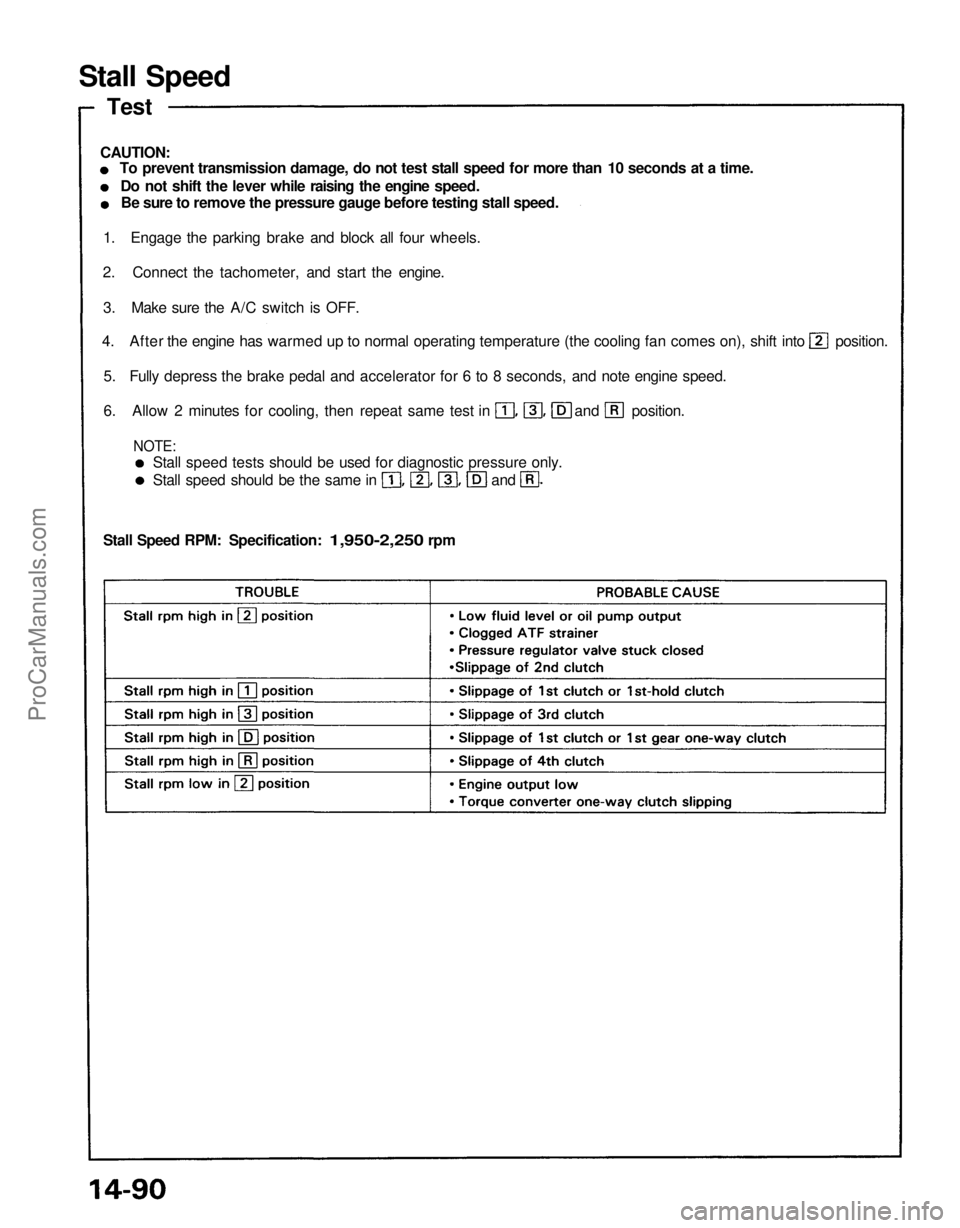
4. After the engine has warmed up to normal operating temperature (the cooling fan comes on), shift into position.
5. Fully depress the brake pedal and accelerator for 6 to 8 seconds, and note engine speed.
6. Allow 2 minutes for cooling, then repeat same test in and position.
NOTE:
Stall speed tests should be used for diagnostic pressure only.
Stall speed should be the same in and
Stall Speed RPM: Specification:
1,950-2,250
rpmProCarManuals.com
Page 1224 of 1640
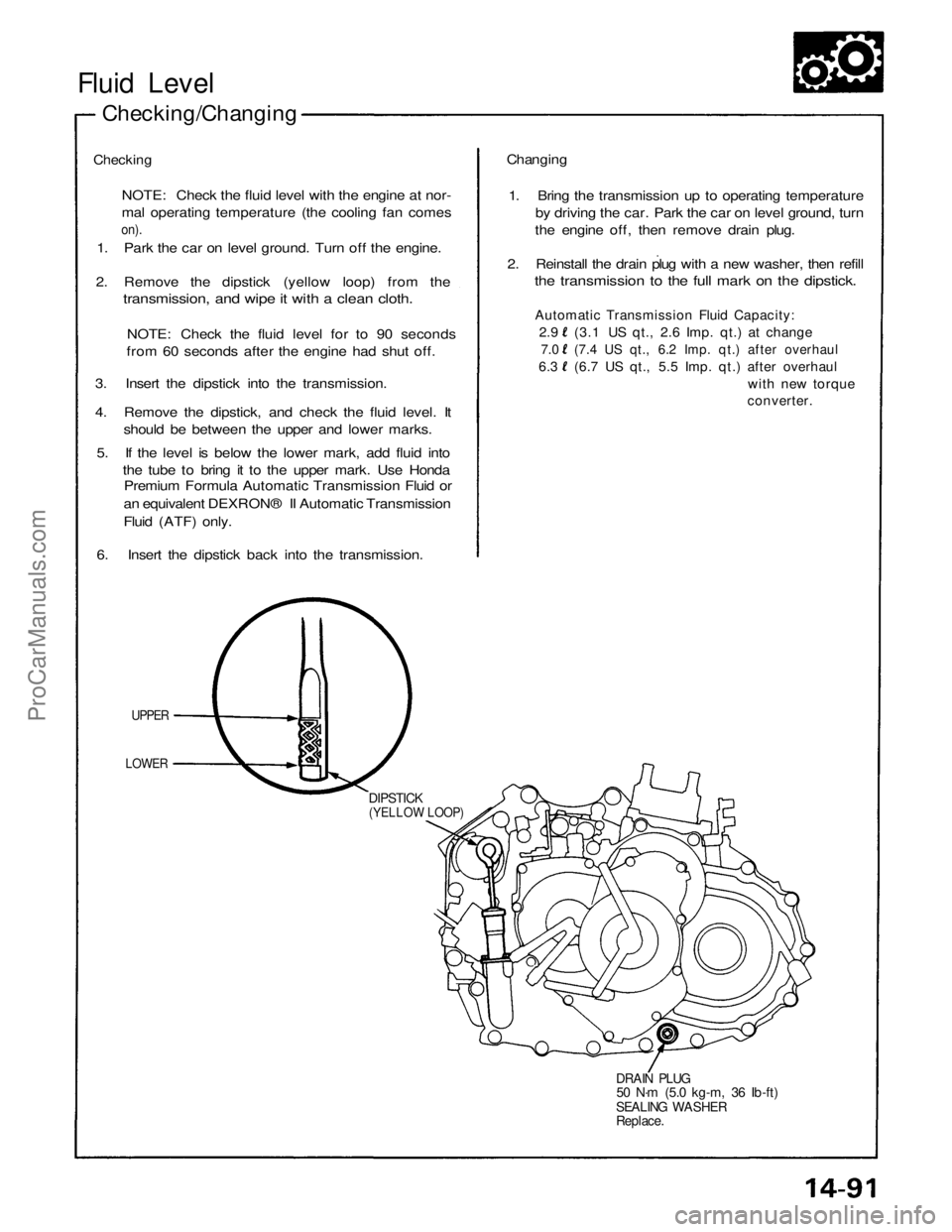
Fluid Level
Checking/Changing
Checking
NOTE: Check the fluid level with the engine at nor-
mal operating temperature (the cooling fan comes
on).
1. Park the car on level ground. Turn off the engine.
2. Remove the dipstick (yellow loop) from the
transmission, and wipe it with a clean cloth.
NOTE: Check the fluid level for to 90 seconds
from 60 seconds after the engine had shut off.
3. Insert the dipstick into the transmission.
4. Remove the dipstick, and check the fluid level. It
should be between the upper and lower marks.
5. If the level is below the lower mark, add fluid into
the tube to bring it to the upper mark. Use Honda
Premium Formula Automatic Transmission Fluid or
an equivalent DEXRON® II Automatic Transmission
Fluid (ATF) only.
6. Insert the dipstick back into the transmission.
UPPER
LOWER
DIPSTICK
(YELLOW LOOP)
DRAIN PLUG
50 N·m (5.0 kg-m, 36 Ib-ft)
SEALING WASHER
Replace.
Changing
1. Bring the transmission up to operating temperature
by driving the car. Park the car on level ground, turn
the engine off, then remove drain plug.
2. Reinstall the drain plug with a new washer, then refill
the transmission to the full mark on the dipstick.
Automatic Transmission Fluid Capacity:
2.9 (3.1 US qt., 2.6 Imp. qt.) at change
7.0 (7.4 US qt., 6.2 Imp. qt.) after overhaul
6.3 (6.7 US qt., 5.5 Imp. qt.) after overhaul
with new torque
converter.ProCarManuals.com
Page 1225 of 1640
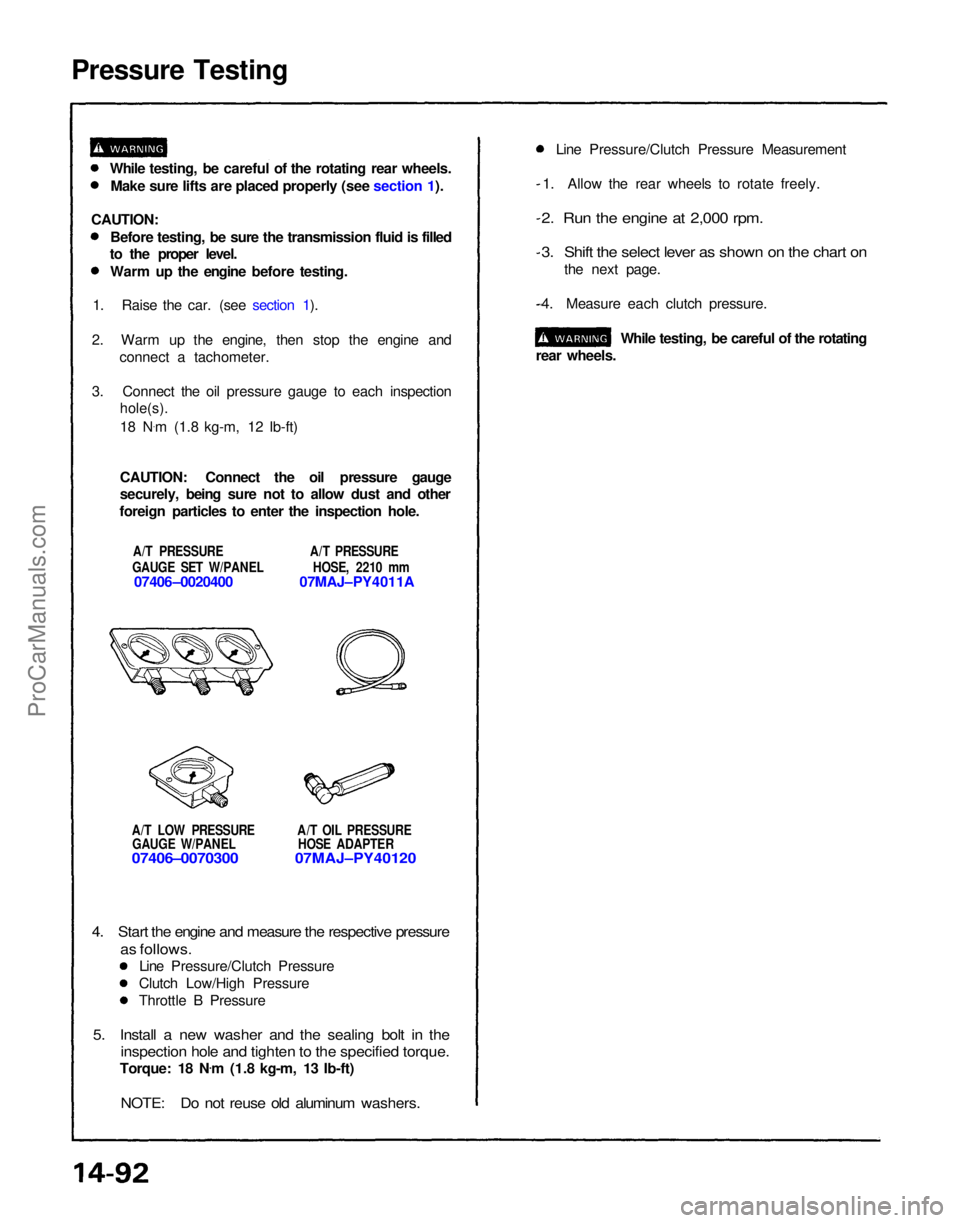
Pressure Testing
A/T LOW PRESSURE A/T OIL PRESSUREGAUGE W/PANEL HOSE ADAPTER
07406–0070300 07MAJ–PY40120
1. Allow the rear wheels to rotate freely.
2. Run the engine at 2,000 rpm.
3. Shift the select lever as shown on the chart on
the next page.
4. Measure each clutch pressure.
While testing, be careful of the rotating
rear wheels.
4. Start the engine and measure the respective pressure
as follows.
Line Pressure/Clutch Pressure
Clutch Low/High Pressure
Throttle B Pressure
5. Install a new washer and the sealing bolt in the
inspection hole and tighten to the specified torque.
Torque: 18 N .
m (1.8 kg-m, 13 Ib-ft)
NOTE: Do not reuse old aluminum washers.
While testing, be careful of the rotating rear wheels.
Make sure lifts are placed properly (see section 1).
CAUTION: Before testing, be sure the transmission fluid is filled
to the proper level.
Warm up the engine before testing.
1. Raise the car. (see section 1).
2. Warm up the engine, then stop the engine and connect a tachometer.
3. Connect the oil pressure gauge to each inspection
hole(s).
18 N .
m (1.8 kg-m, 12 Ib-ft)
CAUTION: Connect the oil pressure gauge
securely, being sure not to allow dust and other
foreign particles to enter the inspection hole.
A/T PRESSURE A/T PRESSURE
GAUGE SET W/PANEL HOSE, 2210 mm
07406–0020400 07MAJ–PY4011A Line Pressure/Clutch Pressure MeasurementProCarManuals.com