engine ACURA NSX 1991 Service Repair Manual
[x] Cancel search | Manufacturer: ACURA, Model Year: 1991, Model line: NSX, Model: ACURA NSX 1991Pages: 1640, PDF Size: 60.48 MB
Page 1227 of 1640
Pressure Testing
(cont'd)
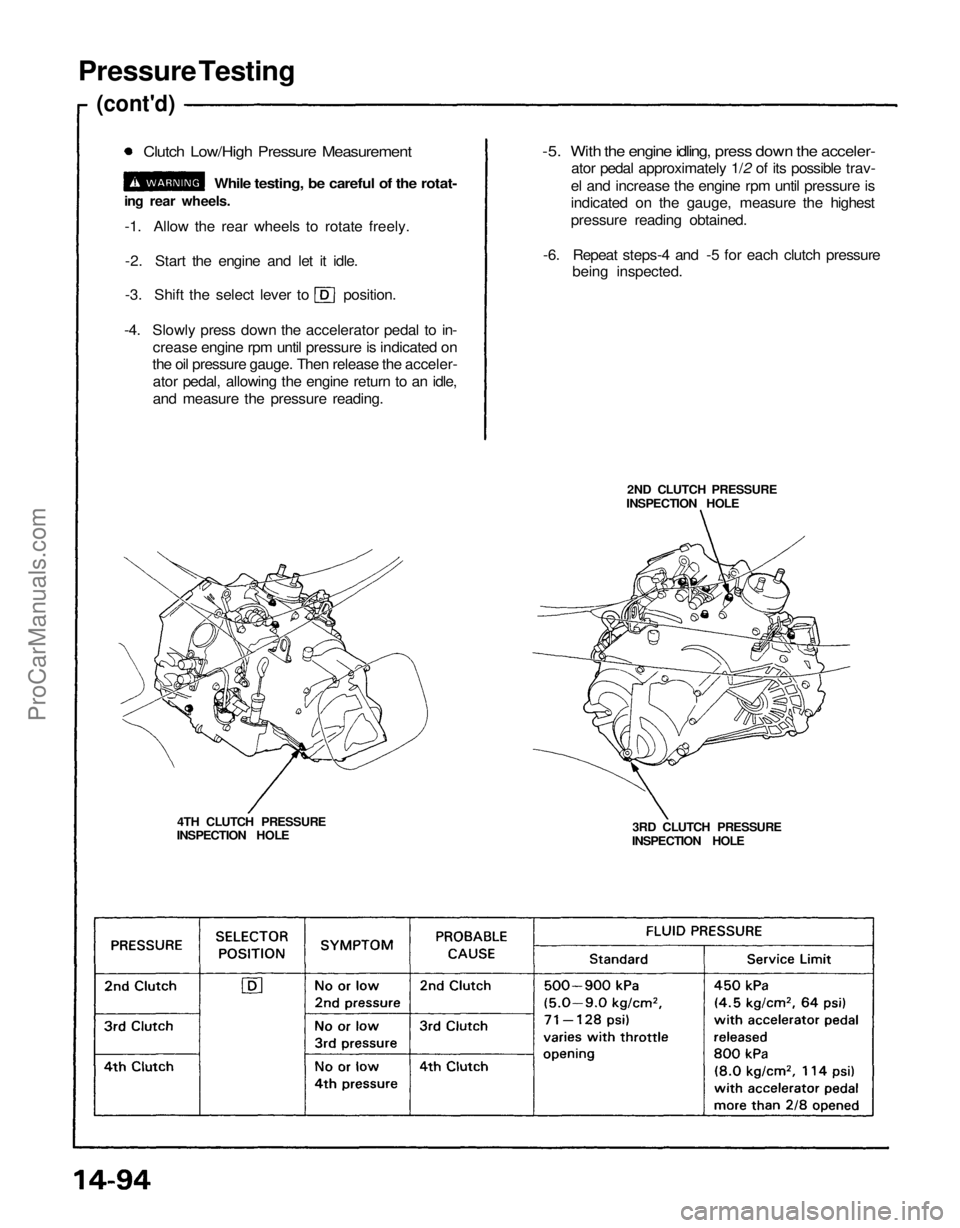
Clutch Low/High Pressure Measurement
While testing, be careful of the rotat-
ing rear wheels.
-1. Allow the rear wheels to rotate freely.
-2. Start the engine and let it idle.
-3. Shift the select lever to position.
-4. Slowly press down the accelerator pedal to in-
crease engine rpm until pressure is indicated on
the oil pressure gauge. Then release the acceler-
ator pedal, allowing the engine return to an idle,
and measure the pressure reading.
-5. With the engine idling, press down the acceler-
ator pedal approximately 1/2 of its possible trav-
el and increase the engine rpm until pressure is
indicated on the gauge, measure the highest
pressure reading obtained.
-6. Repeat steps-4 and -5 for each clutch pressure
being inspected.
2ND CLUTCH PRESSURE
INSPECTION HOLE
3RD CLUTCH PRESSURE
INSPECTION HOLE
4TH CLUTCH PRESSURE
INSPECTION HOLEProCarManuals.com
Page 1228 of 1640
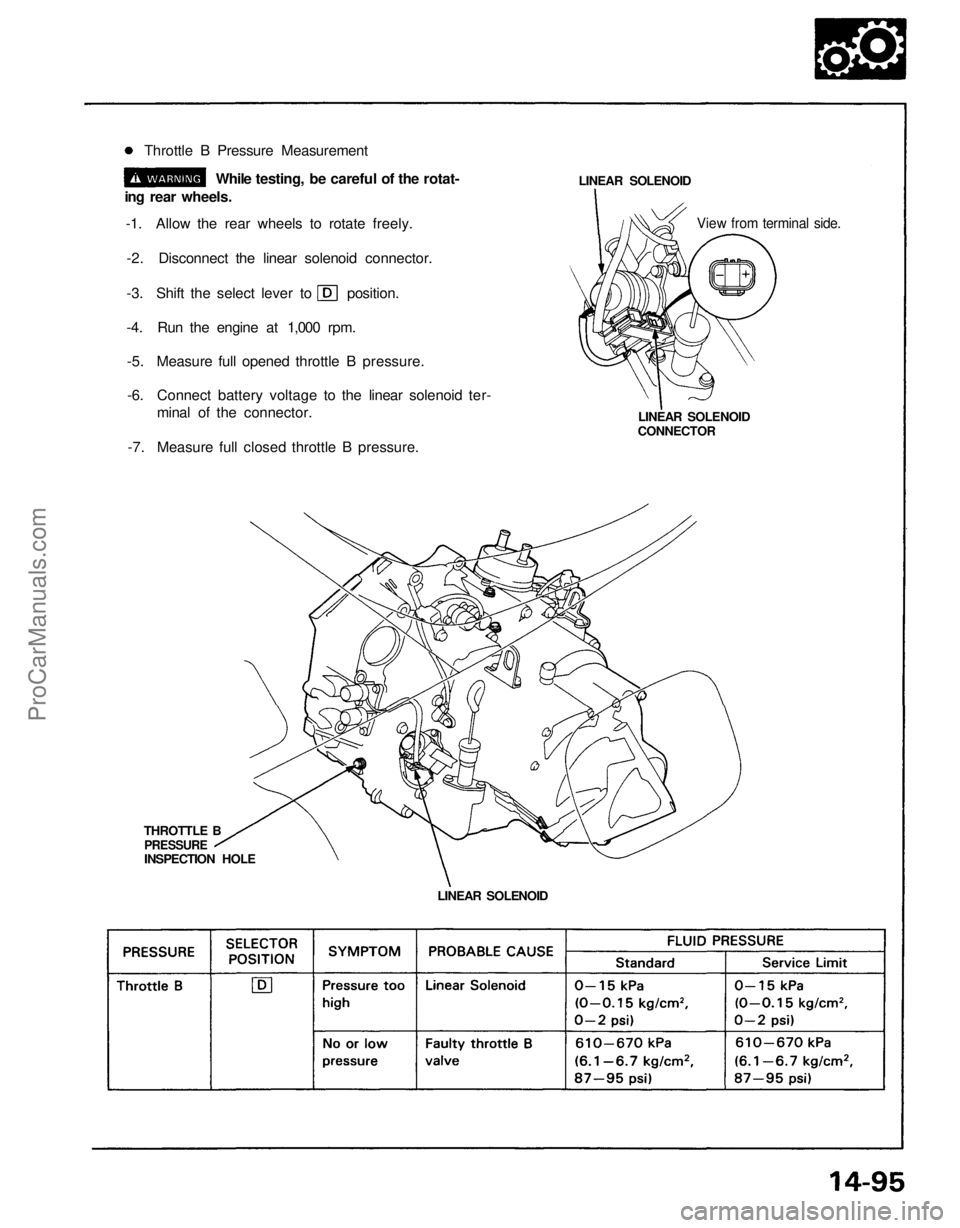
LINEAR SOLENOID
THROTTLE B
INSPECTION HOLE
LINEAR SOLENOID
CONNECTOR
View from terminal side.
LINEAR SOLENOID
Throttle B Pressure Measurement
While testing, be careful of the rotat-
ing rear wheels.
-1. Allow the rear wheels to rotate freely.
-2. Disconnect the linear solenoid connector.
-3. Shift the select lever to position.
-4. Run the engine at 1,000 rpm.
-5. Measure full opened throttle B pressure.
-6. Connect battery voltage to the linear solenoid ter-
minal of the connector.
-7. Measure full closed throttle B pressure.
PRESSUREProCarManuals.com
Page 1231 of 1640
Transmission
Removal (cont'd)
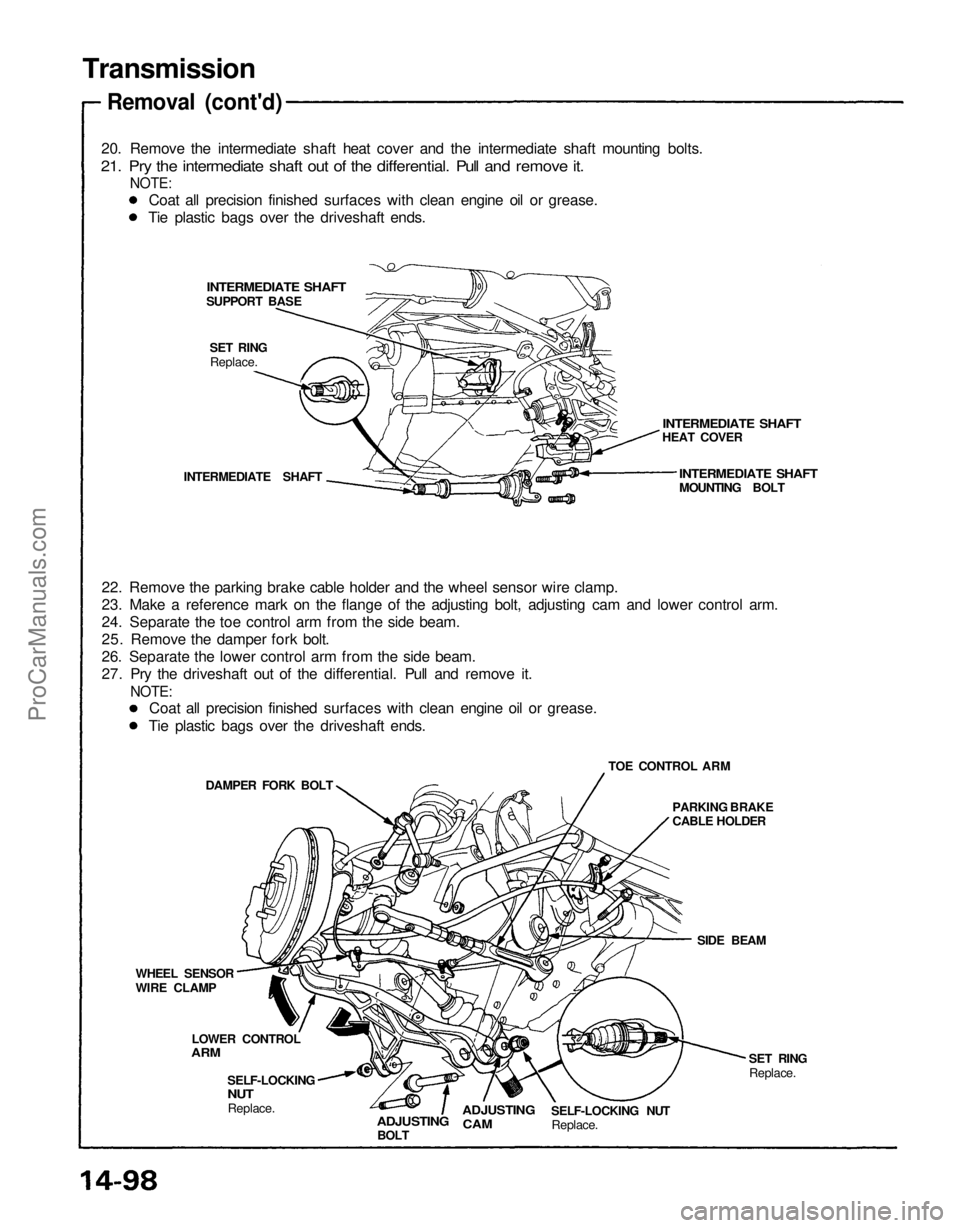
20. Remove the intermediate shaft heat cover and the intermediate shaft mounting bolts.
21. Pry the intermediate shaft out of the differential. Pull and remove it.
NOTE:
INTERMEDIATE SHAFT
INTERMEDIATE SHAFT
HEAT COVER
INTERMEDIATE SHAFT
MOUNTING BOLT
SET RING
Replace.
INTERMEDIATE SHAFT
22. Remove the parking brake cable holder and the wheel sensor wire clamp.
23. Make a reference mark on the flange of the adjusting bolt, adjusting cam and lower control arm.
24. Separate the toe control arm from the side beam.
25. Remove the damper fork bolt.
26. Separate the lower control arm from the side beam.
27. Pry the driveshaft out of the differential. Pull and remove it.
NOTE:
TOE CONTROL ARM
DAMPER FORK BOLT
PARKING BRAKE
CABLE HOLDER
SIDE BEAM
SET RING
Replace.
SELF-LOCKING NUT
Replace.
ADJUSTING
CAM
ADJUSTING
BOLT
SELF-LOCKING
NUT
Replace.
LOWER CONTROL
ARM
WHEEL SENSOR
WIRE CLAMP
SUPPORT BASE
Coat all precision finished surfaces with clean engine oil or grease.
Tie plastic bags over the driveshaft ends.
Coat all precision finished surfaces with clean engine oil or grease.
Tie plastic bags over the driveshaft ends.ProCarManuals.com
Page 1232 of 1640
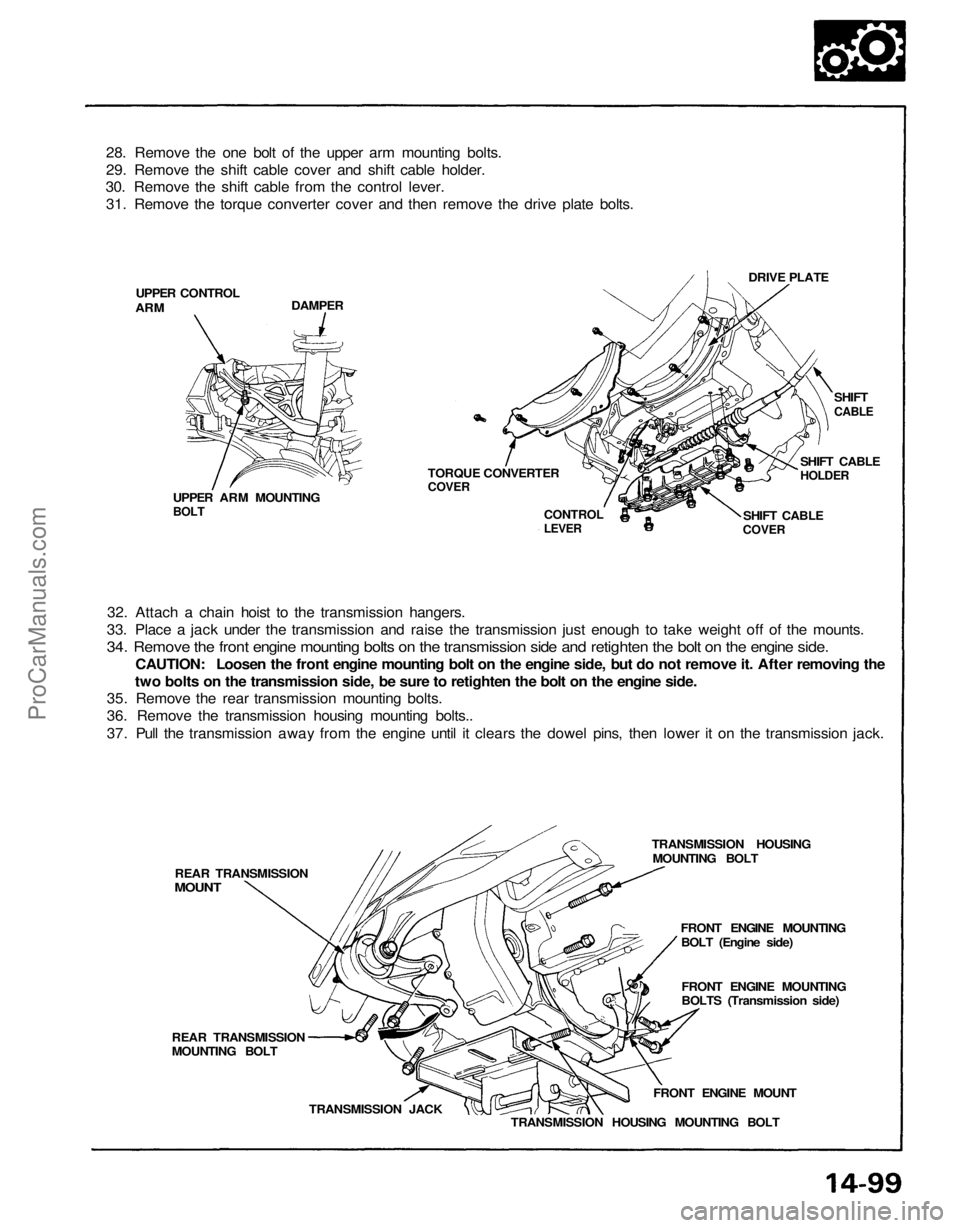
28. Remove the one bolt of the upper arm mounting bolts.
29. Remove the shift cable cover and shift cable holder.
30. Remove the shift cable from the control lever.
31. Remove the torque converter cover and then remove the drive plate bolts.
DRIVE PLATE
DAMPER
UPPER CONTROL
ARM
SHIFT
CABLE
SHIFT CABLE
HOLDER
SHIFT CABLE
COVER
CONTROL
LEVER
TORQUE CONVERTER
COVER
UPPER ARM MOUNTING
BOLT
32. Attach a chain hoist to the transmission hangers.
33. Place a jack under the transmission and raise the transmission just enough to take weight off of the mounts.34. Remove the front engine mounting bolts on the transmission side and retighten the bolt on the engine side.
CAUTION: Loosen the front engine mounting bolt on the engine side, but do not remove it. After removing the
two bolts on the transmission side, be sure to retighten the bolt on the engine side.
35. Remove the rear transmission mounting bolts.
36. Remove the transmission housing mounting bolts..
37. Pull the transmission away from the engine until it clears the dowel pins, then lower it on the transmission jack.
TRANSMISSION HOUSINGMOUNTING BOLT
FRONT ENGINE MOUNTINGBOLT (Engine side)
FRONT ENGINE MOUNTING
BOLTS (Transmission side)
FRONT ENGINE MOUNT
TRANSMISSION HOUSING MOUNTING BOLT
TRANSMISSION JACK
REAR TRANSMISSION
MOUNTING BOLT REAR TRANSMISSION
MOUNTProCarManuals.com
Page 1286 of 1640
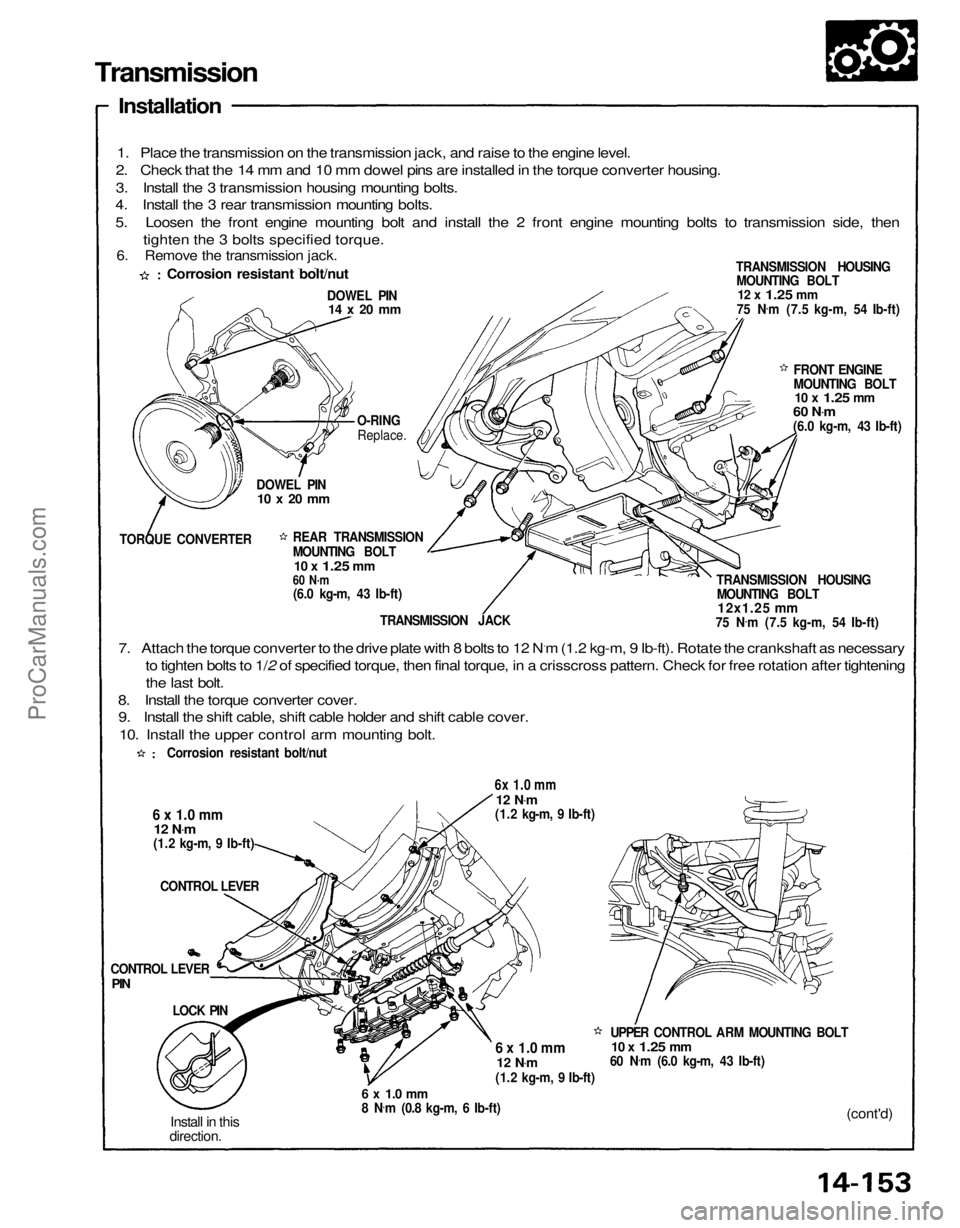
Transmission
Installation
1. Place the transmission on the transmission jack, and raise to the engine level.
2. Check that the 14 mm and 10 mm dowel pins are installed in the torque converter housing.
3. Install the 3 transmission housing mounting bolts.
4. Install the 3 rear transmission mounting bolts.
5. Loosen the front engine mounting bolt and install the 2 front engine mounting bolts to transmission side, then
tighten the 3 bolts specified torque.
TRANSMISSION HOUSINGMOUNTING BOLT
12 x
1.25
mm
75 N .
m (7.5 kg-m, 54 Ib-ft)
DOWEL PIN
14 x 20 mm
FRONT ENGINE
MOUNTING BOLT
10 x
1.25
mm
60 N .
m
(6.0 kg-m, 43 Ib-ft)
TRANSMISSION HOUSING MOUNTING BOLT
12x1.25 mm
75 N .
m (7.5 kg-m, 54 Ib-ft)
O-RING
Replace.
DOWEL PIN
10 x 20 mm
TORQUE CONVERTER REAR TRANSMISSION
MOUNTING BOLT
10 x
1.25
mm
60 N·m
(6.0 kg-m, 43 Ib-ft)
TRANSMISSION JACK
7. Attach the torque converter to the drive plate with 8 bolts to 12 N.m (1.2 kg-m, 9 Ib-ft). Rotate the crankshaft as necessary to tighten bolts to 1/2 of specified torque, then final torque, in a crisscross pattern. Check for free rotation after tighteningthe last bolt.
8. Install the torque converter cover. 9. Install the shift cable, shift cable holder and shift cable cover.
10. Install the upper control arm mounting bolt.
6x 1.0 mm
12 N
.
m
(1.2 kg-m, 9 Ib-ft)
6 x 1.0 mm
12 N
.
m
(1.2 kg-m, 9 Ib-ft)
CONTROL LEVER
UPPER CONTROL ARM MOUNTING BOLT
10 x
1.25
mm
60 N .
m (6.0 kg-m, 43 Ib-ft)
6 x 1.0 mm
12 N
.
m
(1.2 kg-m, 9 Ib-ft)
(cont'd)
6 x 1.0 mm
8 N
.
m (0.8 kg-m, 6 Ib-ft)
Install in this
direction.
LOCK PIN
CONTROL LEVER
PIN
Corrosion resistant bolt/nut
Corrosion resistant bolt/nut
6. Remove the transmission jack.ProCarManuals.com
Page 1289 of 1640
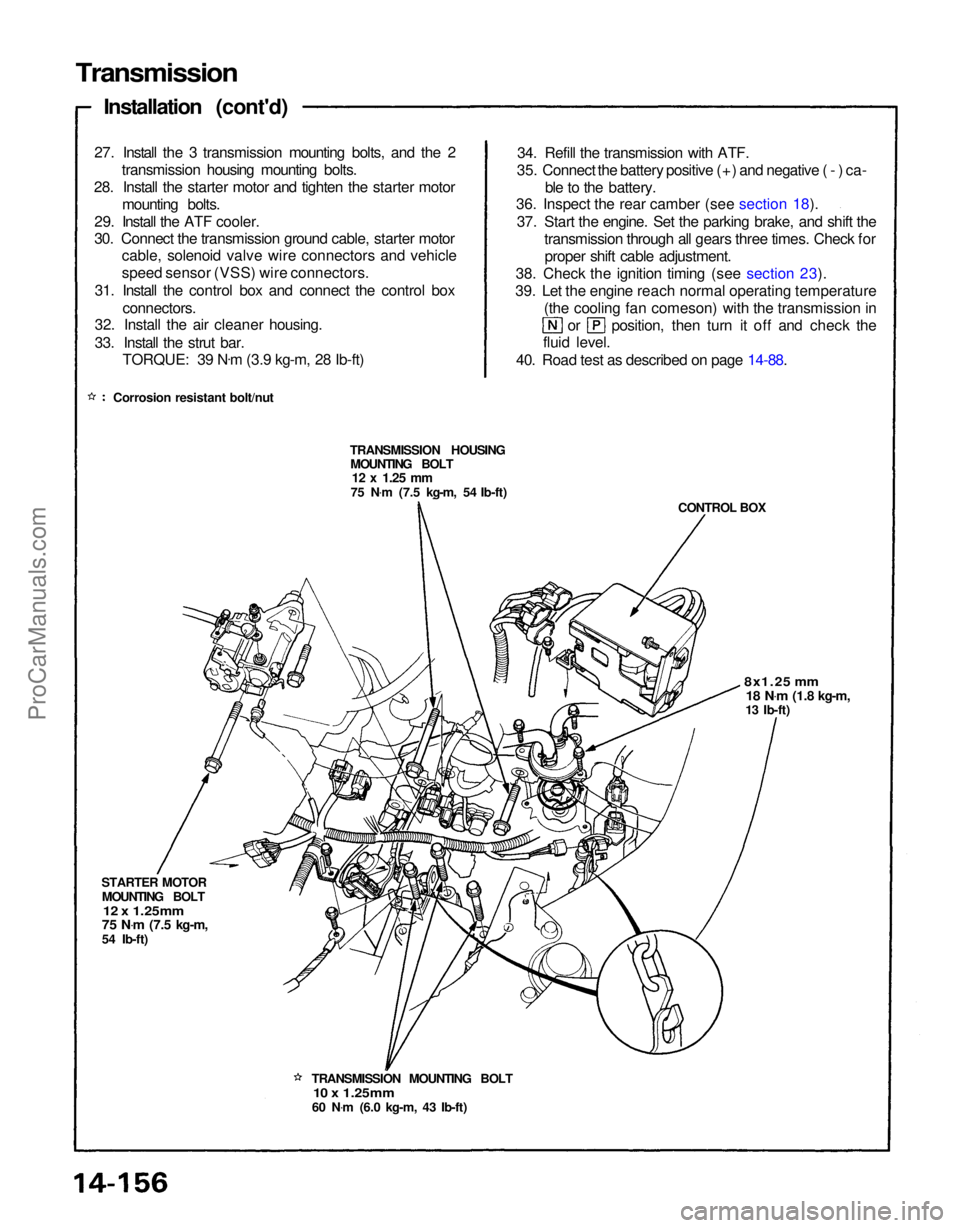
Transmission
Installation (cont'd)
27. Install the 3 transmission mounting bolts, and the 2 transmission housing mounting bolts.
28. Install the starter motor and tighten the starter motor mounting bolts.
29. Install the ATF cooler.
30. Connect the transmission ground cable, starter motor cable, solenoid valve wire connectors and vehicle
speed sensor (VSS) wire connectors.
31. Install the control box and connect the control box connectors.
32. Install the air cleaner housing.
33. Install the strut bar.
TORQUE: 39 N .
m (3.9 kg-m, 28 Ib-ft)
Corrosion resistant bolt/nut 34. Refill the transmission with ATF.
35. Connect the battery positive (+) and negative (-) ca- ble to the battery.
36. Inspect the rear camber (see section 18).
37. Start the engine. Set the parking brake, and shift the transmission through all gears three times. Check forproper shift cable adjustment.
38. Check the ignition timing (see section 23).
39. Let the engine reach normal operating temperature (the cooling fan comeson) with the transmission in or position, then turn it off and check the
fluid level.
40. Road test as described on page 14-88.
TRANSMISSION HOUSING MOUNTING BOLT
12 x
1.25
mm
75 N .
m (7.5 kg-m, 54 Ib-ft)
CONTROL BOX
8x1.25 mm
18 N .
m
(1.8 kg-m,
13 Ib-ft)
TRANSMISSION MOUNTING BOLT
10 x 1.25mm
60 N .
m (6.0 kg-m, 43 Ib-ft)
STARTER MOTOR
MOUNTING BOLT
12 x 1.25mm
75 N .
m
(7.5 kg-m,
54 Ib-ft)ProCarManuals.com
Page 1290 of 1640
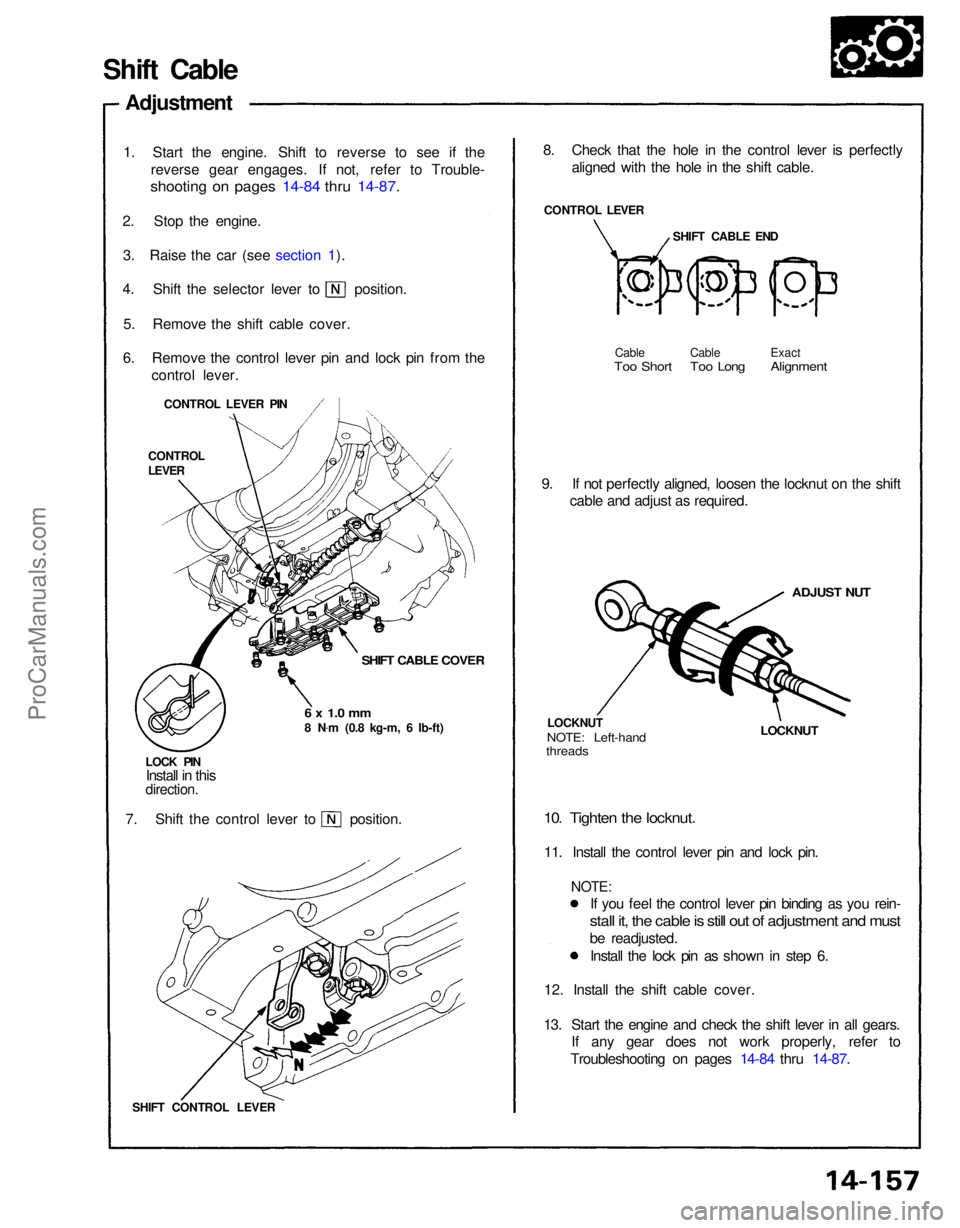
Shift Cable
Adjustment
1. Start the engine. Shift to reverse to see if the reverse gear engages. If not, refer to Trouble-
shooting on pages 14-84 thru 14-87.
2. Stop the engine. 3. Raise the car (see section 1). 4. Shift the selector lever to position.
5. Remove the shift cable cover.
6. Remove the control lever pin and lock pin from the control lever.
CONTROL LEVER PIN
CONTROL
LEVER
SHIFT CABLE COVER
6 x 1.0 mm
8 N .
m (0.8 kg-m, 6 Ib-ft)
LOCK PIN Install in this
direction.
7. Shift the control lever to position.
SHIFT CONTROL LEVER 12. Install the shift cable cover.
13. Start the engine and check the shift lever in all gears. If any gear does not work properly, refer to
Troubleshooting on pages 14-84 thru 14-87. If you feel the control lever pin binding as you rein-
stall it, the cable is still out of adjustment and must
be readjusted.
Install the lock pin as shown in step 6.
10. Tighten the locknut.
11. Install the control lever pin and lock pin.
NOTE:
LOCKNUT
LOCKNUT
NOTE: Left-hand
threads
ADJUST NUT
9. If not perfectly aligned, loosen the locknut on the shift
cable and adjust as required. Cable Cable Exact
Too Short Too Long Alignment
SHIFT CABLE END
CONTROL LEVER
8. Check that the hole in the control lever is perfectly
aligned with the hole in the shift cable.ProCarManuals.com
Page 1298 of 1640
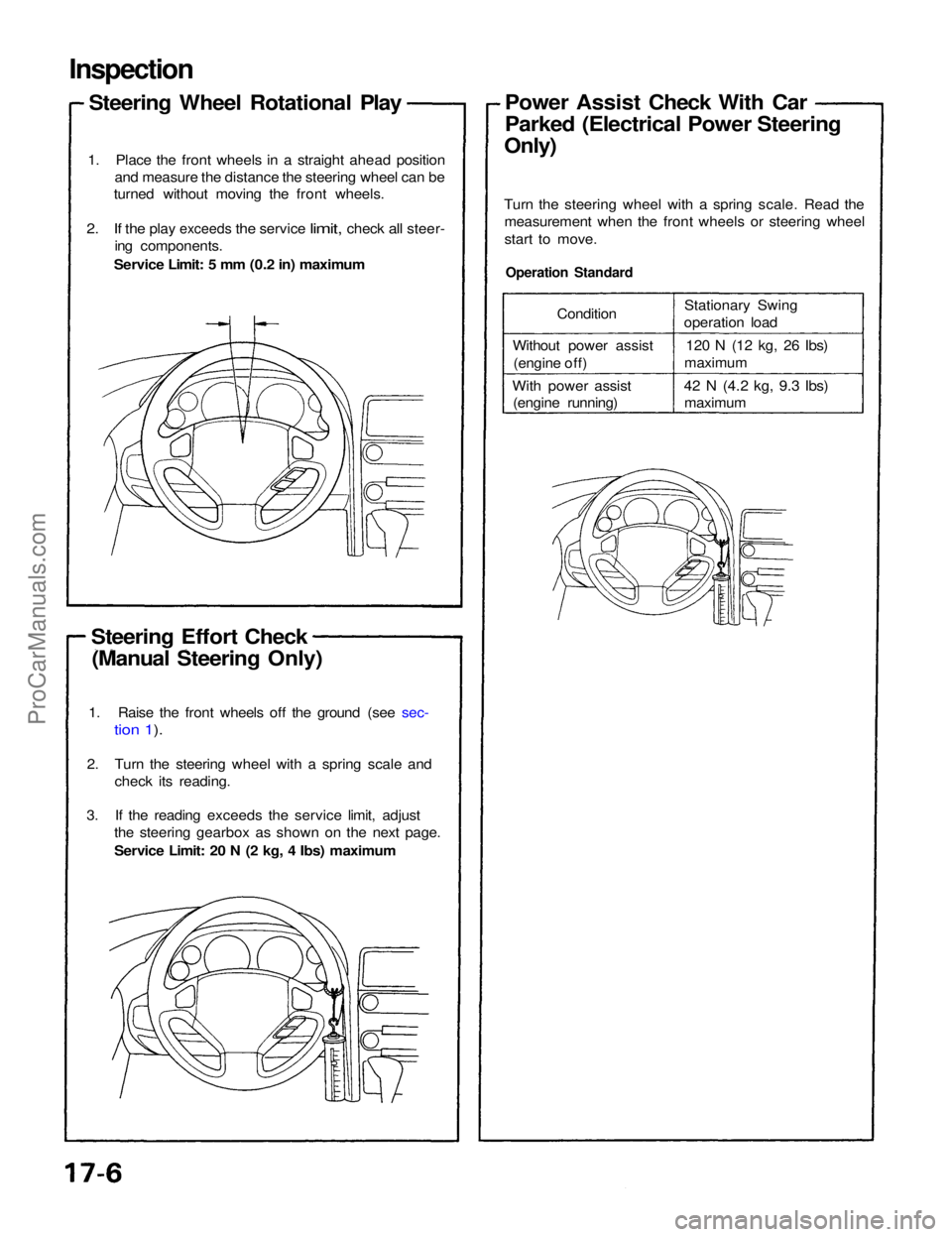
Inspection
Steering Wheel Rotational Play
1. Place the front wheels in a straight ahead position and measure the distance the steering wheel can be
turned without moving the front wheels.
2. If the
play
exceeds
the
service
limit,
check
all
steer- ing components.
Service Limit: 5 mm (0.2 in) maximum
Steering Effort Check (Manual Steering Only)
Operation Standard
Turn the steering wheel with a spring scale. Read the
measurement when the front wheels or steering wheel
start to move.Power Assist Check With Car
Parked (Electrical Power Steering
Only)
1. Raise the front wheels off the ground (see sec-
tion 1).
2. Turn the steering wheel with a spring scale and check its reading.
3. If the reading exceeds the service limit, adjust the steering gearbox as shown on the next page.
Service Limit: 20 N (2 kg, 4 Ibs) maximum Condition
Without power assist (engine off)
With power assist (engine running) Stationary Swing
operation load
120 N (12 kg, 26
Ibs)
maximum
42 N
(4.2
kg, 9.3
Ibs) maximumProCarManuals.com
Page 1324 of 1640
System Description
Electrical Power Steering (EPS)
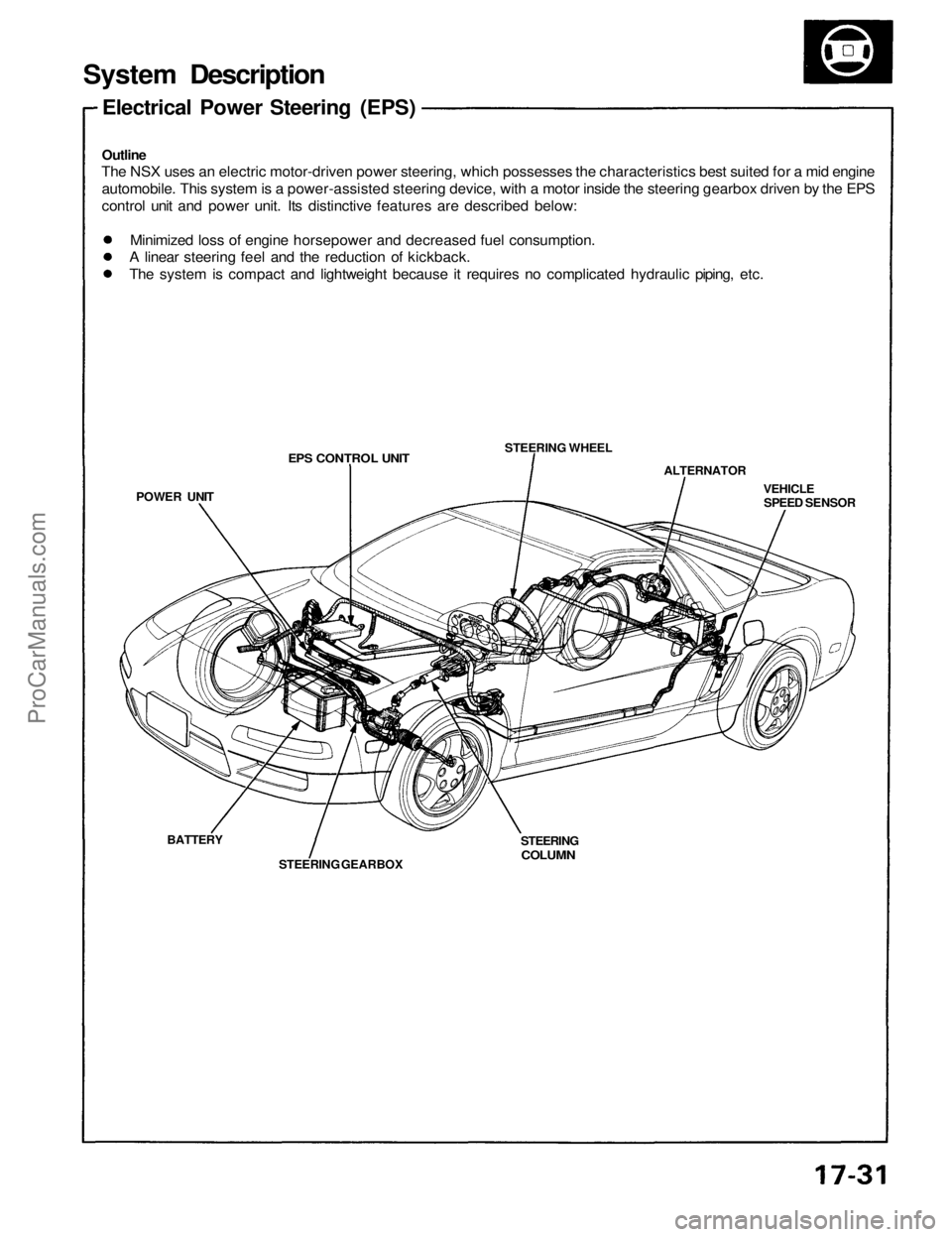
Outline
The NSX uses an electric motor-driven power steering, which possesses the characteristics best suited for a mid engine
automobile. This system is a power-assisted steering device, with a motor inside the steering gearbox driven by the EPS
control unit and power unit. Its distinctive features are described below:
ALTERNATOR
VEHICLE
SPEED SENSOR
STEERING WHEEL
EPS CONTROL UNIT
POWER UNIT
BATTERY
STEERING GEARBOX
STEERING
COLUMN
Minimized loss of engine horsepower and decreased fuel consumption.
A linear steering feel and the reduction of kickback.
The system is compact and lightweight because it requires no complicated hydraulic piping, etc.ProCarManuals.com
Page 1329 of 1640
System Description
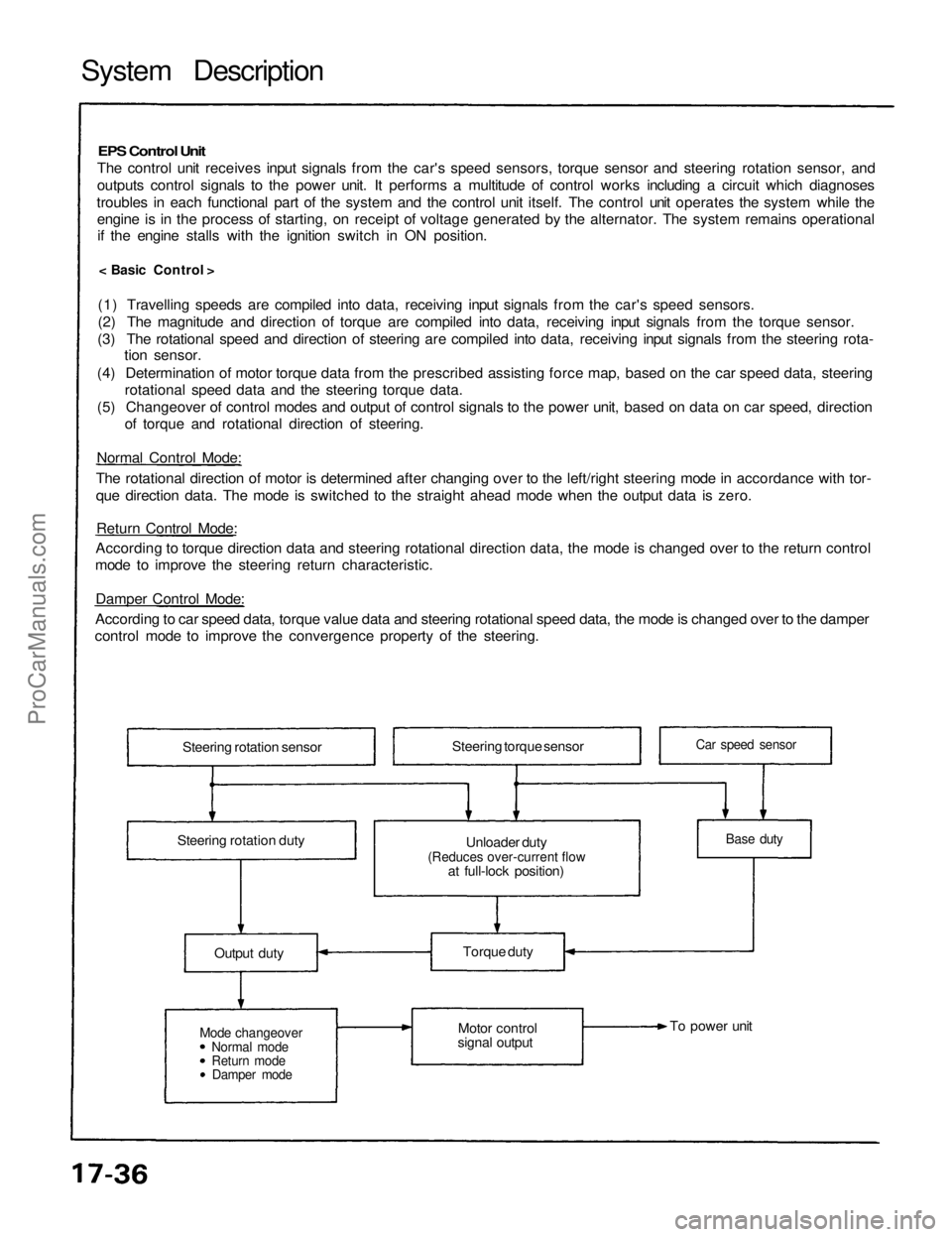
EPS Control Unit
The control unit receives input signals from the car's speed sensors, torque sensor and steering rotation sensor, and
outputs control signals to the power unit. It performs a multitude of control works including a circuit which diagnoses
troubles in each functional part of the system and the control unit itself. The control unit operates the system while the engine is in the process of starting, on receipt of voltage generated by the alternator. The system remains operationalif the engine stalls with the ignition switch in ON position.
< Basic Control >
(1) Travelling speeds are compiled into data, receiving input signals from the car's speed sensors.
(2) The magnitude and direction of torque are compiled into data, receiving input signals from the torque sensor.
(3) The rotational speed and direction of steering are compiled into data, receiving input signals from the steering rota- tion sensor.
(4) Determination of motor torque data from the prescribed assisting force map, based on the car speed data, steering rotational speed data and the steering torque data.
(5) Changeover of control modes and output of control signals to the power unit, based on data on car speed, direction of torque and rotational direction of steering.
Normal Control Mode:
The rotational direction of motor is determined after changing over to the left/right steering mode in accordance with tor-
que direction data. The mode is switched to the straight ahead mode when the output data is zero.
Return Control Mode:
According to torque direction data and steering rotational direction data, the mode is changed over to the return control
mode to improve the steering return characteristic.
Damper Control Mode:
According to car speed data, torque value data and steering rotational speed data, the mode is changed over to the damper
control mode to improve the convergence property of the steering.
Steering rotation sensor
Steering rotation duty Steering torque sensor
Unloader duty
(Reduces over-current flow
at full-lock position)
Output duty
Mode changeover
Normal mode
Return mode
Damper mode
Torque duty
Motor control
signal output To power unit
Base duty
Car speed sensorProCarManuals.com