engine ACURA NSX 1991 Service Repair Manual
[x] Cancel search | Manufacturer: ACURA, Model Year: 1991, Model line: NSX, Model: ACURA NSX 1991Pages: 1640, PDF Size: 60.48 MB
Page 1170 of 1640
Description
Clutches (cont'd)
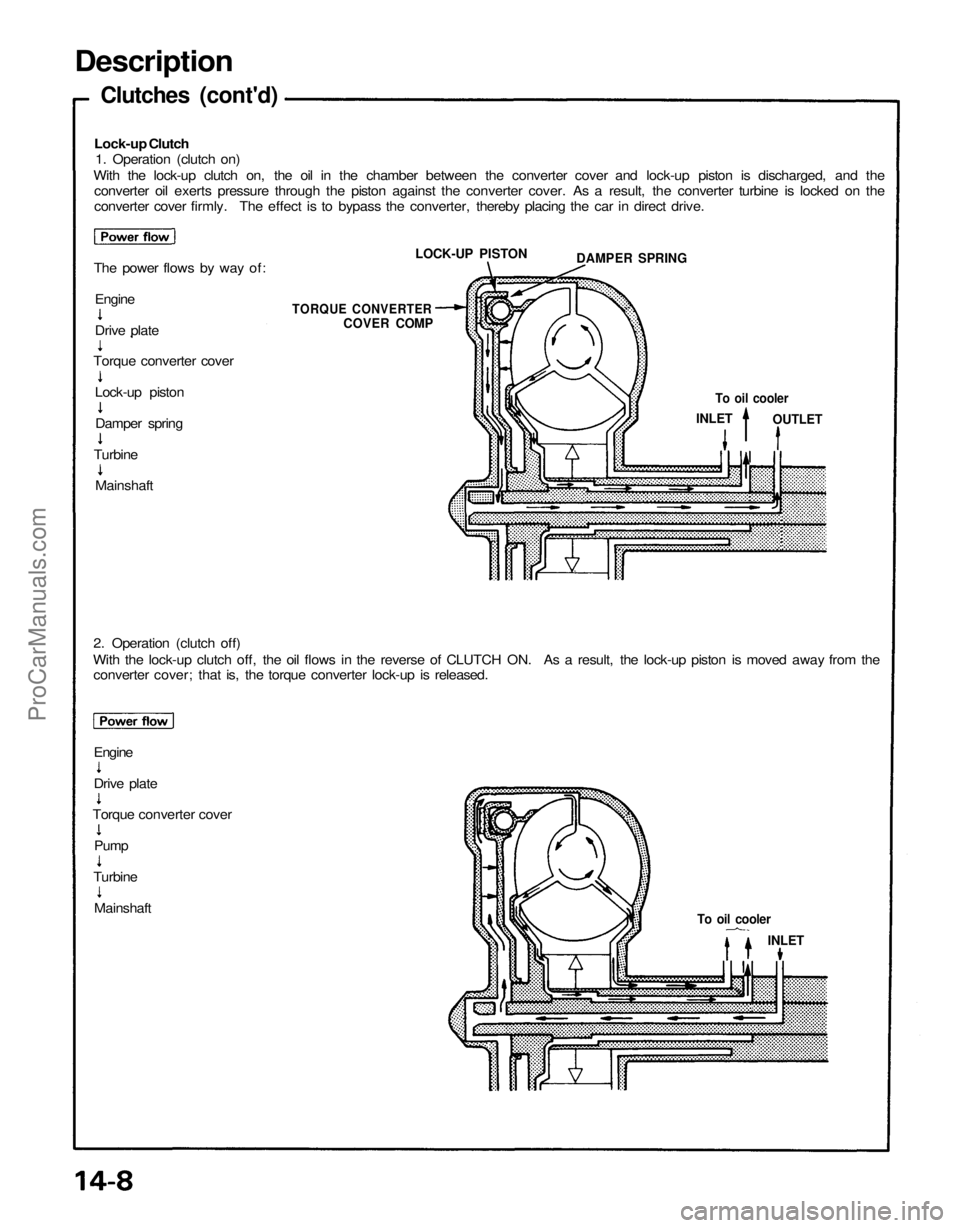
Lock-up Clutch
1. Operation (clutch on)
With the lock-up clutch on, the oil in the chamber between the converter cover and lock-up piston is discharged, and the
converter oil exerts pressure through the piston against the converter cover. As a result, the converter turbine is locked on the
converter cover firmly. The effect is to bypass the converter, thereby placing the car in direct drive.
The power flows by way of:
2. Operation (clutch off)
With the lock-up clutch off, the oil flows in the reverse of CLUTCH ON. As a result, the lock-up piston is moved away from the
converter cover; that is, the torque converter lock-up is released.
Engine
To oil cooler
INLET
To oil cooler
INLET
OUTLET
TORQUE CONVERTER
COVER COMP
LOCK-UP PISTON
DAMPER SPRING
Engine
Drive plate
Torque converter cover
Lock-up piston
Damper spring
Turbine
Mainshaft
Drive plate
Torque converter cover
Pump
Turbine
MainshaftProCarManuals.com
Page 1172 of 1640
Description
Power Flow (cont'd)
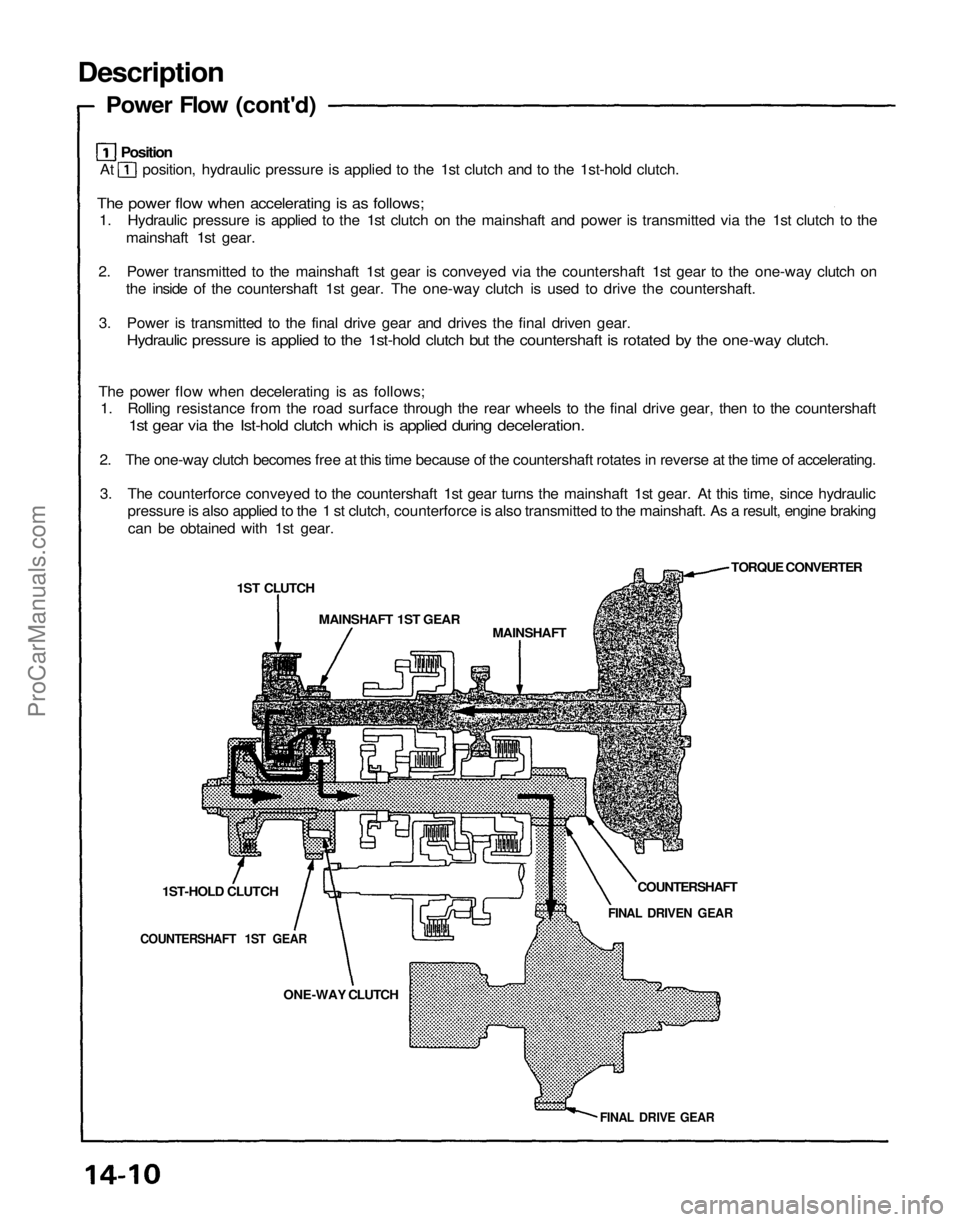
Position
At position, hydraulic pressure is applied to the 1st clutch and to the 1st-hold clutch.
The power flow when accelerating is as follows;
1. Hydraulic pressure is applied to the 1st clutch on the mainshaft and power is transmitted via the 1st clutch to the
mainshaft 1st gear.
2. Power transmitted to the mainshaft 1st gear is conveyed via the countershaft 1st gear to the one-way clutch on
the inside of the countershaft 1st gear. The one-way clutch is used to drive the countershaft.
3. Power is transmitted to the final drive gear and drives the final driven gear.
Hydraulic pressure is applied to the 1st-hold clutch but the countershaft is rotated by the one-way clutch.
The power flow when decelerating is as follows;
1. Rolling resistance from the road surface through the rear wheels to the final drive gear, then to the countershaft
1st gear via the Ist-hold clutch which is applied during deceleration.
2. The one-way clutch becomes free at this time because of the countershaft rotates in reverse at the time of accelerating.
3. The counterforce conveyed to the countershaft 1st gear turns the mainshaft 1st gear. At this time, since hydraulic
pressure is also applied to the 1 st clutch, counterforce is also transmitted to the mainshaft. As a result, engine braking
can be obtained with 1st gear.
1ST CLUTCH
MAINSHAFT 1ST GEAR
MAINSHAFT
TORQUE CONVERTER
COUNTERSHAFT
FINAL DRIVEN GEAR
1ST-HOLD CLUTCH
COUNTERSHAFT 1ST GEAR
ONE-WAY CLUTCH
FINAL DRIVE GEARProCarManuals.com
Page 1175 of 1640
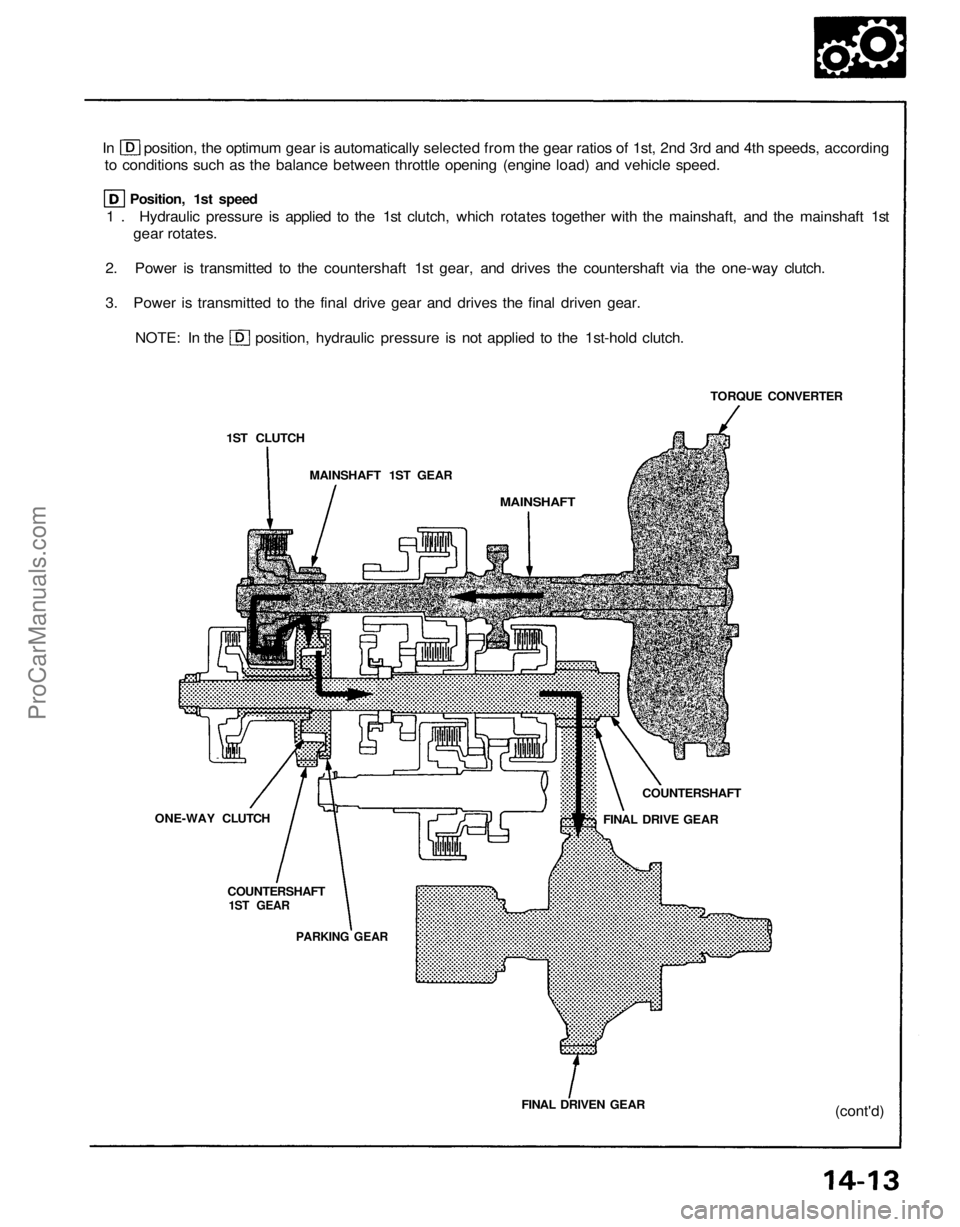
In position, the optimum gear is automatically selected from the gear ratios of 1st, 2nd 3rd and 4th speeds, according
to conditions such as the balance between throttle opening (engine load) and vehicle speed.
1ST CLUTCHMAINSHAFT 1ST GEAR
MAINSHAFT
TORQUE CONVERTER
COUNTERSHAFT
FINAL DRIVE GEAR
(cont'd)
FINAL DRIVEN GEAR
PARKING GEAR
COUNTERSHAFT
1ST GEAR
ONE-WAY CLUTCH
Position, 1st speed
1 . Hydraulic pressure is applied to the 1st clutch, which rotates together with the mainshaft, and the mainshaft 1st gear rotates.
2. Power is transmitted to the countershaft 1st gear, and drives the countershaft via the one-way clutch.
3. Power is transmitted to the final drive gear and drives the final driven gear. NOTE: In the position, hydraulic pressure is not applied to the 1st-hold clutch.ProCarManuals.com
Page 1177 of 1640
Electronic Control System
Electronic Control System
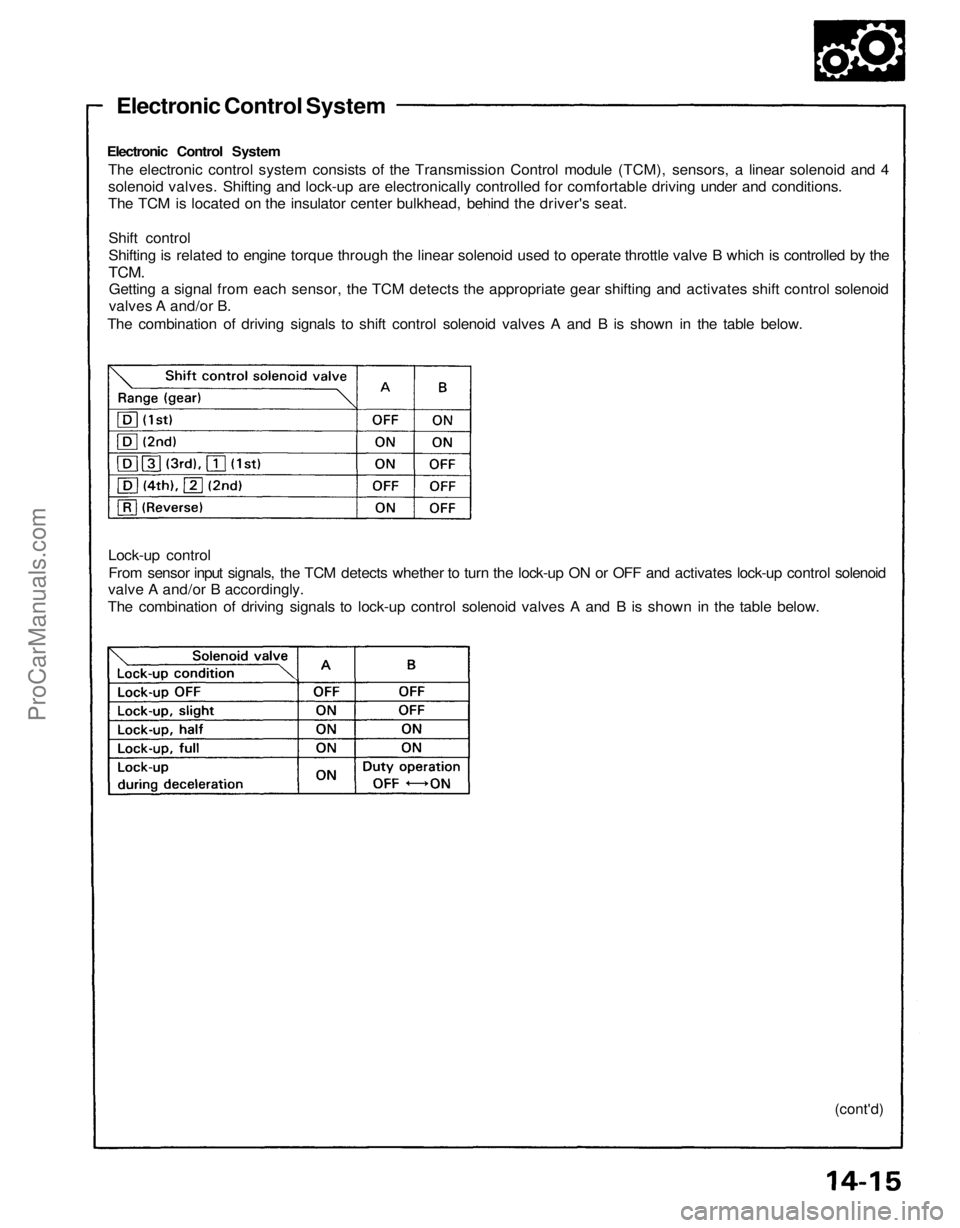
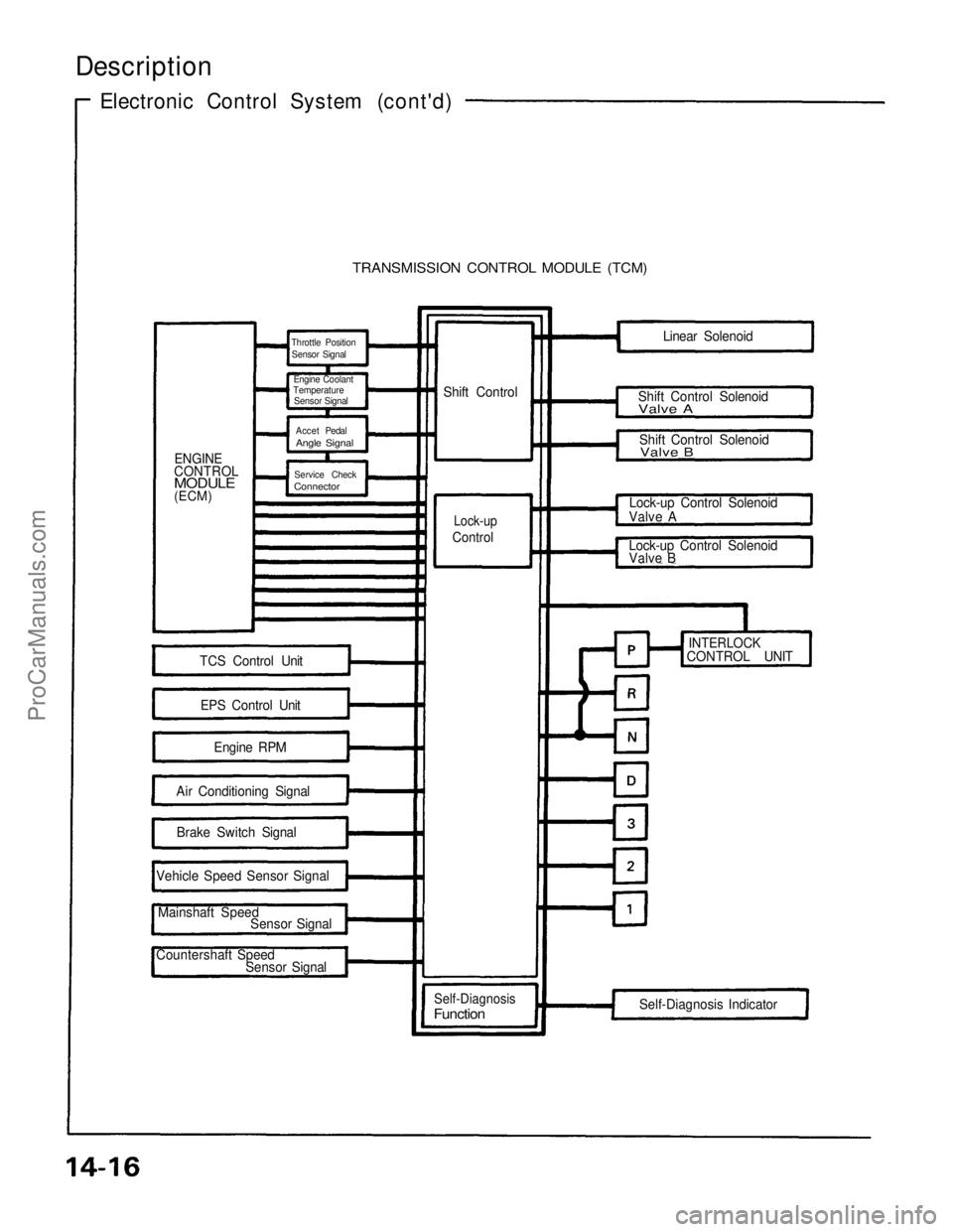
The electronic control system consists of the Transmission Control module (TCM), sensors, a linear solenoid and 4
solenoid valves. Shifting and lock-up are electronically controlled for comfortable driving under and conditions.
The TCM is located on the insulator center bulkhead, behind the driver's seat.
Shift control
Shifting is related to engine torque through the linear solenoid used to operate throttle valve B which is controlled by the
TCM.
Getting a signal from each sensor, the TCM detects the appropriate gear shifting and activates shift control solenoid
valves A and/or B.
The combination of driving signals to shift control solenoid valves A and B is shown in the table below.
Lock-up control
From sensor input signals, the TCM detects whether to turn the lock-up ON or OFF and activates lock-up control solenoid
valve A and/or B accordingly.
The combination of driving signals to lock-up control solenoid valves A and B is shown in the table below.
(cont'd)ProCarManuals.com
Page 1178 of 1640
Description
Electronic Control System (cont'd)
TRANSMISSION CONTROL MODULE (TCM)
ENGINE
CONTROL
MODULE
(ECM) Shift Control
Lock-up
Control
TCS Control Unit
EPS Control Unit Engine RPM
Air Conditioning Signal Brake Switch Signal
Vehicle Speed Sensor Signal
Mainshaft Speed Sensor Signal
Countershaft Speed Sensor Signal
Self-Diagnosis
Function
Self-Diagnosis Indicator
INTERLOCK
CONTROL UNIT
Lock-up Control Solenoid
Valve B
Lock-up Control Solenoid
Valve A Shift Control Solenoid
Valve B
Shift Control Solenoid
Valve A
Linear Solenoid
Throttle Position
Sensor Signal
Engine Coolant
Temperature
Sensor Signal
Accet Pedal
Angle Signal
Service Check
Connector
ProCarManuals.com
Page 1179 of 1640
Description
Hydraulic Control
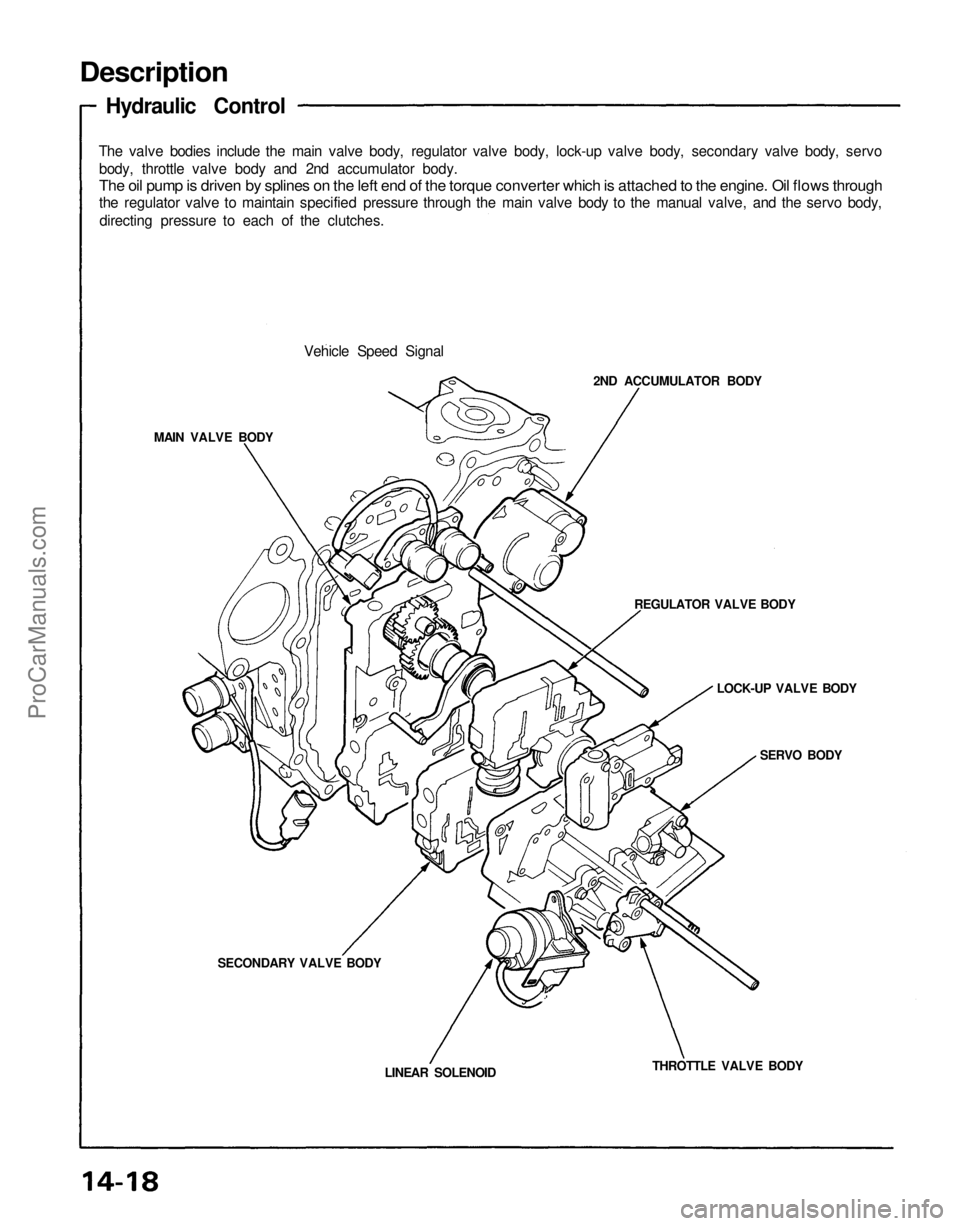
The valve bodies include the main valve body, regulator valve body, lock-up valve body, secondary valve body, servo
body, throttle valve body and 2nd accumulator body.
The oil pump is driven by splines on the left end of the torque converter which is attached to the engine. Oil flows through
the regulator valve to maintain specified pressure through the main valve body to the manual valve, and the servo body,
directing pressure to each of the clutches.
Vehicle Speed Signal
2ND ACCUMULATOR BODY
REGULATOR VALVE BODY
LOCK-UP VALVE BODY
SERVO BODY
THROTTLE VALVE BODY
LINEAR SOLENOID
SECONDARY VALVE BODY
MAIN VALVE BODYProCarManuals.com
Page 1182 of 1640
Regulator Valve
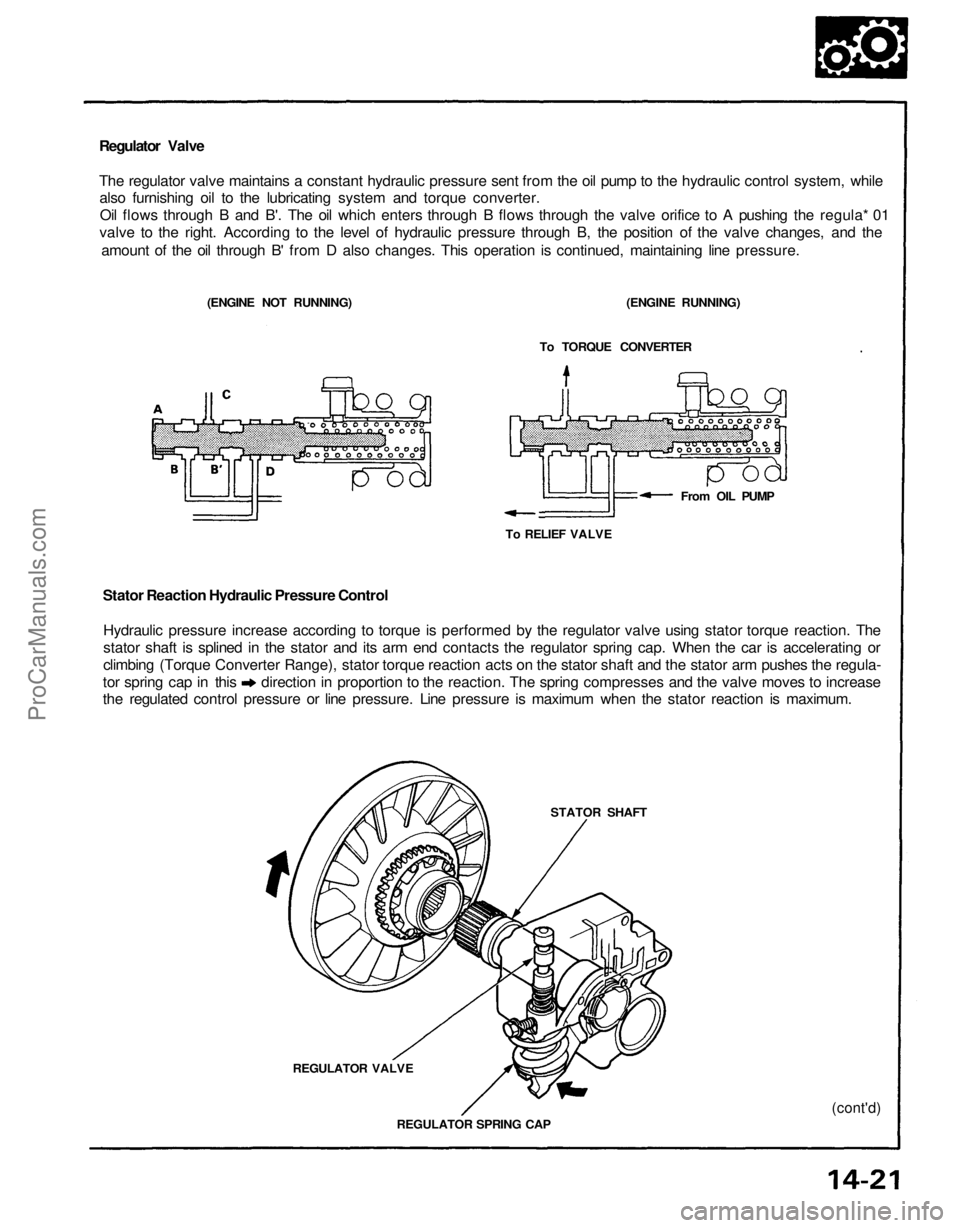
The regulator valve maintains a constant hydraulic pressure sent from the oil pump to the hydraulic control system, while
also furnishing oil to the lubricating system and torque converter.
Oil flows through B and B'. The oil which enters through B flows through the valve orifice to A pushing the regula* 01
valve to the right. According to the level of hydraulic pressure through B, the position of the valve changes, and the
amount of the oil through B' from D also changes. This operation is continued, maintaining line pressure.
(ENGINE NOT RUNNING) (ENGINE RUNNING)
To TORQUE CONVERTER
Stator Reaction Hydraulic Pressure Control
Hydraulic pressure increase according to torque is performed by the regulator valve using stator torque reaction. The
stator shaft is splined in the stator and its arm end contacts the regulator spring cap. When the car is accelerating or
climbing (Torque Converter Range), stator torque reaction acts on the stator shaft and the stator arm pushes the regula-
tor spring cap in this direction in proportion to the reaction. The spring compresses and the valve moves to increase
the regulated control pressure or line pressure. Line pressure is maximum when the stator reaction is maximum.
To RELIEF VALVE
From OIL PUMP
STATOR SHAFT
(cont'd)
REGULATOR SPRING CAP
REGULATOR VALVEProCarManuals.com
Page 1184 of 1640
Oil Pump
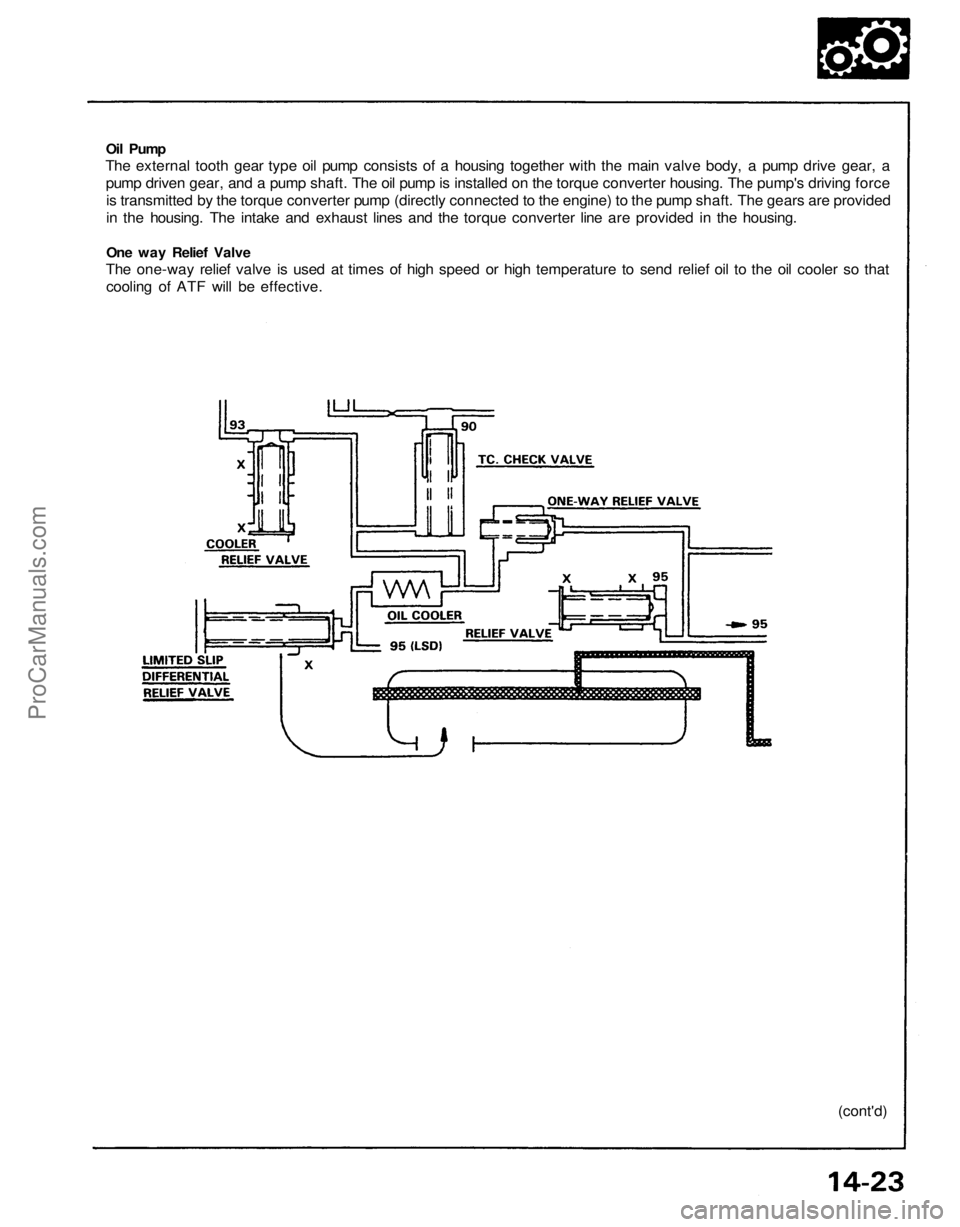
The external tooth gear type oil pump consists of a housing together with the main valve body, a pump drive gear, a
pump driven gear, and a pump shaft. The oil pump is installed on the torque converter housing. The pump's driving force
is transmitted by the torque converter pump (directly connected to the engine) to the pump shaft. The gears are provided
in the housing. The intake and exhaust lines and the torque converter line are provided in the housing.
One way Relief Valve
The one-way relief valve is used at times of high speed or high temperature to send relief oil to the oil cooler so that
cooling of ATF will be effective.
(cont'd)ProCarManuals.com
Page 1190 of 1640
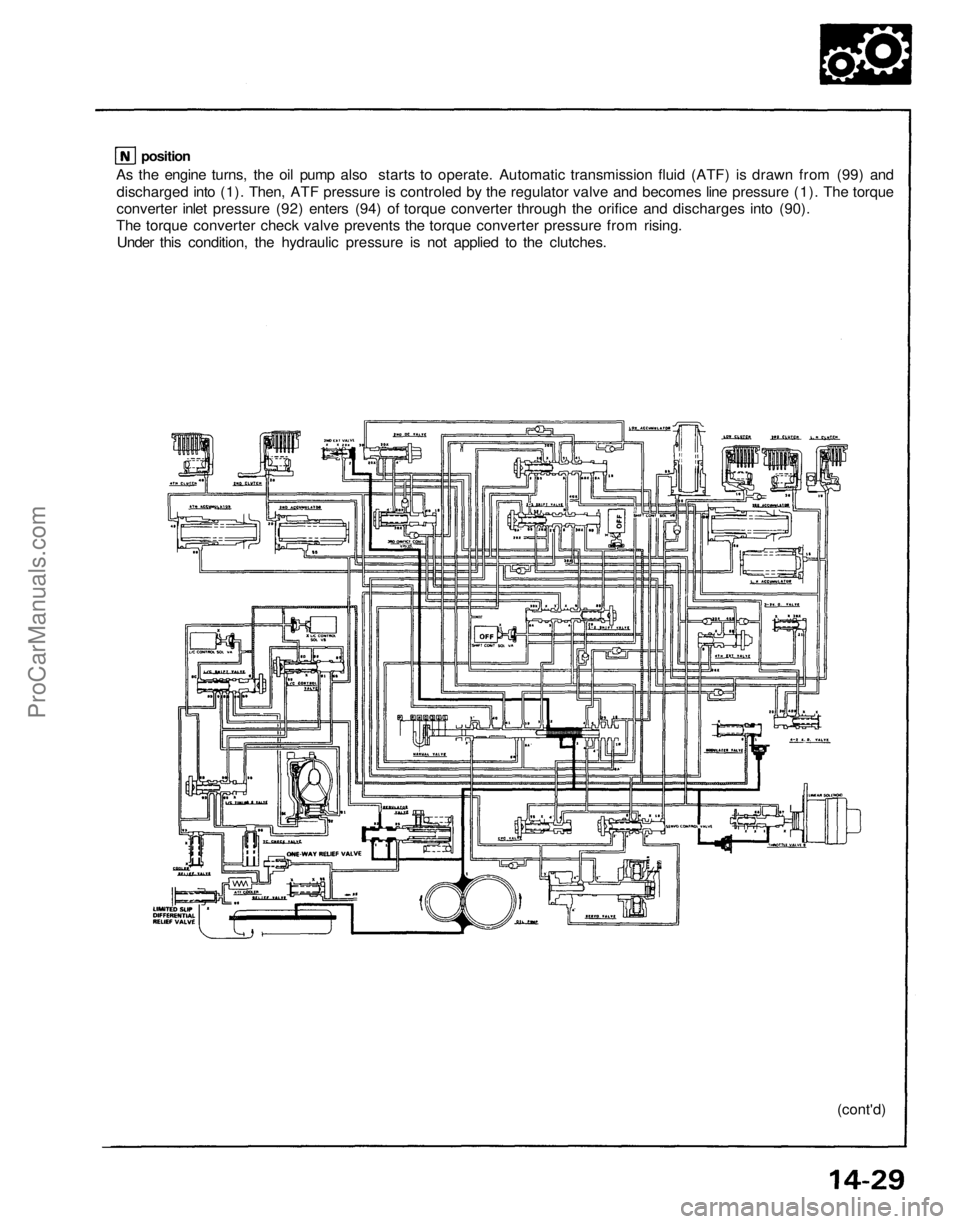
As the engine turns, the oil pump also starts to operate. Automatic transmission fluid (ATF) is drawn from (99) and
discharged into (1). Then, ATF pressure is controled by the regulator valve and becomes line pressure (1). The torque
converter inlet pressure (92) enters (94) of torque converter through the orifice and discharges into (90).
The torque converter check valve prevents the torque converter pressure from rising.
Under this condition, the hydraulic pressure is not applied to the clutches.
(cont'd)
positionProCarManuals.com
Page 1194 of 1640
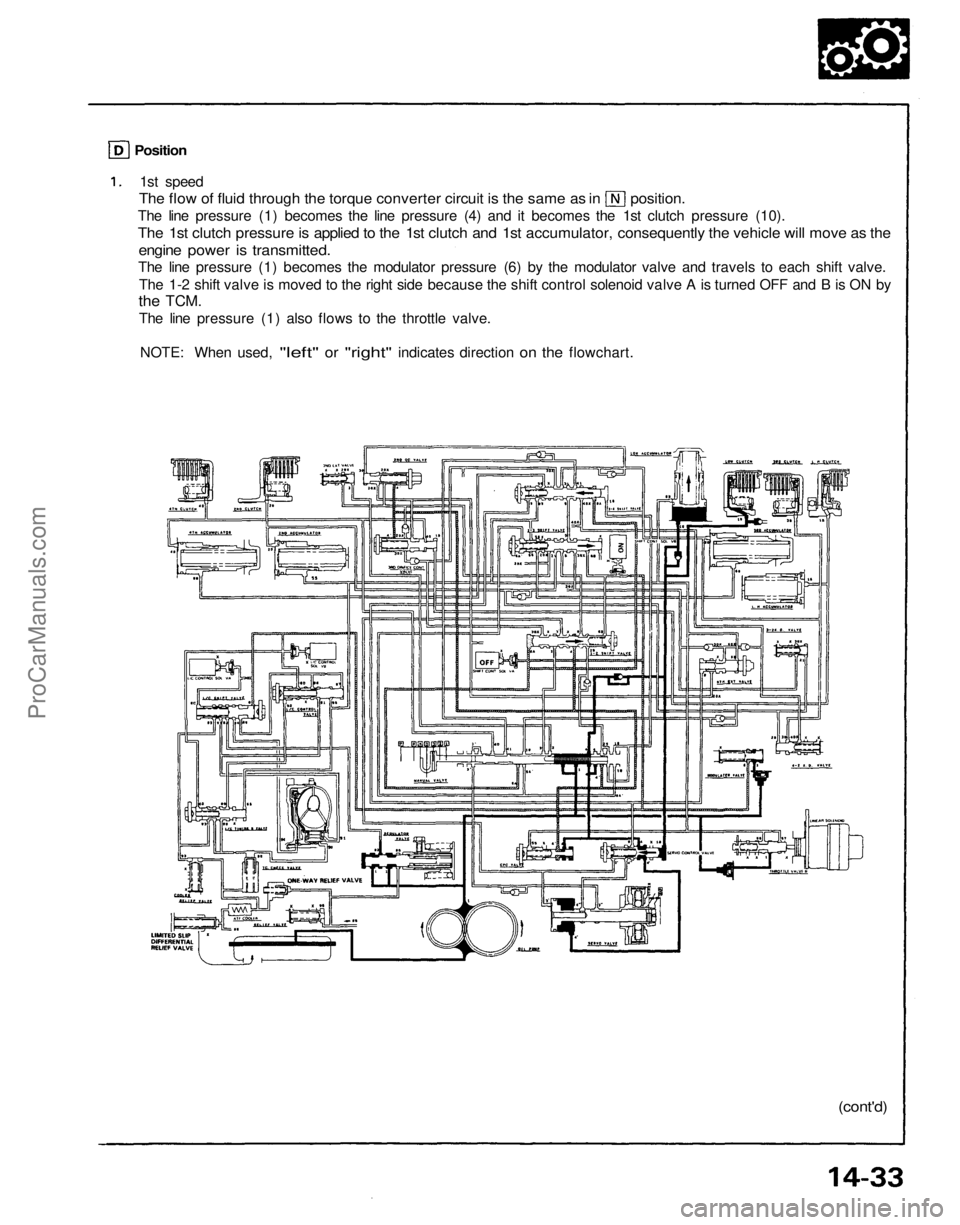
1st speed
The flow of fluid through the torque converter circuit is the same as in position.
The line pressure (1) becomes the line pressure (4) and it becomes the 1st clutch pressure (10).
The 1st clutch pressure is applied to the 1st clutch and 1st accumulator, consequently the vehicle will move as the
engine power is transmitted.
The line pressure (1) becomes the modulator pressure (6) by the modulator valve and travels to each shift valve.
The 1-2 shift valve is moved to the right side because the shift control solenoid valve A is turned OFF and B is ON by
the
TCM.
The line pressure (1) also flows to the throttle valve.
NOTE: When used,
"left"
or
"right"
indicates direction
on the
flowchart.
(cont'd)
PositionProCarManuals.com