check engine ACURA NSX 1991 Service Workshop Manual
[x] Cancel search | Manufacturer: ACURA, Model Year: 1991, Model line: NSX, Model: ACURA NSX 1991Pages: 1640, PDF Size: 60.48 MB
Page 1095 of 1640
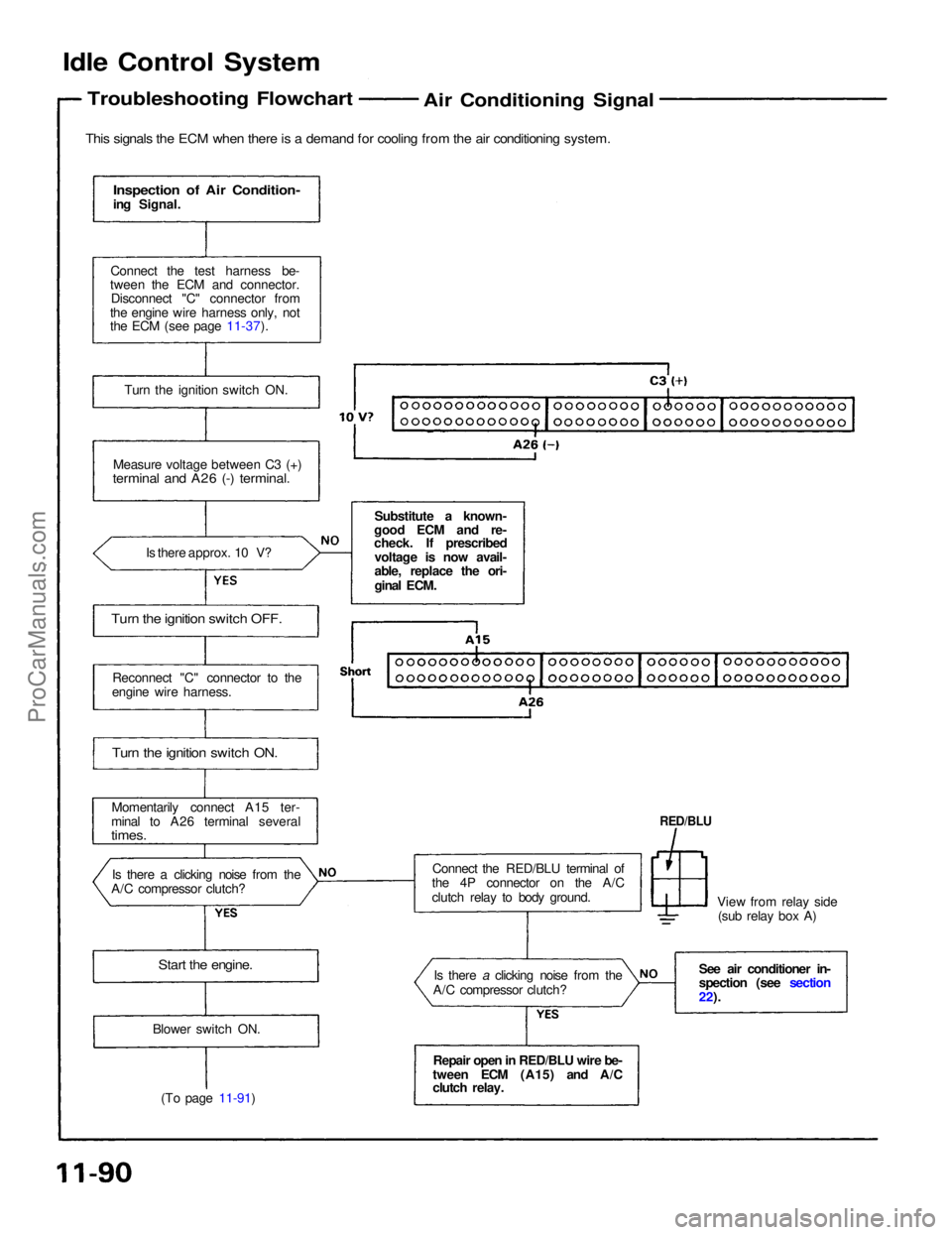
Idle Control System
Troubleshooting Flowchart
Air Conditioning Signal
This signals the ECM when there is a demand for cooling from the air conditioning system.
Inspection of Air Condition-
ing Signal.
Connect the test harness be-
tween the ECM and connector. Disconnect "C" connector from
the engine wire harness only, not
the ECM (see page 11-37).
Turn the ignition switch ON.
Measure voltage between C3 (+)
terminal and A26 (-) terminal.
Is there approx. 10 V?
Turn the ignition switch OFF.
Reconnect "C" connector to the
engine wire harness.
Turn the ignition switch ON.
Momentarily connect A15 ter-
minal to A26 terminal several
times.
Is there a clicking noise from the
A/C compressor clutch?
Start the engine.
Blower switch ON.
(To page 11-91) Repair open in RED/BLU wire be-
tween ECM (A15) and A/C
clutch relay. Is there a clicking noise from the
A/C compressor clutch?
Connect the RED/BLU terminal of
the 4P connector on the A/C
clutch relay to body ground. View from relay side
(sub relay box A)
RED/BLU
See air conditioner in-
spection (see section
22).
Substitute a known-
good ECM and re-
check. If prescribed
voltage is now avail-
able, replace the ori-
ginal ECM.ProCarManuals.com
Page 1097 of 1640
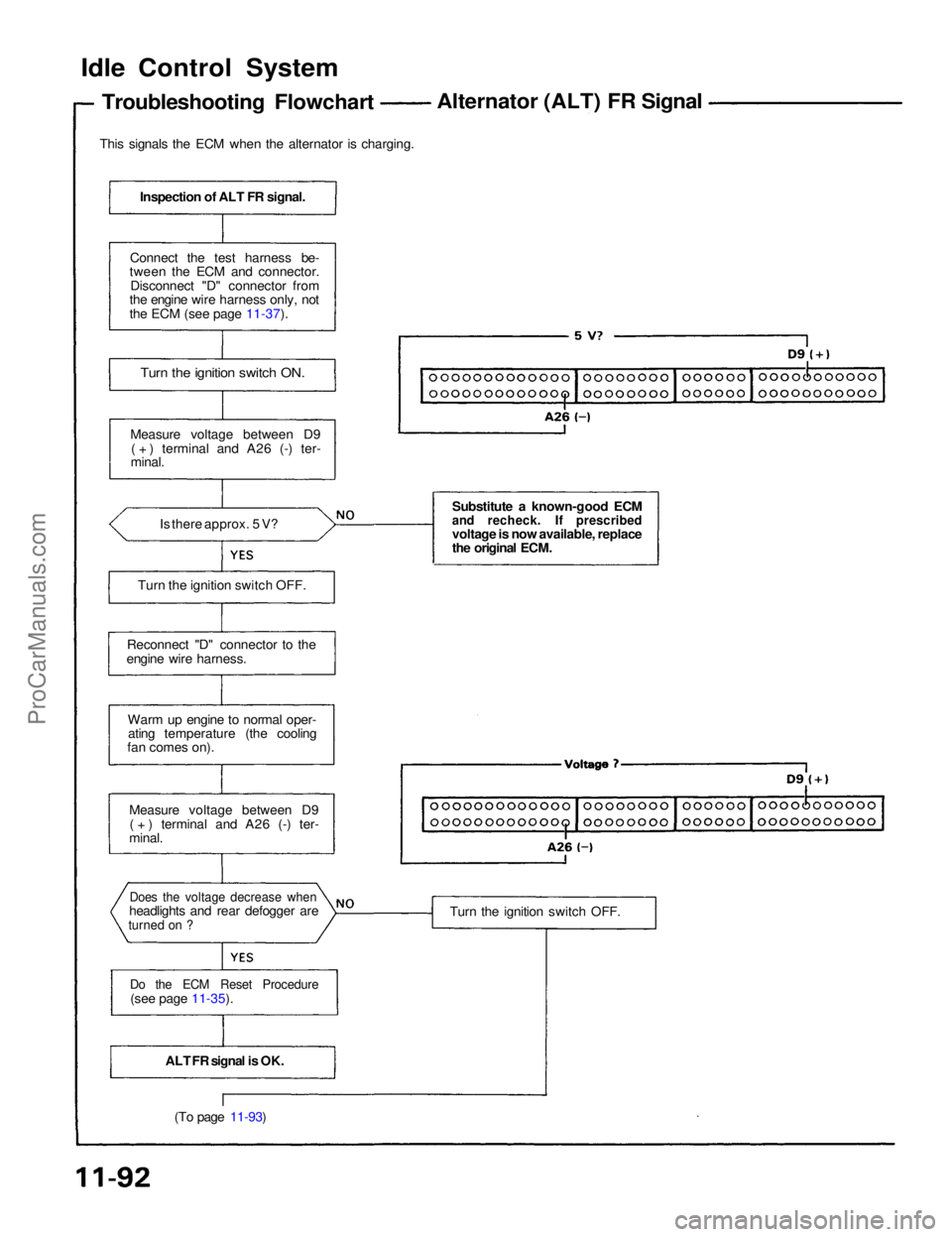
Idle Control System
Troubleshooting Flowchart
Alternator (ALT) FR Signal
This signals the ECM when the alternator is charging.
Inspection of ALT FR signal.
Connect the test harness be-
tween the ECM and connector.
Disconnect "D" connector from
the engine wire harness only, not
the ECM (see page 11-37).
Turn the ignition switch ON.
Measure voltage between D9 ( + ) terminal and A26 (-) ter-
minal.
Is there approx. 5 V?
Turn the ignition switch OFF.
Reconnect "D" connector to the
engine wire harness.
Warm up engine to normal oper-ating temperature (the cooling
fan comes on).
Measure voltage between D9( + ) terminal and A26 (-) ter-
minal.
Does the voltage decrease when
headlights and rear defogger are
turned on ?
Do the ECM Reset Procedure
(see page 11-35).
ALT FR signal is OK.(To page 11-93) Substitute a known-good ECM
and recheck. If prescribed
voltage is now available, replace
the original ECM.
Turn the ignition switch OFF.ProCarManuals.com
Page 1098 of 1640
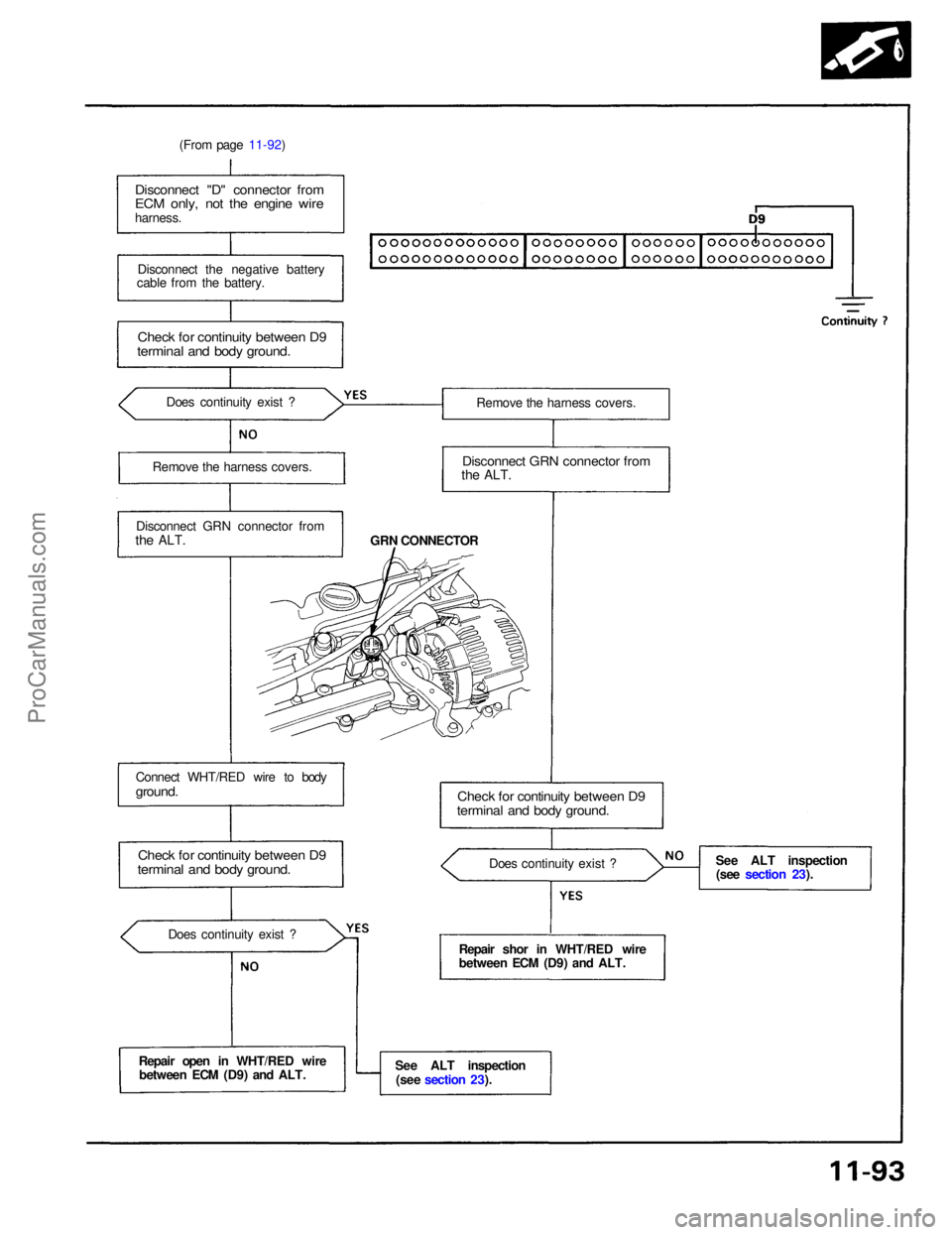
(From page 11-92)
Disconnect "D" connector from
ECM only, not the engine wire
harness.
Disconnect the negative battery
cable from the battery.
Check for continuity between D9
terminal and body ground.
Does continuity exist ?
Remove the harness covers.
Disconnect GRN connector from
the
ALT.
Connect WHT/RED wire to body
ground.
Check for continuity between D9
terminal and body ground.
Does continuity exist ?
Repair open in WHT/RED wire between ECM (D9) and ALT.
See ALT inspection
(see section 23). Repair shor in WHT/RED wire
between ECM (D9) and ALT.
Does continuity exist ?
Check for continuity between D9
terminal and body ground.
Disconnect GRN connector from
the
ALT. Remove the harness covers.
See ALT inspection(see section 23).
GRN CONNECTORProCarManuals.com
Page 1099 of 1640
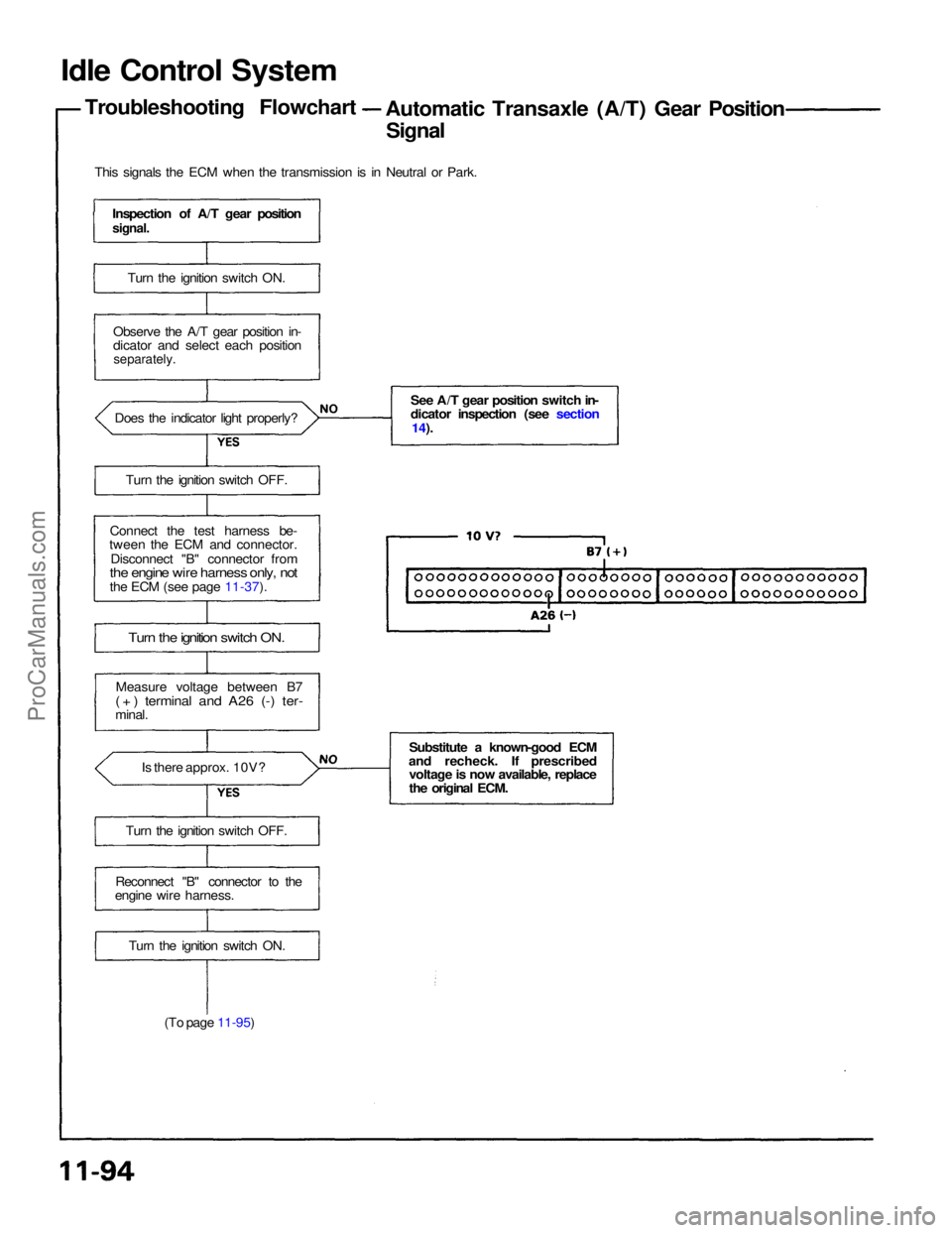
Idle Control System
Troubleshooting Flowchart Automatic Transaxle (A/T) Gear Position
Signal
This signals the ECM when the transmission is in Neutral or Park.
Inspection of A/T gear position
signal.
Turn the ignition switch ON.
Observe the A/T gear position in-
dicator and select each position
separately.
Does the indicator light properly?
Turn the ignition switch OFF.
Connect the test harness be-
tween the ECM and connector.
Disconnect "B" connector from
the engine wire harness only, not
the ECM (see page 11-37).
Turn the ignition switch ON.
Measure voltage between B7
( + ) terminal and A26 (-) ter-
minal.
Is there approx. 10V?
Turn the ignition switch OFF.
Reconnect "B" connector to the
engine wire harness.
Turn the ignition switch ON.
(To page 11-95) See A/T gear position switch in-
dicator inspection (see section
14).
Substitute a known-good ECM
and recheck. If prescribed voltage is now available, replace
the original ECM.ProCarManuals.com
Page 1101 of 1640
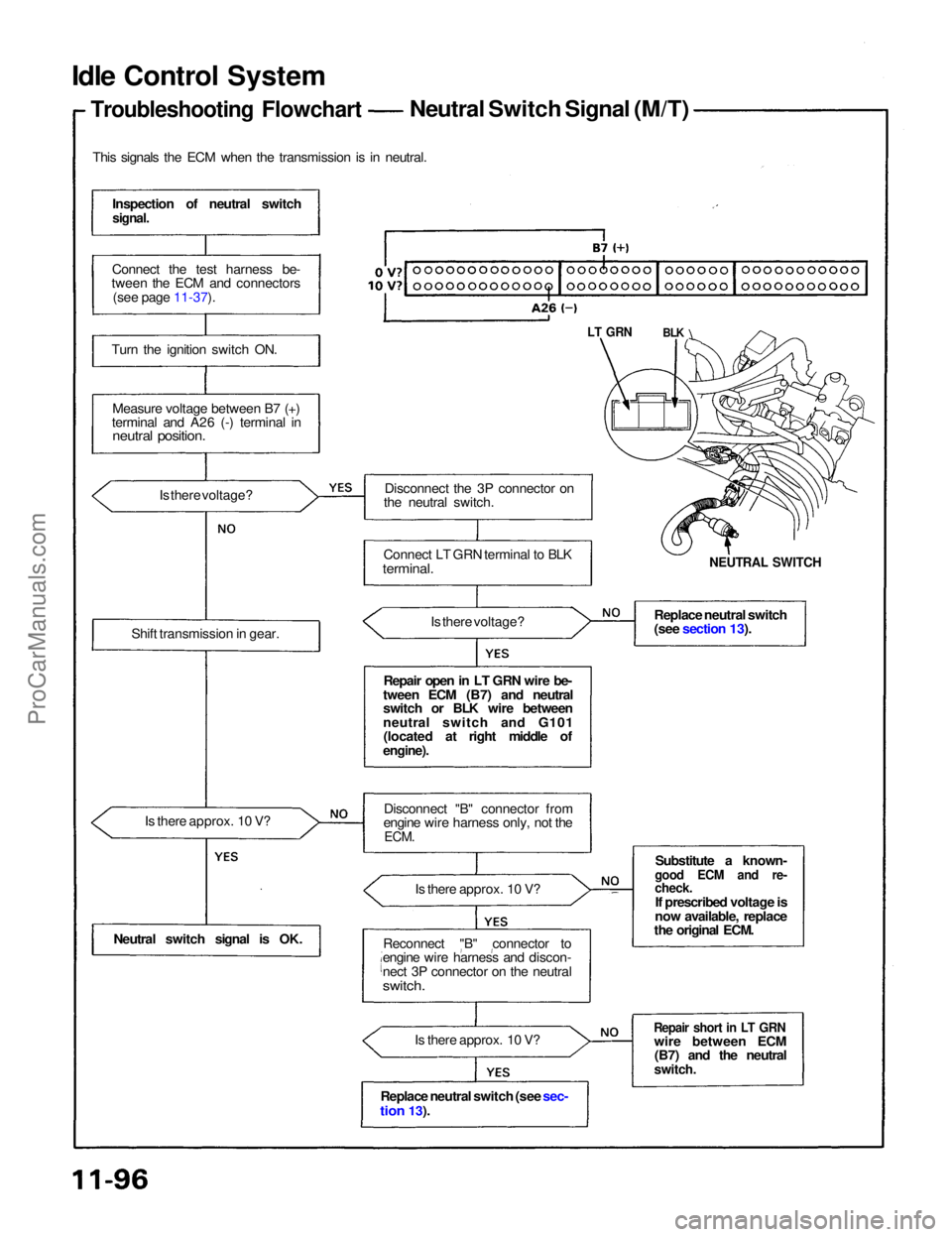
Idle Control System
Troubleshooting Flowchart
Neutral Switch Signal (M/T)
This signals the ECM when the transmission is in neutral.
Inspection of neutral switch
signal.
Connect the test harness be-
tween the ECM and connectors
(see page 11-37).
Turn the ignition switch ON.
Measure voltage between B7 (+)
terminal and A26 (-) terminal in
neutral position.
Is there voltage?
Shift transmission in gear.
Is there approx. 10 V?
Neutral switch signal is OK.
Replace neutral switch (see sec-
tion
13). Is there approx. 10 V?
Reconnect "B" connector to
engine wire harness and discon-
nect 3P connector on the neutral
switch.
Is there approx. 10 V?
Disconnect "B" connector from
engine wire harness only, not the
ECM.
Repair open in LT GRN wire be-
tween ECM (B7) and neutral
switch or BLK wire between
neutral switch and G101 (located at right middle of
engine).
Is there voltage?
Connect LT GRN terminal to BLK
terminal.
Disconnect the 3P connector on
the neutral switch.
Replace neutral switch
(see section 13).
NEUTRAL SWITCH
LT GRN
BLK
Substitute a known-
good ECM and re-
check.
If prescribed voltage is
now available, replace
the original ECM.
Repair short in LT GRN
wire between ECM(B7) and the neutral
switch.ProCarManuals.com
Page 1103 of 1640
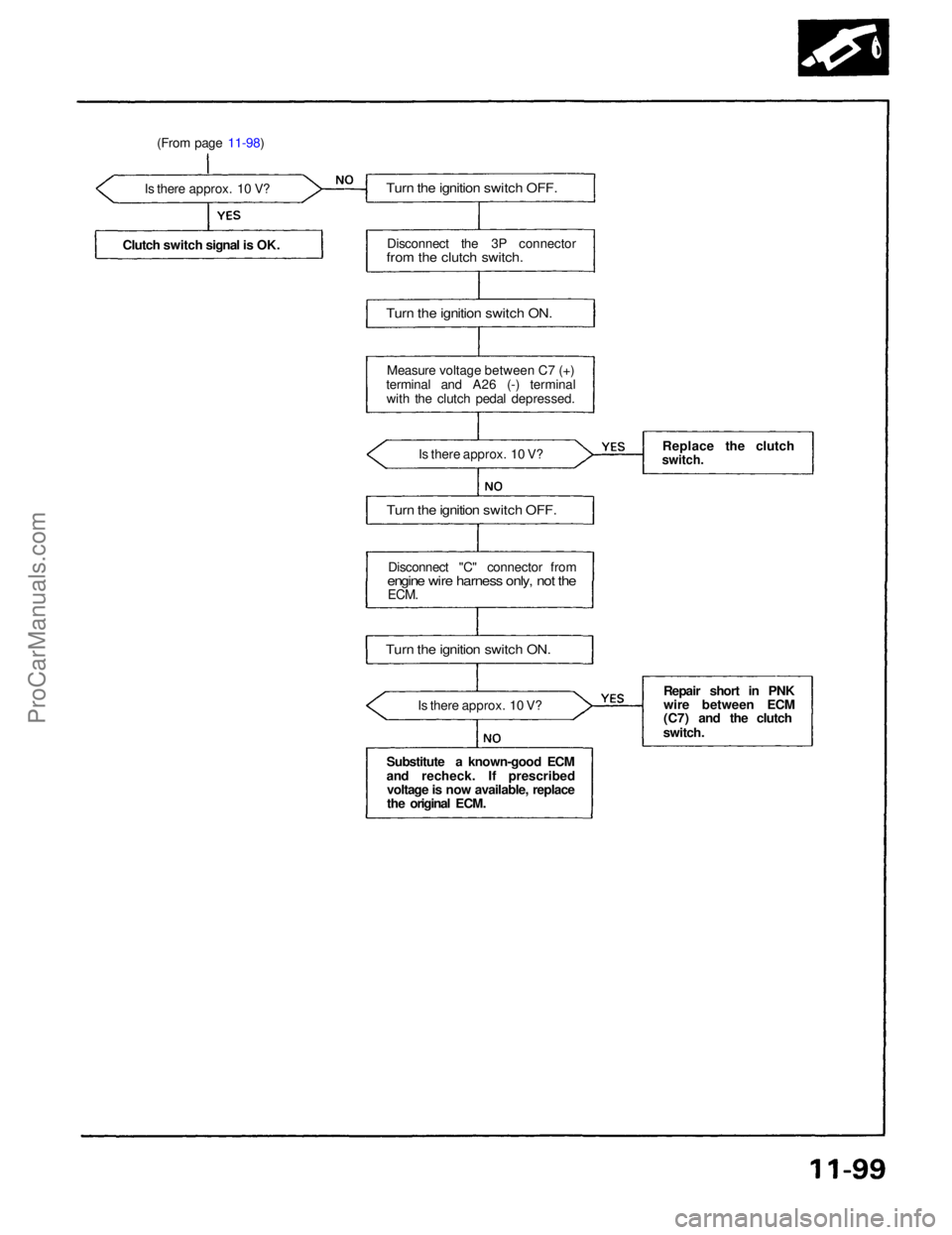
(From page 11-98)
Is there approx. 10 V?
Clutch switch signal is OK.
Turn the ignition switch OFF.
Disconnect the 3P connector
from the clutch switch.
Turn the ignition switch ON.
Measure voltage between C7 (+)
terminal and A26 (-) terminal with the clutch pedal depressed.
Is there approx. 10 V?
Turn the ignition switch OFF.
Disconnect "C" connector from
engine wire harness only, not the
ECM.
Turn the ignition switch ON.
Is there approx. 10 V?
Substitute a known-good ECM
and recheck. If prescribed voltage is now available, replace
the original ECM. Replace the clutch
switch.
Repair short in PNK
wire between ECM
(C7) and the clutch
switch.ProCarManuals.com
Page 1105 of 1640
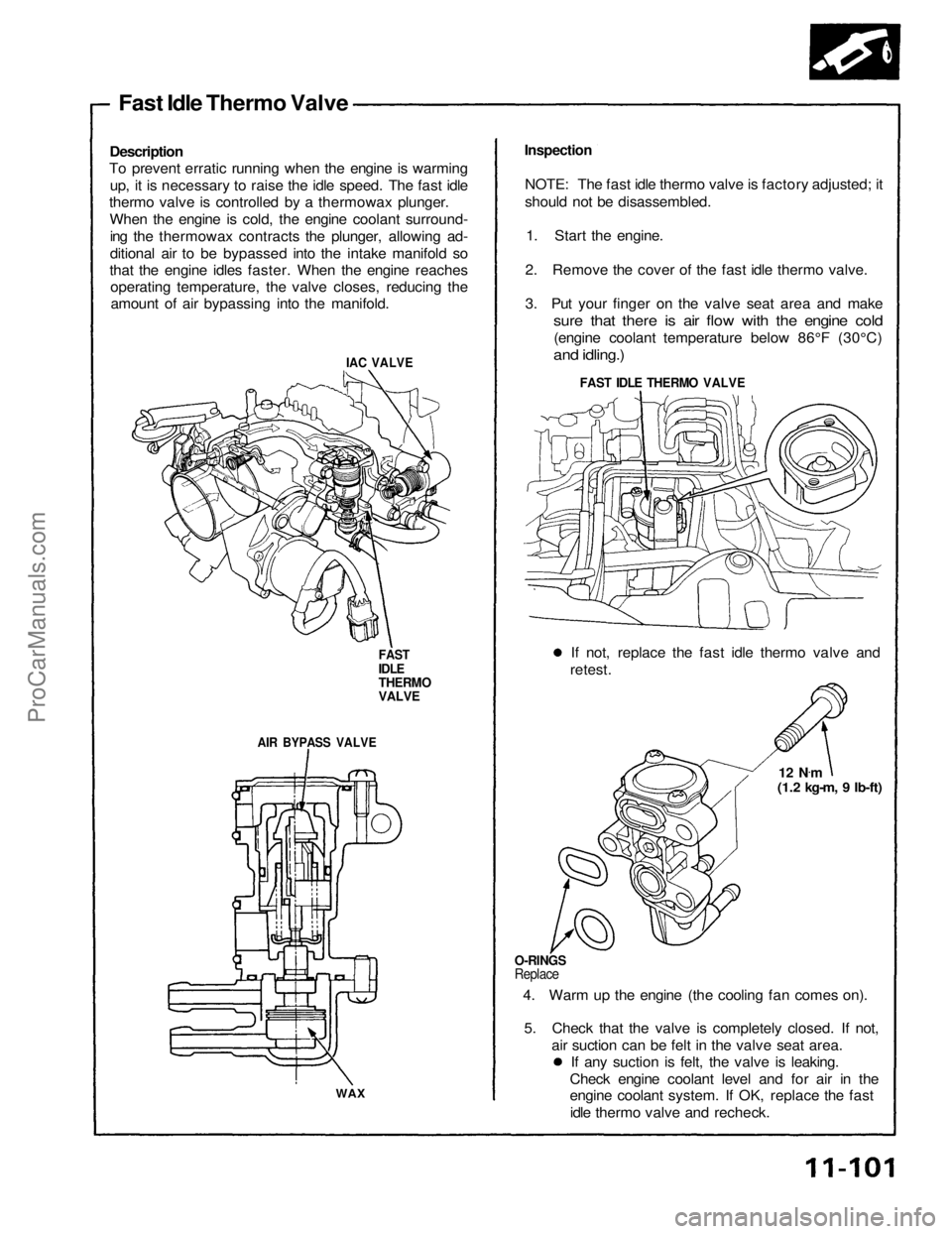
Fast Idle Thermo Valve
Description
To prevent erratic running when the engine is warming
up, it is necessary to raise the idle speed. The fast idle
thermo valve is controlled by a thermowax plunger.
When the engine is cold, the engine coolant surround-ing the thermowax contracts the plunger, allowing ad-
ditional air to be bypassed into the intake manifold so
that the engine idles faster. When the engine reaches operating temperature, the valve closes, reducing theamount of air bypassing into the manifold.
IAC VALVE
FAST
IDLE
THERMO
VALVE
AIR BYPASS VALVE
WAX
Inspection
NOTE: The fast idle thermo valve is factory adjusted; it
should not be disassembled. 1. Start the engine.
2. Remove the cover of the fast idle thermo valve.
3. Put your finger on the valve seat area and make
sure that there is air flow with the engine cold
(engine coolant temperature below 86°F (30°C)
and idling.)
FAST IDLE THERMO VALVE
If not, replace the fast idle thermo valve and
retest.
12 N.
m
(1.2 kg-m, 9 Ib-ft)
O-RINGS
Replace
4. Warm up the engine (the cooling fan comes on).
5. Check that the valve is completely closed. If not, air suction can be felt in the valve seat area.If any suction is felt, the valve is leaking.
Check engine coolant level and for air in the
engine coolant system. If OK, replace the fast idle thermo valve and recheck.ProCarManuals.com
Page 1106 of 1640
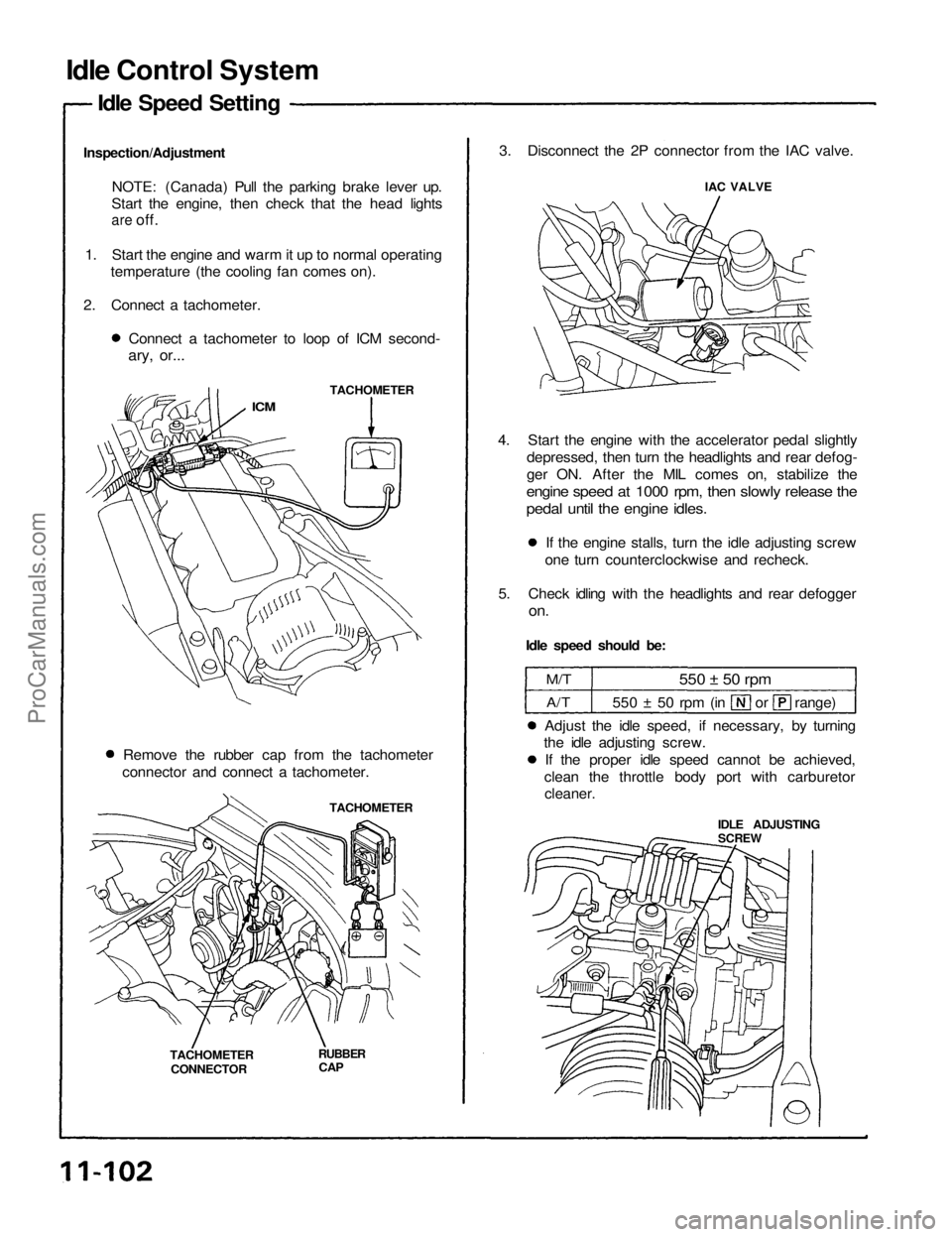
Idle Control System
Idle Speed Setting
Inspection/Adjustment NOTE: (Canada) Pull the parking brake lever up.
Start the engine, then check that the head lights
are
off.
1. Start the engine and warm it up to normal operating temperature (the cooling fan comes on).
2. Connect a tachometer. Connect a tachometer to loop of ICM second-
ary, or...
TACHOMETER
ICM
Remove the rubber cap from the tachometer
connector and connect a tachometer.
TACHOMETER
TACHOMETER CONNECTOR
RUBBER
CAP
3. Disconnect the 2P connector from the IAC valve.
IAC VALVE
4. Start the engine with the accelerator pedal slightly depressed, then turn the headlights and rear defog-
ger ON. After the MIL comes on, stabilize the
engine speed at 1000 rpm, then slowly release the
pedal until the engine idles.
If the engine stalls, turn the idle adjusting screw
one turn counterclockwise and recheck.
5. Check idling with the headlights and rear defogger
on.
Idle speed should be:
M/T
A/T
550 ± 50 rpm
550 ± 50 rpm (in or range)
Adjust the idle speed, if necessary, by turning
the idle adjusting screw.
If the proper idle speed cannot be achieved,
clean the throttle body port with carburetor
cleaner.
IDLE ADJUSTING
SCREWProCarManuals.com
Page 1107 of 1640
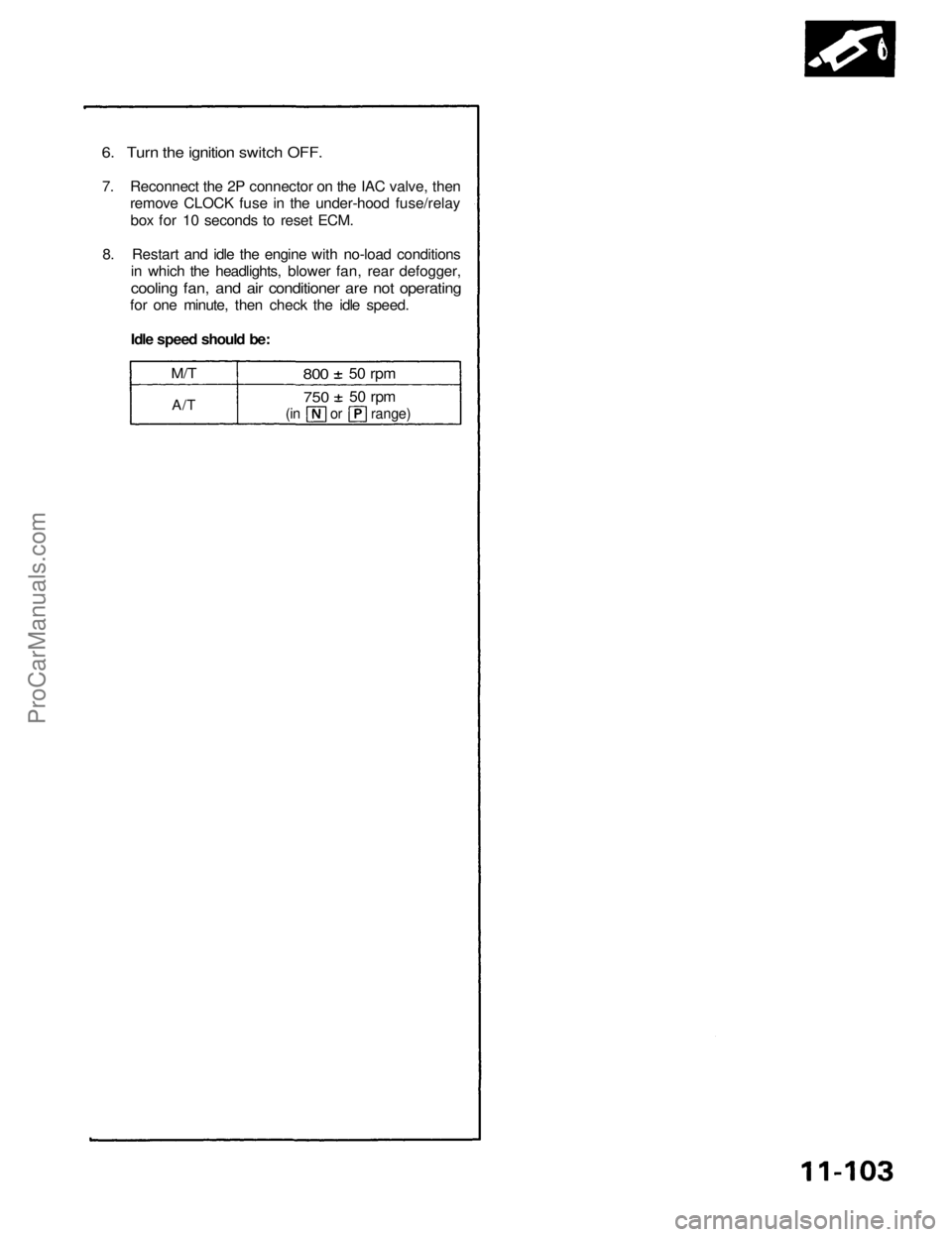
6. Turn the ignition switch OFF.
7. Reconnect the 2P connector on the IAC valve, then
remove CLOCK fuse in the under-hood fuse/relay
box for 10 seconds to reset ECM.
8. Restart and idle the engine with no-load conditions
in which the headlights, blower fan, rear defogger,
cooling fan, and air conditioner are not operating
for one minute, then check the idle speed.
Idle speed should be:
M/T
A/T
800
50 rpm
750
50 rpm
(in or range)ProCarManuals.com
Page 1110 of 1640
Fuel Supply System
Fuel Pressure (cont'd)
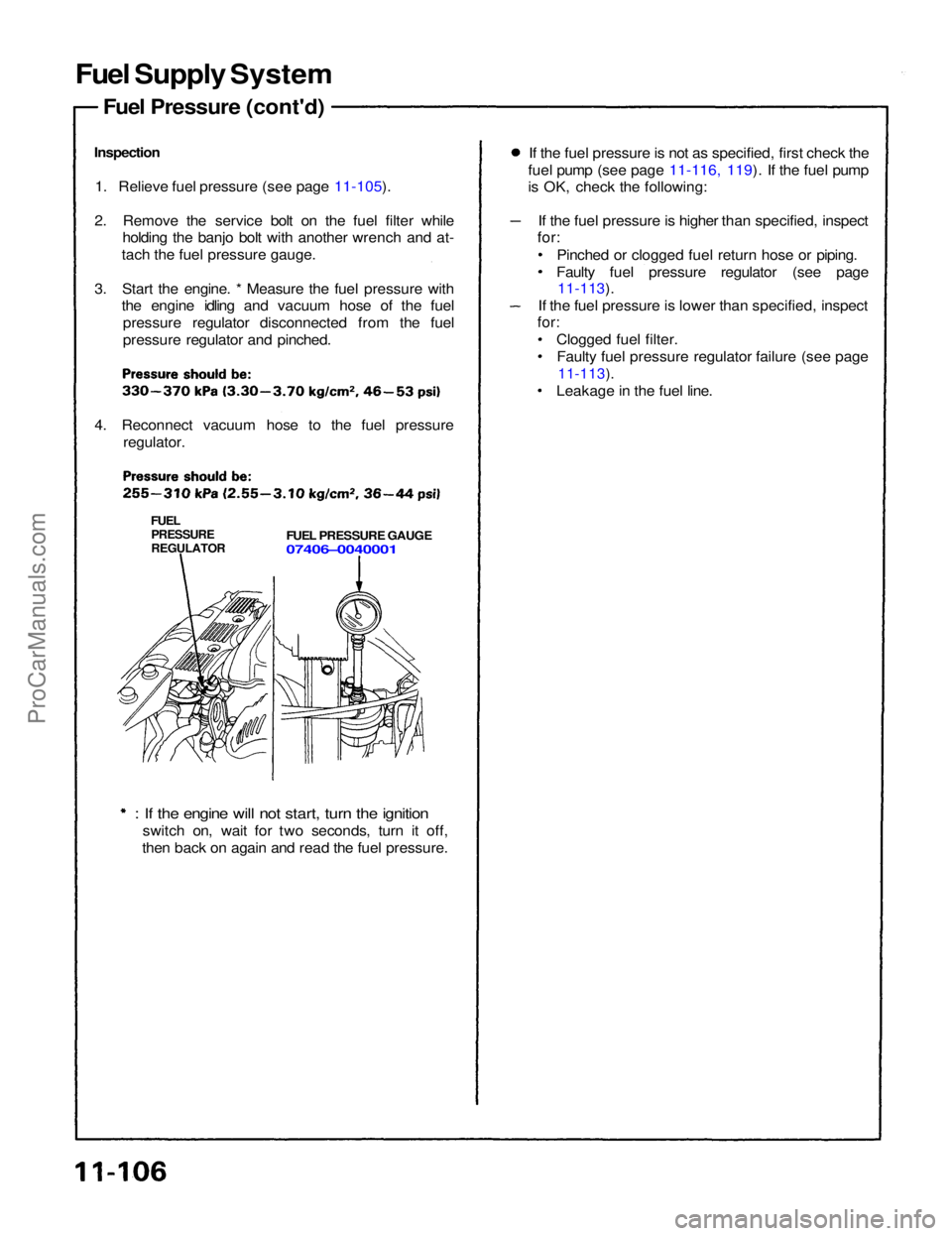
Inspection 1. Relieve fuel pressure (see page 11-105).
2. Remove the service bolt on the fuel filter while holding the banjo bolt with another wrench and at-
tach the fuel pressure gauge.
3. Start the engine. * Measure the fuel pressure with the engine idling and vacuum hose of the fuel
pressure regulator disconnected from the fuel
pressure regulator and pinched.
4. Reconnect vacuum hose to the fuel pressure regulator.
FUEL
PRESSURE
REGULATOR
FUEL PRESSURE GAUGE
07406–0040001
: If the engine will not start, turn the ignition
switch on, wait for two seconds, turn it off,
then back on again and read the fuel pressure. If the fuel pressure is not as specified, first check the
fuel pump (see page 11-116, 119). If the fuel pump
is OK, check the following:
If the fuel pressure is higher than specified, inspect
for:
Pinched or clogged fuel return hose or piping.
Faulty fuel pressure regulator (see page
11-113).
If the fuel pressure is lower than specified, inspect
for:
Clogged fuel filter.Faulty fuel pressure regulator failure (see page
11-113).
Leakage in the fuel line.ProCarManuals.com