engine ACURA NSX 1997 Service Repair Manual
[x] Cancel search | Manufacturer: ACURA, Model Year: 1997, Model line: NSX, Model: ACURA NSX 1997Pages: 1503, PDF Size: 57.08 MB
Page 1056 of 1503
Steering angl e senso r syste m chec k
1 . Star t th e engine .
2 . Pus h th e TC S switc h thre e time s withi n thre e seconds .
NOTE : Alway s maintai n th e sam e numbe r o f rota -
tions .
3 . Tur n th e steerin g whee l slowl y fro m lef t t o righ t mor e
tha n 1. 5 turns .
NOTE :
• Star t checkin g afte r th e steerin g whee l move s a t
leas t 1. 5 turn s fro m righ t t o left .
• Tur n th e steerin g whee l slowly , n o faste r tha n
on e tur n in fou r seconds .
4 . Pus h th e TC S switc h twic e withi n thre e seconds .
NOTE : Alway s maintai n th e sam e numbe r o f rota -
tions .
5 . Retur n th e steerin g whee l t o th e lef t sid e slowly , an d
chec k th e numbe r o f time s th e TC S indicato r ligh t
flashe s afte r th e whee l ha s move d approximatel y
on e turn .
NOTE :
• Star t th e chec k fro m th e beginnin g whe n th e steer -
in g whee l move s a t leas t on e tur n fro m lef t t o
right .
• Tur n th e steerin g whee l slowly , n o faste r tha n on e
tur n in fou r seconds .
Standar d numbe r o f time s th e TC S indicato r ligh t
flashes :
Manual Transmission : 5 time s
Automati c Transmission : 2 time s
6 . I f ther e is a n abnormality , chec k th e troubleshootin g
flowchar t (se e pag e 19-114 ). Selectio
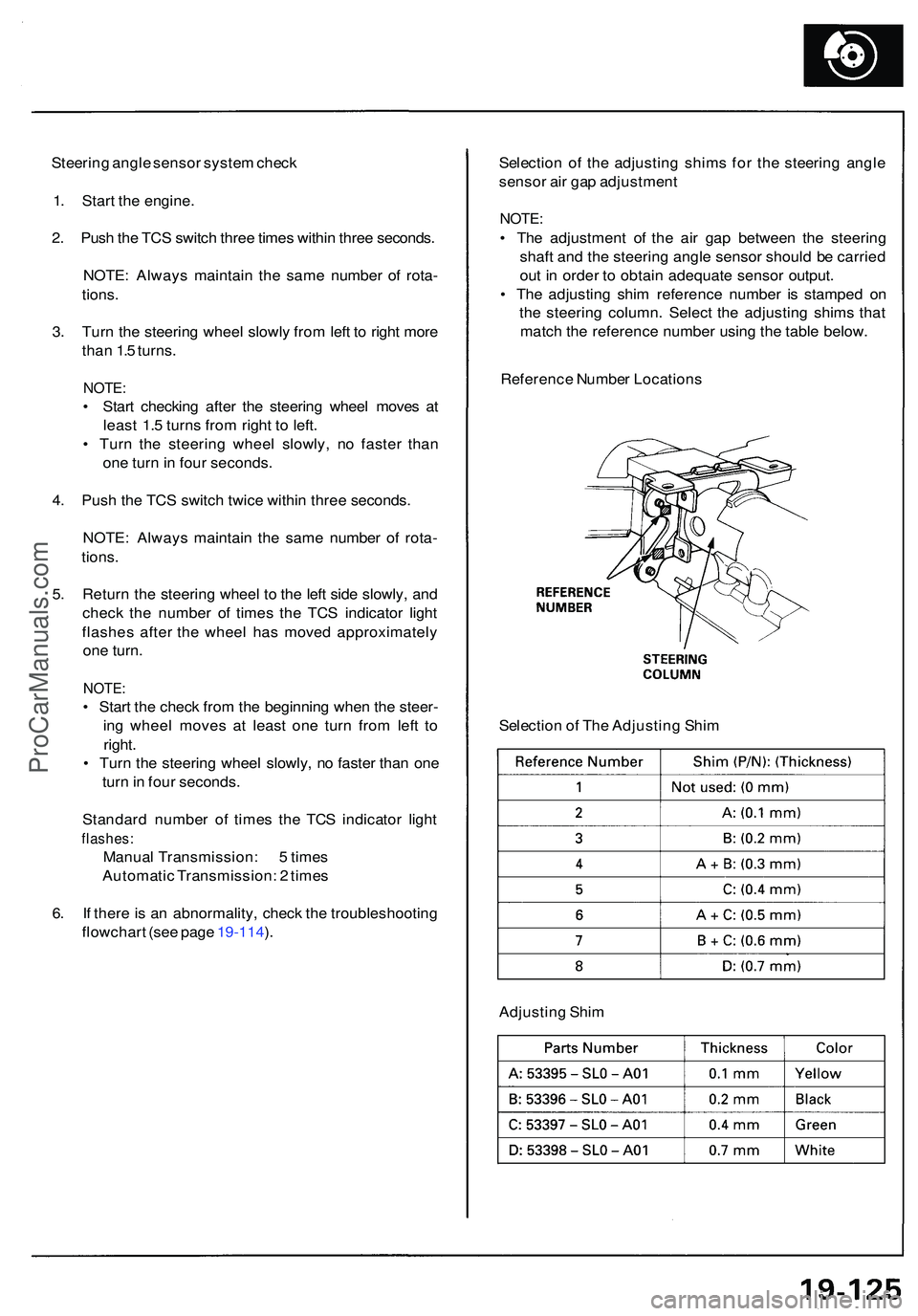
n o f th e adjustin g shim s fo r th e steerin g angl e
senso r ai r ga p adjustmen t
NOTE:
• Th e adjustmen t o f th e ai r ga p betwee n th e steerin g
shaf t an d th e steerin g angl e senso r shoul d b e carrie d
ou t i n orde r t o obtai n adequat e senso r output .
• Th e adjustin g shi m referenc e numbe r i s stampe d o n
th e steerin g column . Selec t th e adjustin g shim s tha t
matc h th e referenc e numbe r usin g th e tabl e below .
Referenc e Numbe r Location s
Selectio n o f Th e Adjustin g Shi m
Adjustin g Shi m
ProCarManuals.com
Page 1121 of 1503
Rear Hatch/Engine Cover
Replacement/Adjustment
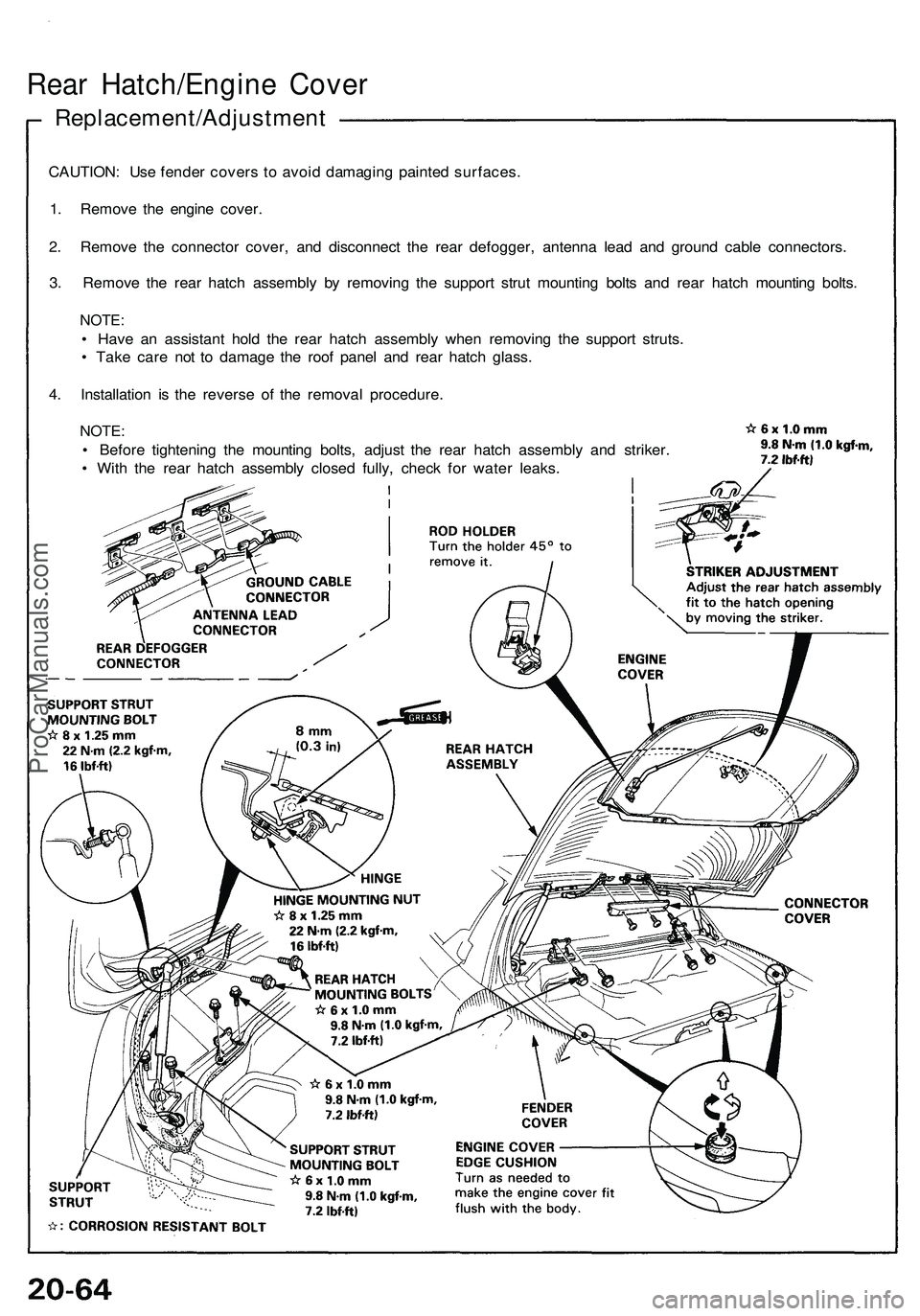
CAUTION: Use fender covers to avoid damaging painted surfaces.
1. Remove the engine cover.
2. Remove the connector cover, and disconnect the rear defogger, antenna lead and ground cable connectors.
3. Remove the rear hatch assembly by removing the support strut mounting bolts and rear hatch mounting bolts.
NOTE:
• Have an assistant hold the rear hatch assembly when removing the support struts.
• Take care not to damage the roof panel and rear hatch glass.
4. Installation is the reverse of the removal procedure.
NOTE:
• Before tightening the mounting bolts, adjust the rear hatch assembly and striker.
• With the rear hatch assembly closed fully, check for water leaks.ProCarManuals.com
Page 1174 of 1503
Engine Cover/Roo f Cove r
Remova l
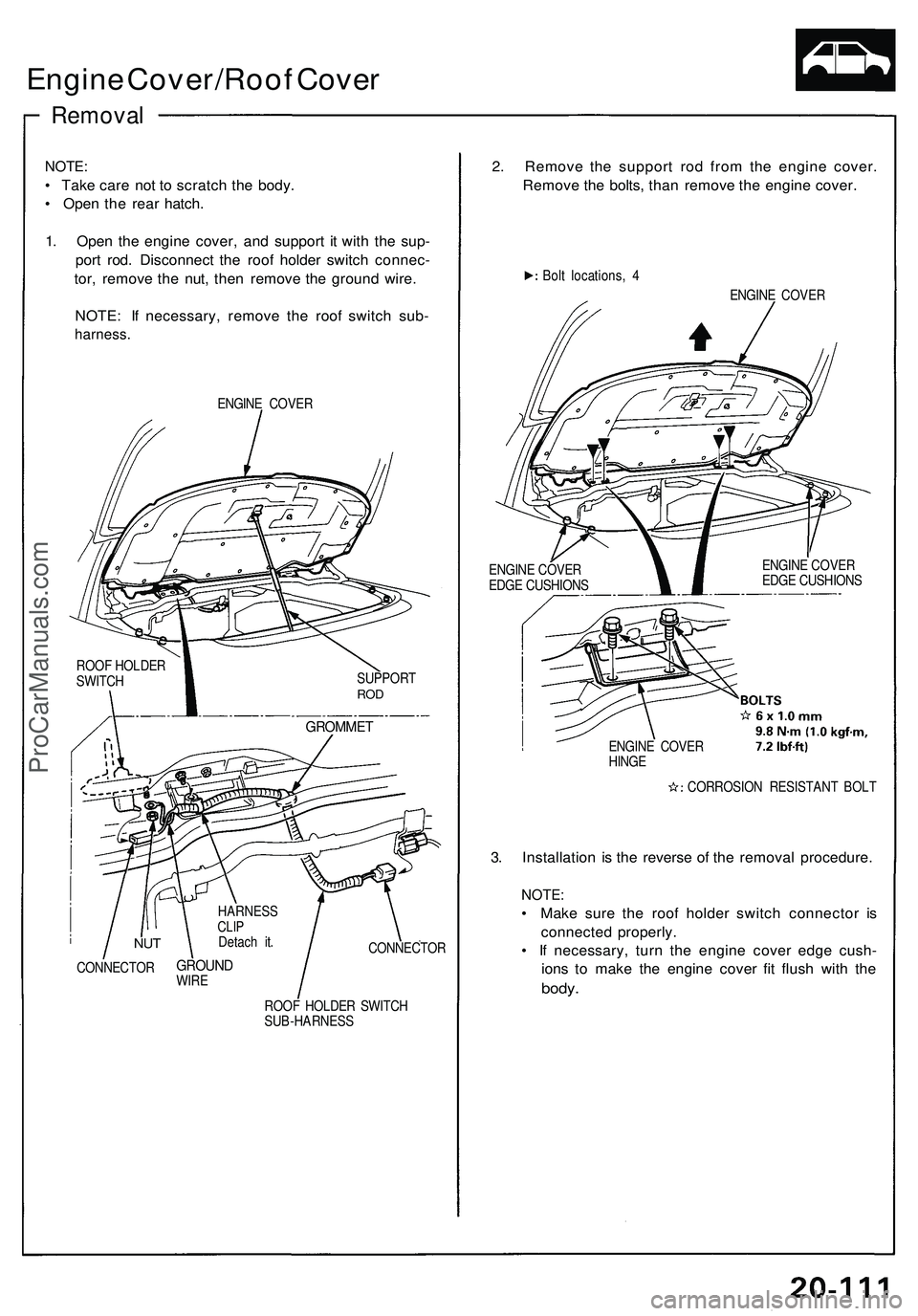
NOTE:
• Tak e car e no t t o scratc h th e body .
• Ope n th e rea r hatch .
1 . Ope n th e engin e cover , an d suppor t i t wit h th e sup -
por t rod . Disconnec t th e roo f holde r switc h connec -
tor , remov e th e nut , the n remov e th e groun d wire .
NOTE : I f necessary , remov e th e roo f switc h sub -
harness .
ENGINE COVE R
NUT
CONNECTO R CONNECTO
RGROUNDWIRE
ROOF HOLDE R SWITC H
SUB-HARNES S
2. Remov e th e suppor t ro d fro m th e engin e cover .
Remov e th e bolts , tha n remov e th e engin e cover .
Bolt locations , 4
ENGINE COVE R
ENGIN E COVE R
HING E
CORROSIO N RESISTAN T BOL T
3. Installatio n i s th e revers e o f th e remova l procedure .
NOTE:
• Mak e sur e th e roo f holde r switc h connecto r i s
connecte d properly .
• I f necessary , tur n th e engin e cove r edg e cush -
ion s t o mak e th e engin e cove r fi t flus h wit h th e
body .
ROO F HOLDE R
SWITC H
SUPPOR
T
ROD
GROMME T
HARNESSCLIPDetac h it . ENGIN
E COVE R
EDG E CUSHION S
ENGIN
E COVE R
EDG E CUSHION S
ProCarManuals.com
Page 1175 of 1503
Engine Cover/Roo f Cove r
Replacemen t
ROOF COVE RLATCH
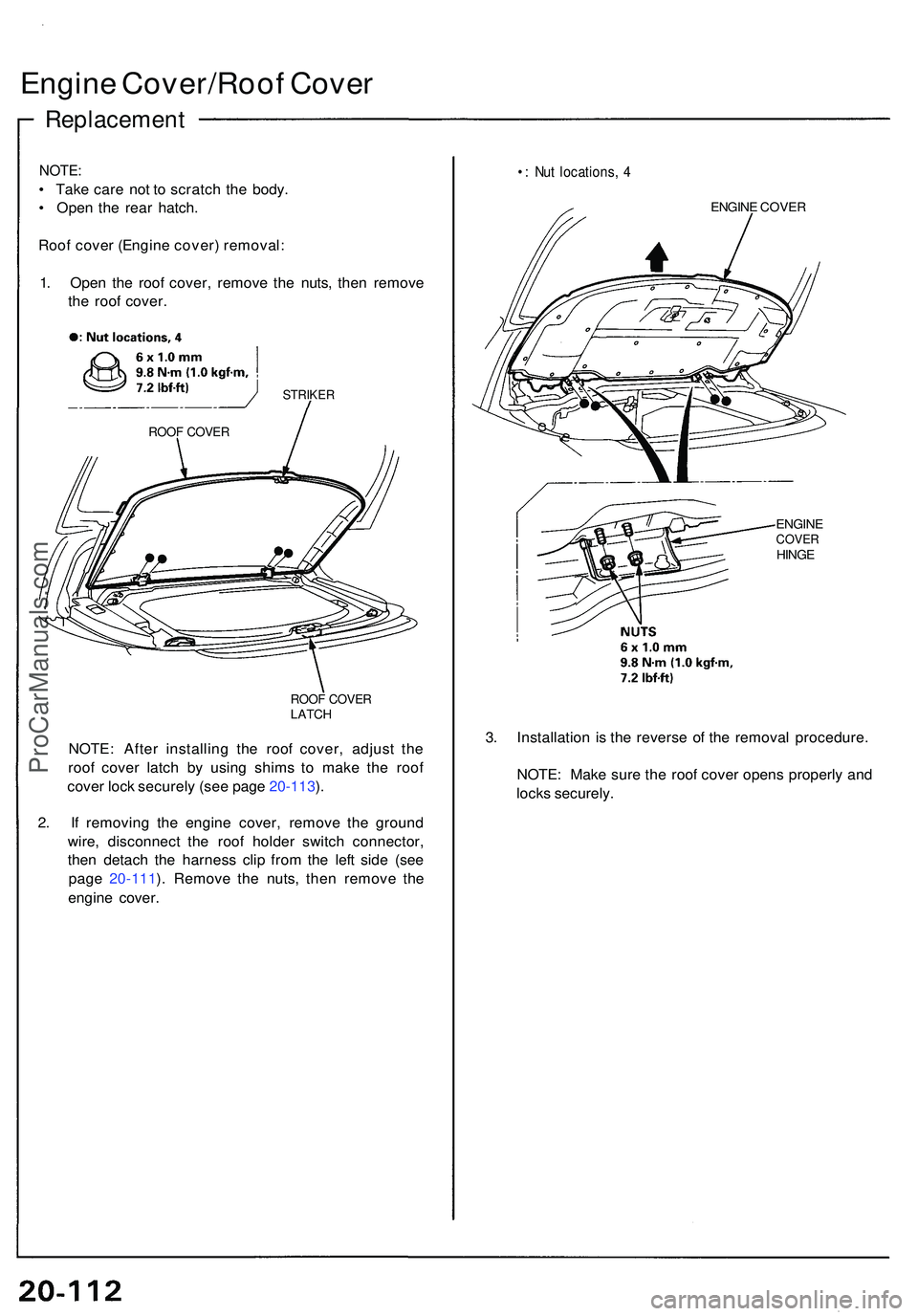
NOTE : Afte r installin g th e roo f cover , adjus t th e
roo f cove r latc h b y usin g shim s t o mak e th e roo f
cove r loc k securel y (se e pag e 20-113 ).
2 . I f removin g th e engin e cover , remov e th e groun d
wire , disconnec t th e roo f holde r switc h connector ,
the n detac h th e harnes s cli p fro m th e lef t sid e (se e
pag e 20-111 ). Remov e th e nuts , the n remov e th e
engine cover.
• : Nu t locations , 4
ENGIN E COVE R
ENGIN E
COVERHINGE
3. Installatio n i s th e revers e o f th e remova l procedure .
NOTE : Mak e sur e th e roo f cove r open s properl y an d
lock s securely .
NOTE:
• Tak e car e no t t o scratc h th e body .
• Ope n th e rea r hatch .
Roo f cove r (Engin e cover ) removal :
1 . Ope n th e roo f cover , remov e th e nuts , the n remov e
th e roo f cover .
ROOF COVE R
STRIKE R
ProCarManuals.com
Page 1176 of 1503
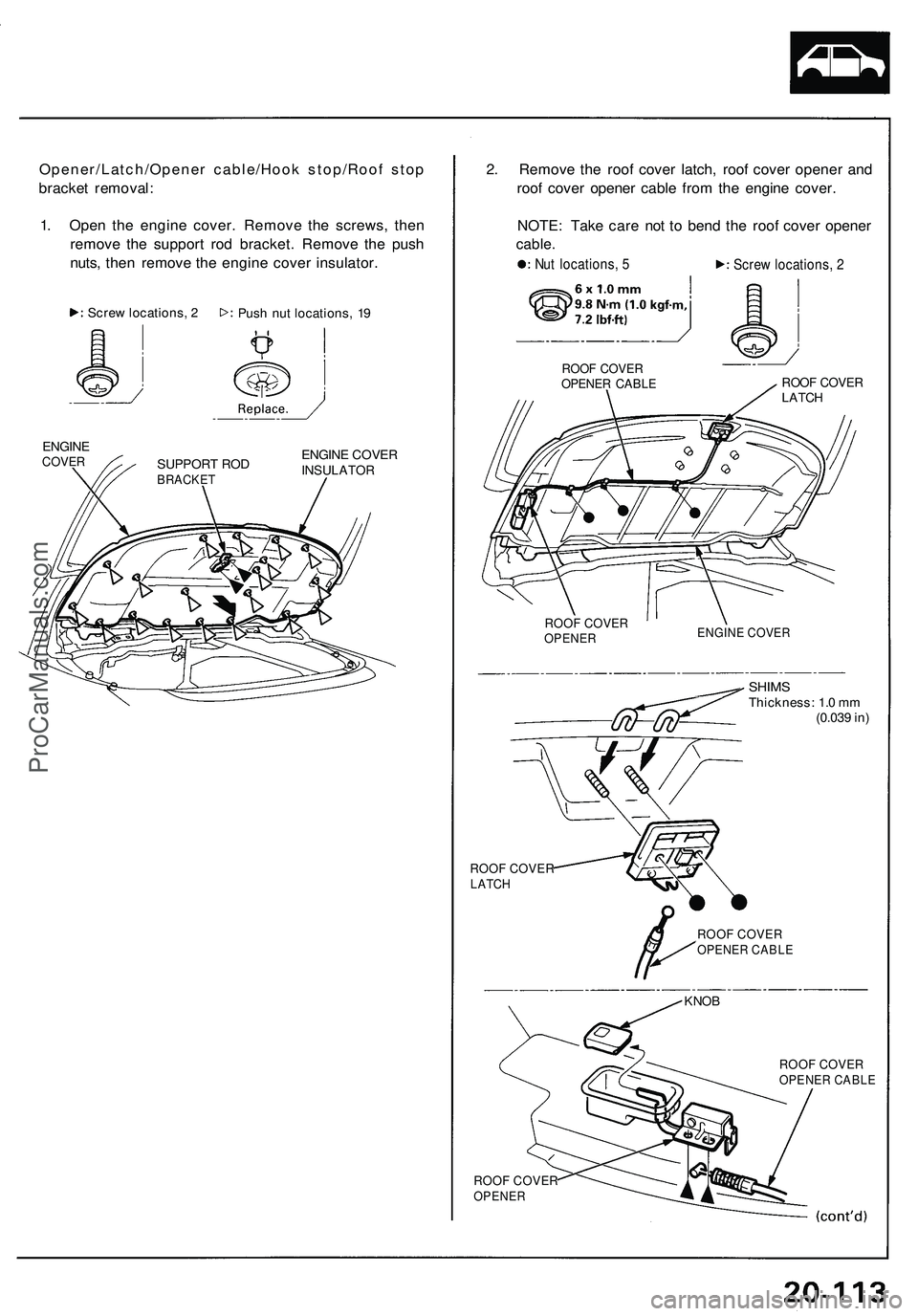
Opener/Latch/Opener cable/Hoo k stop/Roo f sto p
bracke t removal :
1 . Ope n th e engin e cover . Remov e th e screws , the n
remov e th e suppor t ro d bracket . Remov e th e pus h
nuts , the n remov e th e engin e cove r insulator .
ENGINECOVERSUPPOR T RO DBRACKE T
ENGINE COVE RINSULATO R
2. Remov e th e roo f cove r latch , roo f cove r opene r an d
roo f cove r opene r cabl e fro m th e engin e cover .
NOTE : Tak e car e no t t o ben d th e roo f cove r opene r
cable.
Nut locations , 5Scre w locations , 2
ROO F COVE ROPENE R ENGINE COVE R
SHIMSThickness : 1. 0 m m
(0.03 9 in )
ROO F COVE RLATCH
ROOF COVE ROPENE R CABL E
ROOF COVE ROPENE R
PROOF COVE ROPENE R CABL E
KNOB
ROO F COVE RLATCH
ROOF COVE ROPENE R CABL E
Screw locations , 2
Push nu t locations , 1 9
ProCarManuals.com
Page 1177 of 1503
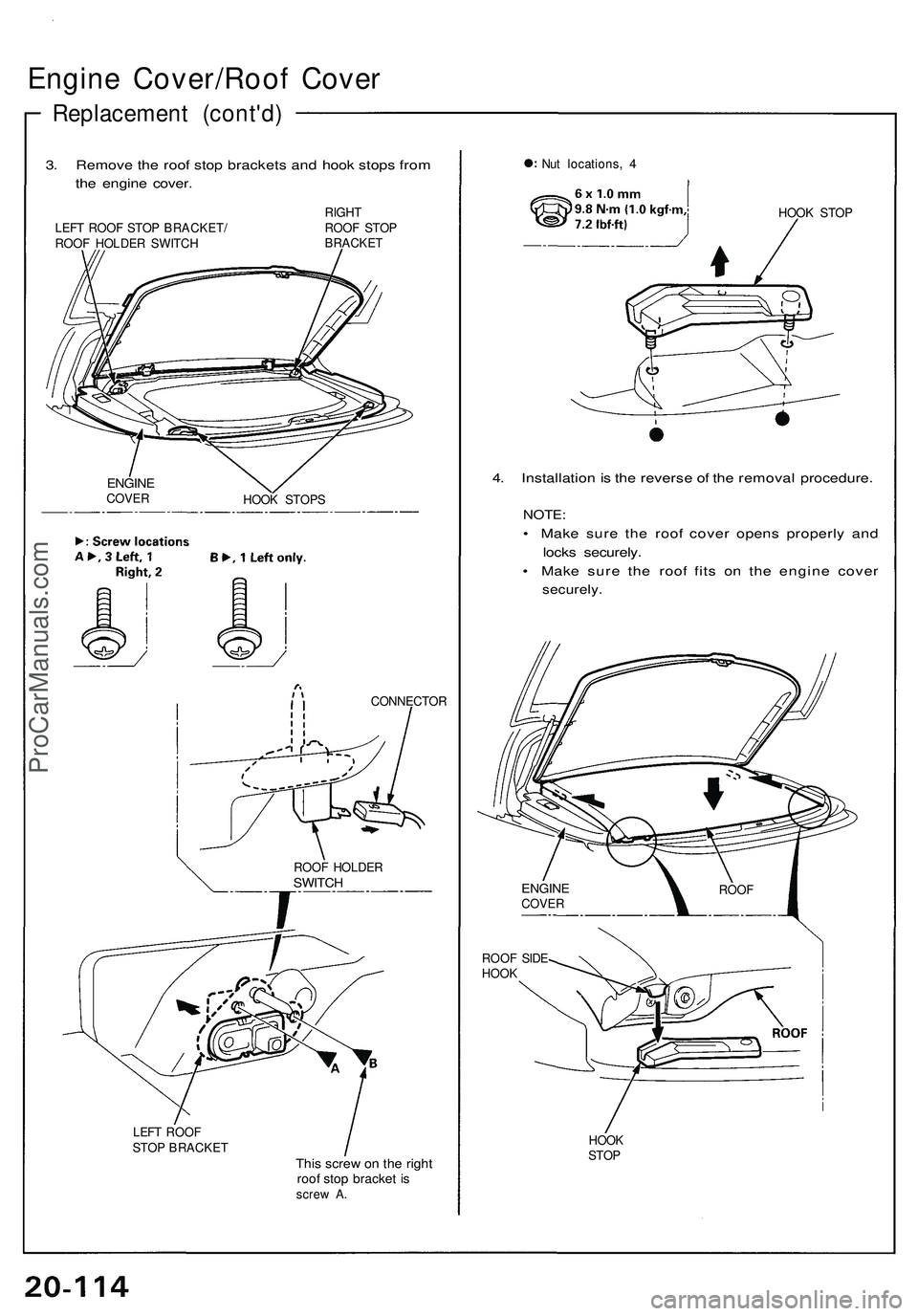
Engine Cover/Roo f Cove r
Replacemen t (cont'd )
3. Remov e th e roo f sto p bracket s an d hoo k stop s fro m
th e engin e cover .
LEFT ROO F STO P BRACKET /
ROO F HOLDE R SWITC H RIGH
T
ROO F STO PBRACKE T
ENGINECOVER
HOOK STOP S
CONNECTO R
LEF T ROO F
STO P BRACKE T
This scre w o n th e righ troof sto p bracke t i sscre w A . Nu
t locations , 4
HOOK STO P
4. Installatio n is th e revers e o f th e remova l procedure .
NOTE:
• Mak e sur e th e roo f cove r open s properl y an d
lock s securely .
• Mak e sur e th e roo f fit s o n th e engin e cove r
securely .
HOOK
STO P
ROO
F HOLDE R
SWITCH
ROOF SID E
HOO K
ENGIN ECOVER ROO
F
ProCarManuals.com
Page 1184 of 1503
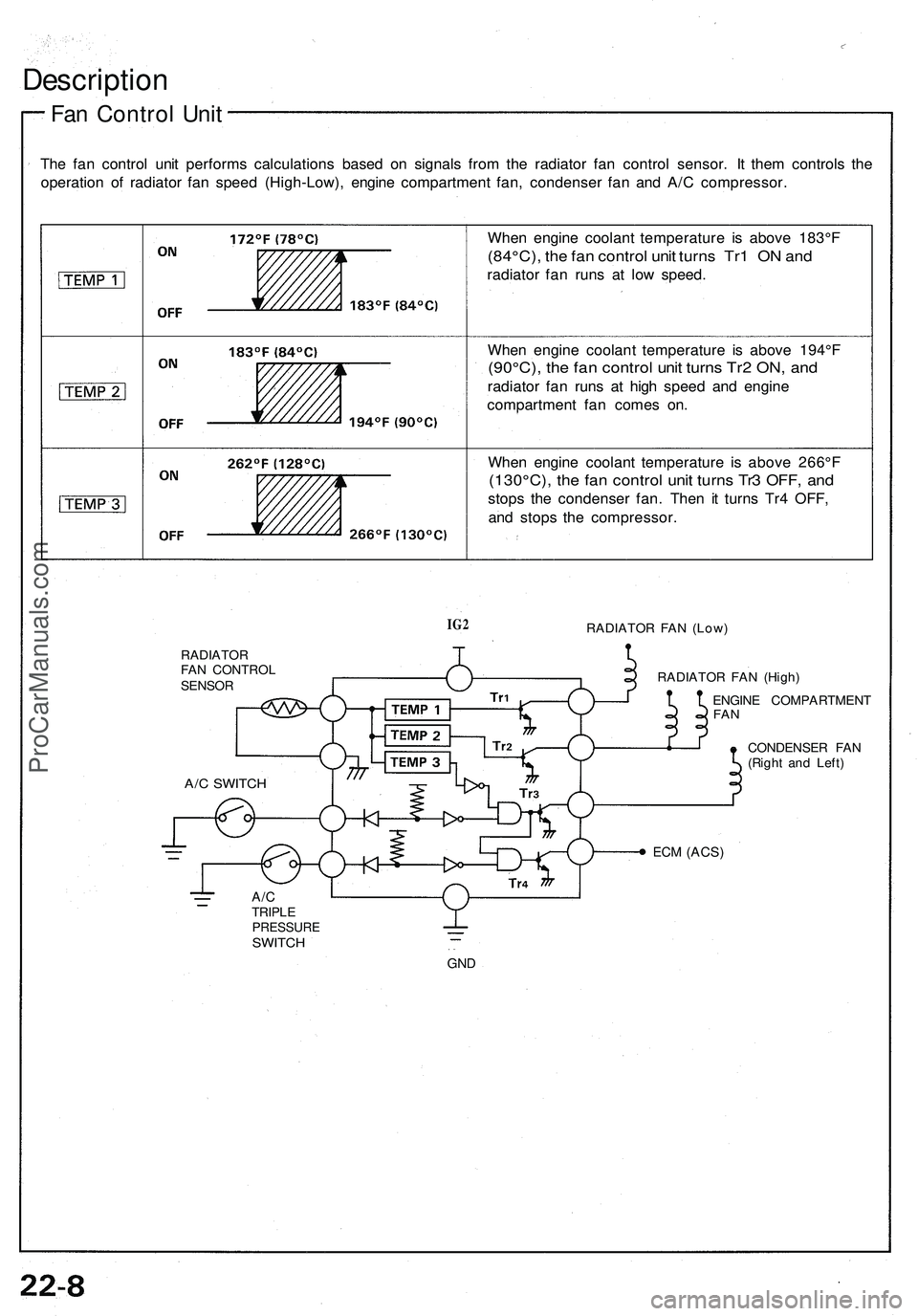
Description
Fan Control Unit
The fan control unit performs calculations based on signals from the radiator fan control sensor. It them controls the
operation of radiator fan speed (High-Low), engine compartment fan, condenser fan and A/C compressor.
When engine coolant temperature is above 183°F
(84°C), the fan control unit turns Tr1 ON and
radiator fan runs at low speed.
When engine coolant temperature is above 194°F
(90°C), the fan control unit turns Tr2 ON, and
radiator fan runs at high speed and engine
compartment fan comes on.
When engine coolant temperature is above 266°F
(130°C), the fan control unit turns Tr3 OFF, and
stops the condenser fan. Then it turns Tr4 OFF,
and stops the compressor.
IG2
RADIATOR FAN (Low)
RADIATOR
FAN CONTROL
SENSOR
RADIATOR FAN (High)
ENGINE COMPARTMENT
FAN
CONDENSER FAN
(Right and Left)
ECM
(ACS)
A/C
TRIPLE
PRESSURE
SWITCH
GND
A/C SWITCHProCarManuals.com
Page 1187 of 1503
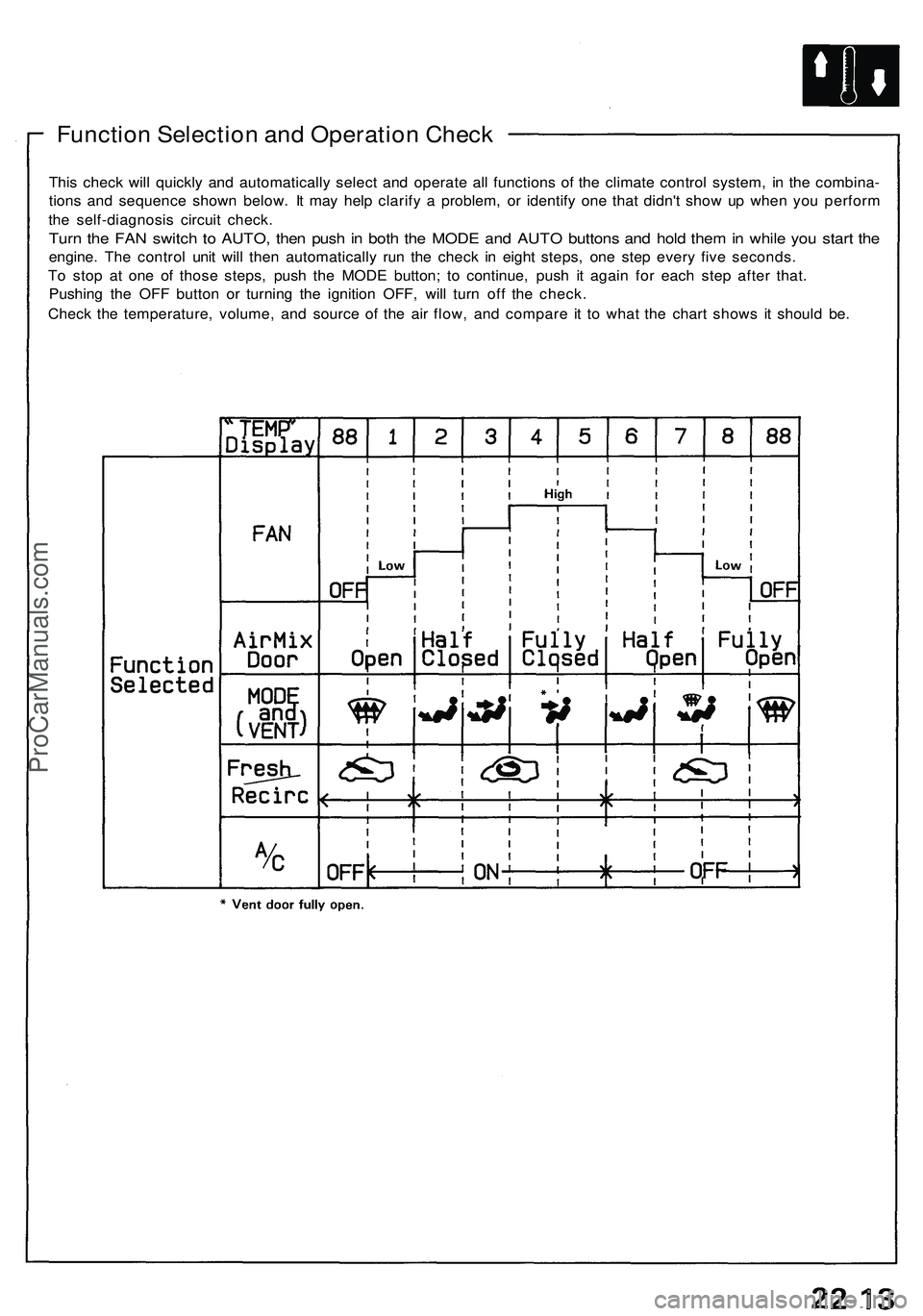
Function Selection and Operation Check
This check will quickly and automatically select and operate all functions of the climate control system, in the combina-
tions and sequence shown below. It may help clarify a problem, or identify one that didn't show up when you perform
the self-diagnosis circuit check.
Turn the FAN switch to AUTO, then push in both the MODE and AUTO buttons and hold them in while you start the
engine. The control unit will then automatically run the check in eight steps, one step every five seconds.
To stop at one of those steps, push the MODE button; to continue, push it again for each step after that.
Pushing the OFF button or turning the ignition OFF, will turn off the check.
Check the temperature, volume, and source of the air flow, and compare it to what the chart shows it should be.ProCarManuals.com
Page 1207 of 1503
A/C System Service
Performance Test
The performance test will help determine if the air con-
ditioning system is operating within specifications.
Only use service equipment that is U.L.-listed and is cer-
tified to meet the requirements of SAE J2210 to remove
HFC-134a (R-134a) from the air conditioning system.
CAUTION: Exposure to air conditioner refrigerant
and lubricant vapor or mist can irritate eyes, nose
and throat. Avoid breathing the air conditioner
refrigerant and lubricant vapor or mist.
If accidental system discharge occurs, ventilate work
area before resuming service.
R-134a service equipment or vehicle air conditioning sys-
tem should not be pressure tested or leak tested with
compressed air.
Some mixtures of air and R-134a have
been shown to be combustible at elevated pressures
and can result in fire or explosion causing injury or
property damage. Never use compressed air to pres-
sure test R-134a service equipment or vehicle air
conditioning systems.
Additional health and safety information may be obtained
from the refrigerant and lubricant manufacturers.
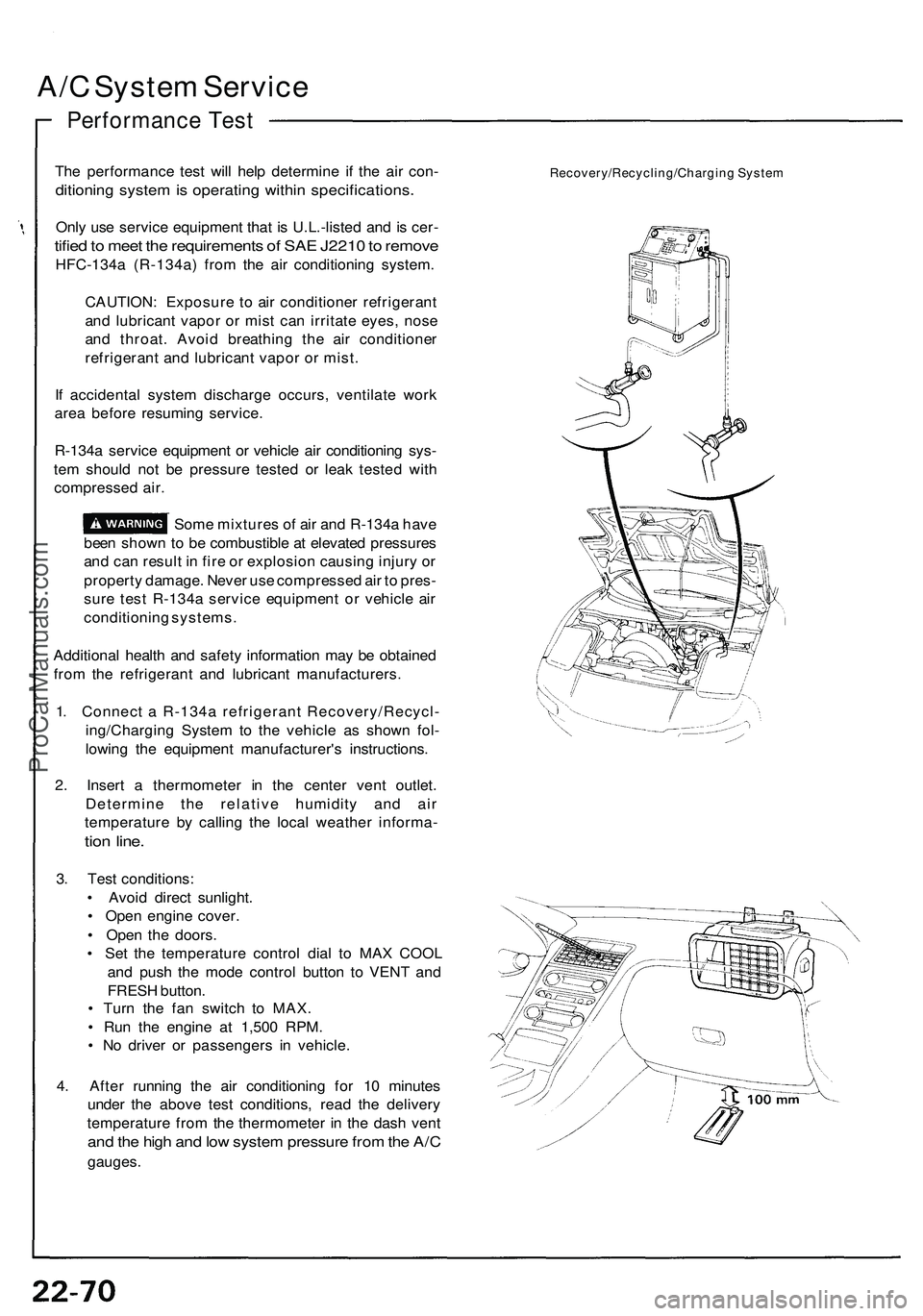
1. Connect a R-134a refrigerant Recovery/Recycl-
ing/Charging System to the vehicle as shown fol-
lowing the equipment manufacturer's instructions.
2. Insert a thermometer in the center vent outlet.
Determine the relative humidity and air
temperature by calling the local weather informa-
tion line.
3. Test conditions:
• Avoid direct sunlight.
• Open engine cover.
• Open the doors.
• Set the temperature control dial to MAX COOL
and push the mode control button to VENT and
FRESH button.
• Turn the fan switch to MAX.
• Run the engine at 1,500 RPM.
• No driver or passengers in vehicle.
4. After running the air conditioning for 10 minutes
under the above test conditions, read the delivery
temperature from the thermometer in the dash vent
and the high and low system pressure from the A/C
gauges.
Recovery/Recycling/Charging SystemProCarManuals.com
Page 1212 of 1503
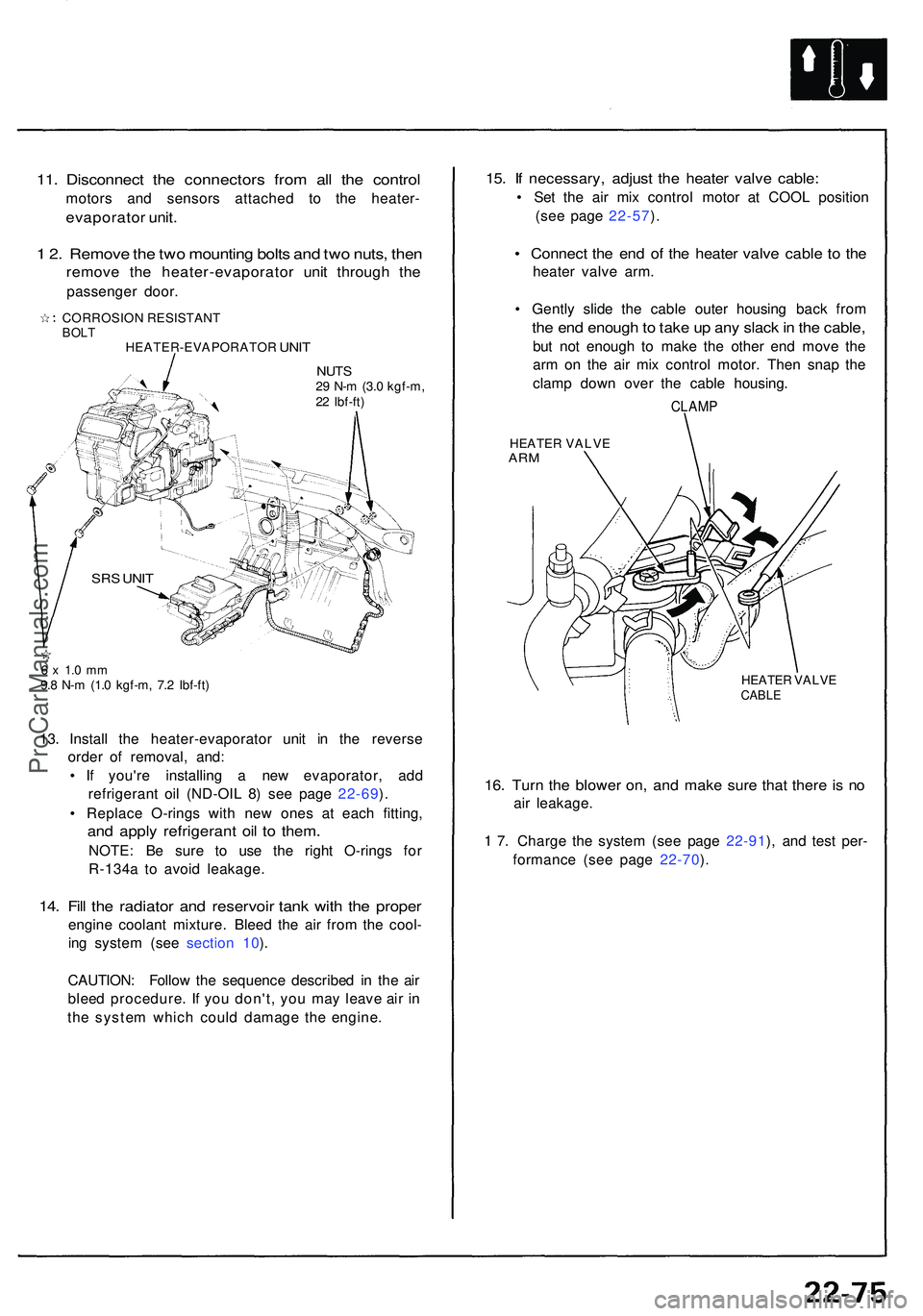
11. Disconnec t th e connector s fro m al l th e contro l
motors an d sensor s attache d t o th e heater -
evaporato r unit .
1 2 . Remov e th e tw o mountin g bolt s an d tw o nuts , the n
remov e th e heater-evaporato r uni t throug h th e
passenge r door .
CORROSIO N RESISTAN TBOLTHEATER-EVAPORATO R UNIT
NUT S29 N- m (3. 0 kgf-m ,
2 2 Ibf-ft )
6 x 1. 0 m m9.8 N- m (1. 0 kgf-m , 7. 2 Ibf-ft )
13. Instal l th e heater-evaporato r uni t i n th e revers e
orde r of removal , and :
• I f you'r e installin g a ne w evaporator , ad d
refrigeran t oi l (ND-OI L 8 ) se e pag e 22-69 ).
• Replac e O-ring s wit h ne w one s a t eac h fitting ,
and appl y refrigeran t oi l t o them .
NOTE : B e sur e t o us e th e righ t O-ring s fo r
R-134 a t o avoi d leakage .
14. Fil l th e radiato r an d reservoi r tan k wit h th e prope r
engine coolan t mixture . Blee d th e ai r fro m th e cool -
in g syste m (se e sectio n 10 ).
CAUTION : Follo w th e sequenc e describe d in th e ai r
blee d procedure . I f you don't , yo u ma y leav e ai r i n
th e syste m whic h coul d damag e th e engine .
15. I f necessary , adjus t th e heate r valv e cable :
• Se t th e ai r mi x contro l moto r a t COO L positio n
(se e pag e 22-57 ).
• Connec t th e en d o f th e heate r valv e cabl e t o th e
heate r valv e arm .
• Gentl y slid e th e cabl e oute r housin g bac k fro m
the en d enoug h to tak e u p an y slac k in th e cable ,
but no t enoug h t o mak e th e othe r en d mov e th e
ar m o n th e ai r mi x contro l motor . The n sna p th e
clam p dow n ove r th e cabl e housing .
CLAMP
HEATE R VALV EARM
HEATE R VALV ECABLE
16. Tur n th e blowe r on , an d mak e sur e tha t ther e is n o
air leakage .
1 7 . Charg e th e syste m (se e pag e 22-91 ), an d tes t per -
formanc e (se e pag e 22-70 ).
SR S UNI T
ProCarManuals.com