Test ACURA TL 1995 Service Repair Manual
[x] Cancel search | Manufacturer: ACURA, Model Year: 1995, Model line: TL, Model: ACURA TL 1995Pages: 1771, PDF Size: 62.49 MB
Page 1507 of 1771
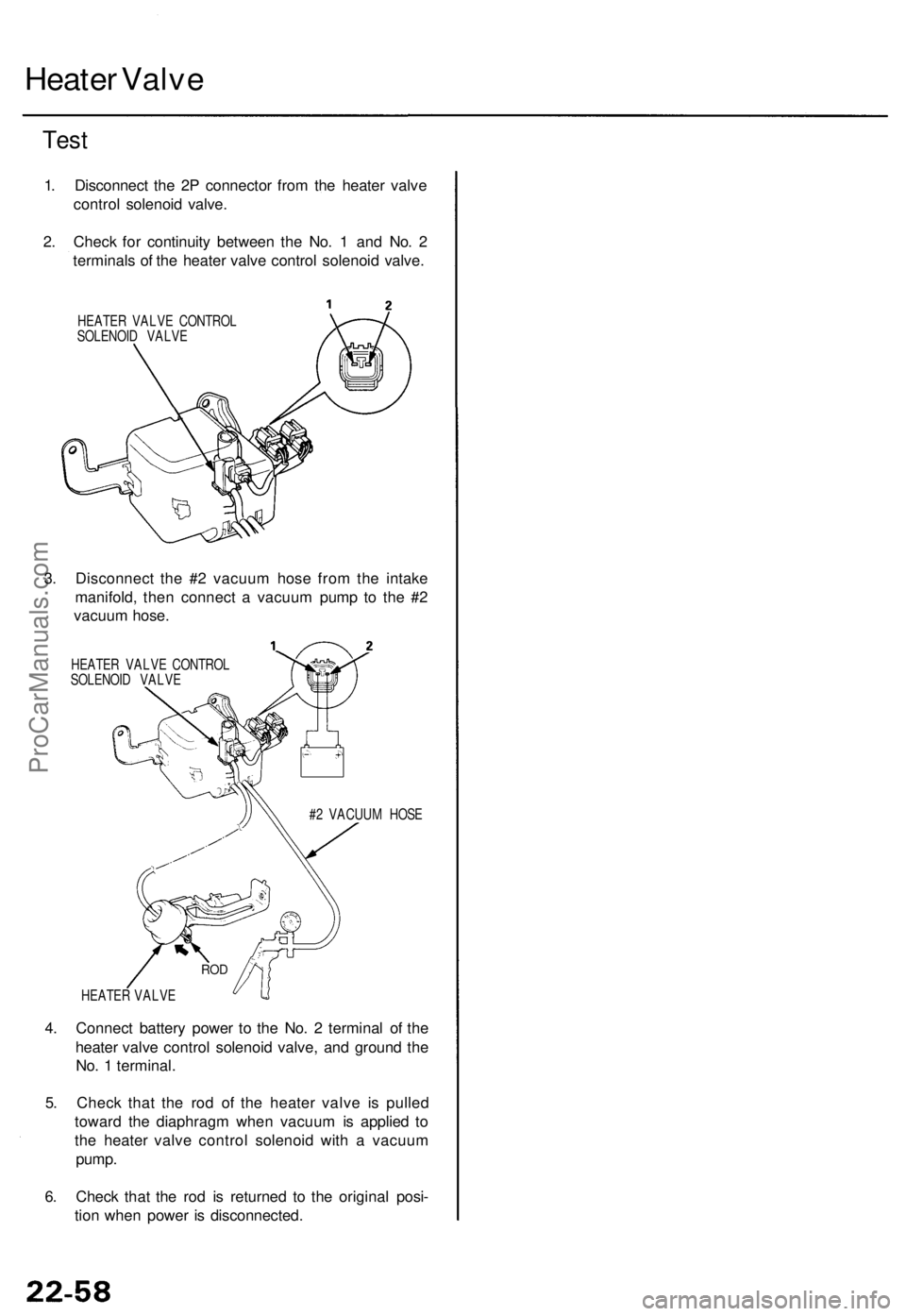
Heater Valve
Test
1. Disconnect the 2P connector from the heater valve
control solenoid valve.
2. Check for continuity between the No. 1 and No. 2
terminals of the heater valve control solenoid valve.
HEATER VALVE CONTROL
SOLENOID VALVE
3. Disconnect the #2 vacuum hose from the intake
manifold, then connect a vacuum pump to the #2
vacuum hose.
HEATER VALVE CONTROL
SOLENOID VALVE
#2 VACUUM HOSE
HEATER VALVE
4. Connect battery power to the No. 2 terminal of the
heater valve control solenoid valve, and ground the
No. 1 terminal.
5. Check that the rod of the heater valve is pulled
toward the diaphragm when vacuum is applied to
the heater valve control solenoid with a vacuum
pump.
6. Check that the rod is returned to the original posi-
tion when power is disconnected.
RODProCarManuals.com
Page 1510 of 1771
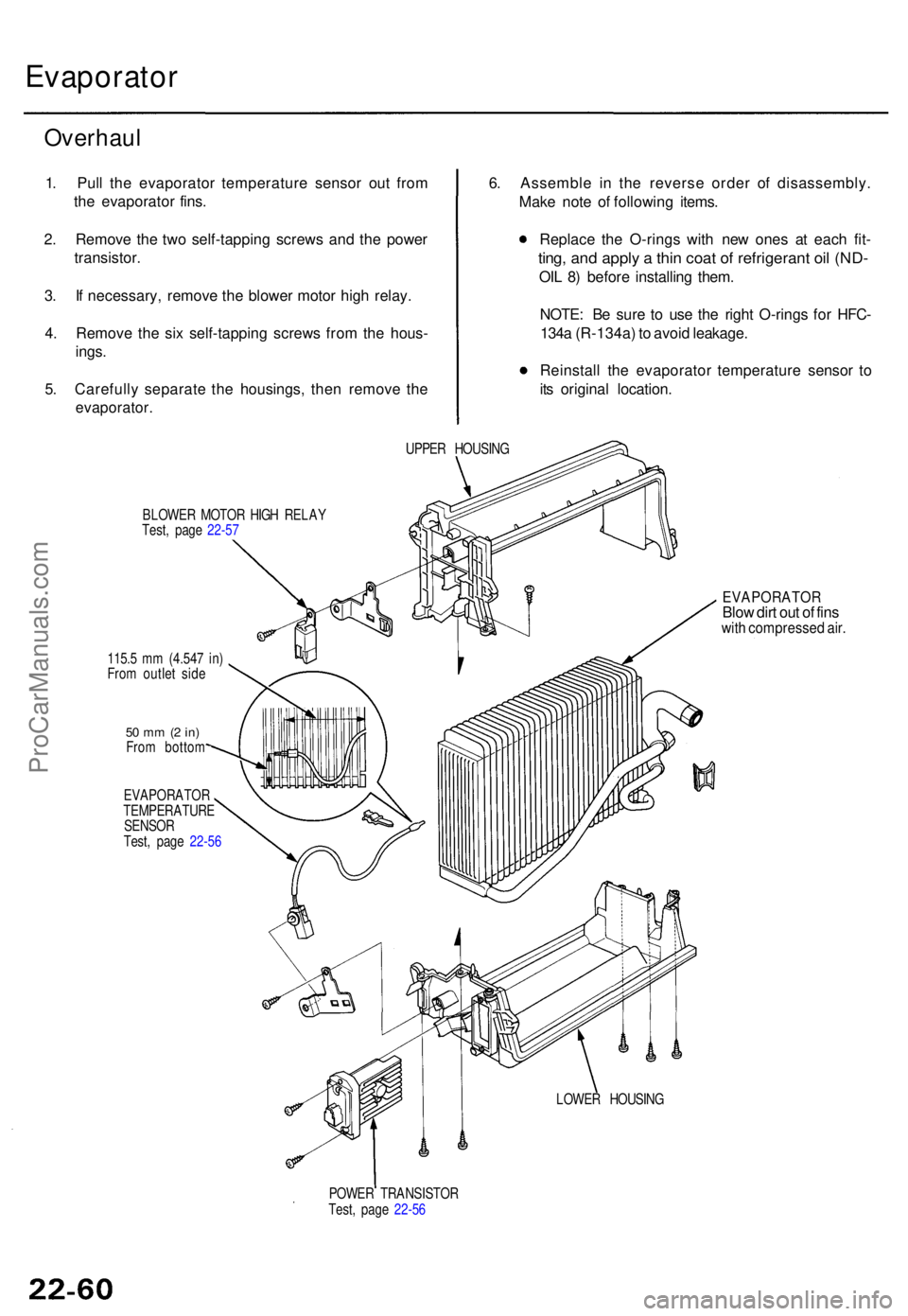
Evaporator
Overhaul
1. Pul l th e evaporato r temperatur e senso r ou t fro m
th e evaporato r fins .
2 . Remov e th e tw o self-tappin g screw s an d th e powe r
transistor .
3 . I f necessary , remov e th e blowe r moto r hig h relay .
4 . Remov e th e si x self-tappin g screw s fro m th e hous -
ings .
5 . Carefull y separat e th e housings , the n remov e th e
evaporator .
6. Assembl e i n th e revers e orde r o f disassembly .
Mak e not e o f followin g items .
Replac e th e O-ring s wit h ne w one s a t eac h fit -
ting , an d appl y a thi n coa t o f refrigeran t oi l (ND -
OIL 8 ) befor e installin g them .
NOTE : B e sur e t o us e th e righ t O-ring s fo r HFC -
134 a (R-134a ) t o avoi d leakage .
Reinstal l th e evaporato r temperatur e senso r t o
it s origina l location .
UPPER HOUSIN G
BLOWE R MOTO R HIG H RELA Y
Test , pag e 22-5 7
115. 5 m m (4.54 7 in )
Fro m outle t sid e
50 m m (2 in )Fro m botto m
EVAPORATO R
TEMPERATUR E
SENSO R
Test , pag e 22-5 6
EVAPORATO RBlow dir t ou t o f fin swit h compresse d air .
LOWE R HOUSIN G
POWE R TRANSISTO R
Test , pag e 22-5 6
ProCarManuals.com
Page 1516 of 1771
A/C Servic e Tip s an d Precaution s
The ai r conditione r syste m use s HFC-134 a (R-134a) refrigeran t and polyalkyleneglyco l (PAG ) refrigeran t oil*, whic h are no t
compatibl e wit h CFC-1 2 (R-12 ) refrigeran t an d minera l oil . D o no t us e R-1 2 refrigeran t o r minera l oi l i n thi s system , an d d o
no t attemp t t o us e R-1 2 servicin g equipment ; damag e t o th e ai r conditione r syste m o r you r servicin g equipmen t wil l result .
* DENS O ND-OIL8 :
P/N 3889 7 - PR 7 - A01AH : 12 0 ( 4 fl-oz , 4. 2 Imp-oz )
P/N 3889 9 - PR 7 - A01 : 4 0 ( 1 1/ 3 fl-oz , 1. 4 Imp-oz )
Us e onl y servic e equipmen t tha t i s U.L.-liste d an d i s certifie d t o mee t th e requirement s o f SA E J221 0 t o remov e R-134 a
fro m th e ai r conditione r system .
CAUTION : Exposur e t o ai r conditione r refrigeran t an d lubrican t vapo r o r mis t ca n irritat e eyes , nos e an d throat . Avoi d
breathin g th e ai r conditione r refrigeran t an d lubrican t vapo r o r mist .
I f accidenta l syste m discharg e occurs , ventilat e wor k are a befor e resumin g service .
R-134 a servic e equipmen t o r vehicl e ai r conditione r system s shoul d no t b e pressur e teste d o r lea k teste d wit h compresse d air .
Som e mixture s o f ai r an d R-134 a hav e bee n show n to b e combustibl e a t elevate d pressure s an d ca n resul t
i n fir e o r explosio n causin g injur y o r propert y damage . Neve r us e compresse d ai r t o pressur e tes t R-134 a servic e equip -
men t o r vehicl e ai r conditione r systems .
Additiona l healt h an d safet y informatio n ma y b e obtaine d fro m th e refrigeran t an d lubrican t manufacturers .
1 . Alway s disconnec t th e negativ e cabl e fro m th e batter y wheneve r replacin g ai r conditionin g parts .
2 . Kee p moistur e an d dus t ou t o f th e system . Whe n disconnectin g an y lines , plu g o r ca p th e fitting s immediately ; don' t
remov e th e cap s o r plug s unti l jus t befor e yo u reconnec t eac h line .
3 . Befor e connecting any hos e o r line , appl y a fe w drop s o f refrigeran t oi l t o th e O-ring .
4 . Whe n tightenin g o r loosenin g a fitting , us e a secon d wrenc h t o suppor t th e matchin g fitting .
5 . Whe n dischargin g th e system , us e a R-134 a refrigeran t Recovery/Recycling/Chargin g System ; don' t releas e refriger -
an t int o th e atmosphere .
6 . Ad d refrigeran t oi l afte r replacin g th e followin g parts :
NOTE :
To avoi d contamination , d o no t retur n th e oi l t o th e containe r onc e dispensed , an d neve r mi x i t wit h othe r refriger -
ant oils .
Immediatel y afte r usin g th e oil , replac e th e ca p o n th e container , an d sea l i t t o avoi d moistur e absorption .
D o no t spil l th e refrigeran t oi l o n th e vehicle ; i t ma y damag e th e paint ; i f th e refrigeran t oi l contact s th e paint , was h
i t of f immediately .
Condense r ....................................... . 2 5 (5/ 6 fl-oz , 0. 9 Imp-oz )
Evaporato r ....................................... . 5 0 ( 1 2/ 3 fl-oz , 1. 8 Imp-oz )
Lin e o r hos e ..................................... . 2 0 (2/ 3 fl-oz , 0. 7 Imp-oz )
Receiver/Drye r ................................ ..... 15(1/ 2(fl-oz , 0. 5 Imp-oz )
Leakag e repai r ................................ . 2 5 (5/ 6 fl-oz , 0. 9 Imp-oz )
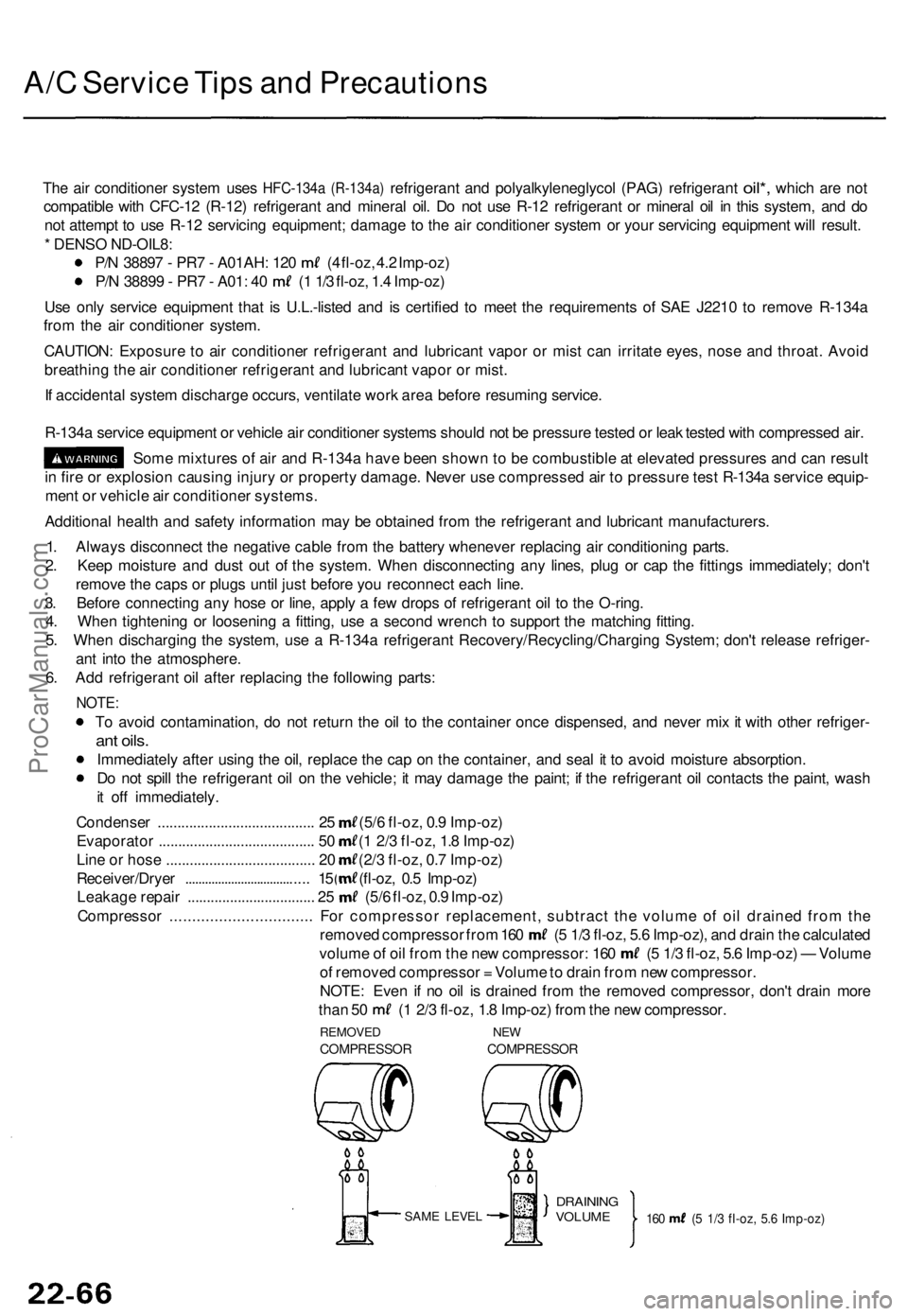
Compresso r ............................... . Fo r compresso r replacement , subtrac t th e volum e o f oi l draine d fro m th e
remove d compresso r fro m 16 0 ( 5 1/ 3 fl-oz , 5. 6 Imp-oz) , an d drai n th e calculate d
volume o f oi l fro m th e ne w compressor : 16 0 ( 5 1/ 3 fl-oz , 5. 6 Imp-oz ) — Volum e
o f remove d compresso r = Volum e to drai n fro m ne w compressor .
NOTE : Eve n i f n o oi l i s draine d fro m th e remove d compressor , don' t drai n mor e
than 5 0 ( 1 2/ 3 fl-oz , 1. 8 Imp-oz ) fro m th e ne w compressor .
REMOVED NE W
COMPRESSOR COMPRESSO R
SAME LEVE LDRAININ GVOLUME160 ( 5 1/ 3 fl-oz , 5. 6 Imp-oz )
ProCarManuals.com
Page 1518 of 1771
A/C Syste m Servic e
Performanc e Tes t
The performanc e tes t wil l hel p determin e i f th e ai r con -
ditione r syste m is operatin g withi n specifications .
Us e onl y servic e equipmen t tha t i s U.L.-liste d an d is cer -
tifie d t o mee t th e requirement s o f SA E J221 0 t o remov e
HFC-134 a (R-134a ) fro m th e ai r conditione r system .
CAUTION : Exposur e t o ai r conditione r refrigeran t an d
lubrican t vapo r o r mis t ca n irritat e eyes , nos e an d
throat . Avoi d breathin g th e ai r conditione r refrigeran t
an d lubrican t vapo r o r mist .
I f accidenta l syste m discharg e occurs , ventilat e wor k
are a befor e resumin g service .
R-134 a servic e equipmen t o r vehicl e ai r conditione r sys -
tem s shoul d no t b e pressur e teste d o r lea k teste d wit h
compresse d air .
Som e mixture s o f ai r an d R-134 a hav e bee n
show n to b e combustibl e a t elevate d pressure s an d ca n
resul t i n fir e o r explosio n causin g injur y o r propert y
damage . Neve r us e compresse d ai r t o pressur e tes t R -
134 a servic e equipmen t o r vehicl e ai r conditione r sys -
tems .
Additiona l healt h an d safet y informatio n ma y b e obtaine d
from th e refrigeran t an d lubrican t manufacturers .
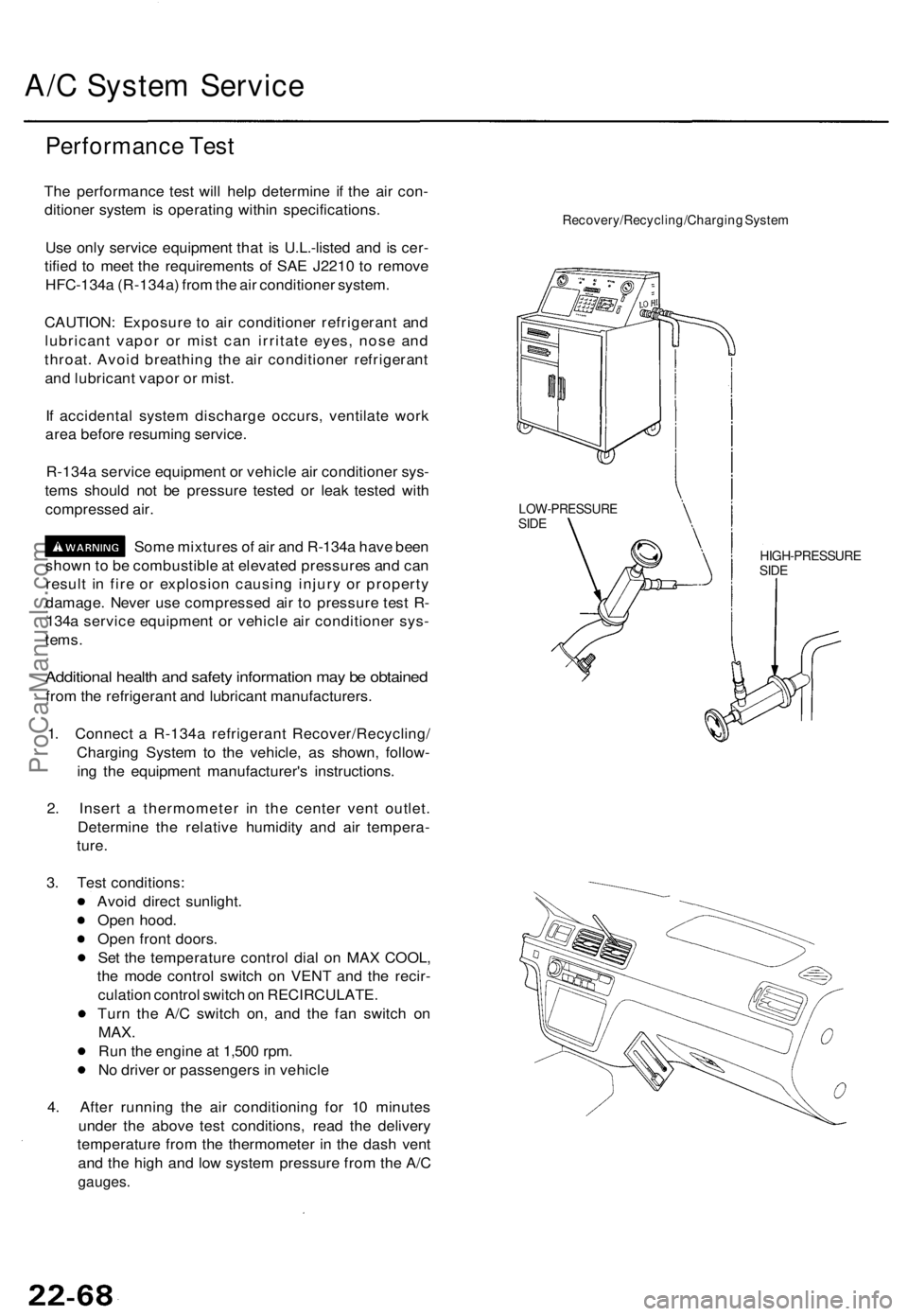
1 . Connec t a R-134 a refrigeran t Recover/Recycling /
Chargin g Syste m to th e vehicle , a s shown , follow -
in g th e equipmen t manufacturer' s instructions .
2 . Inser t a thermomete r i n th e cente r ven t outlet .
Determin e th e relativ e humidit y an d ai r tempera -
ture .
Recovery/Recycling/Chargin g Syste m
HIGH-PRESSUR ESIDE
3. Tes t conditions :
Avoi d direc t sunlight .
Ope n hood .
Ope n fron t doors .
Se t th e temperatur e contro l dia l o n MA X COOL ,
th e mod e contro l switc h o n VEN T an d th e recir -
culatio n contro l switc h o n RECIRCULATE .
Tur n th e A/ C switc h on , an d th e fa n switc h o n
MAX .
Run th e engin e a t 1,50 0 rpm .
N o drive r o r passenger s in vehicl e
4 . Afte r runnin g th e ai r conditionin g fo r 1 0 minute s
unde r th e abov e tes t conditions , rea d th e deliver y
temperatur e fro m th e thermomete r i n th e das h ven t
an d th e hig h an d lo w syste m pressur e fro m th e A/ C
gauges .
LOW-PRESSUR ESIDE
ProCarManuals.com
Page 1519 of 1771
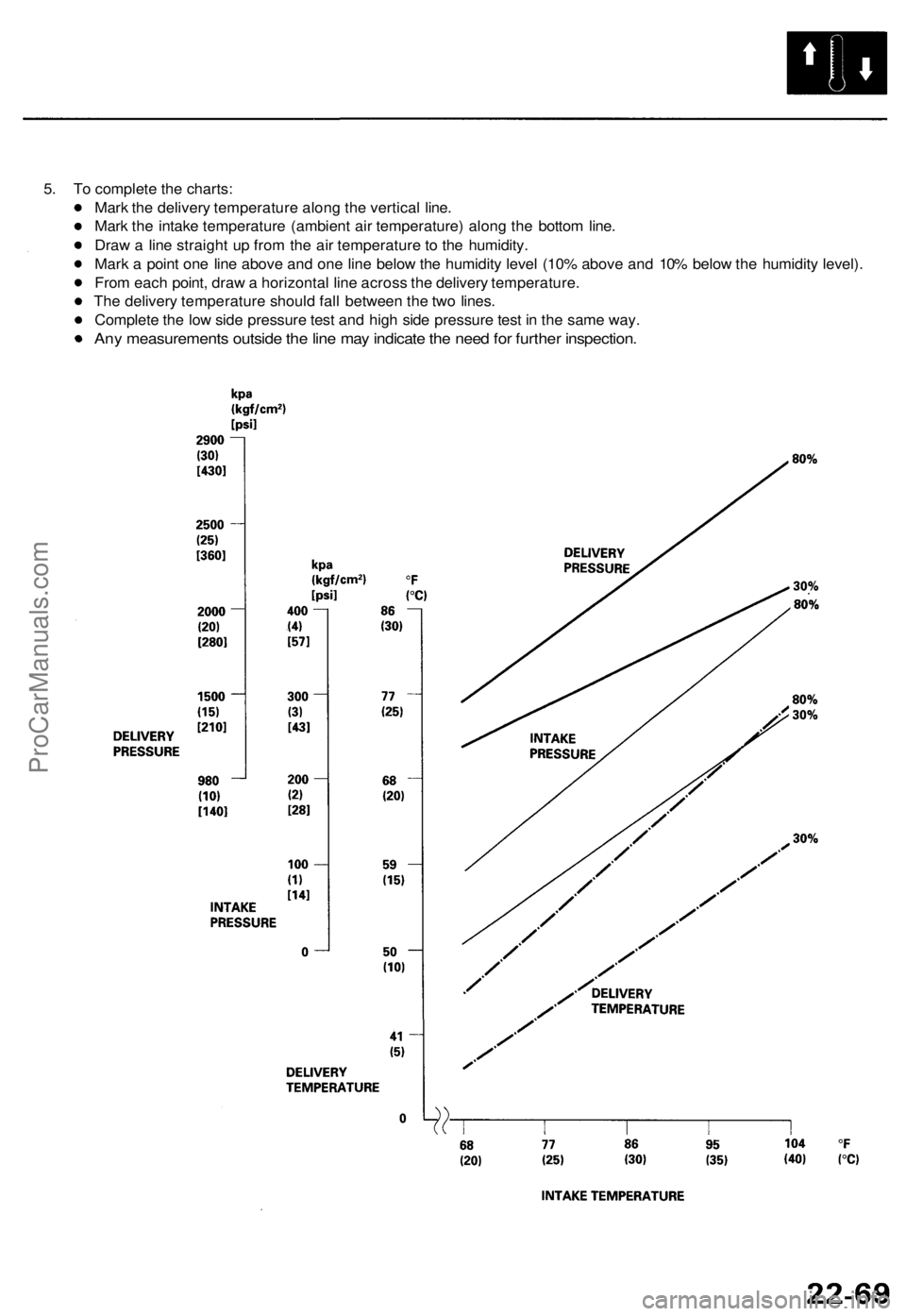
5. To complete the charts:
Mark the delivery temperature along the vertical line.
Mark the intake temperature (ambient air temperature) along the bottom line.
Draw a line straight up from the air temperature to the humidity.
Mark a point one line above and one line below the humidity level (10% above and 10% below the humidity level).
From each point, draw a horizontal line across the delivery temperature.
The delivery temperature should fall between the two lines.
Complete the low side pressure test and high side pressure test in the same way.
Any measurements outside the line may indicate the need for further inspection.ProCarManuals.com
Page 1520 of 1771
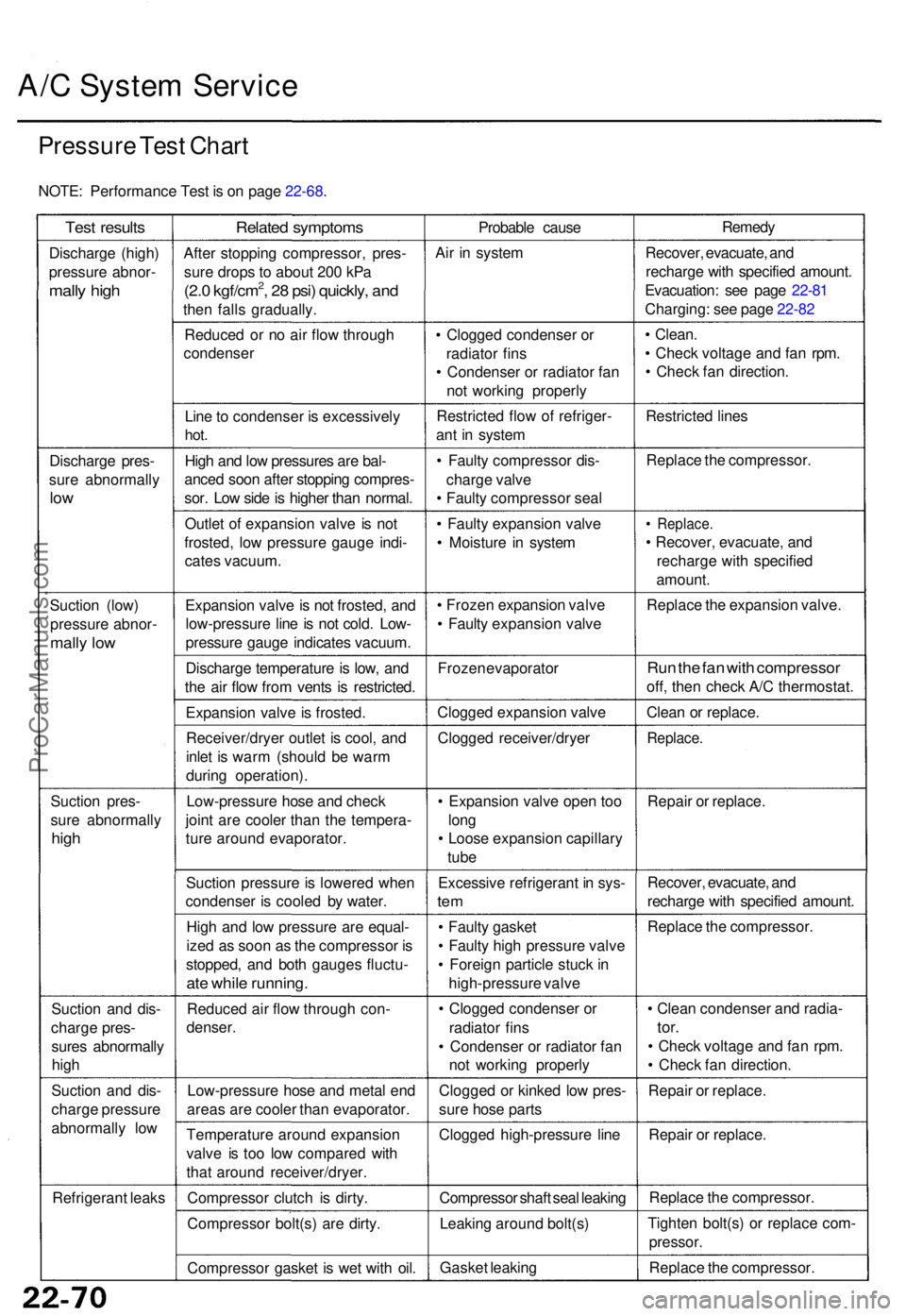
A/C Syste m Servic e
Pressur e Tes t Char t
NOTE : Performanc e Tes t i s o n pag e 22-68 .
Test result s
Discharg e (high )
pressur e abnor -
mally hig h
Discharg e pres -
sur e abnormall y
low
Suctio n (low )
pressur e abnor -
mally lo w
Suctio n pres -
sur e abnormall y
high
Suctio n an d dis -
charg e pres -
sure s abnormall y
hig h
Suctio n an d dis -
charg e pressur e
abnormall y lo w
Refrigeran t leak s
Relate d symptom s
After stoppin g compressor, pres-
sur e drop s t o abou t 20 0 kP a
(2.0 kgf/cm2, 2 8 psi ) quickly , an d
the n fall s gradually .
Reduce d o r n o ai r flo w throug h
condense r
Lin e to condense r i s excessivel y
hot.
Hig h an d lo w pressure s ar e bal -
ance d soo n afte r stoppin g compres -
sor . Lo w sid e is highe r tha n normal .
Outle t o f expansio n valv e is no t
frosted , lo w pressur e gaug e indi -
cate s vacuum .
Expansio n valv e is no t frosted , an d
low-pressur e lin e is no t cold . Low -
pressur e gaug e indicate s vacuum .
Discharg e temperatur e is low , an d
th e ai r flo w fro m vent s i s restricted .
Expansio n valv e is frosted .
Receiver/drye r outle t i s cool , an d
inle t i s war m (shoul d b e war m
durin g operation) .
Low-pressur e hos e an d chec k
join t ar e coole r tha n th e tempera -
tur e aroun d evaporator .
Suctio n pressur e is lowere d whe n
condense r i s coole d b y water .
Hig h an d lo w pressur e ar e equal -
ize d a s soo n a s th e compresso r i s
stopped , an d bot h gauge s fluctu -
ate whil e running .
Reduced ai r flo w throug h con -
denser .
Low-pressur e hos e an d meta l en d
area s ar e coole r tha n evaporator .
Temperatur e aroun d expansio n
valv e i s to o lo w compare d wit h
tha t aroun d receiver/dryer .
Compresso r clutc h i s dirty .
Compresso r bolt(s ) ar e dirty .
Compresso r gaske t i s we t wit h oil . Probabl
e caus e
Ai r i n syste m
• Clogge d condense r o r
radiato r fin s
• Condense r o r radiato r fa n
no t workin g properl y
Restricte d flo w o f refriger -
an t i n syste m
• Fault y compresso r dis -
charg e valv e
• Fault y compresso r sea l
• Fault y expansio n valv e
• Moistur e i n syste m
• Froze n expansio n valv e
• Fault y expansio n valv e
Froze n evaporato r
Clogge d expansio n valv e
Clogge d receiver/drye r
• Expansio n valv e ope n to o
lon g
• Loos e expansio n capillar y
tub e
Excessiv e refrigeran t i n sys -
tem
• Fault y gaske t
• Fault y hig h pressur e valv e
• Foreig n particl e stuc k in
high-pressur e valv e
• Clogge d condense r o r
radiato r fin s
• Condense r o r radiato r fa n
no t workin g properl y
Clogge d o r kinke d lo w pres -
sur e hos e part s
Clogge d high-pressur e lin e
Compresso r shaf t sea l leakin g
Leakin g aroun d bolt(s )
Gaske t leakin g Remed
y
Recover , evacuate , an d
recharg e wit h specifie d amount .
Evacuation : se e pag e 22-8 1
Charging : se e pag e 22-8 2
• Clean .
• Chec k voltag e an d fa n rpm .
• Chec k fa n direction .
Restricte d line s
Replac e th e compressor .
• Replace .
• Recover , evacuate , an d
recharg e wit h specifie d
amount .
Replac e th e expansio n valve .
Run th e fa n wit h compresso r
off, the n chec k A/ C thermostat .
Clea n o r replace .
Replace .
Repair o r replace .
Recover , evacuate , an d
recharg e wit h specifie d amount .
Replac e th e compressor .
• Clea n condense r an d radia -
tor.
• Chec k voltag e an d fa n rpm .
• Chec k fa n direction .
Repai r o r replace .
Repai r o r replace .
Replac e th e compressor .
Tighte n bolt(s ) o r replac e com -
pressor .
Replac e th e compressor .
ProCarManuals.com
Page 1521 of 1771
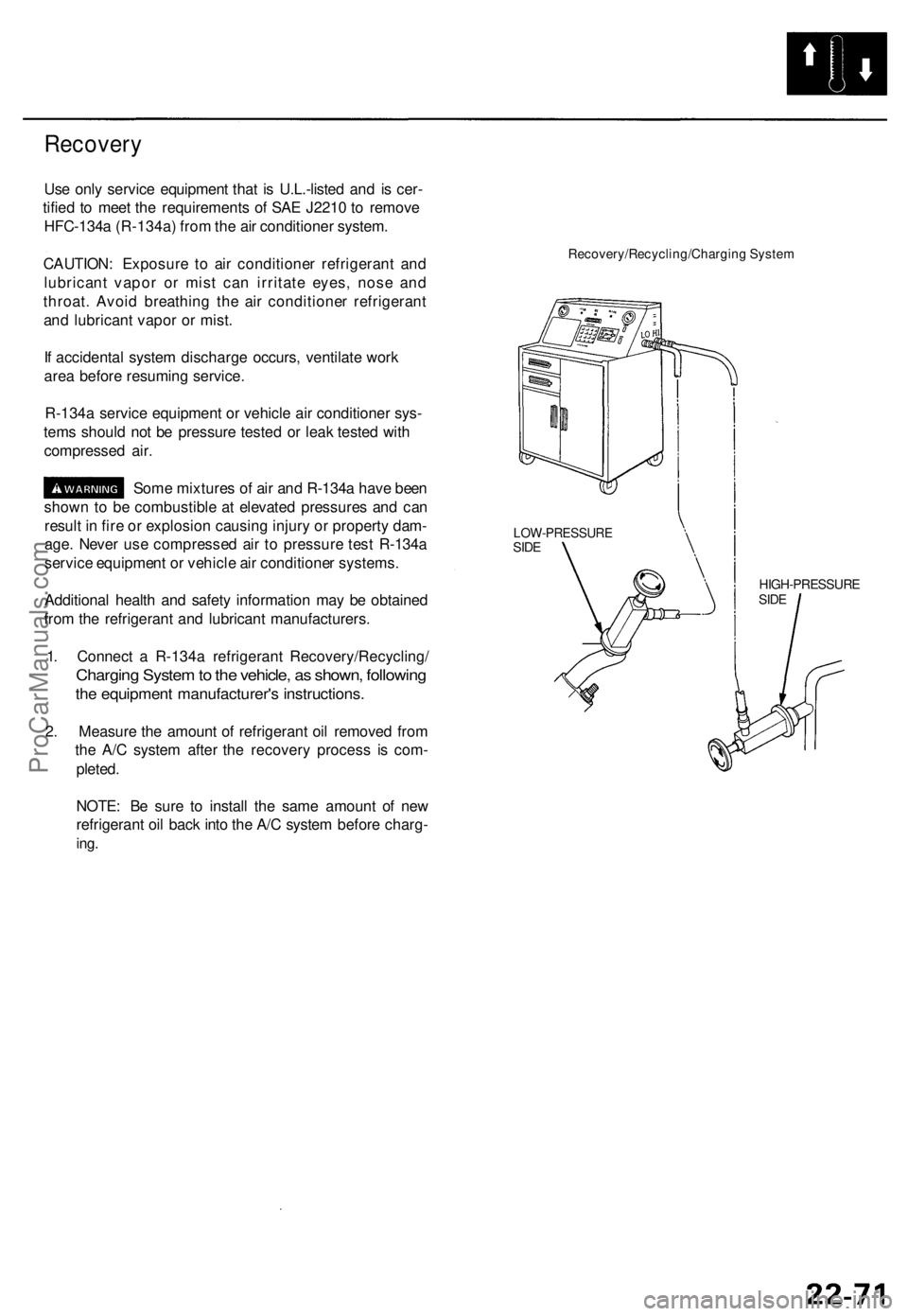
Recovery
Use only service equipment that is U.L.-listed and is cer-
tified to meet the requirements of SAE J2210 to remove
HFC-134a (R-134a) from the air conditioner system.
CAUTION: Exposure to air conditioner refrigerant and
lubricant vapor or mist can irritate eyes, nose and
throat. Avoid breathing the air conditioner refrigerant
and lubricant vapor or mist.
If accidental system discharge occurs, ventilate work
area before resuming service.
R-134a service equipment or vehicle air conditioner sys-
tems should not be pressure tested or leak tested with
compressed air.
Some mixtures of air and R-134a have been
shown to be combustible at elevated pressures and can
result in fire or explosion causing injury or property dam-
age. Never use compressed air to pressure test R-134a
service equipment or vehicle air conditioner systems.
Additional health and safety information may be obtained
from the refrigerant and lubricant manufacturers.
1. Connect a R-134a refrigerant Recovery/Recycling/
Charging System to the vehicle, as shown, following
the equipment manufacturer's instructions.
2. Measure the amount of refrigerant oil removed from
the A/C system after the recovery process is com-
pleted.
NOTE: Be sure to install the same amount of new
refrigerant oil back into the A/C system before charg-
ing.
Recovery/Recycling/Charging System
HIGH-PRESSURE
SIDE
LOW-PRESSURE
SIDEProCarManuals.com
Page 1532 of 1771
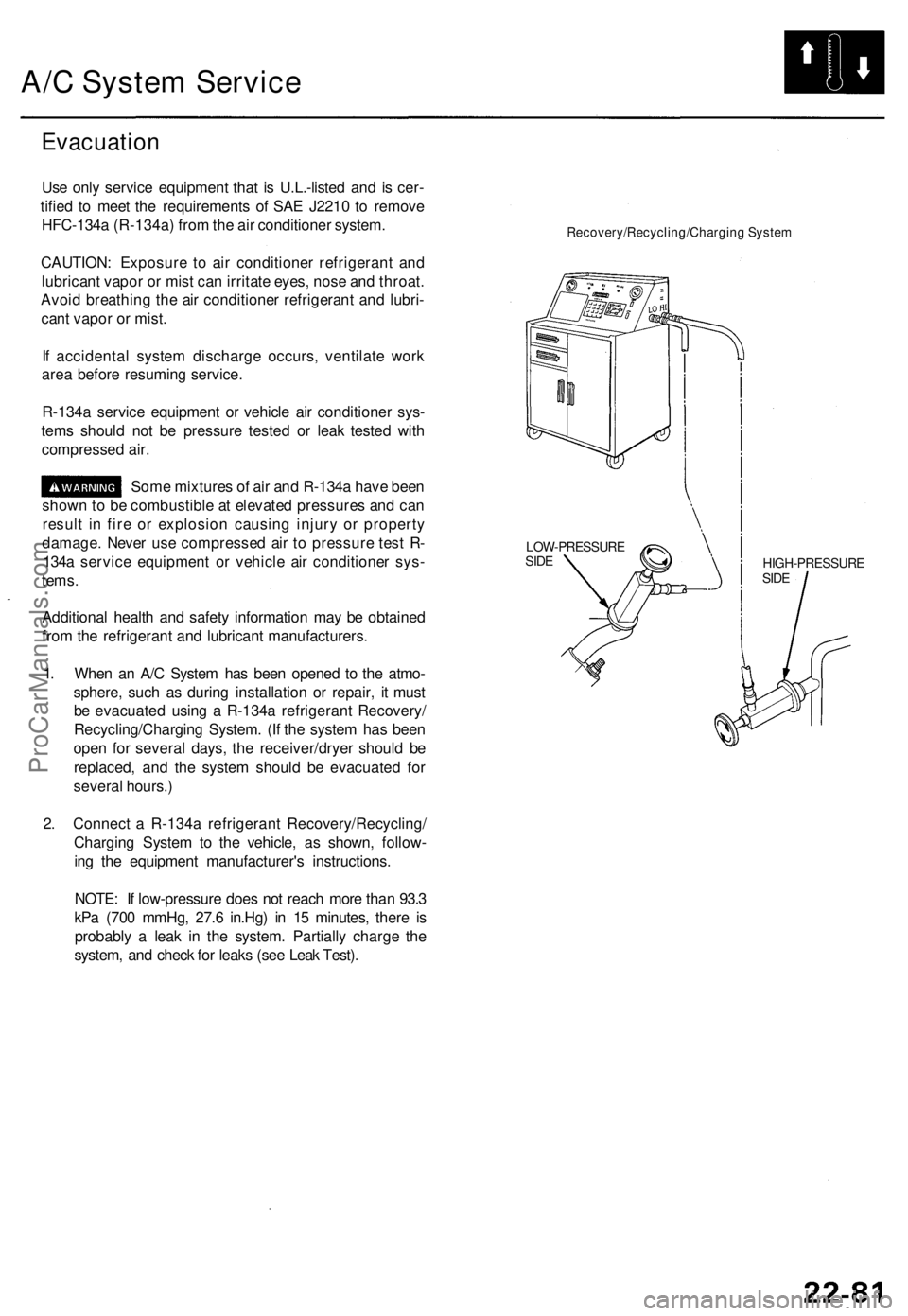
A/C System Service
Evacuation
Use only service equipment that is U.L.-listed and is cer-
tified to meet the requirements of SAE J2210 to remove
HFC-134a (R-134a) from the air conditioner system.
CAUTION: Exposure to air conditioner refrigerant and
lubricant vapor or mist can irritate eyes, nose and throat.
Avoid breathing the air conditioner refrigerant and lubri-
cant vapor or mist.
If accidental system discharge occurs, ventilate work
area before resuming service.
R-134a service equipment or vehicle air conditioner sys-
tems should not be pressure tested or leak tested with
compressed air.
Some mixtures of air and R-134a have been
shown to be combustible at elevated pressures and can
result in fire or explosion causing injury or property
damage. Never use compressed air to pressure test R-
134a service equipment or vehicle air conditioner sys-
tems.
Additional health and safety information may be obtained
from the refrigerant and lubricant manufacturers.
1. When an A/C System has been opened to the atmo-
sphere, such as during installation or repair, it must
be evacuated using a R-134a refrigerant Recovery/
Recycling/Charging System. (If the system has been
open for several days, the receiver/dryer should be
replaced, and the system should be evacuated for
several hours.)
2. Connect a R-134a refrigerant Recovery/Recycling/
Charging System to the vehicle, as shown, follow-
ing the equipment manufacturer's instructions.
NOTE: If low-pressure does not reach more than 93.3
kPa (700 mmHg, 27.6 in.Hg) in 15 minutes, there is
probably a leak in the system. Partially charge the
system, and check for leaks (see Leak Test).
Recovery/Recycling/Charging System
HIGH-PRESSURE
SIDE
LOW-PRESSURE
SIDEProCarManuals.com
Page 1534 of 1771
Leak Tes t
Use onl y servic e equipmen t tha t i s U.L.-liste d an d i s cer -
tified to mee t th e requirement s o f SA E J221 0 to remov e
HFC-134 a (R-134a ) fro m th e ai r conditione r system .
CAUTION : Exposur e t o ai r conditione r refrigeran t an d
lubrican t vapo r o r mis t ca n irritat e eyes , nos e an d throat .
Avoi d breathin g th e ai r conditione r refrigeran t an d lubri -
can t vapo r o r mist .
I f accidenta l syste m discharg e occurs , ventilat e wor k
are a befor e resumin g service .
R-134 a servic e equipmen t o r vehicl e ai r conditione r sys -
tem s shoul d no t b e pressur e teste d o r lea k teste d wit h
compresse d air .
Som e mixture s o f ai r an d R-134 a hav e
bee n show n t o b e combustibl e a t elevate d pressure s
an d ca n resul t i n fir e o r explosio n causin g injur y o r
propert y damage . Neve r us e compresse d ai r t o pressur e
tes t R-134 a servic e equipmen t o r vehicl e ai r conditione r
systems.
Additiona l healt h an d safet y informatio n ma y b e obtaine d
fro m th e refrigeran t an d lubrican t manufacturers .
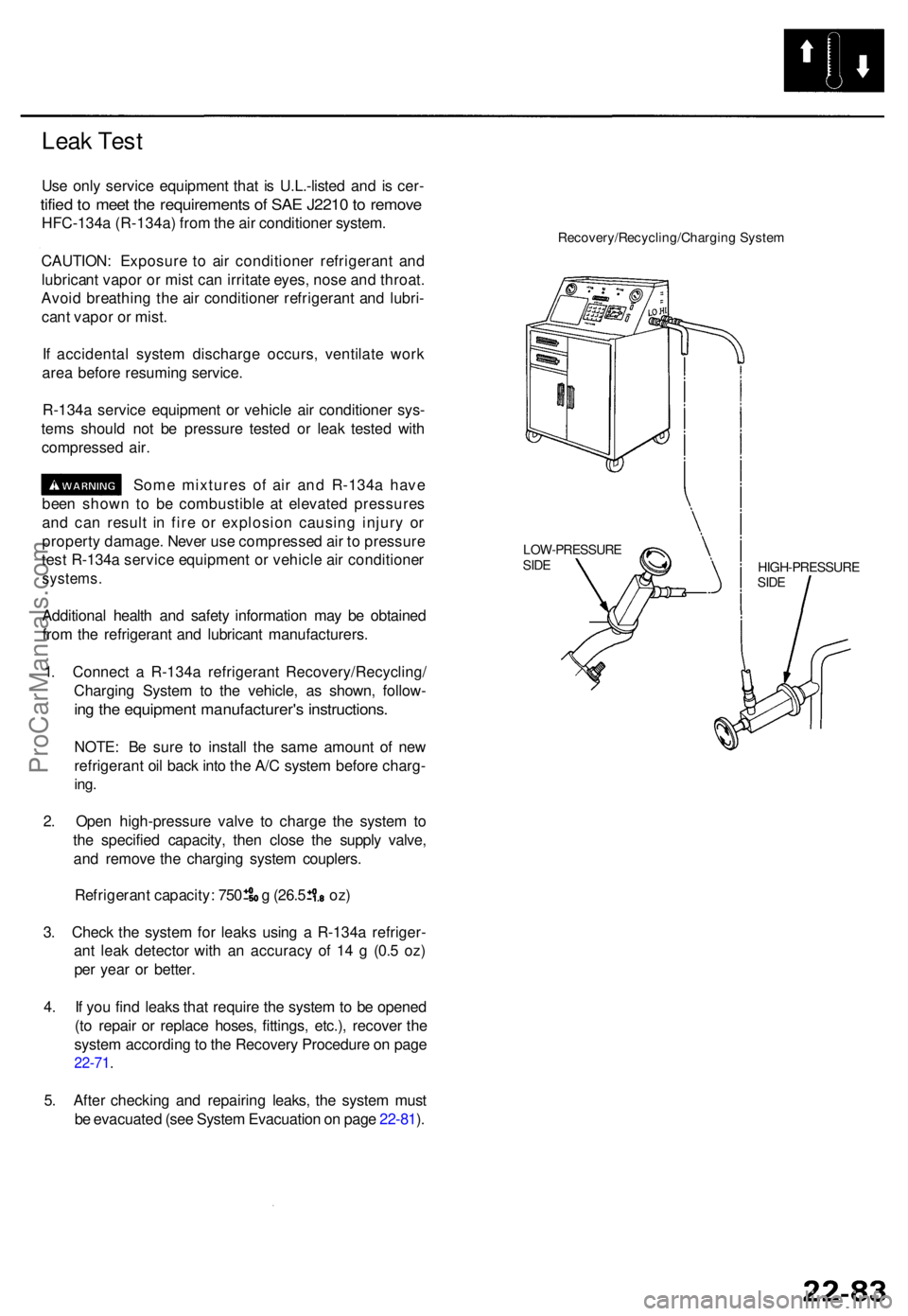
1 . Connec t a R-134 a refrigeran t Recovery/Recycling /
Chargin g Syste m to th e vehicle , a s shown , follow -
ing th e equipmen t manufacturer' s instructions .
NOTE: B e sur e t o instal l th e sam e amoun t o f ne w
refrigeran t oi l bac k int o th e A/ C syste m befor e charg -
ing.
2. Ope n high-pressur e valv e t o charg e th e syste m to
th e specifie d capacity , the n clos e th e suppl y valve ,
an d remov e th e chargin g syste m couplers .
Refrigeran t capacity : 75 0 g (26.5 oz )
3 . Chec k th e syste m fo r leak s usin g a R-134 a refriger -
an t lea k detecto r wit h a n accurac y o f 1 4 g (0. 5 oz )
pe r yea r o r better .
4 . I f yo u fin d leak s tha t requir e th e syste m to b e opene d
(t o repai r o r replac e hoses , fittings , etc.) , recove r th e
syste m accordin g to th e Recover y Procedur e o n pag e
22-71 .
Recovery/Recycling/Chargin g Syste m
HIGH-PRESSUR ESIDE
5. Afte r checkin g an d repairin g leaks , th e syste m mus t
b e evacuate d (se e Syste m Evacuatio n o n pag e 22-81 ).
LOW-PRESSUR ESIDE
ProCarManuals.com
Page 1537 of 1771
Troubleshooting
Tips and Precautions (cont'd)
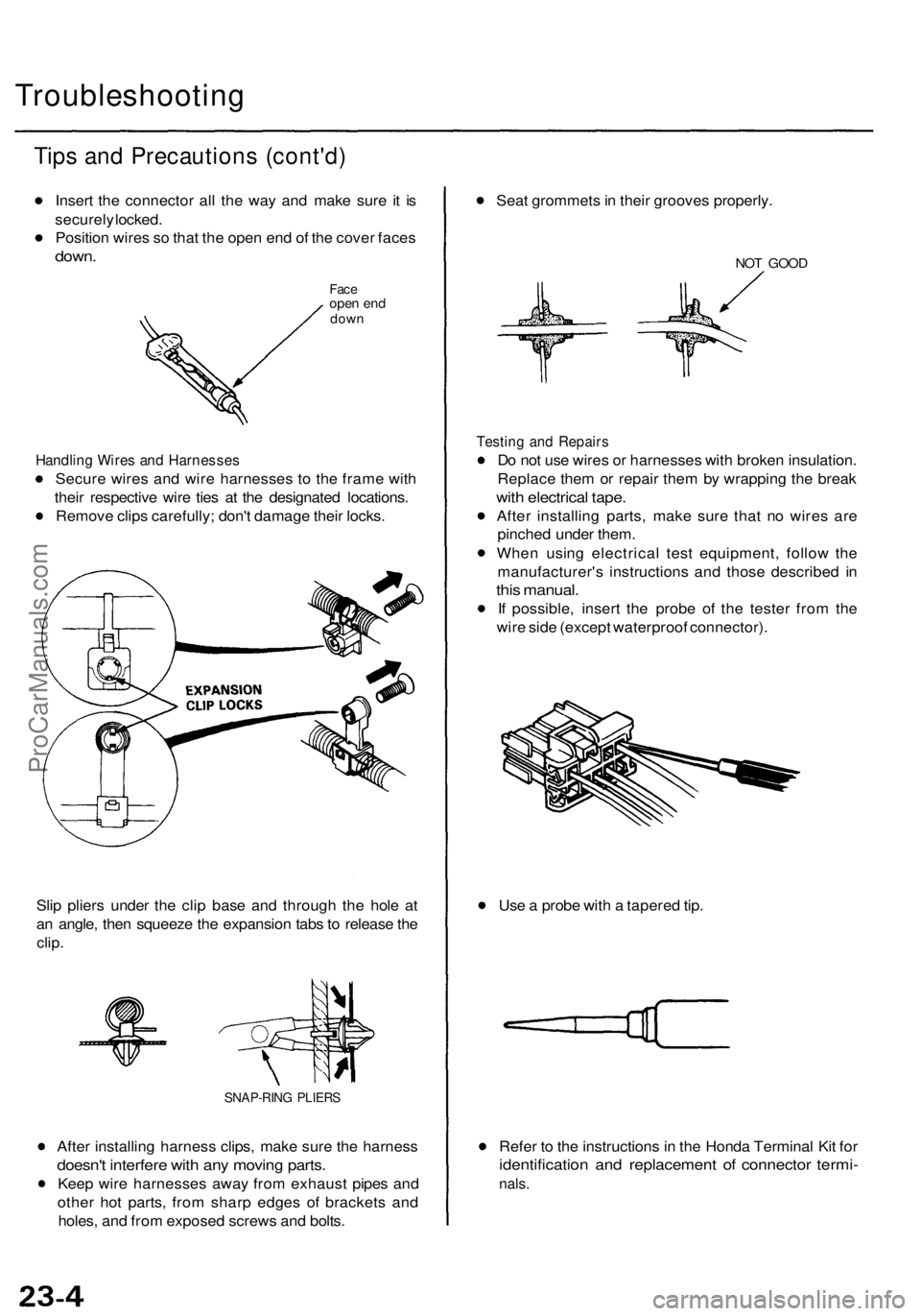
Insert the connector all the way and make sure it is
securely locked.
Position wires so that the open end of the cover faces
down.
Face
open end
down
Handling Wires and Harnesses
Secure wires and wire harnesses to the frame with
their respective wire ties at the designated locations.
Remove clips carefully; don't damage their locks.
Slip pliers under the clip base and through the hole at
an angle, then squeeze the expansion tabs to release the
clip.
SNAP-RING PLIERS
After installing harness clips, make sure the harness
doesn't interfere with any moving parts.
Keep wire harnesses away from exhaust pipes and
other hot parts, from sharp edges of brackets and
holes, and from exposed screws and bolts.
Seat grommets in their grooves properly.
NOT GOOD
Testing and Repairs
Do not use wires or harnesses with broken insulation.
Replace them or repair them by wrapping the break
with electrical tape.
After installing parts, make sure that no wires are
pinched under them.
When using electrical test equipment, follow the
manufacturer's instructions and those described in
this manual.
If possible, insert the probe of the tester from the
wire side (except waterproof connector).
Use a probe with a tapered tip.
Refer to the instructions in the Honda Terminal Kit for
identification and replacement of connector termi-
nals.ProCarManuals.com