Check AUDI Q7 2013 Owner´s Manual
[x] Cancel search | Manufacturer: AUDI, Model Year: 2013, Model line: Q7, Model: AUDI Q7 2013Pages: 348, PDF Size: 87.72 MB
Page 244 of 348
242 Trailer towing
Weight Rating will also change the per
formance and handling characterist ics of
your vehicle, which could cause a crash result ing in serious injury or death .
- The Gross Vehicle Weight Rat ing for your
vehicle would be exceeded if your vehicle
is simultaneously equipped with Panor
am ic sliding sunroof; th ird-row seating;
t railer towing equipment (factory or
dealer-installed) , and running boards
(deale r-installed) . UNDER NO CIRCUM
STANCES MAY ALL SUCH ITEMS BE IN
STALLED ON THE SAME VEHICLE.
Operating instructions
MAX 6.9"
MAX175mm
E
Ill E Ill ... Q) m
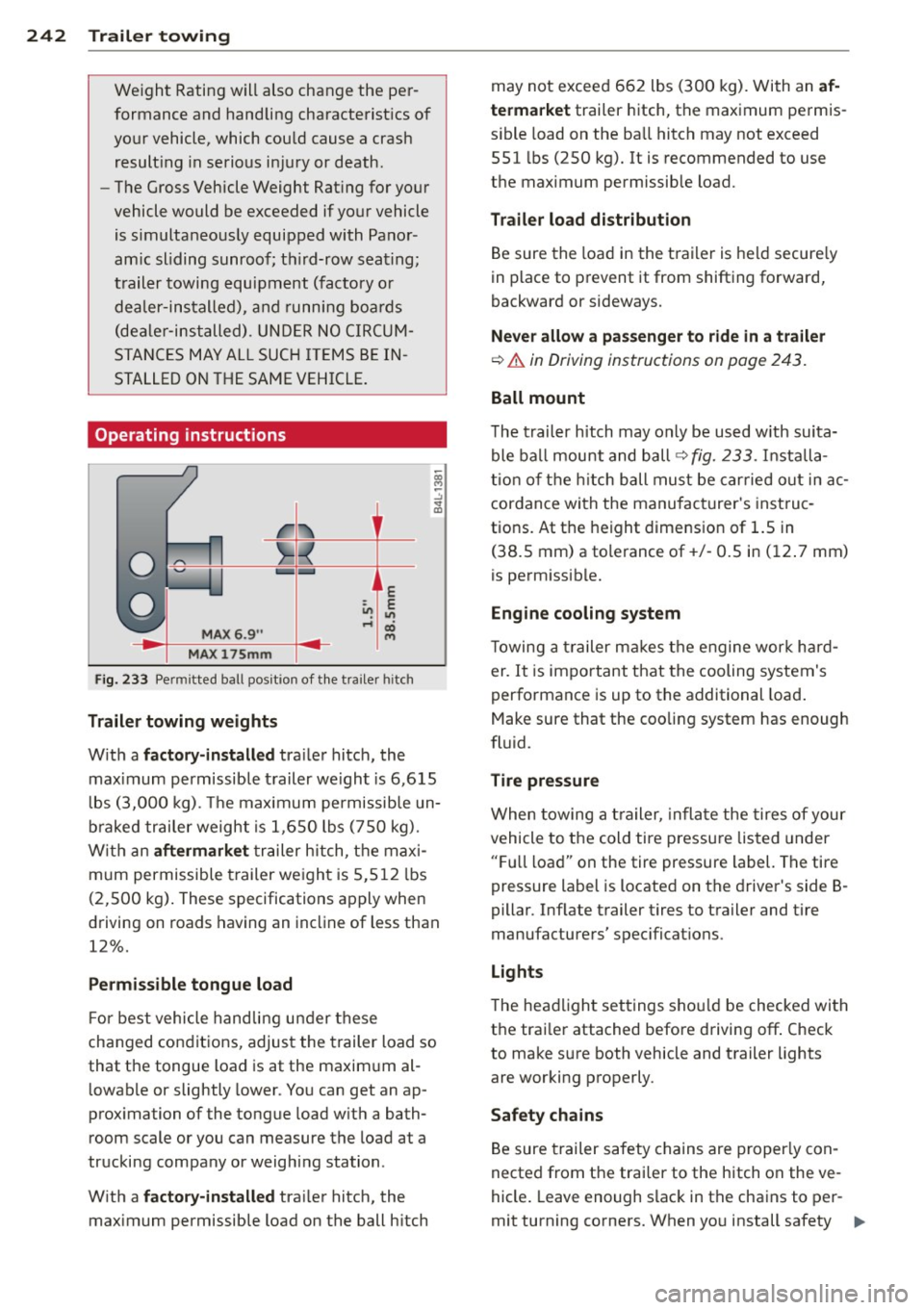
Fig. 233 Permi tted ba ll pos it ion of t he t ra iler h itc h
Trailer towing weights
With a factory-installed trailer hitch, the
maximum permissible trailer weight is 6,615
l bs (3,000 kg) . Th e maximum permissible un
braked trailer weight is 1,650 lbs (750 kg).
With an
aftermarket trailer hitch, the maxi
m um permissible trailer weight is 5,512 lbs
(2,500 kg) . These specifications apply when
driving on roads having an incline of less than
12%.
Permissible tongue load
F or best vehicle handling under these
changed condit ions, adjust the trailer load so
that the tongue load is at the maximum al
lowable or slightly lower . You can get an ap
prox imation of the tongue load w ith a bath
room scale or you can measure the load at a
trucking company or weighing station .
With a
factory-installed trailer hitch, the
maximum permissible load on the ball h itch may not exceed 662 lbs
(300 kg). With an
af
termarket
trailer hitch, the maximum permis
s ib le load on the ba ll hitch may not exceed
551 lbs (250 kg). It is recommended to use
the maximum permissible load.
Trailer load distribution
Be sure the load in the trailer is held secure ly
in place to prevent it from shifting forward,
backward or sideways.
Never allow a passenger to ride in a trailer
¢&. in Driving instructions on page 243.
Ball mount
The trailer hitch may only be used w ith suita
ble ball mount and ball¢
fig. 233. In stalla
tion of the hitch ball must be carried out in ac
cordance with the manufac turer's instruc
tions. At the height dimension of 1.5 in
(38.5 mm) a tolerance of +/- 0.5 in (12. 7 mm)
is permissib le.
Engine cooling system
Towing a trailer makes the engine work ha rd
er . It is important that the cooling system's
performance is up to the additional load .
Make sure that the cooling system has enough
fluid .
Tire pressure
When towing a trailer, infla te the tires of your
vehicle to the cold tire pressu re listed under
" Full l oad" on the tire pressure label. The tire
pressure label is located on the driver's side B
pillar . Inflate trailer tires to trailer and tire
manufacturers' spec ificat ions .
Lights
The headlight settings shou ld be checked with
the trai ler attached before driving
off. Check
to make sure both vehicle and trailer lights
are working properly.
Safety chains
Be sure trailer safety chains are properly con
nected from the trai ler to the h itch on the ve
hicle. Leave enough slack in the chains to per
mit turning corners. When you install safety
IJ,,
Page 252 of 348
250 Cleaning and protec tio n
Cast (light) alloy wheels
Cast (light) alloy wheels require special care .
• Wash the whee ls with a sponge or hose
brush every other week.
• For deep cleaning afterwards, use only a
dedicated
aci d-fr ee cast alloy wheel cleaner .
• Rub a coat of
liq uid wax onto the r ims every
t h ree months. Be su re to reach and treat all
parts of the rim .
To preserve the decorat ive appearance of the
cast alloy whee ls, some specia l care is neces
sa ry. In addit ion to road dirt and sa lt, b rake
d ust is a lso corros ive. If left on for too long,
b rake dust can cause pitting.
Use only specia l
acid-free cleaners formulated
for a lloy rims . Safe p roducts are available at
your author ized Audi dealer. Never leave the
cleane r on the rims longe r than specified on
the label. If not rinsed off promptly, the acid
contained in some cleaners can attack the
threads on the whee l bolts.
Never use ab rasive or metal polishing clean
ing agents. If the protective coating has been
chipped, e .g. by k icked up road dirt, touch it
up as soon as possible.
A WARNING
- Moisture and ice on brakes may affect
braking efficiency¢
page 228, General
information.
Test the brakes carefully
each time you wash the veh icle .
- Always read and heed all WARNINGS and
other information
¢ page 245.
-
Body cavity sealing
The body cavity sealing does no t need to be
checked.
A ll body cavities which co uld be affected by
corrosion have been thoro ughly protected at
the factory.
This sealing does not require any inspection or
addit ional treatment . If any wax should seep
out of the cav ity when the ambient tempera- ture is high, it can be removed with a p
lastic
scraper and a suitable solvent.
A WARNING
-Solvents can be dangerous.
- Benzine is flammab le and toxic. If you
use benzine for removing the wax, keep
sparks, flame and lighted cigarettes
away. Never dump benz ine on the
ground, into open streams or down sew
age drains.
- Be sure to observe all safety and environ
mental regulat ions . Follow all instruc
tions on the container .
- Always read and heed all WARNINGS and
other information ¢
page 245.
, Chassis
Have the undercoating checked for damage
from time to time.
The lower body shell of your Audi is also thor
oughly protected against corros ion.
Any damage to the undercoating caused by road hazards should be repaired prompt ly .
A WARNING
Too much undercoating in the wrong p la
ces can cause a fire.
- Do not app ly additional undercoating or
r u stproof ing on or near the exhaust
manifold, exhaust pipes, catalytic con
verter or heat shields. While driving, the substance used for undercoating could
overheat and cause a fire.
'
- Always read and heed all WARNINGS and
other information ¢
page 245.
Exhaust tail pipes
Road salt and other corrosive materials will
damage the material in the exhaust tail pipes
if they are not cleaned regularly. Do not clean
the tail pipes with wheel cleaner, pa int polish,
chrome polish or other ab rasive cleaners.
Clean the tail pipes with car care products
that are suitable for stainless steel.
Page 256 of 348
254 Cleaning and protec tio n
- Leather cleaning and care kit
- Creams to care for colored leather
- Spot removers for ballpo int pens, shoe pol-
ish, etc .
- Oil/grease dissolving spray
- New and upcoming products.
A WARNING
Always read and heed all WARNINGS and
other information
~ page 245.
{[) Note
-Never use chemical solvents (e.g. lighter
fluid, turpentine), waxes, shoe pol ish or
s imilar products on the leather surfaces
i n your Audi.
- To avoid damage, have stubborn stai ns
removed by a commerc ial cleaning spe
cia list.
Cleaning Alcantara ® (synthetic suede)
App lies to vehicles : wit h Alca nta ra up holstery
Removing dust and dirt
"" Moisten a clot h, squeeze out excess water
and w ipe down the seat s urf aces.
Removing stains
"" Moisten a clot h w ith lukewarm water or
with diluted
ethyl (rubb ing) alcohol.
"" Dab at the stain. Start at the o utside and
wor k inwards.
"" Once t he stain is no longer v isib le , use a
soft dry cloth or t issue to soak up the mois
ture .
Do not use leather cleaning produc ts on Al
cantara .
You may use a suitable shampoo fo r removing
dust and dir t.
Dust and grit in the pores and seams can
scratch and damage the surface .
If the car is
l eft stand ing in the sun fo r long pe riods, the
A lcantara should be p rotected aga inst direc t
sun light to prevent it from fad ing. Slight color
variations will develop in normal use and are
not an indication of material deterioration.
(D Note
- Never use chemica l so lvents (e.g. lighte r
fluid, tu rpentine), waxes, s hoe polish or
sim ilar products on A lcantara® surfaces.
- To avoid damage, have stubbo rn stains
removed by a commercial clean ing spe
cialist.
- Do not use b rushes, stiff sponges or sim
ilar ly abrasive cleaning a ids.
Safety belts
Only well-maintained safety belts work relia
bly when needed.
"" Keep belts clean .
"" For cleaning, use a mild soap a nd water so l
ution. Let belts dry thorough ly and away
from d irect sunlight .
"" Do not allow inertia ree l safety belts to re
tract before they are completely dry.
"" Check the condition of your safety be lts
reg
ularly.
Heavily soiled safety belts may not retract
properly.
A WARNING
D amaged safety belts can break in a crash .
- Anyth ing that might damage your safety
be lts could mea n that you and your pas
sengers would not be adequate ly pro
tec ted in a n accident.
- Safety belt performance depends on co r
rect insta llation. Neve r remove be lts
from the veh icle to clean them.
- Do not use chemical clean ing agents,
b leach or dyes. They have corrosive prop
erties which wea ken the webb ing.
- When clean ing you r safety belts, inspect
them for damage. If you discover dam
age, see yo ur authorized A udi dealer.
- Always read and heed a ll WAR NINGS and
other info rmation
~ page 245.
Page 259 of 348
-Blend must contain not more than 1S%
MTBE.
Seasonally adjusted gasoline
Many gasoline grades are blended to perform
espec ially we ll for winter or summer driving.
During seasonal change-over, we suggest that
you fill up at busy gas stat ions where the sea
sonal adjustment is more likely to be made in
time .
(D Note
-Methanol fuels which do not meet these
requirements may cause corrosion and
damage to plastic and rubber compo
nents in the fuel system.
- Do not use fue ls that fail to meet the
specified criter ia in this chapter.
- If you are unable to determine whether
or not a particular fue l blend meets the
specifications, ask your service station or
its fuel supp lier.
- Do not use fuel for which the contents
cannot be identified.
- Fuel system damage and performance
problems resulting from the use of fuels
different from those specified are not
the responsibility of Audi and are not
covered under the New Vehicle or the Emission Control System Warranties.
- If you experience a loss of fuel economy
or driveability and performance prob l ems due to the use of one of these fuel
blends, we recommend that you switch
to unblended fuel.
Gasoline additives
Applies to vehicles : wit h gasoli ne e ng in e
A majo r concern among many auto manufac
ture rs is carbon deposit build-up caused by
the type of gasoline you use.
Although gasoline grades differ from one manufacturer to another , they have certain
things in common. All gasoline g rades contain
substances that can cause deposits to collect
on vital engine parts, such as fuel injectors
and intake valves. Although most gasoline
Fuel supply and filling your fuel tank 257
brands include additives to keep engine and
fuel systems clean, they are not equally effec
tive .
Audi recommends using TOP TIER Detergent
Gasoline . For more information on TOP TIER
Detergent Gasoline, please go to the official
webs ite (www.toptiergas.com).
After an extended per iod of using inadeq uate
fuels, carbon deposit build-ups can rob your
engine of peak performance.
(D Note
Damage or malf unct ion due to poor fuel
quality is not covered by the Audi New Ve
hicle Limited Warranty.
Diesel fuel
Applies to veh icles: w ith diesel engine
Always use ULSD (Ultra Low Sulfur Diesel) sul
fur content 15 ppm or less.
The ULSD (U ltra Low Sulfur Diesel) meets the
ASTM-D-97S (grade 2).
Die sel fuel with a higher concentration than
ULSD-Die sel No. 2 ASTM D975 and Bio-die
sel with a higher concentration than 5
% like
Bl 1 , B20 or B100 are strictly prohibited.
Service station fue l pumps are labeled with
the correct fuel information for easy recogni
tion by the user. If the diesel fuel pump is not
labeled ask the station operator what fuel is
being dispensed before filling up your vehicle.
Serv ice stations offering Diesel fuel are gener
ally located on truck routes or major high
ways . Directories of Diesel fuel stations are
usually available at Diese l fuel stations.
Some states in the USA require permits to
purchase Diesel fuel. Check with your State
Motor Vehicle Department .
Diesel fuel may not be available outside the
USA and Canada. Be sure to check before trav-
eling to other countries .
Ill-
•
•
Page 261 of 348
container meets industry standards (ANSI/
ASTM F852 -86).
(D Note
Never drive yo ur vehicle unt il the fuel tank
is complete ly empty. The irregular supply
of fuel can cause misfiring . Gasoline could
enter the exhaust system and damage the
catalyt ic converter.
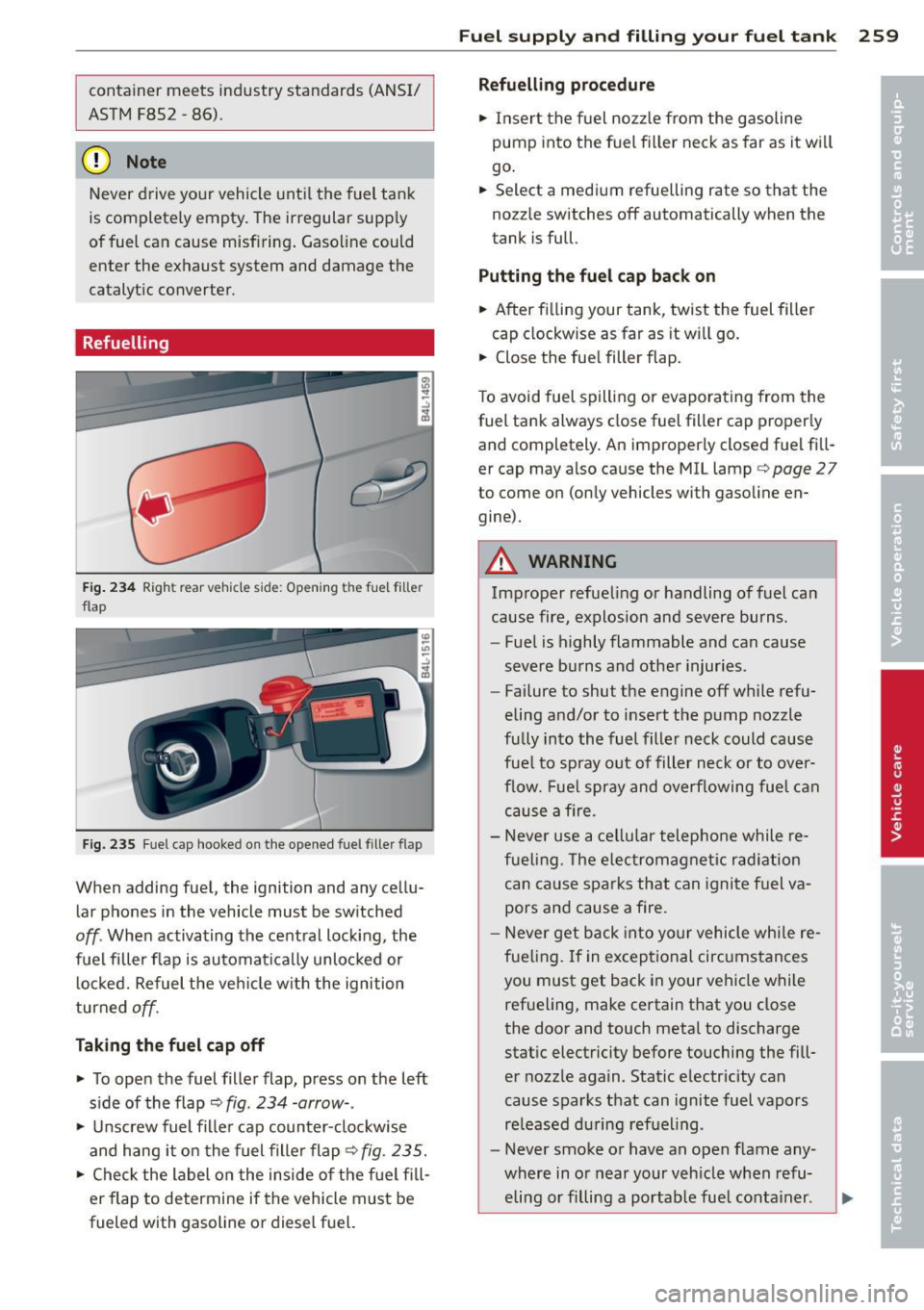
Refuelling
F ig. 234 Righ t rear vehicle side: Opening th e fue l fill er
flap
F ig. 235 Fu el cap hooked on the opened fuel filler flap
When adding fuel, the ignition and any cellu
lar phones in the vehicle must be sw itched
off. When activating the central locking, the
fuel filler flap is automatica lly unlocked or
locked. Refuel the ve hicle w ith the ignition
turned
off.
Tak ing th e fu el cap off
• To open the fuel filler flap, press on the left
s ide of the flap¢
fig. 234 -arrow- .
• Unscrew fuel fil ler cap counter-clockwise
and hang it on the fuel fille r flap ¢
fig. 235.
• Check the label on the inside o f the f uel fill
er flap to determine if the vehicle must be
fueled with gasoline or diesel fuel.
Fuel suppl y and filli ng your fuel t ank 259
Refuelling p ro cedur e
• Insert the fuel nozz le from the gasoline
pump into the fuel fi ller neck as far as it wi ll
go .
• Select a medi um refue lling rate so that the
nozz le switches off automatically when the
tank is full.
Pu tting th e fuel cap bac k on
• After fi lling your tank, twist the fuel filler
cap clockwise as far as it wi ll go.
• Close the fue l filler flap.
T o avoid fuel spill ing or evaporating from the
fuel tank always close fuel filler cap proper ly
and completely. An improperly closed fuel fill
er cap may also cause the MIL lamp¢
page 2 7
to come on (only vehicles with gasoline en
gine).
A WARNING
Improper refueling or handling of fuel can
cause fire, explosion and severe burns.
- Fuel is highly flammable and can cause
severe burns and other injur ies.
- Failure to shut the engine off wh ile refu
eling and/or to insert the pump nozzle
fully into the fuel filler neck could cause
fue l to spray out of filler neck or to over
f low. Fue l spray and overflowing fue l can
cause a fi re.
- Never use a cel lu lar telephone while re
fueling. The electromagnetic rad iation
can cause sparks that can ignite f uel va
pors and cause a fire.
- Never get back into your vehicle whi le re
fueling. If in exceptional circumstances
you must get back in your vehicle while
refueling, make certain that you close
the door and touch metal to discharge
stat ic electricity before touching the fill
er nozzle again. Static e lectricity can
cause sparks that can ignite fuel vapors re leased du ring refuel ing .
- Never smoke or have an open flame any
where in or near your veh icle when refu-
eling or filling a portab le fue l conta iner.
ll>
Page 266 of 348
264 Checking and filling
Checking and filling
Engine hood
Releasing the engine hood
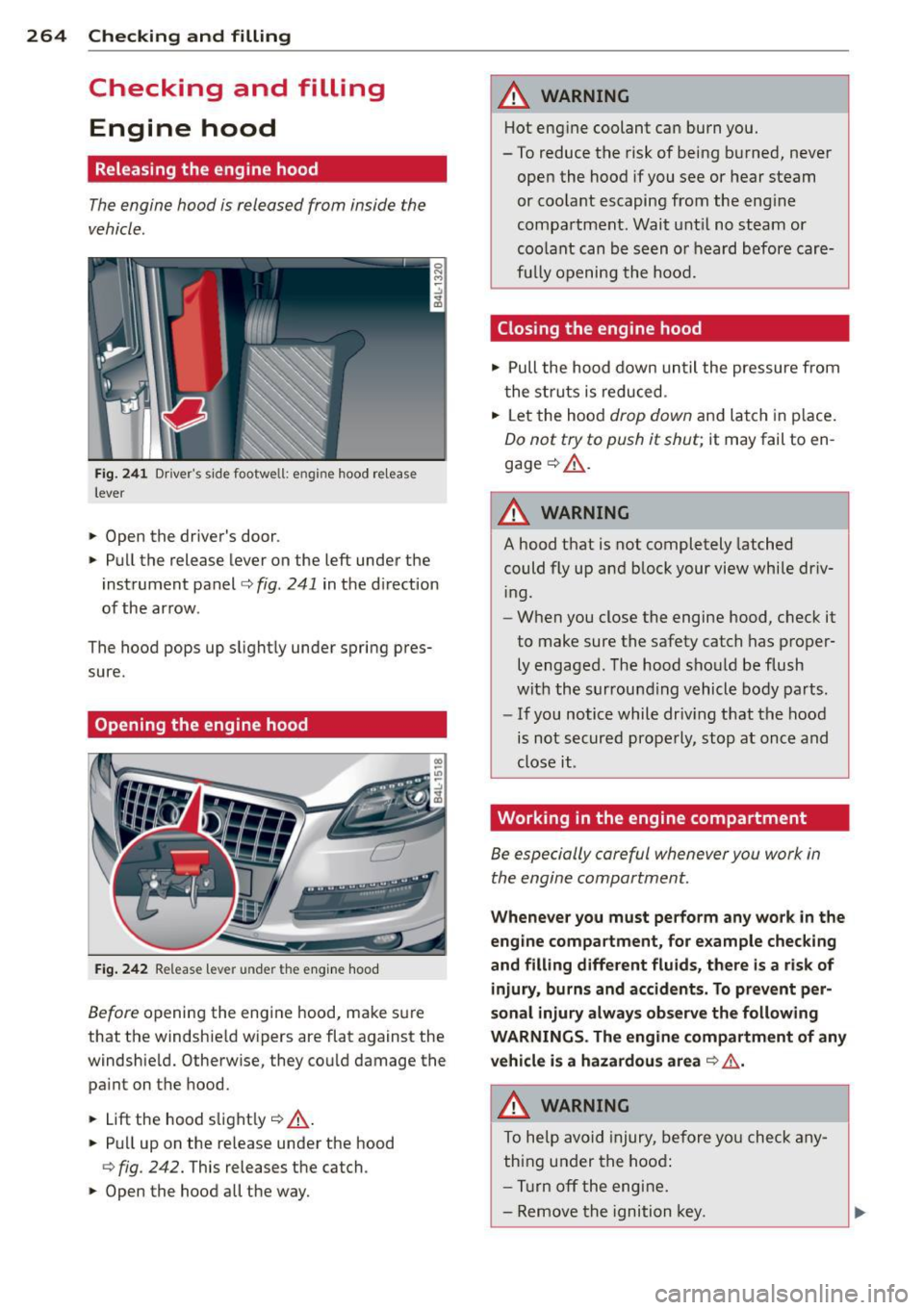
The engine hood is released from inside the
vehicle.
F ig . 2 41 Driver's side footwell: engine hood re lease
lever
.. Open the driver's door.
.. Pull the release lever on the left under the
inst rument panel
c> fig. 241 in the d irect ion
of the ar row .
The hood pops up s light ly under spring pres
sure.
Opening the engine hood
Fig. 242 Re lease lever under the eng ine hood
Before opening the engine hood, make s ure
that the windshie ld wipers are flat against the
windshie ld. Otherwise, they co uld damage the
pa int on the hood.
.. Lift the hood s light ly
c> _& .
.. Pull up on the release under the hood
¢ fig. 242. This releases the catch.
.. Open the hood all the way.
A WARNING
-Hot eng ine co olant can burn you.
- To reduce the risk of being b urned, never
o pen the hood if you see or hear steam
or coo la nt escaping from the eng ine
compa rtment. Wait unt il no steam or
coo lant can b e seen o r heard before care
fu lly openi ng the ho od.
Closing the engine hood
.. Pull the hood down un til the pressure from
t he stru ts is reduced .
.. Let the hood
drop down and la tch in p lace.
Do not try to push it shut; it may fail to en
gage
c> _& .
A WARNING
--
A ho od t hat is not completely latched
could fly up an d block your vi ew while dr iv
i ng.
- W hen you close the engine hood, c heck it
to make sure the safety catch has p roper
ly engaged . The hood sho uld be flush
wit h the surrou nding vehicle body parts.
- If you notice while dr iv ing t hat t he hood
is not s ecured properly, stop at once and
close it.
Working in the engine compartment
Be especially careful whenever you work in
the engine compartment .
Whenever you must perform any wo rk in the
engine compartment, for example checking
and filling different fluids, th ere is a risk of
injury, burns and accidents. To pr event per
sonal injury alway s observe the following
WARNINGS. The engine compartm ent of any
vehicle is a hazardous area
c> &, .
A WARNING
To he lp avo id i njury, before yo u check any
thi ng under the hoo d:
- Tu rn off the eng ine .
- Remove the igni tion key.
Page 267 of 348
-Apply the parking brake.
- Move selector lever to "P" (Park).
- Always let the engine cool down. Hot
components will burn skin on contact.
- To reduce the risk of being burned, never
open the hood if you see or hear steam
or coolant escaping from the engine
compartment. Wa it until no steam or
coolant can be seen or heard before care
fully opening the hood.
- Keep children away from the engine com
partment .
- Never spill fluids on hot engine compo
nents. They can cause a fire.
- Never touch the radiator fan. The auxili
ary electric fan is temperature controlled
and can switch on suddenly.
- Never open the coolant reservoir cap
when the engine is still warm. The cool
ant system is pressurized and hot cool
ant could spray out .
- Protect your face, hands and arm from
steam or hot engine coolant by placing a
thick rag over the cap when you open the
coolant reservoir .
- Do not remove the engine cover under
any circumstances . This increases the
risk of burns.
- If work on the fuel system or the electri
cal system is necessary:
- Always disconnect the battery .
- Never smoke or work near heaters or
open flames. Fluids in the engine com
partment could start a fire.
- Keep an approved fire extinguisher im
mediately available.
- To avoid electrical shock and personal in
jury while the engine is running or being
started, never touch:
- Ignition cables
- Other components of the high voltage
electronic ignition system.
- If you must perform a check or repair
with the engine running:
Checking and filling 265
- First, fully apply the parking brake,
move selector lever to "P" (Park) .
- Always use extreme caution to prevent
clothing, jewelry, or long hair from get
ting caught in the radiator fan, V-belts
or other moving parts, or from contact
ing hot parts . Tie back hair before
starting, and do not wear clothing that
will hang or droop into the engine.
- Minimize exposure to emission and
chemical hazards~&. .
A WARNING
California Proposition 65 Warning:
- Engine exhaust, some of its constituents,
and certain vehicle components contain
or emit chemicals known to the State of
California to cause cancer and birth de
fects and reproductive harm. In addition,
certain fluids contained in vehicles and
certain products of component wear con
tain or emit chemicals known to the State of California to cause cancer and
birth defects or other reproductive harm.
- Battery posts, terminals and related ac
cessories contain lead and lead com
pounds, chemicals known to the State of
California to cause cancer and reproduc
tive harms. Wash hands after handling.
Q) Note
When adding fluids, always make sure that
they are poured into the proper container
or filler opening, otherwise serious dam
age to vehicle systems will occur .
@ For the sake of the environment
To detect leaks in time, inspect the vehicle
floor pan from underneath regularly . If
you see spots from oil or other vehicle flu ids, have your vehicle inspected by an au
thorized Audi dealer. •
•
Page 268 of 348
266 Checking and filling
Engine compartment
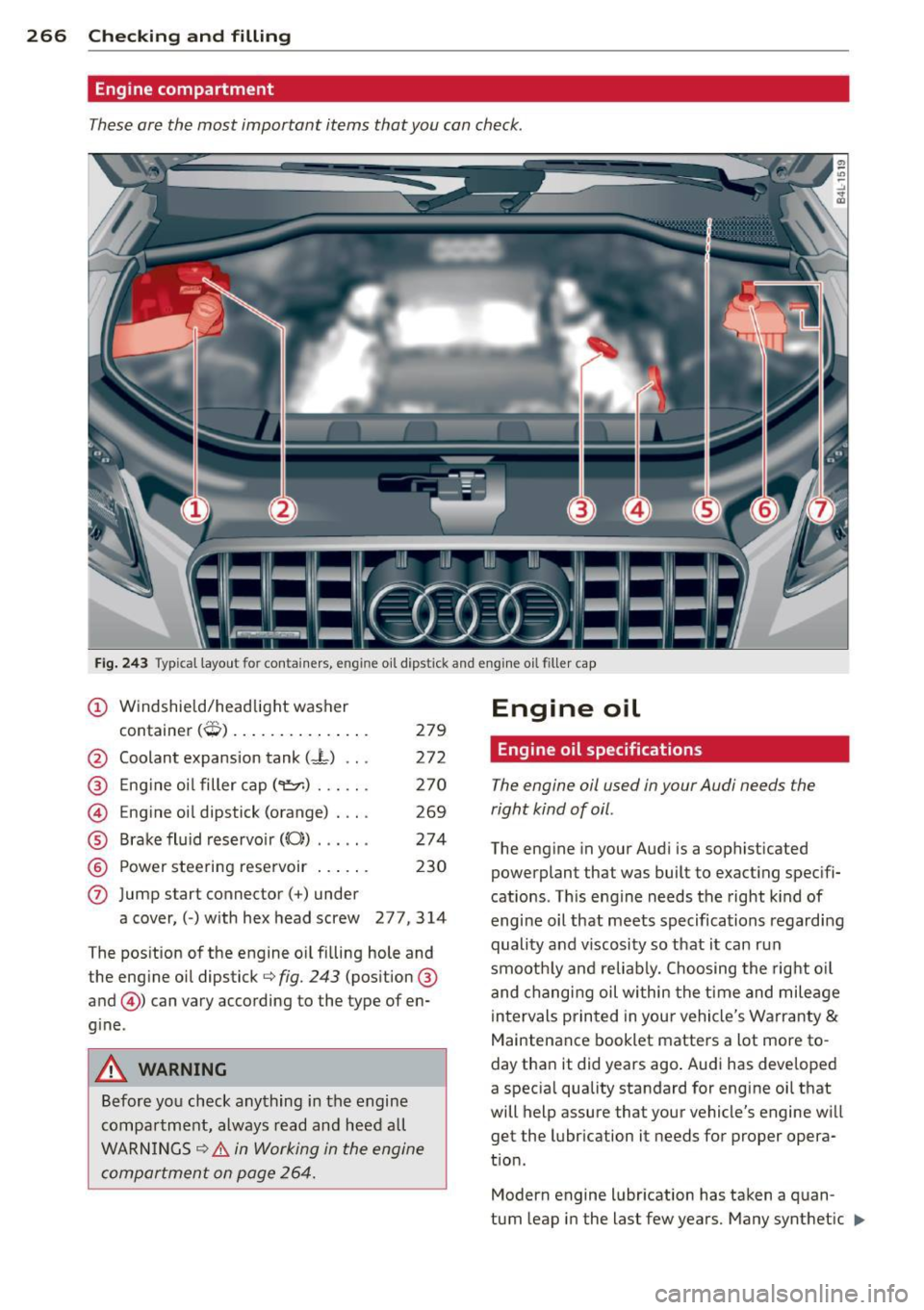
These are the most important items that you can check .
Fig. 243 Typical layout for containers, engine oil di pstick and engine oil fille r cap
CD W indshield/head light washer
. ( ") container O ......... ... .. . 279
@ Coolant expansion tank (-L) ... 272
® E
ng ine oi l filler cap ('t".:r.) ... .. . 270
© Eng ine oil dipstick (orange) . .. . 269
® Brake fluid reservoir ((0)) ...... 274
® Power steering reservoir ... .. . 230
(j) Jump start connector(+) under
a cover, ( -) with hex head screw
277, 314
The position of the engine o il fi lling hole and
the engine oil dipstick
r=;, fig. 243 (position ®
and @) can vary according to the type of en
gine .
_&. WARNING
Before you check anything in the engine
compartment, always read and heed all
WARNINGS ¢.&.
in Working in the engine
comportment on page 264.
-
Engine oil
Engine oil specifications
The engine oil used in your Audi needs the
right kind of oil.
The engine in your Audi is a sophist icated
powerplant that was built to exacting specifi
cations. This engine needs the right kind of
engi ne oil that meets specifications regard ing
quality and v iscosity so that it can run
smooth ly and reliab ly. Choosing the right oil
and changing oil within the time and mileage
intervals printed in your vehicle's Warranty
&
Maintenance booklet matters a lot more to
day than it did years ago . Audi has developed
a spec ia l quality standard for eng ine oil that
will help assure that your vehicle's engine w ill
get the lubrication it needs for proper opera
t ion .
Modern engine lubr ication has taken a quan
tum leap in the last few years. Many synthetic "'
Page 269 of 348
oils available today provide better engine lu
brication that can outlast traditional petrole
um-based oils, making them a smart choice
for use throughout the life of your Audi.
Whether you use synthetic or petroleumbased engine oil, the oil that you use must
conform to Audi's oil quality standard
VW 502 00 (vehicles with gasoline engine) or VW 507 00 (vehicles with diesel engine) to
help keep your vehicle's engine running
smoothly and help prevent the formation of harmful deposits , sometimes called "sludge,"
that over time can lead to expensive repairs.
At the time of printing, engine oils available in
the U .S . and Canada that meet the exacting
specifications of Audi oil standard VW 502 00 (vehicles with gasoline engine) or VW 507 00
(vehicles with diesel engine) are synthetic en
gine oils. This does not mean, however, that
every synthetic engine oil will meet Audi oil
standard VW 502 00 (vehicles with gasoline
engine) or VW 507 00 (vehicles with diesel
engine). So always be sure that you use an ap
proved oil.
To help prevent the formation of harmful de posits use only oil with the following specifi
cations printed on the oil container :
-Audi oil standard VW 502 00 (gasoline en
gine)
- Audi oil standard VW 507 00 (diesel en-
gine)
Oil container labels may carry the specifica
tion singly or in combination with other desig
nations and oil quality standards.
Viscosity
Engine oils are graded according to their vis
cosity . The proper viscosity grade oil for your
engine depends on climactic or seasonal con
ditions where you drive. You can use oil with a
viscosity grade of SAE SW40 ac ross all tem
perature ranges for normal driving conditions.
However, if engine oil viscosity grade SAE
SW40 is not available, you can also use viscos
ity grade SAE SW-30 or SAE OW-40 as long as
it meets Audi oil quality standard VW 502 00
Checking and filling 267
(vehicles with gasoline engine) or VW 507 00
(vehicles with diesel engine) specifications.
Because engine oil that meets the Audi oil
standard may not be available everywhere
when you need it, we strongly recommend
that you always carry with you an extra quart (liter) of oil that expressly conforms to the
VW 502 00 (vehicles with gasoline engine) or
VW 507 00 (vehicles with diesel engine) spec
ification, in case you have to top
off the oil
while on the road.
Applies to vehicles with gasoline engine on
ly: Only if the level of the oil is at or below the
minimum mark on the oil dipstick -and no oil
that expressly conforms to Audi oil standard
VW 502 00 specificat ions is available - may
you top
off with a high quality engine oil, pref
erably synthetic-based, that meets ACEA A3
or API SM specifications, but even then, only in viscosity grades SAE SW-40, SAE SW-30, or
SAE OW-40 . However, during the entire time
between oil change intervals, never top off
with more than a total of 0.5 qt/liter engine
oil that does not conform to Audi oil specifica
tion VW 502 00.
Applies to vehicles with diesel engine only:
Only if the level of the oil is at or below the
minimum mark on the oil dipstick - and no oil
that expressly conforms to Audi oil standard
VW 507 00 spec ifications is available - may
you top
off with a high quality engine oil, that
meets ACEA C3 or API CF specifications, but
even then, only in viscosity grades SAE
5W-40, SAE 5W-30, or SAE OW-40. However,
during the entire time between oil change in
tervals, never top off with more than a total
of 0 .5 qt/liter engine oil that does not con
form to Audi oil specification VW S07 00.
For more information about engine oil that
has been approved for your vehicle, please
contact either your authori zed Audi dealer or
Audi Customer Relations at 1 (800) 822-2834
or visit our web si te at www.audiusa .com or
www .audicanada .ca. Here you will also find a
current list of oils (manufacturers, brand
names etc.) that conform to Audi oil standard
lilJJ,,
•
•
Page 270 of 348
268 Checking and filling
VW 502 00 (vehicles with gasoline engine) or
VW 507 00 (vehicles with diesel engine).
Changing the engine oil
The engine oil and oil filter must be changed
according to the m ileage (ki lometers) and
time intervals specified in your vehicle 's War
ranty
& Maintenance booklet. Do not exceed
these intervals -harmful deposits from old
engine oil can reduce engine performance and
can lead to expensive engine repairs.
Changing the oil at the recommended inter
va ls is so very important because the lubricat
ing properties o f oi l decrease gradually during
normal vehicle use. If you are not sure when
you have your o il changed, ask your author
i z ed Audi Service Advisor.
Under some ci rcumstances the engine oi l
should even be changed more frequently .
Change oi l more often if you drive mostly
short distances, operate the vehicle in dusty
areas or mostly under stop-and-go traffic con
d itions, or when you use your vehicle w here
temperatures stay below freez ing point for
l ong periods .
Detergent additives in the o il w ill make fresh
oil look dark after the engine has been run
ni ng for a short time . This is normal and is not
a reason to change the oil more often than
recommended.
Damage or malfunctions due to lack of
maintenance
It is essential that you change your oil at the recommended intervals using only engine oil
that complies with Audi oi l standard
VW 502 00 (vehicles with gasoli ne engine) or
VW 507 00 (veh icles with diese l engine) . Your
Limited New Vehicle Warranty does not cover
damage or malf unctio ns due to failure to fol
lo w recommended maintenance and use re
quirements as set forth in the A udi Owner's
Manual and Warranty
& Maintenance booklet.
Your dea ler will have to deny warranty cover
age unless you present to the dealer proof in
the form of Service or Repa ir Orders that all scheduled maintenance was
performed in a
timely manner.
Engine oil consumption
To provide effective lubrication and cooling for
internal engine parts, all internal combustion
engines use some o il. Oil consumption varies
from engine to engine and may change over
the life of the engine. Engines tend to use
more o il during the break-in period tha n they
do afterward, when oil consumption has sta
bilized. Depending on the way the vehicle is
driven and the operating conditions, oil con
s u mption can be up to 1 quart per 1,200
miles (1 liter per 2,000 km) . Consumption
may be higher within the first 3,000 m iles
(5,000 km) .
Under normal conditions, the rate of oil con
sumption depends on oil quality as well as vis
cosity, engine speed (rpm), outs ide tempera
ture, road conditions, the amount of oil dilu
t ion caused by condensed water or fue l resi
due, and ox idat ion of the oil. Oil co nsumption
may increase with engine wear over time, un
t il replacement of worn engine pa rts may be
come necessary.
Because of all these variables, there is no
standard or "norma l" rate of oil consumption .
We urge you to check the engine oil level at
regular intervals, preferably every time you
fill the fuel tank, and always before a long
trip.
The oil pressure warning light. is not an
indicator of low engine oil level. If the warn
ing light does not go out after starting, or
flashes while driving (above 1500 rpm), a
buzzer will sound. It indicates that the oil
pressure is too low . Stop the engine immedi·
ately, check the engine oil level and add oil if
necessary. If the engine oil level is normal,
but the light continues to flash, do not keep
driving or let the engine idle, as damage may
occur .
II-