Check AUDI Q7 2013 Owner´s Manual
[x] Cancel search | Manufacturer: AUDI, Model Year: 2013, Model line: Q7, Model: AUDI Q7 2013Pages: 348, PDF Size: 87.72 MB
Page 215 of 348
to the backrest on the vehicle seat. Ad
just or remove the rear seat head restraint if it is diff icult to install the
child seat w ith the head restraint in place
¢ page 77. Install the head restraint
again immed iate ly once the child seat is
removed. Driving without head rest raints
o r with he ad restraints that are not prop
erly adjusted increases the risk of serious
or fatal neck injury dramatically.
- Always read and heed all WARNINGS
whenever using a child rest rained in ave
hicle is being used
¢page 175, Safety
belts,¢ page 184, Airbag system
and
¢ page 205, Important things to know.
A WARNING
If except ional circumstances requ ire the
use of a forward-facing child restra int on
the front passenger's seat, the ch ild's safe
ty and well-being require that the follow
ing special precautions be taken:
- Make sure the forward-fac ing seat has
been designed and certified by its manu
factur er for use on a front seat with a
passenge r fron t and side airbag.
- Always follow the manufacturer's in
st ruct ions provided with the child sa fety
sea t or infan t carrier.
- Always mov e the front passenge r seat in
to the rearmost posit ion of the passen
ger seat's fore and aft ad justment r ange,
and as far away from the airbag as possi
ble before instal ling the child restraint.
- Always m ake sure that noth ing prevents
the front passenger's seat from bei ng
moved to the rearmost position in its
fore and aft adjustment range .
- Always make sure the backrest is in an upright position.
- Make su re that the
PASSENGER AIR BAG
OFF
light comes on and stays on all the
time whenever the ignition is switched
on.
- If the light does not stay on, perform the
checks¢
page 195, Monitoring the Ad
vanced Airbag System.
-
Child S afety 213
-Take the chi ld restraint off the front pas
senger seat and install it properly at one
of the rear seat positions if the
PASSEN
GER AIR BA G OF F
light does not stay on
whenever the ignit ion is switched on.
Booster seats and safety belts
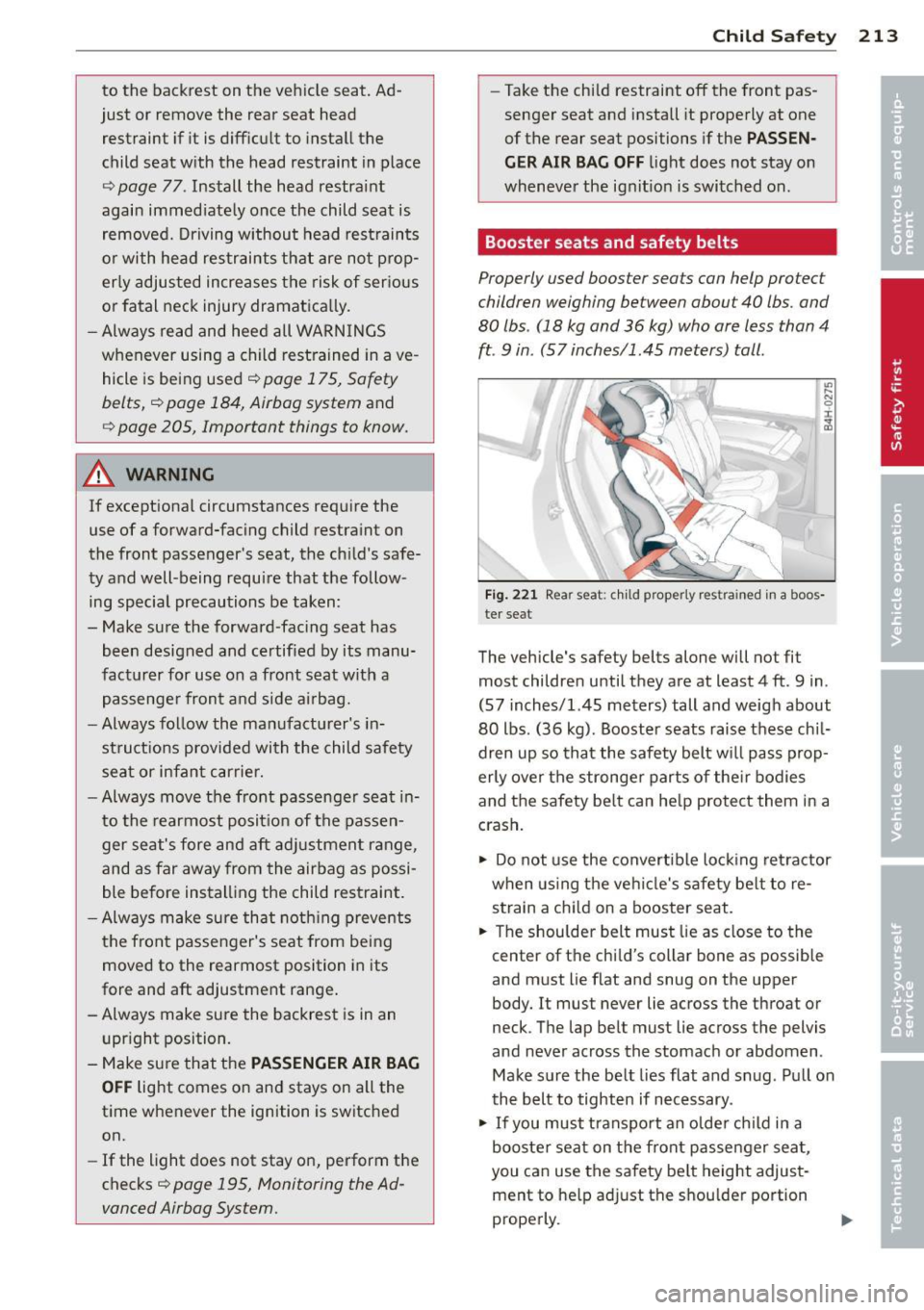
Properly used booster seats con help protect
children weighing between about 40 lbs. and
80 lbs . (18 kg and 36 kg) who are less than 4
ft. 9 in . (57 inches/1 .45 meters) tall.
In .... N 0 ±
~
Fig . 221 Rear seat: ch ild properly res trained in a boos
ter seat
The vehicle's safety belts alone will not fit most children until they are at least 4
ft. 9 in .
(57 inches/1.45 me ters) tall and weigh about
80 lbs . (36 kg) . Booster seats raise these chi l
dren up so tha t the safety belt w ill pass p rop
erly over the stronger parts of the ir bodies
and the safety be lt can he lp protect them in a
crash.
.,. Do not use the conver tible locking ret ra ctor
when using the ve hicl e's s afety be lt to re
s train a ch ild on a booster seat.
... The shoulder belt must lie as close to the
center of the ch ild's collar bone as possible
and must lie flat and snug on the upper
body. It must never lie across the throat or
neck . The lap belt must lie across the pelvis
and never across the stomach or abdomen .
Make s ure the belt lies flat and snug. Pull on
th e belt to tighten if necessary.
.,. If you must transport an o lder ch ild in a
booster seat on the front passenger sea t,
you can use the safety be lt height adjust
ment to he lp ad just the shou lder portion
properly.
Page 217 of 348
-Children on the front seat of any car,
even with Advanced A irbags, can be seri
ous ly injured or even killed when an a ir
bag inflates.
- Never let a child stand or kneel on any
seat, for examp le the front seat.
- Never let a child ride in the cargo area of
your vehicle .
- Always remember that a ch ild lean ing
forward, sitt ing sideways or out of posi
t ion in any way during an acc ident can be
struck by a deploying airbag . This will re
sult in se rious personal injury or death .
- If you must install a booster seat on the
front passenger seat because of excep
t ional circumstances the
PASSENGER
AIR BAG OFF
light must come on and
stay on, whenever the ignition is switch
ed on.
- If the
PASSENGER AIR BAG OFF light
does not come on and stay on, perform
the checks described¢
page 195, Moni
toring the Advanced Airbag System.
- Ta ke the child restrain t off the front pas
senger seat and install it properly at one
of the rear seat positions if the
PASSEN
GER AIR BAG OFF
light does not stay on
whenever the ignition is switched on.
- Always read and heed all WARNINGS
whenever using a child restrained in ave
hicle is being used¢
page 175, Safety
belts,¢ page 184, Airbag system
and
c:> page 205, Important things to know.
Installing a child safety
seat
Securing a child safety seat using a
safety belt
Safety belts for the rear sea ts and the fron t
passenger can be locked wi th the convertible
locking retractor to properly secure child
safety seats .
The safety belts emergency lock ing retractors
for the rear seats safety belts and for the
front passenger's seat safety belt have a con
ve rtible locking retractor for child restraints.
Child Sa fet y 215
The safety belt must be locked so that be lt
webbing cannot unree l. The retractor can be
activated to lock the safety belt and prevent
the safety belt webbing from loosening up
during normal dr iving . A child safety seat can
only be properly installed when the safety belt
i s locked so that the chi ld and child safety
seat w ill stay in place .
Always remember: Even though your vehicle is equipped with an Advanced Airbag system, all
ch ildren, especially those 12 years and young
er, shou ld always r ide in the back seat proper
ly restrai ned fo r the ir age and size.
A WARNING
Improperly installed chi ld safety seats in
crease the risk of serious personal injury
and death in a collision.
- Always ma ke sure that the safety belt re
tracto r is loc ked when installing a child
safety seat . An unlocked safety belt re
tractor cannot hold the child safety seat
in place during normal dr iving or in a
crash.
- Always buckle the child safety seat firmly
in place even if a ch ild is not sitt ing in it.
A loose child safety seat can fly around during a sudden stop or in a collision .
- Always make sure that the rear seat
backrest to which the center rear safety
be lt is attached is securely latched when
eve r the rea r center safety belt is being
used to secure a ch ild restra int.
- If the backrest is not securely latched,
the child and the child restraint will be
thrown forward together with the back rest and will strike parts of the vehicle
interior. The child can be seriously in
jured or killed.
- Never install rear-fa cing child safety
seats or infant carrie rs on the front pas
senger seat . A child will be serio usly in
jured and can be killed when the passen ger airbag inflates.
- The inflating airbag will h it the ch ild
safety seat or infant carrier with great
force and will smash the child safety seat
~
•
•
Page 218 of 348
216 Child Safety
and child against the backrest, center
armrest, door or roof.
- Always install rear-facing child safety
seats or infant carriers on the rear seat.
- Forward-facing child safety seats or in
fant carriers installed on the front pas
senger's seat may interfere with the de
ployment of the airbag and cause serious
injury to the child.
- It is safer to install a forward-facing
child safety seat on the rear seat.
- Always read and heed all WARNINGS whenever using a child restrained in ave
hicle is being used
c::> page 205 . Special
precautions apply when installing a child
safety seat on the front passenger seat
c::> page 186, Child restraints on the front
seat -some important things to know.
A WARNING
Always take special precautions if you
must install a forward or rearward-facing
child restraint on the front passenger's
seat in exceptional situations:
- Whenever a forward or rearward-facing
child restraint is installed on the front
passenger seat, the
PASSENGER AIR
BAG OFF
light must come on and stay on
whenever the ignition is switched on.
- If the
PASSENGER AIR BAG OFF light
does not come on and stay on, perform
the checks described
<=:> page 195, Moni
toring the Advanced Airbag System.
- Take the child restraint off the front pas
senger seat and install it properly at one
of the rear seat positions if the
PASSEN
GER AIR BAG OFF
light does not stay on
whenever the ignition is switched on.
- Improper installation of child restraints
can reduce their effectiveness or even
prevent them from providing any protec
tion.
- An improperly installed child restraint
can interfere with the airbag as it de
ploys and seriously injure or even kill the
child. -
Always carefully follow the manufactur
er's instructions provided with the child
safety seat or carrier.
- Never place additional items on the seat
that can increase the total weight regis
tered by the weight-sensing mat and can
cause injury in a crash .
A WARNING
-Forward-facing child restraints:
- Always make sure the forward-facing
seat has been designed and certified by its manufacturer for use on a front seat
with a passenger front and side airbag .
- Never put the forward-facing child re straint up, against or very near the in
strument panel.
- Always move the passenger seat into its
rearmost position in the seat's fore and
aft adjustment range, as far away from
the airbag as possible before installing
the forward-facing child restraint. The
backrest must be adjusted to an upright
position.
- Make sure that the PASSENGER AIR BAG
OFF
light comes on and stays on all the
time whenever the ignition is switched
on .
A WARNING
Rearward-facing child restraints:
- A child in a rearward-facing child safety
seat installed on the front passenger
seat will be seriously injured and can be killed if the front airbag inflates -even
with an Advanced Airbag System .
- The inflating airbag will hit the child
safety seat or infant carrier with great
force and will smash the child safety seat
and child against the backrest, center
armrest, door or roof.
- Always be especially careful if you must
install a rearward facing child safety seat
on the front passenger seat in exception-
al circumstances.
~
Page 230 of 348
228 Intelligent technology
To ensure that the ASR works properly, all
four wheels must be fitted with identical
tires. Any differences in rolling rad ius of
the t ires can cause the system to reduce
engine power when this is not desired. See
also¢
page 291, New tires and replacing
tires and wheels.
Braking
General information
What affects braking efficiency?
Operating conditions and driving habits
The brakes on today's automob iles are st ill
subject to wea r, depending la rgely on operat
ing cond itions and dr iv ing habits
Q ,& . On
vehicles that are either driven mostly in stop
and -go city traffic or are driven hard, the
brake pads should be checked by your author
ized Audi dealer more often than specified in
the
Warranty & Maintenance booklet . Failure
to have your brake pads inspected can result
in reduced brake performance .
On steep slopes, you shou ld use the braking
effect of the engine. This way, you prevent un
necessary wear on the brake system. If you
must use your brakes, do not hold the brakes
down continuously . Pump the brakes at inter
va ls.
Noises may occur when braking depending on
the speed, braking force and outside condi
tions such as temperature and humidity.
Moisture or road salt
Under certain conditions, for examp le, when
driving through water or very heavy rain, or
even after washing your vehicle, the braking
effect can be reduced due to moisture (or in
freezing conditions ice) on the brake pads. A
few careful brake applications should dry off
the brake pads o r remove any ice coatings.
When you are driving at higher speeds with
the w indshield wipers on, the brake pads will
brief ly touch the brake discs in regular inter- vals so as
to improve reaction time when brak
ing on wet surfaces . You, the driver, will not
notice anything.
T he effect iveness of the brakes can be reduced
when the vehicle is driven on a sa lt-covered
road and the brakes are not used . Here too,
you should clean off accumulated sa lt coating
from brake discs and pads w ith a few careful
applications of the brake¢,&.
Corrosion
There may be a tendency for dirt to build up
on the brake pads and corrosion to form on
the discs if the car is not driven regu larly or
only for short trips with litt le use of the
brakes.
If the brakes are not used frequently, or if cor
rosion has formed on the discs, it is advisable
to clean off the pads and discs by braking
firmly a few times from a moderately high
speed
c> ,& .
Faults in the brake system
If you shou ld notice a sudden increase in
brake pedal trave l, then one of the two brake
c ir cuits may have fa iled
c> ,& .
Low brake fluid level
Malfunctions can occur in the brake system if
the brake fluid level is too low. The brake fluid
l evel is monitored electronically .
Brake lining wear status
Brake lining wear may be checked by visual in
spect ion of the condition of the brake pads
through the openings in the wheel. If neces
sary, the wheel may be removed for this in
spect ion
c> page 304, Changing a wheel.
A WARNING
-- You shou ld perform braking maneuvers
for the purpose of cleaning the brake
system only if road conditions permit.
Othe r road users must not be put at risk -
you may cause an accident!
Page 231 of 348
-Before descending a steep grade, reduce
speed and shift transmiss ion into a lower
gear or lower driving range. Do not ride
the brakes or hold the pedal down too
long or too often. This could cause the
brakes to get hot and dimin ish braking
efficiency.
- Do not "r ide the brakes" by resting your
foot on the pedal when you do not intend
to brake. Th is may cause the brakes to
overheat, prema ture wear and increased
stopping distance .
- Under certain climat ic and operating
condit ions such as passing through wa
ter, driving in heavy rain or after washing
the vehicle, the effectiveness of the
brakes can be reduced . In winter, ice can
accumulate on the brake pads, linings,
discs and drums. Carefully apply brakes
for a test . Brakes will dry and ice coat
ings will be cleaned off after a few care
ful brake applications.
- Driv ing for an extended period of time on
salt-covered roads w ithout us ing your
brakes can also affect braking efficiency .
Clean off accumulated salt coating from
brake discs and pads w ith a few caref ul
brake applicat ions.
- If you damage the front spoiler, or if you
install a different spoiler, be sure the air
flow to the front brakes is not obstruct
ed. Otherwise the brake system could
overheat reducing the effectiveness of
the entire brake system.
- Failure of one brake circuit will impair
the braking capability resulting in an in
creased stopp ing distance. Avoid driv ing
the vehicle and have it towed to the near
est author ized Audi dealer or qualified
workshop .
Brake booster
The brake booster adds extra braking power.
The brake booster works with vacuum pres
sure which is created only when the engine is
running¢ &,.
Int ellig ent technolog y 229
A WARNING
-Never let the veh icle roll to a stop with
the engine shut off .
- If the brake booster is not working, for
example when towing your vehicle, or because the brake booster has somehow
been damaged, the brake pedal must be
pressed considerably harder to make up
for the lack of booster assistance .
Functioning of Anti-Lock Brake System
(ABS)
ABS prevents the wheels from locking up un
der braking.
T he ABS contributes effect ively to vehicle con
trol s ince it preve nts the whee ls from
locking
when the brakes are applied. This means that
the vehicle remains steerable and is less likely
to skid .
With ABS y ou do not n eed to pump the
bra ke. Just h old t he br ake ped al d own .
However, do not expect the ABS to shorten
braking distance under
all circumstances.
When dr iving on g ravel or on new ly fallen
snow o n top of icy s urfaces, braking dis tance
may be even longer, therefore, under these
circumstances, it is especia lly important that
you drive s low ly and with great care.
How the ABS s ystem works
An a utomat ic check is made when a speed of
about 12 mph (20 km/h) is reached . When
th is happens, a pumping noise can be heard.
If an ind iv idual whee l begi ns to rotate too
s low ly in relation to vehicle speed and tends
to lock, the ABS automatically reduces brake
pressure to prevent that whee l from locking .
T his automatic adjustment p rocess will cause
a
sli ght vibrati on of the brake pedal and some
noises to a le rt you that ve hicle speed m ust be
adapted to existing road and traffic condi
tions. •
•
Page 232 of 348
230 Intellig ent technol ogy
8_ WARNING
Although the ABS is very effective, always
remember that bra king capability is limit
ed by t ire traction . Always adjust your dr iv
ing spee d according to the road and t raffic
co nditions. Do no t let t he extra sa fety af
forded by the ABS tempt you into ta king
extra risks. The ABS cannot overcome the
laws of physics.
@ Tips
- If ABS is not functioning prope rly, a
warning light will come on. See
¢page 18 .
-If a fault occurs in the ABS, the EDL is al
so not functioning. This is indicated by
the ABS warning light .
Brake assistant
The brake assistant is designed to achieve the
optimum braking effect .
The brake assistant helps to increase the ef
fective b rak ing power and thus to achieve a
shorter stopp ing distance. If the driver
presses the brake pedal very quickly, the brake
assistant automatica lly boosts the braking
force to the maximum level, up to the point where the anti-lock brake function (ABS) inter
venes to stop the wheels from locking. You
should then keep the brake pedal pressed un
til the veh icle has braked to the required
speed . The brake assistant sw itches itself off
as soo n as you re lease the brake pedal.
Automatic full braking a ssist
This funct ion allows full brak ing in spite of
h igh brake pedal forces (e .g . when the brakes
a re severely stressed because the vehicle is
fully loaded) . The driver notices th is function
throug h a reduction of pedal force and in
creased pedal trave l. When the brake peda l is
r e leased, fu ll braking assis t switc hes off again
automatically.
I f the re is an ABS fa il ur e, the brake ass ista nt
and automatic full b rak ing ass ist are not avai l
ab le . The brake assistant wi
ll not be operative if
there is a ma lfunction in the ABS .
8_ WARNING
-Please remember that the accident risk a l-
ways increases if you drive too fast, espe
cially in corners or on a slippery road, or if
you follow the veh icle ahead of you too
closely. Increased r isk of an accident can
not be compensated for even by the brake
assistant, so always maintain a safe speed.
Servotronic ® -
advanced power
steering system
The power steering systems uses the power of
the running engine to allow precise steering
with little effort.
The advanced Servotronic ® power steering
system senses the road speed and electron i
cally adjusts power assistance to provide com
fortab le and safe steering response exact ly
matched to the vehicle speed .
Power steer ing will not work if the engine is
off . As a result, the steering wheel will be hard
to turn .
The power steering fluid level is checked dur
ing the scheduled maintenance services .
d) Note
If there is an electronic malfunction, ser
votronic
will still function like a conven
tiona l powe r steering system, providing a
constant steering support force that is no
l onger proportionate to the vehicle speed .
This is most not iceable when turning the
stee ring wheel at low speeds (fo r example
when pa rking), - more effort w ill be re
q uired than us ua l.
- Be aware o f the different than usual
steering response and adjust your steer
ing force accordingly.
- Have the problem checked and set r ight
by an Audi dealer as soon as possible .
Page 235 of 348
With the engine running
Although electrical energy is generated when
the vehicle is being driven, the battery can be
come discharged. This happens most ly when
litt le energy is being generated and a great
deal consumed and the battery's state of
charge is not optimal.
To bring the energy balance back into equili
brium, consumers which require especia lly
large amounts of energy are temporarily cut
back or switched off. Heating systems in par
ticular requ ire a great deal of energy. If you
notice, for example, that the heated seats* or
the heated rear window are not heating, they h ave been temporar ily cut back or switched
off. These systems will be available again as
soon as the energy ba lance has been restored.
You will also notice that engine idle speed has
been increased slightly. This is normal and not
a cause for concern . By increasing engine idle
speed the additional energy required is gener
ated and the battery is charged .
Driver notification in the instrument
cluster display
If battery power drops into the range where it
can limit the ab ility of the engine to start, th is
is shown in the instrument cluster display
with the following driver message:
(•) Low battery charge: battery will be
charged while driving
This notification reminds you that the starting
capability of the engine may be limited. As
soon as you start driving again, the battery
will be recharged and the notification will go
out.
Driver notification appears and goes out
again
If th is driver notification appears after the ig
nition is turned on or while driving and it goes
out again after a wh ile, the battery has been
adequately recharged.
Intelligent technology 233
Driver notification appears and does not
go out again
If this driver notification appears after the ig
nition is turned on or whi le driving and does
not go out again, the battery's state of charge
is not in the optimal range. Starting ab ility is
restricted . Have the battery checked as soon
as possible by an authorized Aud i dealer or
qualified workshop.
•
•
Page 240 of 348
238 Driving off road
Driving off road
Driving in difficult road
conditions and offroad
General information
The operation of the E lectronic Stabilization
Control (ESC) is expanded for operation away
from paved roads. In situations where slip or a
differential locking function is required, the ESC offroad mode can be activated
c::> page 225 . Hill descent control is also availa
ble in the ESC offroad mode, which automati
cally brakes the vehicle and thereby keeps
speed constant when diffe rent wheel speeds
a re detected when descending a hill
c::> page 226. Your Audi also has permanent
a ll-wheel drive in addition.
H owever, your Aud i is not a pure off road vehi
cle .
It was not built for d riving unde r extreme
conditions, e.g. fo r trips that are in the nature
of an expedition.
Dri ve only on road s and offroad section s
which mat ch the de sig n of your vehi cle and
y our a biliti es as a driver. Ne ver t ake ris k s!
Before driving offroad
- Check the eng ine oil level, tire pressure,
coolant level , and the fluid level in the w ind
shield washe r reservo ir.
- Stow luggage items and other objects in the
luggage compartment, and secure them
against s lid ing aro und .
After driving offro ad
- After trips offroad, remove any twigs and
other foreign objects from the grill, the underbody and the wheels. Pay spec ia l atten
t ion to fore ign objects (stones) which have
become lodged in the tire tread.
- Clean the body and the veh icle unders ide,
and inspec t the veh icle for poss ible damage.
- Clean dirty w indows , headlamp lenses , rear
l ights, and license plates .
- Perform a brake check (part icularly after
t ravel ling through water) .
A WARNING
-Drive especially attentively and plan
ahead in d iff icu lt road conditions and
when offroad. Excessive speed o r inco r
rect maneuvers can cause injuries and
damage to the vehicle.
-
- Always adapt your speed and driving
style to road, offroad, t raff ic, and weath
er cond itions. Drive especially slowly off
road when you r view is res tricted.
- Please be awa re that in ESC off road
mode, particularly on a smoo th and s lip
pery road, the wheels may have an in
creased tendency to spin and the vehicle may break away -danger of skidding!
- Stability is limited in the ESC off road
mode .
@) For the sake of the environment
Avoid damage to the environment and re
spect nature .
(D Tips
Only drive w here it is permitted and stay
on marked roads and paths.
Explanation of some technical terms
T he following data refe r to ideal cond itions.
Depend ing on veh icle load and ground condi
tions and the environment, the numbers may
vary. It is the driver's responsibility to decide
whether a vehicle can overcome a specific s it
uat ion
c::> ,&. .
Gradient angle
The number of meters in alt itude gained over
a distance of 109.4 yards or 100 meters
(grade) are given as a percentage or degrees.
Information about the gradient the vehicle
can climb under its own power (depends in
part on the road surface and engine power) .
Max imum perm itted grade : 3 1
°
Late ral angle (slope of vehicle )
Indicates the angle up to which the vehicle
can be driven diagonally or across the fall line ..,.
Page 242 of 348
240 Driving off road
If the vehicle threatens to tip over when
driving across a slope , you must immediate
ly steer downhill in the di rection of the
slope.
D o not par k your veh icle on steep slopes or
g rades .
T o reduce t he risk of tippi ng over, dr ive o n
slopes in the d irection o f the downwa rd slope
(fa ll line) -
not cros swise .
A WARNING
After drivin g through wate r, m ud, slush ,
etc ., the brakes may be slow to take effect
because of wet b rake roto rs and pads. Dry
the brakes f irst by braking carefully to re
store the full braking effect.
-
(D Note
Vehicle components s uch as the engine,
transmiss io n, suspension or elect rical sys
tem can be severely damaged by drivi ng
through wat er.
(1) Tips
- Check the depth of the wate r before dr iv
i ng th rough it.
- Do not stop the veh icle, dr ive in reverse
or switc h the engine off whe n driving
t hr ough water .
- Keep in mind that oncoming vehicles may create waves that raise t he water
l eve l and make it t oo deep fo r yo ur vehi
cle to dr ive th rough safely.
- Avoid dr iving thro ugh salt water because
i t can ca use corrosion.
Page 243 of 348
Trailer towing Driving with a trailer
General information
Your Audi was designed primarily for passen
ger transportation .
If you plan to tow a trailer, please remember
that the additional load will affect durability,
economy and performance .
Trailer towing not only places more stress on
the vehicle, it also calls for more concentra
tion from the driver.
For this reason, always follow the operating
and driving instructions provided and use
common sense.
(D Note
If you are going to tow a trailer, you must
activate the trailer operation mode
q page 159, Towing a trailer.
Technical requirements
Trailer hitch
Use a weight-carrying hitch conforming to the
gross trailer weight. The hitch must be suita ble for your vehicle and trailer and must be
mounted securely on the vehicle's chassis at a
technically sound location. Use only a trailer
hitch with a removable ball mount. Always
check with the trailer hitch manufacturer to
make sure that you are using the correct
hitch.
Do not use a bumper hitch.
The hitch must be installed in such a way that
it does not interfere with the impact-absorb
ing bumper system. No modifications should
be made to the vehicle exhaust and brake sys
tems . From time to time, check that all hitch
mounting bolts remain securely fastened.
When you are not towing a trailer, remove the
trailer hitch ball mount. This prevents the
hitch from causing damage should your vehi
cle be struck from behind~.&.
Trailer towing 241
Trailer brakes
If your trailer is equipped with a braking sys
tem, check to be sure that it conforms to all
regulations.
The trailer hydraulic brake system must not be
directly connected to the vehicle's hydraulic
brake system
q .& .
Safety chains
Always use safety chains between your vehicle
and the trailer.
Trailer lights
Trailer lights must meet all regulations. Be
sure to check with your authorized Audi dealer
for correct wiring, switches, and relays.
Mirrors
If you are unable to see the traffic behind you
using the regular outside mirrors, then you
must install extended mirrors.
It is important
that you always have clear vision to the rear.
_&. WARNING
-If a trailer has electrical brakes please
note that these brakes are not activated
by the factory-fitted control unit -risk of
accident!
- After removing the trailer hitch, do not
store it in your vehicle. In case of sudden
braking, the hitch could fly forward and
injure you or your passengers.
- Never install a "weight distributing" or
"load equalizing" trailer hitch on your ve
hicle. The vehicle was not designed for
these kinds of trailer hitches. The hitch
attachment can fail, causing the trailer
to tear loose from the vehicle.
- The Gross Vehicle Weight Rating for your
vehicle, found on the safety compliance
label on the driver's side B-pillar, must
never be exceeded under any circumstan
ces. Exceeding the Gross Vehicle Weight
Rating of your vehicle is likely to damage
your vehicle, and such damage will not
be covered by your Limited New Vehicle
-
Warranty. Exceeding the Gross Vehicle ~
•
•