driver AUDI RS5 CABRIOLET 2015 Repair Manual
[x] Cancel search | Manufacturer: AUDI, Model Year: 2015, Model line: RS5 CABRIOLET, Model: AUDI RS5 CABRIOLET 2015Pages: 284, PDF Size: 69.56 MB
Page 131 of 284

"' N
a: LL co
rl I.O
"' rl
"' rl
_& WARNING
Improperly positioned safety belts can
cause serious personal injury in an acci
dent .
- Expectant mothers must a lways wear the
lap portion of the safety belt as low as
poss ible across the pelv is and be low the
rounding of the abdomen.
- Always read and heed all WARNINGS and
other important information
¢ &. in Fas
tening safety belts on page 12
7.
Unfastening safety belts
Unbuckle the safety belt with the red release
button only after the vehicle has stopped .
Fig. 14 8 Re lea sing the to ngue from the buckle
... Push the red re lease but ton on the buc kle
¢
fig. 148 . The belt tongue wi ll spring out
of the buckle
¢ ,&. .
0 .... N 9 :r
~
... Let the belt wind up on the retractor as you
gu ide the belt tongue to its stowed position.
_& WARNING
Never unfasten safety belt while the veh i
cle is moving. Doing so will increase your
r isk of being inju red or killed .
Improperly worn safety belts
Incorrectly posi tioned safety bel ts can cause
severe injuries .
Wearing safety be lts improperly can cause se
rious injury or death. S afety belts can only
work when they are correct ly positioned on
the body . Improper seating positions reduce
the effect iveness of safety belts and w ill even
Safety belts 129
increase the risk of injury and death by mov
ing the safety be lt to critica l areas of the
body. Improper seating positions a lso in
crease the risk of serious injury and death
when an airbag deploys and strikes an occu
pant who is not in the correct seating posi
t ion. A driver is respo ns ible for the safety of
all vehicle occupants and especially for chil
dren. Therefore:
... Never perm it anyone to assume an incorrect
sitt ing pos ition in the vehicle while traveli ng
¢ ,&. .
_& WARNING
Improperly worn safety bel ts increase the
r isk of ser ious persona l injury and death
whenever a vehicle is being used .
- Always ma ke s ure that all vehi cle occu
pants are correctly restrained and stay in
a co rrect seating position whenever the
veh icle is being used .
- Always read and heed a ll WARNI NGS and
other important information
¢ page 126.
Safety belt preten-
• s1oners
How safety belt pretensioners work
In front, side and rear-end collisions above a
particular severity, safety belts are tensioned automatically.
T he safety belts are equipped with safety belt
pretensioners . The system is act ivated by se n
sors i n fro nt, side and rear -end co llisions of
great seve rity . This tightens the belt and takes
up belt slack¢
& in Service and disposal of
safety b elt pretension er on page 130.
Taking
up the slack he lps to reduce fo rward occupant
movement during a collision .
(D Note
Never let the belt remain ove r a rear seat
back that has been fo lded forward .
Page 133 of 284

M N
er
u..
co ,...., \!) 1.1'1 ,...., 1.1'1 ,....,
Airbag system Important things to know
Importance of wearing safety belts and
sitting properly
Airbags are only supplemental restrain ts . For
airbags to do their job , occupants m ust al
ways properly wear their safety belts and be
in a proper seating position.
F or your safety and the safety of your passen
gers, before driving off, always:
"" Adjust the dr iver's sea t and steeri ng wheel
p roperly
¢ page 113,
"" Adjust the front passenger's seat properly
¢ page 61,
""Wear safety be lts properly ¢ page 126,
"" Always properly use the proper child re-
stra int to protect ch ildren
r::::> page 152.
In a collision airbags must inflat e within th e
blink of an eye and with considerable force .
The supplementa l airbags can cause injuries if
the dr iver or the front seat passenger is not
seated properly . T herefore in order to help the
a irbag to do its job, it is important, both as a
driver and as a passenge r to s it properly at all
times.
By keep ing room between your body and the
steer ing whee l and the front of the passenge r
compartment, the airbag can inflate fully and
comp lete ly and provide supp lemen tal protec
tion in ce rtain frontal collisions
r::::> page 113,
Proper occupant seating positions .
For deta ils
on the operation of the seat adjustment con
trols
¢ page 61.
It's espe cially important that children a re
p roperly restrained
r::::> page 15 2.
There is a lot that the d river and the passen
gers ca n and must do to help the individua l
safety features ins talled in your A ud i work to
gether as a system.
P rope r seat ing pos ition is important so that
the front airbag on the dr iver s ide ca n do its
job. If yo u have a physical impa irment or con-
A irbag system 13 1
dition that prevents yo u from sitting properly
o n the driver seat with the safety belt properly
fastened and reach ing the peda ls, spec ial
modifications to yo ur vehicle may be necessa
ry.
Contact your a uthorized Audi dea ler, or call
Audi C ustome r Re lations at 1-800 -822-2834 .
When the airbag system dep loys, a gas gene r
ator will fi ll the ai rbags, break open the pad
ded covers, and inf late between t he steering
whee l and the dr iver and between the instru
ment panel and the front passenger. The air
bags will deflate immediately after deploy
ment so that the front occupa nts can see
t hr ough the w indshield aga in witho ut inter
ruption .
All of th is takes place in the blink of an eye, so
fast that many people don't even realize that
the a irbags have deployed . The airbags also
inflate wi th a g reat dea l of force and noth ing
shou ld be in their way when they deploy.
Fron t airbags in combin ation wi th properly
worn safety belts slow down and lim it the oc
cupan t's forward movement. Together they
help to prevent the driver and front seat pas
senger from hitting parts of the inside the ve hicle while reducing the forces acting on the
occupant dur ing the crash. In this way they
help to reduce t he risk of injury to the head
and upper body i n the c rash . A irbags do not
protect the a rms o r the lower parts of the
body .
Both front a irbags w ill not inflate in all fronta l
collisions . The t riggering of the a irbag system
depends on the vehicle dece le rat ion rate
ca used by the co llision and registered by the
ele ctron ic co ntro l unit. If thi s rate is below
t he reference value programmed into the con
trol unit, the airbags will not be trigge red,
even though the car may be bad ly damaged as
a resu lt of the co llision . Veh icle damage, re
pair costs or even the lack of ve hicle damage
is no t necessarily an indication of whether an
airbag s hou ld inflate o r not .
It is not possib le to define a range of vehicle
speeds that w ill cover every possib le kind and ..,.
•
•
Page 135 of 284

M N
er
u..
co ,...., \!) 1.1'1 ,...., 1.1'1 ,....,
Even though your vehicle is equipped with an
Advanced Airbag System, make certain that
all ch ildren, especially those 12 years and
younger, a lways ride in the back seat properly
restrained for their age and size. The airbag
on the passenger side makes the front seat a potentially dangerous place for a child to r ide.
The front seat is not the safest place for a
child in a fo rward-facing child safety seat.
It
can be a very dangerous place for an infant or
a child in a rearward-facing seat.
The Advanced Airbag System in your veh icle
h as been certified to comp ly w ith the Requ ire
ments of United States Federa l Moto r Veh icle
Safety Standard 208 as applicable at the time
your vehicle was manufactured.
The Standard requires the front a irbag on the
passenger side to be t urned off ("sup
p ressed") if a ch ild up to about one year of
age restrained in one of the rear -facing or for
ward -facing infant restraints listed in Federal
Motor Vehicle Safety Standard 208 with wh ich
the Advanced Airbag System in your vehicle
was certified has been installed on the front passenger seat . For a listing of the child re
straints that were used to certify compliance
with the US Safety Standard
Q page 154.
The PASSENGER AIR BAG OFF light in the in
strument panel tells you when the front Ad
vanced A irbag on the passenger side has bee n
turned off by the e lectronic control unit.
Each t ime you turn on the ignition, the
PAS
SENGER AIR BA G OFF
light w ill come on for a
few seco nds and :
- will stay on if the front passenger seat is not
occupied,
- will stay on if there is a small child or child restraint on the front passenger seat,
- will go off if the front passenger seat is oc
cupied by an adult as registered by the
weight-sensing mat
Q page 141, Monitor
ing the Advanced Airbag System .
The PASSENGER AIR BAG OFF light comes on
when the control un it detects a total weight
on the front passenger seat that requires the
fro nt airbag to be turned off.
A irbag system 133
If the total weight on the front passenger
seat is more than that of a typical 1 year-o ld
c hi ld but less than the weight of a small
adult, the front airbag on the passenger side
can deploy (the
PASSENGER AIR BAG OFF
light does not come on). If the PASSENG ER
AIR BAG OFF
light does not come on, the
front a irbag on the passenger side has not
been tu rned off by the elect ronic con trol unit
and can deploy if the co ntrol unit senses an
impact that meets the cond itions stored in its
memory .
For exampl e, the air ba g may deplo y if:
-a small ch ild that is heav ie r than a typical 1
year-old ch ild is o n the front passenger seat
( r egard less of whether the child is in one of
the child safety seats listed
Q page 154), or
- a child who has outgrown child restraints is
on the front passenger seat.
If the front passenger airbag is turned off, the
PASSENGER AIR BAG OFF light comes on in
the instrument cluster and stays on.
The front airbag on the passenger side may
not deploy (the P A SSENGER AIR B AG OFF
light does not illum inate and stay lit) even if a
small adult o r teenager, or a passenger who is
not sitting uprig ht with their back against a
non- re cli ned back rest w it h thei r feet on the
vehicle floor in front of the sea t is on t he front
passenger seat
~ page 113, Proper seating
position for the driver.
If the fron t passenger a irbag dep loy s, the
Federa l Standard req uires the airbag to meet
the "low risk" dep loyment criteria to reduce
the risk of injury thro ugh interact ion w it h the
airbag . "Low risk" dep loyment occ urs in those
crashes that take place at lower dece lerat ions
as defined in the electronic control unit
Q page 142, PASSENGER AIR BAG OFF light .
Always remember, a child safety seat or infant
carr ier installed on the front seat may be
struck and knocked out of posit ion by the rap
idly inflat ing passenger's airbag in a frontal
collision . T he ai rbag could greatly reduce the
effectiveness of the ch ild restraint and even
seriously inj ure the child dur ing inflation. •
•
Page 137 of 284

"' N
a: LL co
rl I.O
"' rl
"' rl
-Never place additional items on the seat
that can increase the total weight regis
tered by the weight-sensing mat and can
cause injury in a crash.
Front airbags
Description of front airbags
The airbag system can provide supplemental
protection to properly restrained front seat
o ccupan ts.
F ig . 149 Location of driver airbag: in steering wheel
Fig. 150 Location of front passenger's airbag: in the in
st rument panel
Your veh icle is equipped w ith an "Advanced
Ai rbag System" in compliance with United
States Federal Motor Vehicle Safety Standard (F MVSS) 208 as app licab le at the time your
ve hicle w as manufac tured. The safety be lts
for the seats have "pretensione rs" that help
to take slack out of the belt system . The pre
tensioners are a lso activated by the electronic
contro l unit for the airbag system.
The front safety belts a lso have load limiters
to help reduce the forces applied to the body
in a crash.
The airbag fo r the driver is in the s teer ing
wheel hub
~ fig. 149 and the airbag for the
A irba g sy stem 135
front passenger is in the instr ument panel
~ fig. 150 . The general location of the airbags
is marked "AIRBAG".
T he re is a lot you need to know about t he a ir
bags in your vehicle . We urge you to read the
detailed information about airbags, safety
belts and child safety in this and the other
chapters that make up the owner's literature.
Please be sure to heed the WARNINGS - they
are extremely important for your safety and
the safety o f your passengers, especially in
fants and small children .
.&_ WARNING
Neve r rely on airbags alone for p rotec tion.
- Even w hen they deploy, airbags provide
only suppleme nta l protect ion.
- Airbag work most effectively w hen used
with p roperly worn safety belts.
- Therefore, always wear your safety belts and make sure that eve rybody in your ve
hicle is p rope rly r est rained .
.&_ WARNING
A person on the front passenger seat, es
pe cially infants and sma ll children, w ill re
ceive ser io us i njuries and can even be kil
led by being too close to the airbag when it inflates .
- Altho ugh the Advan ced A irbag Sys tem in
your veh icle is designed to turn off the
fro nt passenge r airbag if a n infant or a
sma ll child is on the front passenger
seat , nobody can absolutely gua rantee
that deployment under these special conditions is impossible i n all conceiva
ble sit uat ions that may happen during
the useful life of your vehicl e.
- The Advanced Airbag System can dep loy
in acco rdance with the "low risk" option
un der the U.S . Fede ral S tanda rd if a child
that is heavie r th an the typical one-yea r
old child is on the front passenge r seat
a nd the ot her condit ions for a irbag de
ployment are met .
-
Page 138 of 284

136 Airbag sys te m
- Accident statistics have shown that chi l
dren are generally safer in the rear seat
area than in the front seating posit ion.
- For their own safety, all children, espe
cially 12 years and younger, should al
ways ride in the back properly restrained
for their age and size.
Advanced front airbag system
Your veh icle is equipped with a front Advanced
A irbag System in compl iance with Un ited
States Federal Motor Vehicle Safety S tandard
208 as applicable a t the t ime yo ur vehicle was
manufactured .
The front Advanced Airbag System supple ments the safety belts to provide addit ional
protection fo r the driver's and front passeng
er 's heads and upper bodies in fronta l crashes.
The airbags inflate only in fronta l impacts
when the vehicle dece leration is high enough .
The front Advanced Airbag System for the
front seat occupants is not a substitute for
your safety be lts. Rather, it is part of the over
all occupant restraint system in your vehicle .
A lways remember that the airbag system can
only help to protect you, if you are s itting up
right, wear ing you r safety belt and wearing it
properly . This is why you and your passenge rs
must always be properly restra ined, not just
because the law requires you to be .
The Advanced Airbag System in your veh icle
has been certified to meet the " low r isk" re
qu irements for 3 and 6 year-o ld children on
the passenge r side and very small adu lts on
the dr iver side. The low ris k deploymen t crite
ria are intended to he lp red uce the risk of in
ju ry through interaction with the front airbag
that can occur, for example , by being too
close to the steering whee l and instrument
panel when the airbag inflates.
I n addition, the system has been certif ied to
comp ly w ith the "suppression" requi rements
of the Safety Standard, to turn
off the front
a irbag for infants 12 months old and yo unger
who are restra ined on the front passenger seat in child restrain
ts that are listed in the
Standard
¢ page 154, Child restraints and
Advanced Airbags.
"Suppress ion" requires the fron t airbag on the
passenger side to be turned
off if :
- a child up to about one year of age is re
s trained on the front p assenger sea t in one
of the rear -fac ing or fo rward -facing infan t
restraints listed in Federal Motor Vehicle
Safety Standard 208 with which the Ad
vanced Airbag System in your veh icle was
cert ified. For a listing of the child restraints
that were used to certify your vehicle's com
plia nce w ith the US Safety Standard
¢page 154,
-weight less than a thresho ld level stored in
the control unit is detected on the front pas
senger seat .
When a person is detected on the front pas
senger seat, weighing more than the total
we ight of a ch ild that is about
1 year old re
stra ined in one of the rear-facing o r forward
facing infant restraints ( listed in Fede ral Mo
tor Vehicle Sa fety Standa rd 208 w it h which
t h e Advan ced Airbag Sys tem in yo ur vehicle
was certif ied), the front airbag on the passen
ger side may or may not deploy .
T he
PASSENGER AIR BAG OFF light comes on
when the electro nic contro l unit de tects a to
ta l we ight on the front passenger seat that re
quires the front airbag to be t urned
off . If the
PASSENGER AIR BAG OFF light does not
come on, the front a irbag on the passenger
s ide has not been t urned
off by the contro l
unit and ca n dep loy if the control u nit senses
an impact that meets the cond itions stored in
its memory.
If the total weight on the front passenger
seat is more than that of a typical 1 year-old, but less than the we ight of a small adult, the
front a irbag on the passenger side may dep loy
(the
PAS SENG ER AIR BAG OFF light does not
come on) .
For example, the airbag may deploy if: ..,_
Page 141 of 284
M N
er
u..
co ,...., \!) 1.1'1 ,...., 1.1'1 ,....,
-Repairs to the front passenger seat must
be performed by qualified and properly
trained workshop personnel.
- Never remove the front passenger or
driver seat from the vehicle.
- Never remove the upholstery from the
front passenger seat.
- Never disassemble or remove parts from
the seat or disconnect wires from it.
- Never carry sharp objects in your pockets
or place them on the seat. If the weight
sensing mat in the passenger seat is
punctured it cannot work properly.
- Never carry things on your lap or carry
objects on the passenger seat. Such
items can increase the weight registered
by the weight-sensing mat and send the
wrong information to the airbag control
unit.
- Never store items under the front pas
senger seat. Parts of the Advanced Air bag System under the passenger seat
could be damaged, preventing them and
the airbag system from working proper
ly.
- Never place seat covers or replacement
upholstery that have not been specifical
ly approved by Audi on the front seats.
- Seat covers can prevent the Advanced
Airbag System from recognizing child re
straints or occupants on the front pas
senger seat and prevent the side airbag
in the seat backrest from deploying prop
erly.
- Never use cushions, pillows, blankets or
similar items on the front passenger
seat. The additional padding will prevent
the weight-sensing mat in the seat from
accurately registering the child restraint
or person on the seat and prevent the
Advanced Airbag System from function
ing properly.
- If you must use a child restraint on the
front passenger seat and the child re
straint manufacturer's instructions re
quire the use of a towel, foam cushion or
something else to properly position the
child restraint, make certain that the
Airbag system 139
PASSENGER AIR BAG OFF light comes
on and stays on whenever the child re
straint is installed on the front passen
ger seat.
- If the
PASSENGER AIR BAG OFF light
does not come on and stay on, immedi
ately install child restraint in a rear seat
ing position and have the airbag system
inspected by your authorized Audi dealer.
How the Advanced Airbag System
components work together
The front Advanced Airbag System and the
side airbags supplement the protection of
fered by the front three-point safety belts
with pretensioners and load limiters and the
adjustable head restraints to help reduce the
risk of injury in a wide range of accident and
crash situations. Be sure to read the impor
tant information about safety and heed the
WARNINGS in this chapter.
Deployment of the Adva need Airbag System
and the activation of the safety belt preten sioners depend on the deceleration measured
by the crash sensors and registered by the
electronic control unit. Crash severity depends
on speed and deceleration as well as the mass
and stiffness of the vehicle or object involved
in the crash.
On the passenger side, regardless of safety
belt use, the airbag will be turned off if the
weight on the passenger seat is less than the
amount programmed in the electronic control
un it. The front airbag on the passenger side
will also be turned off if one of the child safe
ty seats that has been certified under Federal
Motor Vehicle Safety Standard 208 has been
recogni zed on the seat . The
PASSENGER AIR
BAG OFF
light comes on and stays on to tell
you when the front Advanced Airbag on the passenger side has been turned off
~ page 132, Child restraints on the front seat
- some important things to know. .,.
•
•
Page 144 of 284

142 Airbag system
whenever the ignit ion is on. Each t ime yo u
turn on the ignition, the
II airbag monitoring
indicator light will come on for a few seconds
(self diagnostics) .
The sy stem must be in spect ed wh en the
fl ind icator light :
-does not come on when the ignit ion is
switched on,
- does not go out a few seconds after you
have switched on the ignition, or
- comes on while driving .
If an airbag system malf unct ion is dete cted,
the ind icator light will firs t start flash ing to
catch the driver's attention and then stay on
continuously to serve as a constant reminder
to have the system inspected immediately.
If a mal func tion occurs that turns the fron t
airbag on the passenger side off, the
PASSEN
GER AIR BAG OFF
l ight will come on and stay
on whenever the ignition is on.
.&_ WARNING
An airbag system that is not funct ion ing
properly cannot provide supplemental pro
tect ion in a frontal crash.
- If the airbag indicator light
c:> page 19
comes when the vehicle is be ing used,
have the system inspected immed iate ly
by you r autho rized Aud i dea le r. It is pos
sible that the airbag will inf late when it
is not s upposed to, or w ill not inflate
when it sho uld.
PASSENGER AIR BAG OFF light
Fig. 152 Sect ion from the inst rumen t pa nel: PASSEN
GER AIR BAG O FF ligh t
-
The PASSENGER AIR BAG OFF light is located
in the center of the instrument pane l
c:>fig. 152.
The PASSENGER AIR BAG OFF light wi ll come
on and stay on to tell you when the front Ad
vanced Airbag on the passenger side has been
turned off by the electron ic contro l unit. Each
t ime you turn on the ignition , the
PASSEN
GER AIR BAG OFF
light will flash for a few
seconds and:
- will stay on i f the front passenger seat is not
occ upied,
- will stay on if there is a small ch ild or child
restraint on the front passenger seat,
- will go out if the front passenge r seat is oc
cupied by an adult as registered by the
weight-sensing mat.
T he
PASSENGER AIR BAG OFF light mu st
come on and stay on
if the ignition is on and
- a ca r bed has been installed on the fron t
seat, o r
- a rearward-facing child rest rain t has bee n
installed o n the front passenger seat, or
- a forwa rd-fac ing ch ild restra int has been in
stalled on the front passenger sea t, or
- the weight reg iste red on the front passen
ge r seat is equal to or less t han t he com
bined weight o f a typical 1 year -ol d restra in
ed in one of the rea r-facing or forwa rd-fac
ing infant restraints listed in Federal Motor
Veh icle Safety Standard 208 with which the
Advanced A irbag System in your vehicle was
certified .
If the front passenger seat is not occupied,
t h e front airbag will not deploy, and the
PAS·
SENGER AIR BAG O FF
light will stay on. Nev
er install a rearward-facing child restraint on
t h e front passenger seat, the safest p lace for
a ch ild in any k ind of ch ild restraint is at one
of the seating posit ions on the rear sea t
c:> page 132, Child restraints on the front seat
- some important things to know
and
c:> page 152, Child Safety.
If th e PASSENGER A IR BAG OFF light come s
o n
w hen o ne of the cond itions listed above is
met, be su re to check t he light regu larly to
II>-
Page 148 of 284
146 Airbag system
example, increase the force levels measured
by the sensors and make the airbag system
deploy in crashes in which it would not deploy if the changes had not been made. Other
kinds of changes may reduce the force levels
measured by the sensors and prevent the air
bag from deploying when it should.
A WARNING ,.
Changing the vehicle's suspension includ
ing use of unapproved tire-rim combina
tions can change Advanced Airbag per
formance and increase the risk of serious
personal injury in a crash.
- Never install suspension components
that do not have the same performance
characteristics as the components origi
nally installed on your vehicle.
- Never use tire-rim combinations that have not been approved by Audi.
~ WARNING
-
Items stored between the safety belt
buckle and the center console can cause
the sensors in the buckle to send the
wrong information to the electronic con
trol module and prevent the Advanced Air
bag System from working properly .
- Always make sure that nothing can inter-
fere with the safety belt buckles and that
they are not obstructed.
Knee airbags
Description of knee a irbags
Applies to vehicles: with knee airbags
The knee airbag system can provide supple
mental protection to properly restrained
front seat occupants .
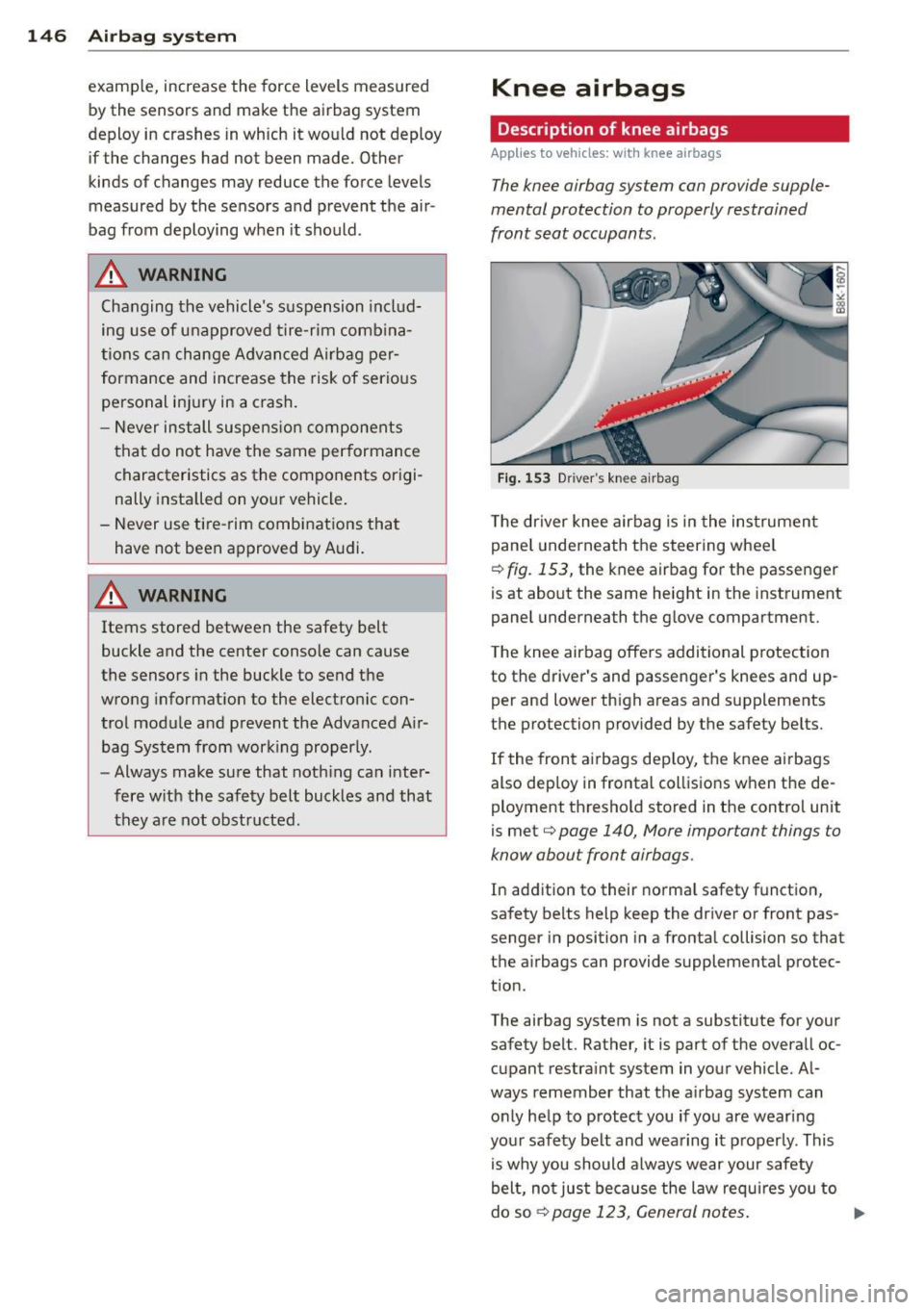
Fig. 153 Driver 's knee airbag
The driver knee airbag is in the instrument
panel underneath the steering wheel
¢ fig. 153, the knee airbag for the passenger
is at about the same height in the instrument
panel underneath the glove compartment.
The knee airbag offers additional protection
to the driver 's and passenger's knees and up
per and lower thigh areas and supplements
the protection provided by the safety belts.
If the front airbags deploy, the knee airbags
also dep loy in frontal collisions when the de
ployment threshold stored in the control unit
is met
¢ page 140, More important things to
know abou t front airbags .
In addition to their normal safety function,
safety belts help keep the driver or front pas
senger in position in a frontal collision so that
the airbags can provide supplemental protec
tion.
The airbag system is not a substitute for your
safety belt . Rather, it is part of the overall oc
cupant restraint system in your vehicle. Al
ways remember that the airbag system can
only help to protect you if you are wearing
your safety belt and wearing it properly . This
is why you should always wear your safety
belt, not just because the law requires you to
do so
r::!;> page 123, General notes. ..,.
Page 149 of 284

"' N
a: LL co
rl I.O
"' rl
"' rl
Remember too, airbags will deploy only once
and only in certain kinds of accidents -your
safety belts are a lways there to offer protec
tion in those acc idents in which airbags are
not supposed to deploy or when they have al
ready deployed, for example when your vehi
cle str ikes or is struck by another afte r the
fi rst coll is ion.
This is just one of the reasons why an a irbag is
not a substitute for the safety belt . The airbag
system works most effectively when used with
the safety belts . Therefore, always wear your
safety bel ts correctly .
It is important to remember that while the
supplemental knee a irbag system is des igned
to reduce the like lihood of serious injur ies,
o ther in juries , fo r example, swel ling , bruising,
and minor abras io ns and frict ion bu rns ca n al
so occur when an airbag inflates.
The knee airbag system basically consists
of :
-The elec tronic control mod ule
- T wo inf latab le airbags (airbag and gas gen-
erato r), one for the driver and one for the
front passenger
- T he airbag ind icator light in the instrument
pane l
The knee airbag system will not deploy:
-when the ign ition is turned off
- in frontal collisions w hen the decelerat ion
measured by the control unit is too low
- in s ide collisions
- in rear-end collisions
- in ro llovers
- in the event of a system malfunct io n (wa rn -
i ng/indicator ligh t is on)
r::!> page 19.
& WARNING
- Safety belts and the airbag system can
only p rov ide protection when occ upants
are in the proper seating posit ion
c::>page 140.
-If the airbag indicator light c::> page 19
comes when the vehicle is be ing used,
have the system inspected immediately
A irba g sy stem 14 7
by your authorized A udi dealer. It is pos
sib le that the airbag will inflate when it
is not supposed to , or will not inflate
when it should .
How knee airbags work
Applies to vehicles: wit h knee airbags
The risk of injury to the leg area can be re
duced by fully deployed knee airbags.
Fi g. 154 In flated a irbags protect ing in a fronta l co lli·
s ion
The knee airbag system has been designed so
that the airbags for the driver and front pas
senger deploy in certain but not all frontal
collisions.
If the front airbags dep loy, the knee airbags
also dep loy in frontal co llisions when the de
ployment threshold stored in the control unit
is met.
When the system deploys, the ai rbags fill
with a propellant gas, and inflate between the l ower part of the instrument pane l and the
driver and t he lower part of the instrument
panel and the front passenger
c::> page 140,
fig . 151 .
Although they are not a soft pi llow, they can
cush io n the impact and in this way they can
help to reduce the risk of injury to the lower
extremit ies .
All of th is takes place in the blin k of an eye, so
fast that many people don't even realize that
the a irbags have deployed. The airbags a lso
i nfla te with a g reat dea l of fo rce and it is im
po rtant for occupant safety that no thing
sho uld be in their way when they deploy.
II>-
Page 150 of 284

148 Airbag system
Fully inflated airbags in combination with
properly worn safety belts slow down and lim
it the occupant's forward movement and help
to reduce the risk of injury.
Important safety instructions on the
knee airbag system
Applies to vehicles: with knee airbags
Airbags are only supplemental restraints. Al
ways wear safety belts correctly and ride in a
proper seating position.
There is a lot that you and your passengers
must know and do to help the safety belts and
a ir bags to provide supplemental protection .
A WARNING
An inflating knee airbag can cause serious
injury. Wearing safety belts incorrectly and
improper seating positions increase the
r isk of serious personal injury and death
whenever a vehicle is being used.
- The knee airbag system cannot protect
you properly if you are seated too close
to any of the airbag locations. When ad
justing their seat positions, it is impor
tant that both the driver and the front
passenger keep their upper bodies and
knees at the following minimum safe
distances:
- at least 10 inches (25 cm) between the
chest and the steering wheel/instru
ment panel.
- at least 4 inches (10 cm) between the
knees and the lower part of the instru
ment panel.
- T he risk of personal injury increases if
you lean forward or to the side, or if the
seat is improperly positioned and you are
not wearing your safety belt. The risk in
creases even more should the airbag de
ploy.
-Always make sure that the knee airbag
can inflate without interference. Objects
between you and the airbag can increase
the risk of injury in an accident by inter
fering with the way the airbag deploys or by being
pushed into you as the airbag
deploys.
- Never let anybody, especially children
o r anima ls ride in the footwell in front
of the passenger seat. If the airbag de
ploys, this can result in serious or fatal
injuries.
- Never carry objects of any kind in the
footwell area in front of the dr iver's or
passenger's seat. Bulky objects (shop
ping bags, for example) can interfere
with or prevent proper deployment of
the airbag. Small objects can be
thrown through the vehicle if the air bag deploys and injure you or your pas
sengers.
- Make sure there are no cracks, deep
scratches or other damage in the area of
the instrument panel where the knee air
bags are located.
- If ch ildren are incorrectly seated, their
risk of injury increases in a collision
~page 152, Child Safety.
Side airbags
Description of side airbags
The airbag system can provide supplemental
protection to properly restrained occupants.
Fig. 155 Sid e airbag location in the driver's seat
The side airbags are located in the sides of the
front seat backrests¢
fig. 155. They are iden
tified by the word "AIRBAG".
The side airbag system basically consists of:
-the electronic contro l module and external
side impact sensors ..,.