ABS AUDI S8 2010 User Guide
[x] Cancel search | Manufacturer: AUDI, Model Year: 2010, Model line: S8, Model: AUDI S8 2010Pages: 384, PDF Size: 90.95 MB
Page 202 of 384
__ _:::S:.::a :..:f...:e :.:t::1y ~ b:..:e:.: l:.: t :.:s :._ ____________________________________________ _
Safety belts protect
People think it's possible to use the hands to brace the
body in a minor collision . It's simply n ot true!
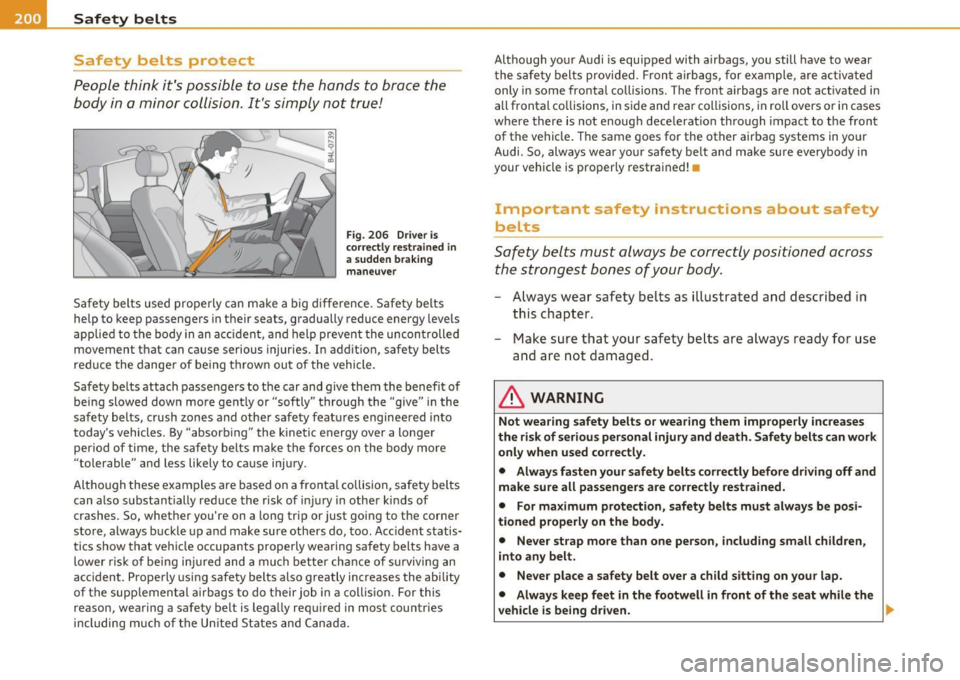
F ig. 2 06 Dri ver is
correct ly re str ain ed in
a s udden b rakin g
m ane uver
Safe ty belts used properly can make a big d ifference. Safe ty belts
help to keep passengers in their seats, gradually reduce energy levels
applied to the body in an accident, an d help prevent the uncon trolled
movement that can cause serious injuries. In add it ion, safety belts
red uce the danger of be ing t hrown ou t of the vehicle .
Safety be lts attach passengers to the car and give them the benefit of
being slowed down more gently or "softly" through the "give" in the
safety belts, crush zones and othe r saf ety features engine ered into
today's vehicles. By "absorb ing" the kinetic energy over a longer
per iod of time , the safety belts m ake the forces on the body more
"tolerable" and less likely to cause injury.
Altho ugh these examples are based on a fronta l collision, safety belts
can also s ubstant ially red uce the risk of injury in other ki nds of
crashes. So, whether you're on a long trip or just going to the corner
sto re, always buckle up and make sure others do, too. Acc ident statis
tics show that vehicle occupants properly wear ing safety belts have a
lower ris k of bei ng inj ured and a mu ch better cha nce of s urviv ing an
acc ident . Properly using safety belts also greatly increases the ability
of the supp lemen tal air bags to do the ir job in a coll is ion. For this
reason, wearing a safety bel t is lega lly requ ired in most coun tries
including muc h of the Un ited States and Canada. Altho
ugh your Audi is equ ipped with a irbags, you still have to wear
t he safe ty belts provided. Fron t air bags, for ex ample, are a ctiv ate d
only in some frontal collisions . T he front a irbags are not act ivated in
all frontal co llisions, in s ide and rear coll isio ns, in roll overs or in cases
where there is not enough decelerat ion thro ugh impact to the front
of the vehicle . The same goes for the other airbag systems in yo ur
Audi. So, always wea r your safety be lt and make su re everybody in
your vehicle is properly restrained!
Important safety Instructions about safety
belts
Safety b elts must always be correctly positioned across
the strongest bones of your body .
-Always wear safety belts as illustrated and described in
this chapter .
- Make sure that your safety belts are always ready for use and are not damaged .
& WARNING
Not wearing safety belts o r wearing them improperly inc reases
the risk of s eriou s personal injury and death . Safety belts can work
only when u sed correctl y.
• Alway s fasten your safety belts correctly bef ore driving off and
make sure all passengers are corre ctly restrained.
• For ma ximum protection , safety belts must alw ays be posi
ti oned properly on the body.
• Never strap more than one person , including small children ,
into any belt .
• Never place a safety belt o ver a ch ild sitting on you r lap .
• Alway s keep feet in the footwell in front of the seat while the
vehicle is being driven.
~
Page 213 of 384

Airbag system -----------------=--=---
& WARNING (co ntinued )
• Airbag work most effectively when used with properly worn
safety belts .
• Therefore, always wear your safety belts and make sure that
everybody in your vehicle is properly restrained .
& WARNING
A person on the front passenger seat, especially infants and small
children, will receive serious injuries and can even be killed by
being too close to the airbag when it inflates .
• Although the Advanced Airbag System in your vehicle is
designed to turn off the front passenger airbag if an infant or a
small child is on the front pa ssenger seat, nobody can absolutely
guarantee that deployment under these special conditions is
impossible in all conceivable situations that may happen during
the useful life of your vehicle.
• The Advanced Airbag Sy stem can deploy in accordance with the
" low risk " option under the U .S. Federal Standard if a child that is
heavier than the typical one-year old child is on the front
pas senger seat and the other condition s for airbag deployment
are met.
• Accident statistics have shown that children are generally safer
in the rear seat area than in the front seating position.
• For their own safety, all children, especially 12 years and
younger, should alway s ride in the back properly re strained for
their age and size. •
Advanced front airbag system
Your vehicle is equipped with a front Advanced Airbag System in
compliance wi th Uni ted States Feder al Motor Vehicle Safe ty Standar d
208 as app licab le at the time your vehicle was manufactured.
Controls and equip
ment Safety first Vehicle operation
T
he front Advanced A irbag System supp lements the safety belts to
prov ide add itional p rote ction for the dr ive r's and fr ont pa ssenge r's
heads a nd upper bodies in fro ntal crashes. The airbags inflate on ly in
fronta l im pacts w he n the vehicle dece le ration is high enoug h.
Th e front Adv anced Airbag Sys te m f or the fron t se at oc cupan ts is no t
a s ubstitute for your safety be lts. Rathe r, it is part o f the overa ll occu
p a nt res tra in t system in y our ve hicl e. Alway s remembe r th at the
airbag system can on ly help to protect you, if yo u are s itting upr ight,
we aring yo ur sa fety be lt and wear ing it prope rly. This i s why you and
your passengers must always be p roperly restra ined, not just beca use
t he law requires you to be.
The Adva nce d A irbag System in your vehicl e has b een cert ified to
meet the " low ris k" requirements fo r 3 and 6 year-old c hildren on the
p as senge r side an d very sma ll adults on the d river side. The low r isk
deployment criter ia a re intended to he lp red uce the risk of in jury
t hroug h in ter action wi th the fr ont air bag t hat can oc cur, fo r exam ple,
by being too close to the steering wheel and instr ument panel when
t he ai rbag inf lates.
I n addit ion, the system has bee n certified to comply wi th t he
"sup pression" requirements of the Safety Sta nda rd, to turn
off the
front airbag for infants 12 mont hs old and you nger w ho are
restra ined o n the front passenger seat in child restraints that are
listed i n the Standard::::>
pag e 233, "Child restraints a nd Advanced
Airbags".
"Supp ression" re quires the fron t airb ag on the passenger side to be
t urn ed
off if:
• a ch ild up to about one yea r of age is restrained on the front
passenger s eat in one o f the re ar-fa cing o r forwar d-fac ing infant
restra ints listed i n Federal Moto r Vehicle Safety Stan dard 208 with
w hich the A dvanc ed Air bag System in y our ve hicle w as certi fied . For a
list ing of the child rest raints t hat were used to ce rtify your vehicle's
co mplia nce wi th th e US Safety St and ard
=> page 2 33,
• weight less than a thresho ld level stored in the contro l unit is
de te cted on t he fr ont passenge r sea t.
Vehicle care Do-it-yourself service Technical data
Page 214 of 384
-Airbag system
----
--=----------------
When a perso n is detected on the fro nt passenger seat, we ig hi ng
mo re t han t he total we ight of a chi ld t hat i s ab out 1 year old
restra ined in o ne of the rear -facing or forward -fac ing infant
restraints (listed in Fed eral Moto r Vehicle Safety Sta ndard
208 with
w hich the Advanced A irbag System in you r veh icle was cert ified), the
front airbag on the passenge r side may or may not dep loy.
Th e
PASSENGER AIR BAG OFF ligh t co mes on when the ele ct ronic
control un it detects a tota l weight on t he front passenger seat t hat
re qu ires the fron t air bag to be turned of f. If the
PASSENGER AIR
BAG OFF
li ght does not come on, the front a irbag on the passenger
side has not been tu rned of f by the con trol unit and can dep loy i f the
cont rol un it senses an impact that meets the cond itions stored in its
memory.
If the tota l weig ht o n th e fron t passenger seat is more than that of a
typical
1 year-old, but less than the weight of a small adult, the front
a ir bag o n the p assenge r sid e m ay deploy (the
PASSENGER AIR BAG
OFF
lig ht does not come on).
For example , the airbag may deploy if:
• a small ch ild that is heav ie r th an a typ ica l 1 year-o ld child is on the
front passenger seat (regard less of whethe r the chi ld is in one of the
c hild se ats liste d=>
page 23 3),
• a child who has outgrown chi ld rest rai nts is on t he front passenger
se at.
If the front passenger a irbag is turned off, the
PASSENGER AIR BAG
OFF
lig ht in the cen ter of t he ins trume nt panel w ill come on and stay
on.
T he front a irbag on the passenger side may
not deploy (the
PASSENGER AIR BAG OFF light do es not illum inate and s tay lit) if:
• a small a dult or teenager is on the front passenger seat
• a passenger w ho i s not sit ting up rig ht w ith their back against a
non -reclined bac krest with the ir feet on the ve hicle floor in front of
th e seat is o n the fr ont pas senge r seat.
If the front passenge r a irbag dep loys, the Federal Standard requires
t he airbag to mee t the "low risk" deployment c rit er ia to help reduce the risk of in
jury t hrough interaction with the a irbag. "Low r isk"
de ploymen t oc cur s in th o se cra shes that take plac e at l owe r de celer
ations as defined in the elect ronic contro l unit=>
page 217 .
Always remember: Even t hough your ve hicle is eq uipped with
Adv anced Airbags, the safes t pla ce for child ren is prope rly re st rai ned
on the back seat. Please be sure to read the important in formation in
th e sections t hat foll ow and be su re t o hee d all of the WA RNINGS .
& WARNING
To reduce the risk of injury when an airbag inflate s, always wear
safety belts properly.
• If you are unrestrained, leaning forward, sitting sideways or
out of position in any way, your risk of injury is much higher .
• You will also receive serious injuries and could even be killed if
you are up against the airbag or too close to it when it inflates -
even with an Advanced Airbag =>
page 206.
& WARNING
A child in a rearward-facing child seat installed on the front
pa ssenger seat will be seriou sly injured and can be killed if the
front airbag inflates -even with an Advanced Airbag System.
• Although the Advanced Airbag System in your vehicle is
designed to turn off the front airbag when a rearward-facing child
restraint has been installed on the front passenger seat, nobody
can absolutely guarantee that deployment is impossible in all
conceivable situation s that may happen during the useful life of
your vehicle .
• The inflating airbag will hit the child seat or infant carrier with
great force and will smash the child seat and child against the
backrest, center armre st, door , or roof .
• Always install rearward-facing child restraints on the rea r seat .
• If you must install a rearward facing child seat on the front
passenger seat because of exceptional circumstances and the
Page 223 of 384

______________________________________________ ___:.A:::::.:.: ir:....: b~ a~g !....= s:ly '..:s~ t~ e~ m~ ---
& WARNING (co ntinued )
• Always make sure that the side airbag can inflate without
interference:
-Never install se at covers or replacement upholstery over the
front seatbacks that have not been specifically approved by
Audi .
- Never use additional seat cushions that cover the areas
where the side airbags inflate .
- Damage to the original seat covers or to the seam in the area
of the side airbag module must always be repaired immedi
ately by an authorized Audi dealer.
• The airbag sy stem can be activated only once. After an airbag
has inflated, it must be replaced by an authorized Audi dealer or
qualified technician who has the technical information , training
and special equipment necessary.
• The airbag sy stem can be deployed only onc e. After an airbag
has been deployed, it must be replaced w ith new replacement
parts de signed and approved es pecially for your Audi model
version . Replacement of complete airbag systems or airbag
components must be performed by qualified workshops only.
Make sure that any airbag service action is entered in your Audi
Warranty
& Maintenance booklet under AIRBAG REPLACEMENT
RECORD.
• For safety reasons in severe accidents, the alternator and
starter are separated from the vehicle battery with a pyrotechni c
circuit interrupter .
- Work on the pyrotechnic circu it interrupter must only be
performed by a qualified dealer -risk of an a ccident!
- If the vehicle or the circu it interrupter is scrapped, all appli
cable safety precautions must be followed .
Controls and equip ment Safety first Vehicle operation
<£' For the sake of the environment
U
ndeployed airbag modules and pretens io ners mig ht be classified as
Perch lorate Material -sp ec ial handling may a pply, see
www.d ts c. ca.gov/ha za rdouswaste/pe rchlorate . W he n t he vehicle or
parts of the restraint system including airbag modules and safety
bel ts wi th prete nsio ners are scra pped, all applica ble laws an d regula
tions m ust be observed. Your authorized Aud i dea ler is familiar with
t hese requireme nts and we recommend tha t you have you r dealer
perform this service for you. •
Other things that can affect Advanced
Airbag performance
Chang ing the ve hicle's suspension system can change the way that
t he Adv anced Airbag System pe rforms in a crash . For example, using
tire-r im combinations not approved by Aud i, lower ing t he veh icle,
c hang ing the st iffness o f the suspe nsio n, incl uding the s prings,
s u spension str uts, shoc k absorbe rs etc. can change the forces that
are meas ured by the airb ag sensors and sen t to the ele ctron ic con trol
uni t. Some suspension changes ca n, for examp le, increase the force
levels measu red by t he sensors and ma ke the airbag sys tem dep loy in
crashes in which it wou ld not deploy if the changes had not bee n
made . Other kin ds of c hanges may re duce the force levels meas ured
by the senso rs and p revent the airbag from dep loyi ng when it should .
The sensors in the safety belt buckle for the d river and front
p assenger se at tell the e le ct ro nic co ntro l mo dule if the sa fe ty belt is
latc hed or not . If the safety be lt is be ing used, the fron t airbag w ill
dep loy at a s ligh tly hig her ra te o f ve hicl e decelerat io n t han if the
safety belt is not be ing us ed. T he refo re, in a part icular collis io n, it is
poss ible that an a irbag wi ll not deploy at a seating posit ion where the
safety belt is being used but wi ll inflate at the posi tion whe re the
safety belt is not bei ng used. It is important that not hing interfere
w ith the s afe ty be lt bu ckles so t hat th e sensor s can sen d the correct
information about safety belt use to the electronic contro l unit. ..
Vehicle care Do-it-yourself service Technical data
Page 242 of 384
• .___C_ h_ il_d _ S_a _ f_ e _ t--= y '------------------------------------------------
- A lways make sure that the chi ld can properly wear the lap
po rtio n of the belt low across t he th ig hs o r pelvis a nd
never over the stomach o r abdome n.
Ch ild ren up t o at le ast 8 years old (over 40 lbs or 18 kg) are best
protected in child safety seats des igned for their age and we ight.
Expe rts say t hat the ske letal structure, par tic ul arly the pelvis, of
these ch ildren is not fully developed , a nd they must not use the
vehicle safety belts w it h out a suitable c hild rest raint .
It is usually best to pu t these ch ildren in app ropria te booster seats.
Be sure the booster seat meets all appl icable safety standards.
Booste r seats r aise the se ating posi tion of the child and reposi tion
both the lap and sho ulder parts of the safety belt so t hat they pass
across the c hild 's body i n the rig ht places . The ro uting of the be lt ove r
t he c hild 's body is ve ry i mp ort an t fo r th e ch ild's p rot ection, wh eth er
or not a booster seat is used . Children age 1 2 and under m ust a lways
r ide in t he re a r se at.
Chi ldren who are at least 4 ft . 9 in . (57 inc hes/1. 45 meters) tall can
gene rally use t he ve hicl e's th ree poi nt la p and sho uld er bel ts. N ever
use t he lap belt port ion of the vehicle 's safety belt alone to restra in
a ny chi ld , re gar dless o f how big t he ch ild i s. Always remem ber that
childr en do no t have the pronounced pelvic s tru ctur e required for the
pr op er f unc tion of lap belt port io n of the vehi cle's t hree poin t lap and
shoulder b elts. Th e chi ld's saf ety absolu tely r equir es tha t a lap belt
portion of the safety be lt be fastened snugly and as low as possible
arou nd the pelvis . Ne ver l et t he lap bel t port ion of the safety b elt
pass over the child's stomach o r abdome n.
I n a cra sh, air bag s must inflat e withi n a bli nk of an eye a nd wi th
cons iderable fo rce . In o rder to do its job, the airbag needs room to
in flat e so t hat it will b e the re to p rotect th e occupa nt a s th e occu pan t
mov es forward into t he a irbag .
A vehi cle occ upant who is out of position and too close to the a irba g
ge ts in the w ay of an inf latin g air bag . Whe n an o ccup ant is too clos e,
he or s he will be struck violently and will rece ive s erio us or poss ibly
eve n fata l in jury. I
n order for the airbag to offe r protect ion, it is impo rta nt t hat all
ve hicle occupant s, especiall y any childr en , wh o must b e in t he front
sea t beca use of exc eptiona l circu mstances, be pro per ly r estra ined
and as far away from t he a irba g as possib le . By keep ing room
b etween t he child's body and the front o f the passenger co mpart
ment , th e a irba g can inflate completely an d prov ide sup plemental
pr ote ction in ce rt ain fro ntal coll isions.
& WARNING
Not using a booster seat, using the booster seat improperly, incor
rectly installing a booster seat or using the vehicle safety belt
improperly increases the risk of serious personal injury and death
in a collision or other emergency situation. To help reduce the risk
of seriou s personal injury and/or death:
• Always make sure to position the shoulder portion of the three
point belt over the middle of child 's shoulder.
• Never let the shoulder portion of the belt rest against or acros s
the neck, face, chin, or throat of the child.
• Always make sure the lap belt portion of the three-point belt is
worn snug and passes as low as possible across the child's pelvis.
Never let the belt pass over the soft abdomen.
• Failure to properly route safety belts over a child's body will
cause severe injuries in an accident or other emergency situation
~ page 197 .
• Children on the front seat of any car, even with Advanced
Airbags, can be seriously injured or even killed when an airbag
inflates.
• Never let a child stand or kneel on any seat, for example the
front seat.
• Never let a child ride in the cargo area of your vehicle .
• Always remember that a child leaning forward, sitting side
ways or out of position in any way during an accident can be struck
by a deploying airbag. This will result in serious personal injury or
death.
~
Page 254 of 384

Intelligent technology
'-----------------------------------------------
Intelligent technology
Notice about data recorded by
vehicle control modules
Your vehicle is not equipped with an Event Data Recorder (EDR),
installed by some manufacturers for the express purpose of
capturing data for retrieva l after an accident or crash event. ED R's are
sometimes called "crash recorders".
Some state laws restrict the retrieval or downloading of data stored
by ED R's that were installed in a vehicle for the express purpose of
retrieving data after an accident or crash event without the owner's
consent.
Although your vehicle is not equipped with an EDR, it is equipped w ith
a number of electronic control modu les for various vehicle systems
such as, for example, engine function, emission control, as well as for
the airbags and safety belts.
T hese electronic contro l modules also record vehicle-re lated data
during normal vehicle operation for diagnostic and repair purposes .
Th e recording capacity of the e lectronic control modu les is limited to
data (no sound is recorded) and only a sma ll amount of data is actu
ally recorded over a very limited period of time and stored when a
system fault or other condition is sensed by a control unit. Some of
the data then stored may relate to vehicle speed, direction, braking
as well as restraint system use and performance in the event of a
crash or other condition. Stored data can only be read and down
loaded with special equipment.
Electronic Stabilization Program
(ESP)
General information
The ESP improves the vehicle stability.
N
-. ...
~
I ' I A I ~ )
--
Fig. 234 Center
console with ESP
switch
ESP is des igned to help you maintain vehicle control in s ituations
where the car approaches the limits of "grip", especia lly when accel
erat ing and cornering. ESP reduces the risk of skidd ing and imp roves
stability under all road conditions.
Th e system operates across the entire speed range in combination
with the ABS system. If the Anti-Lock Brake System (ABS) malfunc
tions, the ESP will also shut down.
How the system works
The Anti-Lock Brake System (ABS), Electronic Differential Lock (EDL)
and the Anti-Slip Regulation System (ASR) are integrated in the elec
tronic stabilizatio n pro gram. In addition to the data provided by
these funct ions, the ESP control unit requires additional measure
ment data provided by high performance sensors. The rotational
speed of the vehicle about its vertical axis, the lateral acceleration ...
Page 255 of 384

_________________________________________ I_ n_ t_ e_ ll_,igent technology ,__E~-
acting on the vehicle, the brake pressure and the steering angle are
all meas ured.
The direction in which the driver wishes to travel is determined with
the aid of the steering angle and vehicle speed and is continually
compared with the actual behavior of the vehicle. If the two do not
match, for example , when the vehicle starts hydroplaning on a wet
road, ESP will automatically brake the appropriate wheel to correct
the problem.
The vehicle is then stabi lized by the forces acting on the whee l during
braking. If the vehicle is
oversteering (rear tends to skid out of the
turn), the brakes are main ly applied on the wheel that is on the
outs ide of the curve. In the case of a vehicle that is
understeering
(tendency to slide out of the curve), the brakes are applied at the rear
wheel that is on the inside of the curve. An acoustic signal ind icates
when ESP brake application cuts in =>
&.
Th e system operates across the entire speed range in combination
with the ABS system=>
page 256. If the Anti-Lock Brake System
(ABS) malfunctions, the ESP will be out of action as we ll.
Activation
When you turn on the engine, ESP will automatically be activated and
will perform a self-test .
The system can be activated or deactivated by pressing the button
=>
page 252, fig. 234 . The warning light comes on when the system
is switched off=>
page 16.
Normally, the ESP should always be on, however, it may be advanta
geous to turn off the sys tem in certain special cases when some
degree of whee l spin is desired such as:
• when driving with snow chains
• when driving in deep snow or on a loose surface (to allow the
wheels to dig in to reach firm ground)
• when trying to "roc k" the vehicle free when it has become stuck.
The system should be reactivated once you are no longer in such situ
ations.
Controls and equip ment Safety first Vehicle operation
Both the ABS and
EDS systems are still functioning even if the ESP is
switched off.
& WARNING
The Electroni c Stabilization Program is nevertheless subject to the
laws of physics. It is particularly important to pay attention to
this fact on wet and slippery roads. It is therefore important that
you always adapt your driving to the condition of the road and
traffic conditions. Do not allow the increased safety provided by
the Electronic Stabilization Program system to lull you into
accepting additional safety risks. •
Electronic differential lock (EDL)
The electronic differential lock monitors the rotational
speed of the drive wheels.
General notes
The electronic differential lock (EDL) helps the car to start moving,
acce lerate and climb a gradient on surfaces providing poor or almost
no grip . Without EDL, this would be difficult, if not impossible .
How the system works
The EDL operates automatically. It monitors the rotational speed of
the drive wheels on an axle with the he lp of the ABS sensors
=>
page 256 . If a noticeable difference in rotational speed between
the drive wheels on one axle is detected (e .g . on slippery ground
on
one side),
the spinning wheel is braked, thereby transferring power to
the other drive whee l or wheels (all -wheel drive). This is done up to a
speed of about 60 mph (100 km/h) . Noises from the brake system
signal that wheel spin is being contro lled.
Driving off
When driving off, always be sure to keep road conditions in mind as
you accelerate. If one drive wheel spins because it is on a surface with
less grip , gradually increase the pressure on the accelerator peda l
Iii>
Vehicle care Do-it-yourself service Technical data
Page 256 of 384

Intelligent technology
'-----------------------------------------------
until the car starts to move . The whee l less ab le to transfer power
spins .
Overheating of brakes
To prevent the disc b rake of the bra ked wheel from ove rhea ting if
subjected to excessive loads, the EDL cuts out temporarily . The
veh icle remains operat ional and beh aves in the same way as a vehicle
without EDL .
As soon as the brake has coo led down, EDL switches on again auto
matically .
& WARNING
• When a ccelerating on slippery surfaces, such as on ice or snow,
alw ay s be careful when depre ssing the a ccelerator pedal. E ven
with the EDL working, the drive wheel s can spin and reduce your
ability to control your car . Risk of crash !
• The in creased safety afforded by EDL does not mean that you
can take safety ri sks. Always adapt your driving st yle to the road
condition s and traffic situation .
fi Tips
If a fault occurs i n the ABS, the EDL is also no t fu nct ion ing . This is
indicated by the ABS warning light~
page 19. •
Anti-Slip Regulation System (ASR)
The Anti-Slip Regulati on System prevents the driven
wheels from spinning when the car is a ccel erating.
General notes
T he Anti-S lip Regulation System (ASR) is integrated in the electronic
stabilization program (ESP). When the veh icle starts up and acceler
ates , the wheels are p reve nted from sp inning by adjust ing the eng ine
powe r to match t he amo unt of grip avai lab le from the road s urface.
How the system works
ASR perfo rms au toma tica lly, i .e . witho ut the drive r's in tervent ion .
With the aid of the A BS sensors~
page 256, ASR monitors the speed
of the driven wheels . If the wheels start to spin, the engine powe r is
reduced automat ically u nti l the t ires find enough gr ip to lock onto
the road s urface. The system is active across the entire speed range.
Th e ASR wor ks in con ju nction with the A BS .
If a m alfu nction sho uld
occur in the ABS, the ASR w ill also be out of action.
& WARNING
The increased safety afforded by ASR does not mean that you can
take safety ri sks . Always adapt your driving style to the road
condit ions and traffic situation.
[ i ] Tips
To ensure that the ASR works prope rly, all four wheels must be fitted
w ith ident ic a l ti res Any differences in rollin g radius of the tires can
cause the system to reduce engine power when t his is not desired .
See also ~
page 318, "N ew t ires and replacing tires and whee ls" .•
Braking
General Information
What affects b raking efficiency ?
Operating cond itions and driving habits
Th e bra kes on t oday's automo biles are still subjec t to we ar,
depending large ly on operating conditions a nd driving habits~ &.
O n ve hicles tha t are eithe r driven mostly in stop- and-go city t raff ic or
are drive n hard, the brake pads should be checked by your author ized
Audi de aler more o ften than specified in the
Warranty & Mainte
nance booklet .
Failure to have your brake pads i nspected can result
in re duced brake pe rformance. .,
Page 258 of 384

lillill.a._...:I:..: n~ t .::.e::::..::.: ll~igent technology ,_ _______________________________________ _
Brake booster
The brake booster adds extra braking power.
The brake booster works with vacuum pressure which is created on ly
w hen the eng ine is ru nn ing =>& .
& WARNING
• Nev er let the vehicle roll to a stop w ith the engine shut off.
• If the brake booster is n ot working , for e xample when towing
your vehicle, or because the brake booster has som ehow been
damaged , the brake pedal must be pressed conside rably harder to
make up for the lack of booster assistan ce. •
Functioning of Anti-Lock Brake System
(ABS)
A BS prevents the wheels fr om locking up under braking.
The ABS co ntributes effectively to ve hicle contro l s i nee it preve nts the
w heels from
locking when the brakes a re applied. T his means that the
vehicle remains steerable and is less likely to skid .
With ABS you do not need to pump the brake. Just hold the brake
pedal down.
However, do not expect the A BS to shorten brak ing distance under all
circumstances. When driving on grave l o r on newly fa llen snow on top
of icy su rfaces, b raking distance may be even longer, therefore, under
these circumstances, it is especially important that you drive slowly
and w ith great care.
How the ABS system works
An automatic check is made w hen a speed of abo ut 4 mph (6 km/h) is
reached . When this happens, a pumping noise can be heard . If a
n ind iv idua l wheel begins to rotate too slow ly in relat ion to ve hicle
speed and tends to lo ck, the ABS automat ically redu ces bra ke pres
su re to p revent t hat wheel from lock ing.
Th is automatic adjustment process wi ll cause a
slight vib ration of
t he bra ke pedal and so me noises to al er t you tha t vehicle s peed mus t
be adapted to existing road and traff ic conditions.
& WARNING
Although the ABS is very effective, always remember that braking
capability is limited by tir e traction. Always adjust your driving
speed acco rding to the road and traffic conditions. Do not let the
extra safety afforded by the ABS tempt you into taking extra ri sks .
The ABS cannot ove rcome the laws of physics.
[I) Tips
• If ABS is not funct ioning properly, a warning light will come on.
See=>
page 19.
• If a fa ult occ urs in the ABS, the ED L is also not functioning . This is
ind icated by the A BS warn ing ligh t.•
Brake assistant
T he brake assistant is designed to achi eve the optimum
b ra king effect.
The b rake ass istant helps to i ncrease the effective brak ing power and
thus to achieve a shorter stopping distance. If the driver p resses the
bra ke pedal
very quickly, the brake assistan t automatically boosts t he
brak ing fo rce to the maximum level, up to the po int where the anti
lo ck bra ke f un ct ion (ABS) intervenes to stop the whee ls from locking.
You shou ld then keep the brake pedal pressed unt il the ve hicle has
bra ked to t he required s peed . T he bra ke ass ist ant sw itches itse lf off
as soon as you re lease the brake pedal. ._
Page 259 of 384

_________________________________________ I_ n_ t_ e_ ll_,igent technology ,__E~-
The brake assistant will not be operative if there is a malfunct io n in
t he ABS.
& WARNING
Plea se remember that the accident ri sk a lwa ys increa se s if you
d riv e too fast , especially in corne rs or on a slippery road , or if you
follow the vehi cle ahead of you too closely . In cre ased ri sk of an
accident cannot be compensated for e ven by the brake ass istant,
so always maintain a safe speed. •
Servotronic® - advanced power
steering system
The power steering systems uses th e power of the
running engine to allow precise steering with little effort.
Th e advanced Servotronic ® power steeri ng system senses the road
speed and electronically ad justs power assistance to provide
c omfortable and safe s teer ing response exa ctly matched to the
vehicle speed.
Powe r steering will not work if the engi ne is of f. As a resu lt, the
steer ing wheel will be hard to turn .
The power stee ring fluid level is checked during the sched uled main
t enance se rvi ces.
0 Note
If the re is an ele ct roni c mal func tion, servotroni c will still f unction
like a conventional power steer ing system, prov iding a constant
steeri ng support force tha t is no lo nger propo rt iona te to the ve hicle
speed. This is most not iceab le when turn ing the steer ing wheel at low
speeds (for example when parking), -more effort will be required
than usual.
Controls and equip ment Safety first Vehicle operation
•
Be aware of the d ifferent than usual steering response and adjust
your stee rin g for ce acco rdi ng ly.
• Have the prob lem checked and set r ight by an A udi dea ler as soon
as possib le.
[ i ] Tips
• Whe n the eng ine is runni ng, neve r hold t he steering w hee l turned
all the way to the right or to t he left for longer than 15 seconds. The
powe r stee ring pump wi ll over heat the hydra ulic fluid if yo u keep
holding the steeri ng w heel tur ned all the way. This is likely to damage
the power steering system .
• If the power stee ring system shou ld fa il entire ly, or if the engine
is not r unning (fo r examp le, while being towed), you w ill still be a ble
to steer the vehicle. However,
considerably more effo rt will be
req uired to do so .
• If the power steering system s hou ld have a lea k, or is not func
tioning properly, contact your authorized Au di dea ler immediate ly .
• The power steering system requ ires a specially formulated
hydra ulic fl uid. The power stee ring re se rvoir is t he one located mos t
forward o n the left side of the eng ine compa rtment=:>
page 290 . The
correct fluid leve l in the reservoir is important fo r proper f unctioning
of t he power steering. •
Dr"ving with your quattro®
With All Whee l Drive, all four wheels are driven .
General information
With All Wheel Drive, power is d istributed to all four wheels. This
happens au tom atically depending on you r d rivi ng style a nd the roa d
conditions at the time. See also=>
page 253, "Electronic different ial
lock (ED L)".
Vehicle care Do-it-yourself service Technical data