Oil pump DODGE RAM 2003 Service Repair Manual
[x] Cancel search | Manufacturer: DODGE, Model Year: 2003, Model line: RAM, Model: DODGE RAM 2003Pages: 2895, PDF Size: 83.15 MB
Page 2278 of 2895
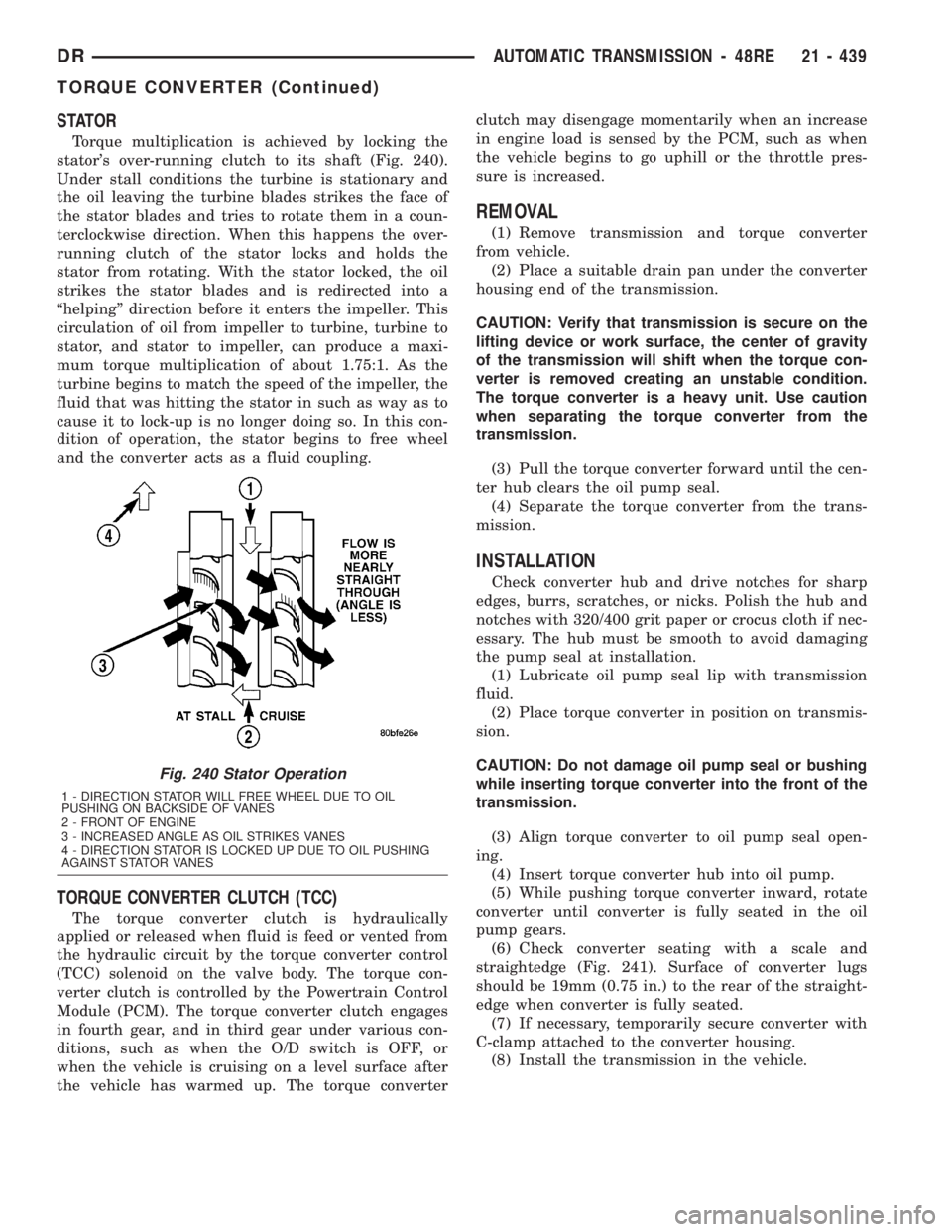
STATOR
Torque multiplication is achieved by locking the
stator's over-running clutch to its shaft (Fig. 240).
Under stall conditions the turbine is stationary and
the oil leaving the turbine blades strikes the face of
the stator blades and tries to rotate them in a coun-
terclockwise direction. When this happens the over-
running clutch of the stator locks and holds the
stator from rotating. With the stator locked, the oil
strikes the stator blades and is redirected into a
ªhelpingº direction before it enters the impeller. This
circulation of oil from impeller to turbine, turbine to
stator, and stator to impeller, can produce a maxi-
mum torque multiplication of about 1.75:1. As the
turbine begins to match the speed of the impeller, the
fluid that was hitting the stator in such as way as to
cause it to lock-up is no longer doing so. In this con-
dition of operation, the stator begins to free wheel
and the converter acts as a fluid coupling.
TORQUE CONVERTER CLUTCH (TCC)
The torque converter clutch is hydraulically
applied or released when fluid is feed or vented from
the hydraulic circuit by the torque converter control
(TCC) solenoid on the valve body. The torque con-
verter clutch is controlled by the Powertrain Control
Module (PCM). The torque converter clutch engages
in fourth gear, and in third gear under various con-
ditions, such as when the O/D switch is OFF, or
when the vehicle is cruising on a level surface after
the vehicle has warmed up. The torque converterclutch may disengage momentarily when an increase
in engine load is sensed by the PCM, such as when
the vehicle begins to go uphill or the throttle pres-
sure is increased.
REMOVAL
(1) Remove transmission and torque converter
from vehicle.
(2) Place a suitable drain pan under the converter
housing end of the transmission.
CAUTION: Verify that transmission is secure on the
lifting device or work surface, the center of gravity
of the transmission will shift when the torque con-
verter is removed creating an unstable condition.
The torque converter is a heavy unit. Use caution
when separating the torque converter from the
transmission.
(3) Pull the torque converter forward until the cen-
ter hub clears the oil pump seal.
(4) Separate the torque converter from the trans-
mission.
INSTALLATION
Check converter hub and drive notches for sharp
edges, burrs, scratches, or nicks. Polish the hub and
notches with 320/400 grit paper or crocus cloth if nec-
essary. The hub must be smooth to avoid damaging
the pump seal at installation.
(1) Lubricate oil pump seal lip with transmission
fluid.
(2) Place torque converter in position on transmis-
sion.
CAUTION: Do not damage oil pump seal or bushing
while inserting torque converter into the front of the
transmission.
(3) Align torque converter to oil pump seal open-
ing.
(4) Insert torque converter hub into oil pump.
(5) While pushing torque converter inward, rotate
converter until converter is fully seated in the oil
pump gears.
(6) Check converter seating with a scale and
straightedge (Fig. 241). Surface of converter lugs
should be 19mm (0.75 in.) to the rear of the straight-
edge when converter is fully seated.
(7) If necessary, temporarily secure converter with
C-clamp attached to the converter housing.
(8) Install the transmission in the vehicle.
Fig. 240 Stator Operation
1 - DIRECTION STATOR WILL FREE WHEEL DUE TO OIL
PUSHING ON BACKSIDE OF VANES
2 - FRONT OF ENGINE
3 - INCREASED ANGLE AS OIL STRIKES VANES
4 - DIRECTION STATOR IS LOCKED UP DUE TO OIL PUSHING
AGAINST STATOR VANES
DRAUTOMATIC TRANSMISSION - 48RE 21 - 439
TORQUE CONVERTER (Continued)
Page 2289 of 2895
OPERATION
NOTE: Refer to the Hydraulic Schematics for a
visual aid in determining valve location, operation
and design.
CHECK BALLS
CHECK BALL
NUMBERDESCRIPTION
1 Allows either the manual valve to put line pressure on the 1-2 governor plug or the KD Valve to
put WOT line pressure on the 1-2 governor plug.
3 Allows either the Reverse circuit or the 3rd gear circuit to pressurize the front clutch.
4 Allows either the Manual Low circuit from the Manual Valve or the Reverse from the Manual
Valve circuit to pressurize the rear servo.
5 Directs line pressure to the spring end of the 2-3 shift valve in either Manual Low or Manual
2nd, forcing the downshift to 2nd gear regardless of governor pressure.
6 Provides a by-pass around the front servo orifice so that the servo can release quickly.
7 Provides a by-pass around the rear clutch orifice so that the clutch can release quickly.
8 Directs reverse line pressure through an orifice to the throttle valve eliminating the extra
leakage and insuring that Reverse line pressure pressure will be sufficient.
9 Provides a by-pass around the rear servo orifice so that the servo can release quickly.
10 Allows the lockup clutch to used at WOT in 3rd gear by putting line pressure from the 3-4
Timing Valve on the interlock area of the 2-3 shift valve, thereby preventing a 3rd gear Lock-up
to 2nd gear kickdown.
REGULATOR VALVE
The pressure regulator valve is needed to control
the hydraulic pressure within the system and reduce
the amount of heat produced in the fluid. The pres-
sure regulator valve is located in the valve body near
the manual valve. The pressure regulator valve train
controls the maximum pressure in the lines by
metering the dumping of fluid back into the sump.
Regulated pressure is referred to as ªline pressure.º
The regulator valve (Fig. 255) has a spring on one
end that pushes the valve to the left. This closes a
dump (vent) that is used to lower pressure. The clos-
ing of the dump will cause the oil pressure to
increase. Oil pressure on the opposite end of the
valve pushes the valve to the right, opening the
dump and lowering oil pressure. The result is spring
pressure working against oil pressure to maintain
the oil at specific pressures. With the engine run-
ning, fluid flows from the pump to the pressure reg-
ulator valve, manual valve, and the interconnected
circuits. As fluid is sent through passages to the reg-
ulator valve, the pressure pushes the valve to the
right against the large spring. It is also sent to the
reaction areas on the left side of the throttle pressure
plug and the line pressure plug. With the gear selec-tor in the PARK position, fluid recirculates through
the regulator and manual valves back to the sump.
Meanwhile, the torque converter is filled slowly. In
all other gear positions (Fig. 256), fluid flows
between two right side lands to the switch valve and
torque converter. At low pump speeds, the flow is
controlled by the pressure valve groove to reduce
pressure to the torque converter. After the torque
converter and switch valve fill with fluid, the switch
valve becomes the controlling metering device for
torque converter pressure. The regulator valve then
begins to control the line pressure for the other
transmission circuits. The balance of the fluid pres-
sure pushing the valve to the right and the spring
pressure pushing to the left determines the size of
the metering passage at land #2 (land #1 being at
the far right of the valve in the diagram). As fluid
leaks past the land, it moves into a groove connected
to the filter or sump. As the land meters the fluid to
the sump, it causes the pressure to reduce and the
spring decreases the size of the metering passage.
When the size of the metering passage is reduced,
the pressure rises again and the size of the land is
increased again. Pressure is regulated by this con-
stant balance of hydraulic and spring pressure.
21 - 450 AUTOMATIC TRANSMISSION - 48REDR
VALVE BODY (Continued)
Page 2327 of 2895
AUTOMATIC TRANSMISSION - 45RFE/545RFE
TABLE OF CONTENTS
page page
AUTOMATIC TRANSMISSION - 45RFE/545RFE
DESCRIPTION........................489
OPERATION..........................490
DIAGNOSIS AND TESTING
DIAGNOSIS AND TESTING - AUTOMATIC
TRANSMISSION.....................491
DIAGNOSIS AND TESTING - PRELIMINARY. . 491
DIAGNOSIS AND TESTING - ROAD
TESTING...........................491
DIAGNOSIS AND TESTING - HYDRAULIC
PRESSURE TEST....................493
DIAGNOSIS AND TESTING - AIR CHECKING
TRANSMISSION CLUTCH OPERATION....494
DIAGNOSIS AND TESTING - CONVERTER
HOUSING FLUID LEAK................495
STANDARD PROCEDURE - ALUMINUM
THREAD REPAIR.....................495
REMOVAL............................495
DISASSEMBLY........................497
CLEANING...........................502
INSPECTION.........................503
ASSEMBLY...........................503
INSTALLATION........................510
SCHEMATICS AND DIAGRAMS
HYDRAULIC SCHEMATICS.............513
SPECIFICATIONS
TRANSMISSION.....................534
SPECIAL TOOLS
RFE TRANSMISSION.................535
4C RETAINER/BULKHEAD
DISASSEMBLY........................538
ASSEMBLY...........................538
ADAPTER HOUSING SEAL
REMOVAL............................539
INSTALLATION........................539
BRAKE TRANSMISSION SHIFT INTERLOCK
SYSTEM
DESCRIPTION........................540
OPERATION..........................540
DIAGNOSIS AND TESTING - BRAKE
TRANSMISSION SHIFT INTERLOCK......540
ADJUSTMENTS - BRAKE TRANSMISSION
SHIFT INTERLOCK...................540
FLUID AND FILTER
DIAGNOSIS AND TESTING
DIAGNOSIS AND TESTING - EFFECTS OF
INCORRECT FLUID LEVEL.............541
DIAGNOSIS AND TESTING - CAUSES OF
BURNT FLUID.......................541DIAGNOSIS AND TESTING - FLUID
CONTAMINATION....................541
STANDARD PROCEDURE
STANDARD PROCEDURE - FLUID LEVEL
CHECK............................542
STANDARD PROCEDURE - FLUID AND
FILTER REPLACEMENT...............542
STANDARD PROCEDURE - TRANSMISSION
FILL...............................544
GEARSHIFT CABLE
DIAGNOSIS AND TESTING - GEARSHIFT
CABLE.............................544
REMOVAL............................544
INSTALLATION........................545
ADJUSTMENTS
GEARSHIFT CABLE..................546
HOLDING CLUTCHES
DESCRIPTION........................546
OPERATION..........................546
INPUT CLUTCH ASSEMBLY
DESCRIPTION........................549
OPERATION..........................549
DISASSEMBLY........................550
ASSEMBLY...........................552
INPUT SPEED SENSOR
DESCRIPTION........................558
OPERATION..........................558
REMOVAL............................559
INSTALLATION........................559
LINE PRESSURE (LP) SENSOR
DESCRIPTION........................559
OPERATION..........................559
REMOVAL............................559
INSTALLATION........................560
LOW/REVERSE CLUTCH
DISASSEMBLY........................560
CLEANING...........................561
INSPECTION.........................561
ASSEMBLY...........................561
OIL PUMP
DESCRIPTION........................562
OPERATION..........................562
STANDARD PROCEDURE - OIL PUMP
VOLUME CHECK.....................563
DISASSEMBLY........................564
CLEANING...........................566
INSPECTION.........................566
ASSEMBLY...........................566
21 - 488 AUTOMATIC TRANSMISSION - 45RFE/545RFEDR
Page 2328 of 2895
OIL PUMP FRONT SEAL
REMOVAL............................567
INSTALLATION........................567
OUTPUT SPEED SENSOR
DESCRIPTION........................567
OPERATION..........................567
REMOVAL............................567
INSTALLATION........................567
OVERDRIVE SWITCH
DESCRIPTION........................568
OPERATION..........................568
REMOVAL............................568
INSTALLATION........................569
PISTONS
DESCRIPTION........................569
OPERATION..........................569
PLANETARY GEARTRAIN
DESCRIPTION........................571
OPERATION..........................571
DISASSEMBLY........................573
CLEANING...........................573
INSPECTION.........................573
ASSEMBLY...........................573
SHIFT MECHANISM
DESCRIPTION........................574
OPERATION..........................574
SOLENOID SWITCH VALVE
DESCRIPTION........................574
OPERATION..........................574
SOLENOIDS
DESCRIPTION........................574OPERATION..........................575
TORQUE CONVERTER
DESCRIPTION........................575
OPERATION..........................579
REMOVAL............................580
INSTALLATION........................580
TRANSMISSION CONTROL RELAY
DESCRIPTION........................581
OPERATION..........................581
TRANSMISSION RANGE SENSOR
DESCRIPTION........................581
OPERATION..........................581
TRANSMISSION SOLENOID/TRS ASSEMBLY
DESCRIPTION........................582
OPERATION..........................582
REMOVAL............................583
INSTALLATION........................583
TRANSMISSION TEMPERATURE SENSOR
DESCRIPTION........................583
OPERATION..........................583
VALVE BODY
DESCRIPTION........................584
OPERATION..........................585
REMOVAL............................585
DISASSEMBLY........................586
CLEANING...........................588
INSPECTION.........................588
ASSEMBLY...........................590
INSTALLATION........................590
AUTOMATIC TRANSMISSION -
45RFE/545RFE
DESCRIPTION
The 45RFE/545RFE automatic transmissions is a
sophisticated, multi-range, electronically controlled
transmission which combines optimized gear ratios
for responsive performance, state of the art efficiency
features and low NVH. Other features include driver
adaptive shifting and three planetary gear sets to
provide wide ratio capability with precise ratio steps
for optimum driveability. The three planetary gear
sets also make available a unique alternate second
gear ratio. The primary 2nd gear ratio fits between
1st and 3rd gears for normal through-gear accelera-
tions. The alternate second gear ratio (2prime) allows
smoother 4-2 kickdowns at high speeds to provide
2nd gear passing performance over a wider highway
cruising range.
The hydraulic portion of the transmission consists
of the transmission fluid, fluid passages, hydraulic
valves, and various line pressure control components.The primary mechanical components of the trans-
mission consist of the following:
²Three multiple disc input clutches
²Three multiple disc holding clutches
²Five hydraulic accumulators
²Three planetary gear sets
²Dual Stage Hydraulic oil pump
²Valve body
²Solenoid pack
The TCM is the ªheartº or ªbrainº of the electronic
control system and relies on information from vari-
ous direct and indirect inputs (sensors, switches, etc.)
to determine driver demand and vehicle operating
conditions. With this information, the TCM can cal-
culate and perform timely and quality shifts through
various output or control devices (solenoid pack,
transmission control relay, etc.).
TRANSMISSION IDENTIFICATION
Transmission identification numbers are stamped
on the left side of the case just above the oil pan
sealing surface (Fig. 1). Refer to this information
when ordering replacement parts. A label is attached
to the transmission case above the stamped numbers.
DRAUTOMATIC TRANSMISSION - 45RFE/545RFE 21 - 489
Page 2330 of 2895

DIAGNOSIS AND TESTING
DIAGNOSIS AND TESTING - AUTOMATIC
TRANSMISSION
CAUTION: Before attempting any repair on a RFE
automatic transmission, check for Diagnostic Trou-
ble Codes with the DRBTscan tool.
Transmission malfunctions may be caused by these
general conditions:
²Poor engine performance
²Improper adjustments
²Hydraulic malfunctions
²Mechanical malfunctions
²Electronic malfunctions
Diagnosis of these problems should always begin
by checking the easily accessible variables: fluid level
and condition, gearshift cable adjustment. Then per-
form a road test to determine if the problem has been
corrected or if more diagnosis is necessary. If the
problem persists after the preliminary tests and cor-
rections are completed, hydraulic pressure checks
should be performed.
DIAGNOSIS AND TESTING - PRELIMINARY
Two basic procedures are required. One procedure
for vehicles that are drivable and an alternate proce-
dure for disabled vehicles (will not back up or move
forward).
VEHICLE IS DRIVABLE
(1) Check for transmission fault codes using DRBt
scan tool.
(2) Check fluid level and condition.
(3) Adjust gearshift cable if complaint was based
on delayed, erratic, or harsh shifts.
(4) Road test and note how transmission upshifts,
downshifts, and engages.
(5) Perform hydraulic pressure test if shift prob-
lems were noted during road test.
(6) Perform air-pressure test to check clutch oper-
ation.
VEHICLE IS DISABLED
(1) Check fluid level and condition.
(2) Check for broken or disconnected gearshift
cable.
(3) Check for cracked, leaking cooler lines, or loose
or missing pressure-port plugs.
(4) Raise and support vehicle on safety stands,
start engine, shift transmission into gear, and note
following:
(a) If propeller shaft turns but wheels do not,
problem is with differential or axle shafts.
(b) If propeller shaft does not turn and transmis-
sion is noisy, stop engine. Remove oil pan, and
check for debris. If pan is clear, remove transmis-
sion and check for damaged driveplate, converter,
oil pump, or input shaft.
(c) If propeller shaft does not turn and transmis-
sion is not noisy, perform hydraulic-pressure test to
determine if problem is hydraulic or mechanical.
DIAGNOSIS AND TESTING - ROAD TESTING
Before road testing, be sure the fluid level and con-
trol cable adjustments have been checked and
adjusted if necessary. Verify that all diagnostic trou-
ble codes have been resolved.
Observe engine performance during the road test.
A poorly tuned engine will not allow accurate analy-
sis of transmission operation.
Operate the transmission in all gear ranges. Check
for shift variations and engine flare which indicates
slippage. Note if shifts are harsh, spongy, delayed,
early, or if part throttle downshifts are sensitive.
Slippage indicated by engine flare, usually means
clutch, overrunning clutch, or line pressure problems.
A slipping clutch can often be determined by com-
paring which internal units are applied in the vari-
ous gear ranges. The Clutch Application charts
provide a basis for analyzing road test results.
DRAUTOMATIC TRANSMISSION - 45RFE/545RFE 21 - 491
AUTOMATIC TRANSMISSION - 45RFE/545RFE (Continued)
Page 2333 of 2895
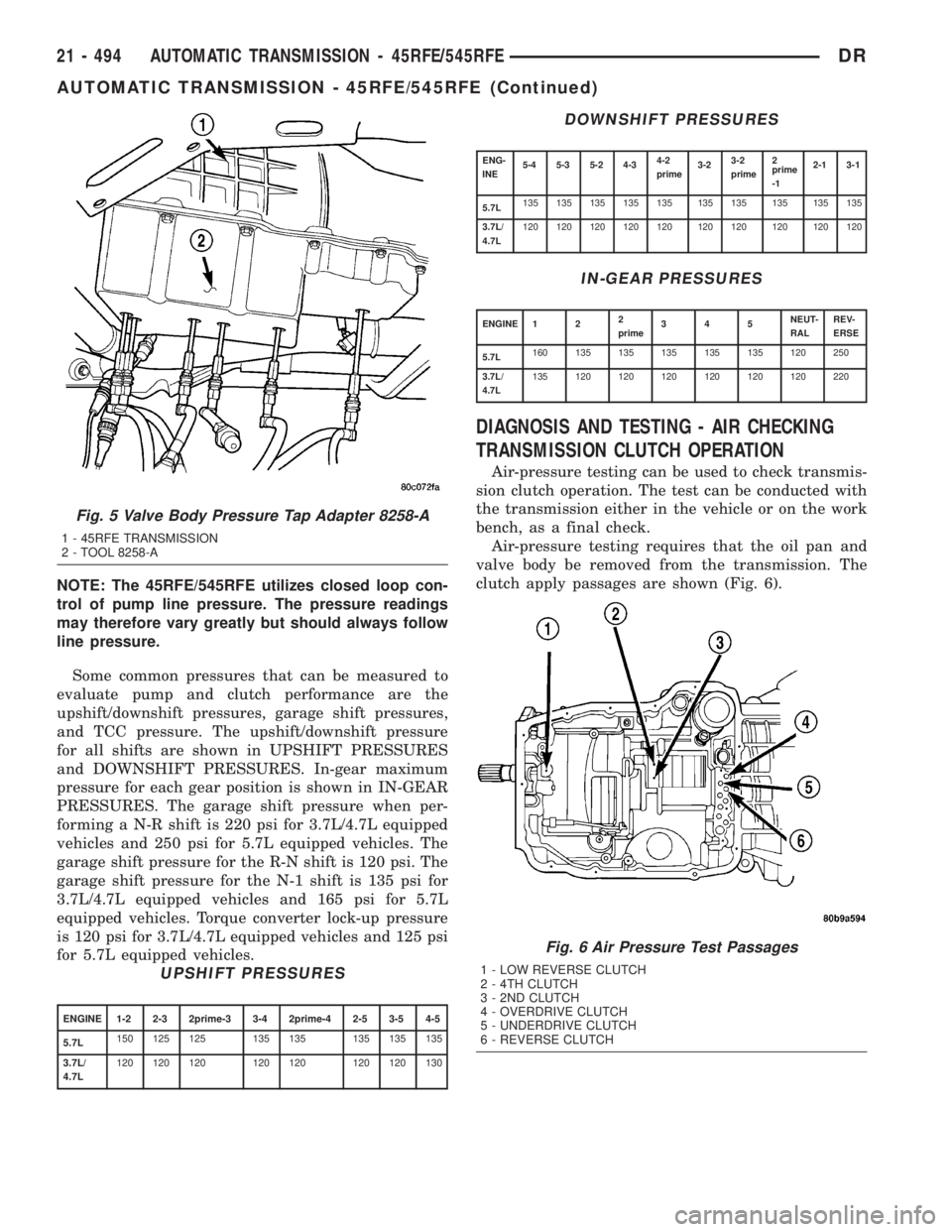
NOTE: The 45RFE/545RFE utilizes closed loop con-
trol of pump line pressure. The pressure readings
may therefore vary greatly but should always follow
line pressure.
Some common pressures that can be measured to
evaluate pump and clutch performance are the
upshift/downshift pressures, garage shift pressures,
and TCC pressure. The upshift/downshift pressure
for all shifts are shown in UPSHIFT PRESSURES
and DOWNSHIFT PRESSURES. In-gear maximum
pressure for each gear position is shown in IN-GEAR
PRESSURES. The garage shift pressure when per-
forming a N-R shift is 220 psi for 3.7L/4.7L equipped
vehicles and 250 psi for 5.7L equipped vehicles. The
garage shift pressure for the R-N shift is 120 psi. The
garage shift pressure for the N-1 shift is 135 psi for
3.7L/4.7L equipped vehicles and 165 psi for 5.7L
equipped vehicles. Torque converter lock-up pressure
is 120 psi for 3.7L/4.7L equipped vehicles and 125 psi
for 5.7L equipped vehicles.
UPSHIFT PRESSURES
ENGINE 1-2 2-3 2prime-3 3-4 2prime-4 2-5 3-5 4-5
5.7L150 125 125 135 135 135 135 135
3.7L/
4.7L120 120 120 120 120 120 120 130
DOWNSHIFT PRESSURES
ENG-
INE5-4 5-3 5-2 4-34-2
prime3-23-2
prime2
prime
-12-1 3-1
5.7L135 135 135 135 135 135 135 135 135 135
3.7L/
4.7L120 120 120 120 120 120 120 120 120 120
IN-GEAR PRESSURES
ENGINE 1 22
prime345NEUT-
RALREV-
ERSE
5.7L160 135 135 135 135 135 120 250
3.7L/
4.7L135 120 120 120 120 120 120 220
DIAGNOSIS AND TESTING - AIR CHECKING
TRANSMISSION CLUTCH OPERATION
Air-pressure testing can be used to check transmis-
sion clutch operation. The test can be conducted with
the transmission either in the vehicle or on the work
bench, as a final check.
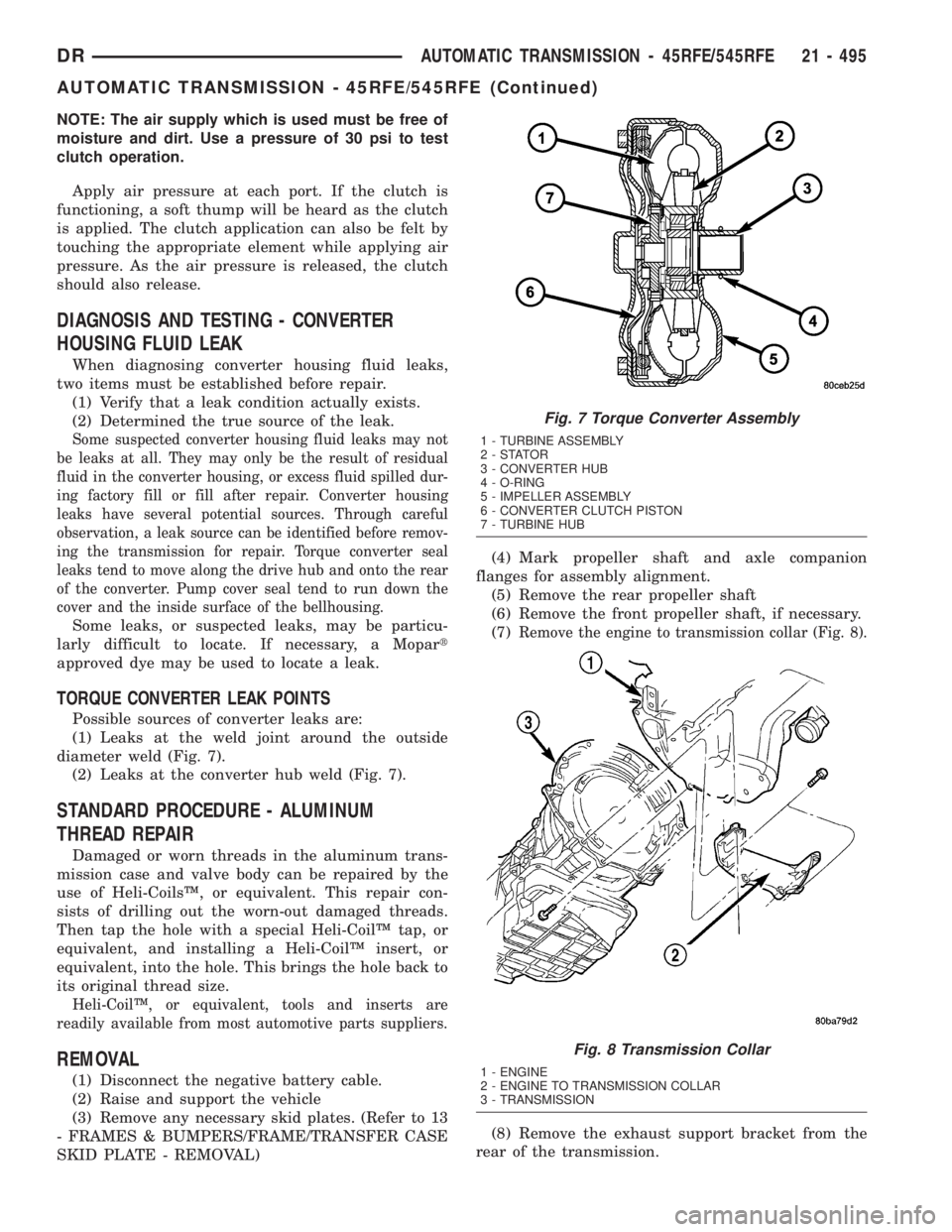
Air-pressure testing requires that the oil pan and
valve body be removed from the transmission. The
clutch apply passages are shown (Fig. 6).
Fig. 5 Valve Body Pressure Tap Adapter 8258-A
1 - 45RFE TRANSMISSION
2 - TOOL 8258-A
Fig. 6 Air Pressure Test Passages
1 - LOW REVERSE CLUTCH
2 - 4TH CLUTCH
3 - 2ND CLUTCH
4 - OVERDRIVE CLUTCH
5 - UNDERDRIVE CLUTCH
6 - REVERSE CLUTCH
21 - 494 AUTOMATIC TRANSMISSION - 45RFE/545RFEDR
AUTOMATIC TRANSMISSION - 45RFE/545RFE (Continued)
Page 2334 of 2895
NOTE: The air supply which is used must be free of
moisture and dirt. Use a pressure of 30 psi to test
clutch operation.
Apply air pressure at each port. If the clutch is
functioning, a soft thump will be heard as the clutch
is applied. The clutch application can also be felt by
touching the appropriate element while applying air
pressure. As the air pressure is released, the clutch
should also release.
DIAGNOSIS AND TESTING - CONVERTER
HOUSING FLUID LEAK
When diagnosing converter housing fluid leaks,
two items must be established before repair.
(1) Verify that a leak condition actually exists.
(2) Determined the true source of the leak.
Some suspected converter housing fluid leaks may not
be leaks at all. They may only be the result of residual
fluid in the converter housing, or excess fluid spilled dur-
ing factory fill or fill after repair. Converter housing
leaks have several potential sources. Through careful
observation, a leak source can be identified before remov-
ing the transmission for repair. Torque converter seal
leaks tend to move along the drive hub and onto the rear
of the converter. Pump cover seal tend to run down the
cover and the inside surface of the bellhousing.
Some leaks, or suspected leaks, may be particu-
larly difficult to locate. If necessary, a Mopart
approved dye may be used to locate a leak.
TORQUE CONVERTER LEAK POINTS
Possible sources of converter leaks are:
(1) Leaks at the weld joint around the outside
diameter weld (Fig. 7).
(2) Leaks at the converter hub weld (Fig. 7).
STANDARD PROCEDURE - ALUMINUM
THREAD REPAIR
Damaged or worn threads in the aluminum trans-
mission case and valve body can be repaired by the
use of Heli-CoilsŸ, or equivalent. This repair con-
sists of drilling out the worn-out damaged threads.
Then tap the hole with a special Heli-CoilŸ tap, or
equivalent, and installing a Heli-CoilŸ insert, or
equivalent, into the hole. This brings the hole back to
its original thread size.
Heli-CoilŸ, or equivalent, tools and inserts are
readily available from most automotive parts suppliers.
REMOVAL
(1) Disconnect the negative battery cable.
(2) Raise and support the vehicle
(3) Remove any necessary skid plates. (Refer to 13
- FRAMES & BUMPERS/FRAME/TRANSFER CASE
SKID PLATE - REMOVAL)(4) Mark propeller shaft and axle companion
flanges for assembly alignment.
(5) Remove the rear propeller shaft
(6) Remove the front propeller shaft, if necessary.
(7)
Remove the engine to transmission collar (Fig. 8).
(8) Remove the exhaust support bracket from the
rear of the transmission.
Fig. 7 Torque Converter Assembly
1 - TURBINE ASSEMBLY
2-STATOR
3 - CONVERTER HUB
4 - O-RING
5 - IMPELLER ASSEMBLY
6 - CONVERTER CLUTCH PISTON
7 - TURBINE HUB
Fig. 8 Transmission Collar
1 - ENGINE
2 - ENGINE TO TRANSMISSION COLLAR
3 - TRANSMISSION
DRAUTOMATIC TRANSMISSION - 45RFE/545RFE 21 - 495
AUTOMATIC TRANSMISSION - 45RFE/545RFE (Continued)
Page 2337 of 2895
(6) Inspect the ends of the sensors for debris,
which may indicate the nature of the transmission
failure.
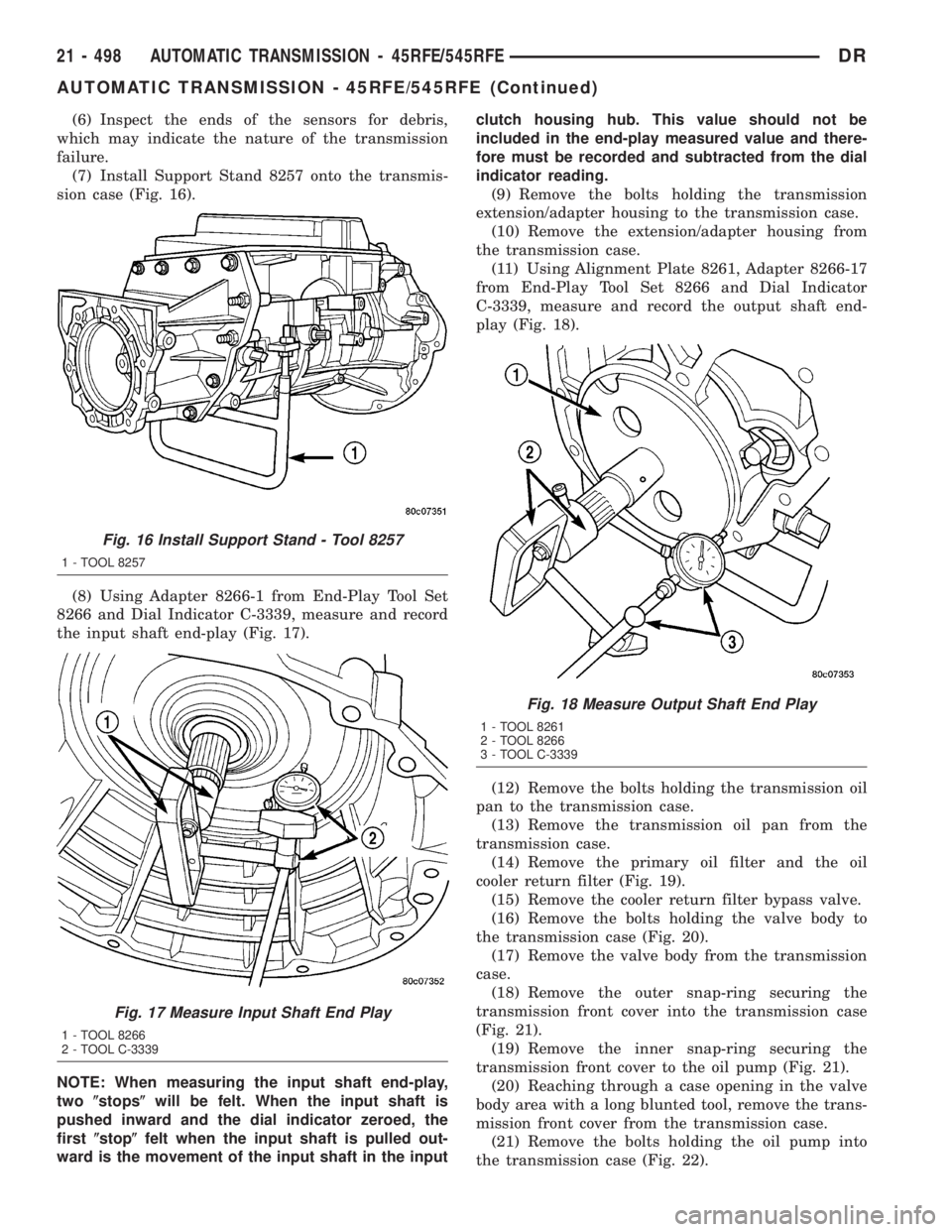
(7) Install Support Stand 8257 onto the transmis-
sion case (Fig. 16).
(8) Using Adapter 8266-1 from End-Play Tool Set
8266 and Dial Indicator C-3339, measure and record
the input shaft end-play (Fig. 17).
NOTE: When measuring the input shaft end-play,
two(stops(will be felt. When the input shaft is
pushed inward and the dial indicator zeroed, the
first(stop(felt when the input shaft is pulled out-
ward is the movement of the input shaft in the inputclutch housing hub. This value should not be
included in the end-play measured value and there-
fore must be recorded and subtracted from the dial
indicator reading.
(9) Remove the bolts holding the transmission
extension/adapter housing to the transmission case.
(10) Remove the extension/adapter housing from
the transmission case.
(11) Using Alignment Plate 8261, Adapter 8266-17
from End-Play Tool Set 8266 and Dial Indicator
C-3339, measure and record the output shaft end-
play (Fig. 18).
(12) Remove the bolts holding the transmission oil
pan to the transmission case.
(13) Remove the transmission oil pan from the
transmission case.
(14) Remove the primary oil filter and the oil
cooler return filter (Fig. 19).
(15) Remove the cooler return filter bypass valve.
(16) Remove the bolts holding the valve body to
the transmission case (Fig. 20).
(17) Remove the valve body from the transmission
case.
(18) Remove the outer snap-ring securing the
transmission front cover into the transmission case
(Fig. 21).
(19) Remove the inner snap-ring securing the
transmission front cover to the oil pump (Fig. 21).
(20) Reaching through a case opening in the valve
body area with a long blunted tool, remove the trans-
mission front cover from the transmission case.
(21) Remove the bolts holding the oil pump into
the transmission case (Fig. 22).
Fig. 16 Install Support Stand - Tool 8257
1 - TOOL 8257
Fig. 17 Measure Input Shaft End Play
1 - TOOL 8266
2 - TOOL C-3339
Fig. 18 Measure Output Shaft End Play
1 - TOOL 8261
2 - TOOL 8266
3 - TOOL C-3339
21 - 498 AUTOMATIC TRANSMISSION - 45RFE/545RFEDR
AUTOMATIC TRANSMISSION - 45RFE/545RFE (Continued)
Page 2338 of 2895
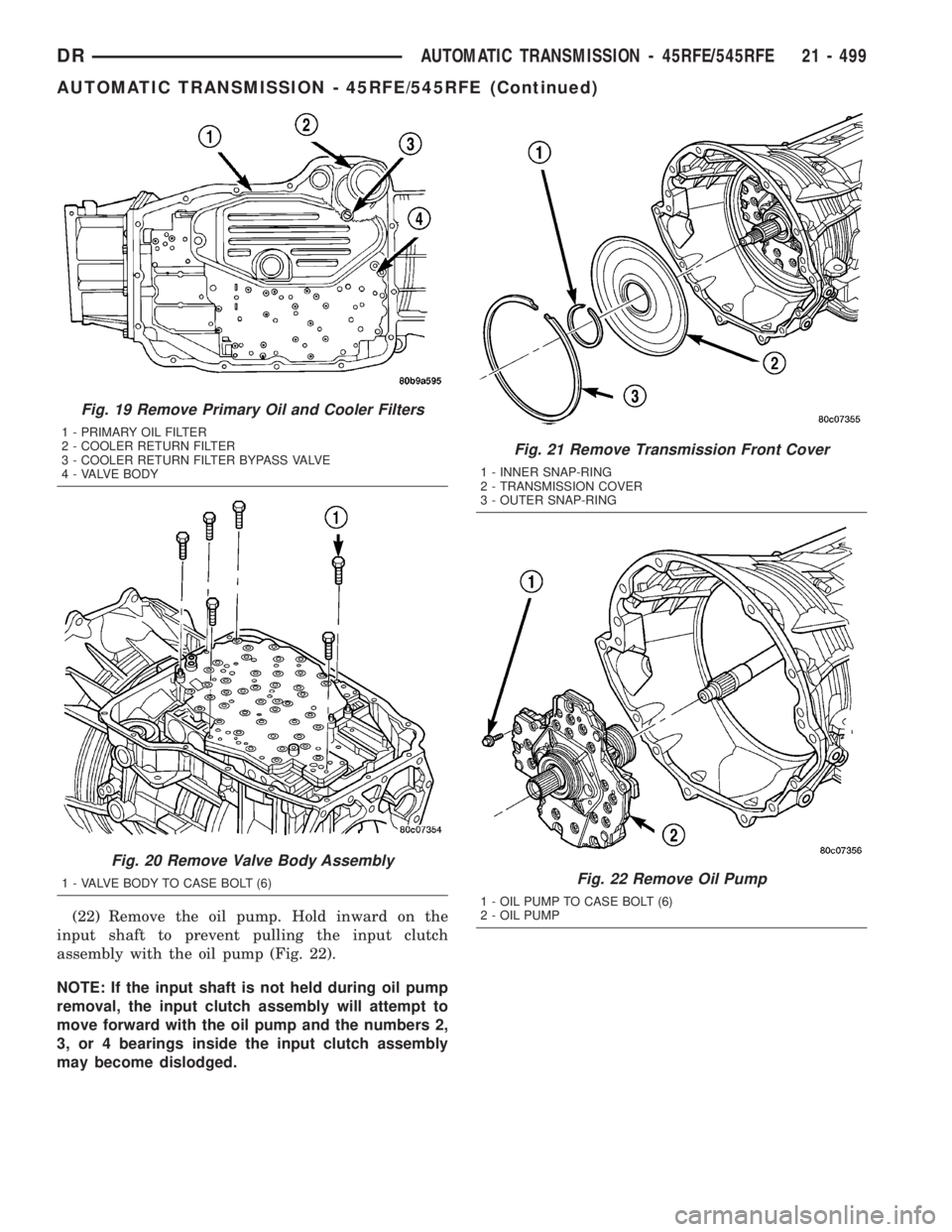
(22) Remove the oil pump. Hold inward on the
input shaft to prevent pulling the input clutch
assembly with the oil pump (Fig. 22).
NOTE: If the input shaft is not held during oil pump
removal, the input clutch assembly will attempt to
move forward with the oil pump and the numbers 2,
3, or 4 bearings inside the input clutch assembly
may become dislodged.
Fig. 19 Remove Primary Oil and Cooler Filters
1 - PRIMARY OIL FILTER
2 - COOLER RETURN FILTER
3 - COOLER RETURN FILTER BYPASS VALVE
4 - VALVE BODY
Fig. 20 Remove Valve Body Assembly
1 - VALVE BODY TO CASE BOLT (6)
Fig. 21 Remove Transmission Front Cover
1 - INNER SNAP-RING
2 - TRANSMISSION COVER
3 - OUTER SNAP-RING
Fig. 22 Remove Oil Pump
1 - OIL PUMP TO CASE BOLT (6)
2 - OIL PUMP
DRAUTOMATIC TRANSMISSION - 45RFE/545RFE 21 - 499
AUTOMATIC TRANSMISSION - 45RFE/545RFE (Continued)
Page 2347 of 2895
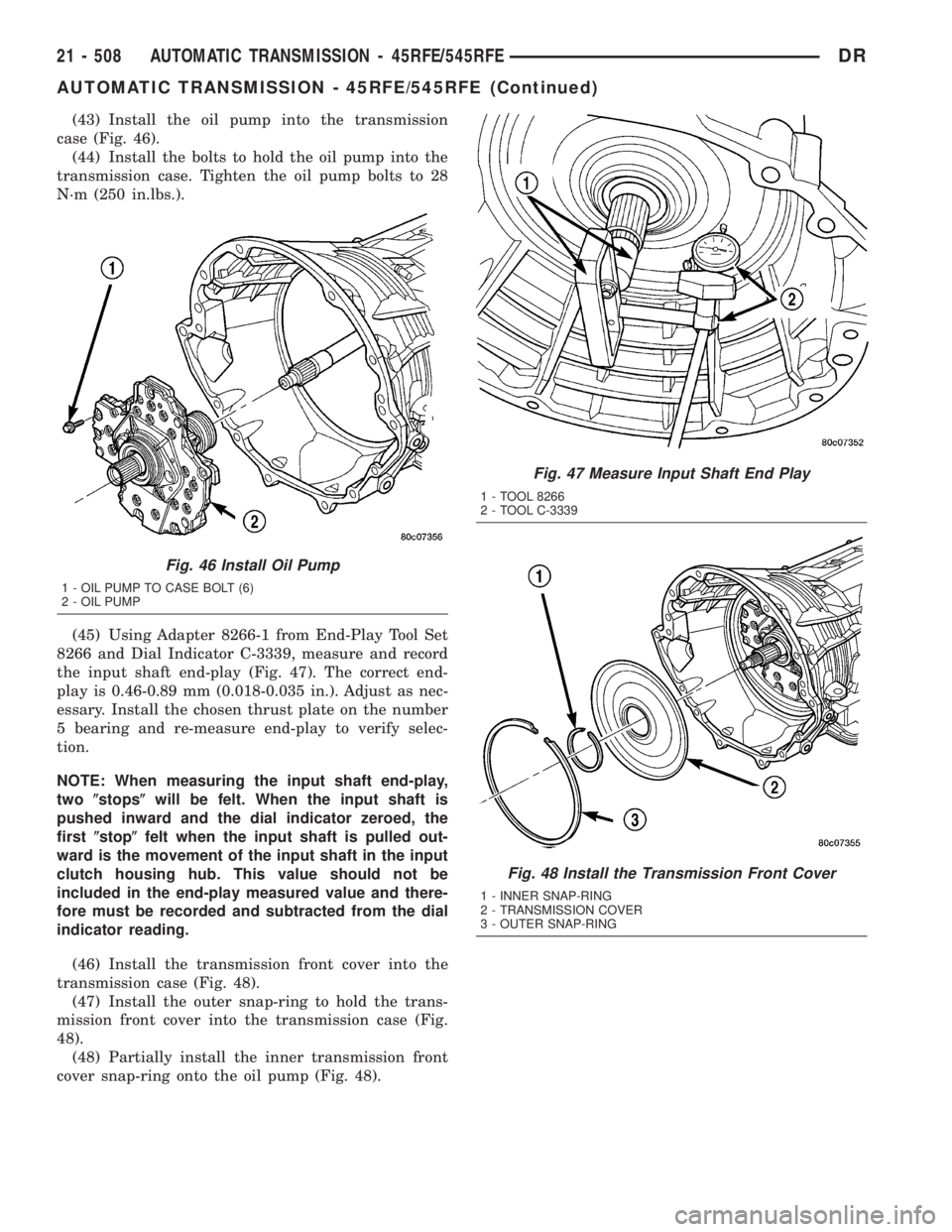
(43) Install the oil pump into the transmission
case (Fig. 46).
(44) Install the bolts to hold the oil pump into the
transmission case. Tighten the oil pump bolts to 28
N´m (250 in.lbs.).
(45) Using Adapter 8266-1 from End-Play Tool Set
8266 and Dial Indicator C-3339, measure and record
the input shaft end-play (Fig. 47). The correct end-
play is 0.46-0.89 mm (0.018-0.035 in.). Adjust as nec-
essary. Install the chosen thrust plate on the number
5 bearing and re-measure end-play to verify selec-
tion.
NOTE: When measuring the input shaft end-play,
two(stops(will be felt. When the input shaft is
pushed inward and the dial indicator zeroed, the
first(stop(felt when the input shaft is pulled out-
ward is the movement of the input shaft in the input
clutch housing hub. This value should not be
included in the end-play measured value and there-
fore must be recorded and subtracted from the dial
indicator reading.
(46) Install the transmission front cover into the
transmission case (Fig. 48).
(47) Install the outer snap-ring to hold the trans-
mission front cover into the transmission case (Fig.
48).
(48) Partially install the inner transmission front
cover snap-ring onto the oil pump (Fig. 48).
Fig. 46 Install Oil Pump
1 - OIL PUMP TO CASE BOLT (6)
2 - OIL PUMP
Fig. 47 Measure Input Shaft End Play
1 - TOOL 8266
2 - TOOL C-3339
Fig. 48 Install the Transmission Front Cover
1 - INNER SNAP-RING
2 - TRANSMISSION COVER
3 - OUTER SNAP-RING
21 - 508 AUTOMATIC TRANSMISSION - 45RFE/545RFEDR
AUTOMATIC TRANSMISSION - 45RFE/545RFE (Continued)