ECU DODGE RAM SRT-10 2006 Service Repair Manual
[x] Cancel search | Manufacturer: DODGE, Model Year: 2006, Model line: RAM SRT-10, Model: DODGE RAM SRT-10 2006Pages: 5267, PDF Size: 68.7 MB
Page 4284 of 5267
LOW RANGE ANNULUS GEAR
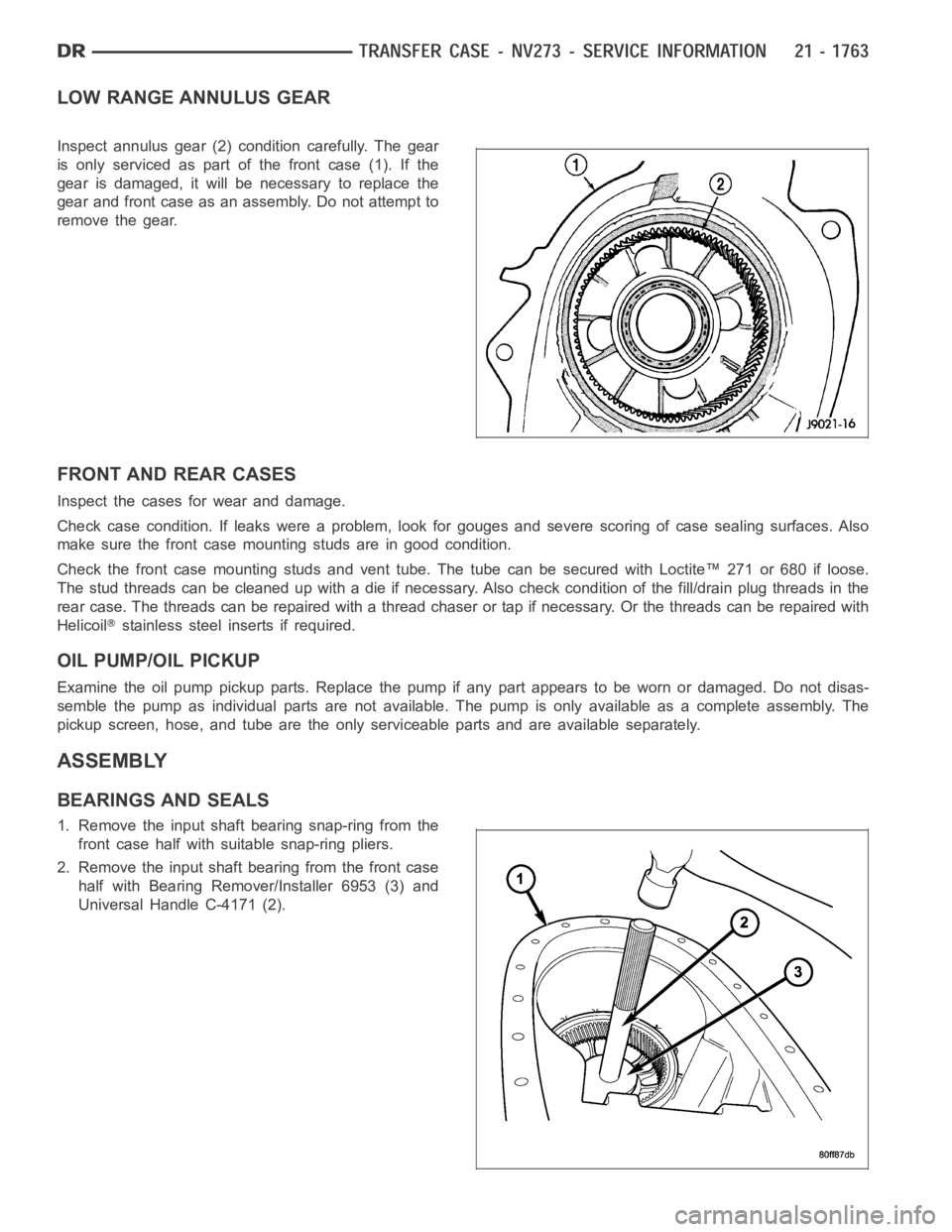
Inspect annulus gear (2) condition carefully. The gear
is only serviced as part of the front case (1). If the
gear is damaged, it will be necessary to replace the
gear and front case as an assembly. Do not attempt to
remove the gear.
FRONT AND REAR CASES
Inspect the cases for wear and damage.
Check case condition. If leaks were a problem, look for gouges and severe scoring of case sealing surfaces. Also
make sure the front case mounting studs are in good condition.
Check the front case mounting studs and vent tube. The tube can be secured with Loctite™ 271 or 680 if loose.
Thestudthreadscanbecleanedupwithadieifnecessary.Alsocheckcondition of the fill/drain plug threads in the
rear case. The threads can be repaired with a thread chaser or tap if necessary. Or the threads can be repaired with
Helicoil
stainless steel inserts if required.
OIL PUMP/OIL PICKUP
Examine the oil pump pickup parts. Replace the pump if any part appears to beworn or damaged. Do not disas-
semble the pump as individual parts are not available. The pump is only available as a complete assembly. The
pickup screen, hose, and tube are the only serviceable parts and are available separately.
ASSEMBLY
BEARINGS AND SEALS
1. Remove the input shaft bearing snap-ring from the
front case half with suitable snap-ring pliers.
2. Remove the input shaft bearing from the front case
half with Bearing Remover/Installer 6953 (3) and
Universal Handle C-4171 (2).
Page 4301 of 5267
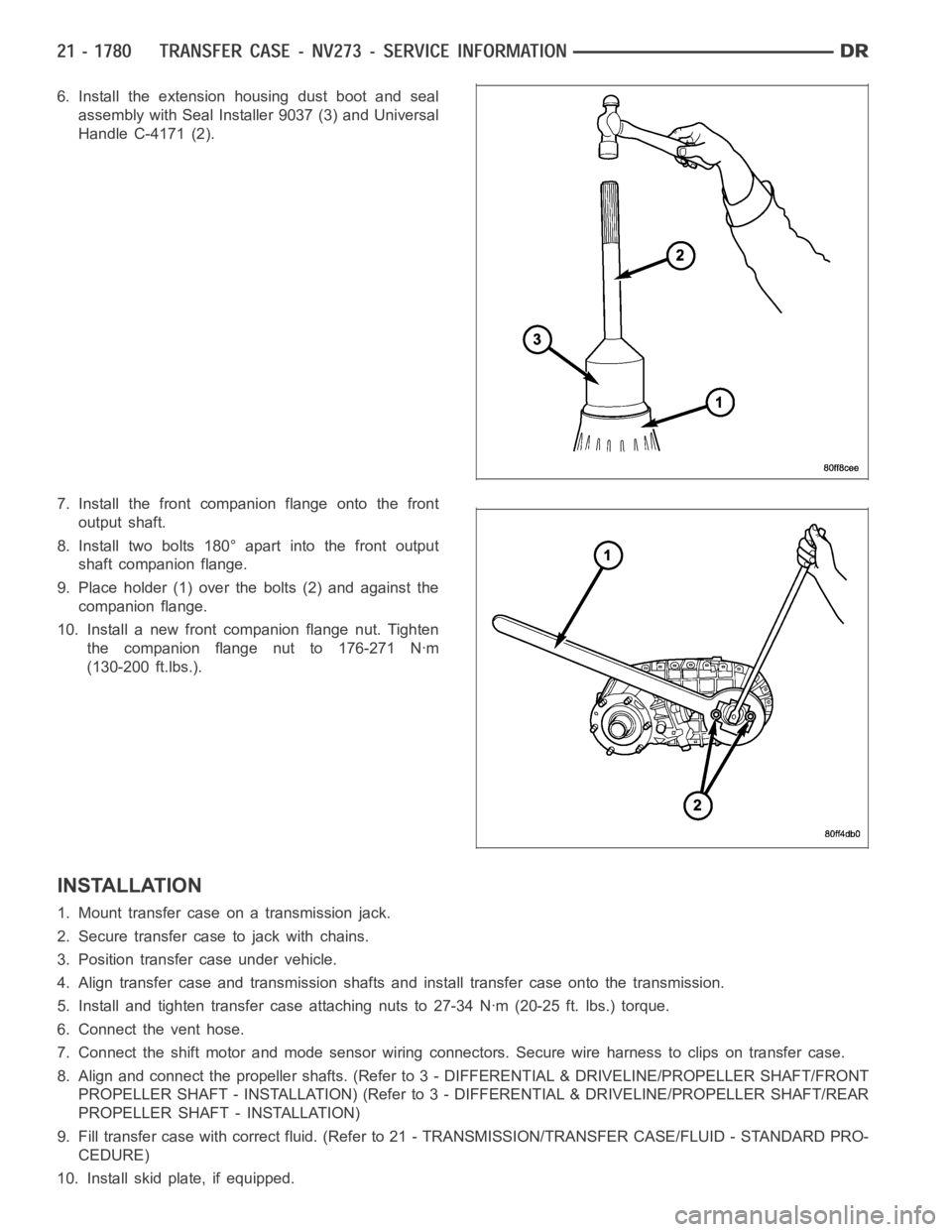
6. Install the extension housing dust boot and seal
assembly with Seal Installer 9037 (3) and Universal
Handle C-4171 (2).
7. Install the front companion flange onto the front
output shaft.
8. Install two bolts 180° apart into the front output
shaft companion flange.
9. Place holder (1) over the bolts (2) and against the
companion flange.
10. Install a new front companion flange nut. Tighten
the companion flange nut to 176-271 Nꞏm
(130-200 ft.lbs.).
INSTALLATION
1. Mount transfer case on a transmission jack.
2. Secure transfer case to jack with chains.
3. Position transfer case under vehicle.
4. Align transfer case and transmission shafts and install transfer case onto the transmission.
5. Install and tighten transfer case attaching nuts to 27-34 Nꞏm (20-25 ft.lbs.) torque.
6. Connect the vent hose.
7. Connect the shift motor and mode sensor wiring connectors. Secure wire harness to clips on transfer case.
8. Align and connect the propeller shafts. (Refer to 3 - DIFFERENTIAL & DRIVELINE/PROPELLER SHAFT/FRONT
PROPELLER SHAFT - INSTALLATION) (Refer to 3 - DIFFERENTIAL & DRIVELINE/PROPELLER SHAFT/REAR
PROPELLER SHAFT - INSTALLATION)
9. Fill transfer case with correct fluid. (Refer to 21 - TRANSMISSION/TRANSFER CASE/FLUID - STANDARD PRO-
CEDURE)
10. Install skid plate, if equipped.
Page 4341 of 5267
POSSIBLE CAUSE OF WIND NOISE
Moldings standing away from body surface can catch wind and whistle.
Gaps in sealed areas behind overhanging body flanges can cause wind-rushing sounds.
Misaligned movable components.
Missing or improperly installed plugs in pillars.
Weld burn through holes.
Improperly installed roof rack cross bars.
STANDARD PROCEDURE
BODY LUBRICATION
All mechanisms and linkages should be lubricated when necessary. This will maintain ease of operation and provide
protection against rust and excessive wear. The weatherstrip seals should be lubricated to prolong their life as well
as to improve door sealing.
All applicable exterior and interior vehicle operating mechanisms should be inspected and cleaned. Pivot/sliding con-
tact areas on the mechanisms should then be lubricated.
1. When necessary, lubricate the operating mechanisms with the specifiedlubricants.
2. Apply silicone lubricant to a clothand wipe it on door seals to avoid over-spray that can soil passenger’s cloth-
ing.
3. Before applying lubricant, the component should be wiped clean. After lubrication, any excess lubricant should be
removed.
4. The hood latch, latch release mechanism, latch striker, and safety latch should be lubricated periodically.
5. The door lock cylinders should be lubricated twice each year (preferably autumn and spring).
Spray a small amount of lock cylinder lubricant directly into the lock cylinder.
Apply a small amount to the key and insert it into the lock cylinder.
Rotate it to the locked position and then back to the unlocked position several times.
Remove the key. Wipe the lubricant from it with a clean cloth to avoid soiling of clothing.
HEAT STAKING
1. Remove trim panel.
2. Bend or move the trim panel components at the heat staked joints. Observethe heat staked locations and/or
component seams for looseness.
3. Heat stake the components.
a. If the heat staked or component seam location is loose, hold the two components tightly together and using
a soldering gun with a flat tip, melt the material securing the components together. Do not over heat the
affected area, damage to the exterior of the trim panel may occur.
b. Iftheheatstakedmaterialisbrokenormissing,useahotglueguntoapplynewmaterialtotheareatobe
repaired. The panels that are being heat staked must be held together whiletheapplyingtheglue.Oncethe
new material is in place, it may be necessary to use a soldering gun to melt the newly applied material. Do
not over heat the affected area, damage to the exterior of the trim panel mayoccur.
4. Allow the repaired area to cool and verify the repair.
5. Install trim panel.
BUZZ, SQUEAK & RATTLE
Buzz, Squeak & Rattles (BSR) may be caused by any one or more of the followingand may be corrected as indi-
cated:
Loose fasteners should be tightened to specifications.
Damaged or missing clips should be replaced.
Damaged trim panels should be replaced.
Incorrectly installed trim panels should be reinstalled properly.
Page 4348 of 5267
PANEL PATCH FABRICATIONS
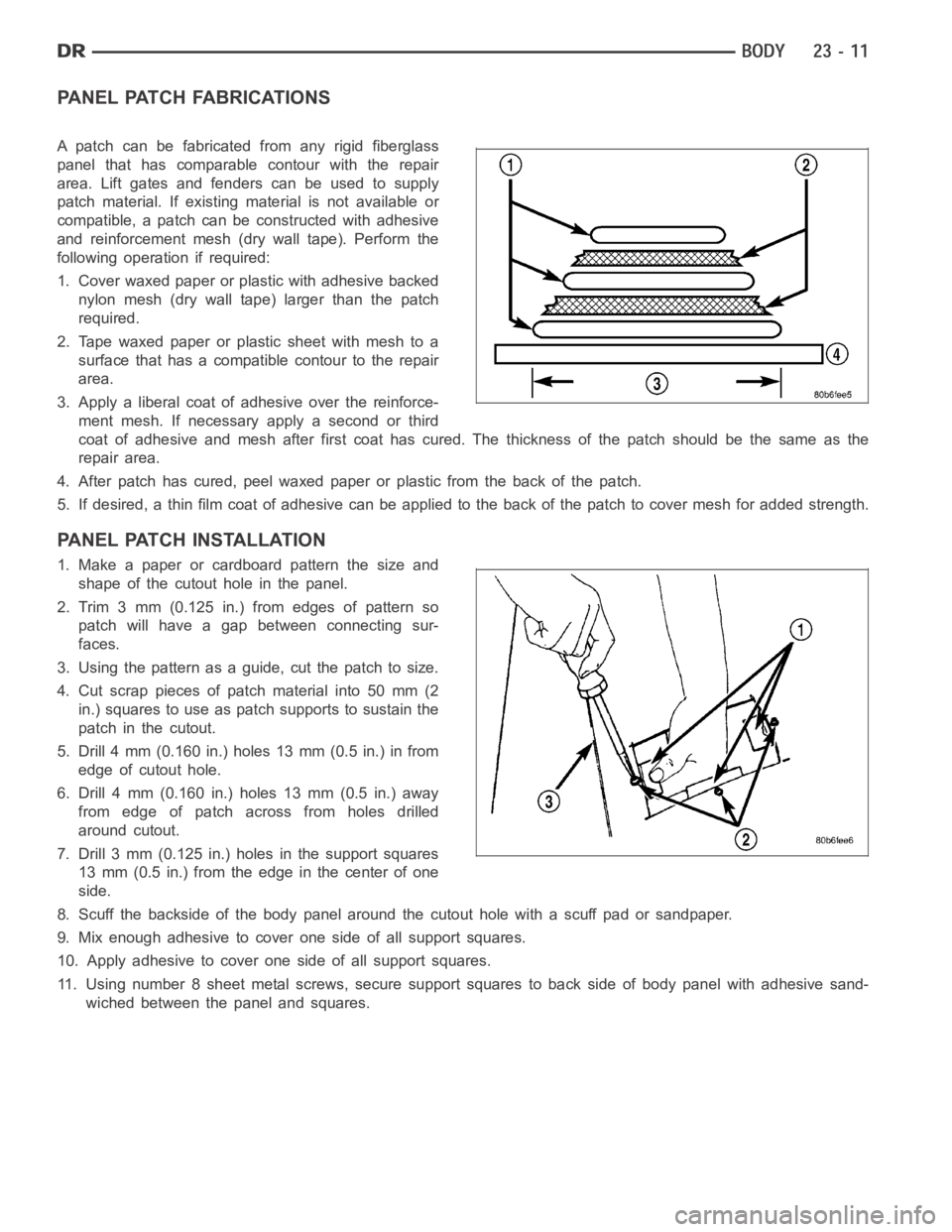
A patch can be fabricated from any rigid fiberglass
panel that has comparable contour with the repair
area. Lift gates and fenders can be used to supply
patch material. If existing material is not available or
compatible, a patch can be constructed with adhesive
and reinforcement mesh (dry wall tape). Perform the
following operation if required:
1. Cover waxed paper or plastic with adhesive backed
nylon mesh (dry wall tape) larger than the patch
required.
2. Tape waxed paper or plastic sheet with mesh to a
surface that has a compatible contour to the repair
area.
3. Apply a liberal coat of adhesive over the reinforce-
ment mesh. If necessary apply a second or third
coat of adhesive and mesh after first coat has cured. The thickness of the patch should be the same as the
repair area.
4. After patch has cured, peel waxed paper or plastic from the back of the patch.
5. If desired, a thin film coat of adhesive can be applied to the back of the patch to cover mesh for added strength.
PANEL PATCH INSTALLATION
1. Make a paper or cardboard pattern the size and
shape of the cutout hole in the panel.
2. Trim 3 mm (0.125 in.) from edges of pattern so
patch will have a gap between connecting sur-
faces.
3. Using the pattern as a guide, cut the patch to size.
4. Cut scrap pieces of patch material into 50 mm (2
in.) squares to use as patch supports to sustain the
patch in the cutout.
5. Drill 4 mm (0.160 in.) holes 13 mm (0.5 in.) in from
edge of cutout hole.
6. Drill 4 mm (0.160 in.) holes 13 mm (0.5 in.) away
from edge of patch across from holes drilled
around cutout.
7. Drill 3 mm (0.125 in.) holes in the support squares
13 mm (0.5 in.) from the edge in the center of one
side.
8. Scuff the backside of the body panel around the cutout hole with a scuff pad or sandpaper.
9. Mix enough adhesive to cover one side of all support squares.
10. Apply adhesive to cover one side of all support squares.
11. Using number 8 sheet metal screws,secure support squares to back side of body panel with adhesive sand-
wiched between the panel and squares.
Page 4355 of 5267
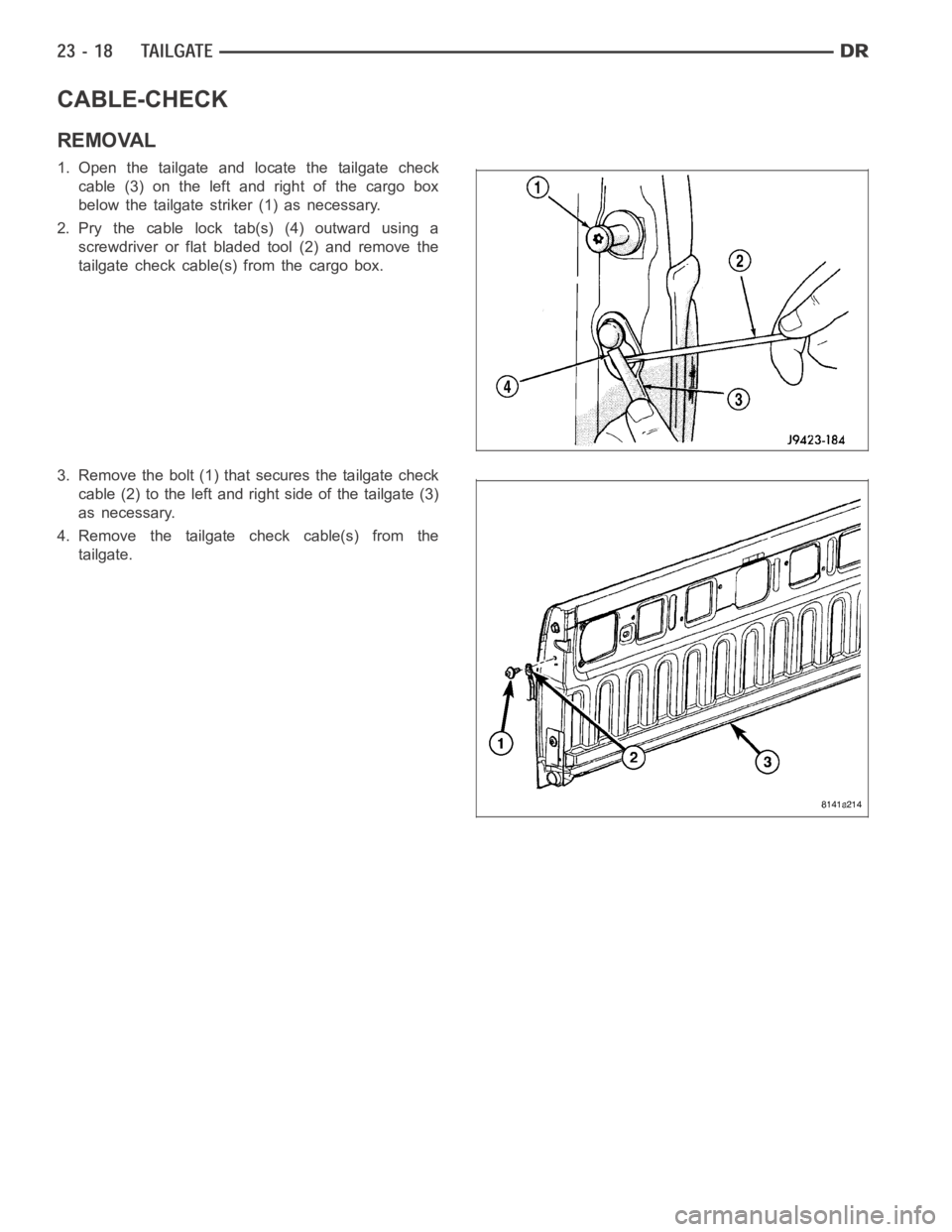
CABLE-CHECK
REMOVAL
1. Open the tailgate and locate the tailgate check
cable (3) on the left and right of the cargo box
below the tailgate striker (1) as necessary.
2. Pry the cable lock tab(s) (4) outward using a
screwdriver or flat bladed tool (2) and remove the
tailgate check cable(s) from the cargo box.
3. Remove the bolt (1) that secures the tailgate check
cable (2) to the left and right side of the tailgate (3)
as necessary.
4. Remove the tailgate check cable(s) from the
tailgate.
Page 4356 of 5267
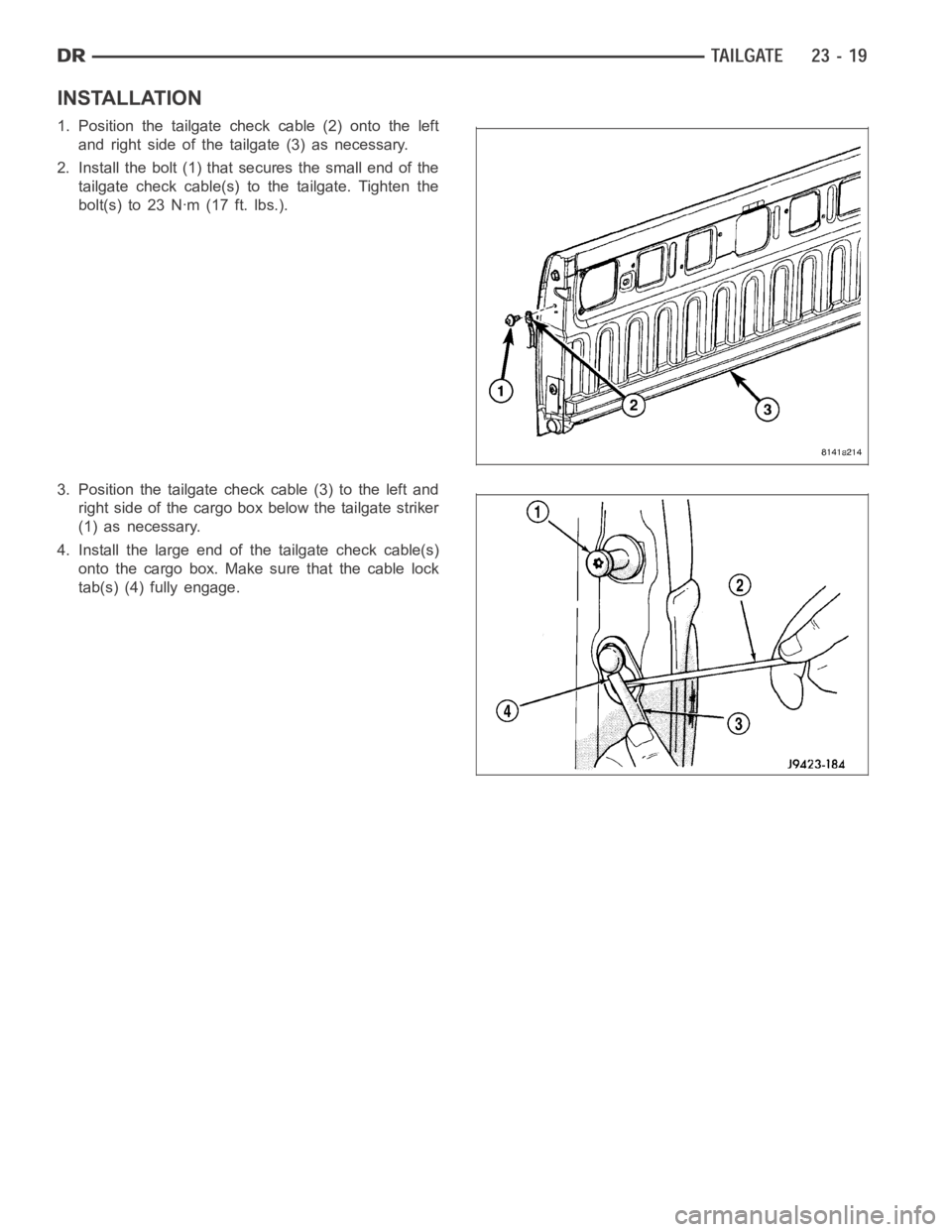
INSTALLATION
1. Position the tailgate check cable (2) onto the left
and right side of the tailgate (3) as necessary.
2. Install the bolt (1) that secures the small end of the
tailgate check cable(s) to the tailgate. Tighten the
bolt(s) to 23 Nꞏm (17 ft. lbs.).
3. Position the tailgate check cable (3) to the left and
right side of the cargo box below the tailgate striker
(1) as necessary.
4. Install the large end of the tailgate check cable(s)
onto the cargo box. Make sure that the cable lock
tab(s) (4) fully engage.
Page 4357 of 5267
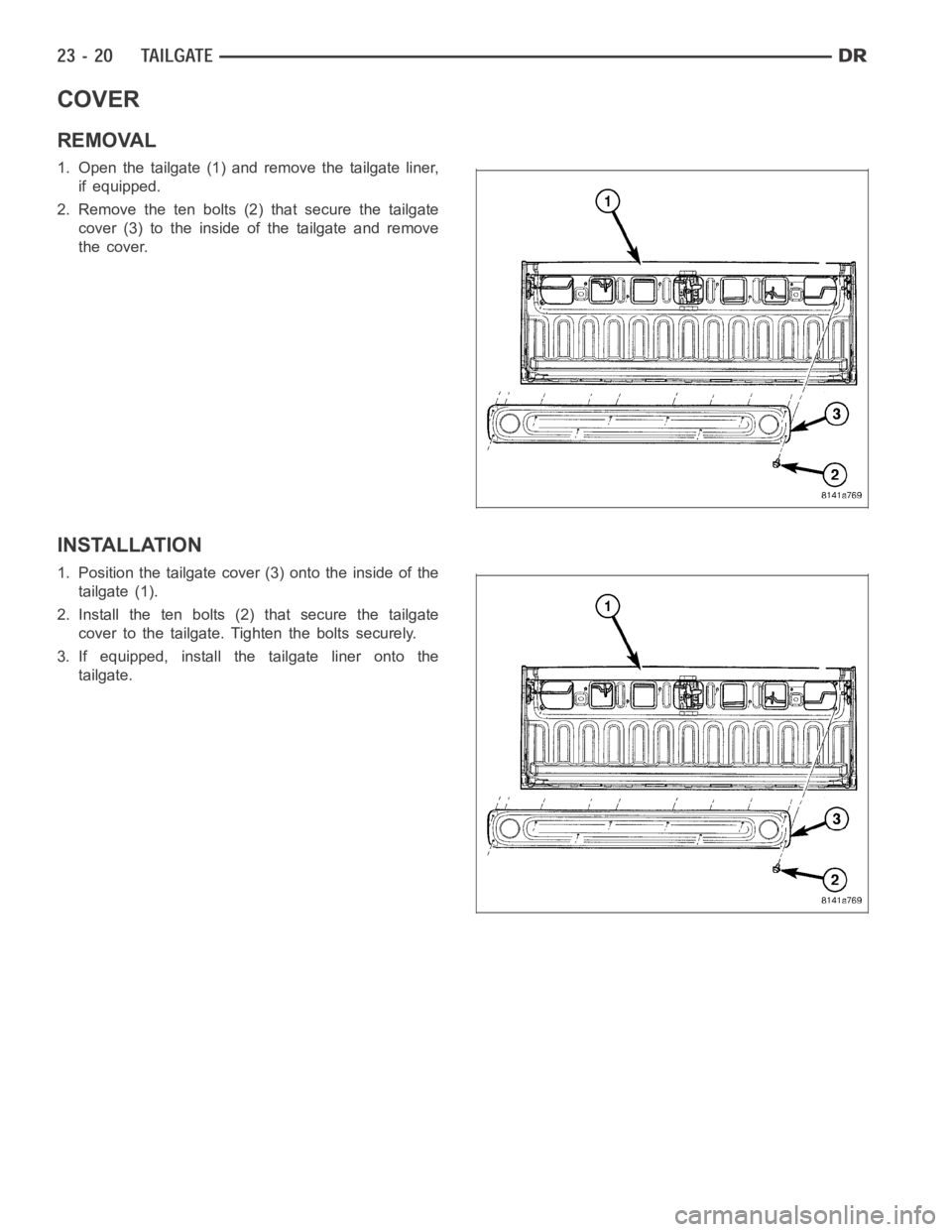
COVER
REMOVAL
1. Open the tailgate (1) and remove the tailgate liner,
if equipped.
2. Remove the ten bolts (2) that secure the tailgate
cover (3) to the inside of the tailgate and remove
the cover.
INSTALLATION
1. Position the tailgate cover (3) onto the inside of the
tailgate (1).
2. Install the ten bolts (2) that secure the tailgate
cover to the tailgate. Tighten the bolts securely.
3. If equipped, install the tailgate liner onto the
tailgate.
Page 4358 of 5267
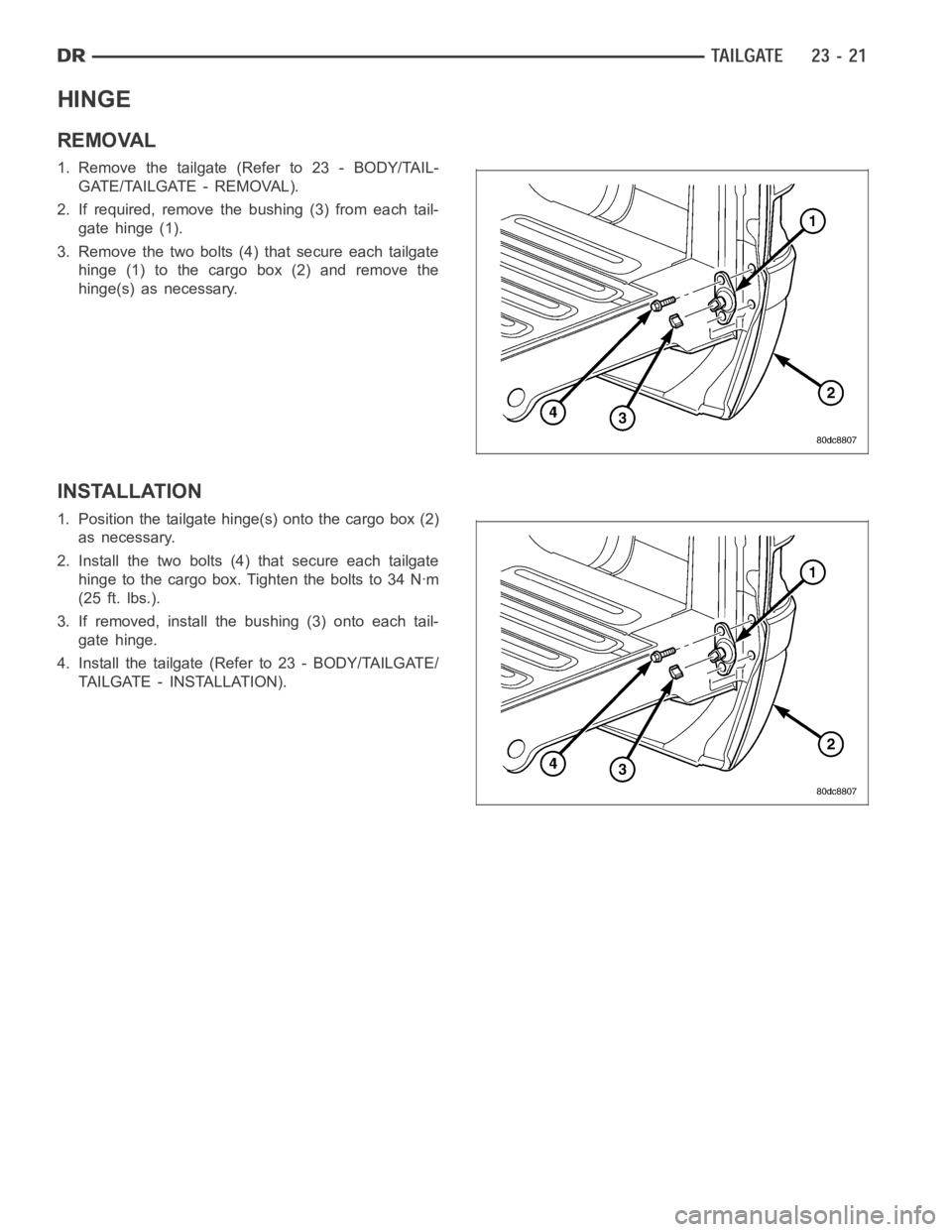
HINGE
REMOVAL
1. Remove the tailgate (Refer to 23 - BODY/TAIL-
GATE/TAILGATE - REMOVAL).
2. If required, remove the bushing (3) from each tail-
gate hinge (1).
3. Remove the two bolts (4)that secure each tailgate
hinge (1) to the cargo box (2) and remove the
hinge(s) as necessary.
INSTALLATION
1. Position the tailgate hinge(s) onto the cargo box (2)
as necessary.
2. Install the two bolts (4) that secure each tailgate
hinge to the cargo box. Tighten the bolts to 34 Nꞏm
(25 ft. lbs.).
3. If removed, install the bushing (3) onto each tail-
gate hinge.
4. Install the tailgate (Refer to 23 - BODY/TAILGATE/
TA I L G AT E - I N S TA L L AT I O N ) .
Page 4359 of 5267
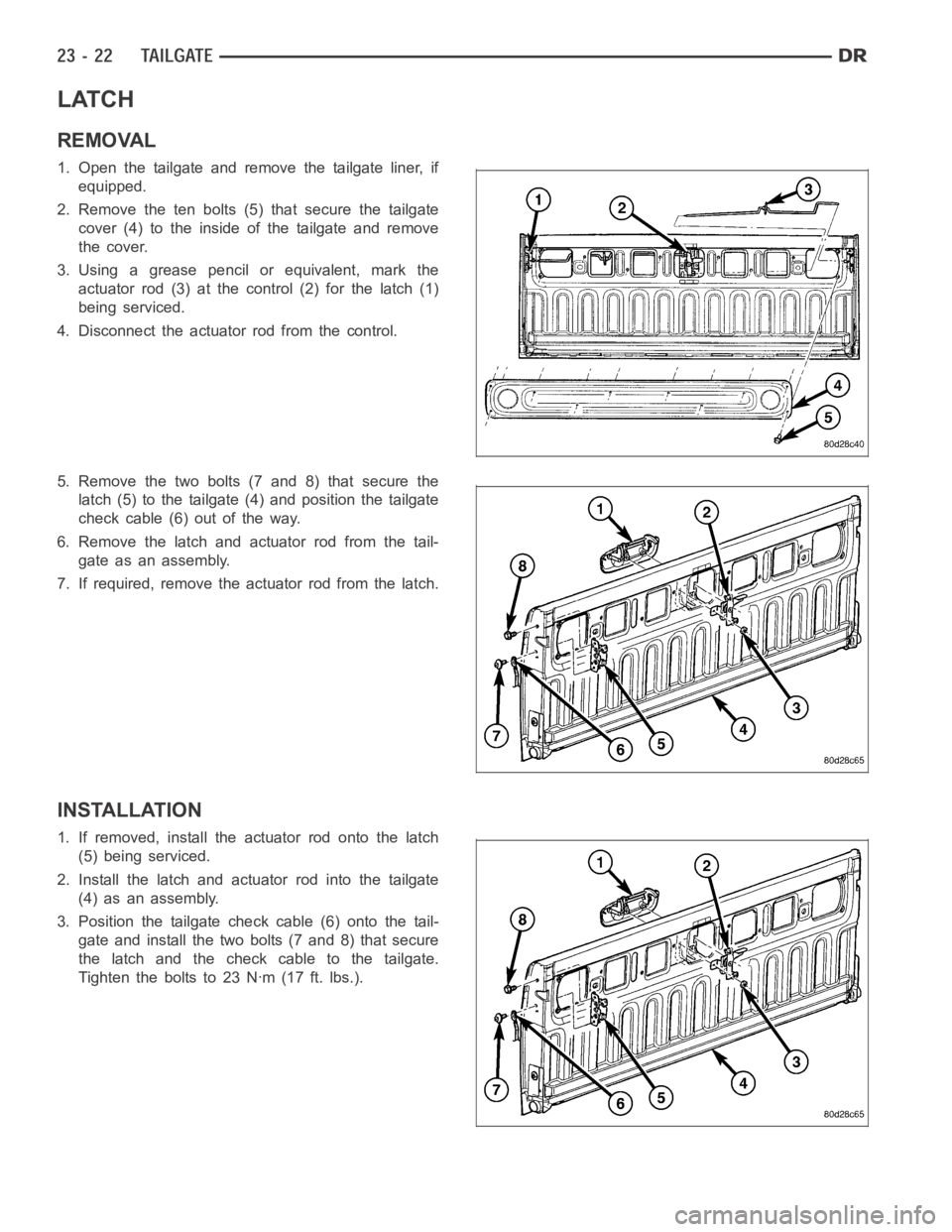
LATCH
REMOVAL
1. Open the tailgate and remove the tailgate liner, if
equipped.
2. Remove the ten bolts (5) that secure the tailgate
cover (4) to the inside of the tailgate and remove
the cover.
3. Using a grease pencil or equivalent, mark the
actuator rod (3) at the control (2) for the latch (1)
being serviced.
4. Disconnect the actuator rod from the control.
5. Remove the two bolts (7 and 8) that secure the
latch (5) to the tailgate (4) and position the tailgate
check cable (6) out of the way.
6. Remove the latch and actuator rod from the tail-
gate as an assembly.
7. If required, remove the actuator rod from the latch.
INSTALLATION
1. If removed, install the actuator rod onto the latch
(5) being serviced.
2. Install the latch and actuator rod into the tailgate
(4) as an assembly.
3. Position the tailgate check cable (6) onto the tail-
gate and install the two bolts (7 and 8) that secure
the latch and the check cable to the tailgate.
Tighten the bolts to 23 Nꞏm (17 ft. lbs.).
Page 4360 of 5267
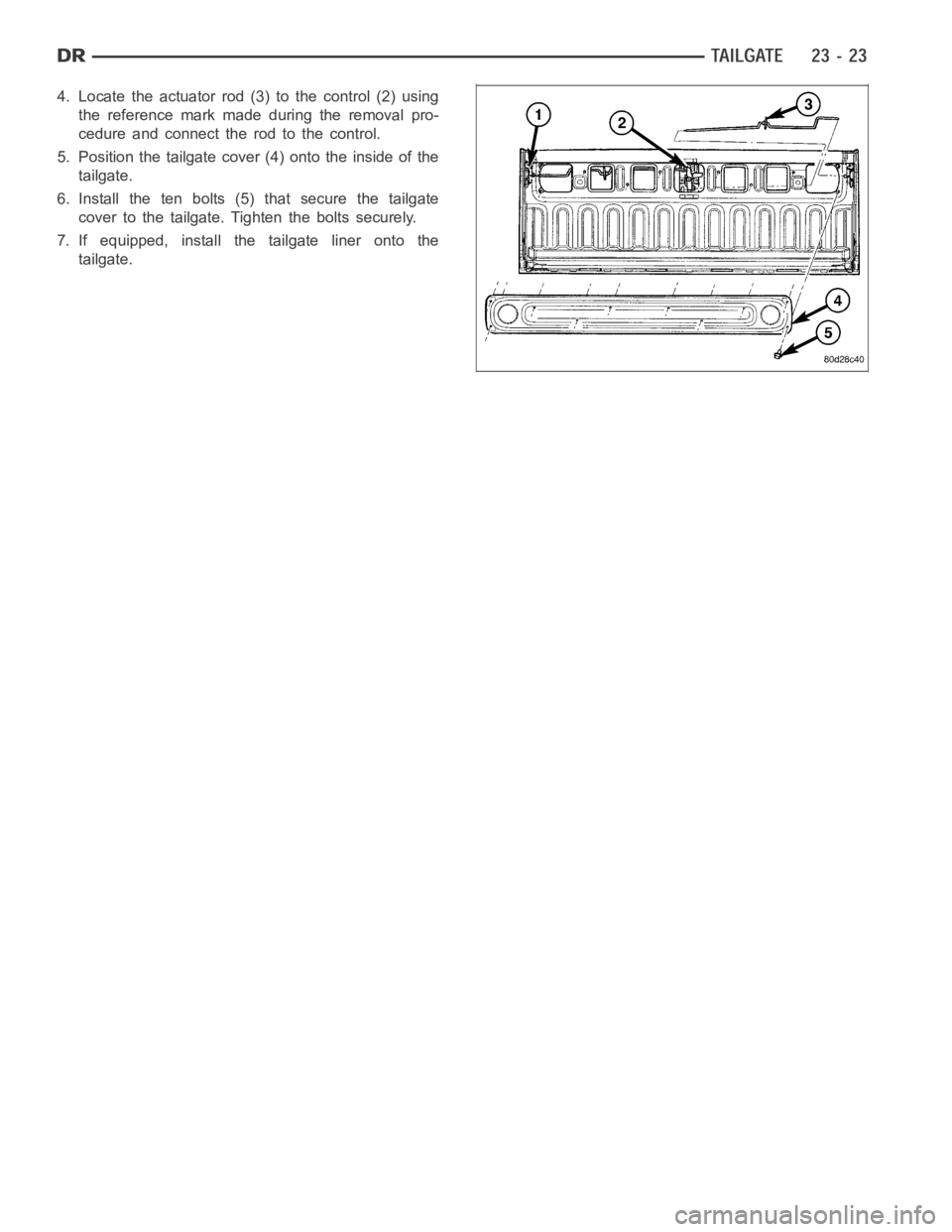
4. Locate the actuator rod (3) to the control (2) using
the reference mark made during the removal pro-
cedure and connect the rod to the control.
5. Position the tailgate cover (4) onto the inside of the
tailgate.
6. Install the ten bolts (5) that secure the tailgate
cover to the tailgate. Tighten the bolts securely.
7. If equipped, install the tailgate liner onto the
tailgate.