ECU DODGE RAM SRT-10 2006 Service Repair Manual
[x] Cancel search | Manufacturer: DODGE, Model Year: 2006, Model line: RAM SRT-10, Model: DODGE RAM SRT-10 2006Pages: 5267, PDF Size: 68.7 MB
Page 3817 of 5267
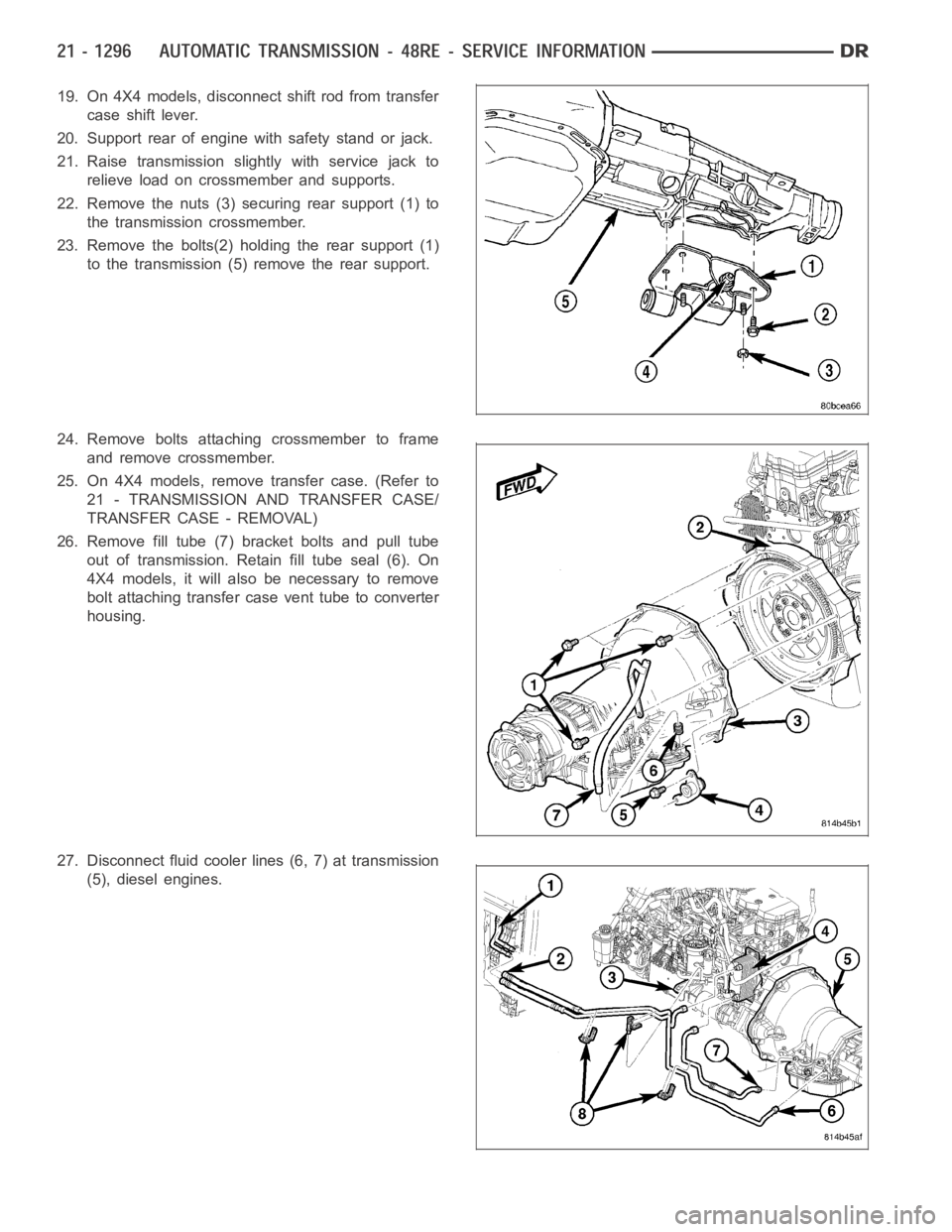
19. On 4X4 models, disconnect shift rod from transfer
case shift lever.
20. Support rear of engine with safety stand or jack.
21. Raise transmission slightly with service jack to
relieve load on crossmember and supports.
22. Remove the nuts (3) securing rear support (1) to
the transmission crossmember.
23. Remove the bolts(2) holding the rear support (1)
to the transmission (5) remove the rear support.
24. Remove bolts attaching crossmember to frame
and remove crossmember.
25. On 4X4 models, remove transfer case. (Refer to
21 - TRANSMISSION AND TRANSFER CASE/
TRANSFER CASE - REMOVAL)
26. Remove fill tube (7) bracket bolts and pull tube
out of transmission. Retain fill tube seal (6). On
4X4 models, it will also be necessary to remove
bolt attaching transfer case vent tube to converter
housing.
27. Disconnect fluid cooler lines (6, 7) at transmission
(5), diesel engines.
Page 3819 of 5267
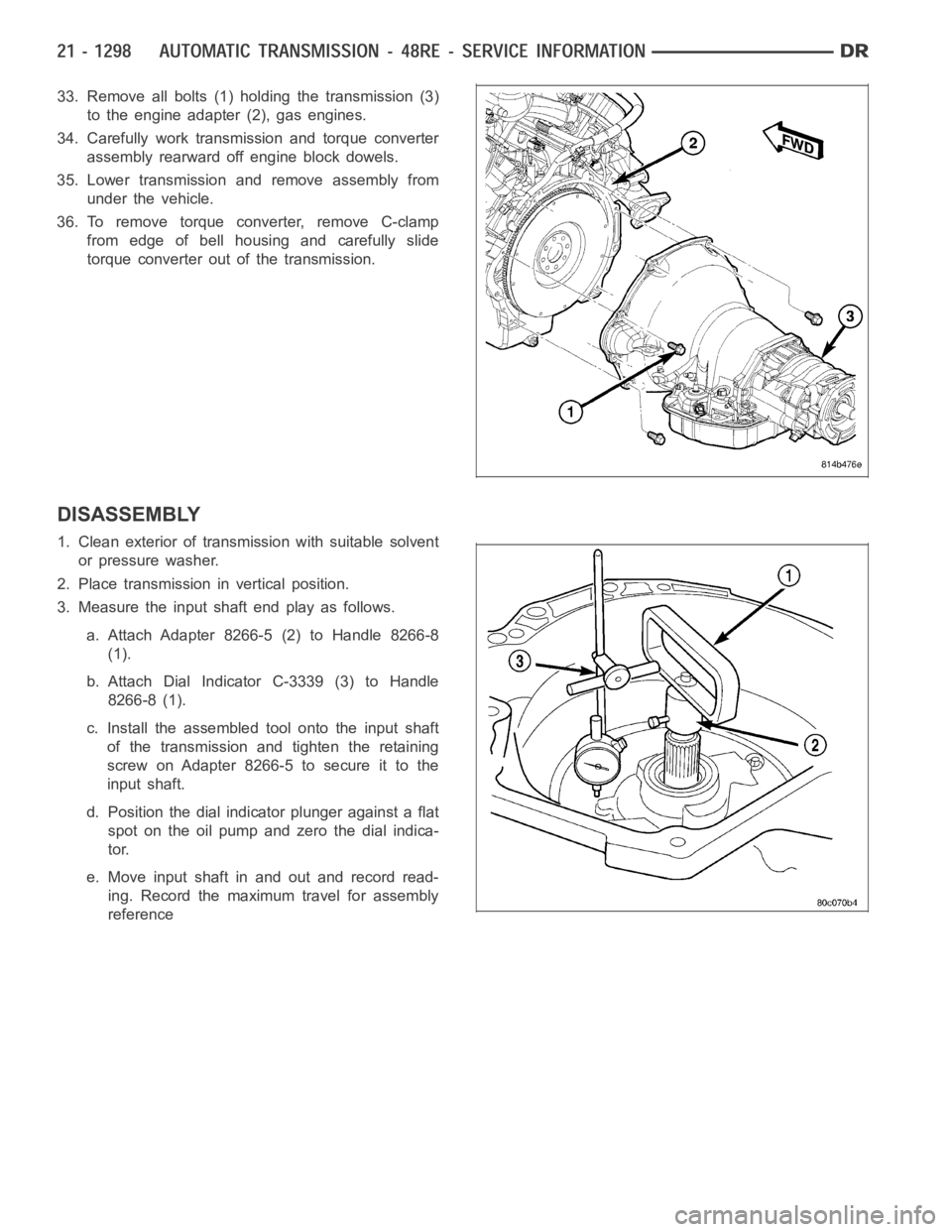
33. Remove all bolts (1) holding the transmission (3)
to the engine adapter (2), gas engines.
34. Carefully work transmission and torque converter
assembly rearward off engine block dowels.
35. Lower transmission and remove assembly from
under the vehicle.
36. To remove torque converter, remove C-clamp
from edge of bell housing and carefully slide
torque converter out of the transmission.
DISASSEMBLY
1. Clean exterior of transmission with suitable solvent
or pressure washer.
2. Place transmission in vertical position.
3. Measure the input shaft end play as follows.
a. Attach Adapter 8266-5 (2) to Handle 8266-8
(1).
b. Attach Dial Indicator C-3339 (3) to Handle
8266-8 (1).
c. Install the assembled tool onto the input shaft
of the transmission and tighten the retaining
screw on Adapter 8266-5 to secure it to the
input shaft.
d. Position the dial indicator plunger against a flat
spot on the oil pump and zero the dial indica-
tor.
e. Move input shaft in and out and record read-
ing. Record the maximum travel for assembly
reference
Page 3830 of 5267
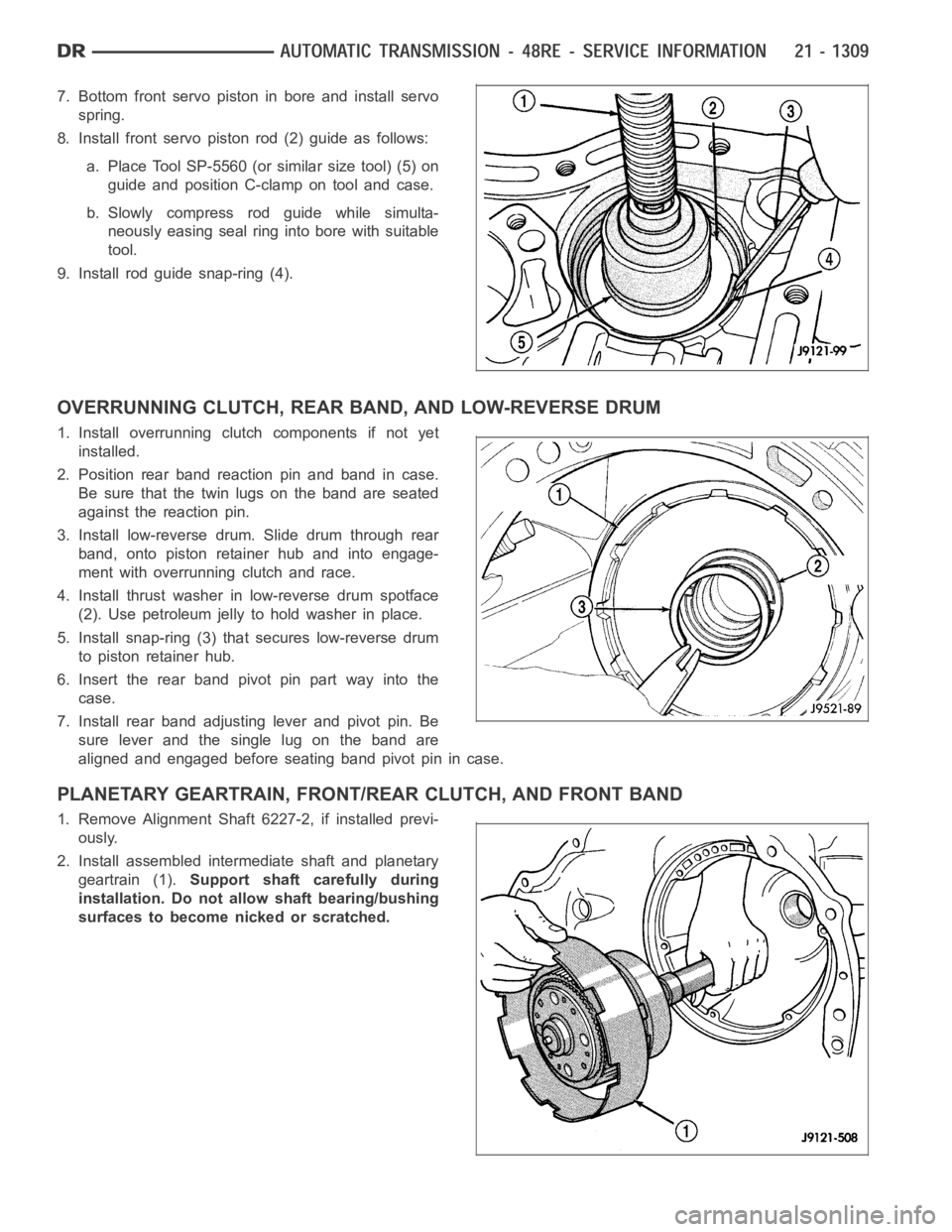
7. Bottom front servo piston in bore and install servo
spring.
8. Install front servo piston rod (2) guide as follows:
a. Place Tool SP-5560 (or similar size tool) (5) on
guide and position C-clamp on tool and case.
b. Slowly compress rod guide while simulta-
neously easing seal ring into bore with suitable
tool.
9. Install rod guide snap-ring (4).
OVERRUNNING CLUTCH, REAR BAND, AND LOW-REVERSE DRUM
1. Install overrunning clutch components if not yet
installed.
2. Position rear band reaction pin and band in case.
Be sure that the twin lugs on the band are seated
against the reaction pin.
3. Install low-reverse drum. Slide drum through rear
band, onto piston retainer hub and into engage-
ment with overrunning clutch and race.
4. Install thrust washer in low-reverse drum spotface
(2). Use petroleum jelly to hold washer in place.
5. Install snap-ring (3) that secures low-reverse drum
to piston retainer hub.
6. Insert the rear band pivot pin part way into the
case.
7. Install rear band adjusting lever and pivot pin. Be
sure lever and the single lug on the band are
aligned and engaged before seating band pivot pin in case.
PLANETARY GEARTRAIN, FRONT/REAR CLUTCH, AND FRONT BAND
1. Remove Alignment Shaft 6227-2, if installed previ-
ously.
2. Install assembled intermediate shaft and planetary
geartrain (1).Support shaft carefully during
installation. Do not allow shaft bearing/bushing
surfaces to become nicked or scratched.
Page 3835 of 5267
5. Check the torque converter hub seal ring on the
reaction shaft for damage. Also check that the seal
ring rotates freely in the reaction shaft groove.
Replace the seal if necessary.
6. Lubricate oil pump seals with petroleum Mopar
AT F + 4 .
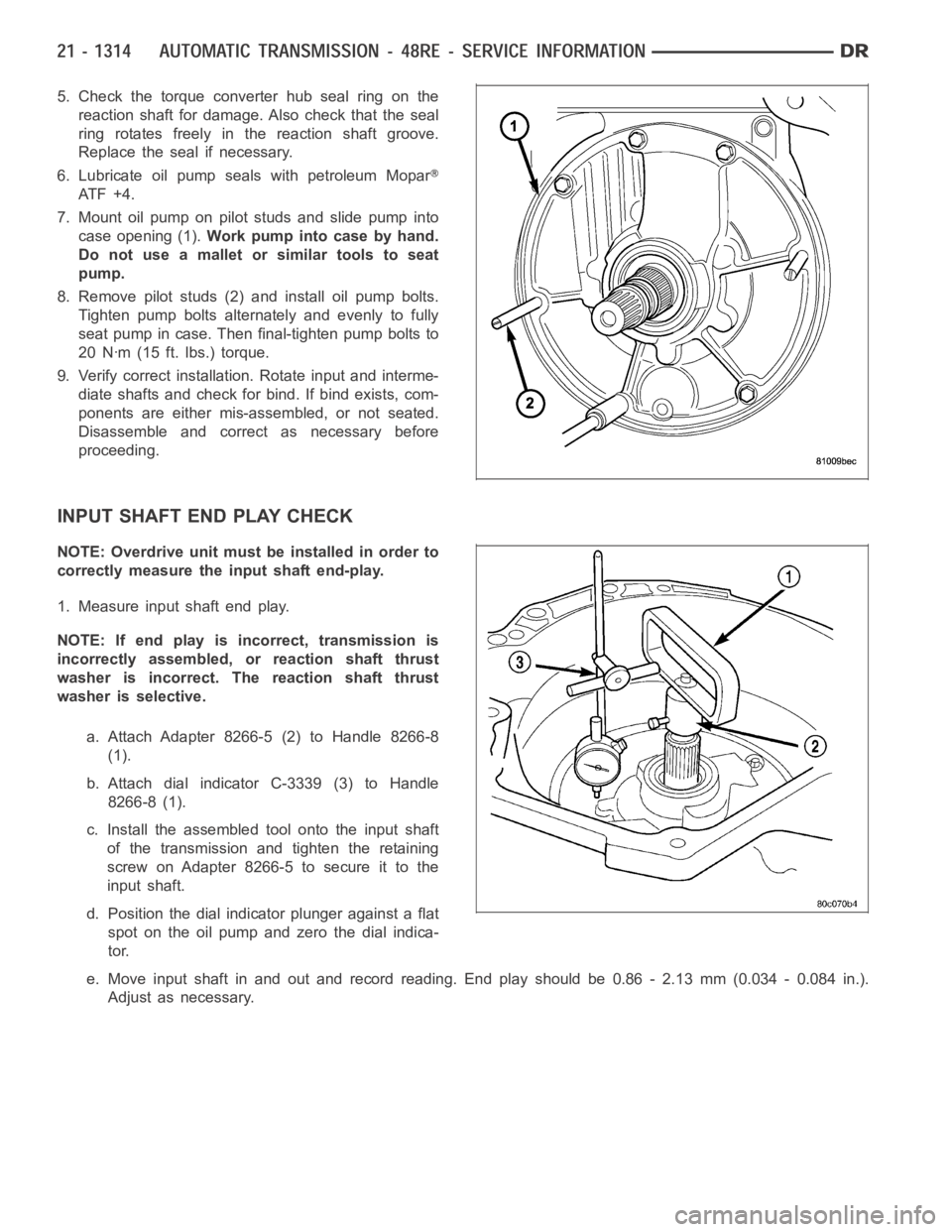
7. Mount oil pump on pilot studs and slide pump into
case opening (1).Work pump into case by hand.
Do not use a mallet or similar tools to seat
pump.
8. Remove pilot studs (2) and install oil pump bolts.
Tighten pump bolts alternately and evenly to fully
seat pump in case. Then final-tighten pump bolts to
20 Nꞏm (15 ft. lbs.) torque.
9. Verify correct installation. Rotate input and interme-
diate shafts and check for bind. If bind exists, com-
ponents are either mis-assembled, or not seated.
Disassemble and correct as necessary before
proceeding.
INPUT SHAFT END PLAY CHECK
NOTE: Overdrive unit must be installed in order to
correctly measure the input shaft end-play.
1. Measure input shaft end play.
NOTE: If end play is incorrect, transmission is
incorrectly assembled, or reaction shaft thrust
washer is incorrect. The reaction shaft thrust
washer is selective.
a. Attach Adapter 8266-5 (2) to Handle 8266-8
(1).
b. Attach dial indicator C-3339 (3) to Handle
8266-8 (1).
c. Install the assembled tool onto the input shaft
of the transmission and tighten the retaining
screw on Adapter 8266-5 to secure it to the
input shaft.
d. Position the dial indicator plunger against a flat
spot on the oil pump and zero the dial indica-
tor.
e. Move input shaft in and out and record reading. End play should be 0.86 - 2.13 mm (0.034 - 0.084 in.).
Adjust as necessary.
Page 3838 of 5267
INSTALLATION
1. Check torque converter hub inner and outer diam-
eters and hub drive notches for sharp edges burrs,
scratches, or nicks. Polish the hub and notches
with 320/400 grit paper and crocus cloth if neces-
sary. The hub must be smooth to avoid damaging
pump seal at installation.
2. Lubricate pocket in the rear oil pump seal lip with
transmission fluid.
3. Lubricate converter pilot hub of the crankshaft with
a light coating of Mopar
High Temp Grease.
4. Align and install converter in oil pump.
5. Carefully insert converter in oil pump. Then rotate
converter back and forth until fully seated in pump
gears.
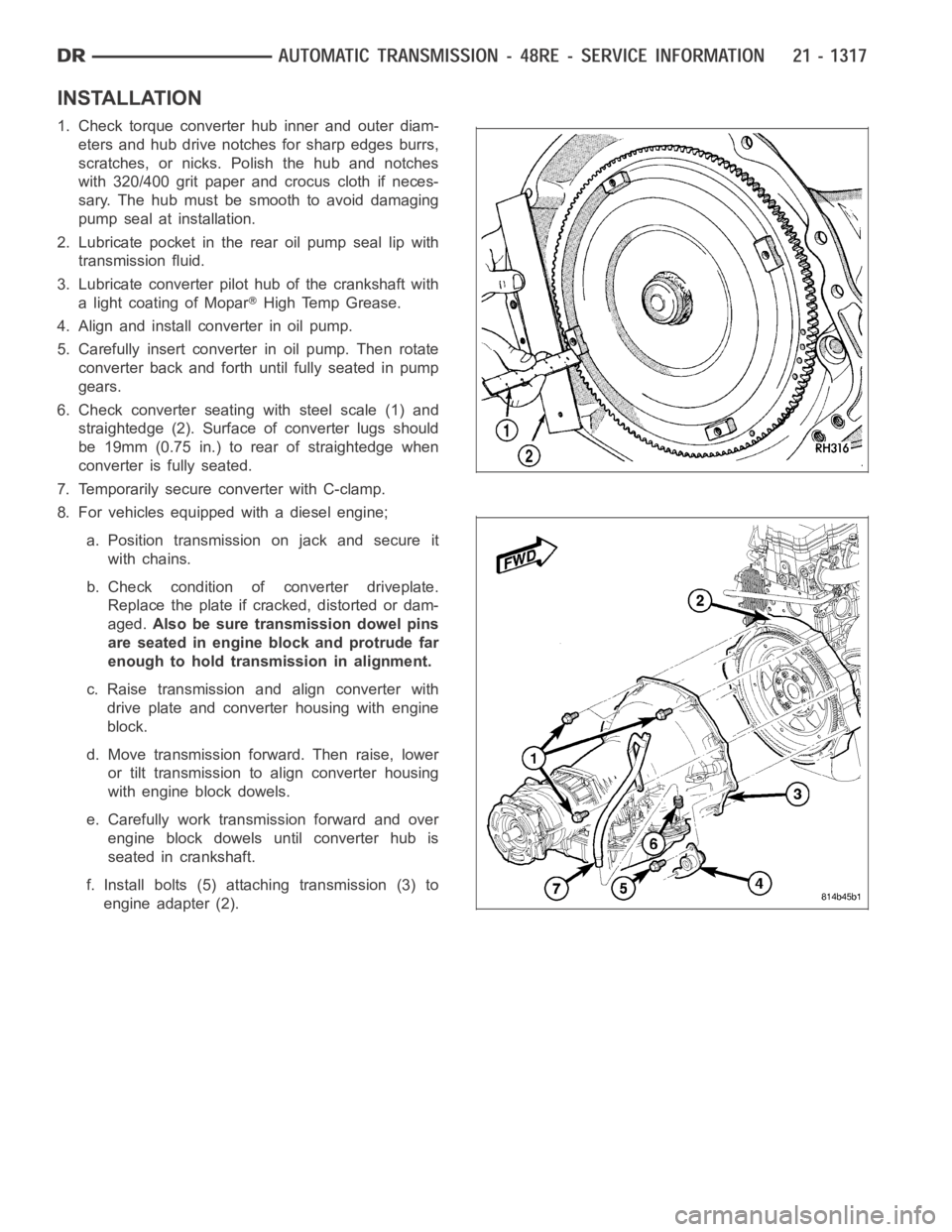
6. Check converter seating with steel scale (1) and
straightedge (2). Surface of converter lugs should
be 19mm (0.75 in.) to rear of straightedge when
converter is fully seated.
7. Temporarily secure converter with C-clamp.
8. For vehicles equipped with a diesel engine;
a. Position transmission on jack and secure it
with chains.
b. Check condition of converter driveplate.
Replace the plate if cracked, distorted or dam-
aged.Also be sure transmission dowel pins
are seated in engine block and protrude far
enough to hold transmission in alignment.
c. Raise transmission and align converter with
drive plate and converter housing with engine
block.
d. Move transmission forward. Then raise, lower
or tilt transmission to align converter housing
with engine block dowels.
e. Carefully work transmission forward and over
engine block dowels until converter hub is
seated in crankshaft.
f. Install bolts (5) attaching transmission (3) to
engine adapter (2).
Page 3839 of 5267
9. For vehicles equipped with a gas engine;
a. Position transmission on jack and secure it
with chains.
b. Check condition of converter driveplate.
Replace the plate if cracked, distorted or dam-
aged.Also be sure transmission dowel pins
are seated in engine block and protrude far
enough to hold transmission in alignment.
c. Raise transmission and align converter with
drive plate and converter housing with engine
block.
d. Move transmission forward. Then raise, lower
or tilt transmission to align converter housing
with engine block dowels.
e. Carefully work transmission forward and over
engine block dowels until converter hub is
seated in crankshaft.
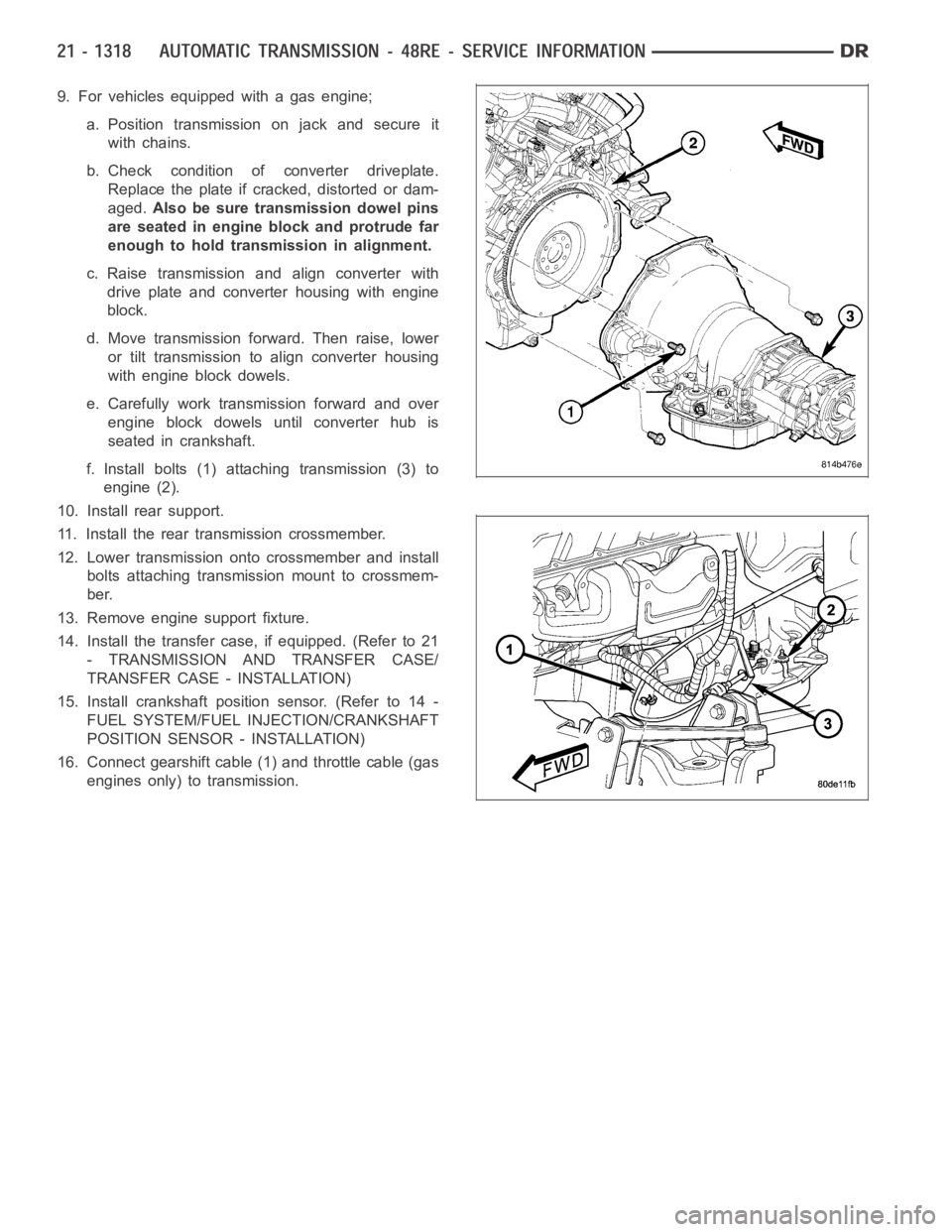
f. Install bolts (1) attaching transmission (3) to
engine (2).
10. Install rear support.
11. Install the rear transmission crossmember.
12. Lower transmission onto crossmember and install
bolts attaching transmission mount to crossmem-
ber.
13. Remove engine support fixture.
14. Install the transfer case, if equipped. (Refer to 21
- TRANSMISSION AND TRANSFER CASE/
TRANSFER CASE - INSTALLATION)
15. Install crankshaft position sensor. (Refer to 14 -
FUEL SYSTEM/FUEL INJECTION/CRANKSHAFT
POSITION SENSOR - INSTALLATION)
16. Connect gearshift cable (1) and throttle cable (gas
engines only) to transmission.
Page 3869 of 5267
OPERATION
Compensation is required for performance variations of two of the input devices. Though the slope of the transfer
functions is tightly controlled, offset may vary due to various environmental factors or manufacturing tolerances.
The pressure transducer is affected by barometric pressure as well as temperature. Calibration of the zero pressure
offset is required to compensate for shifting output due to these factors.
Normal calibration will be performed when sump temperature is above 50 degrees F, or in the absence of sump
temperature data, after the first 10 minutes of vehicle operation. Calibration of the pressure transducer offset occurs
each time the output shaft speed falls below 200 RPM. Calibration shall be repeated each 3 seconds the output
shaft speed is below 200 RPM. A 0.5 second pulse of 95% duty cycle is applied to the governor pressure solenoid
valve and the transducer output is read during this pulse. Averaging of thetransducer signal isnecessary to reject
electrical noise.
Under cold conditions (below 50 degrees F sump), the governor pressure solenoid valve response may be too slow
to guarantee 0 psi during the 0.5 second calibration pulse. Calibration pulses are continued during this period, how-
ever the transducer output valves are discarded. Transducer offset must be read at key-on, under conditions which
promote a stable reading. This value is retained and becomes the offset during the
coldperiod of operation.
GOVERNOR PRESSURE SOLENOID VALVE
The inlet side of the solenoid valve is exposed to normal transmission linepressure. The outlet side of the valve
leads to the valve body governor circuit.
The solenoid valve regulates line pressure to produce governor pressure.Theaveragecurrentsuppliedtothesole-
noid controls governor pressure. One amp current produces zero kPa/psi governor pressure. Zero amps sets the
maximum governor pressure.
The powertrain control module (PCM) turns on the trans control relay whichsupplies electrical power to the solenoid
valve. Operating voltage is 12 volts (DC). The PCM controls the ground sideof the solenoid using the governor
pressure solenoidcontrol circuit.
GOVERNOR PRESSURE SENSOR
The sensor output signal provides the necessary feedback to the PCM. This feedback is needed to adequately
control governor pressure.
GOVERNOR BODY AND TRANSFER PLATE
The transfer plate channels line pressure to the solenoid valve through the governor body. It also channels governor
pressure from the solenoid valve to the governor circuit. It is the solenoid valve that develops the necessary gov-
ernor pressure.
GOVERNOR PRESSURE CURVES
LOW TRANSMISSION FLUID TEMPERATURE
When the transmission fluid is cold the conventional governor can delay shifts, resulting in higher than normal shift
speeds and harsh shifts. The electronically controlled low temperature governor pressure curve is higher than nor-
mal to make the transmission shift at normal speeds and sooner. The PCM usesa temperature sensor in the trans-
mission oil sump to determine when low temperature governor pressure is needed.
NORMAL OPERATION
Normal operation is refined through the increased computing power of the PCM and through access to data on
engine operating conditions provided by the PCM that were not available with the previous stand-alone electronic
module. This facilitated the development of a load adaptive shift strategy - the ability to alter the shift schedule in
response to vehicle load condition. One manifestation of this capabilityis grade
huntingprevention - the ability of
the transmission logic to delay an upshift on a grade if the engine does not have sufficient power to maintain speed
in the higher gear. The 3-2 downshift and the potential for hunting betweengears occurs with a heavily loaded
vehicle or on steep grades. When hunting occurs, it is very objectionable because shifts are frequent and accom-
panied by large changes in noise and acceleration.
Page 3881 of 5267
INSPECTION
Inspect the front clutch components. Replace the clutch discs if warped, worn, scored, burned or charred, the lugs
are damaged, or if the facing is flaking off. Replace the steel plates and reaction plate if heavily scored, warped, or
broken. Be sure the driving lugs on the discs and plate are also in good condition. The lugs must not be bent,
cracked or damaged in any way.
Replace the piston springs and spring retainer if either are distorted, warped or broken.
Check the lug grooves in the clutch piston retainer. The steel plates should slide freely in the slots. Replace the
piston retainer if the grooves are worn or damaged. Also check action of thecheck ball in the piston retainer. The
ball must move freely and not stick.
Replace the retainer bushing if worn, scored, or there is any doubt about bushing condition.
Inspect the piston and retainer seal surfaces for nicks or scratches. Minor scratches can be removed with crocus
cloth. However, replace the piston and/or retainer if the seal surfaces are seriously scored.
Check the clutch piston check ball. The ball should be securely in place. Replace the piston if the ball is missing,
or seized in place.
ASSEMBLY
NOTE: The 48RE transmission uses five plates
and discs for the front clutch.
1. Soak clutch discs in transmission fluid.
2. Install new inner piston seal onto the outer diame-
ter of the clutch retainer inner hub.
3. Install new outer seal onto the clutch piston. Be
sure seal lips of both seals face the interior of the
retainer.
4. Lubricate new inner and outer piston seals with
petroleum jelly.
5. Install clutch piston in retainer. Use twisting motion
to seat piston in bottom of retainer. A thin strip of
plastic (about 0.015 - 0.020 in. thick), can be used to guide seals into placeifnecessary.
CAUTION: Never push the clutch piston straight in. This will fold the sealsover causing leakage and clutch
slip. In addition, never use any type of metal tool to help ease the piston seals into place. Metal tools will
cut, shave, or score the seals.
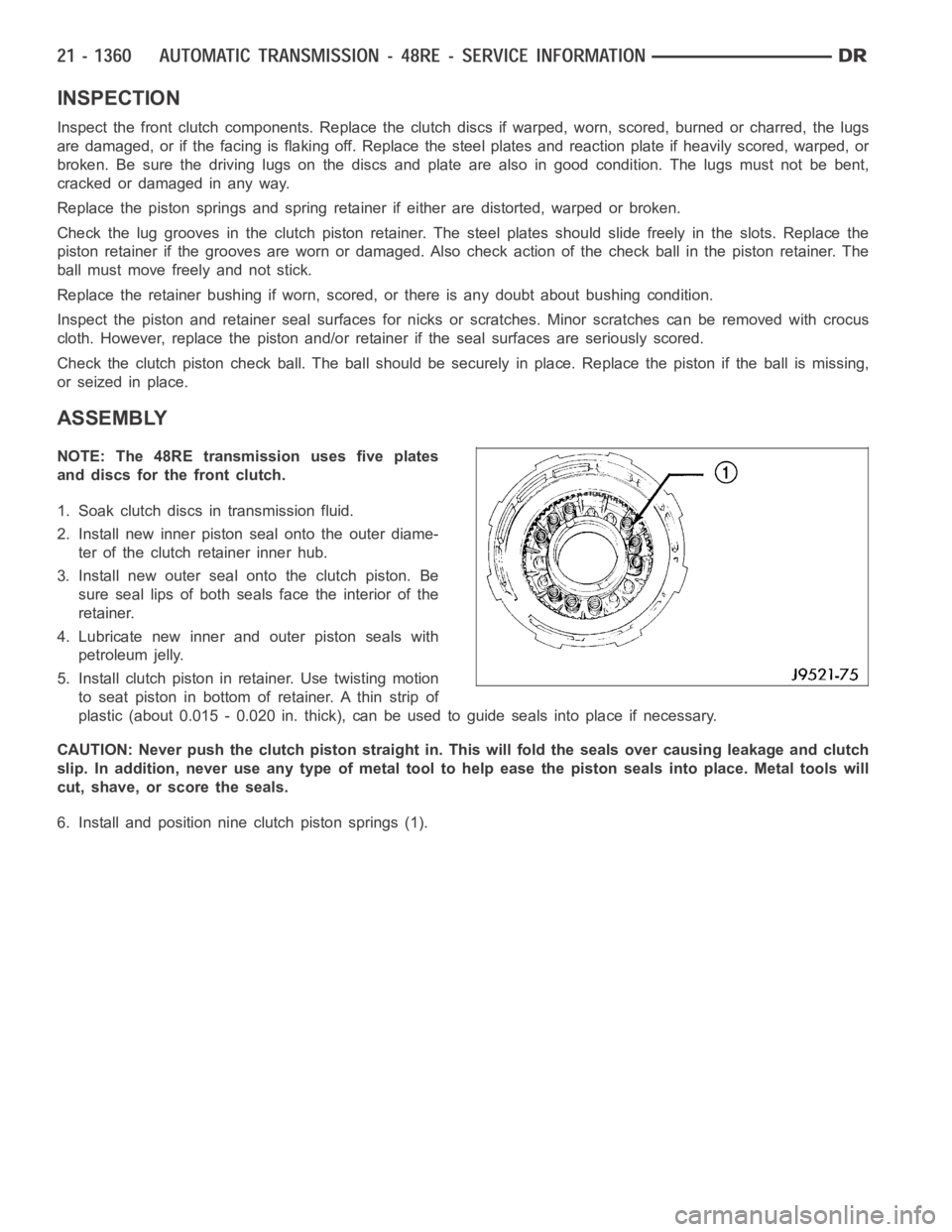
6. Install and position nine clutch piston springs (1).
Page 3888 of 5267
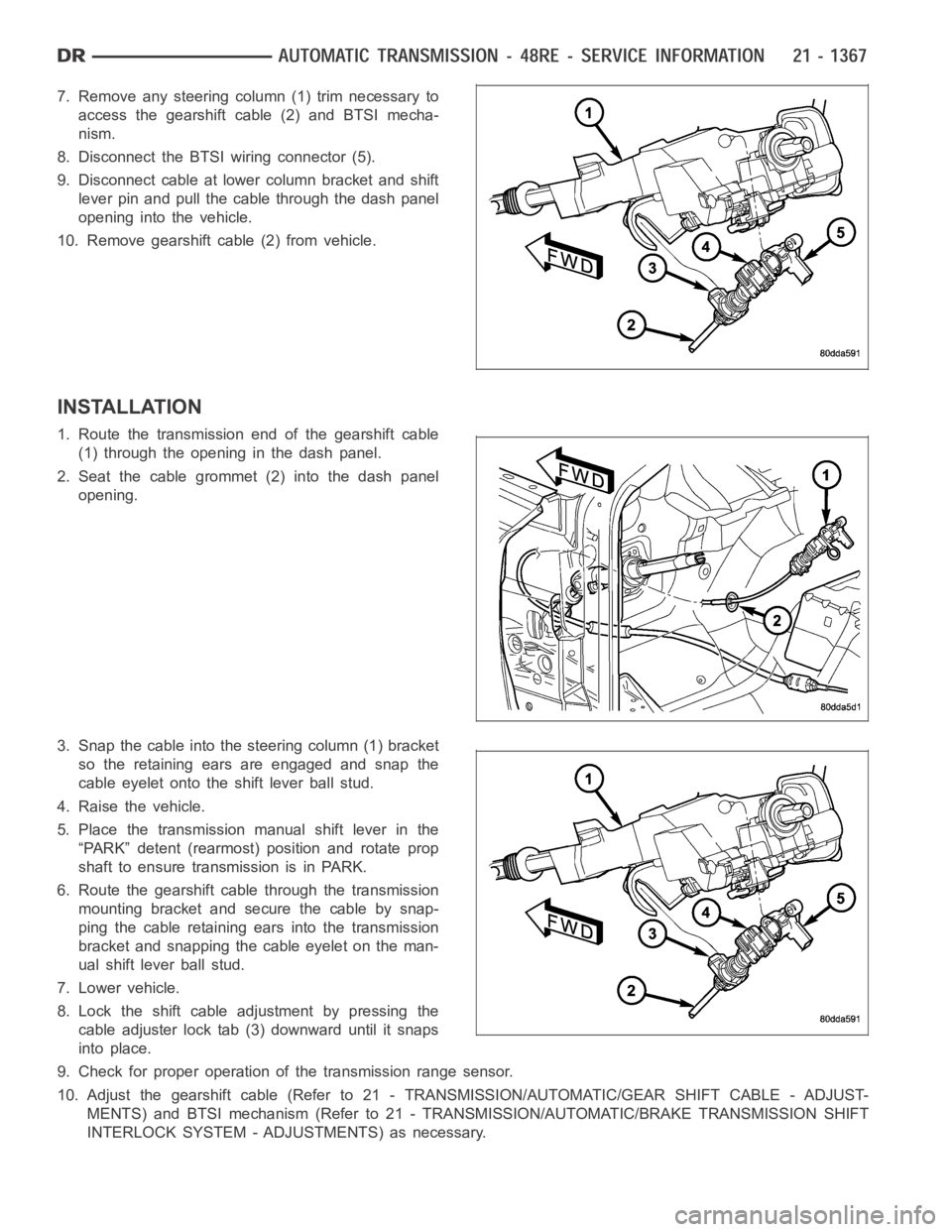
7. Remove any steering column (1) trim necessary to
access the gearshift cable (2) and BTSI mecha-
nism.
8. Disconnect the BTSI wiring connector (5).
9. Disconnect cable at lower column bracket and shift
lever pin and pull the cable through the dash panel
opening into the vehicle.
10. Remove gearshift cable (2) from vehicle.
INSTALLATION
1. Route the transmission end of the gearshift cable
(1) through the opening in the dash panel.
2. Seat the cable grommet (2) into the dash panel
opening.
3. Snap the cable into the steering column (1) bracket
so the retaining ears are engaged and snap the
cable eyelet onto the shift lever ball stud.
4. Raise the vehicle.
5. Place the transmission manual shift lever in the
“PARK” detent (rearmost) position and rotate prop
shaft to ensure transmission is in PARK.
6. Route the gearshift cable through the transmission
mounting bracket and secure the cable by snap-
ping the cable retaining ears into the transmission
bracket and snapping the cable eyelet on the man-
ual shift lever ball stud.
7. Lower vehicle.
8. Lock the shift cable adjustment by pressing the
cable adjuster lock tab (3) downward until it snaps
into place.
9. Check for proper operation of the transmission range sensor.
10. Adjust the gearshift cable (Refer to 21 - TRANSMISSION/AUTOMATIC/GEAR SHIFT CABLE - ADJUST-
MENTS) and BTSI mechanism (Refer to 21 - TRANSMISSION/AUTOMATIC/BRAKE TRANSMISSION SHIFT
INTERLOCK SYSTEM - ADJUSTMENTS) as necessary.
Page 3894 of 5267
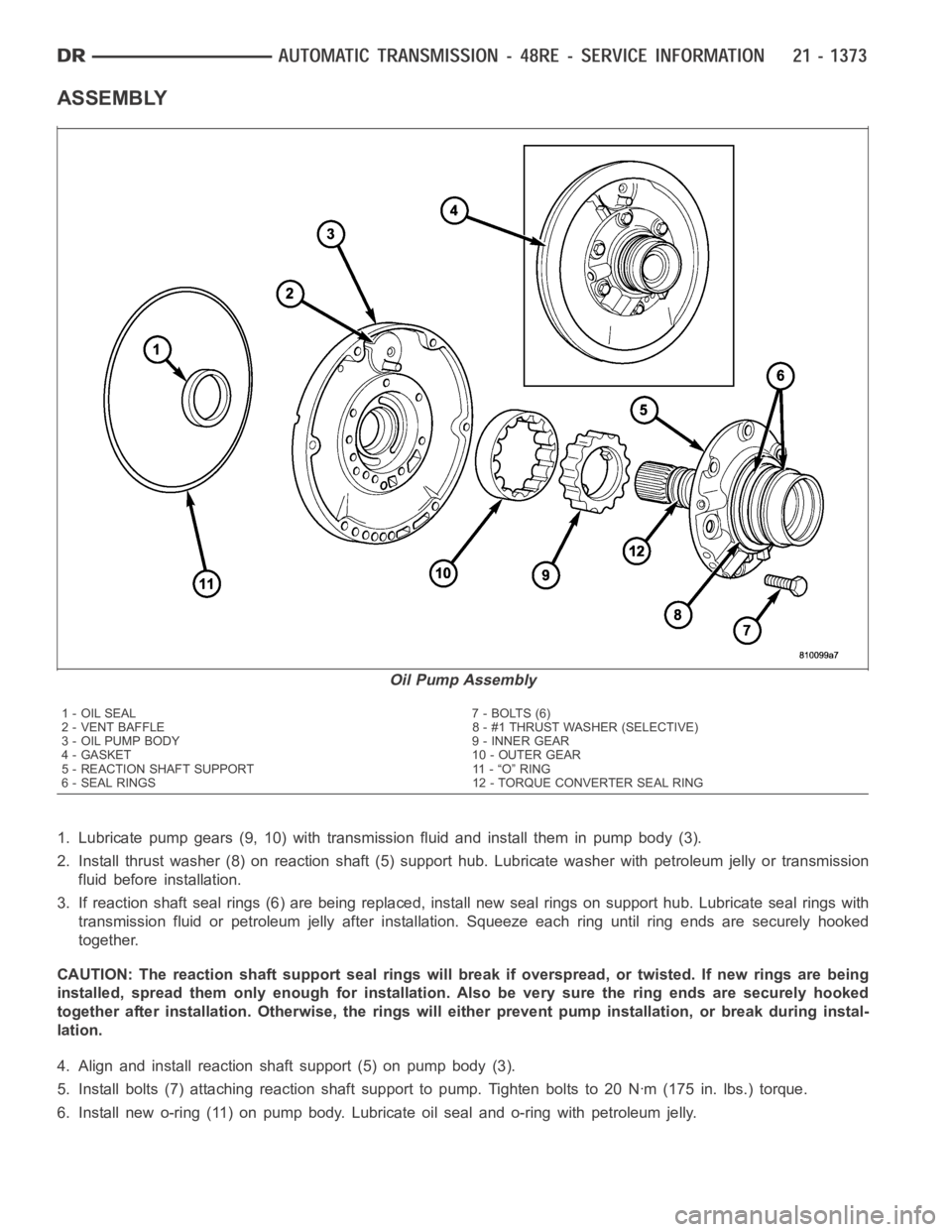
ASSEMBLY
1. Lubricate pump gears (9, 10) with transmission fluid and install them inpump body (3).
2. Install thrust washer (8) on reaction shaft (5) support hub. Lubricate washer with petroleum jelly or transmission
fluid before installation.
3. If reaction shaft seal rings (6) are being replaced, install new seal rings on support hub. Lubricate seal rings with
transmission fluid or petroleum jelly after installation. Squeeze each ring until ring ends are securely hooked
together.
CAUTION: The reaction shaft support seal rings will break if overspread, or twisted. If new rings are being
installed, spread them only enough forinstallation. Also be very sure thering ends are securely hooked
together after installation. Otherwise, the rings will either prevent pump installation, or break during instal-
lation.
4. Align and install reaction shaft support (5) on pump body (3).
5. Install bolts (7) attaching reaction shaft support to pump. Tighten bolts to 20 Nꞏm (175 in. lbs.) torque.
6. Install new o-ring (11) on pump body. Lubricate oil seal and o-ring with petroleum jelly.
Oil Pump Assembly
1 - OIL SEAL 7 - BOLTS (6)
2 - VENT BAFFLE 8 - #1 THRUST WASHER (SELECTIVE)
3 - OIL PUMP BODY 9 - INNER GEAR
4 - GASKET 10 - OUTER GEAR
5 - REACTION SHAFT SUPPORT 11 - “O” RING
6 - SEAL RINGS 12 - TORQUE CONVERTER SEAL RING