ECU DODGE RAM SRT-10 2006 Service Repair Manual
[x] Cancel search | Manufacturer: DODGE, Model Year: 2006, Model line: RAM SRT-10, Model: DODGE RAM SRT-10 2006Pages: 5267, PDF Size: 68.7 MB
Page 5070 of 5267
ACTUATOR-RECIRCULATION DOOR
DESCRIPTION
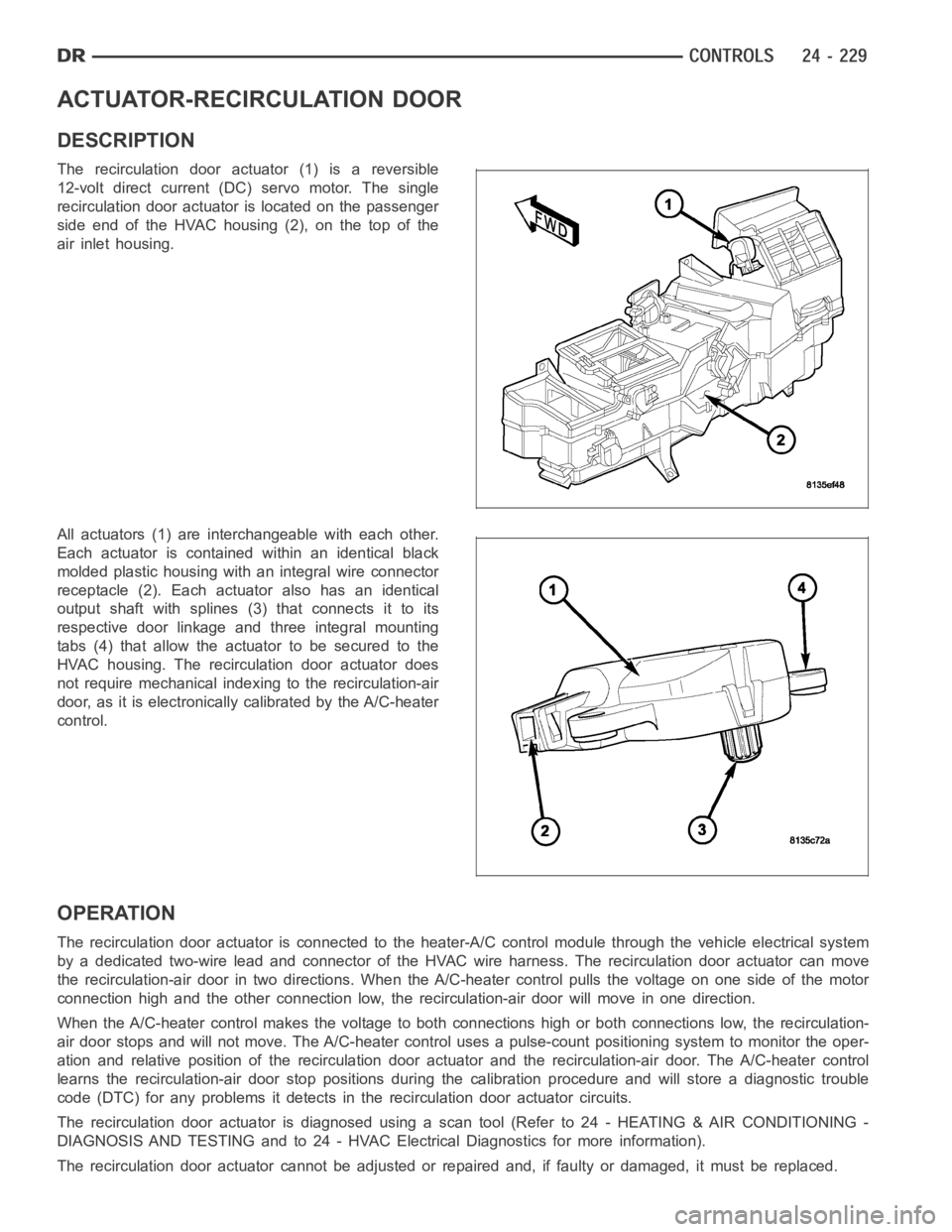
The recirculation door actuator (1) is a reversible
12-volt direct current (DC)servo motor. The single
recirculation door actuator is located on the passenger
side end of the HVAC housing (2), on the top of the
air inlet housing.
All actuators (1) are interchangeable with each other.
Each actuator is contained within an identical black
molded plastic housing with an integral wire connector
receptacle (2). Each actuator also has an identical
output shaft with splines (3) that connects it to its
respective door linkage and three integral mounting
tabs (4) that allow the actuator to be secured to the
HVAC housing. The recirculation door actuator does
not require mechanical indexing to the recirculation-air
door, as it is electronically calibrated by the A/C-heater
control.
OPERATION
The recirculation door actuator is connected to the heater-A/C control module through the vehicle electrical system
by a dedicated two-wire lead and connector of the HVAC wire harness. The recirculation door actuator can move
the recirculation-air door in two directions. When the A/C-heater control pulls the voltage on one side of the motor
connection high and the other connection low, the recirculation-air doorwill move in one direction.
When the A/C-heater control makes the voltage to both connections high or both connections low, the recirculation-
air door stops and will not move. The A/C-heater control uses a pulse-countpositioning system to monitor the oper-
ation and relative position of the recirculation door actuator and the recirculation-air door. The A/C-heater control
learns the recirculation-air door stop positions during the calibrationprocedure and will store a diagnostic trouble
code (DTC) for any problems it detects in the recirculation door actuator circuits.
The recirculation door actuator is diagnosed using a scan tool (Refer to 24- HEATING & AIR CONDITIONING -
DIAGNOSIS AND TESTING and to 24 - HVAC Electrical Diagnostics for more information).
The recirculation door actuator cannot be adjusted or repaired and, if faulty or damaged, it must be replaced.
Page 5071 of 5267
REMOVAL
WARNING: On vehicles equipped with airbags, disable the airbag system before attempting any steering
wheel, steering column, or instrument panel component diagnosis or service. Disconnect and isolate the
battery negative (ground) cable, then wait two minutes for the airbag system capacitor to discharge before
performing further diagnosis or service. This is the only sure way to disable the airbag system. Failure to
take the proper precautions could result in accidental airbag deploymentand possible personal injury or
death.
1. Disconnect and isolate the negative battery cable.
2. Remove the glove box from the instrument panel
(Refer to 23 - BODY/INSTRUMENT PANEL/
GLOVE BOX - REMOVAL).
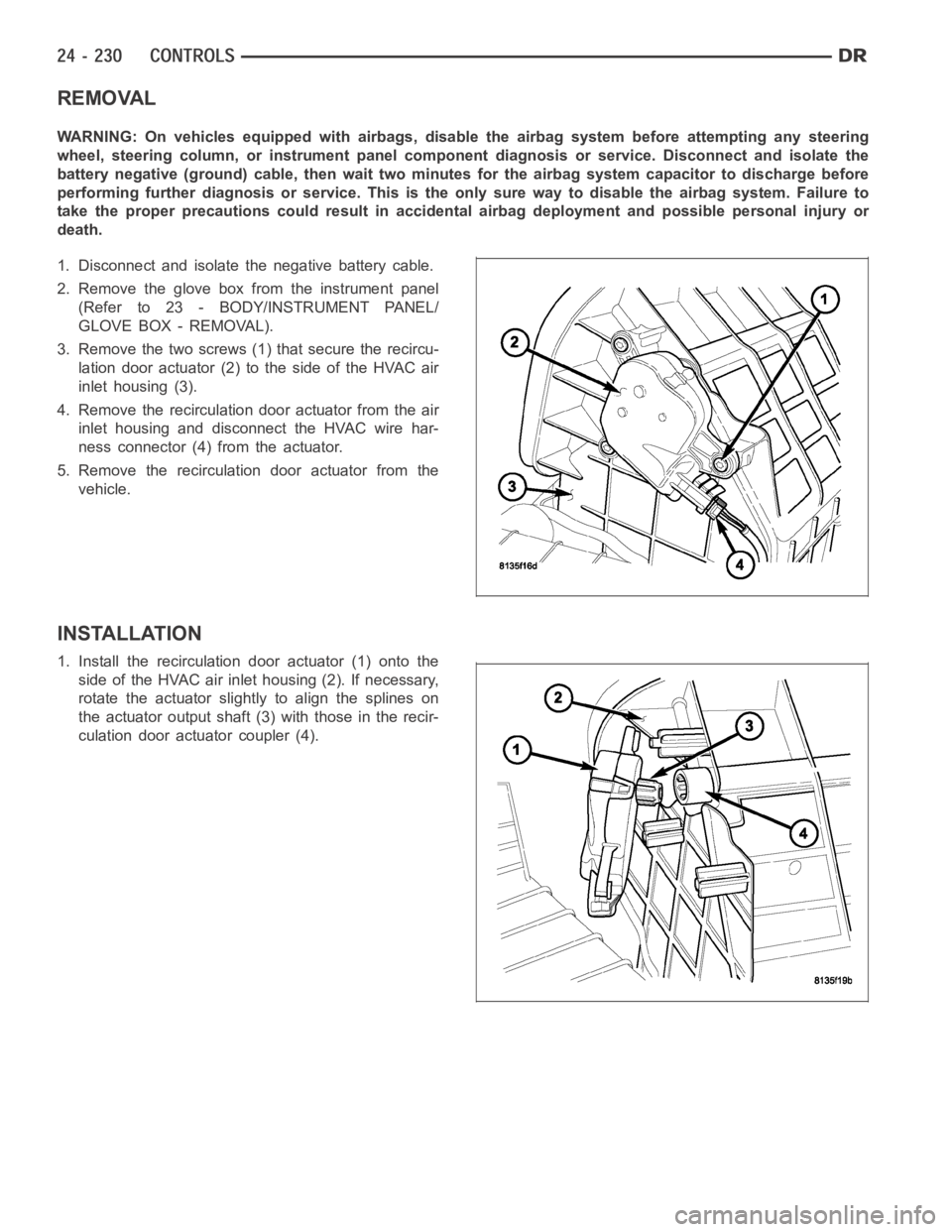
3. Remove the two screws (1) that secure the recircu-
lation door actuator (2) to the side of the HVAC air
inlet housing (3).
4. Remove the recirculation door actuator from the air
inlet housing and disconnect the HVAC wire har-
ness connector (4) from the actuator.
5. Remove the recirculation door actuator from the
vehicle.
INSTALLATION
1. Install the recirculation door actuator (1) onto the
side of the HVAC air inlet housing (2). If necessary,
rotate the actuator slightly to align the splines on
the actuator output shaft (3) with those in the recir-
culation door actuator coupler (4).
Page 5072 of 5267

2. Install the two screws (1)that secure the recircula-
tion door actuator (2) to the air inlet housing (3).
Tighten the screws to 2.2 Nꞏm (20 in. lbs.).
3. Connect the HVAC wire harness connector (4) to
the recirculation door actuator.
4. Install the glove box (Refer to 23 - BODY/INSTRU-
MENT PANEL/GLOVE BOX - INSTALLATION).
5. Reconnect the negative battery cable.
Page 5073 of 5267
CLUTCH-A/C COMPRESSOR
DESCRIPTION
NOTE: Denso 10S17 A/C clutch assembly shown.
Visteon HS-18 compressor similar.
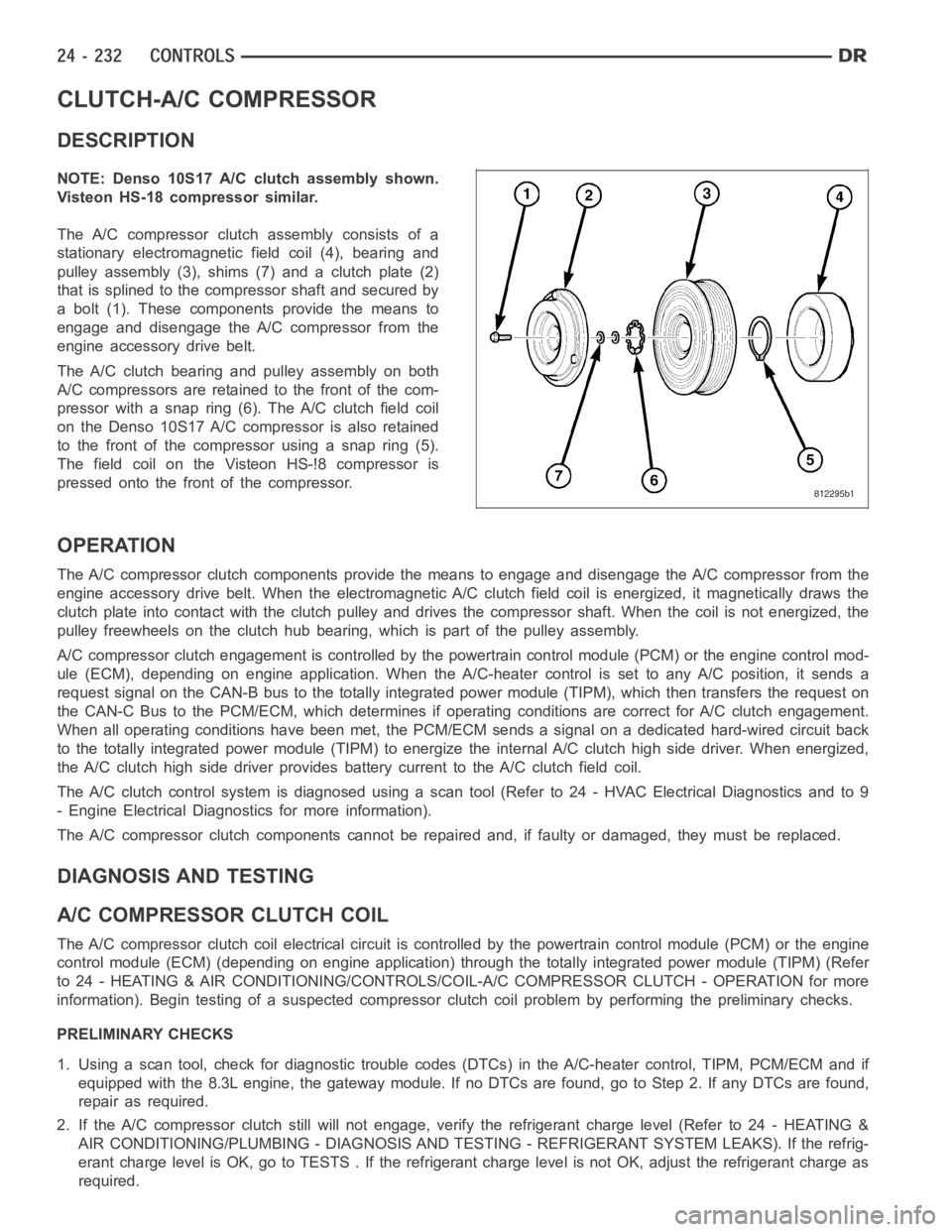
The A/C compressor clutch assembly consists of a
stationary electromagnetic field coil (4), bearing and
pulley assembly (3), shims (7) and a clutch plate (2)
that is splined to the compressor shaft and secured by
a bolt (1). These components provide the means to
engage and disengage the A/C compressor from the
engine accessory drive belt.
The A/C clutch bearing and pulley assembly on both
A/C compressors are retained to the front of the com-
pressor with a snap ring (6). The A/C clutch field coil
on the Denso 10S17 A/C compressor is also retained
to the front of the compressor using a snap ring (5).
The field coil on the Visteon HS-!8 compressor is
pressed onto the front of the compressor.
OPERATION
The A/C compressor clutch components provide the means to engage and disengage the A/C compressor from the
engine accessory drive belt. When the electromagnetic A/C clutch field coil is energized, it magnetically draws the
clutch plate into contact with the clutch pulley and drives the compressorshaft. When the coil is not energized, the
pulley freewheels on the clutch hub bearing, which is part of the pulley assembly.
A/C compressor clutch engagement is controlled by the powertrain controlmodule (PCM) or the engine control mod-
ule (ECM), depending on engine application. When the A/C-heater control is set to any A/C position, it sends a
request signal on the CAN-B bus to the totally integrated power module (TIPM), which then transfers the request on
the CAN-C Bus to the PCM/ECM, which determines if operating conditions arecorrect for A/C clutch engagement.
When all operating conditions have been met, the PCM/ECM sends a signal on adedicated hard-wired circuit back
to the totally integrated power module (TIPM) to energize the internal A/Cclutch high side driver. When energized,
the A/C clutch high side driver provides battery current to the A/C clutch field coil.
The A/C clutch control system is diagnosed using a scan tool (Refer to 24 - HVAC Electrical Diagnostics and to 9
- Engine Electrical Diagnostics for more information).
The A/C compressor clutch components cannot be repaired and, if faulty or damaged, they must be replaced.
DIAGNOSIS AND TESTING
A/CCOMPRESSORCLUTCHCOIL
The A/C compressor clutch coil electrical circuit is controlled by the powertrain control module (PCM) or the engine
control module (ECM) (depending on engine application) through the totally integrated power module (TIPM) (Refer
to 24 - HEATING & AIR CONDITIONING/CONTROLS/COIL-A/C COMPRESSOR CLUTCH -OPERATION for more
information). Begin testing of a suspected compressor clutch coil problem by performing the preliminary checks.
PRELIMINARY CHECKS
1. Using a scan tool, check for diagnostic trouble codes (DTCs) in the A/C-heater control, TIPM, PCM/ECM and if
equipped with the 8.3L engine, the gateway module. If no DTCs are found, go to Step 2. If any DTCs are found,
repair as required.
2. If the A/C compressor clutch still will not engage, verify the refrigerant charge level (Refer to 24 - HEATING &
AIR CONDITIONING/PLUMBING - DIAGNOSIS AND TESTING - REFRIGERANT SYSTEM LEAKS). If the refrig-
erant charge level is OK, go to TESTS . If the refrigerant charge level is notOK, adjust the refrigerant charge as
required.
Page 5075 of 5267
REMOVAL
DENSO A/C COMPRESSOR
NOTE: The compressor clutch assembly can be serviced with the refrigerantsystem fully-charged.
NOTE: Typical A/C compressor shown in illustrations.
1. Disconnect and isolate the negative battery cable.
2. Remove the accessory drive belt (Refer to 7 -
COOLING/ACCESSORY DRIVE/BELTS-DRIVE -
REMOVAL).
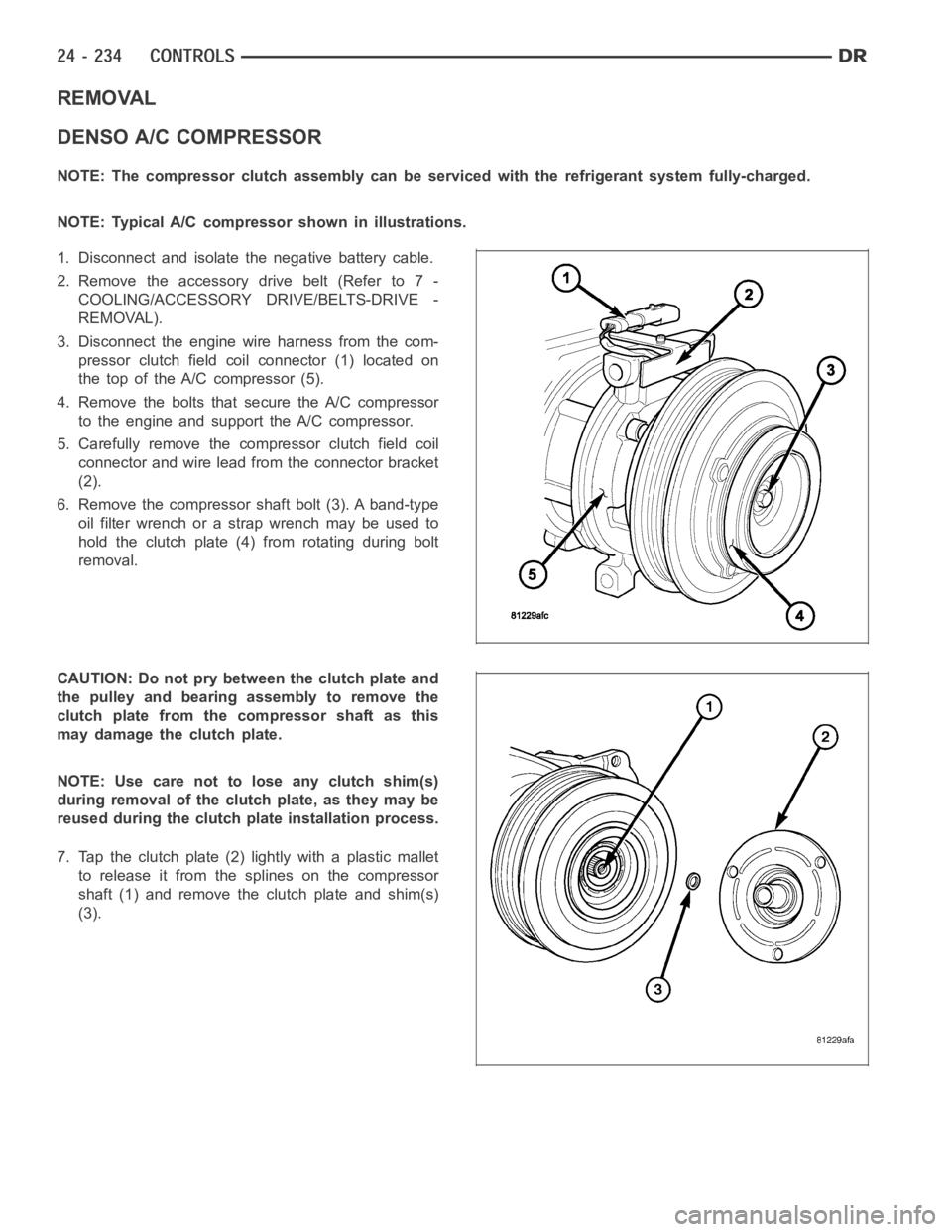
3. Disconnect the engine wire harness from the com-
pressor clutch field coilconnector (1) located on
the top of the A/C compressor (5).
4. Remove the bolts that secure the A/C compressor
to the engine and support the A/C compressor.
5. Carefully remove the compressor clutch field coil
connector and wire lead from the connector bracket
(2).
6. Remove the compressor shaft bolt (3). A band-type
oil filter wrench or a strap wrench may be used to
hold the clutch plate (4) from rotating during bolt
removal.
CAUTION: Do not pry between the clutch plate and
the pulley and bearing assembly to remove the
clutch plate from the compressor shaft as this
may damage the clutch plate.
NOTE: Use care not to lose any clutch shim(s)
during removal of the clutch plate, as they may be
reused during the clutch plate installation process.
7. Tap the clutch plate (2) lightly with a plastic mallet
to release it from the splines on the compressor
shaft (1) and remove the clutch plate and shim(s)
(3).
Page 5076 of 5267
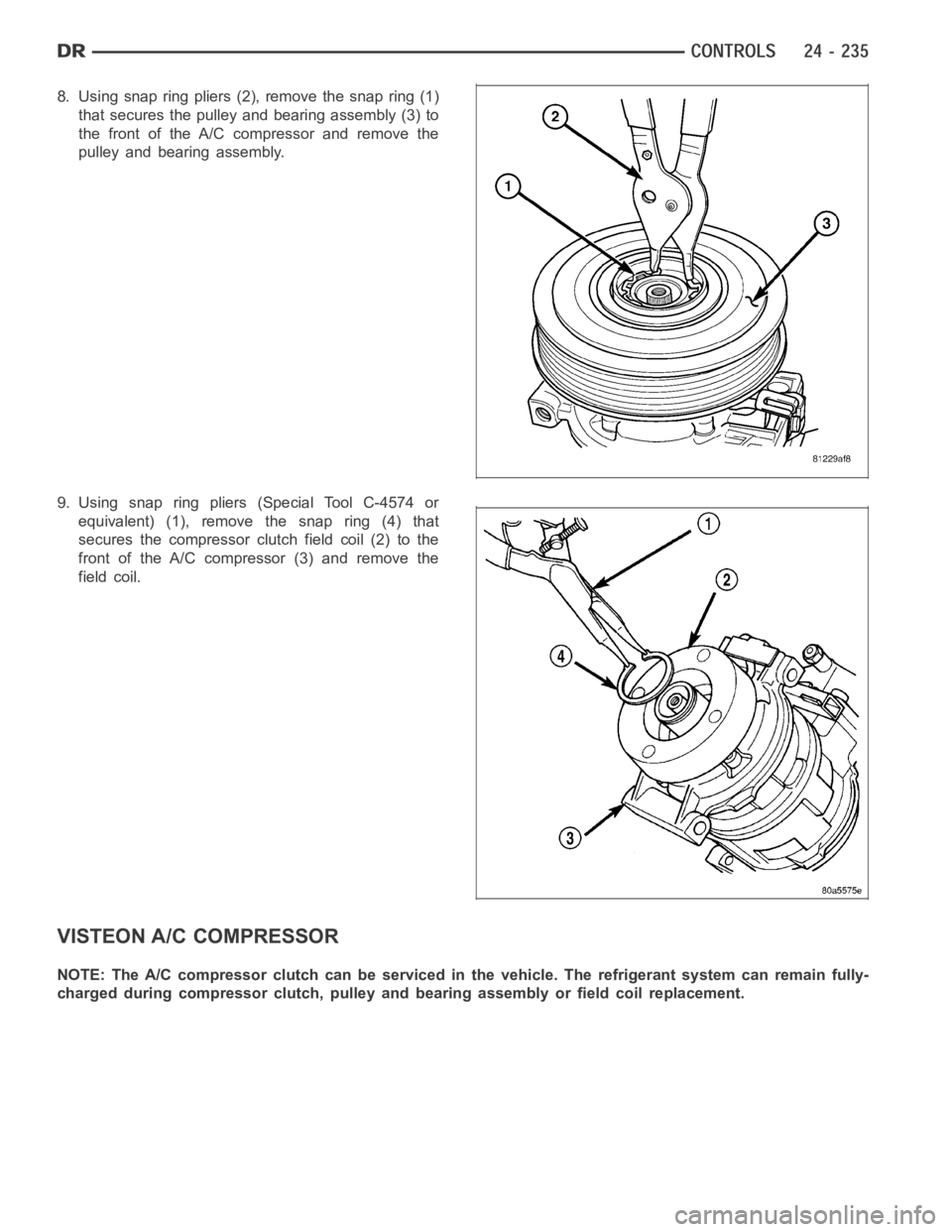
8. Using snap ring pliers (2), remove the snap ring (1)
that secures the pulley and bearing assembly (3) to
the front of the A/C compressor and remove the
pulley and bearing assembly.
9. Using snap ring pliers (Special Tool C-4574 or
equivalent) (1), remove the snap ring (4) that
secures the compressor clutch field coil (2) to the
front of the A/C compressor (3) and remove the
field coil.
VISTEON A/C COMPRESSOR
NOTE: The A/C compressor clutch can be serviced in the vehicle. The refrigerant system can remain fully-
charged during compressor clutch, pulley and bearing assembly or field coil replacement.
Page 5077 of 5267
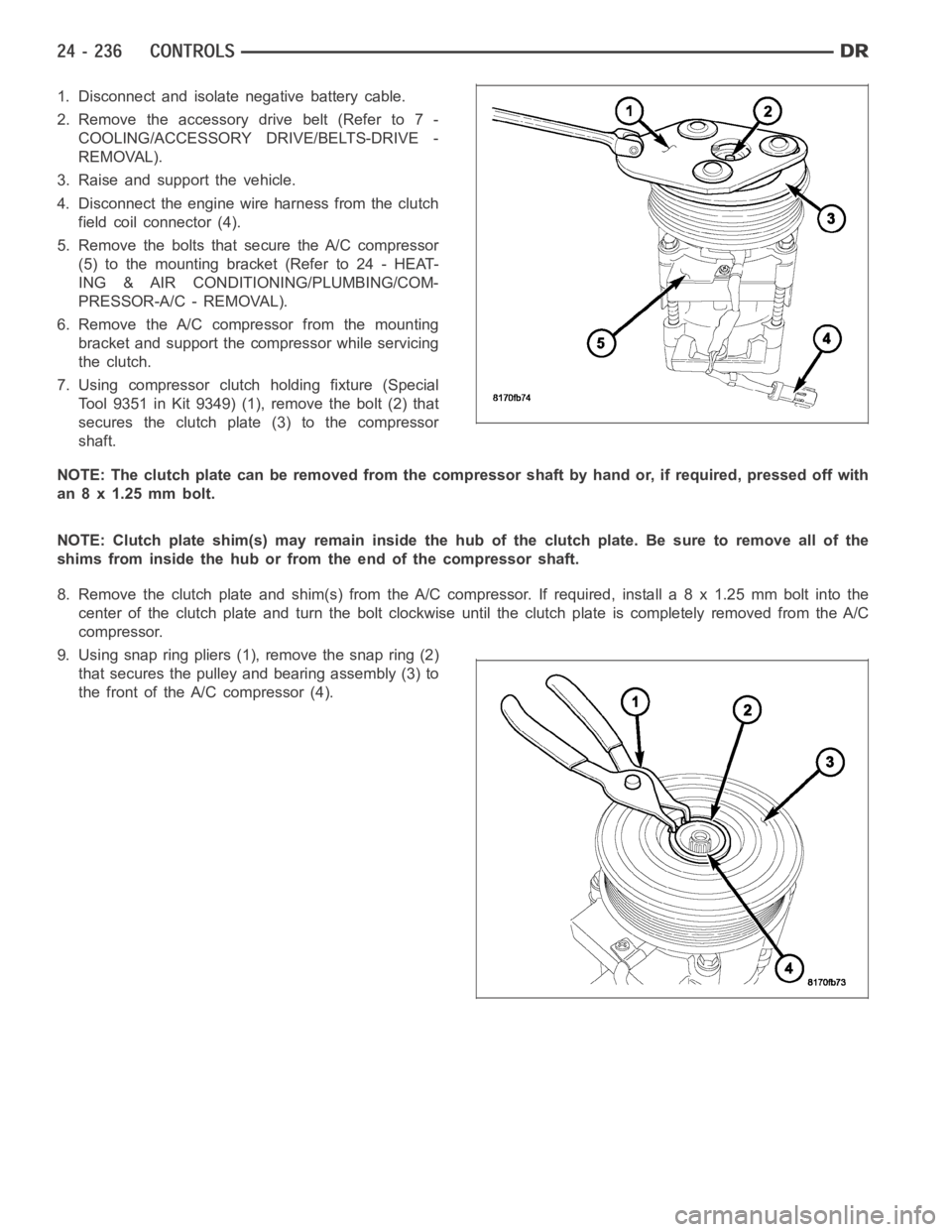
1. Disconnect and isolate negative battery cable.
2. Remove the accessory drive belt (Refer to 7 -
COOLING/ACCESSORY DRIVE/BELTS-DRIVE -
REMOVAL).
3. Raise and support the vehicle.
4. Disconnect the engine wire harness from the clutch
field coil connector (4).
5. Remove the bolts that secure the A/C compressor
(5)tothemountingbracket(Referto24-HEAT-
ING & AIR CONDITIONING/PLUMBING/COM-
PRESSOR-A/C - REMOVAL).
6. Remove the A/C compressor from the mounting
bracket and support the compressor while servicing
the clutch.
7. Using compressor clutch holding fixture (Special
Tool 9351 in Kit 9349) (1), remove the bolt (2) that
secures the clutch plate (3) to the compressor
shaft.
NOTE: The clutch plate can be removed from the compressor shaft by hand or, if required, pressed off with
an 8 x 1.25 mm bolt.
NOTE: Clutch plate shim(s) may remain inside the hub of the clutch plate. Besure to remove all of the
shims from inside the hub or from the end of the compressor shaft.
8. Remove the clutch plate and shim(s) from the A/C compressor. If required, install a 8 x 1.25 mm bolt into the
centeroftheclutchplateandturntheboltclockwiseuntiltheclutchplate is completely removed from the A/C
compressor.
9. Using snap ring pliers (1), remove the snap ring (2)
that secures the pulley and bearing assembly (3) to
the front of the A/C compressor (4).
Page 5078 of 5267
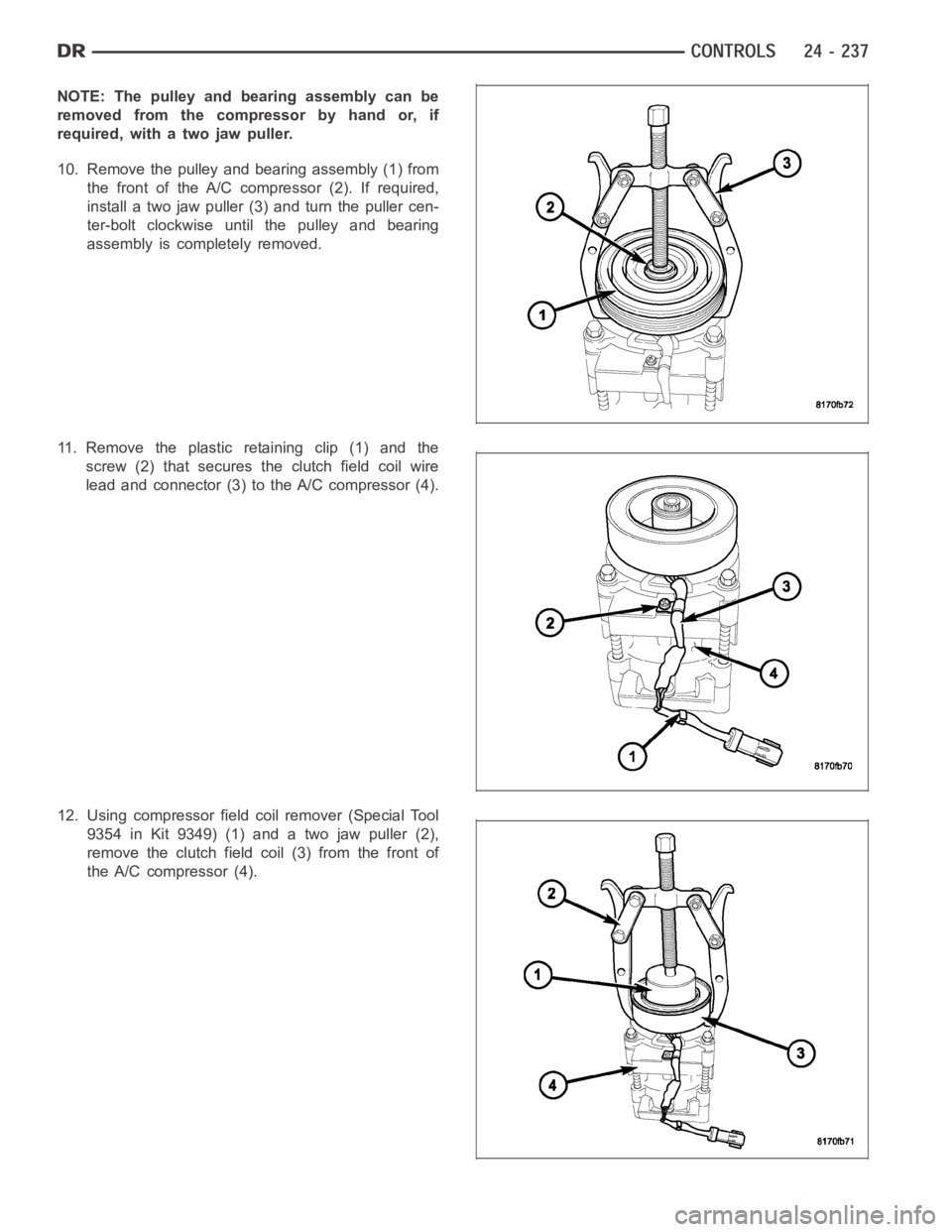
NOTE: The pulley and bearing assembly can be
removed from the compressor by hand or, if
required, with a two jaw puller.
10. Remove the pulley and bearing assembly (1) from
the front of the A/C compressor (2). If required,
install a two jaw puller (3) and turn the puller cen-
ter-bolt clockwise until the pulley and bearing
assembly is completely removed.
11. Remove the plastic retaining clip (1) and the
screw (2) that secures the clutch field coil wire
lead and connector (3) to the A/C compressor (4).
12. Using compressor field coil remover (Special Tool
9354 in Kit 9349) (1) and a two jaw puller (2),
remove the clutch field coil (3) from the front of
the A/C compressor (4).
Page 5079 of 5267
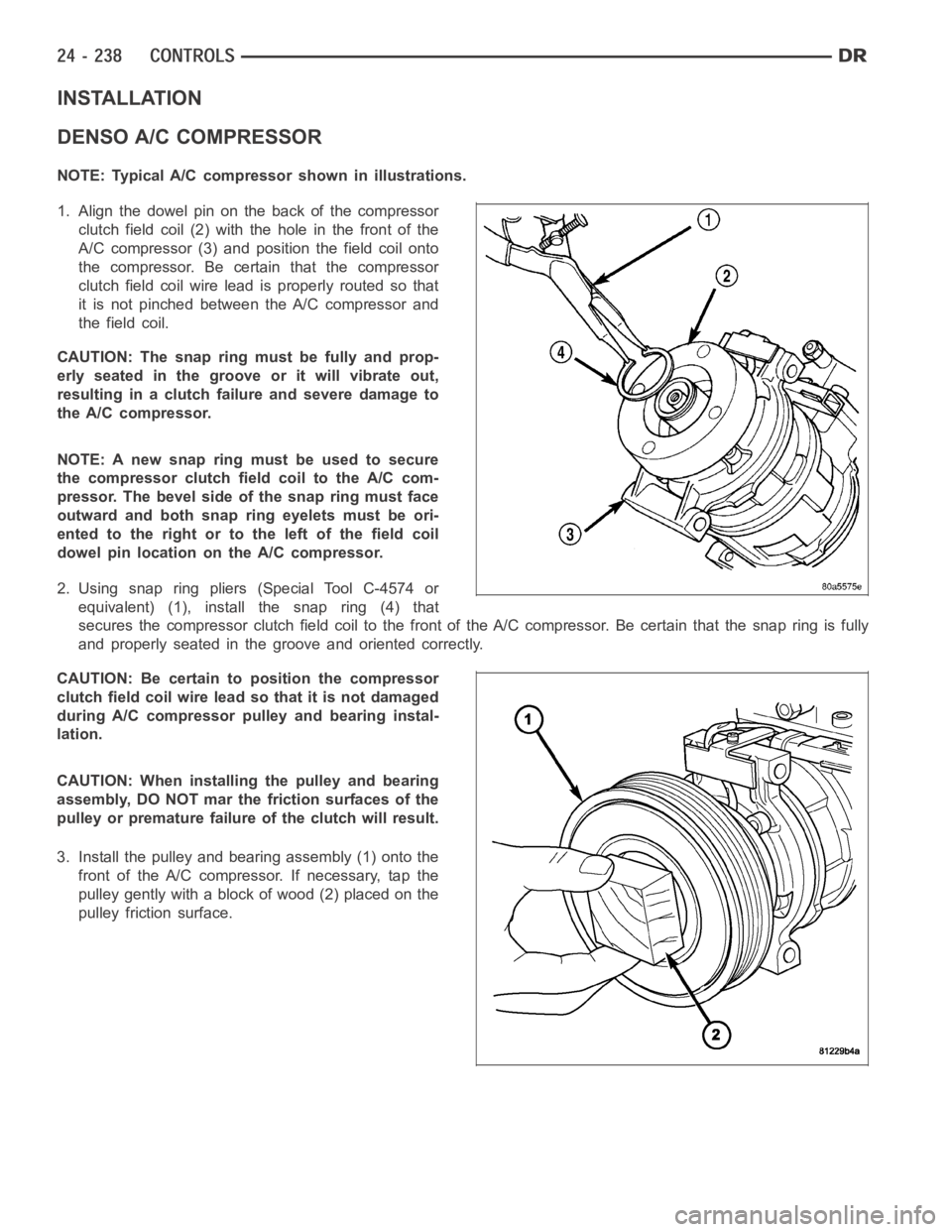
INSTALLATION
DENSO A/C COMPRESSOR
NOTE: Typical A/C compressor shown in illustrations.
1. Align the dowel pin on the back of the compressor
clutch field coil (2) with the hole in the front of the
A/C compressor (3) and position the field coil onto
the compressor. Be certain that the compressor
clutch field coil wire lead is properly routed so that
it is not pinched between the A/C compressor and
the field coil.
CAUTION:Thesnapringmustbefullyandprop-
erly seated in the groove or it will vibrate out,
resulting in a clutch failure and severe damage to
the A/C compressor.
NOTE:Anewsnapringmustbeusedtosecure
the compressor clutch field coil to the A/C com-
pressor. The bevel side of the snap ring must face
outward and both snap ring eyelets must be ori-
ented to the right or to the left of the field coil
dowel pin location on the A/C compressor.
2. Using snap ring pliers (Special Tool C-4574 or
equivalent) (1), install the snap ring (4) that
secures the compressor clutch field coil to the front of the A/C compressor. Be certain that the snap ring is fully
and properly seated in the groove and oriented correctly.
CAUTION:Becertaintopositionthecompressor
clutch field coil wire lead so that it is not damaged
during A/C compressor pulley and bearing instal-
lation.
CAUTION: When installing the pulley and bearing
assembly, DO NOT mar the friction surfaces of the
pulley or premature failure of the clutch will result.
3. Install the pulley and bearing assembly (1) onto the
front of the A/C compressor. If necessary, tap the
pulley gently with a block of wood (2) placed on the
pulley friction surface.
Page 5080 of 5267
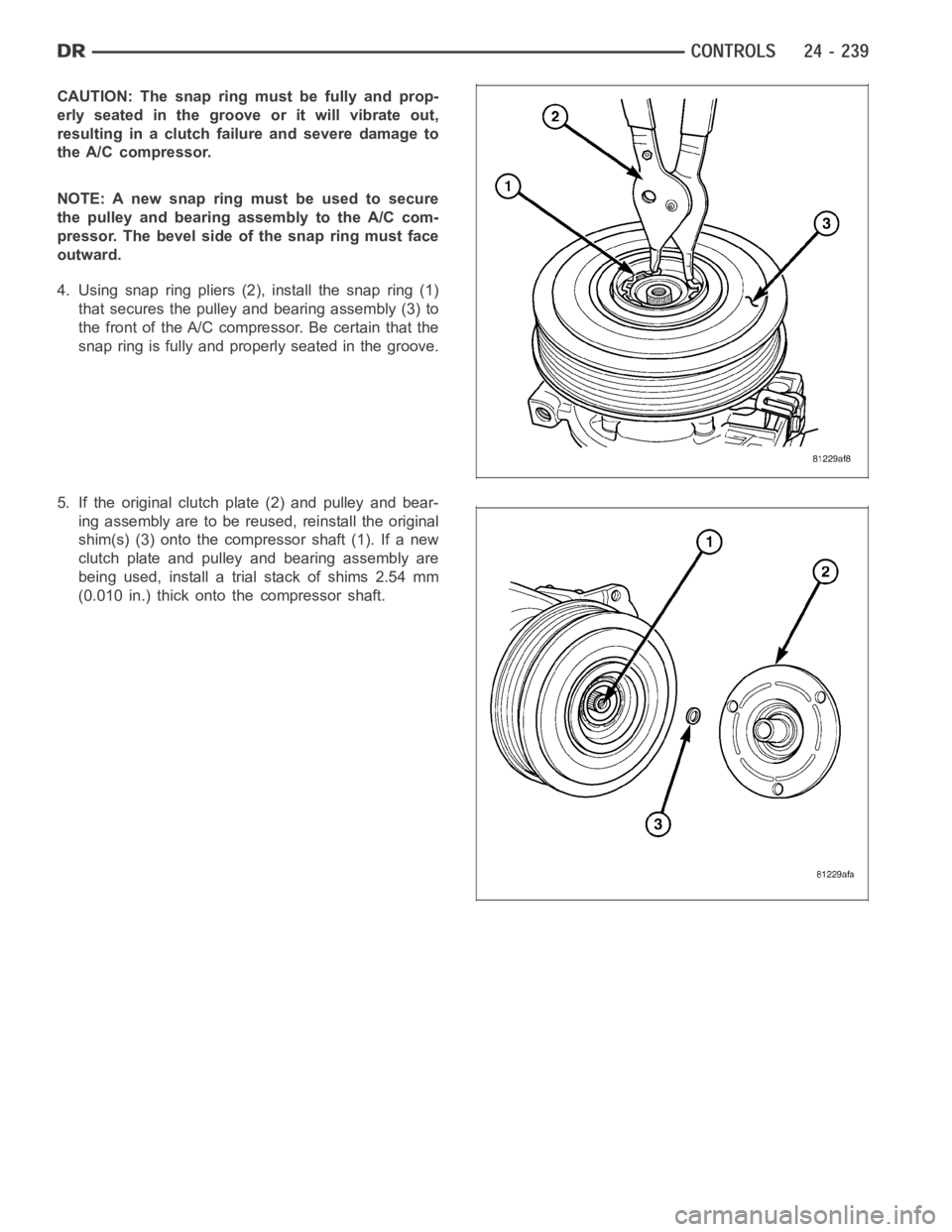
CAUTION:Thesnapringmustbefullyandprop-
erly seated in the groove or it will vibrate out,
resulting in a clutch failure and severe damage to
the A/C compressor.
NOTE:Anewsnapringmustbeusedtosecure
the pulley and bearing assembly to the A/C com-
pressor. The bevel side of the snap ring must face
outward.
4. Using snap ring pliers (2), install the snap ring (1)
that secures the pulley and bearing assembly (3) to
the front of the A/C compressor. Be certain that the
snap ring is fully and properly seated in the groove.
5. If the original clutch plate (2) and pulley and bear-
ing assembly are to be reused, reinstall the original
shim(s) (3) onto the compressor shaft (1). If a new
clutch plate and pulley and bearing assembly are
being used, install a trial stack of shims 2.54 mm
(0.010 in.) thick onto the compressor shaft.