ECU DODGE RAM SRT-10 2006 Service Repair Manual
[x] Cancel search | Manufacturer: DODGE, Model Year: 2006, Model line: RAM SRT-10, Model: DODGE RAM SRT-10 2006Pages: 5267, PDF Size: 68.7 MB
Page 5051 of 5267
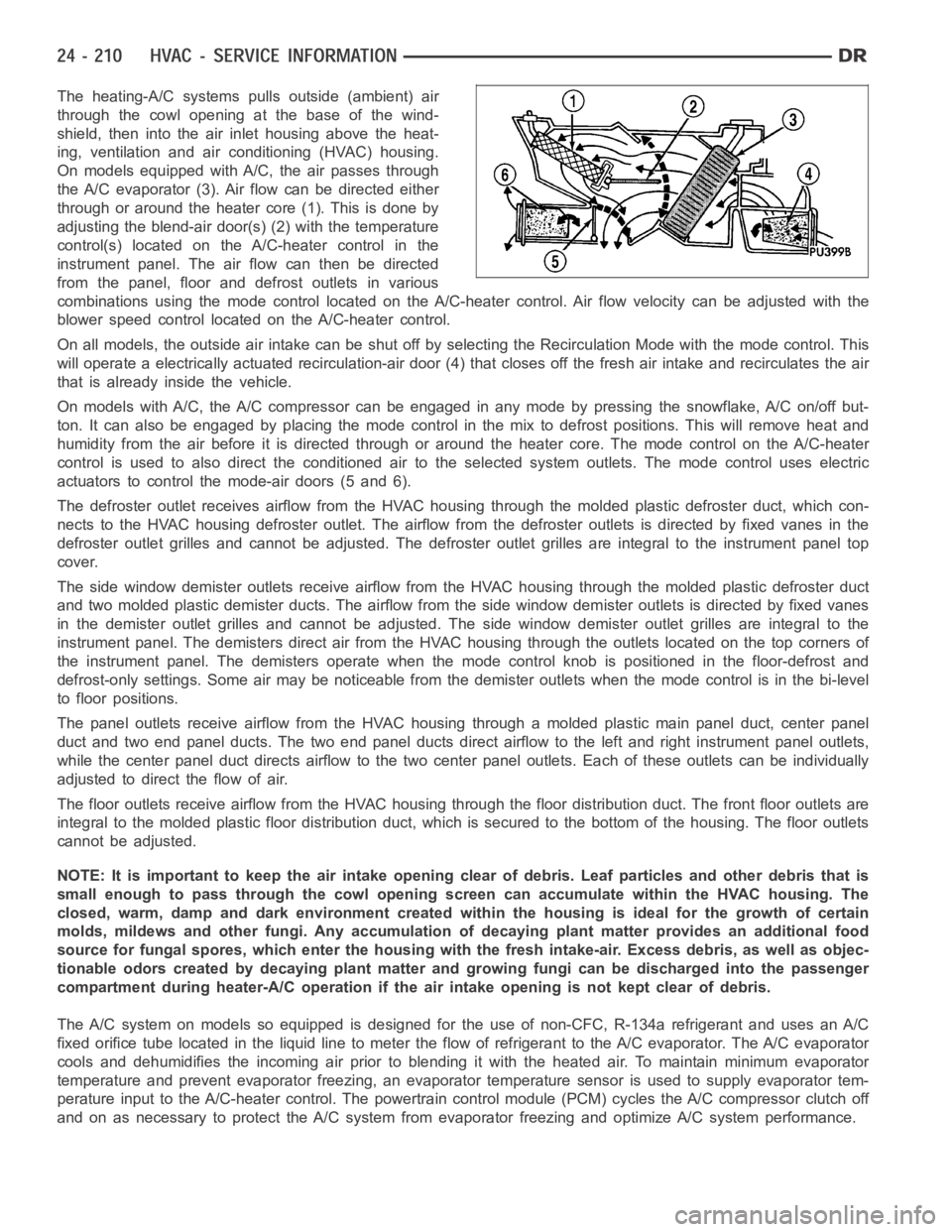
The heating-A/C systems pulls outside (ambient) air
through the cowl opening at the base of the wind-
shield, then into the air inlet housing above the heat-
ing, ventilation and air conditioning (HVAC) housing.
On models equipped with A/C, the air passes through
the A/C evaporator (3). Air flow can be directed either
through or around the heater core (1). This is done by
adjusting the blend-air door(s) (2) with the temperature
control(s) located on the A/C-heater control in the
instrument panel. The air flow can then be directed
from the panel, floor and defrost outlets in various
combinations using the mode control located on the A/C-heater control. Air flow velocity can be adjusted with the
blower speed control located on the A/C-heater control.
On all models, the outside air intake can be shut off by selecting the Recirculation Mode with the mode control. This
will operate a electrically actuated recirculation-air door (4) that closes off the fresh air intake and recirculates the air
that is already inside the vehicle.
On models with A/C, the A/C compressor can be engaged in any mode by pressingthe snowflake, A/C on/off but-
ton. It can also be engaged by placing the mode control in the mix to defrost positions. This will remove heat and
humidity from the air before it is directed through or around the heater core. The mode control on the A/C-heater
control is used to also direct the conditioned air to the selected system outlets. The mode control uses electric
actuators to control the mode-air doors (5 and 6).
The defroster outlet receives airflow from the HVAC housing through the molded plastic defroster duct, which con-
nects to the HVAC housing defroster outlet. The airflow from the defrosteroutlets is directed by fixed vanes in the
defroster outlet grilles and cannot be adjusted. The defroster outlet grilles are integral to the instrument panel top
cover.
The side window demister outlets receive airflow from the HVAC housing through the molded plastic defroster duct
and two molded plastic demister ducts. The airflow from the side window demister outlets is directed by fixed vanes
in the demister outlet grilles and cannot be adjusted. The side window demister outlet grilles are integral to the
instrument panel. The demisters direct air from the HVAC housing through the outlets located on the top corners of
the instrument panel. The demisters operate when the mode control knob is positioned in the floor-defrost and
defrost-only settings. Some air may be noticeable from the demister outlets when the mode control is in the bi-level
to floor positions.
The panel outlets receive airflow from the HVAC housing through a molded plastic main panel duct, center panel
duct and two end panel ducts. The two end panel ducts direct airflow to the left and right instrument panel outlets,
while the center panel duct directs airflow to the two center panel outlets. Each of these outlets can be individually
adjusted to direct the flow of air.
The floor outlets receive airflow from the HVAC housing through the floor distribution duct. The front floor outlets are
integral to the molded plastic floor distribution duct, which is secured to the bottom of the housing. The floor outlets
cannot be adjusted.
NOTE: It is important to keep the air intake opening clear of debris. Leaf particles and other debris that is
small enough to pass through the cowl opening screen can accumulate withinthe HVAC housing. The
closed, warm, damp and dark environment created within the housing is ideal for the growth of certain
molds, mildews and other fungi. Any accumulation of decaying plant matterprovides an additional food
source for fungal spores, which enter the housing with the fresh intake-air. Excess debris, as well as objec-
tionable odors created by decaying plant matter and growing fungi can be discharged into the passenger
compartment during heater-A/C operation if the air intake opening is not kept clear of debris.
The A/C system on models so equipped is designed for the use of non-CFC, R-134a refrigerant and uses an A/C
fixedorificetubelocatedintheliquidlinetometertheflowofrefrigerant to the A/C evaporator. The A/C evaporator
cools and dehumidifies the incoming air prior to blending it with the heated air. To maintain minimum evaporator
temperature and prevent evaporator freezing, an evaporator temperaturesensor is used to supply evaporator tem-
perature input to the A/C-heater control. The powertrain control module (PCM) cycles the A/C compressor clutch off
and on as necessary to protect the A/C system from evaporator freezing and optimize A/C system performance.
Page 5061 of 5267
ACTUATOR-BLEND DOOR
DESCRIPTION
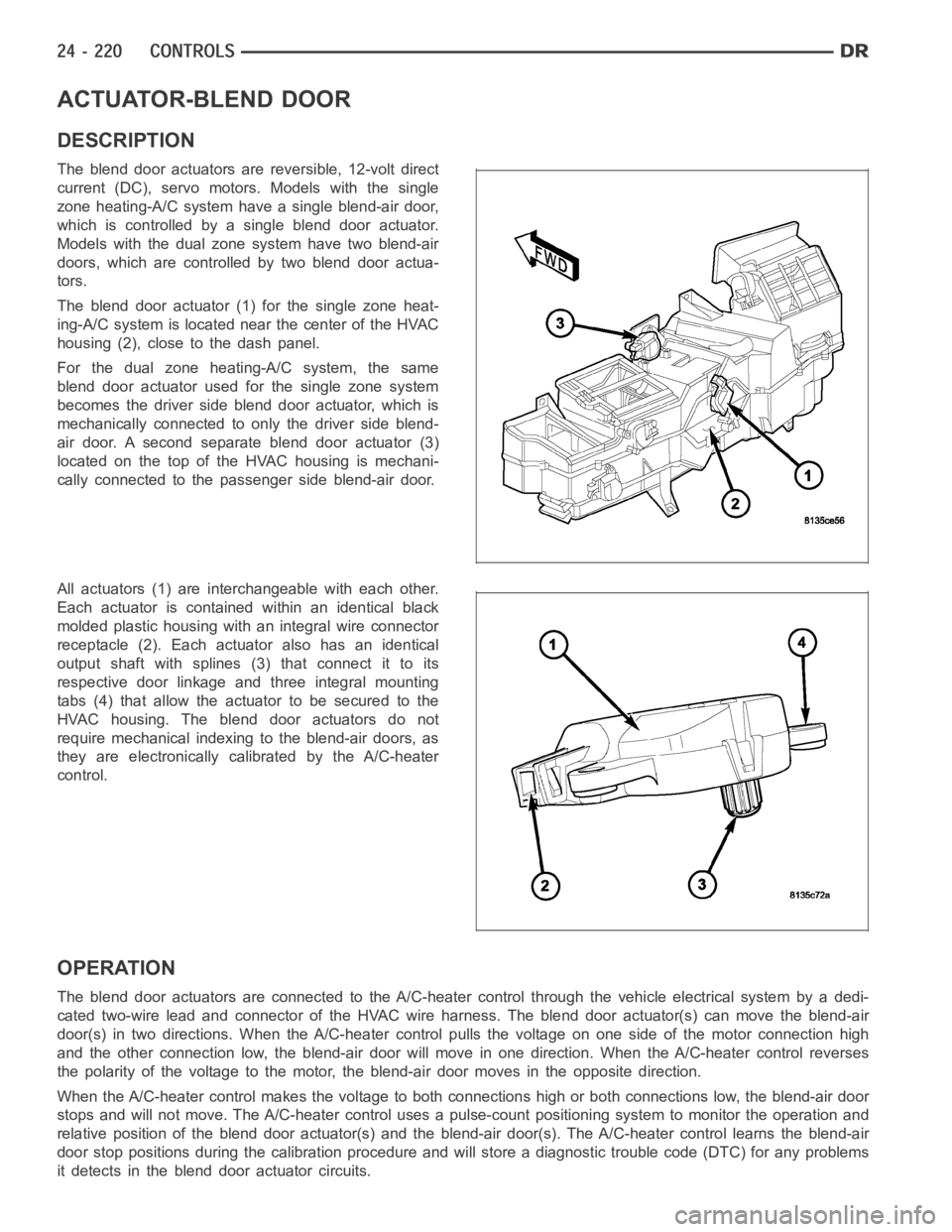
The blend door actuators are reversible, 12-volt direct
current (DC), servo motors. Models with the single
zone heating-A/C system have a single blend-air door,
which is controlled by a single blend door actuator.
Models with the dual zone system have two blend-air
doors, which are controlled by two blend door actua-
tors.
The blend door actuator (1) for the single zone heat-
ing-A/C system is located near the center of the HVAC
housing (2), close to the dash panel.
For the dual zone heating-A/C system, the same
blend door actuator used for the single zone system
becomes the driver side blend door actuator, which is
mechanically connected to only the driver side blend-
air door. A second separate blend door actuator (3)
located on the top of the HVAC housing is mechani-
cally connected to the passenger side blend-air door.
All actuators (1) are interchangeable with each other.
Each actuator is contained within an identical black
molded plastic housing with an integral wire connector
receptacle (2). Each actuator also has an identical
output shaft with splines (3) that connect it to its
respective door linkage and three integral mounting
tabs (4) that allow the actuator to be secured to the
HVAC housing. The blend door actuators do not
require mechanical indexing to the blend-air doors, as
they are electronically calibrated by the A/C-heater
control.
OPERATION
The blend door actuators are connected to the A/C-heater control through the vehicle electrical system by a dedi-
cated two-wire lead and connector of the HVAC wire harness. The blend door actuator(s) can move the blend-air
door(s) in two directions. When the A/C-heater control pulls the voltage on one side of the motor connection high
and the other connection low, the blend-air door will move in one direction. When the A/C-heater control reverses
the polarity of the voltage to the motor, the blend-air door moves in the opposite direction.
When the A/C-heater control makes the voltage to both connections high or both connections low, the blend-air door
stops and will not move. The A/C-heater control uses a pulse-count positioning system to monitor the operation and
relative position of the blend door actuator(s) and the blend-air door(s). The A/C-heater control learns the blend-air
door stop positions during the calibration procedure and will store a diagnostic trouble code (DTC) for any problems
it detects in the blend door actuator circuits.
Page 5062 of 5267
The blend door actuators are diagnosed using a scan tool (Refer to 24 - HEATING & AIR CONDITIONING - DIAG-
NOSIS AND TESTING and to 24 - HVAC Electrical Diagnostics for more information).
The blend door actuators cannot be adjusted or repaired and, if faulty or damaged, they must be replaced.
REMOVAL
WARNING: On vehicles equipped with airbags, disable the airbag system before attempting any steering
wheel, steering column, or instrument panel component diagnosis or service. Disconnect and isolate the
battery negative (ground) cable, then wait two minutes for the airbag system capacitor to discharge before
performing further diagnosis or service. This is the only sure way to disable the airbag system. Failure to
take the proper precautions could result in accidental airbag deploymentand possible personal injury or
death.
NOTE: The single zone heating-A/C system is equipped with a single blend door actuator. The dual zone
system has two blend door actuators, one for the driver side blend-air doorand one for the passenger side
blend-air door.
SINGLE ZONE/DUAL ZONE DRIVER SIDE
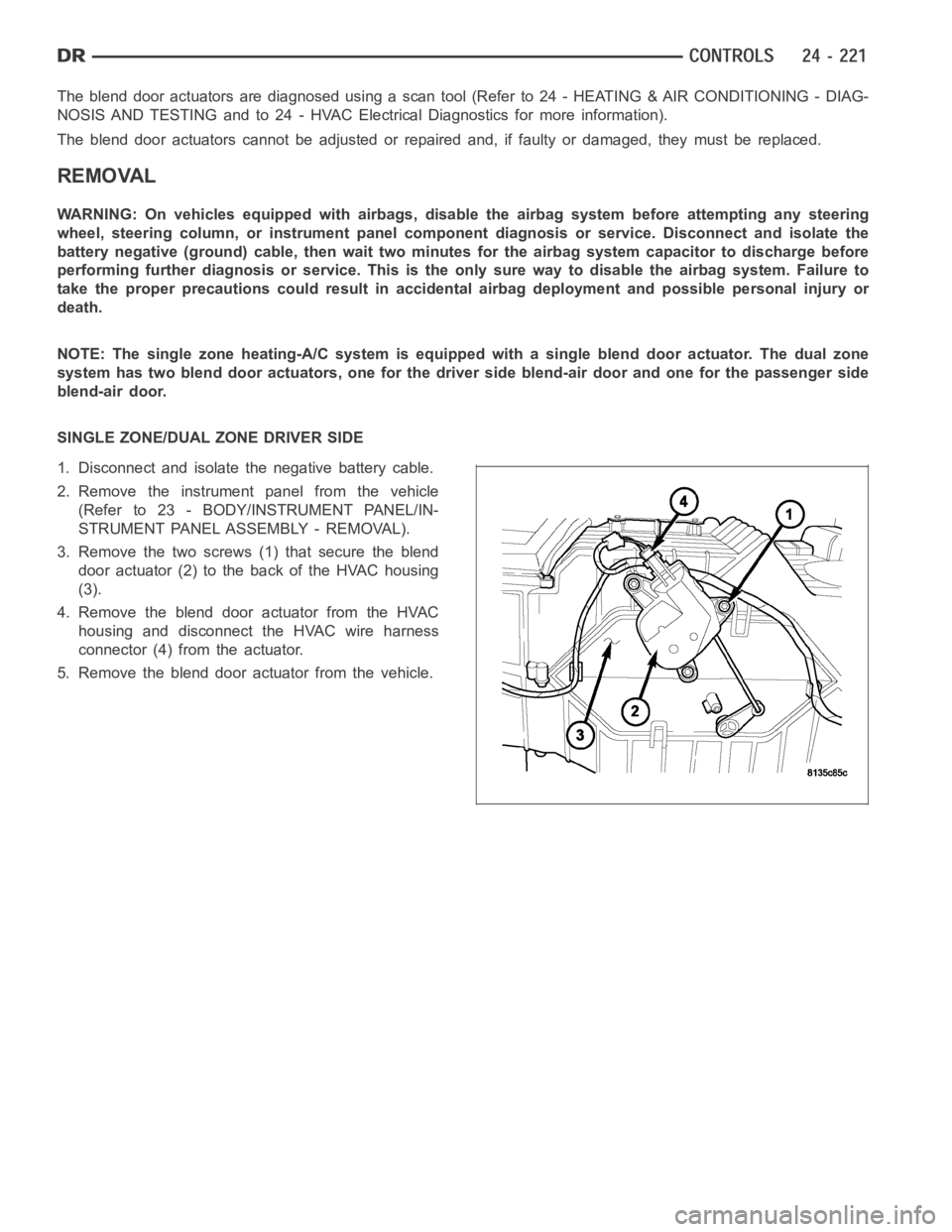
1. Disconnect and isolate the negative battery cable.
2. Remove the instrument panel from the vehicle
(Refer to 23 - BODY/INSTRUMENT PANEL/IN-
STRUMENT PANEL ASSEMBLY - REMOVAL).
3. Remove the two screws (1) that secure the blend
door actuator (2) to the back of the HVAC housing
(3).
4. Remove the blend door actuator from the HVAC
housing and disconnect the HVAC wire harness
connector (4) from the actuator.
5. Remove the blend door actuator from the vehicle.
Page 5063 of 5267
DUAL ZONE PASSENGER SIDE
1. Disconnect and isolate the negative battery cable.
2. Remove the instrument panel from the vehicle
(Refer to 23 - BODY/INSTRUMENT PANEL/IN-
STRUMENT PANEL ASSEMBLY - REMOVAL).
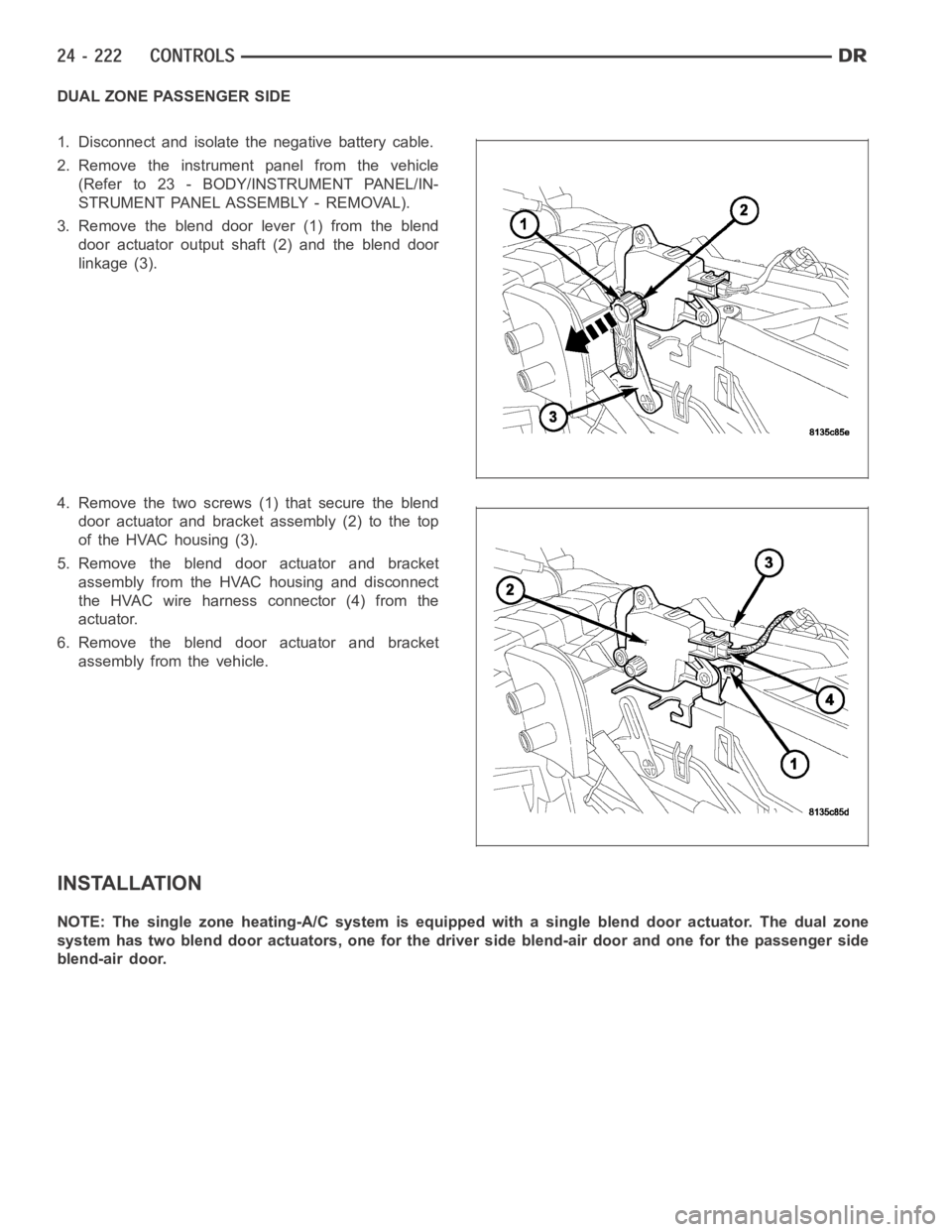
3. Remove the blend door lever (1) from the blend
door actuator output shaft (2) and the blend door
linkage (3).
4. Remove the two screws (1) that secure the blend
door actuator and bracket assembly (2) to the top
of the HVAC housing (3).
5. Remove the blend door actuator and bracket
assembly from the HVAC housing and disconnect
the HVAC wire harness connector (4) from the
actuator.
6. Remove the blend door actuator and bracket
assembly from the vehicle.
INSTALLATION
NOTE: The single zone heating-A/C system is equipped with a single blend door actuator. The dual zone
system has two blend door actuators, one for the driver side blend-air doorand one for the passenger side
blend-air door.
Page 5064 of 5267
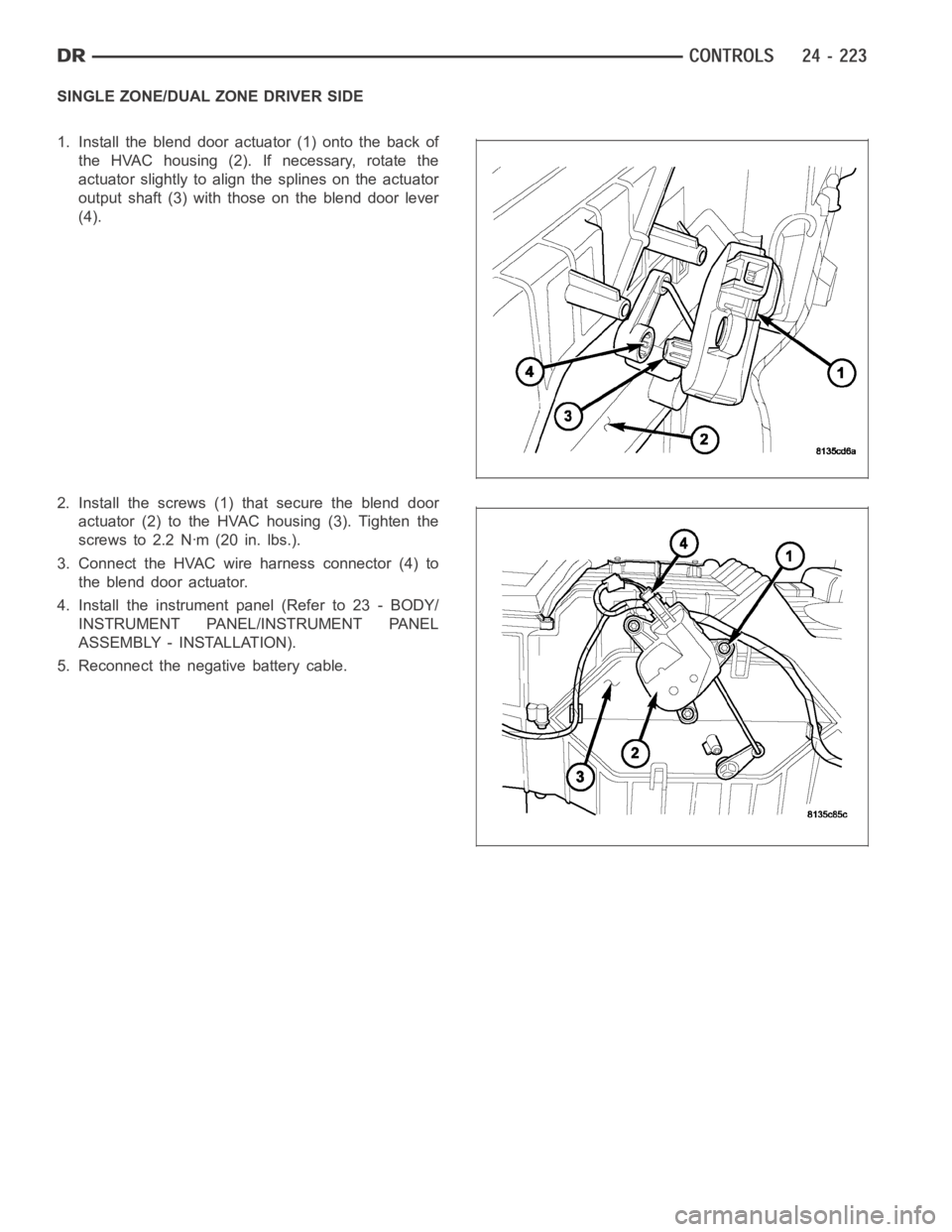
SINGLE ZONE/DUAL ZONE DRIVER SIDE
1. Install the blend door actuator (1) onto the back of
the HVAC housing (2). If necessary, rotate the
actuator slightly to align the splines on the actuator
output shaft (3) with those on the blend door lever
(4).
2. Install the screws (1) that secure the blend door
actuator (2) to the HVAC housing (3). Tighten the
screws to 2.2 Nꞏm (20 in. lbs.).
3. Connect the HVAC wire harness connector (4) to
the blend door actuator.
4. Install the instrument panel (Refer to 23 - BODY/
INSTRUMENT PANEL/INSTRUMENT PANEL
ASSEMBLY - INSTALLATION).
5. Reconnect the negative battery cable.
Page 5065 of 5267
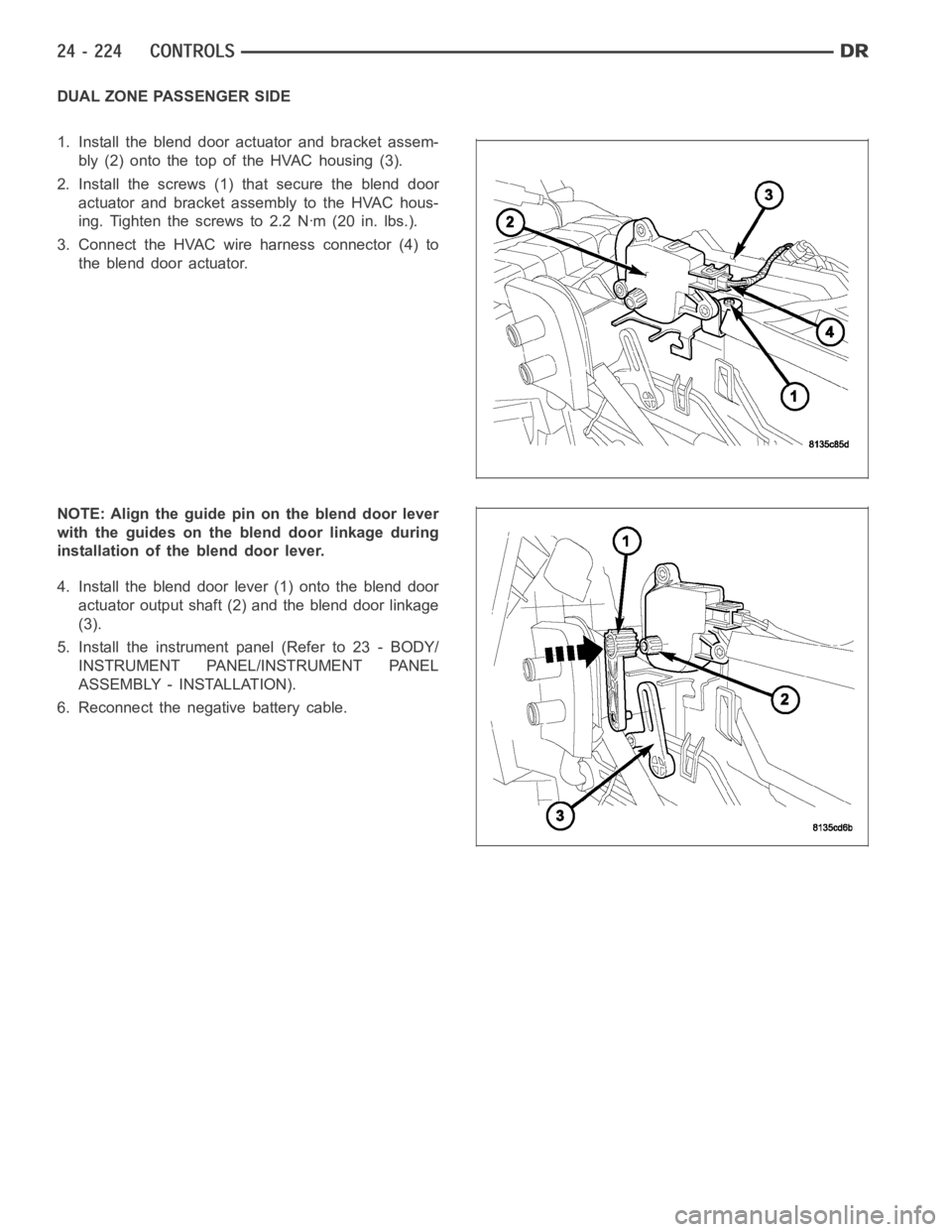
DUAL ZONE PASSENGER SIDE
1. Install the blend door actuator and bracket assem-
bly (2) onto the top of the HVAC housing (3).
2. Install the screws (1) that secure the blend door
actuator and bracket assembly to the HVAC hous-
ing. Tighten the screws to 2.2 Nꞏm (20 in. lbs.).
3. Connect the HVAC wire harness connector (4) to
the blend door actuator.
NOTE: Align the guide pin on the blend door lever
with the guides on the blend door linkage during
installation of the blend door lever.
4. Install the blend door lever (1) onto the blend door
actuator output shaft (2) and the blend door linkage
(3).
5. Install the instrument panel (Refer to 23 - BODY/
INSTRUMENT PANEL/INSTRUMENT PANEL
ASSEMBLY - INSTALLATION).
6. Reconnect the negative battery cable.
Page 5066 of 5267
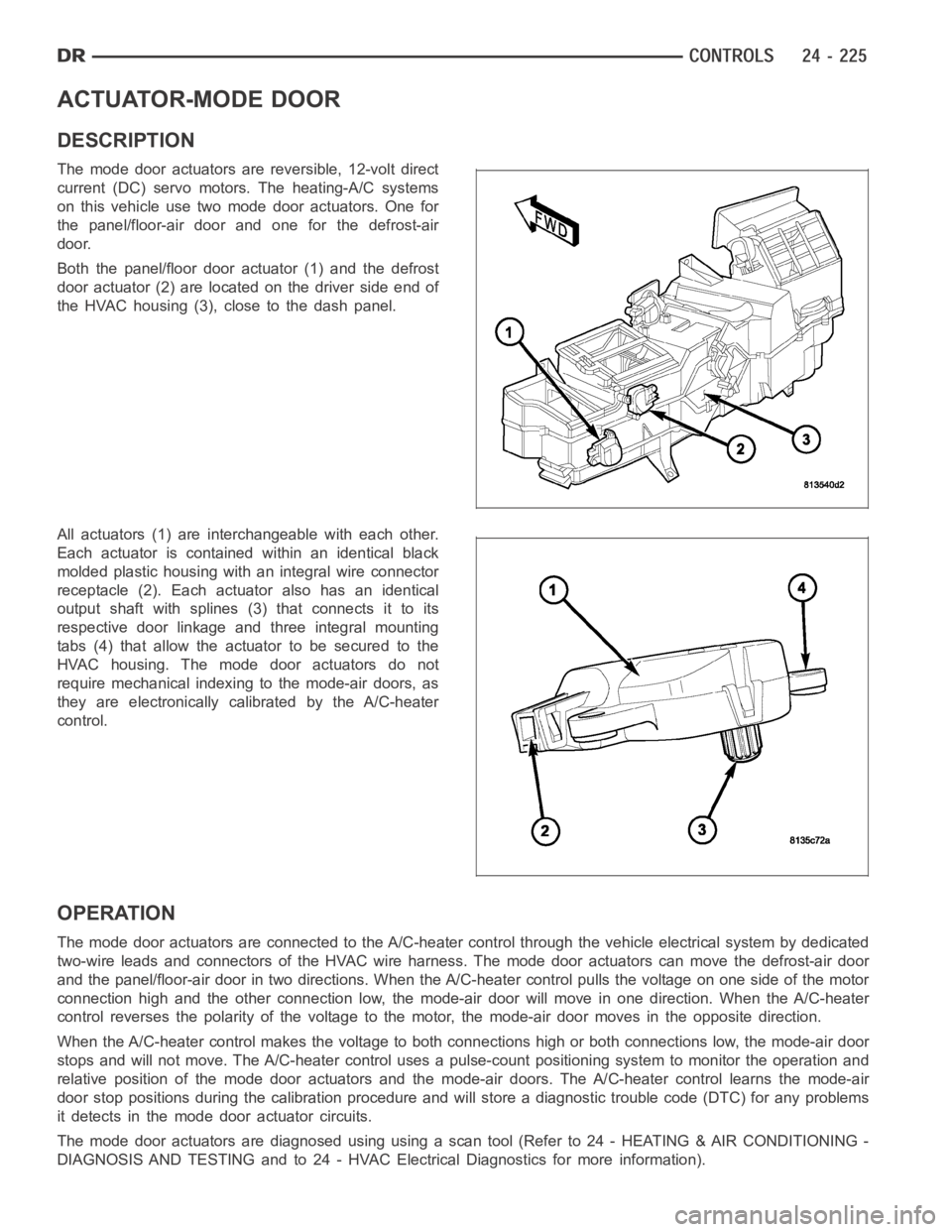
ACTUATOR-MODE DOOR
DESCRIPTION
The mode door actuators are reversible, 12-volt direct
current (DC) servo motors.The heating-A/C systems
on this vehicle use two mode door actuators. One for
the panel/floor-air door and one for the defrost-air
door.
Both the panel/floor door actuator (1) and the defrost
door actuator (2) are located on the driver side end of
the HVAC housing (3), close to the dash panel.
All actuators (1) are interchangeable with each other.
Each actuator is contained within an identical black
molded plastic housing with an integral wire connector
receptacle (2). Each actuator also has an identical
output shaft with splines (3) that connects it to its
respective door linkage and three integral mounting
tabs (4) that allow the actuator to be secured to the
HVAC housing. The mode door actuators do not
require mechanical indexing to the mode-air doors, as
they are electronically calibrated by the A/C-heater
control.
OPERATION
The mode door actuators are connectedto the A/C-heater control through the vehicle electrical system by dedicated
two-wire leads and connectors of the HVAC wire harness. The mode door actuators can move the defrost-air door
and the panel/floor-air door in two directions. When the A/C-heater control pulls the voltage on one side of the motor
connection high and the other connection low, the mode-air door will move in one direction. When the A/C-heater
control reverses the polarity of the voltage to the motor, the mode-air door moves in the opposite direction.
When the A/C-heater control makes the voltage to both connections high or both connections low, the mode-air door
stops and will not move. The A/C-heater control uses a pulse-count positioning system to monitor the operation and
relative position of the mode door actuators and the mode-air doors. The A/C-heater control learns the mode-air
door stop positions during the calibration procedure and will store a diagnostic trouble code (DTC) for any problems
it detects in the mode door actuator circuits.
The mode door actuators are diagnosed using using a scan tool (Refer to 24 - HEATING & AIR CONDITIONING -
DIAGNOSIS AND TESTING and to 24 - HVAC Electrical Diagnostics for more information).
Page 5067 of 5267
The mode door actuators cannot be adjusted or repaired and, if faulty or damaged, they must be replaced.
REMOVAL
WARNING: On vehicles equipped with airbags, disable the airbag system before attempting any steering
wheel, steering column, or instrument panel component diagnosis or service. Disconnect and isolate the
battery negative (ground) cable, then wait two minutes for the airbag system capacitor to discharge before
performing further diagnosis or service. This is the only sure way to disable the airbag system. Failure to
take the proper precautions could result in an accidental airbag deployment and possible personal injury or
death.
NOTE: The heating-A/C system is equipped with two mode door actuators, onefor the panel/floor-air door
and one for the defrost-air door.
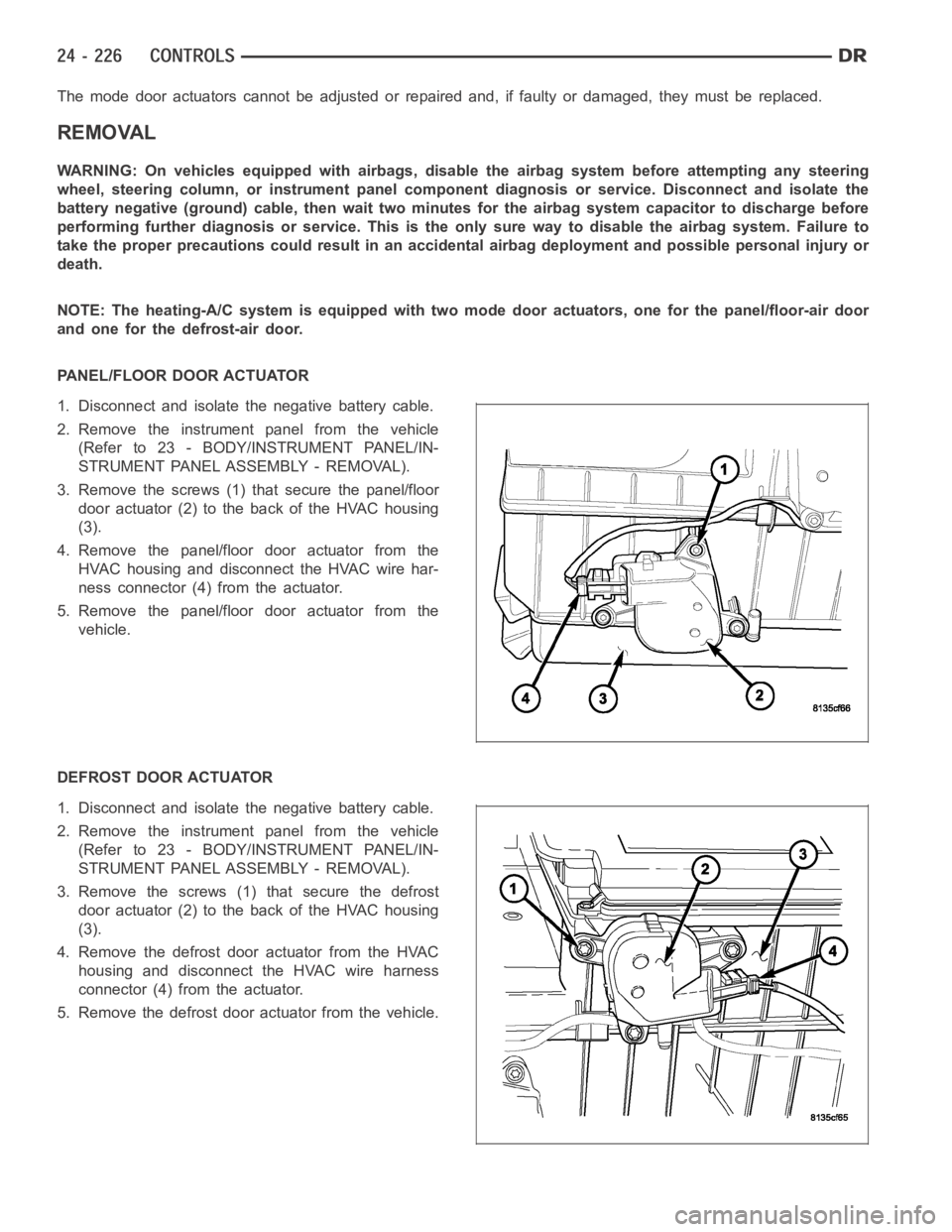
PANEL/FLOOR DOOR ACTUATOR
1. Disconnect and isolate the negative battery cable.
2. Remove the instrument panel from the vehicle
(Refer to 23 - BODY/INSTRUMENT PANEL/IN-
STRUMENT PANEL ASSEMBLY - REMOVAL).
3. Remove the screws (1) that secure the panel/floor
door actuator (2) to the back of the HVAC housing
(3).
4. Remove the panel/floor door actuator from the
HVAC housing and disconnect the HVAC wire har-
ness connector (4) from the actuator.
5. Remove the panel/floor door actuator from the
vehicle.
DEFROST DOOR ACTUATOR
1. Disconnect and isolate the negative battery cable.
2. Remove the instrument panel from the vehicle
(Refer to 23 - BODY/INSTRUMENT PANEL/IN-
STRUMENT PANEL ASSEMBLY - REMOVAL).
3. Remove the screws (1) that secure the defrost
door actuator (2) to the back of the HVAC housing
(3).
4. Remove the defrost door actuator from the HVAC
housing and disconnect the HVAC wire harness
connector (4) from the actuator.
5. Remove the defrost door actuator from the vehicle.
Page 5068 of 5267
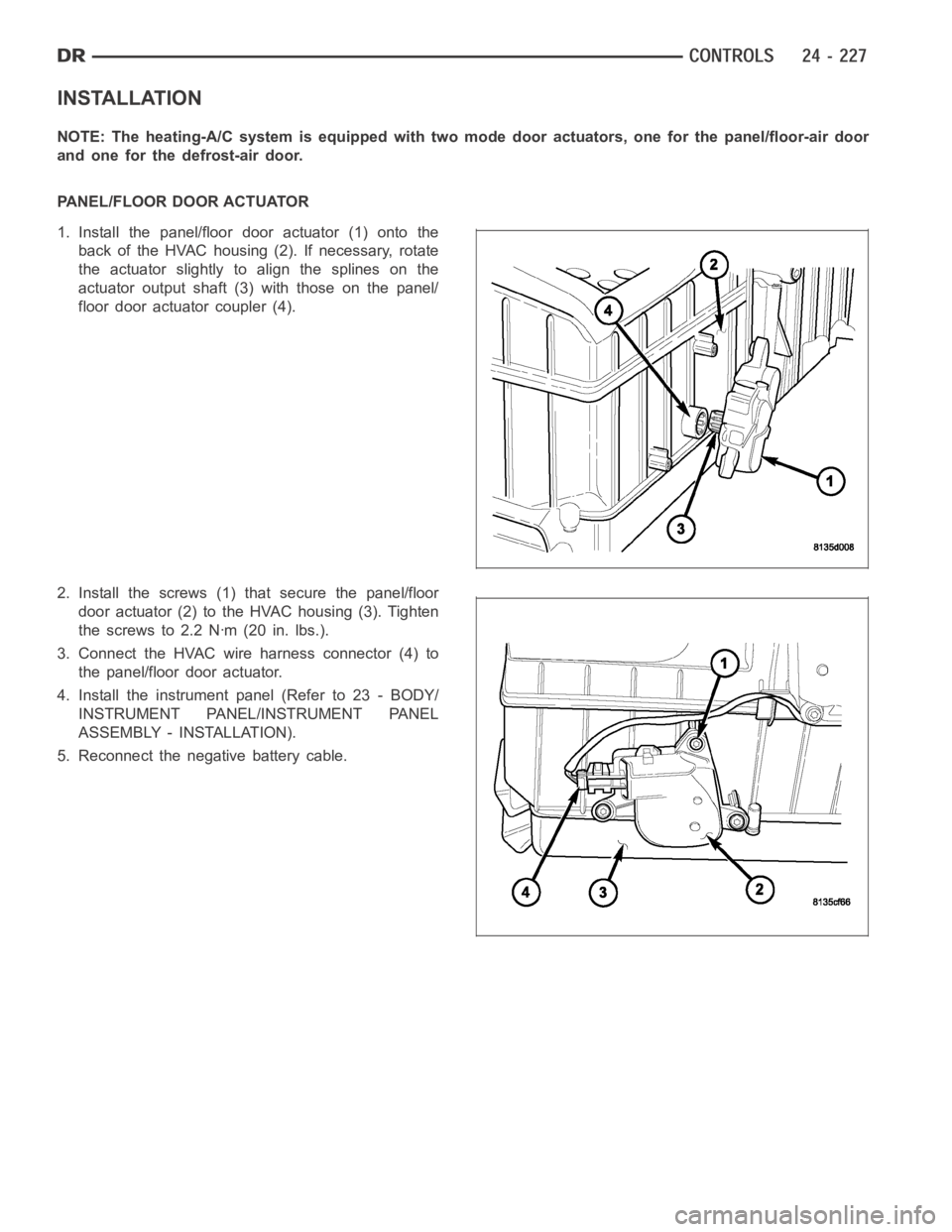
INSTALLATION
NOTE: The heating-A/C system is equipped with two mode door actuators, onefor the panel/floor-air door
and one for the defrost-air door.
PANEL/FLOOR DOOR ACTUATOR
1. Install the panel/floor door actuator (1) onto the
back of the HVAC housing (2). If necessary, rotate
the actuator slightly to align the splines on the
actuator output shaft (3) with those on the panel/
floor door actuator coupler (4).
2. Install the screws (1) that secure the panel/floor
door actuator (2) to the HVAC housing (3). Tighten
the screws to 2.2 Nꞏm (20 in. lbs.).
3. Connect the HVAC wire harness connector (4) to
the panel/floor door actuator.
4. Install the instrument panel (Refer to 23 - BODY/
INSTRUMENT PANEL/INSTRUMENT PANEL
ASSEMBLY - INSTALLATION).
5. Reconnect the negative battery cable.
Page 5069 of 5267
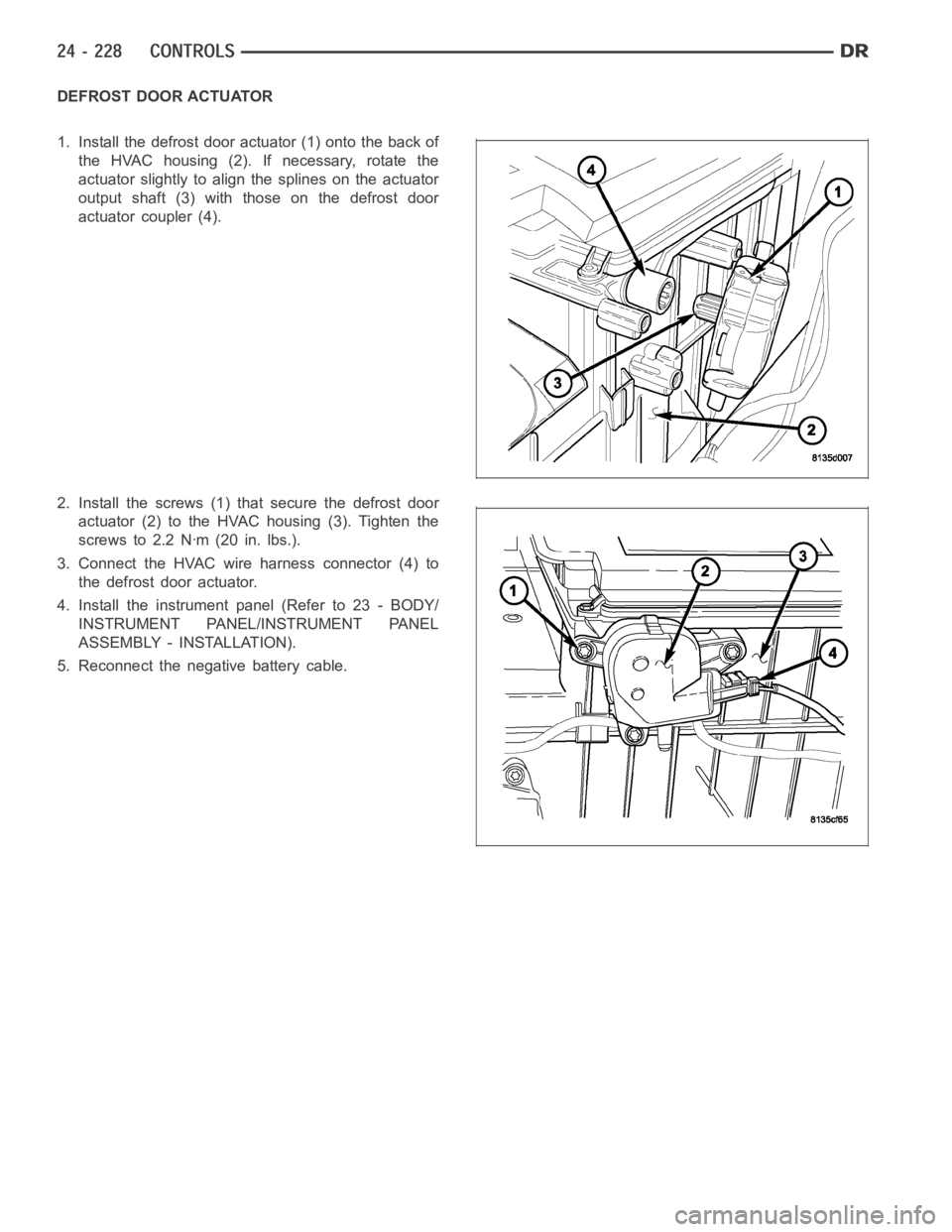
DEFROST DOOR ACTUATOR
1. Install the defrost door actuator (1) onto the back of
the HVAC housing (2). If necessary, rotate the
actuator slightly to align the splines on the actuator
output shaft (3) with those on the defrost door
actuator coupler (4).
2. Install the screws (1) that secure the defrost door
actuator (2) to the HVAC housing (3). Tighten the
screws to 2.2 Nꞏm (20 in. lbs.).
3. Connect the HVAC wire harness connector (4) to
the defrost door actuator.
4. Install the instrument panel (Refer to 23 - BODY/
INSTRUMENT PANEL/INSTRUMENT PANEL
ASSEMBLY - INSTALLATION).
5. Reconnect the negative battery cable.