torque DODGE RAM SRT-10 2006 Service Repair Manual
[x] Cancel search | Manufacturer: DODGE, Model Year: 2006, Model line: RAM SRT-10, Model: DODGE RAM SRT-10 2006Pages: 5267, PDF Size: 68.7 MB
Page 3225 of 5267
When Monitored:
Continuously while driving in a forward gear.
Set Condition:
The PCM continuously monitors Actual Line Pressure. If the Actual Line Pressure reading is greater than the
highest Desired Line Pressure ever used in the current gear, while the Pressure Control Solenoid duty cycle is
at or near its maximum value (which should result in minimum line pressure), the DTC will set.
Possible Causes
(F856) 5-VOLT SUPPLY CIRCUIT OPEN
LINE PRESSURE SENSOR CONNECTION
(T118) PRESSURE CONTROL SOLENOID CONTROL CIRCUIT OPEN
(F856) 5-VOLT SUPPLY CIRCUIT SHORT TO GROUND
(T118) PRESSURE CONTROL SOLENOID CONTROL CIRCUIT SHORT TO GROUND
TRANSMISSION CONTROL RELAY OUTPUT CIRCUIT
LINE PRESSURE SENSOR
STUCK OR STICKING MAIN REGULATOR VALVE
POWERTRAIN CONTROL MODULE
Always perform the 45RFE/545RFE Pre-Diagnostic Troubleshooting Procedure before proceeding. (Refer to
21 - TRANSMISSION/TRANSAXLE/AUTOMATIC - 45RFE/545RFE - STANDARD PROCEDURE)
Theory of Operation
Line pressure is measured by the Line Pressure Sensor (LPS) and regulationis achieved by changing the duty
cycle of the Pressure Control Solenoid (PCS) controlled by the Transmission Control System. (5% duty cycle =
solenoid off = Max line pressure, 62%duty cycle = solenoid on = Min line pressure). The Transmission Control
System calculates the desired line pressure based on inputs from both the engine and transmission.
The Transmission Control System calculates torque input to the transmission and uses it as the primary input to the
desired line pressure calculation. This is called Torque Based Line Pressure. In addition, the line pressure is set to
a preset level 827 or 931 kPa (120 or 135 psi) during shifts and in Park and Neutral to ensure consistent shift
quality. The desired line pressure is continuously being compared to the actual line pressure. If the actual line pres-
sure is consistently higher than the highest desired line pressure ever used in the current gear, the line pressure
high DTC P0869 will set.
Diagnostic Test
1.CHECKFORRELATEDDTC’S
With the scan tool, check for other Transmission DTC’s
Is the DTC P0932 or P0882 present also?
Ye s>>
Refer to the Transmission category and perform the appropriate symptom.
No>>
Go To 2
2.CHECK IF THE DTC IS CURRENT
With the scan tool, check the STARTS SINCE SET counter for P0869.
Is the STARTS SINCE SET COUNTER 2 or less?
Ye s>>
Go To 3
No>>
Go To 10
Page 3277 of 5267
When Monitored:
Continuously with the ignition on, engine running, with the transmissionin gear.
Set Condition:
The PCM continuously monitors Actual Line Pressure and compares it to DesiredLinePressure.IftheActual
Line Pressure reading is more than 172.4 kPa (25 psi) higher than the Desired Line Pressure, but is less than
the highest Line Pressure ever used in the current gear, the DTC sets.
Possible Causes
RELATED DTC’S PRESENT
LINE PRESSURE CONNECTOR AND WIRING
INTERNAL TRANSMISSION
POWERTRAIN CONTROL MODULE
Always perform the 45RFE/545RFE Pre-Diagnostic Troubleshooting Procedure before proceeding. (Refer to
21 - TRANSMISSION/TRANSAXLE/AUTOMATIC - 45RFE/545RFE - STANDARD PROCEDURE)
Theory of Operation
Line pressure is electronically controlled by the Transmission Control System and is measured by the Line Pressure
Sensor (LPS). The desired line pressure is continuously being compared tothe actual line pressure and is regulated
by electronically changing the dutycycle of the Pressure Control Solenoid (PCS). (5% duty cycle = solenoid off =
max line pressure, 62% duty cycle =solenoid on = min line pressure).
The Transmission Control System calculates the desired line pressure based on inputs from the transmission and
engine. A calculated torque input to the transmission is used as the primary input of the desired line pressure cal-
culation and is called Torque Based Line Pressure. In addition, the line pressure is set to a preset level 827 to 931
kPa (120 to 135 psi) during shifts and in Park and Neutral to ensure consistent shift quality.
Diagnostic Test
1.DETERMINING IF RELATED DTCS ARE PRESENT
With the scan tool, check for other transmission DTCs.
Are there any other line pressure related DTCs present?
Ye s>>
Refer to the Transmission category and perform the appropriate symptom. Perform the test for P0934
and/or P0935 first if present.
No>>
Go To 2
2.COMPARE ACTUAL LINE PRESSURE TO DESIRED LINE PRESSURE
CAUTION: Apply Parking Brake
Start the engine.
CAUTION: Firmly apply the brakes.
With the scan tool, monitor the Line Pressure, Desired Line Pressure and the TPS degrees.
While firmly applying the brakes, place the shifter in reverse, then slowly press the accelerator pedal to a TPS
degree of 15°.
Compare the Line Pressure reading to the Desired Line Pressure reading on the scan tool.
Does the Line Pressure stay within ± 34 kPa or 5 psi of the Desired Line Pressure?
No>>
Go To 3
Ye s>>
Go To 5
Page 3280 of 5267
When Monitored:
Continuously with the ignition on and engine running.
Set Condition:
This DTC will set when the monitored Line Pressure Sensor voltage is less than or equal to 0.35 volts for 0.18
seconds.
Possible Causes
(F856) 5-VOLT SUPPLY CIRCUIT OPEN
(F856) 5-VOLT SUPPLY CIRCUIT SHORT TO GROUND
(T38) LINE PRESSURE SENSOR SIGNAL CIRCUIT SHORT TO GROUND
LINE PRESSURE SENSOR
POWERTRAIN CONTROL MODULE
Always perform the 45RFE/545RFE Pre-Diagnostic Troubleshooting Procedure before proceeding. (Refer to
21 - TRANSMISSION/TRANSAXLE/AUTOMATIC - 45RFE/545RFE - STANDARD PROCEDURE)
Theory of Operation
Line pressure is electronically controlled by the Transmission Control System and is measured by the Line Pressure
Sensor (LPS). The desired line pressure is continuously being compared tothe actual line pressure and is regulated
by electronically changing the dutycycle of the Pressure Control Solenoid (PCS). (5% duty cycle = solenoid off =
max line pressure, 62% duty cycle =solenoid on = min line pressure).
The Transmission Control System calculates the desired line pressure based on inputs from the transmission and
engine. A calculated torque input to the transmission is used as the primary input of the desired line pressure cal-
culation and is called Torque Based Line Pressure. In addition, the line pressure is set to a preset level 827 to 931
kPa (120 to 135 psi) during shifts and in Park and Neutral to ensure consistent shift quality.
The monitored Line Pressure Sensor voltage should always be between 0.35 and 4.75 volts. Any monitored volt-
ages outside these parameters indicate an Line Pressure Sensor or wiring problem and will cause either DTC
P0934 or P0935 to set.
Diagnostic Test
1.CHECK IF DTC IS CURRENT
With the scan tool, check the STARTS SINCE SET counter for P0934.
NOTE: This counter only applies to the last DTC set.
Is the STARTS SINCE SET counter 2 or less?
Ye s>>
Go To 2
No>>
Go To 6
2.CHECK THE PCM AND WIRING
Turn the ignition off to the lock position.
Remove the Ignition Switch Feed fuse from the TIPM.
CAUTION: Removal of the Ignition Switch Feed fuse from the TIPM will prevent the vehicle from being
startedingear.
WARNING: The Ignition Switch Feed fuse must be removed from the TIPM. Failure to do so can result in
personal injury or death.
Install the Transmission Simulator, Miller tool #8333.
Ignition on, engine not running.
With the scan tool, under Transmission Sensors, monitor the Line Pressure.
Using the Transmission Simulator, set the rotary switch to each of the 3 line pressure positions.
Page 3285 of 5267
When Monitored:
Continuously with ignition on and engine running.
Set Condition:
This DTC will set if the monitored Line Pressure Sensor voltage is greater than or equal to 4.75 volts for the
period of 0.18 seconds
Possible Causes
(T38) LINE PRESSURE SENSOR SIGNAL CIRCUIT OPEN
(K900) SENSOR GROUND CIRCUIT OPEN
(T38) LINE PRESSURE SENSOR SIGNAL CIRCUIT SHORT TO VOLTAGE
LINE PRESSURE SENSOR
POWERTRAIN CONTROL MODULE
Always perform the 45RFE/545RFE Pre-Diagnostic Troubleshooting Procedure before proceeding. (Refer to
21 - TRANSMISSION/TRANSAXLE/AUTOMATIC - 45RFE/545RFE - STANDARD PROCEDURE)
Theory of Operation
Line pressure is electronically controlled by the Transmission Control System and is measured by the Line Pressure
Sensor (LPS). The desired line pressure is continuously being compared tothe actual line pressure and is regulated
by electronically changing the dutycycle of the Pressure Control Solenoid (PCS). (5% duty cycle = solenoid off =
max line pressure, 62% duty cycle =solenoid on = min line pressure).
The Transmission Control System calculates the desired line pressure based on inputs from the transmission and
engine. A calculated torque input to the transmission is used as the primary input of the desired line pressure cal-
culation and is called Torque Based Line Pressure. In addition, the line pressure is set to a preset level 827 to 931
kPa (120 to 135 psi) during shifts and in Park and Neutral to ensure consistent shift quality.
The monitored Line Pressure Sensor voltage should always be between 0.35 and 4.75 volts. Any monitored volt-
ages outside these parameters indicate an Line Pressure Sensor or wiring problem and will cause either DTC
P0934 or P0935 to set.
Diagnostic Test
1.CHECK TO SEE IF DTC IS CURRENT
With the scan tool, Check the STARTS SINCE SET counter for P0935.
NOTE: This counter only applies to the last DTC set.
Is the STARTS SINCE SET counter 2 or less?
Ye s>>
Go To 2
No>>
Go To 6
2.CHECK THE PCM AND WIRING
Turn the ignition off to the lock position.
Remove the Ignition Switch Feed fuse from the TIPM.
CAUTION: Removal of the Ignition Switch Feed fuse from the TIPM will prevent the vehicle from being
startedingear.
WARNING: The Ignition Switch Feed fuse must be removed from the TIPM. Failure to do so can result in
personal injury or death.
Install the Transmission Simulator, Miller tool #8333.
Ignition on, engine not running.
With the scan tool, monitor the Line Pressure.
Using the Transmission Simulator, set the rotary switch to each of the 3 line pressure positions.
Page 3327 of 5267

When Monitored:
During an attempted shift into 1st gear.
Set Condition:
This DTC is set if three unsuccessful attempts are made to shift the SolenoidSwitchValve(SSV)intothe
downshiftedpositioninonegivenignitionstart.ThisDTCcantakeuptofive minutes to mature before illumi-
nating the MIL.
Possible Causes
RELATED DTC P0841 PRESENT
SOLENOID SWITCH VALVE STICKING
L/R PRESSURE SWITCH SENSE CIRCUIT SHORT TO OTHER CIRCUITS
TRANSMISSION SOLENOID/TRS ASSEMBLY
POWERTRAIN CONTROL MODULE
Always perform the 45RFE/545RFE Pre-Diagnostic Troubleshooting Procedure before proceeding. (Refer to
21 - TRANSMISSION/TRANSAXLE/AUTOMATIC - 45RFE/545RFE - STANDARD PROCEDURE)
Theory of Operation
The Solenoid Switch Valve (SSV) controls the direction of the transmission fluid when the L/R Solenoid is energized.
The SSV will be in the downshifted position in 1st gear, thus directing the fluid to the L/R clutch circuit. In 2nd
through 5th gears, it will be in the upshifted position and directing the fluid into the torque converter clutch (TCC).
When shifting into 1st gear, a special hydraulic sequence is performed to ensure SSV movement into the down-
shifted position. The L/R Pressure Switch is monitored to confirm SSV movement. If movement is not confirmed (the
L/R pressure switch does not close), EMCC is inhibited until SSV operationis confirmed.
Diagnostic Test
1.DETERMINING IF RELATED DTC’S ARE PRESENT
With the scan tool, check for other transmission DTC’s
Is the DTC P0841 present also?
Ye s>>
Refer to the Transmission category and perform the appropriate symptom.
No>>
Go To 2
2.CHECK IF THE DTC IS CURRENT
Perform a visual inspection of all connectors, wiring, and cooler connections before proceeding. Repair as neces-
sary.
With the scan tool, Check the STARTS SINCE SET counter.
NOTE: This counter only applies to the last DTC set.
Is the STARTS SINCE SET counter for P1775 at 2 or less?
Ye s>>
Go To 3
No>>
Go To 6
Page 3331 of 5267
When Monitored:
Continuously when performing partial or full EMCC - PEMCC or FEMCC.
Set Condition:
If the transmission senses the L/R pressure switch closing while performing PEMCC or FEMCC. This DTC will
set after two unsuccessful attempts toperform PEMCC or FEMCC. This DTC cantake up to five minutes of
problem identification before illuminating the MIL.
Possible Causes
RELATED DTC P0841 PRESENT
LR PRESSURE SWITCH SENSE CIRCUIT OPEN
LR PRESSURE SWITCH SENSE CIRCUIT SHORT TO GROUND
SOLENOID SWITCH VALVE
POWERTRAIN CONTROL MODULE
INTERMITTENT WIRING AND CONNECTORS
Always perform the 45RFE/545RFE Pre-Diagnostic Troubleshooting Procedure before proceeding. (Refer to
21 - TRANSMISSION/TRANSAXLE/AUTOMATIC - 45RFE/545RFE - STANDARD PROCEDURE)
Theory of Operation
The Solenoid Switch Valve (SSV) controls the direction of the transmission fluid when the L/R Solenoid is energized.
The SSV will be in the downshifted position in 1st gear, thus directing the fluid to the L/R clutch circuit. In 2nd
through 5th gears, it will be in the upshifted position and directing the fluid into the torque converter clutch (TCC).
When in 2nd, 2nd Prime, 3rd, 4th, or 5th gear, the Torque Converter Clutch (TCC) can be engaged when certain
conditions are met. The TCC piston is electronically modulated by increasing the duty cycle of the L/R solenoid until
the torque converter slip difference (difference between engine and transmission input speed) is within 60 RPM.
Then the L/R solenoid isfully energized (FEMCC - 100% duty cycle). Torque converter slip is monitored in FEMCC
to ensure adequate clutch capacity.
Diagnostic Test
1.CHECKFORRELATEDDTCS
With the scan tool, check for other transmission DTCs.
Is the DTC P0841 present also?
Ye s>>
Refer to the Transmission category and perform the appropriate symptom.
No>>
Go To 2
2.CHECK TO SEE IF DTC P1776 IS CURRENT
With the scan tool, Check the STARTS SINCE SET counter.
NOTE: NOTE: This counter only applies to the last DTC set.
Is the STARTS SINCE SET counter 2 or less?
Ye s>>
Go To 3
No>>
Go To 7
Page 3364 of 5267
INSTALLATION .............................. 954
GEARTRAIN-PLANETARY
DESCRIPTION ............................... 955
OPERATION ................................. 956
DISASSEMBLY .............................. 957
CLEANING .................................. 957
INSPECTION ................................ 957
ASSEMBLY .................................. 958
MECHANISM-SHIFT
DESCRIPTION ............................... 959
OPERATION ................................. 959
VALVE-SOLENOID SWITCH
DESCRIPTION ............................... 960
OPERATION ................................. 960
CONVERTER-TORQUE
DESCRIPTION ............................... 961
OPERATION ................................. 964
REMOVAL ................................... 966
INSTALLATION .............................. 967
RELAY-TRANSMISSION CONTROL
DESCRIPTION ............................... 968OPERATION ................................. 968
SENSOR-TRANSMISSION RANGE
DESCRIPTION ............................... 969
OPERATION ................................. 969
ASSEMBLY-TRANSMISSION SOLENOID/TRS
DESCRIPTION ............................... 970
OPERATION ................................. 970
REMOVAL ................................... 971
INSTALLATION .............................. 972
SENSOR-TRANSMISSION TEMPERATURE
DESCRIPTION ............................... 973
OPERATION ................................. 973
BODY-VALVE
DESCRIPTION ............................... 974
OPERATION ................................. 975
REMOVAL ................................... 976
DISASSEMBLY .............................. 977
CLEANING .................................. 980
INSPECTION . . .............................. 981
ASSEMBLY .................................. 983
INSTALLATION .............................. 986
Page 3366 of 5267
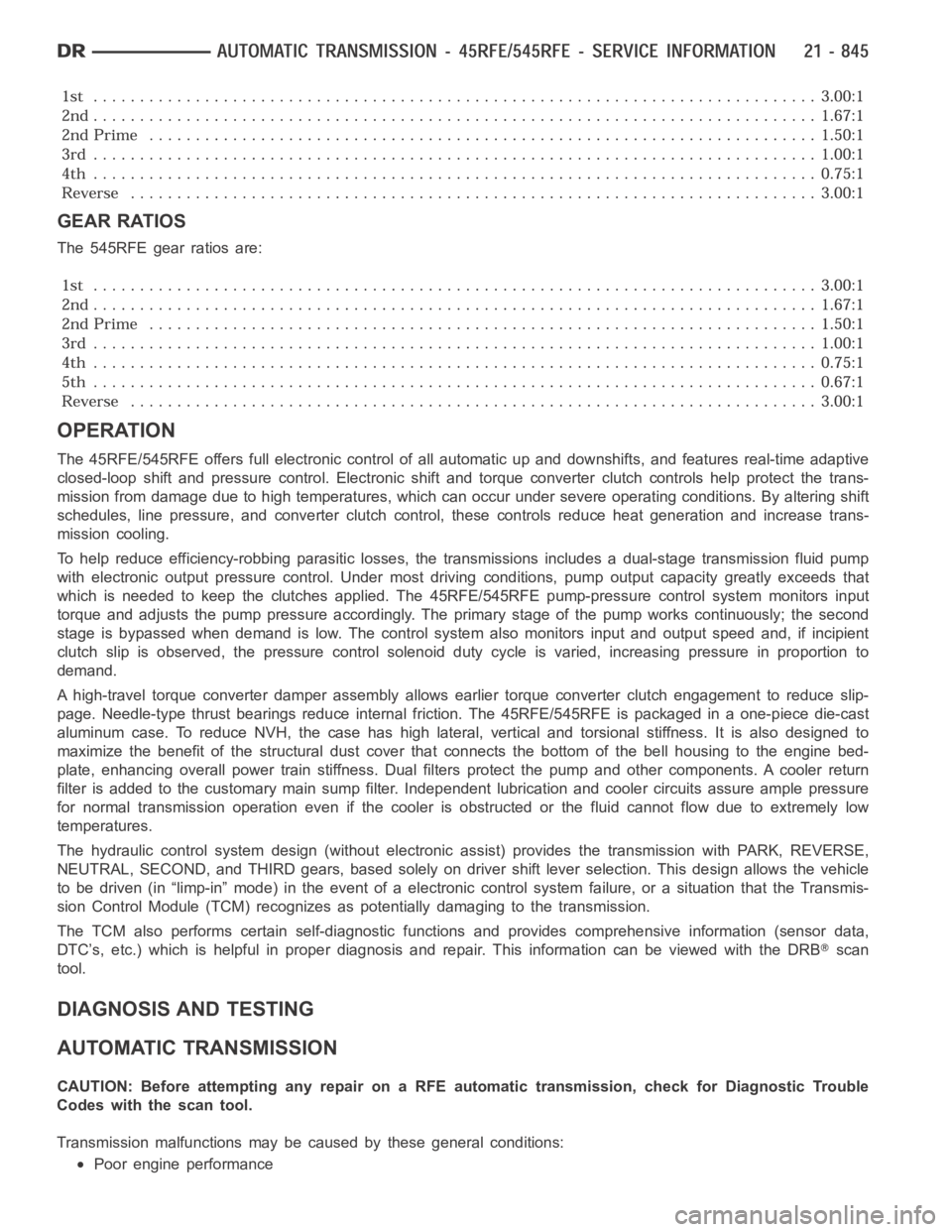
GEAR RATIOS
The 545RFE gear ratios are:
OPERATION
The 45RFE/545RFE offers full electronic control of all automatic up and downshifts, and features real-time adaptive
closed-loop shift and pressure control. Electronic shift and torque converter clutch controls help protect the trans-
mission from damage due to high temperatures, which can occur under severeoperating conditions. By altering shift
schedules, line pressure, and converter clutch control, these controls reduce heat generation and increase trans-
mission cooling.
To help reduce efficiency-robbing parasitic losses, the transmissions includes a dual-stage transmission fluid pump
with electronic output pressure control. Under most driving conditions,pump output capacity greatly exceeds that
which is needed to keep the clutches applied. The 45RFE/545RFE pump-pressure control system monitors input
torque and adjusts the pump pressure accordingly. The primary stage of thepump works continuously; the second
stage is bypassed when demand is low. The control system also monitors input and output speed and, if incipient
clutch slip is observed, the pressure control solenoid duty cycle is varied, increasing pressure in proportion to
demand.
A high-travel torque converter damper assembly allows earlier torque converter clutch engagement to reduce slip-
page. Needle-type thrust bearings reduce internal friction. The 45RFE/545RFE is packaged in a one-piece die-cast
aluminum case. To reduce NVH, the case has high lateral, vertical and torsional stiffness. It is also designed to
maximize the benefit of the structural dust cover that connects the bottomof the bell housing to the engine bed-
plate, enhancing overall power train stiffness. Dual filters protect thepump and other components. A cooler return
filter is added to the customary main sump filter. Independent lubrication and cooler circuits assure ample pressure
for normal transmission operation even if the cooler is obstructed or the fluid cannot flow due to extremely low
temperatures.
The hydraulic control system design (without electronic assist) provides the transmission with PARK, REVERSE,
NEUTRAL, SECOND, and THIRD gears, based solely on driver shift lever selection. This design allows the vehicle
to be driven (in “limp-in” mode) in the event of a electronic control systemfailure, or a situation that the Transmis-
sion Control Module (TCM) recognizes as potentially damaging to the transmission.
The TCM also performs certain self-diagnostic functions and provides comprehensive information (sensor data,
DTC’s, etc.) which is helpful in proper diagnosis and repair. This information can be viewed with the DRB
scan
tool.
DIAGNOSIS AND TESTING
AUTOMATIC TRANSMISSION
CAUTION: Before attempting any repair on a RFE automatic transmission, check for Diagnostic Trouble
Codes with the scan tool.
Transmission malfunctions may be caused by these general conditions:
Poor engine performance
Page 3369 of 5267
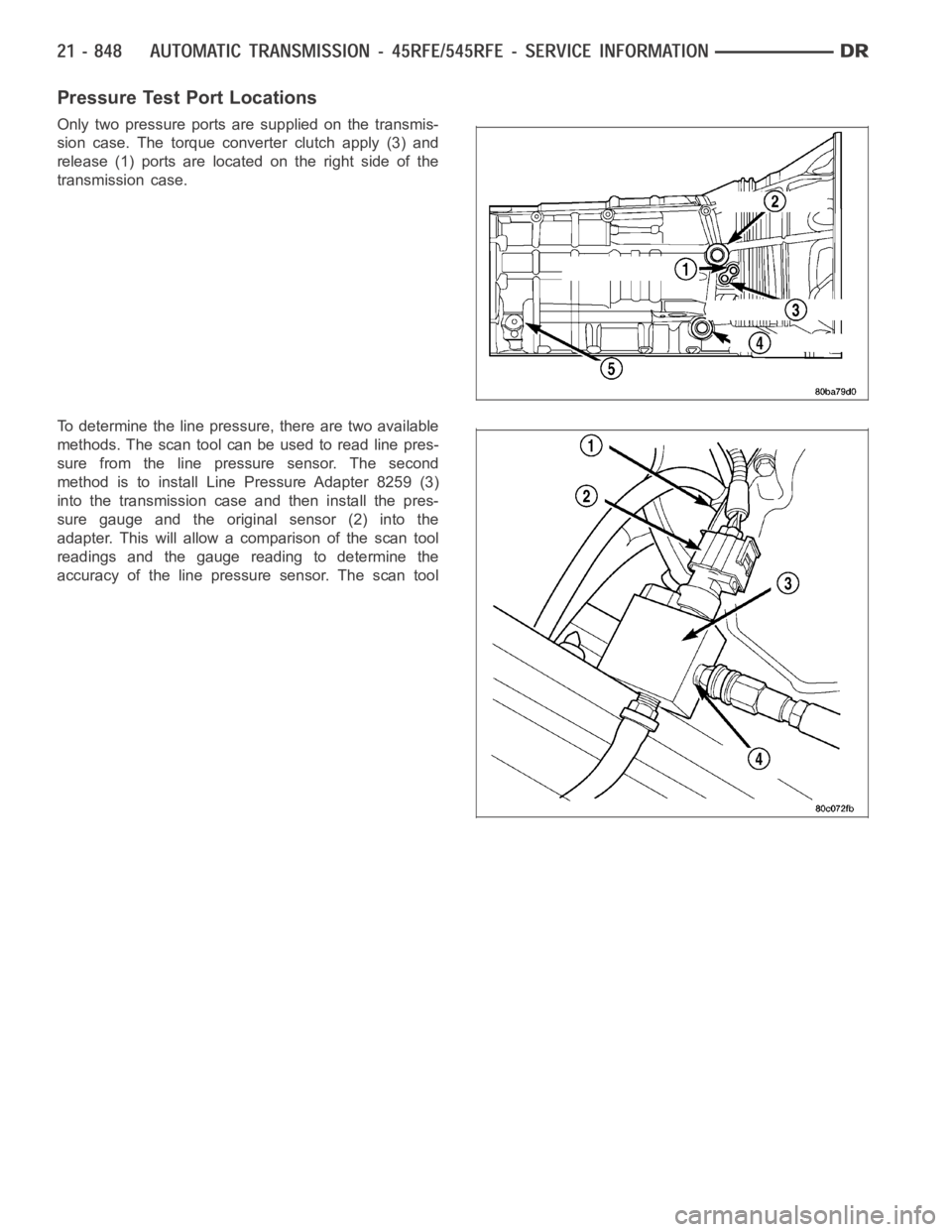
Pressure Test Port Locations
Only two pressure ports are supplied on the transmis-
sion case. The torque converter clutch apply (3) and
release(1)portsarelocatedontherightsideofthe
transmission case.
To determine the line pressure, there are two available
methods. The scan tool can be used to read line pres-
sure from the line pressure sensor. The second
method is to install Line Pressure Adapter 8259 (3)
into the transmission case and then install the pres-
sure gauge and the original sensor (2) into the
adapter. This will allow a comparison of the scan tool
readings and the gauge reading to determine the
accuracy of the line pressure sensor. The scan tool
Page 3371 of 5267
vehicles. Torque converter lock-up pressure is 120 psi for 3.7L/4.7L equipped vehicles and 125 psi for 5.7L
equipped vehicles.
UPSHIFT PRESSURES
ENGINE 1-2 2-3 2prime-3 3-4 2prime-4 2-5 3-5 4-5
5.7L150 125 125 135 135 135 135 135
3.7L/4.7L120 120 120 120 120 120 120 130
DOWNSHIFT PRESSURES
ENGINE 5-4 5-3 5-2 4-3 4-
2prime3-2 3-
2prime2prime-1 2-1 3-1
5.7L135 135 135 135 135 135 135 135 135 135
3.7L/
4.7L120 120 120 120 120 120 120 120 120 120
IN-GEAR PRESSURES
ENGINE122prime345NEUTRALREVERSE
5.7L160 135 135 135 135 135 120 250
3.7L/4.7L135 120 120 120 120 120 120 220
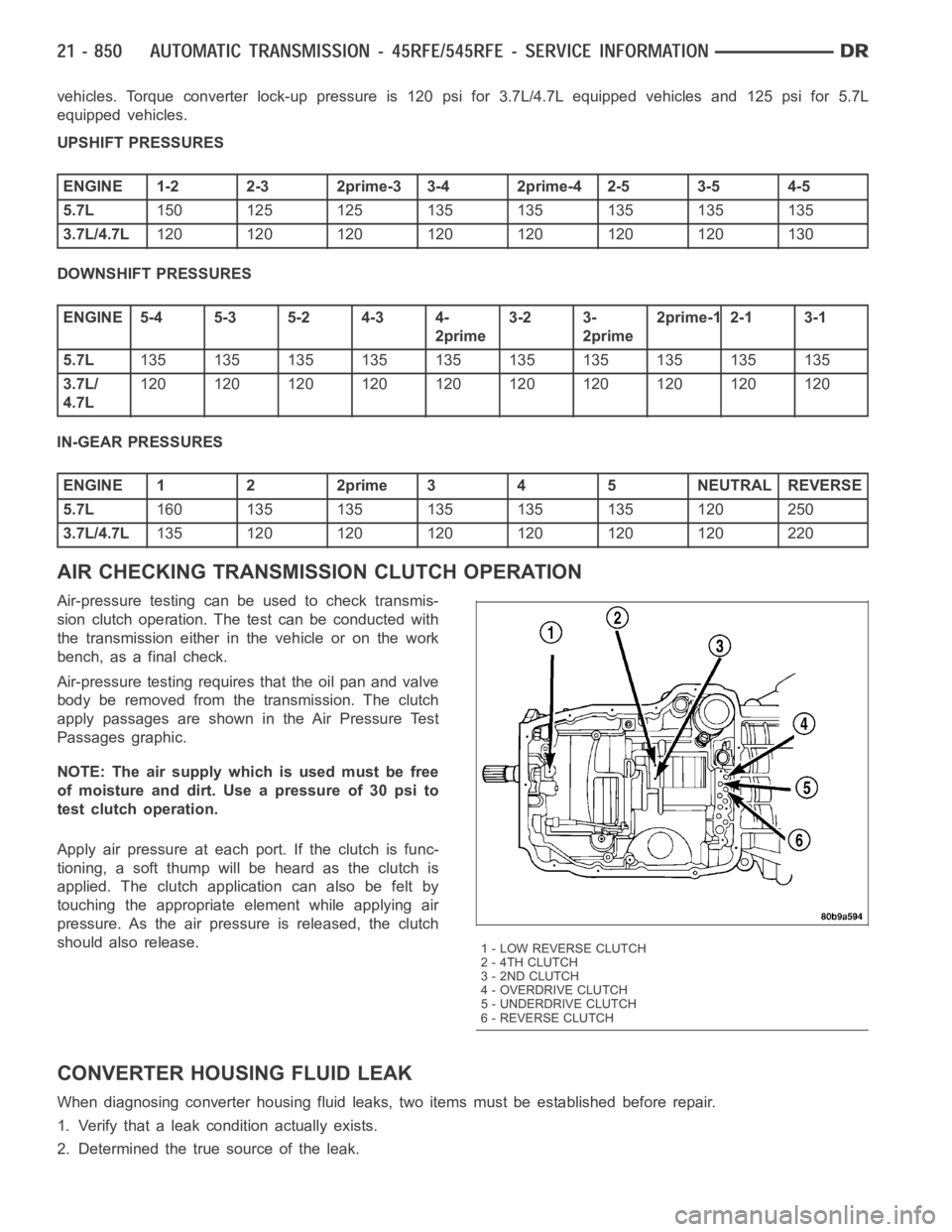
AIR CHECKING TRANSMISSION CLUTCH OPERATION
Air-pressure testing can be used to check transmis-
sion clutch operation. The test can be conducted with
the transmission either in the vehicle or on the work
bench, as a final check.
Air-pressure testing requires that the oil pan and valve
body be removed from the transmission. The clutch
apply passages are shown in the Air Pressure Test
Passages graphic.
NOTE: The air supply which is used must be free
ofmoistureanddirt.Useapressureof30psito
test clutch operation.
Apply air pressure at each port. If the clutch is func-
tioning, a soft thump will be heard as the clutch is
applied. The clutch application can also be felt by
touching the appropriate element while applying air
pressure. As the air pressure is released, the clutch
should also release.
CONVERTER HOUSING FLUID LEAK
When diagnosing converter housing fluid leaks, two items must be established before repair.
1. Verify that a leak condition actually exists.
2. Determined the true source of the leak.
1 - LOW REVERSE CLUTCH
2 - 4TH CLUTCH
3 - 2ND CLUTCH
4-OVERDRIVECLUTCH
5 - UNDERDRIVE CLUTCH
6 - REVERSE CLUTCH